Showing posts with label New Zealand as Social Laboratory of the World. Show all posts

Tuesday, 13 May 2014

New Zealand's Progressive Nationalism

Progressive Nationalist: Murray Horton has been the public face of the Campaign Against Foreign Control in Aotearoa (CAFCA) since the mid-1970s. He has just completed his triennial, election year, tour of New Zealand during which he reacquaints grass-roots New Zealanders with the facts, the figures and the consequences of trans-national corporate dominance of their country.
 
LAST FRIDAY I had the privilege of listening to one of Canterbury’s finest sons, Murray Horton. For 40 strenuous years Murray and a dedicated band of supporters have run the organisation called Campaign Against Foreign Control in Aotearoa (CAFCA). The official organ of CAFCA – Foreign Control Watchdog – is edited by Murray, published quarterly, and along with articles and reviews on politics and economics contains a handy compendium of all the latest decisions of the Overseas Investment Office. It always makes for challenging, not to mention sobering, reading.
 
Every election year, for close on 20 years now, Murray has journeyed from one end of New Zealand to the other, bringing to New Zealanders the facts, the figures and the consequences of foreign investment in their country. Though the rigorously atheistic Horton would probably frown at the suggestion, I look upon these nationwide tours as a kind of pilgrimage. Not the sort of pilgrimage where faith is restored through the proximity of saints, shrines and relics, but through a renewed connection with that most essential raw material of Democracy – the people themselves.
 
In trades halls, church halls, community halls (and the occasional university lecture hall) from Bluff to Kaitaia, Murray gives his 90 minute talk to groups ranging in size from half-a-dozen to several score. It’s not for the faint-hearted because Murray’s a political campaigner of the old-school – the sort that eschews sound-bites for hard evidence and patient reasoning.
 
And people love it: asking him questions and arguing about his answers for hours at a time. In this regard the talk I attended in Auckland on Friday was no exception. People arrived at 4 and didn’t leave until after 7:00pm.
 
The gospel according to Horton is a compelling testament not least because the person delivering it is so quintessentially Kiwi. Laconic, sharp, self-deprecating, larger-than-life and with an accent you could sharpen a knife on, he’s the sort of character Labour used to hoist onto the hustings. (Back in the days when describing someone as working-class and clever was not discounted, in rounded middle-class vowels, as oxymoronic.)
 
It is compelling, too, because it is directed at people who still regard themselves, culturally, as members of a national community, and, politically, as citizens of a nation state.
 
It’s no accident that CAFCA was founded in 1974, a year in which the potent, genuinely progressive New Zealand nationalism unleashed by Norman Kirk just 12 months earlier was gathering strength. The nationalism which would reach its apogee in the anti-tour protests and nuclear-free New Zealand movement of the early 1980s. The enduring conviction of what New Zealand should represent – and could represent – that the neoliberal ideology introduced by Roger Douglas and Ruth Richardson has worked so diligently to deconstruct for the past 25 years.
 
Kirk’s progressive nationalism – and Horton’s – can trace its origins all the way back to the progressivism of the Liberal Government of 1891-1912. It was during this period that New Zealand acquired the sobriquet “social laboratory of the world”, giving practical effect to the author of God Defend New Zealand, Thomas Bracken’s, prayer that the Almighty would “guide her in the nations’ van” as humanity’s pathfinder to a more just and abundant society.
 
That New Zealand’s most enduring nationalistic traditions should derive directly from the progressive side of politics is hardly surprising. The mobilising sentiment against which they have invariably measured themselves has almost always been generated by this country’s conservative elites on behalf of the supra-national entities in which New Zealand has historically found itself culturally, politically and (most importantly) economically enmeshed.
 
First as a colony and then as a (reluctant) dominion, New Zealand’s conservative leaders have consistently presented these islands and their inhabitants as the British Empire’s most loyal subjects. The awful blood sacrifice of World War I kept the “Mother Country’s” doors open to all the butter, cheese, wool and lamb her Pacific farmers could send. And when, in 1941, the Japanese were unkind enough to sink Mother’s warships Repulse and Prince of Wales, New Zealand was compelled to shift, without so much as a pause of breath, into the imperial embrace of Uncle Sam.
 
While the USA was under the progressive management of Franklin D. Roosevelt that might not seem so bad, but as Uncle Sam swiftly acquired the bloodthirsty habits of all imperial potentates, New Zealand’s conservative elites were only too happy to again subsume their country’s interests in the supra-national, American-led “Free World” and, after the Cold War’s end, into “the global marketplace”.
 
Listening to Murray Horton’s inspirational pitch for progressive New Zealanders to put the interests of New Zealand first, and those of foreign investors second, and, then, to reduce the “Five Eyes” global surveillance agreement to a Kiwi-less four, I suddenly understood Che Guevara’s cryptic observation:
 
“The Revolution is not a portrait – it’s a landscape.”
 
This essay was originally published in The Press of Tuesday, 13 May 2014.

Tuesday, 29 October 2013

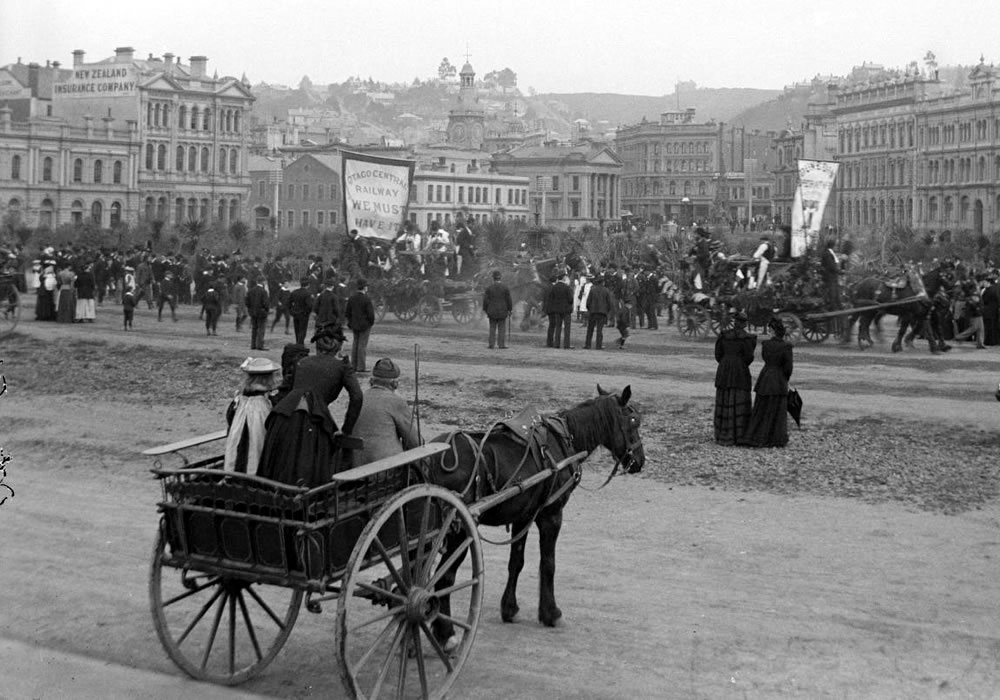
A Photograph Taken On Labour Day

Labour Day, Dunedin, 1894: As the unions mass in what is now Dunedin's Queen's Gardens, a mother leans forward to tell her children about the meaning of Labour Day. What would a mother tell her children about "the cause of labour" in 2013? That it died in 1991? Or, that it will be reborn in 2014?
 
WHAT SORT OF PEOPLE were they, this mother and her children? The photograph is dated Labour Day, 1894. The little family stands in a dog cart, watching, while across the dusty roadway several hundred unionists, their bright banners billowing against the regular lines of the city’s commercial hub, muster for their grand procession. The strict Victorian civility of the scene cannot mask the underlying political context: Labour versus Capital. How did that mother convey Labour Day’s meaning to her children on that overcast morning in October, 109 years ago?
 
Perhaps her husband, the children’s father, was among the union throng. He may have helped to build one of the many floats about to make their way up the city’s main street. Most of the trades were represented: carpenters, butchers, bakers; their carts festooned with the all the paraphernalia of their occupation. The bakers have loaded up great barrels of flour. On the cart’s sideboards a painted banner proclaims: “Peace and Plenty”.
 
The connections were clearer then. When work lay at the very heart of the human experience, and when the correspondence between the condition of labour and the condition of the community was obvious and indisputable. Without the carpenters, stonemasons and glaziers there would be no city to live in. Without the butchers and the bakers, no meat and no bread.
 
In the minds of the nineteenth century working-classes, mere ownership did not constitute the be-all and end-all of social significance. A factory without workers was an empty and expensive shell. The butchery or bakery, without butchers or bakers, had nothing to sell. Capital without Labour was a ledger entry – nothing more.
 
And perhaps that brute fact was easier to see in the colonies than in the Old Country. The churches and the town halls of nineteenth century New Zealand and Australia (and the rapidly growing states of the American West) may have looked as though they had stood above their Squares and Octagons for centuries, but the colonists knew better. The men and women who had built Christchurch, Dunedin, Melbourne, Adelaide and Chicago, all understood that the great settler cities which had exploded out of the raw landscapes of imperial ambition were overwhelmingly and unquestionably collective enterprises. Capital and Labour had arrived together: neither lived but by the efforts of the other.
 
It’s what the carpenter, Sam Parnell, had grasped the moment his feet touched the Petone foreshore in 1840. That this was a new land, with new rules, where the expectations of the masters back in England would be subject to radical revision. Here, the worker would labour for eight of the day’s 24 hours. Eight more would be for his rest. And the remaining eight would be for himself and his family. If the masters wanted or needed more than eight hours, then they would be obliged to pay their employees a handsome premium for the “over-time”.
 
Perhaps this was the grand old tale that the mother in the photograph told her children as they watched the Labour Day procession form up on that October morning long ago.
 
Newer stories, too, she’d have to tell. About how the Reverend Rutherford Waddell had preached against “The Sin of Cheapness”, exposing the sweated labour of the seamstresses, and how, from the resulting public outrage, the Tailoresses’ Union had been born. Of the Great Maritime Strike of 1890, she would have spoken. Of how the seafarers, the watersiders and the coal miners came together on 28 October 1889 to form the Maritime Council (New Zealand’s first effective union combination). She would have told her children how, though the nationwide strike was broken, the cause of labour did not falter: for in that same year the Liberals were swept to power on the votes of working men. And re-elected, she would have added, her eyes shining with pride, on the votes of working women. And of how the Liberal Government, earlier that very year, had passed the Industrial Conciliation and Arbitration Act – which would, on New Year’s Day, make the workers of New Zealand the envy of workers all the world around.
 
That woman’s children would, of course, live to see the great wave of social progress in which their parents participated rolled back upon the rocky reefs of war and economic catastrophe. The millennial dreams of their mother’s and father’s generation would not be realised, but the unrelenting push of the unions would achieve many of their most cherished objectives. The Welfare State and the 40-hour week would both become law when Labour finally took up the reins of government in its own name in 1935.
 
So what, if anything, should mothers tell their children about the meaning of Labour Day in 2013? That dreams, like photographs, can fade? Or that history, like spring, reminds us what hope is for?
 
This essay was originally published in The Press of Tuesday, 29 October 2013.

Tuesday, 13 August 2013

The 100% Pure "Model Nation"

As We Would Like The World To See Us: But repeated contamination scandals and a growing international awareness that all is not well in the New Zealand environment is causing more and more people to doubt Tourism NZ's staggeringly successful slogan. New Zealanders must now decide whether they wish to live up to, or abandon, the promise that has, for better or for worse, branded their nation.
 
NEW ZEALAND was barely half-a-century old when it became a “Brand State”. Our first government elected under (nearly) universal male suffrage – the Liberal Government of 1891 – had, within just a few years of taking office, earned New Zealand an international reputation for being “the social laboratory of the world”.
 
The bitter struggles between Capital and Labour that were tearing the societies of the Old and New Worlds’ apart at the turn of the Nineteenth Century seemed to have been tamed in New Zealand by the passing of the Industrial Conciliation and Arbitration Act. And, while the women of Great Britain and the United States were staging massive demonstrations in favour of women’s suffrage, New Zealand women were already marching to the polling booths.
 
The potency of New Zealand’s “progressive” brand was only enhanced by the radical reforms of the First Labour Government. So much so that, well into the 1950s, the publishers of encyclopaedias were still accepting introductions to the entry on New Zealand like this one, from the 1958 Edition of the Richards Topical Encyclopaedia:
 
“The World’s ‘Model Nation’: How Little New Zealand, Starting Her Career amid Wars and Many Money Problems, Built Up for Herself a Government So Sound and Humane that She Came to Be Called the Best-Governed Nation in the World.”
 
 
As The World Used To See Us: New Zealand in 1958 - A "Model Nation".
 
Between 1984 and 1999 there was a deeply cynical attempt on the part of the right-wing promoters of the neoliberal economic “reforms” responsible for dismantling the progressive achievements of earlier generations of New Zealanders, to appropriate that “model nation” brand.
 
To no avail. People from other lands looked at New Zealand and saw the same destructive economic forces at work – albeit in more extreme form – that had disfigured their own societies. From being the little nation that marched to the beat of a different, more “humane”, drummer, New Zealand had fallen into the same, sad, neoliberal lock-step as the rest of the world.
 
But then, miraculously, in 1999, New Zealand got a second chance.
 
Commissioned to come up with a new slogan for Tourism NZ, the Saatchi ad agency boss, Alan Morden, came up with “100% Pure New Zealand”. Everyone who heard it sensed they were on to a winner.
 
Two years later, just a fortnight before Christmas 2001, things got even better.
 
Into a world still reeling from the terrible events of 9/11 came the first of Peter Jackson’s movie adaptations of J.R.R. Tolkien’s The Lord of the Rings, and people saw a landscape of unbelievable beauty. In this, the most far-flung tourist destination on the planet, God seemed to have hidden the very last, most lovely jewel of his creation.
 
Overnight, “100% Pure New Zealand” ceased to be merely the advertising slogan of Tourism NZ and became the motto of a “Brand State”.
 
Almost accidentally, New Zealanders found themselves bound to meet the near impossible challenge of 100% purity. But they could not turn back, because already the magic of the motto was transforming the expectations of New Zealand’s customers.
 
The global consumer reads the name “New Zealand” on a label and, instantly, their minds are filled with the imagery of snow-capped peaks, sparkling rivers and streams, unspoiled beaches and endless vistas of deep green pastureland. Surely, they say, the food and beverages from such a land must be the purest, the safest, the very best in the whole world! It is difficult to imagine a perception more likely to clear the shelves of the world’s supermarkets for New Zealand’s agricultural exports.
 
But the magic works in other ways for New Zealand. Purity, if it is to go on selling our exports, must be more than a rhetorical flourish – it has to be real. Our rivers and streams must be clean all the way from the mountains to the sea. Our green pasturelands must leave no chemical residues in our food. The milk from our free-ranging, grass-chewing cows, and the products derived from their milk, must, just like the slogan, be 100% pure – not contaminated by botulism.
 
Fonterra’s latest scandal has revealed, in the most dramatic fashion, the double-edged nature of all magical incantations. We know now that our 100% Pure designation can just as easily prove a curse as a blessing.
 
We stand now at a fork in the road. One way leads us to a future of reduced expectations. To a New Zealand no longer described as 100% Pure: where open-cast mines disfigure our conservation lands; deep sea oil coats our coasts; and cow-shit pours into our poisoned rivers and streams.
 
The other way leads to a New Zealand that dares to live up to its promises. To a future where intelligence and creativity are enthroned as our culture’s sovereign lords. And where the purity of our environment is matched only by the purity of our purpose.
 
A “Model Nation” again.
 
This essay was originally published in The Press of Tuesday, 13 August 2013.