Showing posts with label Labour Party Annual Conference 2015. Show all posts

Wednesday, 25 November 2015

Leaving Jiangxi: Tat Loo Marches Out Of The Labour Party.

Despairing Of Reform: Dunedin-based Labour Party dissident, Tat Loo (aka "Colonial Viper") told fellow members of the Anderson's Bay-Peninsula Branch that the Labour Party "is now lost at sea but does not appear to recognise that fact." Their response was a vote to put the branch into recess. Loo advised his comrades that he wanted  "no part of propping up the Thorndon Bubble careerist ‘pretend and extend’ set" and was "moving on to new political projects".
 
TAT LOO, like the ceremonial Chinese lion, is a potent mixture of playfulness and ferocity. Intelligent, articulate, passionate, politically impatient and singularly unwilling to suffer fools gladly, he set his sights on the Dunedin Labour Party about three years ago – and has only just run out of ammunition.
 
At a Special Formal Meeting of the Anderson’s Bay-Peninsula Branch of the Labour Party held in South Dunedin on Sunday afternoon (22/11/15) Loo and about twenty others announced that they were putting their controversially resurrected branch back into the constitutional limbo from which they had called it forth. Loo, himself, relinquished his executive role – but not before using-up all his remaining shot and shells in a scathing farewell to a Labour Party he had, finally, despaired of reforming.
 
“Several of the current officers and LEC delegates of the ABP Branch have become deeply dissatisfied with the performance and direction of the Labour Party both locally and in Wellington and no longer wish to remain in their roles or continue supporting the party.” Loo explained in a posting on the Labour-aligned political blog, The Standard.
 
“Labour’s inability to be consistent in opposing the neoliberal corporation-drafted Trans-Pacific Partnership Agreement, the softening of the stance against the 90-day right to fire, the ethnically divisive and ineffective tactics against Chinese property buyers in Auckland, the voting for National’s inequitable and discriminatory social welfare reform legislation, and the support of National’s spying and anti-terrorism bill,” said Loo, “all point to a Labour Party which is now lost at sea but does not appear to recognise that fact.”
 
Loo’s conclusion was grim. “The palpable sense conveyed has been that apart from minor tinkering, there are no likely or viable prospects for positive, real progressive change coming from the Labour Party in the foreseeable future.”
 
The veteran political journalist, Richard Harman, writing on the POLITIK blog, suggested Loo’s departure was not something over which the Labour hierarchy was likely to lose much sleep: “In fact [President Nigel] Haworth and leader, Andrew Little, might well regard the move as a minor victory in their quest to make the party more relevant to mainstream New Zealand.”
 
According to Harman: “Anderson’s Bay was exactly the kind of left wing Labour branch which enabled Jeremy Corbyn to become leader of the British Labour party, a move which now threatens that party with divisiveness and possible electoral ostracism.”
 
This is nonsense. Corbyn was nominated by a clear plurality of “constituency organisations” – the equivalent of New Zealand Labour’s “LECs” (Labour Electorate Committees). The disaffection in British Labour extended throughout the entire party and its affiliated unions. Had support for Corbyn been restricted to a handful of left-wing branches the 66-year-old backbencher could never have been elected.
 
New Zealand’s “Corbyn Moment” came three years ago at the 2012 annual conference held at Ellerslie in Auckland, when the party rank-and-file rebelled against the parliamentary caucus. It was around this time that Loo’s public profile began to grow, especially after his Standard pseudonym, “Colonial Viper”, was “outed” by Dunedin-based opponents of the Labour Left’s champion, David Cunliffe – of whom Loo was a strong and vocal supporter.
 
Indeed, it is almost certainly the “Peace of Palmerston North” – shorthand for the restoration of more-or-less cordial relations between the party rank-and-file and the parliamentary caucus that was plainly in evidence at the party’s 2015 annual conference held in Palmerston North earlier this month – that accounts for the timing of Loo’s decision to recess the Anderson’s Bay-Peninsula Branch.
 
After the long list of political “sins” detailed in his statement, Loo was clearly devastated by the party’s quiescent response to what he saw as the Caucus’s continuing perfidy. The “revolutionary moment” had clearly passed, and with it any good that the rebel Anderson’s Bay-Peninsula Branch might have hoped to achieve. The curious failure of David Cunliffe to fire in the 2014 election, and the catastrophic defeat it presaged, has reduced the Labour Left to a demoralised and thoroughly chastened rump.
 
Time to go. Loo’s parting shot was delivered with considerable accuracy at the Grant Robertson-led faction of the party, which, he believes, is slowly-but-surely gaining the upper-hand in the Little-led caucus. “We want no part of propping up the Thorndon Bubble careerist ‘pretend and extend’ set any further and will be moving on to new political projects.”
 
Like Mao Zedong, Tat Loo is gathering what remains of his revolutionary army and setting forth on his own “Long March” to Ya’nan.
 
This essay was posted on The Daily Blog and Bowalley Road of Wednesday, 25 November 2015.

Friday, 13 November 2015

Of Dreams And Nightmares.

Bread-and-Butter-Land: Andrew Little's keynote speech to Labour's 2015 annual conference took "Rebuilding the New Zealand Dream as its theme If this conjures-up an image of a 1960s family; Dad, Mum and the kids; standing in front of Dad’s shiny new Ford station-wagon; with Mum’s spotless suburban bungalow in the background; then Little’s speech-writers have done their job. And yet, for so many, the Dream he seeks to restore was never anything other than a nightmare.
 
SOME VERY STRAIGHT TALKING went on behind closed doors at Labour’s annual conference in Palmerston North. Persons described only as “senior party people” visited the party’s “sector groups” (Women, Youth, Maori, Pasifika, Rainbow) with a very clear message. All reform proposals smacking of what some experts call “identity politics” and others refer to as “social liberalism” are on the down-low. Not forbidden, exactly, but to be kept well away from the media spotlight. In the simplest terms: the days of “man bans” are over.
 
The Party Leader’s stirring keynote speech highlighted in dramatic terms where Labour’s focus has shifted. When Andrew Little was a young industrial lawyer, working for the Engineers Union, his conservative “brothers” would have described Labour’s new stance as “concentrating on the bread-and-butter issues that ordinary people care about”. Other organisers, in more radical unions, would have lamented Labour’s “economism”: a Marxist-Leninist term denoting an exclusive focus on working people’s material (as opposed to their political) advancement.
 
Little, himself, is calling it “rebuilding the New Zealand dream”. In the simplest terms: “Owning a home; having security for the people we love; a chance to enjoy the outdoors and the environment we love and a job that gives us the time and the money to lead a fulfilling life. These are the aspirations that we all share.”
 
Now, if that rather clunky definition conjures-up an image of a 1960s family; Dad, Mum and the kids; standing in front of Dad’s shiny new Ford station-wagon; with Mum’s spotless suburban bungalow in the background; then Little’s speech-writers have done their job. Because if you ask the Baby-Boom generation to describe how the New Zealand Dream looked, back in the days when it seemed within the reach of every Kiwi family, chances are they’ll say it looked like that. And if you ask the younger generation to describe the New Zealand dream, they will likely begin by highlighting how little of their parent’s idyllic ensemble they can expect to replicate.
 
Nostalgia and aspiration are powerful emotions, and when you attach them to a simple set of desired things, then the political effects can be startling. That’s why, in one way or another, the idea of the New Zealand Dream is exploited by every political party. National might substitute a Mercedes Benz for the Holden, and a graceful Arts and Craft mansion for the suburban bungalow. The Greens might add solar panels to the bungalow’s roof and put the whole family on bicycles. NZ First might include Grandma and Grandpa in the family line-up. In essence, however, the dream remains the same.
 
Allowing the Dream to slip away is thus, for most of the electorate, the very definition of political failure. Accordingly, parties will argue endlessly about whether they are succeeding or failing to keep the New Zealand Dream alive. Most will react with alarm, however, if the reality and/or desirability of the Dream itself is challenged.
 
Hence the hard words delivered to Labour’s sector groups last weekend. Those “senior party people” are determined that the discordant notes of feminism, indigenous rights and LGBT activism do not intrude upon the nostalgic and aspirational harmonies of the militantly “normal” New Zealand Dreamers. The memory of 2013’s “man ban” still rankles, but a much deeper psychic wound was inflicted by the “anti-smacking” legislation.
 
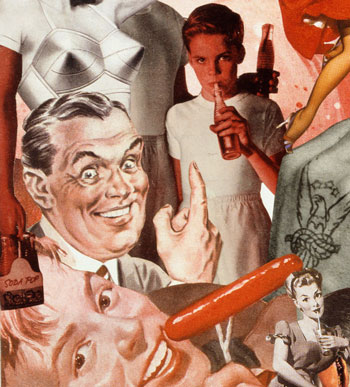
Dream - Or Nightmare? (Collage of 50s imagery by Sally Edelstein.)
 
The New Zealand voter did not enjoy being reminded that behind the happy familial images of material prosperity there often lurked horrific stories of child abuse. The idea that they, themselves, might have ventured even a little way along that grim continuum of domestic violence infuriated and repelled them – and Helen Clark became the lightning-rod for their rage.
 
Labour’s leaders are determined that it will not happen again. No rancid additives from the world of identity politics will be permitted to contaminate the bland bread-and-butter promises of Little’s keynote speech.
 
And yet, for so many, the Dream he seeks to restore was never anything other than a nightmare. A horror story made worse by the unrelenting pressure to pretend that the injustices and discrimination endured by women, Maori, gays, lesbians and transgendered persons wasn’t real, and wasn’t happening. Little’s soft-focus rendition of the New Zealand Dream was never more than a sociological version of The Picture of Dorian Gray. A cursed portrait that, with every tortured victim’s revelation, grows increasingly hideous.
 
This essay was originally published in The Waikato Times, The Taranaki Daily News, The Timaru Herald, The Otago Daily Times and The Greymouth Star of Friday, 13 November 2015.

Wednesday, 11 November 2015

Reclaiming The Dream: Labour’s Annual Conference Lifts Spirits And Raises Hopes.

I Have A Dream: Andrew Little's address to the Labour Party Conference was a bold and moving restatement of core Labour aims and objectives. Unfortunately, his replies to the obvious questions arising from the speech were less than forthright. Little's advisers need to get their boss into some serious media training - and quickly!
 
IF ELECTIONS COULD BE WON with a single speech, Andrew Little would be a shoe-in for New Zealand’s next prime-minister. Sunday’s keynote address to the Labour Party faithful in Palmerston North has been acknowledged, even by Little’s critics, as an outstanding rhetorical success. Certainly, its astute combination of the personal, the political, the traditional and the inspirational had the 1,500-strong audience in the city’s Regent Theatre on their feet and cheering.
 
This rapturous reception of Little’s speech notwithstanding, most observers agree that the 500 delegates who turned up to Labour’s 99th Conference were a thoroughly chastened bunch. The open and bitter confrontations between ordinary members and MPs that had become such a feature of recent conferences were nowhere in evidence. Indeed, top-down appeals for unity, focus and discipline, and warnings against doing anything that might embarrass the party, found an unusually compliant audience. Between them, Labour’s President, Professor Nigel Haworth, and Little’s staffers, Matt McCarten, Neale Jones and Sarah Stuart, managed to create an atmosphere in which the professional politicians were heeded – not heckled.
 
This appeal for unity worked because, for the past twelve months, the parliamentary caucus has demonstrated its capacity for working together as a team. The unauthorised leaks to gallery journalists and bloggers; the secret briefings against colleagues; all the disloyalties that helped to destroy the prime-ministerial hopes of Phil Goff, David Shearer and David Cunliffe, have largely ceased. And what’s sauce for the caucus geese, Haworth told the delegates, must now become sauce for the activist ganders. It was time for Labour to decide what it was: “a jolly decent loose confederation of like-minded individuals and organisations”, or, “a united, disciplined party”. From The Daily Blog’s Martyn Bradbury, to POLITIKS’ Richard Harmon, the journalists in attendance agreed that the delegates had opted enthusiastically for the latter option.
 
Little’s task now is to use that united and disciplined party to sell Labour’s message to the wider electorate. And, unfortunately, it’s about here that the organisation and efficiency run out. Having set himself and his party some big, inspirational goals: “Jobs, jobs, jobs”; the elimination of child poverty; properly resourcing the health and education systems; Little has next to nothing in the way of credible answers to the questions that inevitably follow such bold political statements of intent.
 
Rather than answer, simply, “Yes”, when RNZ’s Guyon Espiner asked whether it was now Labour’s policy to eradicate poverty, Little prevaricated. Labour’s policies will be rolled out over the next two years, he said. Not good enough. Intelligent voters know that eradicating poverty necessarily entails lifting the incomes of the poor. Does Labour intend to restore the purchasing power of welfare benefits to 1991 levels – thereby reversing Ruth Richardson’s 25-30 percent cuts in beneficiary incomes? If so, where will the money come from? Does Labour intend to increase the top tax rate? And if Labour has no plans to reverse Richardson’s benefit cuts, or raise taxes, how can it possibly be serious about eradicating poverty?
 
The general journalistic consensus is that Labour’s strategists are attempting to emulate the highly successful, Crosby-Textor-guided, National Party campaign of 2008. This entails shedding all the policies that the punters don’t like or can’t understand (Capital Gains Tax, raising the retirement age, NZ Power) and holding back on announcing any new policies until much closer to the General Election.
 
But this is a thoroughly inaccurate reading of National’s 2007-2008 strategy. What the voters feared most about National in 2006 was the radical and divisive agenda Dr Don Brash had persuaded it to adopt in 2005. John Key’s priority, therefore, was to allay the voters’ fears by ditching the Brash agenda and keeping in place most of Labour’s more important economic and social reforms (Working For Families, Interest-Free Student Loans, Kiwisaver). He also gave practical expression to this change of National’s heart by visiting McGeehan Close and promising to address the problems of the underclass, and by cutting adrift the far-right opponents of Sue Bradford’s anti-smacking legislation. Far from being a do-nothing Opposition leader, Key worked constantly to build-up the image of a new kind of National Party: one committed to giving New Zealand a “kinder, gentler” version of conservatism.
 
The most important piece of advice Lynton Crosby gives to his right-wing clients is: “When in doubt, stand for something!” The people around Little should be saying exactly the same thing. Indeed, they’ve already said it – in Sunday’s speech. Little has declared Labour’s intention of re-claiming the New Zealand Dream: the dream that past Labour leaders and governments fought to bring within the reach of every Kiwi family. His No. 1 priority over the next two years must be to show New Zealanders how he and his party intend to bring that dream into the twenty-first century; and how to refute the inevitable arguments hurled against it by Labour’s political foes.
 
Equivocation cannot do that. Inoculation cannot do that. Turning yourself into the smallest possible target for a hostile news media cannot do that. When Sid Holland declared, in 1937, that Labour’s Social Security Bill was “applied lunacy”, Mickey Savage responded by saying that he thought of it as “applied Christianity”. The nation cheered. More recently, when asked why he had made sure that half of his new cabinet were women, Canada’s Justin Trudeau replied: “Because it’s 2015.” A party of change must carry the country with it to defeat the forces of conservatism. Rather than rely upon the dark arts of Crosby-Textor, Andrew Little should put his faith in the sentiments that brought the Regent Theatre to its feet on Sunday afternoon.
 
Those who borrow the Devil’s weapons, end up fighting the Devil’s wars.
 
This essay was originally posted on The Daily Blog of Tuesday, 10 November 2015.

Tuesday, 10 November 2015

Napoleon Little?

The Revolution Concluded: At the end of every revolutionary period a figure arises who promises to restore order and stability. The most famous example of this historical type is Napoleon Bonaparte. One hesitates to describe Andrew Little as Labour’s Napoleon, but what cannot be disputed is the eagerness with which both the membership and the caucus responded to his calls for  unity, focus and discipline, and to his passionate reaffirmation of Labour’s radical political mission.
 
LABOUR’S annual conference in Palmerston North concluded with a rip-roaring speech from Andrew Little – and no controversy. How much responsibility for the absence of negative headlines should be attributed to the party’s decision to exclude the news media from most of the conference proceedings is unclear. Behind those closed doors there may have been a party seething with discontent. But, the authorised version, of a rather chastened party, eager to swing-in behind its new leader and his red-letter promises, is almost certainly genuine.
 
If so, then it would seem that the “revolution on the conference floor” that first came to the public’s attention back in 2012 has run its course. Three years ago there was no mistaking the belligerent mood of conference delegates. They were still furious that, in 2011, the parliamentary caucus had passed over their preferred candidate for party leader, David Cunliffe, in favour of David Shearer. That fury fuelled their dramatic decision to subject future leadership contenders to a party-wide ballot. How the delegates cheered when union organiser, Len Richards, declared: “Today’s the day we take our party back!”
 
Richards’ boast was proved correct less than a year later when Shearer threw in the towel and the party membership elected David Cunliffe as leader, on the first ballot, and in the teeth of bitter caucus opposition.
 
But, Cunliffe’s dismal performance as party leader throughout 2014, culminating in Labour’s catastrophic election defeat, left thousands of demoralised and uncertain party members in its wake. The narrowness of Andrew Little’s victory over his rival, Grant Robertson (50.52 percent – 49.48 percent, on the third ballot) spoke eloquently of just how uncertain the membership felt about the party’s future direction.
 
One year on, in Palmerston North, that uncertainty had vanished. Twelve months of steady leadership from Andrew Little has settled down both the caucus and the members, to the point where, if the tweets emerging from the conference are anything to go by, both sides can now give a passable impression of actually liking one another. Pep talks from Hawkes Bay MP, Stuart Nash, and the party president, Professor Nigel Haworth, on the need for increased unity and discipline have clearly had their effect.
 
So, too, have the party’s years of internal strife.
 
As any student of the history of revolutions will attest, the revolutionary process unfolds in three, clearly discernible, phases. First there is the moment of revolt, when the people rise as one against the ancien regime. Dickens, in his novel, A Tale of Two Cities, called this “the Spring of Hope”. Once the old order has fallen, however, the revolutionaries rapidly fall out over the vexed question of what should take its place. It is during this phase that the Revolution “devours its own children”. Finally, with most of the revolutionaries dead, and the people exhausted by years of terror and upheaval, a figure arises who promises to restore order and stability. The most famous example of this historical type is Napoleon Bonaparte: someone with both the ability and the ruthlessness to bring the Revolution to an end.
 
Napoleon Bonaparte: Someone with both the ability and the ruthlessness to bring the Revolution to an end.
 
One hesitates to describe Andrew Little as Labour’s Napoleon, but what cannot be disputed is the eagerness with which both the membership and the caucus responded to his calls for  unity, focus and discipline, and to his passionate reaffirmation of Labour’s radical political mission.
 
Sheer exhaustion may also explain the New Zealand Labour Party’s curiously subdued reaction to the rank-and-file revolution that installed Jeremy Corbyn as leader of the British Labour Party. It wasn’t that the Kiwis were all secret Blairites, more a matter of New Zealand Labour having “been there, done that, sold the T-shirts – lost the election!”
 
In restoring order and stability, Little has been quietly, but very ably, assisted by Labour’s President, Professor Nigel Haworth. As delegate Stephanie Rodgers tweeted from the conference on Saturday afternoon: “Cries of mock outrage as it’s announced we’ve wrapped up a policy discussion with time to spare.” Anyone with the slightest experience of Labour conferences will grasp the enormity of that achievement – testimony to the quiet authority and gentle humour of Haworth in the Chair.
 
And just as Napoleon’s coup d’état consolidated and entrenched the French Revolution’s achievements, Little’s keynote speech to conference delegates confirmed, in the most dramatic fashion, that Labour’s democratic-socialist aims and objectives, so unequivocally restated by the 2012 “revolution on the conference floor”, are now inscribed in the programmatic bedrock of the party’s platform.
 
The policies mandating a capital gains tax and raising the retirement age to 67, both of which aggrieved a large number of ordinary members, have been quietly discarded. Policies attacking poverty, homelessness and unemployment have taken their place.
 
Without this gesture of solidarity from the caucus to the rank-and-file, this weekend’s ‘Peace of Palmerston North’ could never have been more than a temporary ceasefire.
 
This essay was originally published in The Press of Tuesday, 10 November 2015.

Thursday, 5 November 2015

All In The Family: Labour’s President Keeps The Media Out Of His Party’s Annual Conference.

Family Man: Labour's president, Nigel Haworth, wants key debates and discussions at this year's Labour Party Conference kept "in the family". As a consequence, all but a handful of set-piece speeches and "Challenge Sessions" will be "Closed to the Media". But to ban the media from the constitutional and policy debates of a party’s annual conference is insupportable. Political parties are – by definition – creatures of the public sphere. As such, the presumption must always be that the media, as the voters’ eyes and ears, will be granted free access to as much of their proceedings as possible.

PROFESSOR NIGEL HAWORTH has a peculiar view of the Labour Party. Justifying the exclusion of the news media from most of its annual conference to the NZ Herald’s Claire Trevett, the party’s president explained that its proceedings needed to be kept “in the family”. Putting to one side the obvious fact that a political party is nothing like a family, the professor’s words raise some pretty alarming issues. Families that shut their doors and draw their curtains against the outside world are often trying to hide something. So, what is it that Labour is trying to hide, Professor? Something shameful? Something ugly? Both?
 
Paradoxically, what Haworth and the Leader of the Opposition, Andrew Little, are trying to hide isn’t in the least bit shameful or ugly. Free and frank political debate is the declared objective of the media ban. “We want people to be able to speak freely and frankly and be reported appropriately”, was the way Haworth put it to Trevett.
 
Curiously, the Herald journalist did not challenge Haworth’s implication that she and her colleagues would not report the delegates’ statements “appropriately”. Nor did Trevett point out to the Herald’s readers that with the news media excluded from important debates party leaders can crack down hard on dissident delegates with impunity.
 
This is no small consideration. At the 2012 annual conference, held in the Auckland suburb of Ellerslie, journalists were able to report the extraordinary vitriol hurled at disobedient delegates by Labour MPs. The latter were furious that the conference had voted contrary to their instruction. They were probably even more furious that their behaviour was reported. (See here and here.)
 
Free and frank discussion is actually much more likely when the whole world’s watching. Absent the television lights, anyone daring to challenge the top table is likely to be flayed alive by individuals who throw insults for a living.
 
Another of Haworth’s claims that went unchallenged by Trevett was his attempt to paint media access to Labour conferences as something rare and exceptional. He claimed that the media had been permitted access in 2013 because the party was introducing a new policy platform structure: “We felt at the time it was important for media to see that process. When we go into the revisions of it, these are debates we want to keep in the family.”
 
This is pure bullshit. For most of its 99-year history Labour’s conferences have been freely reported by the news media. Back in the 1970s, for example, a TV outside broadcast unit would set up shop outside the conference venue and broadcast a 20-minute News Special at the end of every day the conference was in session. The often riveting policy debates were beamed into the nation’s living rooms without let or hindrance.
 
It was the same in the 1980s, when the party’s resistance to Rogernomics was dramatically broadcast to the electorate. As Jim Anderton once boasted to journalists gathered to report a crucial debate on GST at a regional Labour conference on the West Coast: “This is the real Opposition!”
 
And it is here that we come to the nub of Haworth’s objection to the news media’s presence at Palmerston North this weekend. He and Little’s staffers are terrified that if journalists are afforded free access to the most important conference sessions they will discover that, on issues like the Trans-Pacific Partnership, the leader and his tight inner-circle do not speak for the party as a whole. Words and images conveying any other message than the Labour “family’s” complete and utter unity are, therefore, being prevented from reaching the public.
 
This kind of blatant media manipulation runs counter to everything a trustworthy political party should stand for. In democratic societies, political parties are where the nation’s future leaders are first recognised and readied for public office. They are the places where ideologically motivated citizens gather to debate and refine a broad range of economic and social policies intended to shape the nation’s future. As such, they cannot possibly lay claim to being “private” organisations.
 
Certainly, there are aspects of party activity which are justifiably kept confidential. Financial reports; personnel issues; discussions of election tactics and strategy: no one expects a party to permit the media to report these events. But to ban the media from the constitutional and policy debates of a party’s annual conference is insupportable. Political parties are – by definition – creatures of the public sphere. As such, the presumption must always be that the media, as the voters’ eyes and ears, will be granted free access to as much of their proceedings as possible.
 
This essay was originally posted on The Daily Blog of Thursday, 5 November 2015.

Tuesday, 3 November 2015

Litmus Test: Will Labour’s Rank-And-File Revolution Roll On – Or Be Halted – In Palmerston North?

Revolution On The Conference Floor: At the 2012 Labour Party Conference in Ellerslie, Trade Unionist Len Richards told the Labour leadership: "Today's the day we take our party back!" But will the forward march of Labour's rank-and-file be halted at this weekend's 2015 Conference in Palmerston North? (Photo by John Chapman)
 
“ONLY ONE political party conference matters in New Zealand”, says veteran political journalist, Richard Harman. “The National Party’s conference is little more than a PR presentation; NZ First keeps theirs behind closed doors and the Greens is entirely predictable.” But, according to Harman, Labour conferences are different. As recently as 2012, he says, “Labour’s has been coloured by political blood on the floor.”
 
There’s a very good reason for paying attention to what goes on at Labour Party Conferences, and that’s because the political fault line dividing the defenders of the status quo from the advocates of real change runs right down the middle of the conference floor. It’s been that way since the 1980s when a small cabal of Labour MPs, led by Roger Douglas, seized control of the party’s parliamentary caucus and, upon winning the 1984 General Election, introduced a slew of far-right economic and social reforms that transformed not only New Zealand but the Labour Party as well.
 
Prior to the 1980s, the political fault line ran – much more naturally – between the Labour and National parties. Yes, there were radicals and conservatives in both organisations, but on neither side of the ideological divide did the opponents and advocates of change step outside the traditional boundaries of Left and Right. Labour’s values were collectivist, solidaristic and firmly rooted in the public sphere. National’s instincts, by contrast, were resolutely individualistic and fiercely protective of private enterprise.
 
By the time “Hurricane Roger” had blown itself out, the Labour Party was barely recognizable. Tens-of-thousands of members had simply voted with their feet – deserting a party that had unquestionably deserted them.
 
Those traditional left-wing members who opted to stay, resisted Roger Douglas’s “free market” reforms in a series of increasingly bitter rear-guard actions, until it became clear that a narrow majority of party membership simply could not be persuaded that there were viable alternatives to the policies “their” government had introduced. At that point, roughly a third of the remaining Labour membership split from the organisation to form the NewLabour Party, led by Jim Anderton. A few years later, Douglas’s hard-core followers did the same. Despairing of Labour ever again uplifting the banner of market reform, they split away to form the United and Act parties.
 
With the party in tatters, and the remaining membership evincing an alarming “My party, right or wrong!” attitude to politics, Labour, as a political force, was reduced to its parliamentary caucus; parliamentary staffers; paid electorate personnel; the party secretariat, affiliated trade union officials; and the handful of individuals in each electorate upon whom each Labour MP depended for personal and/or campaign support. Included in all these groups (bar the caucus) were a clutch of ambitious individuals determined to win public office.
 
This was the Labour Party over which Helen Clark presided for the best part of 15 years. Its active core was comprised of people whose professional and political gaze was focused upwards, on the needs and deeds of the party leadership, rather than outwards, to what remained of Labour’s rank-and-file membership. It was a party dominated by what the Soviets used to call apparatchiks – men and women of the apparatus – who were extremely protective of the party leader, as well as the formal and informal structures which supported her. They were also deeply suspicious of, and often overtly hostile towards, dissident behaviour.
 
One of the few remaining entry points for dissidents in this increasingly oligarchical Labour Party were the handful of private-sector trade unions which had, in spite of all that had happened in the 1980s and 90s, remained affiliated to the Labour Party. From these, paid officials and active delegates could be fed into the party’s annual conferences in numbers proportionate to their union’s affiliated membership.
 
It is difficult to overstate the impact of these unionists on the morale of ordinary members. They brought with them the direct experience of the working-class people who still constituted the bulk of Labour’s support in the electorate. Not being employees of the party, or Parliamentary Services, they had no reason to defer to the opinions of Labour’s caucus and often contradicted their pronouncements. Such open defiance of the hierarchy was infectious. Very slowly, individual party members relearned how to assert themselves against the apparatchiks.
 
From 2005, with growing momentum, Labour’s annual conference began to recover an increasing measure of autonomy vis-à-vis the party’s parliamentary leadership. “My party, right or wrong!”, was fast becoming “The wrongs of my party can be righted.”
 
Between 2011 and 2014 the power of the ordinary and affiliated members was extended to include the election of the party leader and the drafting of the party platform. Terrified, the parliamentary caucus struck back: destroying the reputation of the party’s choice for leader, David Cunliffe; and allowing the party’s share of the popular vote to fall to levels not seen since the 1920s.
 
Whether Labour’s rank-and-file revolution continues to roll on at the 2015 Annual Conference (being held this weekend in Palmerston North) is what POLITIK blog proprietor, Richard Harman, and The Daily Blog’s editor, Martyn Bradbury, are most interested in finding out. Will the present leader’s, Andrew Little’s, trade union background, and the recent merger of the conservative Engineering, Printing and Manufacturing Union with the much more radical Service and Food Workers Union, mean more union agitation on the conference floor, or less? Will the presence of former union officials Matt McCarten and Neale Jones in the Leader of the Opposition’s Office allow the parliamentary leadership to, at last, fasten a lid on the ferment down below?
 
The litmus test will be the conference’s ability to claim a role in shaping the party’s position on the Trans-Pacific Partnership (TPP). Little and his team of ex-union apparatchiks will be working hard, even now, to prevent any attempt by the rank-and-file to re-commit Labour to its former stance of qualified opposition. Crucial to their success will be the attitude of the Party President, Nigel Haworth. Will he, like Jim Anderton’s successor as Party President, Margaret Wilson, sanction an open, party-wide debate?  Or, will he use his gavel to shut down the voices of dissent?
 
Will the litmus paper turn red – or blue?
 
This essay was originally posted on The Daily Blog of Tuesday, 3 November 2015.