
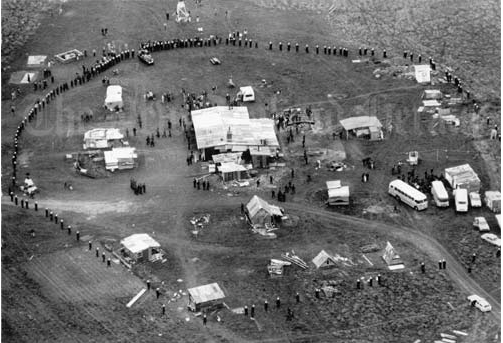
Day 506: On 25 May 1978 a massive Police operation, backed by the NZ Army, evicted 218 protesters from their occupation village on Bastion Point. This was the last time a Kiwi prime minister unequivocally answered the question: "Who has the final say in New Zealand?"
ONLY A FOOL would attempt to portray sovereignty as an
unimportant issue. (See The NZ Herald,
Editorial, 11/2/15) It takes a special sort of smugness and a huge amount of
ignorance to suggest that “practical” people don’t really care who has (or
should have) the final say in their country. Only someone for whom the idea of not
having the final say is genuinely inconceivable would make so absurd a claim.
And only someone with no real knowledge or understanding of the past could
possibly believe that sovereignty is ever acquired cheaply or relinquished lightly.
The question of precisely where sovereignty is located in Aotearoa/New
Zealand is by no means an easy one to answer. Indeed, it has been many years
since anyone seriously tried. The first instinct of our politicians,
bureaucrats, and even of our police officers, whenever the question of
sovereignty raises its deeply problematic head, is to fudge, fudge, fudge, and,
if necessary, fudge again.
The last time a New Zealand political leader unequivocally
asserted the indivisible sovereignty of the post-colonial Settler State was Rob
Muldoon. Faced with the refusal of Ngati Whatua protesters to abandon their 506-day
occupation of Auckland’s Bastion Point, Prime Minister Muldoon ordered their
forcible eviction.
This was by no means a straight-forward exercise. Hundreds
of Police, supported by the NZ Army, were required to remove the 218 people who
refused to vacate their ancestral land. The images broadcast to New Zealand on
the evening news of 25 May 1978 were deeply disturbing to a great many of its
citizens – so much so, that no similar operation was authorised until the
ill-starred “Operation Eight” of 2007.
Certainly, when confronted with the Whanganui people’s
occupation of Pakaitore (Moutoa Gardens) in 1995, the government of Jim Bolger
steadfastly refused to authorise the use of force to secure their eviction. Nearly
20 years on from Bastion Point, and with many Maori openly asserting tino rangatiratanga, or Maori
Sovereignty, it was by no means certain that the protesters and their
supporters would “go quietly”.
Fortunately, for the peace of the realm, the Whanganui
people were equally unwilling to answer the question: ‘Who has the final say in
New Zealand?’ Instead, like their warrior ancestors, they quietly “abandoned
the Pa” – slipping away into the night and leaving the gardens empty.
Though the ill-fated “Operation Eight” was not launched in
response to a land occupation, the manner of its execution left a great many
New Zealanders – Maori and Pakeha – with a bitter taste in their mouths. The
television images of heavily armed Police manning road-blocks and carrying out property
searches and interrogations throughout the tiny Tuhoe settlement of Ruatoki
revealed just how high the sovereignty stakes had been raised since 1978.
Any New Zealand government intending to assert state power over
Maori in the second decade of the twenty-first century must anticipate
considerably more than the passive resistance of Bastion Point, and the
self-restraint of Pakaitore. It must be ready to use deadly force.
The Herald’s
editorial writer would, of course, reject all such statements as alarmist. He
is quite certain that “practical” Kiwis will never let things come to such a
pass. But that is only because a willingness to compromise has always been the
strongest component of the Maori-Pakeha relationship. Faced with stepping
forward into open and uncompromising confrontation, Maori and the Crown (some
disgruntled Pakeha might say ‘especially the Crown’) have, for the most part, chosen
to step back.
But it requires an heroic leap of faith to accept that one’s
country’s rulers are going to be lucky all the time. A day may come when New
Zealand is again ruled by a person with the same autocratic temperament as Rob
Muldoon. When the issue in dispute is too important for compromise. When
neither side feels able to step back from the brink without suffering a
catastrophic loss of mana. It is on that day that the all-important question:
“Who has the final say in New Zealand?” will be answered. And the only
“practical matters” to be considered on that day will be: Who’s will is the stronger?
and, Who has the most guns?
This essay was
originally posted on The Daily Blog
of Wednesday, 11 February 2015.
