Showing posts with label Operation Eight. Show all posts

Wednesday, 16 December 2020

Be Careful What You Wish For.

This Is What Counter-Terrorism Looks Like: Has the New Zealand Left forgotten already the enormous fuss they made about the ill-fated “Operation Eight”. How appalled they all were when the Police and other elements of the security services moved against a group of left-wing activists observed training in the Urewera Ranges with semi-automatic weapons and Molotov cocktails? Have they forgotten their outrage at the illegal use of surveillance equipment? The interception of e-mails. The heavy-handed raid on Ruatoki?

THERE’S A CURIOUS disconnect between the Left’s support for the Muslim community and its deep-seated mistrust of the security services. On the one hand, they are demanding that white supremacists be hunted down and brought to justice – by any means necessary – while, on the other, they are wary of expanding the already extensive powers of the secret state. The problem, of course, is that it’s very difficult to achieve the former without promoting the latter. It is, however, far from certain that the Left understands this.

One of the most consistent themes to emerge from the Left’s response to the Royal Commission of Inquiry into the Christchurch Mosque Attacks is that of the authorities’ failure to identify and neutralise Brenton Tarrant’s terrorist operation. Unspoken in these critiques (most probably because those making them are unwilling to acknowledge the full implications of their own demands) is the expectation that, in order to guard against such a terrible crime ever happening again, the Ardern Government will oversee a significant expansion of the National Intelligence Community’s (NIC) counter-terrorist capabilities.

But what, exactly, would that look like? By what means could the activities of a Brenton Tarrant be detected? He had planned his operation with considerable care, always conscious of the need to avoid attracting the attention of the authorities. He understood the acute vulnerabilities of a democratic society and exploited them ruthlessly. Most particularly, he took advantage of our system’s fundamental assumption that people are motivated by good (or, at least, not illegal) intentions. By the time a society like our own realises that it is dealing with someone whose intentions are homicidally destructive – it is far too late.

To its credit, the Royal Commission recognised this core truth of the Christchurch Attacks: that only the intervention of pure chance could have prevented Tarrant from carrying out his deadly mission. The Left, however, remains unsatisfied. It refuses to accept that Tarrant was essentially unstoppable. With all its powers, surely the secret state could have intercepted Tarrant’s electronic communications? A proper network of spies and informants, buried deep in the white supremacist movement, would have had no difficulty in picking-up on this new member of the gun club; this obsessive body-builder at the gym; this traveller with the interesting collection of stamps in his passport.

But, what sort of society would that be? A society in which the state is permitted to eavesdrop on any and every communication without the benefit of a judicial warrant, would hardly merit the title of “democratic”. Likewise, any society in which every new face, every unguarded comment, is noted, recorded and reported to the security services by a vast secret network of spies and informants. A society, in short, bearing a striking family resemblance to the society of the (East) German Democratic Republic (GDR) and its state security (Stasi) protectors.

Is that really the direction in which the Left would like to see Aotearoa-New Zealand travel?

The scary thing is that it’s not entirely clear that such a society is not the Left’s ultimate goal. Not when its extreme antipathy to white supremacy and its determination to protect vulnerable groups from its “hate crimes” and “hate speech” are factored into the equation. After all, it was the Socialist Unity Party’s (as the GDR’s communists called themselves) fear of fascism, both within the GDR and across the border in the Federal Republic (West Germany) that led to the creation of the Stasi and the building of the Berlin Wall.

Is it really too fanciful to suggest that, just as the East German working-class sought protection from any resurgence of the recently defeated Nazis, so, too, does Aotearoa’s diverse multicultural society require protection from the hateful manifestations of white supremacy?

It is so very tempting to buy into the goals and methods of counter-terrorism when the terrorists are people you despise. Think back to the early 1960s, when the Black civil rights movement was being beaten, bombed and murdered by the Ku Klux Klan. Recall the enraging photographs, published in Life magazine, of lounging Southern sheriffs, obscenely confident that their murderous suppression of African-Americans would go unpunished by the all-white juries empanelled to determine their guilt or innocence. Remember the increasingly shrill demands from liberal Americans that the FBI must “do something” to shut the Klan down. The unspoken assurance being that, whatever the FBI's “something” amounted to, the federal government would turn a blind eye.

And it worked. Of course it worked! Paid informers, midnight abductions, threats of torture, infiltration, disinformation, fostering extreme paranoia, deliberately inciting factional strife: such tactics always work. And when the Ku Klux Klan began to eat itself and its members started ratting each other out to the Feds, well, liberal America just set its jaw, shook the FBI Special Agents’ hands, and murmured “Well done.”

It is, however, important to remember that although the FBI’s Counter-Intelligence Programme (COINTELPRO) may have started with the Klan, it didn’t end there – no siree! Having shut down the southern white supremacists, the FBI turned its attention to the burgeoning left-wing movement against the war in Vietnam; the Black Panther Party; Students for a Democratic Society. Because, that’s the thing about counter-terrorism in a capitalist society: it may crack down on the Right out of a sense of duty; but destroying the Left is something it will always do happily – for the pure pleasure of watching it burn.

Has the New Zealand Left forgotten already the enormous fuss they made about the ill-fated “Operation Eight”. How appalled they all were when the Police and other elements of the security services moved against a group of left-wing activists observed training in the Urewera Ranges with semi-automatic weapons and Molotov cocktails? Have they forgotten their outrage at the illegal use of surveillance equipment? The interception of e-mails. The heavy-handed raid on Ruatoki? Their message to the National Intelligence Community, then, was admirably clear: “Stop trying to turn New Zealand into a police state!”

Ah, yes, but Operation Eight was directed against the Left’s friends and comrades – wasn’t it? Thirteen years on, what would the response be if the news media broke a story about a group of heavily armed white supremacists undergoing military training in a remote South Island pine forest? How many on the Left would complain, I wonder, when scores of heavily-armed and armoured police officers descended on the little Canterbury town of Geraldine to apprehend the fascists?

Hopefully, the outcry in defence of New Zealanders’ civil liberties would be just as loud in 2020 as it was in 2007. Hopefully, the insistence on the presumption of innocence would be just as great.

Every state possesses the means to keep its citizens under strict control. The democratic trick is to ensure that it receives no encouragement to use them. If governments are incited to believe the worst of their citizens, then those citizens will not be slow to live up to their masters’ expectations.

Be careful what you wish for.


This essay was originally posted on The Daily Blog of Tuesday, 15 December 2020.

Thursday, 12 February 2015

Questions Of Sovereignty: Who Has The Final Say In New Zealand? – And Should We Be Frightened Of Finding Out?

Day 506: On 25 May 1978 a massive Police operation, backed by the NZ Army, evicted 218 protesters from their occupation village on Bastion Point. This was the last time a Kiwi prime minister unequivocally answered the question: "Who has the final say in New Zealand?"
 
ONLY A FOOL would attempt to portray sovereignty as an unimportant issue. (See The NZ Herald, Editorial, 11/2/15) It takes a special sort of smugness and a huge amount of ignorance to suggest that “practical” people don’t really care who has (or should have) the final say in their country. Only someone for whom the idea of not having the final say is genuinely inconceivable would make so absurd a claim. And only someone with no real knowledge or understanding of the past could possibly believe that sovereignty is ever acquired cheaply or relinquished lightly.
 
The question of precisely where sovereignty is located in Aotearoa/New Zealand is by no means an easy one to answer. Indeed, it has been many years since anyone seriously tried. The first instinct of our politicians, bureaucrats, and even of our police officers, whenever the question of sovereignty raises its deeply problematic head, is to fudge, fudge, fudge, and, if necessary, fudge again.
 
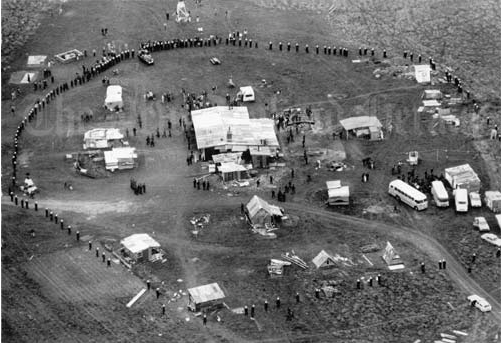
The last time a New Zealand political leader unequivocally asserted the indivisible sovereignty of the post-colonial Settler State was Rob Muldoon. Faced with the refusal of Ngati Whatua protesters to abandon their 506-day occupation of Auckland’s Bastion Point, Prime Minister Muldoon ordered their forcible eviction.
 
This was by no means a straight-forward exercise. Hundreds of Police, supported by the NZ Army, were required to remove the 218 people who refused to vacate their ancestral land. The images broadcast to New Zealand on the evening news of 25 May 1978 were deeply disturbing to a great many of its citizens – so much so, that no similar operation was authorised until the ill-starred “Operation Eight” of 2007.
 
Certainly, when confronted with the Whanganui people’s occupation of Pakaitore (Moutoa Gardens) in 1995, the government of Jim Bolger steadfastly refused to authorise the use of force to secure their eviction. Nearly 20 years on from Bastion Point, and with many Maori openly asserting tino rangatiratanga, or Maori Sovereignty, it was by no means certain that the protesters and their supporters would “go quietly”.
 
Fortunately, for the peace of the realm, the Whanganui people were equally unwilling to answer the question: ‘Who has the final say in New Zealand?’ Instead, like their warrior ancestors, they quietly “abandoned the Pa” – slipping away into the night and leaving the gardens empty.
 
Though the ill-fated “Operation Eight” was not launched in response to a land occupation, the manner of its execution left a great many New Zealanders – Maori and Pakeha – with a bitter taste in their mouths. The television images of heavily armed Police manning road-blocks and carrying out property searches and interrogations throughout the tiny Tuhoe settlement of Ruatoki revealed just how high the sovereignty stakes had been raised since 1978.
 
Any New Zealand government intending to assert state power over Maori in the second decade of the twenty-first century must anticipate considerably more than the passive resistance of Bastion Point, and the self-restraint of Pakaitore. It must be ready to use deadly force.
 
The Herald’s editorial writer would, of course, reject all such statements as alarmist. He is quite certain that “practical” Kiwis will never let things come to such a pass. But that is only because a willingness to compromise has always been the strongest component of the Maori-Pakeha relationship. Faced with stepping forward into open and uncompromising confrontation, Maori and the Crown (some disgruntled Pakeha might say ‘especially the Crown’) have, for the most part, chosen to step back.
 
But it requires an heroic leap of faith to accept that one’s country’s rulers are going to be lucky all the time. A day may come when New Zealand is again ruled by a person with the same autocratic temperament as Rob Muldoon. When the issue in dispute is too important for compromise. When neither side feels able to step back from the brink without suffering a catastrophic loss of mana. It is on that day that the all-important question: “Who has the final say in New Zealand?” will be answered. And the only “practical matters” to be considered on that day will be: Who’s will is the stronger? and, Who has the most guns?
 
This essay was originally posted on The Daily Blog of Wednesday, 11 February 2015.

Monday, 28 May 2012

No Comparison: Why Tame Iti Has No Role In "Smith's Dream"

Bogus Equivalence: As anyone who's actually read C.K. Stead's novel Smith's Dream, or seen Roger Donaldson's Sleeping Dogs will tell you, the desperate political situation prevailing in their fictional New Zealand bears absolutely no resemblance to the real New Zealand of either 2007 or 2012. Sam Neil's heroic "Smith" has nothing in common with Tame Iti or his embryonic Maori militia.

THE POSTER featured at the top of this posting indicates how very far from reality the Far Left in this country has drifted. So far that they can no longer even distinguish the salient differences between C.K. Stead’s 1971 novel Smith’s Dream (which Roger Donaldson turned into the 1977 New Zealand film Sleeping Dogs) and Tame Iti’s embryonic “private militia”.

In Stead’s/Donaldson’s fictional setting, New Zealand finds itself in the grip of an authoritarian dictatorship - complete with secret police, imprisonment without trial, torture, military tribunals, executions and lethal violence meted out to protesters on the streets. Not surprisingly, this leads to the formation of an armed resistance movement, which in turn spurs the government to invite in American "advisers".

Were any of these factors present in 2007? No.

So, the equating of Stead’s/Donaldson’s fictional New Zealand with New Zealand as it really was in 2007 is completely bogus. No one was being fatally beaten in the streets by murderous riot police. No one was being tortured. No one was being tried and sentenced to death by military tribunals. No American “advisers” were clambering through the New Zealand bush.

Yes, there was an unnecessarily heavy-handed raid on Ruatoki by armed police. But this was the culmination of a year’s worth of observation and evidence-gathering directed at apprehending a group alleged to be organising covert, military-style training camps in the Urewera Ranges, and undertaken on search-warrants lawfully issued. It resulted in the seizure of 18 firearms.

The persons arrested as a result of “Operation Eight” were not held incommunicado, denied access to legal advice and tortured until they confessed. Nor were they tried and executed in secret. On the contrary, they were given a fair trial in an open court and only convicted on a number of firearms charges. Two of the accused were jailed for two-and-a-half years. Their convictions and their sentences are now being appealed.

So, no. The "real life" Tame Iti is not the same as the fictional hero "Smith" played by Sam Neill. He was not fighting a murderous dictatorship. He was not being hunted down by US “advisers”. Nor were he and his followers being strafed and bombed by RNZAF Skyhawks.

What Mr Iti does appear to have been doing, however, was giving practical effect to the numerous discussions, extending over many decades, in which Maori nationalists and their far-Left Pakeha allies have weighed the pros and cons of organising a revolutionary Maori army.

Inspired by the Mexican “Zapatista” model, in which indigenous issues are fused with issues of environmental despoliation and globalisation, was Tame Iti attempting to turn the Ureweras into Mexico’s Chiapas province, and himself into Tuhoe’s own “Subcomandante Marcos”?

Finally, as bogus as it undoubtedly is, the poster’s comparison remains potentially very dangerous. People who construct a fantasy world, and then decide to live in it, very rapidly place themselves beyond the reach of arguments grounded in reason and evidence. And, as the images emerging from Syria over the past 24 hours make so tragically clear, those who forsake reason for violence are capable of doing just about anything.

This posting is exclusive to the Bowalley Road blogsite.