Showing posts with label Ronald Reagan. Show all posts

Monday, 29 July 2019

Another War With Iran?

A Long, Vicious And Forgotten War: The country which unleashed the Iran-Iraq War (1980-1988) was Iraq. For the duration, Iraq’s dictator, Saddam Hussein, was able to count on the strong support of the United States. The backing of Presidents Jimmy Carter’s and Ronald Reagan’s administrations never wavered, not even when, for the first time since World War One, the Iraqis deployed chemical weapons.

WILL THERE BE a war with Iran? Better to ask: will there be another war with Iran?

So many of us in the West have forgotten that the country, currently being fitted-up as the next Middle Eastern aggressor, endured eight years of extremely vicious fighting, at the cost of at least half-a-million lives, between 1980 and 1988.

The country which unleashed this war was Iraq. For the duration, Iraq’s dictator, Saddam Hussein, was able to count on the strong support of the United States. The backing of Presidents Ronald Reagan’s and Jimmy Carter’s administrations never wavered, not even when, for the first time since World War One, the Iraqis deployed chemical weapons.

The date of the Iran-Iraq War’s outbreak, September 1980, is significant. Eleven months earlier, 52 American hostages had been seized in an attack on the US Embassy in Tehran. When his secret mission to rescue the hostages ended in disaster, President Jimmy Carter quietly appealed to Saddam, who, as a secular Baathist, was no friend of Ayatollah Khomeini’s “Islamic Revolution”, for help. His reward, providing his army could win them, would be Iran’s most productive oil fields.   

The hostages’ eventual liberation, pointedly timed to coincide with Ronald Reagan’s inauguration, came in January 1981. When asked by a reporter if he would ever go back to Iran, one of the freed hostages replied: “Only in a B-52!” Thanks to Saddam’s illegal invasion, however, President Reagan was never required to unleash his strategic bombers on the Iranians. The Iraqi armed forces had become America’s proxy punishers. Iran had humiliated the United States, and for eight terrible years it was required to pay the price.

With another war on Iranian soil looming, it is interesting to register the size of the Iraqi invasion force. Saddam sent 100,000 troops and hundreds of battle tanks across the Iranian border in September 1980, while his air force flew hundreds of sorties against Iranian targets. The scale of Saddam’s invasion bears close comparison with the Anglo-Soviet invasion of neutral Iran in August 1941. That, too, was a massive affair, involving hundreds of thousands of British Empire and Soviet troops.

Remember, these were invasions of Iran – not by Iran. As strategic analyst, Dr Paul Buchanan, observes:

“[I]t should be remembered that modern Iran has not engaged in an unprovoked attack on another country. Although it supports and uses irregular military proxies, it is nowhere close to being the sponsor of terrorism that several Sunni Arab petroleum oligarchies are. In spite of its anti-Israel rhetoric (destined for domestic political consumption), it has not fired a shot in anger towards it.”

This is important. If war is unleashed against Iran, its 80 million citizens will find themselves engaged in a defensive war. Accordingly, the Iranians will enjoy the home-ground advantage. The Americans, and whoever is foolish enough to join them in such a mad endeavour, will find themselves, like the Iraqis, required to fight not only Iran’s people, but also its formidable geography. In addition to confronting human-beings, the United States will be battling snow-capped mountain ranges and waterless deserts.

The Americans are not daunted. When it comes to the Middle East (and its oil) the behaviour of the United States can only be described as unhinged. When Saddam dared to act independently of the US, the debt America owed his country, for its costly – and ultimately futile – war against its Iranian neighbour, was forgotten in a heartbeat.

And it wasn’t just Saddam who paid dearly for his failure to comprehend the full extent of America’s derangement. When US Secretary of State, Madeline Albright, was asked by CBS’s Lesley Stahl: “We have heard that half a million [Iraqi] children have died. I mean, that’s more children than died in Hiroshima. And, you know, is the price worth it?” Albright replied: “I think this is a very hard choice, but the price — we think the price is worth it.”

Astonishingly, the same people who beat the war-drums for the illegal invasion of Iraq in 2003, are beating them again in 2019. President Trump’s National Security Adviser, John Bolton, gives every impression of never having seen a square kilometre of Middle Eastern soil which could not be immeasurably improved by being pulverised with US ordnance.

It would be comforting to believe that wiser heads will prevail. Sadly, history suggests otherwise.

This essay was originally published in The Otago Daily Times and The Greymouth Star of Friday, 26 July 2019.

Tuesday, 4 February 2014

Wearing Racism

What's Wrong With This Picture? In this cartoon from the Presidential Election Campaign of 1860, Black Americans in Victorian finery are depicted as a warning of what will happen to America if the Republican Party's candidate, Abraham Lincoln, becomes President. Clothing as a status marker carries with it a powerful political charge when the person wearing it is assumed to occupy an inferior social position.

THERE WAS A VICIOUSNESS about the United States presidential campaign of 1860 that, with hindsight, seems horribly portentous. No matter how many times the South’s politicians did the political math the result was always the same. The newly-formed Republican Party was going to win a majority in the Electoral College, and its anti-slavery candidate, Abraham Lincoln, was going to become the sixteenth President of the United States.
 
In desperation the slave-owning South and their Democratic Party allies in the northern states threw everything they could at “Honest Abe”. Given the hugely divisive issue at the heart of the campaign, racial slurs abounded. Plucking the most tightly-wound string of the American electorate’s fiddle, Lincoln’s opponents accused him of believing in racial equality, miscegenation and plotting secretly to turn America into a mongrel state.
 
Naturally, the pro-slavery parties’ cartoonists had a field day. One of their favourite visual taunts was to portray black men and women sashaying around beneath “Honest Abe’s” approving gaze in the clothing of the upper-classes.
 
To racially prejudiced Americans (which in 1860 constituted the overwhelming majority of US citizens) the image of a black person decked out in the lavish Victorian finery of the period was profoundly offensive. It implied that Blacks might one day disport themselves in exactly the same symbols of economic success and superior social status as Whites.
 
The anti-Republican cartoons were also intended to warn voters about the Abolitionists’ determination to not only free the slaves, but also to have them declared United States citizens with exactly the same civil and political rights as their White brothers.
 
It must also be noted, however, that in addition to making White Americans angry these images of “gussied-up niggers” also made them laugh. The whole idea was so preposterous, so outlandish – like an ape in evening dress – that it could not be taken seriously. Racial equality was thus revealed as a wild abolitionist fantasy – proof of just how far beyond the pale the Republicans and their candidate had positioned themselves.
 
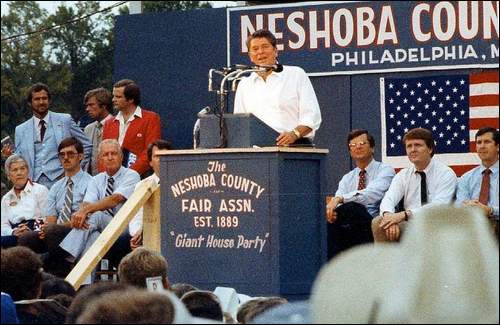
One hundred and twenty years later, proof of American racism’s cultural tenacity was clearly evident in the presidential election campaign of 1980. The Republican Party’s candidate, Ronald Reagan (whose party had, in one of History’s most poignant ironies, become the preferred party of the old Confederacy) launched his campaign at the Neshoba County Fair, an annual event held on the outskirts of Philadelphia, Mississippi, the town where three civil rights workers were murdered by the Ku Klux Klan in 1964.
 
The White Man's Candidate: Resplendent in his white shirt-sleeves, Ronald Reagan launches his 1980 Presidential Campaign on the outskirts of Philadelphia, Mississippi, where, just 16 years earlier, three civil rights workers were murdered by the Ku Klux Klan. American racism has a remarkable cultural tenacity.
 
America’s racists grasped the dark symbolism of Reagan’s choice immediately. He was identifying himself proudly and unmistakably as the White voters’ candidate. Not that they needed much convincing. Four years earlier, in his first run at the Republican presidential nomination, Reagan had introduced America to the person he dubbed the “Welfare Queen” – a Black American woman living on the South Side of Chicago:
 
“She has eighty names, thirty addresses, twelve Social Security cards and is collecting veteran's benefits on four non-existing deceased husbands. And she is collecting Social Security on her cards. She’s got Medicaid, getting food stamps, and she is collecting welfare under each of her names. Her tax-free cash income is over $150,000.”
 
Reagan’s words served a purpose identical to those 1860 cartoons’ depicting Black Americans dressed in upper-class attire. His Welfare Queen, with her “tax-free cash income” of over $150,000, played to exactly the same prejudices. The notion of a Black woman earning $150,000 was clearly preposterous: only the most egregious defrauding of the welfare system could possibly produce such a creature.
 
Reagan’s message was clear: Liberal America, by promoting racial equality and demanding that the equal rights of citizenship, won at such cost under Lincoln’s presidency, be enforced in every state of the union had created (at the ever-escalating expense of the long-suffering taxpayer) a feckless underclass of welfare cheats, drug addicts and gang-bangers. Reagan didn’t have to say that the people he was talking about were Black. The people who cheered him on knew that already.
 
Disreputable politics? Undoubtedly. But also highly effective – which is why so many politicians throughout the English-speaking world have tried so hard to emulate Reagan’s success.
 
Including some New Zealand politicians?
 
I would certainly like to think not. The idea that there might be some Pakeha politicians who, without resorting to the derogatory terms of our not-too-distant racist past, and almost certainly without reflecting on how their words were likely to be misinterpreted, might nevertheless call attention to the way a non-Pakeha person was dressed, and to how much money they might have spent on their ensemble – is a very troubling one.
 
To the minds of some undoubtedly oversensitive wee sausages those 1860 cartoons might be recalled, along with Ronald Reagan’s quip about welfare queens.
 
Just how would a racist politician say “gussied-up nigger” in 2014?
 
This essay was originally published in The Press of Tuesday, February 04, 2014.

Sunday, 1 May 2011

Code Red

"You can't handle the truth!" Colonel Jessep defends the darkness behind the wire in Aaron Sorkin's A Few Good Men. When it comes to the SAS in Afghanistan it would seem that the few good men are all in the field and that our military and political leaders share Colonel Jessep's view of the public's ability to deal with the realities of New Zealand's involvement in a brutal, dirty and illegal war.

TO MAKE a political lie work, writes American historian, Rick Perlstein, you need only two things: “A powerful person or institution willing to utter it, and another set of powerful institutions to amplify it.”

No institution is more powerful than the State, so when statesmen decide to lie they’ve always got a head-start on the truth.

And the sheer size of the State means they can lie on a grand scale.

It was Adolf Hitler who penned the infamous sentence: “When you lie, tell big lies.”

Most of us only dare to “tell small lies in little matters”. Judging people by our own timorous moral standards, we have real difficulty believing others can “fabricate colossal untruths”.

Hence Hitler’s confidence that: “The grossly impudent lie always leaves traces behind it, even after it has been nailed down.”

The State also enjoys another – and arguably even greater – advantage over its citizens: its legitimacy.

For a society to function, ordinary people must retain at least a modicum of trust and confidence in its core institutions. Each one of those institutions, therefore, has a strong interest in reinforcing and protecting the others.

This places the second most powerful institution in our society – the news media – in a thoroughly invidious position.

To retain the trust and confidence of its audiences the news media must tell them the truth without fear or favour. But, if it tells “the truth, the whole truth, and nothing but the truth” about government, big business, the military, the police, the judiciary and all the other “powerful institutions” out of which our social fabric is woven, it risks unravelling it altogether.

According to Rick Perlstein, this is what began to happen in the 1970s when: “The investigative reporter became a sexy new kind of hero. A shaggy-haired loner, too inquisitive for his own good, played by Warren Beatty, Robert Redford and Dustin Hoffman.”

It was the decade of Watergate and the Church Committee’s inquiry into the CIA and the FBI. An era of whistle-blowers like Daniel Ellsberg – who leaked ‘The Pentagon Papers’ to The New York Times. The period when consumer advocate, Ralph Nader, warned Americans that corporate capitalism might be “unsafe at any speed”.

“The truth hurt”, says Rick Perlstein, “but the incredible thing was the citizenry seemed willing to bear the pain.”

Perhaps. But the “powerful institutions” of American society – what the baby-boom generation called “The Establishment” – wasn’t.

Rick Perlstein argues that the counter-attack began when Ronald Reagan was elected US President in 1980. This, he says, was the moment when telling the truth ceased to be an act of patriotism and, almost overnight, became an act of treachery against God, Justice and the American Way. The shaggy-haired investigative journalist, with his subversive curiosity, ceased to be sexy and became, instead, a professional bore.

If the State lies, intone the ladies and gentlemen of today’s press, it no doubt has very good reasons for doing so – reasons that are in no way the business of the news media to challenge. A journalist’s job isn’t to hold the powers-that-be to account. On the contrary, the journalist’s first responsibility is to preserve societal cohesion by reinforcing and protecting its core institutions.

If you doubt this grim assessment, go out and buy the latest issue of Metro magazine and read Jon Stephenson’s article “Eyes Wide Shut”. Jon’s not exactly what you’d call “shaggy-haired”, but he’s cut from exactly the same cloth as those investigative journalists of the 1970s.

Jon’s story is about the conduct of New Zealand troops in Afghanistan – what they’ve done, and what they’re still doing.

I defy any fair-minded person to read this story and arrive at any other conclusion than that our military and political leaders have lied to us.

“I want the truth!” yells Lieutenant Kaffee in A Few Good Men, to which Colonel Jessep scornfully replies: “You can’t handle the truth!”

That’s what all political liars believe to be true.

It’s time we opened their eyes.

This essay was originally published in The Dominion Post, The Timaru Herald, The Taranaki Daily News, The Otago Daily Times and The Greymouth Star of Friday, 29 April 2011.