Showing posts with label US Civil War. Show all posts

Friday, 29 May 2020

Poisonous Legacy: Why George Floyd Could Be Choked While The Whole World Watched.

"I can't breathe, Mama. I'm dying." - Last words of George Floyd.

LOOK HARD at this image. Think about what it depicts. Ask yourself how one human-being could behave so brutally when so many eye-witnesses – and very soon millions of people online around the world – were there to watch him do it. Then ask yourself why he didn’t care.

In this photograph, lifted from a video taken at the scene, the Minneapolis police officer whose knee is choking the life out of George Floyd, registers the presence of witnesses with a mixture of surprise and annoyance. The fact that he is looking directly into the lens of the cellphone recording his actions – strongly suggests that he is aware of what is happening.

Most people, caught in a similarly compromising position would respond by removing their knee from the suspect’s neck. The man was in handcuffs. He posed no threat to the officer or anybody else. The witnesses present could hear the man protesting that he couldn’t breathe. So, presumably, could the officer. So, why didn’t he remove his knee? Why didn’t he stop?

Part of the answer lies in the culture of American law enforcement. In all but the smallest communities, US police officers are encouraged to view their fellow citizens as the enemy. This is true even of white citizens, who will be shown scant respect unless the socio-political context of their encounter with law enforcement, and/or their possession of all the accessories of high social status, indicate a more deferential demeanour might be in order. In the absence of these warning markers, however, blank indifference to the rights and opinions of their fellow citizens is considered mandatory. Anything less would convey an impression of softness and weakness: displays of which could quickly lead to a potentially fatal loss of police authority.

With African-Americans, the need for maximum rigor on the part of law enforcement has always been a given. On the central question of equal treatment under the law, all of American history conspires against people of colour. Their role in the development of American capitalism – and of capitalism globally – may have been crucial. One cannot picture the cotton mills of Lancashire without also picturing the cotton fields of Mississippi! But, the great tragedy of African-American history is that it is equally difficult to explain the global dominance of American capitalism without acknowledging the racial segmentation of the American working-class. With racial prejudice forever forestalling working-class unity, anti-capitalism has never found any enduring purchase on the soil of the United States.

As long ago as the 1830s it was apparent to dispassionate observers of the American Republic that “free” white American males (the only people then vested with political power) were bound to the idea of the United States with chains every bit as strong as those which burdened its black slaves. The loyalty of the poorest white farmer and/or factory worker was in large measure guaranteed by his understanding that at least two categories of human-being would always occupy a more degraded position than himself in the socio-economic hierarchy: women and blacks.

Nowhere is this crucial political understanding more clearly spelled out than in the 1857 judgement of the Chief Justice of the United States, Roger Taney, who ruled against the legal attempt by the freed slave, Dred Scott, to secure equality of treatment under the Constitution of the United States.

According to Taney:

“The question is simply this: Can a negro, whose ancestors were imported into this country, and sold as slaves, become a member of the political community formed and brought into existence by the Constitution of the United States, and as such become entitled to all of the rights, and privileges, and immunities, guarantied by that instrument to the citizen?”

The Chief Justice’s answer was an unequivocal “No”.

“We think... that [black people] are not included, and were not intended to be included, under the word “citizens” in the Constitution, and can therefore claim none of the rights and privileges which that instrument provides for and secures to citizens of the United States. On the contrary, they were at that time [of America's founding] considered as a subordinate and inferior class of beings who had been subjugated by the dominant race, and, whether emancipated or not, yet remained subject to their authority, and had no rights or privileges but such as those who held the power and the Government might choose to grant them.”

Taney’s (along with six more of the nine Supreme Court justices’) judgement stated more honestly than anything written before, or since, White America’s true feelings towards Black America:

“It is difficult at this day to realize the state of public opinion in relation to that unfortunate race, which prevailed in the civilized and enlightened portions of the world at the time of the Declaration of Independence, and when the Constitution of the United States was framed and adopted.... They had for more than a century before been regarded as beings of an inferior order...; and so far inferior, that they had no rights which the white man was bound to respect; and that the negro might justly and lawfully be reduced to slavery for his benefit.”

It could hardly be stated more plainly: African-Americans have no rights which the white man is bound to respect. In very large measure the American Civil War was fought to nullify Chief Justice Taney’s (himself a slaveowner) crushing judgement. And though, by the victory of the Union armies, the slaves were freed, recognised as citizens of the United States, and guaranteed the equal protection of the laws, their victory was short-lived. Barely a decade after the war’s end, the relentless roll-back of African-American rights had begun. On the ground, where it counted, most white Americans found it more expedient to enshrine the prejudices of Roger Taney than to give heed to Abraham Lincoln’s “better angels”.

It required terror, of course, this denial of African-American rights: terror and the connivance of local law enforcement. Between them, the Ku Klux Klan, the local sheriff and the officials down at the county courthouse reduced those African-Americans still living within the borders of the defeated Confederacy to a new form of servitude. It would be another 100 years before the civil rights won in the Civil War were again afforded the meaningful protection of federal authority.

Perhaps predictably, the spectacle of African-Americans reaching out to reclaim their lost political, social and economic rights struck fear into white Americans. Across the whole of America this time, the prospect of giving up their privileged status – even if its surrender would greatly enhance the ability of all Americans to pursue happiness more successfully – was enough to drive working-class whites into the arms of, first, George Wallace, then Richard Nixon, and ultimately Ronald Reagan.

Is it drawing too long a bow to suggest that in the aftermath of the Civil Rights Struggle (1954-1980) the terroristic role formerly assigned to the Ku Klux Klan was assumed by local law enforcement? The Black Lives Matter movement would not say so. If he had not been silenced forever by a Minneapolis cop, it is likely that George Floyd would not say so. Not when practically every day in the United States police officers pay deadly tribute to Chief Justice Taney’s poisonous legacy.

Demonstrably, it is the opinion of American law enforcement that African-Americans are indeed members of an inferior order. So far inferior, that they have no rights which any white police officer is bound to respect; and that African-Americans might justly and lawfully be put to death – even when the whole world is watching.

This essay was originally posted on The Daily Blog of Friday, 29 May 2020.

Thursday, 20 June 2019

What Is A White Supremacist?

The Original White Supremacists: The current misuse of the term “white supremacy” is highly dangerous politically. By singling out this particular form of racism and misapplying it to famous figures from the past, as well as to people living in the present, the users of the term risk not only its rapid devaluation, but also the angry retaliation of those who feel both themselves and their beliefs to have been wrongly and unfairly condemned.

THE TERM “WHITE SUPREMACIST” is rapidly replacing the more straightforward “racist” in mainstream journalism. The term is also being used to describe the belief system of Philip Arps, the self-confessed Nazi who was sentenced earlier this week to 21 months imprisonment. On social media, especially Twitter, the term is being used, anachronistically, to characterise the ideas of explorers and colonialists living in the eighteenth and nineteenth centuries. While it is not unusual to encounter such terminological misuse in the writings of radical post-modernists, it is worrying to see the mainstream media subsume so many different historical and ideological phenomena into this single, catch-all, expression.

The current misuse of the term “white supremacy” is also highly dangerous politically. By singling out this particular form of racism and misapplying it to famous figures from the past, as well as to people living in the present, the users of the term risk not only its rapid devaluation, but also the angry retaliation of those who feel both themselves and their beliefs to have been wrongly and unfairly condemned.

Because the number of New Zealanders subscribing to the beliefs journalists now describe as “white supremacist” is by no means a small one. Indeed, it is likely that a majority of older Pakeha New Zealanders still adhere, either wholly or in part, to the notion that the achievements of western civilisation – of white people – far outstrip those of any other. They may be careful about who they share these ideas with, but they hold them nonetheless.

It is certainly the case that this assumption of western superiority informed the response of practically all the western nations to the terrorist attacks of 9/11. When President George W. Bush explained the terrorists’ murderous attacks by saying: “they hate our freedoms, they hate our way of life”; very few white Americans, or whites living in any other western nation, failed to grasp his racially-charged sub-text: they are less than us.

The mainstream media, itself, is equally guilty of assigning considerably greater value to the lives of westerners than to human-beings living in other parts of the world. A cruise liner carrying wealthy Europeans runs into a Venice wharf, injuring half-a-dozen, and it’s headline news around the planet. An overcrowded ferry-boat collides with another vessel and sinks, drowning 200 Indians, and all it rates is a one-line mention three-quarters of the way down the news bulletin. What other message can we draw from that, other than – whites are more important?

So, racism is a hard habit for westerners to break. The use of the term “white supremacy”, however, should properly be restricted to the specific political actors and the particular historical context from which it emerged. It refers, primarily, to the political regimes which arose in the southern states of the USA in the years following the American Civil War – most particularly in the decades immediately following the withdrawal of federal troops from the states of the defeated Confederacy in 1877.

These regimes were built on the bedrock requirement that whites must in all conceivable circumstances: economic, social, cultural, legal and political; be placed ahead of and above blacks. The poorest and most ill-educated white farmer had to be able to count himself better off, both subjectively and objectively, than his black neighbours. White supremacy wasn’t just a matter of personal racial animus, it described a comprehensive and internally coherent system of race-based rule. A “white supremacist”, accordingly, is a person who not only subscribes to the principles underpinning the infamous “Jim Crow” system, but also – like the contemporary Ku Klux Klan – strives for its return. Obviously, the term may also be legitimately applied to the very similar systems of race-based rule erected in South Africa and Rhodesia between 1948 and 1992.

It is important to acknowledge that a political entity driven by the principles of genuine white supremacy will be very different from one in which the official goal is racial assimilation, as was formerly the case in New Zealand. It will also be quite distinct from a regime, such as Nazi Germany’s, whose official goal was the physical elimination of all races deemed to be a threat to the herrenvolk – the master race. This is because, in both the American South, and in Southern Africa, blacks were absolutely essential to the successful operation of the white-controlled economy. Without plentiful and criminally cheap black labour, the white supremacist regimes on both continents would not have been economically viable.

This is why it is so dangerous to conflate all economic, social and political systems in which racial prejudice and inequality thrive as “white supremacist” regimes. Simple racial chauvinism is very different from the conscious creation of a race-based economic and political system. If, however, the media persists in lumping together every Pakeha who takes pride in the achievements of western civilisation with avowed Nazis, like Philip Arps, or genocidal eco-fascists, like the Christchurch shooter, then not only will the charge lose all its definitional and moral force, but, sooner or later, those so lumped will come to the conclusion that they might as well be hung for sheep as lambs.

Those on the Left who are promoting the use of this term, presumably as a way of shaming Pakeha New Zealanders into acknowledging and renouncing their “white privilege”, may soon come to regret driving their boots so forcefully into such a large pack of sleeping dogs. Giving these mutts the bad name of “white supremacists” will in no way blunt, or shorten, their political teeth.

What happened at Orewa in January 2004, can happen again.

This essay was originally posted on The Daily Blog of Thursday, 20 June 2019.

Wednesday, 30 August 2017

Is America Heading For A Second Civil War?

Divided Future: “Were Trump either to quit in pique and frustration or, worse, be removed by either of the legal means available, the US would risk being plunged into civic unrest on an unknowable scale.”  - NZ Listener.
 
“TRY TO IMPEACH HIM, just try it. You will have a spasm of violence in this country, an insurrection like you’ve never seen. The people will not stand for impeachment. A politician that votes for it would be endangering their own life.” That is the frightening prediction of the American right-wing activist, Roger Stone, one of US President Donald Trump’s most outspoken supporters.
 
Stone, himself, has many painful personal memories of the impeachment process. He was, after all, an official in the administration of President Richard Nixon. But, a lot has changed in 40 years. In 2017, Stone warns, impeaching a sitting Republican president might not be so easy: “Both sides are heavily armed … This is not 1974. The people will not stand for impeachment.” Asked if he was predicting civil war, Stone replied unequivocally: “Yes, that’s what I think will happen.”
 
Nonsense? Not according to the editorial writers of New Zealand’s own Listener magazine:
 
“Were Trump either to quit in pique and frustration or, worse, be removed by either of the legal means available, the US would risk being plunged into civic unrest on an unknowable scale.”
 
Drawing their readers’ attention to the “considerable” support which Trump still commands among “a socially disaffected rump”, the Listener argues that his diehard supporters “might not hesitate to form militias and try to instigate civil war.”
 
How has it come to this? How has the greatest republic the world has ever known been led to the edge of such a profound political abyss? A more useful line of questioning might begin with another, albeit related, question: “How has the American republic avoided dissolution for so long? Because the most astonishing historical fact about the United States of America is that it is still with us.
 
It very nearly wasn’t. Had anyone but Abraham Lincoln won the 1860 presidential election, it is highly unlikely that the United States as we know it would have survived. Either, the American South’s “peculiar institution” of slavery would have obliged its anti-slavery Northern neighbours to undertake a long and painful retreat from the “self-evident” truths of the American revolution. Or, the North American continent would have been divided between the “United”, and the “Confederate”, States of America.
 
Lincoln forestalled both of these outcomes – but only at enormous cost. The casualties inflicted during the American Civil War of 1861-1865 still outnumber all the casualties sustained by the USA in all subsequent conflicts – including World Wars One and Two. What’s more, the terrible political wounds opened up by the Civil War: essentially a conflict about the economic and social role of Race in American society; have never properly healed.
 
Lincoln’s successors brave attempt to vindicate the sacrifices of the Civil War: the so-called “Reconstruction Period”; lasted barely a decade. Equality between Southern blacks and whites could only be enforced by the bayonets of the occupying Union Army. Its withdrawal, in 1877, was followed by the brutal subjugation and virtual re-enslavement of the black population by the white. The means adopted: illegal terror by the Ku Klux Klan, reinforced by the institutional repression of “Jim Crow” segregation laws, received no early constitutional reproof from the Supreme Court. The federal government thereby signaled its willingness to see established, across the South, racist political regimes that can only be described as “proto-fascist”.
 
Accordingly, when critics of the Alt-Right demonstrators in Charlottesville denounce their “fascist” tactics as foreign to American democracy, they’re mistaken. The much more unpalatable truth is that many of the political motifs we associate with European fascism were actually borrowed from America. Torchlight parades, for example, date all the way back to the 1832 campaign of America’s first populist president, Andrew Jackson. Klansmen’s robes may, similarly, have inspired Mussolini’s black-shirts and Hitler’s stormtroopers. And anyone who believes that the Nazi Party invented the mass political rally should take a look at any American party convention, or the news photographs of 50,000 robed Klansmen marching down Pennsylvania Avenue in 1925.
 
American Fascism: Ku Klux Klan marches down Pennsylvania Avenue, Washington DC, 1925.
 
Racism, and the fascistic trappings that give it political momentum, are as American as apple-pie. Indeed, it is possible to argue that the Kennedy/Johnson-led Democratic Administrations’ successful efforts to abolish Jim Crow and end Klan terror in the early-1960s have been the primary drivers of American politics ever since. Be it Nixon’s 1968 “Southern Strategy”; Reagan’s upholding of “State’s Rights” in 1980; or, Trump’s 2016 “Let’s make America GREAT again!” (i.e. “WHITE” again) campaign slogan; the Republicans have been the party of race-based politics for nearly fifty years. That President Obama was followed by President Trump is no historical accident.
 
Tragically, the Republican Party has made itself a willing hostage to the political terror and unconstitutional objectives that have always marched in lock-step with the advance of America’s white supremacist traditions. Defeating both may well require a second civil war.
 
This essay was originally published in The Press of Tuesday, 29 August 2017.

Tuesday, 4 February 2014

Wearing Racism

What's Wrong With This Picture? In this cartoon from the Presidential Election Campaign of 1860, Black Americans in Victorian finery are depicted as a warning of what will happen to America if the Republican Party's candidate, Abraham Lincoln, becomes President. Clothing as a status marker carries with it a powerful political charge when the person wearing it is assumed to occupy an inferior social position.

THERE WAS A VICIOUSNESS about the United States presidential campaign of 1860 that, with hindsight, seems horribly portentous. No matter how many times the South’s politicians did the political math the result was always the same. The newly-formed Republican Party was going to win a majority in the Electoral College, and its anti-slavery candidate, Abraham Lincoln, was going to become the sixteenth President of the United States.
 
In desperation the slave-owning South and their Democratic Party allies in the northern states threw everything they could at “Honest Abe”. Given the hugely divisive issue at the heart of the campaign, racial slurs abounded. Plucking the most tightly-wound string of the American electorate’s fiddle, Lincoln’s opponents accused him of believing in racial equality, miscegenation and plotting secretly to turn America into a mongrel state.
 
Naturally, the pro-slavery parties’ cartoonists had a field day. One of their favourite visual taunts was to portray black men and women sashaying around beneath “Honest Abe’s” approving gaze in the clothing of the upper-classes.
 
To racially prejudiced Americans (which in 1860 constituted the overwhelming majority of US citizens) the image of a black person decked out in the lavish Victorian finery of the period was profoundly offensive. It implied that Blacks might one day disport themselves in exactly the same symbols of economic success and superior social status as Whites.
 
The anti-Republican cartoons were also intended to warn voters about the Abolitionists’ determination to not only free the slaves, but also to have them declared United States citizens with exactly the same civil and political rights as their White brothers.
 
It must also be noted, however, that in addition to making White Americans angry these images of “gussied-up niggers” also made them laugh. The whole idea was so preposterous, so outlandish – like an ape in evening dress – that it could not be taken seriously. Racial equality was thus revealed as a wild abolitionist fantasy – proof of just how far beyond the pale the Republicans and their candidate had positioned themselves.
 
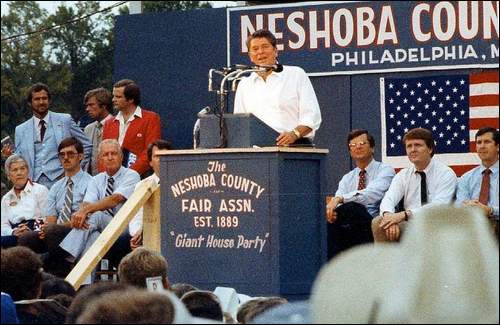
One hundred and twenty years later, proof of American racism’s cultural tenacity was clearly evident in the presidential election campaign of 1980. The Republican Party’s candidate, Ronald Reagan (whose party had, in one of History’s most poignant ironies, become the preferred party of the old Confederacy) launched his campaign at the Neshoba County Fair, an annual event held on the outskirts of Philadelphia, Mississippi, the town where three civil rights workers were murdered by the Ku Klux Klan in 1964.
 
The White Man's Candidate: Resplendent in his white shirt-sleeves, Ronald Reagan launches his 1980 Presidential Campaign on the outskirts of Philadelphia, Mississippi, where, just 16 years earlier, three civil rights workers were murdered by the Ku Klux Klan. American racism has a remarkable cultural tenacity.
 
America’s racists grasped the dark symbolism of Reagan’s choice immediately. He was identifying himself proudly and unmistakably as the White voters’ candidate. Not that they needed much convincing. Four years earlier, in his first run at the Republican presidential nomination, Reagan had introduced America to the person he dubbed the “Welfare Queen” – a Black American woman living on the South Side of Chicago:
 
“She has eighty names, thirty addresses, twelve Social Security cards and is collecting veteran's benefits on four non-existing deceased husbands. And she is collecting Social Security on her cards. She’s got Medicaid, getting food stamps, and she is collecting welfare under each of her names. Her tax-free cash income is over $150,000.”
 
Reagan’s words served a purpose identical to those 1860 cartoons’ depicting Black Americans dressed in upper-class attire. His Welfare Queen, with her “tax-free cash income” of over $150,000, played to exactly the same prejudices. The notion of a Black woman earning $150,000 was clearly preposterous: only the most egregious defrauding of the welfare system could possibly produce such a creature.
 
Reagan’s message was clear: Liberal America, by promoting racial equality and demanding that the equal rights of citizenship, won at such cost under Lincoln’s presidency, be enforced in every state of the union had created (at the ever-escalating expense of the long-suffering taxpayer) a feckless underclass of welfare cheats, drug addicts and gang-bangers. Reagan didn’t have to say that the people he was talking about were Black. The people who cheered him on knew that already.
 
Disreputable politics? Undoubtedly. But also highly effective – which is why so many politicians throughout the English-speaking world have tried so hard to emulate Reagan’s success.
 
Including some New Zealand politicians?
 
I would certainly like to think not. The idea that there might be some Pakeha politicians who, without resorting to the derogatory terms of our not-too-distant racist past, and almost certainly without reflecting on how their words were likely to be misinterpreted, might nevertheless call attention to the way a non-Pakeha person was dressed, and to how much money they might have spent on their ensemble – is a very troubling one.
 
To the minds of some undoubtedly oversensitive wee sausages those 1860 cartoons might be recalled, along with Ronald Reagan’s quip about welfare queens.
 
Just how would a racist politician say “gussied-up nigger” in 2014?
 
This essay was originally published in The Press of Tuesday, February 04, 2014.

Tuesday, 15 January 2013

Lincoln

"Government of the people, by the people, for the people." : Saviour of the Union; Emanicpator of the Slaves; and tutelary deity of the American Republic: Abraham Lincoln.

LINCOLN WILL BE HERE in eleven days. Already over twenty million Americans have seen Steven Spielberg’s acclaimed movie. Critics report audiences rendered mute by a combination of reverence and awe. Amidst all the tribulations occasioned by a faltering economy and an increasingly rancorous society, Americans are taking time out to be reminded that the American republic still stands as humanity’s most remarkable experiment.
 
The rest of the world may laugh at America’s excess and sneer at her lack of sophistication but the truth remains that the American republic is an enterprise imbued with the highest moral purpose. Abraham Lincoln understood this better than any other American President.
 
On his way to dedicate the Soldiers National Cemetery at Gettysburg on 19 November 1863, Lincoln jotted down the 271 words that still stand as not only his greatest speech but also the most succinct encapsulation of the democratic impulse ever penned. Resonant with the rhetorical power of Shakespeare’s plays and the King James Bible (large tracts of which Lincoln had committed to memory) his Gettysburg Address effortlessly mixes the universal and particular aspects of the struggle in which Americans were then engaged.
 
He begins by directly linking the conflict whose victims they had gathered to commemorate with the ideals of the American Revolution of 1776.
 
“Four score and seven years ago our fathers brought forth on this continent a new nation, conceived in liberty, and dedicated to the proposition that all men are created equal. Now we are engaged in a great civil war, testing whether that nation, or any nation, so conceived and so dedicated, can long endure.”
 
With characteristic humility, Lincoln then turns to the men whose deaths have transformed that purely speculative test into something approaching a blood pact: not only with those who began the American enterprise, but also with those future generations of Americans whose task it would be to preserve and extend it.
 
In what must surely rank as one of the great perorations of American oratory, Lincoln then concluded his address with these simple, but unforgettable, words:
 
“[W]e here highly resolve that these dead shall not have died in vain—that this nation, under God, shall have a new birth of freedom—and that government of the people, by the people, for the people, shall not perish from the earth.”
 
It is easy to forget that when Lincoln’s revolutionary formula was proclaimed over Gettysburg’s blood-soaked battlefield, the United States of America stood alone as the only nation among all the empires and kingdoms of the Earth that was even rhetorically committed to the democratic ideal. The aristocratic oligarchy which ruled Britain (and would have recognised the slave-owning Confederacy had the Battle of Gettysburg gone the other way) had, under great political pressure, consented to enfranchise its middle class in 1832. Full manhood suffrage would not be achieved in the United Kingdom until 1918. In Democracy’s second home, France, Napoleon’s nephew had proclaimed an authoritarian “Second Empire”.
 
Lincoln understood that a Confederate victory would re-admit British and French imperialism (Napoleon III was already eyeing Mexico) to the North American continent. How long a savagely truncated USA, hemmed in by unfriendly competitors to the north and south, could have preserved its democratic institutions is one of history’s imponderables. One cannot, however, escape the conclusion that the sentiments expressed by Lincoln in his Gettysburg Address were those of a man who understood that what was a stake in the American Civil War was nothing less than the completion of the American Revolution or, if the Union’s arms failed, its eventual repudiation.

 Heroic Role: Daniel Day Lewis plays Abraham Lincoln in Spielberg's acclaimed movie.
 
Spielberg’s movie takes as its subject the final months of Lincoln’s presidency, during which he cajoles, inveigles and just plain threatens Congress into embracing a constitutional amendment abolishing slavery. It’s a brutal but ultimately inspiring depiction of politics as it is played by politicians who still believe that great things are possible when men are encouraged to heed what Lincoln called “the better angels” of their nature.
 
Perhaps this explains the peculiarly serious mood in which Americans are viewing Spielberg’s vivid recreation of Lincoln’s presidency. As if the cinematic amplification of America’s revolutionary history and its revelation of the scale of the moral objectives pursued by its protagonists has provided welcome confirmation that human-beings, flawed though they be, may yet contrive to realise in their earthly institutions the uncompromising injunctions of Heaven.
 
Those revolutionary echoes were always going to be strengthened by Barack Obama’s presidency, and his re-election has only given them an additional boost in volume. Slavery and inequality were ever the serpent in America’s Eden. Lincoln knew it and by the sheer force of his will and the prodigious quality of his political talent he inspired his fellow Americans to ensure that neither would find permanent refuge in the garden of the Great Republic.
 
This essay was originally published in The Press of Tuesday, 15 January 2013.