
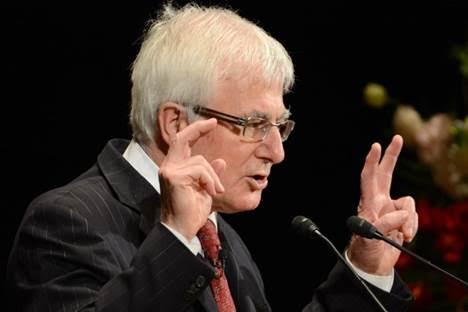
Diplomatic Genius, Or Corporate Minion? From its humble origins as a modest New Zealand trade initiative, the TPPA has always been viewed by Tim Groser (above) as the Kiwi sprat to catch an American mackerel. New Zealand corporates just ain't that clever!
TIM GROSER may be a lot smarter than even his most fervent
supporters claim. It’s just possible that the Trans-Pacific Partnership
Agreement (TPPA) – as currently drafted – is the document he had in mind all
along. That, from its humble origins as a modest New Zealand trade initiative,
the TPPA was always viewed by Groser as the sprat to catch a giant USA mackerel.
With the benefit of hindsight, it is clear there was never the slightest chance that the United States was ever going to sit back and let a handful of small Pacific states set up a free-trade zone from which it was excluded. As a pretty shrewd geopolitician, Groser would also have realised that, as the US slowly disengaged from its military entanglements in the Middle East, there was a very high probability that its struggle with China in the Pacific – disrupted by 9/11 and all that it inspired – would be resumed.
A comprehensive free-trade agreement, including an
increasingly apprehensive Japan – but
excluding the Peoples Republic of China – was an obvious “next move” for
a United States determined to reassert its hegemony over the nations of the
Pacific Rim. It was also an obvious “next move” for New Zealand, whose economic
fortunes were, to a potentially dangerous degree, becoming entwined with those
of its principal protector’s principal rival.
The plausibility of this argument depends entirely on how skilled
at playing geopolitical chess you are willing to believe this country’s
diplomats and trade envoys truly are.
Who was it, for example, who initiated the process which led
to the New Zealand-China Free Trade Agreement (FTA): New Zealand or China?
This country’s preference, for at least the past two
decades, has been an FTA with the United States. Was it the latter’s refusal to
negotiate seriously (i.e. to commit to the liberalisation of its agricultural
sector) that persuaded the Ministry of Foreign Affairs and Trade (MFAT) to
focus its attention, instead, on the Chinese? Because, in addition to boosting
our exports, the New Zealand-China FTA also provided our diplomats with the precious
bonus of just a little leverage vis-à-vis
our “very, very, very good” friends in Washington. Groser, himself, is at pains
to reassure anybody who asks, that should the TPPA negotiations fall through,
New Zealand will not be left without options. Sceptics are invited to ponder
the significance of New Zealand’s early decision to join the Chinese-initiated
Asian Infrastructure Investment Bank.
Could Tim Groser and his colleagues at MFAT really be so
smart? Is it possible that, sometime in the next few days, New Zealand will put
its signature to a document that gives its key exporters the best of both
worlds? Not only a vastly rewarding economic relationship with the second most
powerful economic entity on the planet; but also the long-sought and
much-desired prize of a free-trade agreement with the world’s mightiest nation?
Well, yes, it is possible. And, if it happens, Tim Groser’s much anticipated
appointment as this country’s next ambassador to the United States will have
been well-earned.
From Washington, Groser will be supremely well-positioned to
judge just how serious the developing struggle between the US Eagle and Chinese
Dragon has become. With the TPPA in place, he will, of course, be free to
choose between these two heraldic beasts. Free access for New Zealand’s
agricultural exports to all the markets of the Pacific Rim – especially those
of the USA, Canada and Japan – will mean that if push eventually comes to shove,
New Zealand’s economic eggs will not be concentrated in the basket labelled
“Made in China”.
A Peoples Republic of China beset by crashing stock markets
and a rapidly slowing pace of economic growth will soon be faced with even
greater difficulties. Constant economic expansion has been utterly crucial to
the Communist Party of China’s ability to keep its population, if not happy,
then at least quiescent. Mass unemployment, sharpened by the mass
impoverishment of China’s rural and urban stock market investors, could very
easily panic China’s leaders into a series of ultra-nationalist distractions in
the South China Sea or along the Sino-Indian border. Very quickly, having all
our economic (and most of our diplomatic) eggs in a single Chinese basket could
prove to be very awkward.
Many New Zealanders are fearful of the TPPA. They worry about
the future of Pharmac and are alarmed at the prospect of becoming enmeshed in
the coils of the Investor State Dispute Settlement process. While these are by
no means insignificant issues, there are much greater dangers out there that we
would be most unwise to ignore. Looking back, we may yet have cause to feel
relieved that the TPPA was wound up in July-August 2015. And even those on the
left of New Zealand politics may feel just a little bit thankful that Tim
Groser was where he was, when he was.
This essay was
originally posted on The Daily Blog
of Wednesday, 29 July 2015.
