Showing posts with label NZ-USA Relationship. Show all posts

Thursday, 11 June 2020

Taking Back Our Eyes.

Seeing For Ourselves: If remaining in the Anglo-Saxon alliance means embracing a far-right version of populism already indistinguishable from incipient fascism; if it requires New Zealand to join its “allies” in repeating all the horrors of Anglo-Capitalism’s imperial past; then we must have nothing to do with it.

WHY IS AUSTRALIA so keen to bring the finance ministers of the “Five Eyes” together? Since when did the intelligence gathering and sharing arrangement launched nearly 70 years ago as the UK-USA Agreement start morphing into an economic and military alliance? More importantly, how long has Canberra been anticipating New Zealand’s participation in this transformation? Clearly, the promoters of what is looking more and more like ANZUS 2.0 are not particularly worried that such a policy would jeopardise our relationship with China. Indeed, alienating China from New Zealand may be one of the key objectives of the whole exercise.

Canberra clearly believes that if Beijing is ready to impose a heavy economic cost on  Australia for its unwavering allegiance to the United States, then Wellington, too, should be prepared to endure the lash of Chinese displeasure. And make no mistake, Canberra is paying a price. Its food exports to China are being impeded and the Chinese Government is warning its citizens to avoid visiting Australia on account of its deep-seated racial antagonism towards Asian peoples. This warning will damage not only the Australian tourist industry (already stricken thanks to Covid-19) but it will also choke off the multi-billion-dollar flow of Chinese fee-paying students to Australia’s schools and universities.

These are merely the preliminaries, however, should Australia persist in its determination to be the best deputy-sheriff Uncle Sam has ever had. New Zealanders often express concern at their own country’s growing economic dependence on the Chinese market. Our economic vulnerability pales, however, when set alongside the Australian mining industry’s reliance on China’s apparently insatiable appetite for the Lucky Country’s mineral exports. A full-scale boycott of Australian coal, copper, bauxite and iron-ore would plunge the Australian economy into an even deeper recession.

What reward is Canberra hoping to receive in return for jeopardising its economic future? Why is it so keen to take up such an exposed position in the “New Cold War” which is fast intensifying between the Peoples Republic and the so-called “Quad States” – the USA, Japan, Australia and India? Has the rise and rise of China awakened all the old atavistic Australian fears of the “Yellow Peril”? The existential fears which fuelled the frankly racist “White Australia Policy” which lasted from federation in 1901 until well into the 1970s. And if that is the driving force behind Canberra’s reckless willingness to put at risk Australia’s own vital economic interests, then how does it expect the USA to make good the loss of its Chinese buyers?

The crucial feature of a declining power is its diminishing capacity to offer a credible quid pro quo for its friends’ and allies’ loyalty.

Why was New Zealand (a nation of barely one million in 1914) prepared to sacrifice upwards of 12,000 of its young sons for the greater glory of the British Empire in World War I? The cynical answer: because the primary produce importers on London’s Tooley Street were willing to take everything Britain’s South Seas “farm” could send them. Not to put too fine a point upon it, we traded blood for butter. A Devil’s bargain, no doubt, but a profitable one!

Is Canberra labouring under the illusion that the USA will absorb all its vital mineral exports should China decline to receive them? Does the Australian Government really believe that America’s own mining industry is just going to sit back and let Australian imports flood their markets and drive down their prices? The United States is a mature, almost post-industrial, capitalist economy. It passed through the phase through which China is currently passing more than a century ago. Australia’s much-vaunted “luck” stems from it being handsomely endowed and strategically located to supply the needs of a rapidly industrialising Asia. Overwhelmingly, for the last 40 years, that has meant China. What has Washington told Canberra about the region’s geopolitical future that has made Australian politicians so willing to court the ire of Beijing. What does Scotty Morrison know that we don’t?

The name of the “Quad’s” new geopolitical initiative, the “Indo-Pacific Strategy”, offers a pretty big clue. Simply recall that, until very recently, all the talk among the Five Eyes and their allies was about their “Asia-Pacific Strategy”. The shift in focus, from East to South Asia, from China to India, points to the overall direction of travel of Anglo-Capitalism in the twenty-first century. With China stubbornly refusing to follow the same path as the Soviet Union; with Tibet, Xinjiang, Hong Kong and Taiwan significantly failing to replicate the fates of Ukraine, Georgia, the “stans” and the Baltic states; with Beijing forging ahead to reclaim its historical primacy in the region; the time has apparently arrived for the Five Eyes powers to sink their talons into yet another vast population of peasants. For India, what came around in the seventeenth century is about to come around again.

The politics required for the Five Eyes powers to pull this off isn’t pretty.

Remember the BRIC countries? (Brazil, Russia, India and China) Remember the Anglo-capitalists’ alarm at the emergence of a bloc determined to step out of the shadow of its individual members’ tragic histories? Where are they now? Brazil and India – like the USA and the UK – are (mis)ruled by far-right populists hellbent on leading their people back into the steely embrace of the imperialists. The survivors, China and Russia, are now – according to the Five Eyes powers – Public Enemies 1 and 2.

And so, at last, we can answer the question of why the Australians are so determined to ensure that every last one of the Five Eyes are on the same economic (i.e. ideological) page. Why it is so important that no one (and, yes, they’re looking at you Jacinda and Grant) breaks ranks by declining to see China as an enemy. How vital it is that no member state draw attention to the fact that the planet cannot possibly sustain the massive carbon investment required to turn India into another China.

It was the “Asia-Pacific Strategy” that fouled the lungs of Planet Earth. The “Indo-Pacific Strategy” threatens to bring on a fever that will stop her heart.

We should inform Canberra, Washington, Ottawa and London that we are taking back our eyes – the better to find and follow an independent foreign policy path. If remaining in the Anglo-Saxon alliance means embracing a far-right version of populism already indistinguishable from incipient fascism; if it requires New Zealand to join its “allies” in repeating all the horrors of Anglo-Capitalism’s imperial past; then we must have nothing to do with it.

This essay was originally posted on The Daily Blog of Thursday, 11 June 2020.

Friday, 15 March 2019

New Zealand's Current Foreign Policy: An Absence Of Realism.

What Are You trying To Say? The contrast between Helen Clark’s stewardship of New Zealand foreign policy and Jacinda Ardern’s is stark. Ardern’s generation, raised in the shadow of Rogernomics, has never evinced the same strong interest in international issues that characterised the Baby Boomers. The USA had won the Cold War, leaving neoliberal capitalism in command of the planet. Taking issue with this new status quo could be seriously career-limiting. With Ardern, it’s not quite a matter of “where Uncle Sam goes, we go” – but it’s close.

NOWHERE is the difference between Helen Clark and Jacinda Ardern more apparent than in the field of foreign policy.

Clark’s induction to left-wing politics came, as it did for so many of her generation, from New Zealand’s interactions with the rest of the world.

Be it this country’s relationship with the United States, France or South Africa, there was never any shortage of deficiencies to be challenged and (hopefully) overcome. The Vietnam War, Atmospheric Nuclear Testing, Apartheid: these were the issues that mobilised thousands of young New Zealanders – and Labour was on the right side of them all.

For those, like Clark, who were driven to do more than protest, serious engagement with foreign policy issues required a high degree of intellectual and political discipline. If one’s intention was to do more than shout slogans and wave placards, then the facts had to be mastered and the arguments, both for and against, understood. Without the ability to make a case, and defend it, the chances of being heard by those with the power to effect change were negligible.

What was sauce for the goose of foreign policy was, of course, also sauce for the gander of domestic policy. Mastering the art of the possible in relation to the former pretty much guaranteed equal mastery with respect to the latter. More importantly, Clark soon realised than in a small trading nation tucked away at the bottom of the planet, building and maintaining strong and mutually advantageous relationships with the rest of the world was absolutely crucial to the preservation of national prosperity.

It was an insight which propelled Clark towards the “realist” school of international relations pioneered by Hans Morgenthau. At the heart of Morgenthau’s realism was his belief that the relationships between countries should be guided by an assessment of the power each is able to bring to the task of advancing and defending their national interests. Ethical considerations are not irrelevant to this sort of calculation, but neither are they pivotal. In Morgenthau’s opinion: “A good foreign policy minimizes risks and maximizes benefits.”

Clark’s realism proved highly effective in advancing New Zealand’s national interest. She earned the respect of four-fifths of humanity by declining to join in the USA’s illegal invasion of Iraq in 2003. More impressively, she persuaded the Chinese to put their trust in New Zealand, and thus became the first western leader to negotiate a free trade agreement with the People’s Republic.

The contrast between Clark’s stewardship of New Zealand foreign policy and Ardern’s is stark. Ardern’s generation, raised in the shadow of Rogernomics, has never evinced the same strong interest in international issues that characterised the Baby Boomers. The USA had won the Cold War, leaving neoliberal capitalism in command of the planet. Taking issue with this new status quo could be seriously career-limiting. With Ardern, it’s not quite a matter of “where Uncle Sam goes, we go” – but it’s close.

This is a long way from Morgenthau’s realism. Absent from New Zealand’s current foreign policy is the constant and careful calculation of precisely how much diplomatic power is available to us at any given moment for the advancement of our national interest.

The Foreign Minister, Winston Peters, apparently on his own recognisance, has signed New Zealand up holus-bolus to the USA’s new “Indo-Pacific” strategy. In the process he has gratuitously breached the trust upon which New Zealand’s immensely valuable economic relationship with China rests. He did not see fit to consult his Prime Minister about this radical realignment – and, by all accounts, she saw no reason to object.

Quite what Clark makes of the unholy mess Peters has made of her carefully balanced foreign policy can only be imagined. When the pressure is applied: from Canberra, London, Washington or Beijing; the Foreign Minister is suddenly nowhere to be found. Leaving his hapless Prime Minister to follow the line of least diplomatic resistance. Towards Washington one day. Towards Beijing the next.

From the point of view of the two largest powers on New Zealand’s dance card, squeezing the Kiwis makes perfect sense. If a nation reveals itself to be vulnerable to pressure, then pressure will be applied.

Ardern has led New Zealand into the very predicament Clark worked so hard to keep us out of: caught between an American rock and a Chinese hard place.

This essay was originally published in The Otago Daily Times and The Greymouth Star of Friday, 15 March 2019.

Tuesday, 28 November 2017

When Five Million Seems Like A Very Small Number.

Divided Loyalties: When it comes to settling on a Twenty-First Century protector, New Zealand faces a dilemma. The United States provides military protection, but refuses to offer economic security. China provides economic security, but cannot (for the moment) offer military protection. Neither power is likely to go on contributing the ‘missing half’ of a complete protection package indefinitely.

NEW ZEALAND is a tiny nation living in a big country. It’s one of those mind-boggling facts that in an island roughly the same size as New Zealand’s two largest islands combined, the United Kingdom somehow manages to squeeze-in 66 million human-beings. Greater London, alone, packs twice New Zealand’s entire population into an area smaller than Stewart Island. In the greater scheme of things, Planet Earth’s roughly five million New Zealanders don’t count for much: not in the eyes of the other 7.6 billion human-beings who share it with them.

Given its tiny population, how should New Zealand position itself vis-à-vis the rest of the world? How does it deal with the all-too-obvious discrepancy between its landmass and its population?

This is not a trick question. As Maori discovered in the Nineteenth Century: a large pair of islands, located comfortably in the southern hemisphere’s temperate zone, and peopled by (at most) 150,000 human-beings; is simply too-tempting a prize for the world’s predator nations to ignore. Had the tribes not signed-up with the British, chances are they’d have signed-on with the French.

From a strategic perspective, the Maori decision to place themselves under the protection of what was then the world’s most powerful state makes perfect sense. That their faith in the British Government’s promise to respect the manifold local sovereignties of hapu and iwi was misplaced is hardly their fault! Even after the military defeat and economic marginalisation of New Zealand’s indigenous population, however, the Waitangi signatories’ original strategic insight remains unimpeachable. Two relatively large, but thinly-populated islands, located at the bottom of the world, will always be in need of at least one unanswerably powerful friend.

Unfortunately, that sort of protection comes at a price. (As any victim of the New York Mafia will attest!) And, Dear God! New Zealand has paid dearly! For keeping the sea-lanes open to the endless circuit of refrigerated vessels transporting this country’s lamb, wool, butter and cheese to the port cities of the British Isles, the “Mother Country” siphoned-off a small lake of New Zealand blood.

Less visceral, but arguably even more debilitating, was the oppressive cultural straight-jacket into which the United Kingdom fastened its most loyal dominion. All the worst features of British imperialism: its deeply ingrained class prejudices; the complacent avarice of its monied elites; and, most damaging of all, the Empire’s indefatigable racism; left deep scars on New Zealand’s collective psyche. More than a century after the signing of the Treaty of Waitangi, and notwithstanding the tragic losses of two world wars, New Zealanders – Maori as well as Pakeha – could still be reduced to obsequious delirium by the mere physical presence of the reigning British monarch.

There was, however, no disputing the fact that Britain’s imperial sun was setting. If New Zealand was to remain safe, it would require a more credible protector than the over-extended empire whose power-projection pretentions were sent to the bottom of the South China Sea in December 1941.

The United States’ rise to super-power status during World War II, when combined with the UK’s demise as a global player, unleashed a cultural revolution in far-off New Zealand. The official egalitarianism of the American republic, especially when combined with the raw energy of its artistic output – its music and cinema particularly – armed the USA with a historically unprecedented amount of “soft-power”. Though Kiwis have been slow to admit it, the emancipation of their cultural imagination owes an enormous debt of gratitude to their American protector.

New Zealand’s strategic dilemma in the Twenty-First Century arises out of two historically related developments. The first was Deng Xiaoping’s decision to pursue “Socialism with Chinese Characteristics” – basically, his Communist Party’s re-invention of traditional Chinese mercantilism. The second, the “Reagan Revolution’s” triumph over Rooseveltian progressivism in the 1980s. This brought about a qualitative change in the character of American soft power. It was a change which many New Zealanders found unpalatable – even frightening.

As the consequences of these two historical shifts worked their way through New Zealand’s economy and society, the maintenance of a coherent foreign policy became increasingly difficult. Economically, New Zealand is oriented firmly towards its crucial Chinese markets. Culturally, diplomatically and militarily, however, the ties that bind remain American. The challenge confronting successive New Zealand governments has been how to reconcile Washington’s insistence that New Zealand remain a US protectorate, while simultaneously refusing to guarantee its economic security.

When it comes to settling on a Twenty-First Century protector, therefore, New Zealand faces a dilemma. The United States provides military protection, but refuses to offer economic security. China provides economic security, but cannot (for the moment) offer military protection. Neither power is likely to go on contributing the ‘missing half’ of a complete protection package indefinitely.

There are times when five million seems like a very small number indeed.


This essay was originally published in The Press of Tuesday, 28 November 2017.

Thursday, 5 January 2017

2017: In The Shadow Of Trump

A Shadow Across The Sun: A key factor driving the New Zealand electorate’s probable flight to the right in 2017 will be the profound and ideologically toxic influence of Donald Trump’s presidency.
 
THE POLITICAL CONSENSUS, at the beginning of 2017 – election year – is that the National-led Government will hold on to power. Not in its own right, as might have happened had John Key led them into battle, but with sufficient parliamentary support to govern comfortably. The identity and character of National’s support will likely prove the most intriguing electoral story of the year. The most significant political event of 2017, however, could well be the collapse of the Labour Party and the emergence of the Greens as New Zealand’s leading party of the centre-left.
 
A key factor driving the New Zealand electorate’s flight to the right will be the profound and ideologically toxic influence of Donald Trump’s presidency. Nobel economics laureate, Paul Krugman, predicts a global trade war, and the prestigious Foreign Policy magazine is filled with disquieting articles foreshadowing an ominous deterioration in the relationship between the USA and China.
 
If either of these predictions come to pass, then the consequences for the New Zealand economy will be extremely serious. Both the Chinese and the American governments will expect their “friends” to stand by them in any test of geopolitical strength. Initially, Foreign Minister Murray McCully will strive to retain the good will of both this country’s leading export market and its principal defence guarantor. But, if push comes to shove, he will come under enormous pressure from both Washington and Canberra to declare for the “auld alliance”. The Foreign Minister may conclude that he has no choice but to recommend to Prime Minister Bill English that we let go of China’s hand – with all that portends for New Zealand’s primary industries.
 
It’s a scenario which can only make the already strong electoral challenge of NZ First even stronger. The provinces will suffer most if the NZ-China economic connection falters and the voters most affected: farmers and the agricultural servicing sector; will be looking for someone to blame. Inevitably, the government will be criticised, but by far the largest share of the blame will be directed towards the government of the Chinese people. This rapidly-developing, racially-charged, crisis will be Winston Peters’ opportunity.
 
In a neat division of political labour, NZ First will lead the attack on China while, publicly, National condemns (but not too loudly) Peters’ racially-charged rhetoric. Meanwhile, privately, the conservative supporters of both parties will be encouraged to recognise the inherent electoral synergies of the unfolding crisis. As the countdown to the election shortens, the prospect of a National-NZ First coalition government will begin to acquire the aura of inevitability.
 
Amplifying the conservative message among the Maori electorate, the Maori Party will cast the Chinese as a second-wave of colonisers threatening not only tino rangatiratanga but also Pakeha sovereignty. Iwi corporations will be portrayed as the foundation stones of Aotearoa/New Zealand’s economic independence. The incipient government of the centre-right will thus be presented as a National-NZ First-Maori Party alliance.
 
The turmoil created by the Trump Administration will similarly throw into sharp relief the serious disjunction between the beliefs of the Labour Party and its electoral base. Even if Andrew Little and his advisors were of a mind to join with Peters in attacking China, the reflexive anti-Americanism of his caucus and Labour’s wider membership would drive the party inexorably towards their enemy’s enemy. Immediately, what was left of Labour’s support among “Waitakere Men” would decamp for the Sinophobic right.
 
The reverse manoeuvre: in which Little prevails upon caucus and party to follow National, NZ First and the Maori Party into Trumpism and Sinophobia; would only drive Labour’s younger, more progressive, voters towards the Greens. The classic Labour solution – trying to have a bob each way – risks losing both the conservative and the progressive components of its electoral base.
 
The extreme-nationalist complexion of the Trump Administration and its geopolitical focus on the burgeoning power of China can only hasten the disintegration of Labour’s electoral position. The party’s embrace of globalisation and free-market ideas in the 1980s, by hollowing-out the traditional working-class communities from which it drew its most consistent support, made Labour ever more dependent on the support of well-educated middle-class baby-boomers. But, as these voters have aged, their progressive instincts have shrivelled. Increasingly, the banners of the left are being carried by younger voters – the Chloe Swarbrick generation.
 
It is, however, highly doubtful that sufficient young people will participate in the 2017 general election to significantly offset the emotionally powerful appeal of an unabashedly nationalistic, Sinophobic and pro-American coalition of National, NZ First and the Maori Party. Neither conservative fish, nor progressive fowl, Labour is likely to see its party vote plummet into the teens – and with it any hope of reclaiming major party status. The baton of progressive politics will pass to the Greens. Real political power, however, will remain with the National Party and its allies.
 
This essay was originally published in The Press of Tuesday, 3 January 2017.

Thursday, 17 November 2016

Is This The Right Time To Protest Against An American Warship?

Bearing Witness: Hemmed in by police and sneered at by an unsympathetic news media as “the usual left-wing suspects”, the viaduct protesters view of themselves as a prophetic minority bearing witness against a corrupt and violent world will undoubtedly be reinforced. Their hearts and minds will remain pure.
 
DOES THIS MORNING’S PROTEST* outside the Viaduct Events Centre advance or retard the progressive cause in New Zealand? Some would say that bearing witness against the horrors of war and calling to account arms manufacturers is, unquestionably, a good thing to do. Others would argue that this is a quasi-religious position which takes no account of public opinion and is, therefore, both apolitical and unhelpful.
 
At the heart of the debate lie two very different assessments of what politics is about. The first views society as both corrupt and irredeemable: ruined by humanity’s predisposition towards greed and violence. That being the case, it behoves every individual strong enough to resist these twin evils to encourage as many others as possible to do likewise. In other words: politics is not about you changing the world; it’s about striving to prevent the world from changing you.
 
It’s a view of politics which encourages its adherents to divide humanity into those who “get” how corrupted the world has become, and those who don’t. And because the latter almost always outnumber the former, the ability of democracy to deliver meaningful change is questioned. In a world where greed and violence are accepted as the prime drivers of human affairs, isn’t it more likely that democracy will end up entrenching, rather than eradicating, these evils? And if that’s true (and doesn’t the election of Donald Trump prove it?) then attempting to influence public opinion is a waste of time.
 
Opposing this view are those who see humanity as being neither wholly corrupt, not wholly irredeemable. Yes, greed and violence occupy a distressingly prominent place in the conduct of human affairs, but they are very far from being the only impulses that drive us. Human-beings are also motivated by generosity, solidarity and compassion. The history of human civilisation is, essentially, a record of the struggle between our worst impulses and our best.
 
The key arbiter in this endless struggle between selfishness and altruism, violence and compassion, is human reason. Without a belief in humanity’s capacity to be moved by rational argument, politics – especially democratic and progressive politics – makes absolutely no sense.
 
Which is why, faced with poll results indicating that a very substantial majority of New Zealanders are positive about the rapprochement between their country and the United States, reasonable progressives would have been disinclined to organise a protest against the participation of a US destroyer in the New Zealand Navy’s 75th anniversary celebrations.
 
That disinclination would have been vindicated entirely by the events of the past few days. Far from being seen as a symbol of American imperialism, the USS Sampson – now on its way to assist earthquake victims stranded in Kaikoura – is being welcomed by the vast majority of New Zealanders as a symbol of American friendship and solidarity.
 
Those same New Zealanders are unlikely to look with any sympathy upon this morning’s protest action on the Auckland waterfront, and the core messages of the protesters themselves are unlikely to be received. Indeed, they are almost certain to be misinterpreted and/or disregarded.
 
Hemmed in by police and sneered at by an unsympathetic news media as “the usual left-wing suspects”, the viaduct protesters view of themselves as a prophetic minority bearing witness against a corrupt and violent world will undoubtedly be reinforced. Their hearts and minds will remain pure.
 
Unfortunately, the hearts and minds of the rest of us will remain unwon.
 
* Wednesday, 16 November 2016.
 
This essay was originally posted on The Daily Blog of Wednesday, 16 November 2016.

Tuesday, 3 November 2015

Between A Rock And A Hard Place.

Difficult Decisions Ahead: New Zealand cannot endorse Obama’s gunboat diplomacy in the South China Sea without antagonising its largest trading partner. Hence, Defence Minister Gerry Brownlee’s description of China as a “true strategic partner”, and his announcement that Kiwi troops will train alongside the Peoples Liberation Army. This both-sides-against-the-middle approach to building strategic security may end up dwarfing the consequences of the anti-nuclear policy.
 
MANY NEW ZEALANDERS would be surprised to learn that their government considers the Peoples Republic of China a “true strategic partner”.  Most of us have come to terms with the fact that China is our largest trading partner – but a “true strategic partner”? Strategic partnerships are the stuff of geopolitics: they’re about the nation’s fundamental interests; its oldest loyalties. When something’s wrong in your neighbourhood, who ya gonna call?
 
Up until the Japanese sinking of the British warships Repulse and Prince of Wales in 1941, New Zealand’s “true strategic partner” had been Britain. New Zealand had been a British colony since 1840, and a Dominion since 1907. At the outbreak of war in 1939, New Zealand’s foreign policy was memorably summed-up by Prime Minister, Michael Joseph Savage, when he stated simply: “Where Britain stands, we stand. Where she goes, we go.”
 
And go we did. Not even the Japanese attack on Pearl Harbour and her armies lightning advance into the Pacific and South-East Asia was sufficient to persuade the New Zealand Government to bring her only effective military forces home from North Africa. The Australians were not so selfless. With Darwin in flames, and Emperor Hirohito’s forces advancing across New Guinea, Prime Minister Curtin recalled his troops to defend the Australian continent. He, at least, understood that, in geopolitical terms, Australasia’s “true strategic partner” was no longer Britain, but the United States of America.
 
By 1951 that partnership had taken the form of the Australian, New Zealand, United States (ANZUS) Agreement. Diplomatically and militarily, the ANZUS alliance spoke eloquently of the new strategic realities inside the Pacific rim. While sentiment, and London’s fading dreams of empire, may have persuaded many Kiwis to persist in calling Britain “home”, it was to Washington that her senior soldiers and diplomats turned – not only for protection, but also for guidance.
 
And that was the way the story went for the best part of thirty years, until, as we all know, it fell apart amidst New Zealanders’ determination to make, and keep, their country nuclear-free. Needless to say it wasn’t an outcome with which the country’s senior defence force personnel, diplomats and public servants were at all comfortable. As far as they were concerned, New Zealand’s need for a “true strategic partner” had grown more, not less, acute. The Chinese giant was waking up. South America was outgrowing its dictators. Absent her true strategic partners, New Zealand was extremely vulnerable.
 
Their problem was that, in the eyes of those partners, New Zealand’s anti-nuclear policy constituted a massive rock in the road to a full restoration of the strategic relationship. And that wouldn’t happen, said Washington and Canberra, until the obstacle was removed. In vain did the NZ defence Force and MFAT protest that removing the obstacle was politically impossible. With both the Labour and National parties committed to a nuclear-free New Zealand, that wretched rock wasn’t going anywhere.
 
New Zealand diplomats had no other option except to come up with their own solution to the problem of how to restore the Washington, Canberra, Wellington relationship. In the end, MFAT and the NZDF decided that if they couldn’t remove the rock, or go through the rock, then they would simply have to go around the rock.
 
As a way out of the impasse it was nothing short of brilliant. By quietly cutting a narrow track on both sides of the rock, and then widening it, laying down shingle, and, finally, sealing it over, the rock was gradually reduced to one of those landmarks that everybody passes by without really noticing. Washington and Canberra hadn’t changed their position on the undesirability of the rock, but now, with the encouragement of successive New Zealand governments, they were simply invited to ignore it. The signing of the Wellington Declaration in November 2010, while not formally restoring New Zealand to the status of an American “ally”, did describe her as the United States’ “partner” in the Pacific. It was a remarkable diplomatic breakthrough.
 
Rapprochement with the USA did not, however, leave New Zealand suddenly bereft of rocks in the road. Determined to check the Peoples Republic’s rising global influence, President Barack Obama “pivoted” away from the Middle East and back towards the Pacific, where he’s currently flexing American muscle in the South China Sea. America’s Pacific “partners” will be expected to join in.
 
New Zealand cannot, however, endorse Obama’s gunboat diplomacy without antagonising its largest trading partner. Hence, Defence Minister Gerry Brownlee’s description of China as a “true strategic partner”, and his announcement that Kiwi troops will train alongside the Peoples Liberation Army. This both-sides-against-the-middle approach to building strategic security threatens to dwarf the consequences of the anti-nuclear policy.
 
Somehow, New Zealand has to avoid catching itself between this latest rock in the road and a very hard place indeed.
 
This essay was originally published in The Press of Tuesday, 3 November 2015.

Thursday, 30 July 2015

How Smart Is Tim Groser? Will We End Up Panning Or Praising New Zealand's Trade Minister?

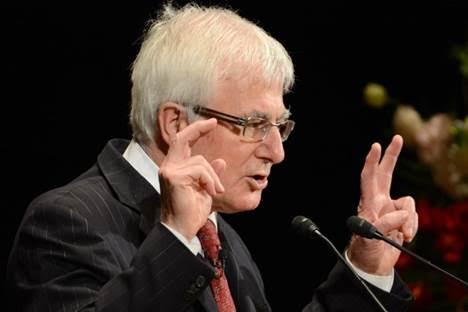
Diplomatic Genius, Or Corporate Minion? From its humble origins as a modest New Zealand trade initiative, the TPPA has always been viewed by Tim Groser (above) as the Kiwi sprat to catch an American mackerel. New Zealand corporates just ain't that clever!
 
TIM GROSER may be a lot smarter than even his most fervent supporters claim. It’s just possible that the Trans-Pacific Partnership Agreement (TPPA) – as currently drafted – is the document he had in mind all along. That, from its humble origins as a modest New Zealand trade initiative, the TPPA was always viewed by Groser as the sprat to catch a giant USA mackerel.

With the benefit of hindsight, it is clear there was never the slightest chance that the United States was ever going to sit back and let a handful of small Pacific states set up a free-trade zone from which it was excluded. As a pretty shrewd geopolitician, Groser would also have realised that, as the US slowly disengaged from its military entanglements in the Middle East, there was a very high probability that its struggle with China in the Pacific – disrupted by 9/11 and all that it inspired – would be resumed.

A comprehensive free-trade agreement, including an increasingly apprehensive Japan – but  excluding the Peoples Republic of China – was an obvious “next move” for a United States determined to reassert its hegemony over the nations of the Pacific Rim. It was also an obvious “next move” for New Zealand, whose economic fortunes were, to a potentially dangerous degree, becoming entwined with those of its principal protector’s principal rival.
 
The plausibility of this argument depends entirely on how skilled at playing geopolitical chess you are willing to believe this country’s diplomats and trade envoys truly are.
 
Who was it, for example, who initiated the process which led to the New Zealand-China Free Trade Agreement (FTA): New Zealand or China?
 
This country’s preference, for at least the past two decades, has been an FTA with the United States. Was it the latter’s refusal to negotiate seriously (i.e. to commit to the liberalisation of its agricultural sector) that persuaded the Ministry of Foreign Affairs and Trade (MFAT) to focus its attention, instead, on the Chinese? Because, in addition to boosting our exports, the New Zealand-China FTA also provided our diplomats with the precious bonus of just a little leverage vis-à-vis our “very, very, very good” friends in Washington. Groser, himself, is at pains to reassure anybody who asks, that should the TPPA negotiations fall through, New Zealand will not be left without options. Sceptics are invited to ponder the significance of New Zealand’s early decision to join the Chinese-initiated Asian Infrastructure Investment Bank.
 
Could Tim Groser and his colleagues at MFAT really be so smart? Is it possible that, sometime in the next few days, New Zealand will put its signature to a document that gives its key exporters the best of both worlds? Not only a vastly rewarding economic relationship with the second most powerful economic entity on the planet; but also the long-sought and much-desired prize of a free-trade agreement with the world’s mightiest nation? Well, yes, it is possible. And, if it happens, Tim Groser’s much anticipated appointment as this country’s next ambassador to the United States will have been well-earned.
 
From Washington, Groser will be supremely well-positioned to judge just how serious the developing struggle between the US Eagle and Chinese Dragon has become. With the TPPA in place, he will, of course, be free to choose between these two heraldic beasts. Free access for New Zealand’s agricultural exports to all the markets of the Pacific Rim – especially those of the USA, Canada and Japan – will mean that if push eventually comes to shove, New Zealand’s economic eggs will not be concentrated in the basket labelled “Made in China”.
 
A Peoples Republic of China beset by crashing stock markets and a rapidly slowing pace of economic growth will soon be faced with even greater difficulties. Constant economic expansion has been utterly crucial to the Communist Party of China’s ability to keep its population, if not happy, then at least quiescent. Mass unemployment, sharpened by the mass impoverishment of China’s rural and urban stock market investors, could very easily panic China’s leaders into a series of ultra-nationalist distractions in the South China Sea or along the Sino-Indian border. Very quickly, having all our economic (and most of our diplomatic) eggs in a single Chinese basket could prove to be very awkward.
 
Many New Zealanders are fearful of the TPPA. They worry about the future of Pharmac and are alarmed at the prospect of becoming enmeshed in the coils of the Investor State Dispute Settlement process. While these are by no means insignificant issues, there are much greater dangers out there that we would be most unwise to ignore. Looking back, we may yet have cause to feel relieved that the TPPA was wound up in July-August 2015. And even those on the left of New Zealand politics may feel just a little bit thankful that Tim Groser was where he was, when he was.
 
This essay was originally posted on The Daily Blog of Wednesday, 29 July 2015.

Tuesday, 17 March 2015

Empire Games: How Nicky Hager's Revelations Are Re-Shaping The Nationhood Debate.

The Anglo-Saxon Empire: As World War II ended the imperial baton passed from the United Kingdom to the United States. Bounding to Uncle Sam's side were the old empire's eager puppies - Canada, Australia and New Zealand. The current debate about the "Five Eyes" espionage network is in the process of morphing into a much broader debate about who New Zealanders are - and whom they should serve.
 
“I’M SENTIMENTAL – if you know what I mean – I love the country but I can’t stand the scene.” So sings Leonard Cohen in the final verse of his grand 1992 anthem “Democracy”. The country he’s singing about is, of course, the United States of America, and his conflicting feelings about the place are shared by millions of people around the world. There is a great deal to love about America and Americans, but there is, equally, a great deal that rest of the world, like Cohen, cannot stand.
 
The tragic human cost of US “diplomacy”. The vast powers wielded by what President Dwight Eisenhower dubbed the “military-industrial complex”. The evident inability of the “special interests” which now control the US Congress to any longer even recognise, let alone serve, America’s national interests. All of these political afflictions, combined, have created a “scene” to which no sane person (or nation) would pledge allegiance.
 
And yet that is exactly what the tight little political and journalistic clique clustering around John Key (like the doomed 300 at Thermopylae?) is demanding of New Zealanders. We are being told that, in spite of its manifest failings, the United States remains the last, best, hope of humanity, and that any person, or group, who dares to question the NZ-US relationship is guilty of something very close to treason.
 
Nicky Hager: Patriot.
 
The prime target of this latest thrust against the Key Government’s critics is Nicky Hager. No other journalist has so consistently – and accurately – mapped the moral fault-lines running through the NZ-US relationship. Whether it be the exposure of our own Government Communications Security Bureau’s unacknowledged participation in the US National Security Agency’s Echelon spy system in Secret Power (1996) or the NZ Defence Force’s unmandated determination to range itself alongside America in Other People’s Wars (2011) Hager’s investigative journalism has for the best part of 20 years undermined successive New Zealand governments’ attempts to remain a member in good standing of the Anglo-Saxon “club”.
 
It is worth taking a moment to consider what New Zealand, as a member of this 70-year-old club (the USA, the United Kingdom, Canada, Australia and New Zealand) has signed-up to.
 
Though these five states represent less than 7 percent of the world’s population, the USA and its four closest allies constitute the Earth’s most powerful military, economic and diplomatic combination. English-speaking, and still predominantly white, the Anglo-Saxon club holds the rest of humanity (overwhelmingly non-English-speaking and non-white) in its grip. The global reach of the so-called “Five Eyes” intelligence gathering apparatus is but one aspect of the Anglo-Saxons’ “full-spectrum dominance” of the planet and its peoples.
 
When we consider the extent to which these powers dominate the world’s key resources – especially oil, coal and iron-ore; when we add up the number of nations that, in one way or another, are beholden to them; when we recall that the US Dollar remains the world’s fiat currency; and when the five Anglo-Saxon nations’ ability to project decisive military resources to any point on the Earth’s surface is taken into account; are we not justified in discarding the word “club” and replacing it with the much more appropriate “empire”?
 
No one likes to hear it called that, of course. The world is supposed to have rid itself of empires in the years immediately following World War II. Ours is a democratic age, and as every good historian knows, imperialism and democracy don’t mix. And yet, the behaviour of the five Anglo-Saxon powers, in the 70 years since the end of World War II, is difficult to characterise as anything other than imperialistic. If the “club” looks like an empire, speaks like an empire, and acts like an empire, then, chances are, it’s an empire.
 
Anglo-Saxon Imperialism: If it looks like an empire, speaks like an empire, and acts like an empire, then, chances are, it’s an empire. (Magnum photo by Philip Jones Griffiths)
 
The Prime Minister’s media defenders condemn Hager as “anti-American” because he has been able to correlate directly the strength of New Zealand’s military and intelligence ties to the United States with New Zealand’s loss of diplomatic independence. This would be dangerous enough in itself, but Hager’s revelations also help to remind New Zealanders of those occasions when their leaders had the courage to stand apart from the American-led Anglo-Saxon Empire. That Hager was an active player in the events that led to New Zealand declaring itself nuclear-free in the mid-1980s only sharpens the Right’s determination to blacken his reputation.
 
Indeed, it is becoming increasingly clear that New Zealand’s most senior and effective right-wing journalists are engaged in an attempt to fundamentally re-shape New Zealanders’ perceptions of the anti-nuclear movement. Rather than an expression of our growing sense of nationhood, they intend to re-cast it as the unfortunate result of a left-wing conspiracy to extricate New Zealand from the “Western Alliance” (also known as the Anglo-Saxon Empire). According to this revised history of the past 30 years, Kiwis have been duped by leftist radicals like Hager (and Helen Clark?) whose ultimate objective is to thrust New Zealand naked and alone into an increasingly dangerous world.
 
And to whom should this duped and defenceless New Zealand turn for protection? Why, Uncle Sam, of course! Hager’s revelations have upped the ante of the national independence debate and, in Poker parlance, the Right has opted to “see him” and “raise him”. The debate about New Zealand’s involvement in the Five Eyes alliance is, accordingly, being broadened out to embrace the much more vital questions of who we are and whom we should serve. Will New Zealand continue striving to become an independent South Pacific nation, or will it opt to remain a far-flung, but intensely loyal, province of the Anglo-Saxon Empire?
 
For those who love this country, but can’t stand the political scene, the stakes have never been higher.
 
This essay was posted on The Daily Blog and Bowalley Road blogsites on Tuesday, 17 March 2015.