Showing posts with label USA. Show all posts

Monday, 13 January 2020

Who’s Going To Stop Him?

Blank And Pitiless: Having ordered the assassination of the Iranian General, Qasem Soleimani, President Donald Trump promised to reduce the cultural monuments of Iran’s 3,000 year-old civilisation to rubble if a revenge attack was mounted. A breach of international law? Certainly. A war crime? Indisputably. Who’s going to stop him? Nobody.

WHAT WERE THEY thinking? Allowing angry crowds to storm the US Embassy in Baghdad? If such scenes were authorised by General Qasem Soleimani, then he was not the master strategist and tactician his countrymen are proclaiming him to have been. Believing an American president – any American president – could look upon such scenes with equanimity betrayed the most astonishing ignorance of recent US history.

The storming and capture of the American embassy in Tehran in 1979 set off 444 days of diplomatic and military humiliation that not only destroyed the presidency of Jimmy Carter, but also created a thirst for vengeance that not even the passage of 40 years has diminished. It matters little that Soleimani was instrumental in clearing the Baghdad embassy compound of demonstrators, simply by allowing such images to imprint themselves upon Donald Trump’s retinas, the General was guilty of the most enormous, and ultimately fatal, error of judgement.

Nor will the American President be in the slightest measure intimidated by the size of General Soleimani’s funeral procession, or by the promises of vengeance offered to his widow by Iran’s Supreme Leader, Ayatollah Ali Khamenei. Iran’s capacity to inflict harm on the American Empire is considerably less than Queen Boudica’s ability to make the Roman Empire pay for its outrages. The Roman Empire did not have an air force.

In some part of the Iranian Islamic Republic, the unanswerable character of American air power must, surely, be weighing heavily upon the judgements of its public servants and soldiers. A retaliatory strike against the United States that even remotely resembled the assassination of General Soleimani in terms of scale and significance would provoke the USA to, in the memorable quip of the late US Senator from Arizona, John McCain, “Bomb, bomb, bomb-bomb, Iran”.

The armed forces of the Islamic Republic of Iran have nothing with which to stop an American air attack. Its fighters are too old and its pilots insufficiently trained to take on the state-of-the-art aircraft, air-crews and missile technology of the United States. Everything the Iranians could throw at them would be effortlessly brushed aside by their American attackers. Not only that, but the very instruments of Iran’s self-defence would themselves be among the Americans’ first targets. They would not, however, be the last.

Having rendered Iran defenceless to American (and, almost certainly, Israeli and Saudi) attack, the list of targets would include (in no particular order) the country’s weapons factories, transportation systems, manufacturing enterprises, cement plants, water purification facilities, media networks, state ministries and scientific research centres – especially Iran’s nuclear research programme – pharmaceutical production plants and fertiliser factories. All of the above would be attacked even as Iran’s military and civilian command-and-control centres and all of its major cities were being pounded into dust.

President Donald Trump has further promised to reduce the cultural monuments of Iran’s 3,000 year-old civilisation to rubble if a revenge attack is mounted. A breach of international law? Certainly. A war crime? Indisputably. Who’s going to stop him? Nobody.

There are some who insist that Iran is not entirely helpless. That its little navy has developed weapons and tactics capable of sinking a US aircraft carrier with all hands. But, what then? The snuffing-out of 3,000 American lives in a single attack would, almost certainly, provoke the current American president into ordering a tactical nuclear response. Tehran, or if he was feeling particularly vindictive, the holy Shia city of Qom, would, in a split second, be transformed into a radioactive wasteland.

Impossible? No, sadly, it’s not. The rest of the world would certainly be shocked and horrified by such an act of disproportionate savagery. But, once again, who would/could stop an American president determined to demonstrate to the rest of humanity that America has been made great again – and will not be constrained by any power upon the face of the planet?

Still not convinced? Well, consider this. When 60 Minutes journalist, Lesley Stahl, put the following question to American Secretary of State, Madeline Albright in 1996: “We have heard that a half million [Iraqi] children have died. I mean, that’s more children than died in Hiroshima. And, you know, is the price worth it?” Albright replied:  “I think this is a very hard choice, but the price – we think the price is worth it.”

And she was a Democrat!

POSTSCRIPT: When assessing the actions and options of the Iranians it is always wise to recall that it was in their part of the world that the game of Chess was invented. To have avenged the death of General Soleimani without killing a single American (or any other human-being) has to be adjudged a truly inspired move. Forced into a duel by President Trump, Ayatollah Khamenei elected to fire his pistol harmlessly into the air. Honour is satisfied – and the world breathes again.

This essay was originally published in The Otago Daily Times and The Greymouth Star of Friday, 10 January 2020.

Friday, 22 January 2016

The Ultimate Guarantor.

Don't Mess With Me! The knowledge that a nation possesses nuclear weapons is usually enough to dissuade its enemies from launching any kind of attack or invasion. For those unfortunate states caught in the cross-hairs of the great powers, it is difficult to imagine a stronger incentive to risk everything on acquiring the ultimate guarantor of national independence.
 
WITH THE IMPORTANT EXCEPTION of Israel, no nation in possession of nuclear weapons has ever been invaded. It is difficult to conceive of a better incentive for any state threatened with aggression to risk everything for the deadly technology History has taught it to esteem as the ultimate guarantor of national independence.
 
Exactly how many nuclear weapons Israel possessed when she was attacked by her Arab neighbours in 1973 is unclear, but she certainly possessed some. Exactly how close she came to using them, however, remains even more historically hazy.
 
To the south, the Israelis had the buffer of the Sinai Peninsula in which to absorb Egypt’s thrust across the Suez Canal. In the north, however, the situation was much more fraught. Had the Israeli Defence Force not been able to halt the advance of Syria’s armoured columns in the first 72 hours of the Yom Kippur War, Prime Minister Golda Meir may have concluded that she had no choice except to threaten Damascus and Cairo with obliteration if hostilities were not halted immediately and their troops withdrawn.
 
In the deadly chess game that is nuclear strategy, the very possibility that Israel might feel obliged to make such a threat, required the United States to signal that a nuclear counter-threat against Israel, issued by the Soviet Union in defence of its Arab allies, would not be countenanced. That signal took the form of advancing the US armed forces to DEFCON 3 – a “Defence Condition” positioned just two perilously short steps away from Armageddon.
 
The Nearest Run Thing You Ever Saw: The Israeli PM, Golda Meir and her Defence Minister, Moshe Dyan, visit the Golan Heights in the hours following the Syrian army's thwarted attack. Had things gone differently, Israel's leaders would have been forced to threaten the use of its small stockpile of nuclear weapons.
 
Fortunately for the world, the Russians were not about to initiate World War III on behalf of Egypt and Syria. With the benefit of hindsight it is also clear that the mere possibility of an Israeli nuclear strike was sufficient for the leaders of Egypt and Syria to limit their military and diplomatic objectives to the restoration of Sinai and the Golan Heights, and the Israeli evacuation of the West Bank and Gaza.
 
In the light of these facts, the Israeli case is not as exceptional as it might, at first, appear. Even when they possessed the military resources to launch a war of annihilation against the State of Israel, the Egyptians and the Syrians dared not do so. No one doubts the willingness of the Jewish people to defend themselves against a second genocide with every weapon at their disposal – including Israel’s atomic bombs. Like the biblical hero Samson, Israel, in extremis, will not hesitate to bring down the Temple upon the heads of its enemies – even at the cost of being crushed itself.
 
These lessons in invulnerability were not lost on Israel’s middle-eastern neighbours. Does anyone seriously suppose that the United States and the United Kingdom would have launched a conventional invasion of Iraq if Saddam Hussein had possessed even a small stockpile of nuclear weapons? And is anyone truly surprised that the revolutionary government of the Islamic Republic of Iran very early on began diverting resources to what Israel and the United States were convinced was an all-out effort to create a nuclear arsenal?
 
That Iran has been persuaded to abandon its, geopolitically-speaking, extremely strategically destabilising nuclear-weapons programme, is not due entirely to the United Nations’ crippling economic sanctions. The Iranians have witnessed the exemplary fate of, first, the Iraqi, and then the Syrian, attempts to construct and operate a nuclear reactor capable of enriching Uranium and/or producing weapons-grade Plutonium.
 
The Israelis call it the “Begin Doctrine” – after Prime Minister Menachem Begin, who, in 1981, authorised a pre-emptive air-strike against Saddam Hussein’s nuclear reactor at Osirak. Begin described Osirak’s successful destruction as “anticipatory self-defence at its best”. In 2007 the Israelis did it again. “Operation Orchard” utterly destroyed the nuclear reactor constructed (with North Korean assistance) in the remote Deir ez-Zor region of Syria.
 
Although the Iranians took the precaution of locating most of their nuclear facilities deep underground, their military chiefs were never entirely convinced that the Israelis wouldn’t deploy tactical nuclear weapons to take them out. The bloodthirsty threats of Israel’s hard-line Prime Minister, Benjamin Netanyahu (whose bellicosity frightens even his own generals!) upped-the-ante still further. In 2015, sanctioned and intimidated, the Iranians finally abandoned their bid for the ultimate guarantor.
 
One question, however, remains. Does Israel’s acceptance of Iran’s diplomatic assurances have anything to do with Pakistan’s possession of nuclear weapons?
 
This essay was originally published in The Waikato Times, The Taranaki Daily News, The Timaru Herald, The Otago Daily Times and The Greymouth Star of Friday, 22 January 2016.

Tuesday, 17 March 2015

Empire Games: How Nicky Hager's Revelations Are Re-Shaping The Nationhood Debate.

The Anglo-Saxon Empire: As World War II ended the imperial baton passed from the United Kingdom to the United States. Bounding to Uncle Sam's side were the old empire's eager puppies - Canada, Australia and New Zealand. The current debate about the "Five Eyes" espionage network is in the process of morphing into a much broader debate about who New Zealanders are - and whom they should serve.
 
“I’M SENTIMENTAL – if you know what I mean – I love the country but I can’t stand the scene.” So sings Leonard Cohen in the final verse of his grand 1992 anthem “Democracy”. The country he’s singing about is, of course, the United States of America, and his conflicting feelings about the place are shared by millions of people around the world. There is a great deal to love about America and Americans, but there is, equally, a great deal that rest of the world, like Cohen, cannot stand.
 
The tragic human cost of US “diplomacy”. The vast powers wielded by what President Dwight Eisenhower dubbed the “military-industrial complex”. The evident inability of the “special interests” which now control the US Congress to any longer even recognise, let alone serve, America’s national interests. All of these political afflictions, combined, have created a “scene” to which no sane person (or nation) would pledge allegiance.
 
And yet that is exactly what the tight little political and journalistic clique clustering around John Key (like the doomed 300 at Thermopylae?) is demanding of New Zealanders. We are being told that, in spite of its manifest failings, the United States remains the last, best, hope of humanity, and that any person, or group, who dares to question the NZ-US relationship is guilty of something very close to treason.
 
Nicky Hager: Patriot.
 
The prime target of this latest thrust against the Key Government’s critics is Nicky Hager. No other journalist has so consistently – and accurately – mapped the moral fault-lines running through the NZ-US relationship. Whether it be the exposure of our own Government Communications Security Bureau’s unacknowledged participation in the US National Security Agency’s Echelon spy system in Secret Power (1996) or the NZ Defence Force’s unmandated determination to range itself alongside America in Other People’s Wars (2011) Hager’s investigative journalism has for the best part of 20 years undermined successive New Zealand governments’ attempts to remain a member in good standing of the Anglo-Saxon “club”.
 
It is worth taking a moment to consider what New Zealand, as a member of this 70-year-old club (the USA, the United Kingdom, Canada, Australia and New Zealand) has signed-up to.
 
Though these five states represent less than 7 percent of the world’s population, the USA and its four closest allies constitute the Earth’s most powerful military, economic and diplomatic combination. English-speaking, and still predominantly white, the Anglo-Saxon club holds the rest of humanity (overwhelmingly non-English-speaking and non-white) in its grip. The global reach of the so-called “Five Eyes” intelligence gathering apparatus is but one aspect of the Anglo-Saxons’ “full-spectrum dominance” of the planet and its peoples.
 
When we consider the extent to which these powers dominate the world’s key resources – especially oil, coal and iron-ore; when we add up the number of nations that, in one way or another, are beholden to them; when we recall that the US Dollar remains the world’s fiat currency; and when the five Anglo-Saxon nations’ ability to project decisive military resources to any point on the Earth’s surface is taken into account; are we not justified in discarding the word “club” and replacing it with the much more appropriate “empire”?
 
No one likes to hear it called that, of course. The world is supposed to have rid itself of empires in the years immediately following World War II. Ours is a democratic age, and as every good historian knows, imperialism and democracy don’t mix. And yet, the behaviour of the five Anglo-Saxon powers, in the 70 years since the end of World War II, is difficult to characterise as anything other than imperialistic. If the “club” looks like an empire, speaks like an empire, and acts like an empire, then, chances are, it’s an empire.
 
Anglo-Saxon Imperialism: If it looks like an empire, speaks like an empire, and acts like an empire, then, chances are, it’s an empire. (Magnum photo by Philip Jones Griffiths)
 
The Prime Minister’s media defenders condemn Hager as “anti-American” because he has been able to correlate directly the strength of New Zealand’s military and intelligence ties to the United States with New Zealand’s loss of diplomatic independence. This would be dangerous enough in itself, but Hager’s revelations also help to remind New Zealanders of those occasions when their leaders had the courage to stand apart from the American-led Anglo-Saxon Empire. That Hager was an active player in the events that led to New Zealand declaring itself nuclear-free in the mid-1980s only sharpens the Right’s determination to blacken his reputation.
 
Indeed, it is becoming increasingly clear that New Zealand’s most senior and effective right-wing journalists are engaged in an attempt to fundamentally re-shape New Zealanders’ perceptions of the anti-nuclear movement. Rather than an expression of our growing sense of nationhood, they intend to re-cast it as the unfortunate result of a left-wing conspiracy to extricate New Zealand from the “Western Alliance” (also known as the Anglo-Saxon Empire). According to this revised history of the past 30 years, Kiwis have been duped by leftist radicals like Hager (and Helen Clark?) whose ultimate objective is to thrust New Zealand naked and alone into an increasingly dangerous world.
 
And to whom should this duped and defenceless New Zealand turn for protection? Why, Uncle Sam, of course! Hager’s revelations have upped the ante of the national independence debate and, in Poker parlance, the Right has opted to “see him” and “raise him”. The debate about New Zealand’s involvement in the Five Eyes alliance is, accordingly, being broadened out to embrace the much more vital questions of who we are and whom we should serve. Will New Zealand continue striving to become an independent South Pacific nation, or will it opt to remain a far-flung, but intensely loyal, province of the Anglo-Saxon Empire?
 
For those who love this country, but can’t stand the political scene, the stakes have never been higher.
 
This essay was posted on The Daily Blog and Bowalley Road blogsites on Tuesday, 17 March 2015.

Friday, 27 February 2015

A Killing Joke: Halford Mackinder's Last Laugh

Defending The Heartland: Russian volunteers bar the eastward road to a US-installed Ukrainian government determined to derange the strategic equilibrium of Eastern Europe - even at the risk of igniting World War III.
 
IN THE CAPITAL CITIES of Europe, diplomats are sharing the following, rather grim, joke: It seems that Washington, having missed out on the beginning of World Wars I and II, is determined to be in right at the start of World War III.
 
No one in the European Union is laughing very loudly. The flames of war are already lighting-up Europe’s eastern horizon, and a fire in your neighbour’s house, if not extinguished quickly, can all-too-easily set your own ablaze.
 
Beneath the joke’s mildly anti-American punch-line lie a host of barely acknowledged European fears. For almost half-a-century after the end of World War II the nations of Europe were effectively relieved of the responsibility for formulating their own foreign policies. To the east, the nations of the Warsaw Pact followed Moscow’s lead. In the West the members of Nato allowed themselves to be guided by Washington.
 
With the fall of the Berlin Wall in 1989, and the collapse of the USSR two years later, that all changed. The collapse of the Soviet Empire allowed a huge power vacuum to develop between the eastern border of the newly re-united Germany and the western border of a Russian Federation shorn of territories formerly regarded as integral and indispensable to the Russian State.
 
Diplomacy, like nature, abhors a vacuum. The West was thus presented with some very difficult – but crucially important – choices. Would the United States and her European allies take advantage of Russia’s temporary weakness and extend Nato’s reach hundreds of kilometres to the east. Or, would they acknowledge the historical justification for Russia’s demand that a buffer-zone of friendly and largely demilitarised states be erected between itself and the military might of the Nato powers? After all, the last time a large Western European state decided to move eastwards, 20 million Russian citizens lost their lives.
 
In spite of giving the last Soviet leader, Mikhail Gorbachev, his word that the Nato powers would not attempt to extend the alliance all the way to Russia’s new borders, the US President, George H.W. Bush, and his successors, attempted to do exactly that.
 
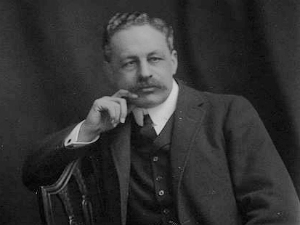
Their strategy was almost exactly the same as the one which had been urged on the Big Three victors of World War I, Great Britain, France and the USA, by the British envoy to Southern Russia in 1919, the geopolitician, Sir Halford Mackinder.
 
Sir Halford Mackinder: The father of geopolitics.
 
To keep the revolutionary Russian government weak, he argued, it would be necessary to construct a “cordon sanitaire” of Western-oriented regimes out of bits of the now defunct Austro-Hungarian, German and Russian Empires. Crucially, among the territories to be included in Mackinder’s list of westward-oriented buffer-states were Georgia, Byelorussia and the Ukraine.
 
According to Mackinder’s own “Heartland” theory, whichever great power, or combination of great powers, ended up acquiring these territories – especially the Ukraine – would soon be in a position to rule the world. This was because the possession of these territories would open the way to the strategic heart of what he called “The World Island” – the geographically contiguous Eurasian and African land-masses.
 
Mackinder’s infamous geopolitical formula: “Who rules East Europe commands the Heartland; Who rules the Heartland commands the World Island; Who rules the World Island commands the World”; was to inspire not only Adolf Hitler, but an alarming number of American geostrategic thinkers throughout the Cold War.
 
 
Geopolitics For Beginners: Frank Kapra's Why We Fight - a motivational series of films produced for American servicemen during World War II - leans heavily (and without attribution) on Mackinder's geopolitical theories. That  they were seized upon by German nationalists in the 1920s and 30s rendered Mackinder's ideas unfit for polite public discussion. (But not for Cold War strategy sessions!) The relevant section begins about 4 minutes in.
 
These same geostrategic thinkers, confronted with the unexpected collapse of the Soviet Union, immediately sought to apply Mackinder’s formula. The US and its Nato allies were urged to take control of East Europe as quickly as possible.
 
What was surprising was that the West European states, freed from the threat of Moscow’s armoured divisions, were unwilling to assert a more independent course. In spite of seeing the ruin all previous attempts to apply Mackinder’s geopolitical formulae had wrought upon Europe, her leaders made no attempt to restrain their American counterparts.
 
Perhaps those European leaders would have tried harder, had they known that Russia’s rising political star, Vladimir Putin, and his sinister coterie of foreign policy and military advisers, were every bit as enthusiastic in their admiration for Sir Halford Mackinder’s theories as their hawkish American adversaries. The West is not going to be permitted to rule East Europe on their watch. Not while Russia still commands nuclear weaponry.
 
Contemplating the outbreak of World War III is no joke.
 
This essay was originally published in The Waikato Times, The Taranaki Daily News, The Timaru Herald, The Otago Daily Times and The Greymouth Star of Friday, February 27, 2015.

Tuesday, 10 February 2015

Gone With The Nuclear Wind?

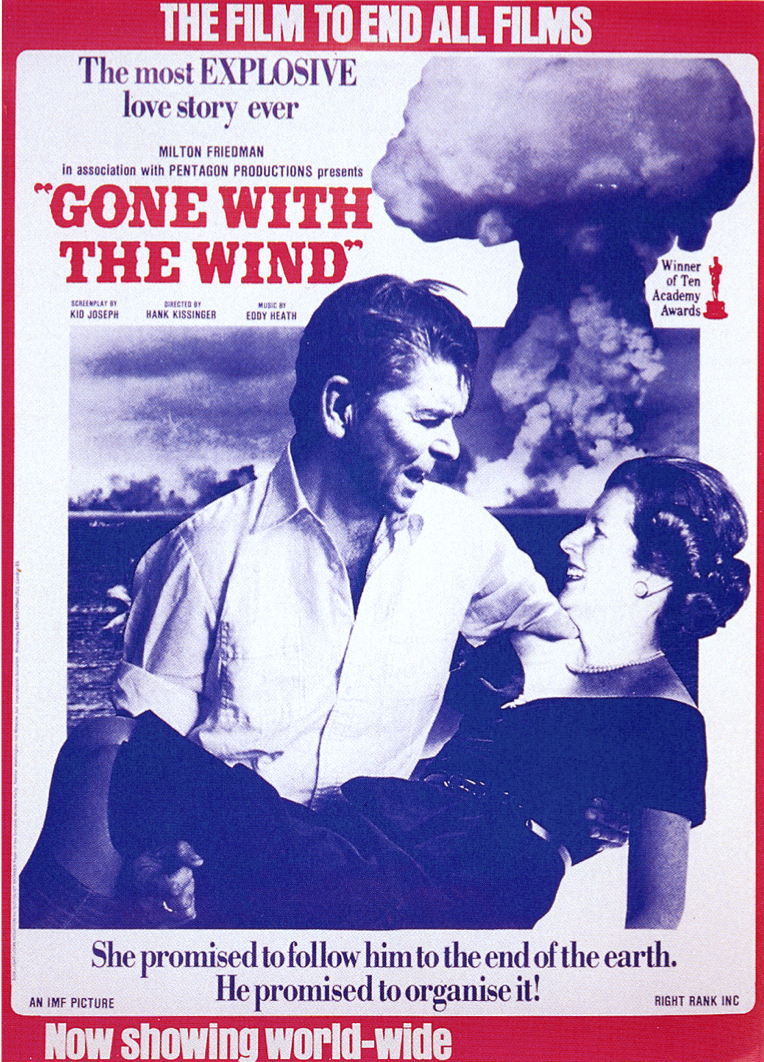
Tomorrow Might Not Be Another Day: The poster which swept the pre-Internet world in the anti-nuclear 80s. Those born in the post-Cold War period have little idea of how pervasive was the fear of nuclear annihilation. Those weapons have not gone away. Vladimir Putin's reassertion of his country's geopolitical interests may yet reacquaint the world with the fears of the 1980s. The Russian bear still has nuclear teeth.
 
IT WAS ONE of the most famous posters of the anti-nuclear 80s. Parodying the 1939 movie poster promoting Gone With The Wind, the 1980s version depicted Ronald Reagan in the role of Rhett Butler, and Margaret Thatcher as Scarlet O’Hara. Instead of rescuing his heroine from the wreckage of a burning Atlanta, Reagan carried Thatcher from the fallout of an ominous mushroom cloud. The anti-nuclear poster’s tag-line read: “She promised to follow him to the end of the earth. He promised to organise it.”
 
Black humour? Undoubtedly. But the worldwide popularity of the poster in those pre-Internet days speaks volumes about the existential fears of ordinary people everywhere that their leaders were impelling them towards a nuclear Armageddon.
 
These globally experienced fears were given specific expression in New Zealand by the nationwide movement to have the country declared nuclear-free. Distracted by the upheavals of the Springbok Tour for most of 1981, the Nuclear-Free New Zealand Movement only began gathering serious political momentum in 1982. By 1984, however, there were very few cities and towns in New Zealand that had not declared themselves nuclear-free. The incoming Labour Government, elected in July 1984, had little option but to go with the flow. Among its rank-and-file members (all 85,000 of them!) anti-nuclear sentiment was as intense as it was immovable.
 
It is difficult for New Zealanders who did not live through the early-1980s to appreciate just how tense the stand-off between the USA and the Soviet Union had become.
 
President Reagan and Prime Minister Thatcher were both implacable cold warriors. Indeed, when asked by a youthful aide to sum up his position on the Cold War, President Reagan breezily replied: “Well, I think we should win it.”
 
Soviet leaders, by contrast, came and went with almost comical speed. Between the death of Leonid Brezhnev in 1982 and the accession of the Soviet Union’s last leader, Mikhail Gorbachev, in 1985, the world welcomed and farewelled in quick succession Yuri Andropov and Konstantin Chernenko.
 
Meanwhile, as the Soviets were casting about frantically for a leader capable of lasting longer than eighteen months in office, Nato forged ahead with its plans to install nuclear-tipped Cruise missiles – a first-strike weapon – along the length of the Iron Curtain. Not surprisingly, the vast nuclear arsenals of the opposing superpowers were on a hair-trigger.
 
To New Zealanders born after 1991, the year the Soviet Union quietly blipped-off History’s screen, the mutual and assured destruction (MAD!) strategies of the Cold War era are mostly experienced as the more-or-less harmless echoes from a far-off, but very-far-from-harmless, historical era.
 
Today’s 24-year-olds may be intellectually aware that substantial stockpiles of nuclear weapons still exist in the United States and the Russian Federation, but the oppressive sense of their parents’ generation, that the slightest political miscalculation (or even a flock of errant geese!) might trigger the utter destruction of human civilisation, has, mercifully, faded from memory.
 
Global Warming, the existential threat du jour, may prove to be equally devastating, but its effects will be experienced over decades – not in the micro-seconds of a nuclear detonation.
 
Meanwhile, as the Millennials battle to prevent runaway global warming, another, all-too-literal battle rages between the forces of the Nato-supported Ukrainian government and the Russian-backed militias of Ukraine’s breakaway eastern provinces. Reported only fitfully in the Western news media, this conflict now threatens to escalate into a general European war. As former Swedish Prime Minister, Carl Bildt, told the Frankfurter Allgemeine Zeitung on Sunday.
 
“Unfortunately, war with Russia is conceivable. We are definitely living through one of the more dangerous historical phases, especially if you view the situation from a European perspective […] What makes the situation so explosive is that there is also great uncertainty about global power relations.”
 
The global uncertainty Mr Bildt speaks of is being fuelled by statements issuing from the United States Vice President, Joe Biden, reaffirming the Obama Administration’s determination to “allow Ukraine to defend herself”. By which the Americans mean – be given access to the heavy weapons necessary to drive back the pro-Russian separatists.
 
The German Chancellor, Angela Merkel, has reacted sharply to the Vice President’s statement, declaring that she could not “imagine any situation in which improved equipment for the Ukrainian army leads to President Putin being so impressed that he believes he will lose militarily.”
 
Only now is the European Union beginning to grasp its reckless folly in allowing anti-Russian extremists within Nato to connive in the fascist-supported overthrow of Ukraine’s democratically-elected President, Victor Yanukovych, in February 2014. Only now, having spent the last 12 months baiting the Russian bear, have the Europeans, the Americans, and the rest of us, belatedly remembered that the Russian bear has nuclear teeth.
 
The Nato powers promise to follow the fascist-backed Ukrainian regime to the end of the earth. Vladimir Putin offers to organise it.
 
This essay was originally published in The Press of Tuesday, 10 February 2015.

Tuesday, 9 December 2014

Choke-Hold

Suffocating Justice: The New York Daily News's cartoonist, Bill Bramhall, captures the shock and dismay of liberal America at the frightening implications of a New York Grand Jury's refusal to indict those responsible for the homicide of Eric Garner.
 
“I CAN’T BREATHE!” Who could hear those words and not respond? What sort of police officer, effecting the arrest of an unarmed black man by placing him in an illegal chokehold, could hear that anguished cry and refuse to lessen his grip?
 
The first part of the answer is, quite simply: a person who has never learned how to look at a black person and see a human-being. The second: a police officer who understands that, if the deceased is a black man, then his arresting officer/s will never be made accountable for his death.
 
Racism, and the informal legal protection afforded to racist police officers by America’s Grand Jury system, is what makes the deaths of unarmed African-Americans, like Eric Garner, inevitable. In spite of the fact that the NYPD officer responsible for Mr Garner’s death had a record of “racial bias”; and regardless of the fact that the whole outrageous incident was recorded on a witness’s cellphone; a Grand Jury composed of “ordinary” New Yorkers declined to press charges.
 
The widespread protests that followed the Grand Jury’s decision have made headlines around the world. Less visible, however, was the counter-protest of a group of female primary school teachers against their union’s condemnation of Mr Garner’s death. These women, all of them white and all wearing an “I support the NYPD” t-shirt, took a photograph of themselves and posted it on Facebook. They were all employees of a public school with African-American and Hispanic children on the student roll.


Racist to the Core: Teachers from Public School 220, Queens, New York, indicate the value they place on the life of a Black father of six.
 
What shocked liberal Americans was not only the nature of the counter-protesters’ profession – these were teachers, for God’s sake! – but also their absolute and deeply disturbing ordinariness.
 
Presented to the public gaze were not the angular, lock-jawed matriarchs of some 1960s Mississippi backwater staring malevolently into the lens of a photojournalist from Life magazine. No, these were “Soccer Moms” from Queens. Gals next door. The sort of friendly, fresh-faced suburbanites Americans bump into every day at the super-market. The “lovely women” encountered several times a year at parent-teacher evenings. The trained professionals who teach their kids!
 
Racists to the core.
 
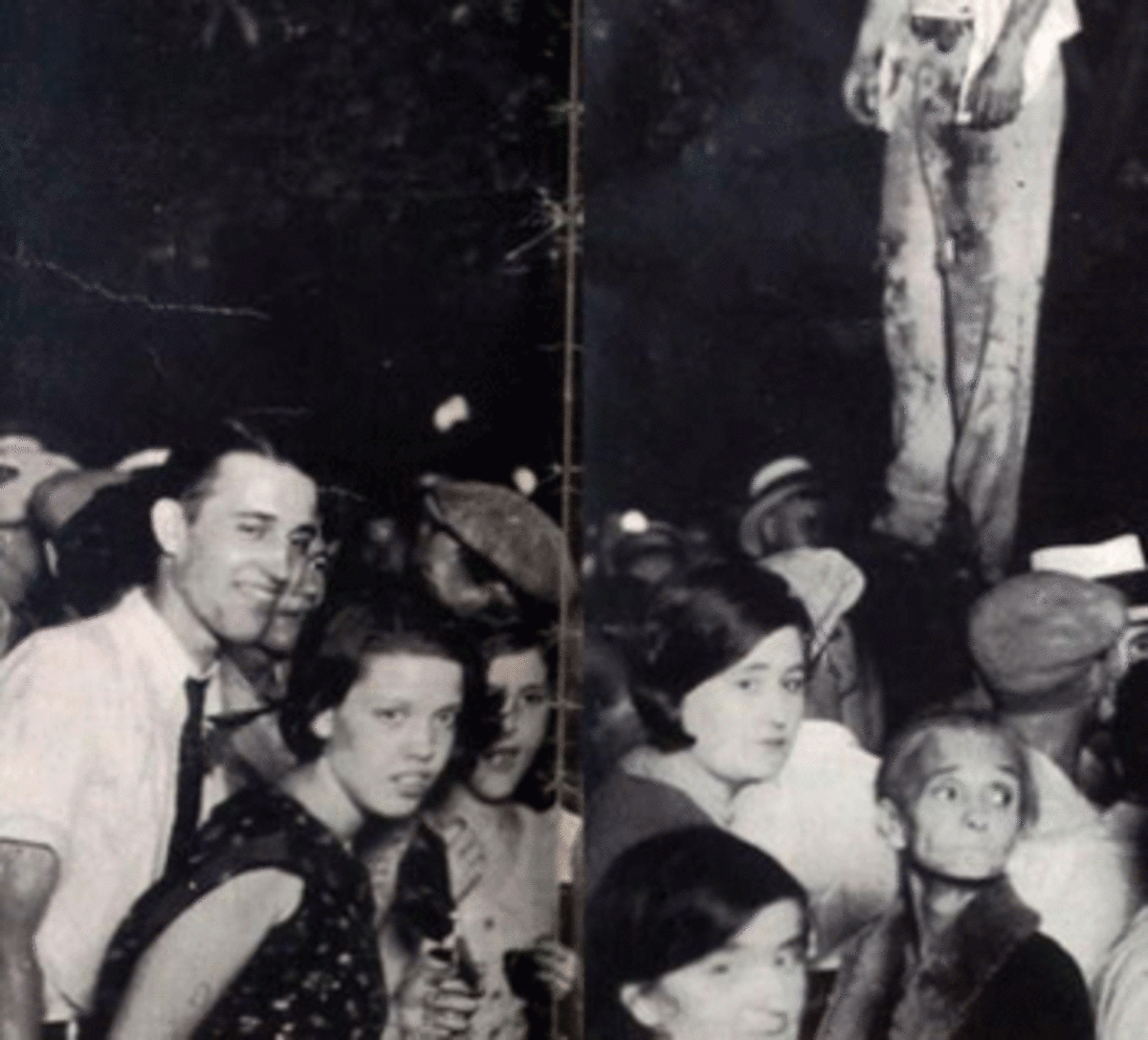
The teachers’ Facebook posting produced the same jarring effect as photographs taken at lynchings during the 1920s and 30s. Surrounding the charred remains of the lynch-mob’s Black victims were, typically, scores of perfectly “normal” white people (and their children!) who had turned out to watch the “fun”. The bland, smiling faces of the female staff of New York City Public School No. 220 offered a visual echo of those dreadful images from 90 years ago. They bear grim testimony to a white community every bit as oblivious to its complicity in racial injustice and exemplary violence.

Faces At A Lynching: "Ordinary" people utterly oblivious to their complicity in racial injustice and exemplary violence.
 
The example of New York’s, Eric Garner, like the example of Ferguson, Missouri’s Michael Brown, and countless others before them, has exposed the extent to which African-Americans remain the despised “Other” of United States’ Society. Many other ethnicities have had to endure the scorn of America’s White Anglo-Saxon Protestant elite. But, while the Irish, Italians, Poles and Jews eventually found their hyphenated niche within the American Dream, African-Americans remain, overwhelmingly, on the outside looking in.
 
Can anyone honestly say that the extreme animus directed towards the presidency of Barack Obama owes nothing to his colour? That the Tea Party’s extraordinary political traction among elderly white Americans has nothing to do with a Black President’s determination to admit African-American and Hispanic citizens into full membership of the national family? That the relentless arithmetic of demographic change, which points to White Americans falling below 50 percent of the population within the lifetimes of children living today, has not reignited the same primal fears that spawned the intractable racial violence of the Deep South?
 
Those of us who remember the American Civil Rights Movement of the 1950s and 60s also recall the central role Southern law enforcement played in the enforcement of racial segregation and the maintenance of white power. Southern county sheriffs and local police departments had always provided the front-line troops of Dixie’s racial war. On the rare occasions Southern police officers were charged with offences against African-Americans, Southern juries inevitably voted for acquittal.
 
The fate of Eric Garner points to the “Dixiefication” of the whole of the United States. The same racialization of poverty and powerlessness that characterised the Deep South has migrated both North and West. The same fetishisation of skin pigmentation as the crucial determinant of one’s place in the social hierarchy now infects even that last, great bastion of liberal influence, the teaching profession. And, finally, the near universal contracting-out of the practical business of racial oppression to local law enforcement is leading thoughtful Americans to the grim conclusion that, in the long-run, it is the South that won the Civil War.
 
America, herself, will soon be gasping: “I can’t breathe!”
 
This essay was originally published in The Press of Tuesday, 9 December 2014.

Monday, 8 September 2014

Putin - The Grand Master


I FOUND THIS little gem on Cameron Slater's Whaleoil blogsite (yes, yes, I know, but it's actually a really interesting place to visit!) and I just had to re-post it on Bowalley Road.
 
This posting is exclusive to the Bowalley Road blogsite.

Wednesday, 18 September 2013

Letting The Bad Do Good In Syria

Russia Eclipses America: Sergey Lavrov, the Russian Foreign Minister, seized the initiative over Syria by turning a throwaway comment from the American Secretary of State, John Kerry, into a plan to forestall an American strike against the Assad regime and open the way for peace negotiations.
 
ONE OF THE GREAT QUESTIONS in life is: why do bad things happen to good people? A few days ago the TV news carried a story of an frail Syrian grandfather who had lost his entire family in a bombing raid. The news crew found him sitting outside the ruins of his village.
 
“They are all gone, and I am left behind”, he lamented. “Why did God spare me and not them?”
 
An equally perplexing question, in the light of even more recent developments in the Syrian civil war, is: can good things come from bad people?
 
The Russian Federation, presided over by the autocratic Vladimir Putin, is a dark and menacing state in which persistent critics find themselves imprisoned on trumped-up charges, and effective critics are found murdered in the street.
 
And yet, this vast kleptocracy, with its protective screen of political praetorians, is currently the only permanent member of the United Nations Security Council in possession of a viable plan for preventing a military escalation in Syria. It is even possible that Russia’s plan to collect and destroy President Bashar al Assad’s chemical weapons stockpile could end up establishing the conditions for a negotiated peace.
 
The Russian plan – to which Syria swiftly assented – set the diplomatic machinery in motion at top speed. It also fell like a life-belt over the flailing hands of President Barack Obama, facing imminent defeat and humiliation at the hands of his own legislators.
 
The plan itself was inspired by a throwaway suggestion, elicited by a British journalist’s question addressed to the US Secretary of State, John Kerry, and dismissed by him as impossible in almost the same breath.
 
Asked what Assad could do to avert a military strike, Kerry responded that he could “turn over every single bit of his chemical weapons to the international community in the next week. Turn it over. All of it. Without delay, and allow a full and total accounting before that, but he isn't about to do it and it can’t be done.”
 
The Russian Foreign Minister, Sergey Lavrov, thought differently. With his Syrian counterpart fortuitously in the Russian capital, negotiations were instantaneous and intense. It did not take long for both men to agree that Kerry’s throwaway suggestion offered the framework for a consensus resolution on Syria which all five veto-weilding members of the UN Security Council could sign.
 
Cynical? Opportunistic? Yes, Lavrov’s move was all of those. And yet, without the Russians’ determination to pick up and run with Kerry’s suggestion, the Syrian situation would have remained intractable and the likelihood of an American attack would have grown.
 
Lavrov’s diplomatic flexibility, his capacity to seize upon Kerry’s words and fashion a new and workable alternative to a punishing American attack, owes a great deal to the authoritarian character of the Russian state.
 
The pluralistic nature of American politics; the rigid separation of powers enforced by the US Constitution; the multiple and effective opportunities for democratic engagement available to American citizens: all these contribute to the slow pace US diplomacy.
 
Sergey Lavrov, unlike John Kerry, has only to convince one man before proceeding. The same is true of Syria’s foreign minister. Kerry’s master, however, has many hoops to jump through before shouting: “Go!” Autocracies may be cruel and rapacious, but they can also be extremely efficient.
 
And therein lies history’s terrible irony. The United States of America, the world’s richest and most powerful state, also claims the role of the world’s sole moral arbiter. The American people are encouraged to view their great republic as “the indispensable nation”. To the Americans, and the Americans alone, belongs the responsibility of dividing the world’s nations into the good, the bad and the ugly. When America goes to war it is “to make the world safe for democracy” (Woodrow Wilson) or in defence of “the free world” (Harry Truman).
 
And yet, wherever the beneficent and liberating figure of Uncle Sam has set down his giant combat boots – Vietnam, Iraq – all that he has wrought is greater destruction and more misery. Even America’s “good war”, World War II, was marred by its atomic conclusion.
 
And, of course, the war against the Nazis was won not by that great democrat, Franklin Delano Roosevelt, but by the murderous Joseph Stalin. Evil overcame evil on the killing fields of Russia and Eastern Europe: Good had a supporting role – at best.
 
Winston Churchill grasped this irony: of evil doing good in spite of itself; as only an aristocratic conservative could. “If Hitler invaded Hell,” he quipped to one of his colleagues, “I would at least make a favourable reference to the Devil in the House of Commons.”
 
So, let’s wish Mr Lavrov and his master every success. If the Devil is determined to bring peace to Syria, why would God stand in his way?
 
This essay was originally published in The Press of Tuesday, 17 September 2013.

Friday, 21 June 2013

An Assad Victory Is Syria’s (And The World’s) Least-Worst Option

The Spoils Of Victory? Syria 2013. Those who cry "Let justice be done - though the heavens fall!", are seldom to be found living amongst the ruins. The World's options in Syria are rapidly narrowing. It can either allow Assad to restore enough order to make meaningful peace talks possible, or, by increasing arms shipments to the rebels, risk the whole of the Middle East erupting in flames.
 
RIGHT UP UNTIL its actions triggered World War I, hardly anyone in New Zealand gave a damn about Serbia. Until very recently, the same was probably true of our relationship with Syria.
 
Even now, with images of Syria’s gruesome civil war nightly smearing the world’s television screens, I find myself reacting to the rapidly rising body-count with a mixture of pity and frustration. As the angry, anguished faces of the slayers and their victims flash before me, I demand to know what could possibly be worth so much suffering?
 
Freedom?
 
Democracy?
 
Observing the “Arab Spring’s” slow descent into its entirely predictable winter of democratically-sanctioned fanaticism, I impotently admonish the opponents of the Syrian dictator, Bashar Al Assad:
 
“Be careful what you wish for!”
 
Freedom and democracy are probably impossible now, anyway, wished for or not. Too much blood has been spilt and too many homicidal sectarian passions aroused, for the ballot to be seen, miraculously, as an acceptable substitute for the bullet. The time for compromise in Syria was at the very beginning of the conflict – and that moment has passed. Neither side can now afford to rest until all their enemies are dead and absolute victory secured.
 
Of all the potential victors of the Syrian civil war, it is of Bashar Al Assad’s Baathist regime that the world has the least reason to be fearful. For all its faults – and they are legion – Assad’s government is now the only armed force in the country still committed to preserving Syria’s territorial integrity and to its continuance as an independent nation state.
 
Assad’s opponents can no longer credibly commit to either of those objectives. Whether its leaders are willing to acknowledge it or not, the Syrian rebellion has taken on the character of a Saudi and Qatar financed Sunni jihad. Victory for the rebels would dissolve the existing boundaries of the Middle East – thereby unleashing a wider and infinitely more dangerous war into which the whole world could be drawn.
 
By upholding Syria’s rights as a nation-state, China and Russia are, contrary to most Western commentary, making the most useful contribution to the preservation of both the regional and the global peace. It is the United Kingdom and France – both major arms exporters to the leading Sunni monarchies and emirates – that have opted to further inflame the Syrian crisis by bullying the European Union into lifting its ban on selling arms to either side of the conflict.
 
If the UK and France end up putting their thumbs on the strategic scales in Syria, the United States will have no choice but to weigh-in alongside them. This would result not only in the Russian Federation stepping-up its arms shipments to the Syrian Government, but also in the Shia republics of Iran and Iraq increasing the size and capability of their own military and paramilitary contingents (including the Lebanon-based Hezbollah Militia) currently fighting alongside the Syrian armed forces.
 
A fiery crescent of conflict, extending from Iran in the east, to Lebanon (and Israel?) in the west, and threatening all of the states to its immediate north and south, will be the inevitable outcome of any strategy which does not take as its starting point the restoration of the political status quo ante in Syria, the disarming of the rebels, a full amnesty for all of Assad’s opponents, and the drawing-up of a new constitution for the Syrian people – to be guaranteed by all five permanent members of the UN Security Council.
 
Whether they be English, American or Spanish, civil wars only end when one side decisively defeats the other. Unless it is the West’s desire to prolong the agony of the Syrian people indefinitely, its best option is to call upon the Sunni monarchs to cease arming the rebels and allow the Syrian armed forces to re-establish something approximating order.
 
That would be the least-worst-case Syrian scenario. The alternative – an oil-fuelled (and quite possibly nuclear) conflagration devouring the entire Middle East – could hardly avoid setting the whole world on fire.
 
This essay was originally published in The Dominion Post, The Waikato Times, The Taranaki Daily News, The Timaru Herald, The Otago Daily Times and The Greymouth Star of Friday, 21 June 2013.

Tuesday, 4 June 2013

Forewarned Is Forearmed

Composite Image: The release by party insiders of material outlining what amounts to a far-right plot to take over and drive the National Party sharply to the right indicates a level of factional intrigue that should give all New Zealanders pause. Godwin's law notwithstanding, the 1930s German precedents bear close scrutiny. Exposing the plotters is always better done sooner than later - before it is too late.
 
THE PHOTOGRAPHS could have saved 60 million lives. They were taken on 4 January 1933, outside the Cologne residence of Baron Kurt von Schroder, a well-connected German banker. Captured on film as they passed through the baron’s gates were Adolf Hitler, Rudolf Hess, Wilhelm Keppler and Heinrich Himmler. A little while later Franz von Papen, the recently dismissed German Chancellor and intimate friend of Reich President, Paul von Hindenberg, joined them.
 
Within hours, this photographic evidence of the Cologne conspiracy was in the hands of  Chancellor Kurt von Schleicher. By the next morning Berlin’s newspapers were denouncing Hitler’s “secret meeting” with von Papen.
 
It proved to be too little and too late. By 30 January Hindenberg had replaced von Schleicher with Hitler. The new Vice-Chancellor was von Papen.
 
Had the saner elements within Germany’s ruling class acted earlier, and with General Kurt von Schleicher’s readiness to expose the Nazi Party’s behind-the-scenes machinations with politically-driven bankers and businessmen, the world might have been spared the horrors of World War II and the Holocaust.
 
As the political philosopher, Edmund Burke, rightly observed: “All that is necessary for the triumph of evil is that good men do nothing.”
 
New Zealanders should breathe a large sigh of relief that “a few good men” can still be found in their country’s own ruling class, and that they have seen fit to act earlier – and, hopefully, with more positive effect – than their German counterparts of the 1930s.
 
The leaking of documents allegedly penned by the right-wing political consultant, Mr Simon Lusk, should be sufficient to forestall what can only be described as a sinister “long term plan to move the political centre to the right.”
 
Let me state very clearly at this point that I do not consider Mr Lusk to be a Nazi, nor indeed a fascist of any kind. If the material attributed to him (and he has not disowned any of it) offers us any guide, then Mr Lusk’s political beliefs match very closely those of the extreme right-wing of the United States Republican Party.

New Directions: Simon Lusk appears to be drawing his political inspiration from the far-right-wing of the US Republican Party.
 
What he appears to favour is the establishment in New Zealand of an outright plutocracy: a state in which, although the formal institutions of democratic government remain in place, their capacity to impede the interests of the very wealthy has been rendered ineffective by the intimidating tutelage of an ideologically-driven bureaucracy, and pressure weighted with crushing quantities of cash.
 
This impression is, once again, confirmed in the leaked documents, which state quite openly: “This means reducing the size of government, weakening the power of those who believe in big government, and investing for at least 20 years to ensure that these changes are permanent.”
 
Mr Lusk appears to have been pursuing his plans for a plutocratic (or, to use the language of the leaked documents “fiscally conservative”) government, led by members of an ideologically re-booted National Party, for at least three years. Tellingly, the earliest documents look to the United States not only for inspiration but funding.
 
In the document dated July 2010, it is proposed that the highly professionalised political culture of the United States be transplanted to New Zealand so that, over time, and with the interest accruing from an initial investment of $5 million from conservative American donors, “an enduring centre right majority, with a pro United States outlook on the world stage” can be elected to parliament.
 
There are those who dispute the attribution of “evil” motives to the author of these documents. They point to the fact that Mr Lusk has devoted considerable time and energy into making himself one of the very few professional political consultants operating in New Zealand. Is it not possible, they argue, that these documents, intended for the eyes of like-minded National Party members, might simply be Mr Lusk “writing his own job description”?
 
Well, yes, of course it could. But, even if that’s true, the sinister aspects of the plans attributed to Mr Lusk are in no way diminished. He is already credited with assisting four individuals into parliamentary seats: Sam Lotu-Iga; Louise Upston, Chris Tremain and Jamie-Lee Ross. Political commentators are constantly linking his name with the alleged leadership aspirations of Justice Minister, Judith Collins. The documents he is said to have authored speak openly of the present National Government being “a disappointment to fiscal conservatives” and promise “there will be a clean out” following the party’s next defeat.
 
New Zealanders deserve better than a hollowed-out democracy in which government of the wealthy, by the wealthy, for the wealthy becomes the norm.
 
Nor should it be forgotten that any political figure openly promising to make his economic and social programme “permanent”, is also promising to prevent its opponents from mounting a successful challenge. Ever.
 
And when the programme fails?
 
Who will there be left to complain?
 
This essay was originally published in The Press of Tuesday, 4 June 2013.

Tuesday, 5 March 2013

Lovers And Haters: Further Thoughts On The Hobbit Dispute

Enforcing Difference: In the American South, during the "Jim Crow" era, it was as vital for whites to engage in discrimination as it was for blacks to suffer it. In New Zealand, during the Hobbit Controversy, it was vital that most Kiwis be seen to be backing Sir Peter Jackson and his anti-union allies. "Hobbit Hater!" - like "Nigger Lover!" - is an insult designed to both discipline and isolate the dissenting minority from the assenting majority.

“NIGGER LOVER!” No accusation was more feared by white citizens of the old American South. Upon its recipients’ shoulders descended – with the sting of an overseer’s stock-whip – the entire, obdurate and unyielding expectations of Dixie’s racially-defined culture.
 
Following the withdrawal of the federal government’s army of occupation in 1877, a “Nigger Lover” was any Southern white who dared to deviate from the brutal racist consensus which,  vote by vote, law by law, lynching by lynching, was rebuilding white supremacy in the states of the shattered Confederacy.
 
It is a fact easily forgotten that the “Jim Crow” segregationist regimes of the South were as dependent on the willingness of whites to enforce their will, as they were on the legally engineered incapacity of blacks to defy them.
 
Securing the full co-operation of Southern whites in the grim business of exploiting Southern blacks, required constant and unrelenting ideological effort. The beneficiaries of segregation had to be reassured that the racist rules of their society represented not simply the most practical answer to the “race question”, but also constituted its best, self-evidently moral, resolution.
 
To ignore or openly defy the Jim Crow Laws of the South, by reaching out to one’s black neighbours, workmates or employees was, in effect, to engage in an act of brazen subversion. To treat African-Americans as equals was to concede their full constitutional status, both as human-beings and citizens, and thus to acknowledge their right to all the opportunities and services denied by segregation.
 
“Nigger Lover!”, therefore, wasn’t merely a declaration of racist scorn, it was a reminder – a very sharp reminder – of the white individual’s obligation to maintain solidarity with every other beneficiary of racist bigotry. The whole socio-economic and political order of the South, and their status within it, required whites (either passively or actively, as the situation dictated) to hate and oppress their black neighbours.
 

THESE MUSINGS on the most devastating disciplinary insult of the Old South were prompted by the past week’s recapitulation of the so-called “Hobbit Crisis” of October 2010.
 
The release by both the National-led Government and the Council of Trade Unions of hitherto withheld documents and e-mails has confirmed the reportage of that very small number of journalists who refused to accept the “official version” of events which so inflamed New Zealanders at the time. (Again, I raise my hat to Radio New Zealand’s Brent Edwards and Scoop’s Gordon Campbell.)
 
We know now that the “official version” of events, the version scripted by Sir Peter Jackson and the National Government, and relayed almost verbatim to the public by a distressingly large section of the news media, bore very little relation to what was actually happening.
 
Being wrong, however, in no way reduced the “official version’s” effectiveness. Sir Peter is a master story-teller and the tale he wove around the hapless Actors Equity Union was one from which it could not escape.
 
Hobbit Lovers: Even children were enrolled in the campaign to prevent the New Zealand film industry from being unionised.
 
Because Actors Equity wasn’t simply the villain of Sir Peter’s particular story. His admirers were encouraged to see it as something more: a generic enemy which threatened not only The Hobbit and the local film industry to which it was so important, but also the whole way of doing business in Twenty-First Century New Zealand.
 
It is important to recall the context in which the Hobbit Crisis took place. The world remained in the grip of the Global Financial Crisis, the Labour Party was moving to the left, and the trade union movement had just held a series of mass rallies around the country. On the right of politics there was a sense of unease – a feeling that, after thirty years of steady advance, its ideology was in retreat.
 
Sir Peter’s genius allowed him to transform the question of whether The Hobbit would be filmed in New Zealand, and under what sort of labour relations regime, into a litmus test of people’s allegiance to the social, economic and political realities of the “new” New Zealand.
 
The actual provenance of the epithet used by those opposing the efforts of Actors Equity and the CTU to unionise the New Zealand film industry is unclear. What cannot be disputed, however, is its impact. “Hobbit Hater” – like “Nigger Lover” – branded the recipient as someone hostile to the objectives of national revitalisation. Someone who still saw ordinary workers – even actors – as people with a legal right to bargain collectively for higher wages and improved conditions.
 
“Hobbit Haters” were the sort of people who wanted to return New Zealand to the bad old days of unbridled union power. “Hobbit Haters” had no respect for Weta Workshop’s Sir Richard Taylor or his army of “independent contractors”. “Hobbit Haters” were people who stood in the way of jobs and prosperity – like Labour and the Greens.
 
“Hobbit Haters”, like “Nigger Lovers”, refused to recognise what was good for them.
 
This essay was originally published in The Press of Tuesday, 5 March 2013.

Tuesday, 13 September 2011

The Legacy of 9/11

Sowing The Wind: And the whole world has reaped the whirlwind of American wrath.

IT WAS A Wednesday morning, much like any other, ten years ago, when I switched on my television set to witness the fall of the North Tower of the World Trade Centre. I stood there, transfixed, as all the air left my lungs. It was as if someone had punched me in the gut.

I wasn’t alone. The blow struck that day connected with the soft emotional tissue of the entire world; and in the ten years that have passed since “9/11”, the entire world has hardened-up.

But not in a good way.

The enormity of the assault upon the United States conferred upon its Al Qaeda perpetrators a momentary equivalence that proved to be entirely spurious. Yet, at the time, and when the inevitable American counter-attack came, it was enough for people to be convinced that human savagery had become uncontainable, and that all those who sought to “rescue” and “improve” humanity were, ultimately, cheats and liars. After 9/11 and Abu Ghraib, the best thing we, the sparrows of this world, could hope to do was stay out of the hawks’ field of vision.

Which suited the hawks just fine.

Conservative intellectuals and politicians all over the world – but especially in the United States and the United Kingdom – had long maintained that the human animal was wild, vile and in need of constant restraint. Enduring moral fables, insisted the followers of the conservative philosopher, Leo Strauss, were necessary to keep the masses headed in more-or-less the right direction. And for those who stepped out of line there needed to be punishments of sufficient severity pour encourager les autres.

I use the word “fables” advisedly here, because the stories constructed by the men who were empowered by 9/11 did not need to be true – merely motivational. In fact “truth”, with all its unrelenting and indiscriminate powers of illumination, was actually much less helpful than untruth. Those “weapons of mass destruction” – ready for deployment in 45 minutes – were far more effective in mobilising war-fever than any number of tiresome lectures on the geopolitics of middle-eastern oil.

9/11 has cowed and coarsened the quality of public discourse to the point where, increasingly, the wielders of power at home and abroad are treated as forces to be appeased rather than challenged.

We have witnessed some particularly telling examples of this attitude over the past fortnight as conservative academics, politicians and journalists have responded to the investigative journalist, Nicky Hager’s, latest book, Other People’s Wars.

Central to the conservatives’ response is the effort they’ve devoted to shoring up the “moral fables” justifying New Zealand’s involvement in the post-9/11 conflicts. The scorn directed at the book’s author by his fellow journalists shows clearly what a vital role the news media plays in perpetuating the “necessary fictions” so important to New Zealanders’ self-image.

As well they might. The horrors of the 9/11 attacks unleashed, in their turn, many new horrors (Abu Ghraib, Guantanamo, prisoner rendition, waterboarding, drone-aircraft-assisted assassination) as well as rehabilitating many old ones (carpet-bombing, free-fire zones, collateral damage, extra-judicial killings, mass surveillance of civilians).

Many of these latter evils date back to the United States’ last great exercise in imperial power projection – Vietnam. It should come as no surprise, therefore, to learn that many of the principal architects of the post-9/11 global horror franchise (Dick Cheney, Donald Rumsfeld) cut their political teeth in the Nixon Administration. While 9/11 spawned many historical novelties, it also reproduced an equally large – maybe greater – number of continuities.

At the heart of these continuities lies the inescapable fact that the United States remains the planet’s dominant military, economic and cultural power. Like Hitler before him, the leader of Al Qaeda, Osama Bin Laden, misread the secular pluralism and cultural heterogeneity of his enemy as signs of weakness. He paid for that miscalculation with his life.

Nevertheless, the attacks carried out in Al Qaeda’s name ten years ago have produced enduring – if unintended – consequences.

It wasn’t just the twin towers that crumpled and fell on September 11 2001. Demolished also was America’s faith in the humane and progressive ideals which for so many centuries had distinguished it from other great empires. Bin Laden’s true triumph came when President George W. Bush was persuaded to tear up the Geneva Conventions and sanction the use of torture.

How tragic that the man occupying the White House on 9/11 lacked the rare moral strength and wisdom of Norway’s Labour Prime Minister, Jens Stoltenberg, who, when confronted with the horrific work of Anders Breivik, told his people that the only answer to such violence was “more democracy, more openness”. And who then, using the words of one of Breivik’s intended victims, spoke directly to our broken world:

If one man can show so much hate, think how much love we could show, standing together.”

This essay was originally published in The Press of Tuesday, 13 September 2011.

Friday, 2 January 2009

Foreseeing the Unforeseeable

The Battle of Midway

I am reprinting my keynote address to the "Defence - A Debate" symposium, organised by the Centre for Strategic Studies and held at Victoria University of Wellington on 30-31 May 2001, for two reasons. First, because elements of it now seem strangely prophetic, and second, because, with a new National Government and a new Defence Minister, the key elements of that pre-9/11 debate are probably due for a re-airing.

I WOULD like to begin this short address by quoting a few lines from the Australian novelist, Frank Moorhouse’s, Grand Days. The novel is set at the headquarters of the League of Nations in Geneva in the 1920s. The heroine Edith Campbell Berry, a young, idealistic Australian, employed in the Secretariat of the League, is discussing the Kellogg-Briand "Pact of Peace" with Robert Dole, a cynical English journalist:

"Dole leaned over their table. ‘You know that the pact is really France trying to marry America,’ he said. He went on to say that the Kellogg-Briand Pact, if signed, was simply France manipulating America into a military alliance disguised as a peace treaty."

This is too much for Edith who "becomes defensive, arguing in what she called her ill-behaved voice, which rose unpleasantly to just below a shrill."

Later, Edith’s lover, Ambrose, admonishes her: "'Edith, you give it all too much heart.'" But the young Australian won’t admit defeat: "'Please – before we change the subject – you agree, don’t you? … Everyone agrees that since Locarno, and since the proven power of the League to settle conflicts – Germany in the League, and so on – you agree that things have never looked better?’ He smiled. ‘I agree. It is a historical fact. Things have never looked better. But you must also keep a realpolitik view of things Edith.’"

When I hear the Prime Minister, Helen Clark, dismiss the critics of her defence policies with the airy assertion that New Zealand faces no discernible threat to its security for the foreseeable future, I am reminded of Miss Edith Campbell Berry and her touching Antipodean faith in the efficacy of diplomatic devices, like the ill-fated Kellogg-Briand Pact of 1928 - which "outlawed war as an instrument of national policy". Like Ambrose, I feel the need to remind her to "keep a realpolitik view of things".

That is not always easy. For there have been moments in history when the prospects for international peace and security have, indeed, "never looked better". Ms Clark’s predecessor, Sir Joseph Ward, surveying the world in May of 1929 would have encountered just such a state of affairs – a beneficent global order which the best brains of the era confidently predicted would continue well into the foreseeable future.

There were many reasons for this sanguine assessment of international relations. Four years earlier, Germany, with France and Great Britain, had signed the Treaty of Locarno by which she guaranteed the existing frontiers of France and Belgium and undertook not to alter her eastern boundaries except by negotiation. In 1926 Germany was admitted to the League of Nations, and in 1928 joined the other peoples of Europe in signing Edith’s ill-starred "Pact of Peace".

In the United States an unparalleled economic boom roared on and on – prompting the newly elected President, Herbert Hoover, to predict that the USA was "in sight of the day when poverty will be banished from the nation". Japan, though racked with internal political difficulties, remained at least nominally democratic. China and Russia, struggling to rise above the vicissitudes of famine and civil war, posed no military threat to anyone.

As a loyal Dominion Prime Minister, Sir Joseph Ward happily left the serious business of international relations and national defence to the British. The Royal Navy provided all that was needed by way of strategic guarantees. New Zealand’s army was tiny, ill-equipped and intended primarily for the maintenance of internal security. As a separate branch of the armed services, the Air Force did not exist.

If asked, Sir Joseph would undoubtedly have had as much difficulty as Ms Clark in identifying any foreseeable military threat to New Zealand’s security.

Ten years later, in May of 1939, the world had changed – changed utterly. The happy dreams of "outlawing" war had disappeared – worldwide economic failure had seen to that. Germany and Japan’s withdrawal from the League of Nations had rendered it powerless to resist aggression, and everywhere re-armament was proceeding at breakneck speed. Japan was engaged in a bloody war of conquest against the Chinese; the Spanish Republic was in its death throes; and Hitler, having swallowed up Austria and Czechoslovakia, was preparing to dismember Poland. All over the world people recalled the horrors of the First World War and despaired. No one bothered to ask if war was coming; the only question in May 1939 was when it would break out.

These sombre observations, as you will no doubt have guessed, place me in the camp of the Robert Doles of this world – rather than the Edith Campbell Berrys. Those bright moments in the historical landscape – such as the 1920s and the 1990s – when world peace seemed possible, were more often than not periods of rest and recuperation following the terrible exertions of war.

The League and its philosophy had its hey-day in the decade following the "war to end all wars". The relative peace of the 1990s followed the aggressive assertion of US power against Saddam Hussein in the Gulf, the final collapse of the Soviet Union, and the ending of the Cold War in 1991.

A prolonged period of international stability should put statesmen – and women - on their guard. As the grizzled cavalry scout always says in the old westerns: "I don’t like it. It’s too quiet."

Should it suddenly get noisy – how is New Zealand placed?

The answer, sadly, is "not well". Most New Zealanders have experienced an enormous feeling of pride at what our troops have accomplished in East Timor. But New Zealand’s professional soldiers are only able to perform so creditably in that theatre (with military equipment inferior to that issued to the Australian territorials!) because of the superb training they have received as part of a fully integrated military force.

By decommissioning the combat wing of the RNZAF, the Labour-Alliance Government has fundamentally compromised the future combat readiness of our defence force. Without the contribution of close-air-support training, the capability of the New Zealand infantryman and woman will rapidly diminish. Our future ability to inject and extract military personnel into and out of combat zones - without sustaining heavy casualties - has been seriously degraded by the Government’s decision to scrap the Skyhawks.

At this point in any dispute over New Zealand’s military posture, someone inevitably throws down the challenge: "So, who is going to attack us? Who should we be preparing to fight?" It is a challenge that politicians, academics, and "responsible" journalists are loath to answer for fear of sparking a diplomatic incident, or being branded that most risible of creatures – a "conspiracy theorist".

Since I am none of the above, I have no hesitation in identifying the Peoples Republic of China as the most likely source of military aggression in the Pacific Region.

My reasons for viewing the PRC as a potential military aggressor are probably identical to those of the Pentagon and the US State Department.

The modernisation of the Chinese economy is producing a tidal wave of lay-offs and redundancies as the inefficient plant and machinery of the Maoist era is being upgraded and replaced by much more efficient and less labour intensive technology. Millions of industrial workers, and tens of millions of agricultural labourers, are being tipped out of the labour market into a society whose welfare and housing provision is still intimately bound up with the workplace.

This is a recipe for social and political disaster.

To make matters worse, China’s political institutions are singularly ill-suited to managing the looming social crisis. In essence the Chinese Communist Party leadership has only two options – to democratize the country’s political system, or to divert the grievances of the Chinese people down the channels of aggressive nationalism. With the sobering example of the Soviet Union before them, China’s leaders are unlikely to embrace the democratic option. Nationalism is, therefore, the most likely strategy to be adopted. That can only mean the re-conquest of Taiwan, and that can only mean war with the United States.

This scenario – which anyone involved with strategic studies in Australia will tell you pretty much underpins current US military doctrine – requires the New Zealand Government to make a choice between the two great powers of the region: - the PRC or the USA.

The choice is not as straightforward as it may seem; while our common language, and shared cultural values impel us towards the United States, there are pressing economic reasons for keeping on the right side of the PRC. In fifty years, barring a full-scale military confrontation with the US, China will boast the world’s largest and most dynamic economy, and all of East Asia will move to the rhythms of what will have become a Sino-Japanese condominium. If Australia and New Zealand decide to place themselves outside the strategic and economic perimeters of the Western Hemisphere, then our diplomatic and economic priorities will increasingly be determined in Beijing.

Every political fibre of my being tells me that Australians and New Zealanders will not tolerate a foreign affairs and defence policy which isolates this nation from its cultural, linguistic, historical and ideological allies. We are heirs of the European Enlightenment and Liberty - not of Confucianism and the one party state.

As a Marxist, I consider myself to be a part of the West’s long pursuit of human emancipation, and so my choice is simple. Though the United States has been guilty of many crimes in its brief history as an imperial power, its extraordinarily open society has always proved equal to the task of challenging the delinquency of its leaders. Vietnam was a terrible error of American policy – but it was an error corrected by the robustness of American democracy. The "mistakes" of the PRC’s leadership – be they the 25 million dead of the Great Leap Forward, or the thousands massacred in Tiananmen Square, have never been the subject of popular correction – for the simple reason that the Chinese people are not free. And if the 20th Century taught me nothing else, it is that the freedom which socialism is supposed to deliver can never grow out of the barrel of a gun.

The Australians need no lessons in the superiority of open societies to closed dictatorships. They, like the Americans, have accepted the challenge of foreseeing the unforeseeable, and have glimpsed very similar pictures. They realise, for example, that it would not require a Chinese invasion of the Australian continent to place the Australian people in mortal danger – merely the assertion of Chinese hegemony throughout the Indonesian archipelago.

The Australian Government – unlike our own – has not forgotten that Britain dominated the 19th Century world by controlling the sea, not the land. In the 21st Century that means a tightly integrated air and naval capability - something which both major political parties in Australia have chosen not only to preserve – but to enhance.

At some point in the future – and it may be a lot closer than people think - Helen Clark, Jim Anderton and the Greens are going to face the choice the Aussies have already made. I hope they chose wisely. In a small, under-populated nation, political disagreements should cease at the water’s edge. The secret to preserving our independence, and safeguarding the welfare of our citizens, lies in contributing to the collective strength of our friends – not in relying upon the good-will of our neighbours.

Coming to our cinemas in a few days time is a movie called Pearl Harbour. I hope that the subject matter of the film serves as a wake-up call to young New Zealanders; that it reminds them that last week’s "unrealistic fears" can all-too-easily become this week’s unbelievable headlines. I hope also, that Pearl Harbour reminds them that New Zealand can never isolate itself from the great events of planetary history.

In the weeks after the real Pearl Harbour, before the crucial Battle of Midway, terrified New Zealanders cursed the parsimony and short-sightedness of previous governments; recalling, too late, the ancient Roman adage: He who desires peace – should prepare for war.