Showing posts with label Nuclear Weapons. Show all posts

Friday, 25 May 2018

Speaking For The Don.

Role Model? What does it mean when the United States Secretary of State acts like one of the Godfather’s enforcers? How should the international community respond when a nation, armed to the teeth and openly contemptuous of the rule of international law, commands the rest of the world to join it in “crushing” its enemy?

MIKE POMPEO looks and sounds like one of Tony Soprano’s capos. That first impression was powerfully reinforced earlier this week when he addressed the ultra-conservative Heritage Foundation. His speech, full of insults and threats to the government of Iran, was clearly intended to convey “an offer they could not refuse”.

When, a week or so ago, the late-night talk-show host, Bill Maher, made a case for the Trump Administration being indistinguishable from a Mafia family, his viewers no doubt appreciated the black humour of the comparison. It is now clear that Maher wasn’t joking.

What does it mean when the United States Secretary of State acts like one of the Godfather’s enforcers? How should the international community respond when a nation, armed to the teeth and openly contemptuous of the rule of international law, commands the rest of the world to join it in “crushing” its enemy?

Believing in the word of the United States, leading members of the European Union responded to the 2015 Iran Nuclear Deal by investing billions of dollars in the Iranian economy. Bad luck. Secretary of State Pompeo has told them to tear up their contracts and get the hell out of Tehran. In future, he warned them, any country trading with the United States had better not be caught trading with Iran also – not if it wants to keep its access to America’s markets. A number of European oil companies have already taken the hint and abandoned Iran to its fate.

And what is that likely to be? What does the United States expect Iran to do? If Secretary Pompeo’s speech is any guide, that unfortunate country is expected to render itself defenceless militarily and to abandon any pretence of conducting an independent foreign policy.

Iran’s production of advanced ballistic missiles – the only weapons in the Iranian arsenal capable of inflicting serious damage on a would-be aggressor – must cease.

The same cease-and-desist order has been slapped on Iran’s diplomatic relationships with Iraq, Syria, Russia, China and the rebel forces in Yemen.

Secretary Pompeo has further declared that Iran, despite it being a signatory to the nuclear non-proliferation treaty and ignoring its membership of the International Atomic Energy Agency, has no right to possess a nuclear reactor – not even for the purposes of generating electricity.

Secretary of State, Mike Pompeo, seated next to Vice-President Mike Pence, looks on as President Donald Trump addresses his Cabinet.

In other words, the United States isn’t making Iran an offer it cannot refuse, it is sending Iran an ultimatum it cannot possibly accept. In effect, Secretary Pompeo is demanding that the Iranians place themselves under the “protection” of the United States. Whereupon, having driven its European, Russian and Chinese competitors out of the Iranians’ oil and natural gas fields, the Americans will, presumably, settle down to suck the country dry.

Because, stripped of all the bombast and all the faux concern for the Iranian people, the real reason for the United States’ implacable hostility towards the government of Iran is that ever since the Islamic Revolution of 1978-79 the Ayatollahs have refused to let the USA “wet its beak” in their nation’s most valuable natural resource. The core of Secretary Pompeo’s message to Tehran’s leaders is, therefore, brutally simple. “If you continue to refuse America its cut, then the Global Godfather will rub you out. Capisce?”

In its determination to emulate La Cosa Nostra, however, the Trump Administration has all-too-clearly forgotten what happens to the Don who goes rogue and makes it impossible for the other crime families to do business. Nothing unites Mafia chieftains faster than a threat to their cash flows. As Bob Dylan puts it his poignant tribute to the maverick Italian-American mobster, Joey Gallo: “It’s peace and quiet that we need to go back to work again.”

If the United States insists on extorting a bigger slice of the global pie than the European Union, Russia and China can afford to concede, then they will have no choice except to come together in defence of their economic interests. If that happens, then the United States will find itself competing with a vast global alliance stretching all the way from the Pacific Ocean to the English Channel; the North Pole to the Cape of Good Hope. Militarily formidable and economically self-sufficient, this monster-of-America’s-own-making is likely to prove a great deal harder to intimidate than the beleaguered nation of Iran.

These gangsters will be packing nuclear pistols.

This essay was originally published in The Otago Daily Times and The Greymouth Star of Friday, 25 May 2018.

Wednesday, 19 April 2017

Taking Care of North Korea.

Yesterday's Diplomacy: The Trump Administration has dispatched a naval strike force to the seas off the Korean Peninsula. Unfortunately, the Kim family's dynastic dictatorship cannot afford to be seen to back down in the face of the President's gunboat diplomacy. Any US attack on North Korea will, likewise, force "Supreme Leader" Kim Jong Un to unleash "Total War" on its enemies. President Trump is, hopefully, being reminded that Kim doesn't necessarily require an ICBM to deliver a nuclear device to US territory - an unsuspecting container ship will do the job just as effectively.
 
PRESIDENT TRUMP says North Korea “will be taken care of” if its dictator, Chairman Kim Jong Un, authorises another round of nuclear weapons tests. A naval strike force, led by the Nimitz-class “supercarrier” the USS Carl Vinson, is positioned off the Korean Peninsula. The American ships will soon be joined for “exercises” by an undisclosed number of Japanese naval vessels.*
 
This grim show of force is intended to serve as a stark reminder of America’s ability to project its military power wherever and whenever if desires. In the aftermath of the recent Tomahawk Cruise Missile strike on Syria, Kim is expected to draw the obvious lessons and stand down his nuclear weapons testing programme.
 
This is not something the Supreme Leader of the Democratic People’s Republic of Korea (DPRK) can do. Not without sustaining a catastrophic loss of face. Though it possesses all the trappings of a Soviet-style socialist state, the DPRK is, in reality, a quasi-monarchical dynastic regime, whose hereditary rulers are required to maintain an image of unassailable power and strength. Backing down in the face of American threats would likely prove fatal to the Kim family dynasty.
 
This would not be on account of the North Korean people rising up and overthrowing their semi-sacred head of state. Such is the iron grip of Kim’s “Workers’ Party” government that the North Koreans would never hear a word about their leader’s back down. The threat to Kim would come from his generals and party bosses. They chafe under the Kim family’s ruthless rule. The international humiliation of Kim Jong Un would be a heaven-sent opportunity to bring his family’s dynasty to an end.
 
A successful American strike against the DPRK’s nuclear weapons test site at Punggye-ri would deliver a similar blow to Kim Jong Un’s prestige. Not that the North Korean people would learn anything at all about a US attack. Punggye-ri is located in rugged, mountainous terrain, far from large population centres. The remoteness of the testing site could not, however, keep the upper-echelons of the army and the party out of the information loop. How would their Supreme Leader respond?
 
Much would depend of just how successful the American strike turned out to be. Punggye-ri is a complex of deep tunnels drilled into solid rock. An attack using the same ordnance as the Syrian strike would likely prove ineffective.
 
The Americans do, of course, possess much larger bombs: like the 10-ton “bunker-buster” dropped on an ISIS-controlled tunnel complex in Afghanistan earlier this week. (Was that operation supposed to send a warning to the North Koreans?) The problem with these huge weapons, however, is that they can only be delivered by large, relatively slow, military aircraft. The Americans would, therefore, have to destroy the fighter aircraft and surface-to-air missile batteries with which the Punggye-ri complex is defended. This would be a major military operation on the part of the United States.
 
There can be little doubt that, confronted with an American assault of such magnitude, Kim Jong Un would order “total war” against the United States. Thousands of 170mm Goksan artillery pieces and 240mm multiple-tube rocket launchers, among the largest such weapons in the world, would rain down death and destruction upon the South Korean capital, Seoul, and devastate the US military bases adjoining the Demilitarised Zone. According to the former US Commander in South Korea, General Thomas A Schwartz, the 28,000-strong US army in Korea “would be destroyed in less than three hours”.
 
Kim Jong Un’s order to unleash total war upon the United States would set in motion something else. A nuclear device, probably not much bigger than the bomb which devastated Hiroshima, would set out towards one of the key ports of the United States. Concealed in the hold of a fishing trawler. Or, perhaps, hidden in one of thousands of identical shipping containers stacked on the deck of a container ship bound for San Diego or New York, this device would be effectively undetectable and unstoppable until it came close enough to inflict scores-of-thousands of civilian casualties. Such a catastrophe would dwarf completely Al Qaeda’s attack of 11 September 2001.
 
And President Trump’s response? (Assuming the North Koreans weren’t inventive enough to deliver their nuclear device to a warehouse in Washington DC!) Who would be willing to bet against the enraged American president ordering a retaliatory nuclear strike against North Korea? Would he listen to those who pleaded with him not to incinerate millions of innocent North Koreans for the crimes of their Supreme Leader? Would he care that the radioactive fallout from such a strike would be no more a respecter of international borders than the fallout from Chernobyl? How could America’s Commander-in-Chief be sure that the Chinese and Russians would not respond in kind?
 
Can Donald Trump really “take care” of this?
 
 
* This information was subsequently revealed to be more “fake news” from the Trump Administration. At the time of writing (16/4/17) the USS Carl Vinson and its strike force was nowhere near the location indicated by the White House Communications Director, Sean Spicer. As of this morning (19/4/17) the strike force was still, apparently, en route!
 
 
This essay was originally published in The Press of Tuesday, 18 April 2017.

Friday, 22 January 2016

The Ultimate Guarantor.

Don't Mess With Me! The knowledge that a nation possesses nuclear weapons is usually enough to dissuade its enemies from launching any kind of attack or invasion. For those unfortunate states caught in the cross-hairs of the great powers, it is difficult to imagine a stronger incentive to risk everything on acquiring the ultimate guarantor of national independence.
 
WITH THE IMPORTANT EXCEPTION of Israel, no nation in possession of nuclear weapons has ever been invaded. It is difficult to conceive of a better incentive for any state threatened with aggression to risk everything for the deadly technology History has taught it to esteem as the ultimate guarantor of national independence.
 
Exactly how many nuclear weapons Israel possessed when she was attacked by her Arab neighbours in 1973 is unclear, but she certainly possessed some. Exactly how close she came to using them, however, remains even more historically hazy.
 
To the south, the Israelis had the buffer of the Sinai Peninsula in which to absorb Egypt’s thrust across the Suez Canal. In the north, however, the situation was much more fraught. Had the Israeli Defence Force not been able to halt the advance of Syria’s armoured columns in the first 72 hours of the Yom Kippur War, Prime Minister Golda Meir may have concluded that she had no choice except to threaten Damascus and Cairo with obliteration if hostilities were not halted immediately and their troops withdrawn.
 
In the deadly chess game that is nuclear strategy, the very possibility that Israel might feel obliged to make such a threat, required the United States to signal that a nuclear counter-threat against Israel, issued by the Soviet Union in defence of its Arab allies, would not be countenanced. That signal took the form of advancing the US armed forces to DEFCON 3 – a “Defence Condition” positioned just two perilously short steps away from Armageddon.
 
The Nearest Run Thing You Ever Saw: The Israeli PM, Golda Meir and her Defence Minister, Moshe Dyan, visit the Golan Heights in the hours following the Syrian army's thwarted attack. Had things gone differently, Israel's leaders would have been forced to threaten the use of its small stockpile of nuclear weapons.
 
Fortunately for the world, the Russians were not about to initiate World War III on behalf of Egypt and Syria. With the benefit of hindsight it is also clear that the mere possibility of an Israeli nuclear strike was sufficient for the leaders of Egypt and Syria to limit their military and diplomatic objectives to the restoration of Sinai and the Golan Heights, and the Israeli evacuation of the West Bank and Gaza.
 
In the light of these facts, the Israeli case is not as exceptional as it might, at first, appear. Even when they possessed the military resources to launch a war of annihilation against the State of Israel, the Egyptians and the Syrians dared not do so. No one doubts the willingness of the Jewish people to defend themselves against a second genocide with every weapon at their disposal – including Israel’s atomic bombs. Like the biblical hero Samson, Israel, in extremis, will not hesitate to bring down the Temple upon the heads of its enemies – even at the cost of being crushed itself.
 
These lessons in invulnerability were not lost on Israel’s middle-eastern neighbours. Does anyone seriously suppose that the United States and the United Kingdom would have launched a conventional invasion of Iraq if Saddam Hussein had possessed even a small stockpile of nuclear weapons? And is anyone truly surprised that the revolutionary government of the Islamic Republic of Iran very early on began diverting resources to what Israel and the United States were convinced was an all-out effort to create a nuclear arsenal?
 
That Iran has been persuaded to abandon its, geopolitically-speaking, extremely strategically destabilising nuclear-weapons programme, is not due entirely to the United Nations’ crippling economic sanctions. The Iranians have witnessed the exemplary fate of, first, the Iraqi, and then the Syrian, attempts to construct and operate a nuclear reactor capable of enriching Uranium and/or producing weapons-grade Plutonium.
 
The Israelis call it the “Begin Doctrine” – after Prime Minister Menachem Begin, who, in 1981, authorised a pre-emptive air-strike against Saddam Hussein’s nuclear reactor at Osirak. Begin described Osirak’s successful destruction as “anticipatory self-defence at its best”. In 2007 the Israelis did it again. “Operation Orchard” utterly destroyed the nuclear reactor constructed (with North Korean assistance) in the remote Deir ez-Zor region of Syria.
 
Although the Iranians took the precaution of locating most of their nuclear facilities deep underground, their military chiefs were never entirely convinced that the Israelis wouldn’t deploy tactical nuclear weapons to take them out. The bloodthirsty threats of Israel’s hard-line Prime Minister, Benjamin Netanyahu (whose bellicosity frightens even his own generals!) upped-the-ante still further. In 2015, sanctioned and intimidated, the Iranians finally abandoned their bid for the ultimate guarantor.
 
One question, however, remains. Does Israel’s acceptance of Iran’s diplomatic assurances have anything to do with Pakistan’s possession of nuclear weapons?
 
This essay was originally published in The Waikato Times, The Taranaki Daily News, The Timaru Herald, The Otago Daily Times and The Greymouth Star of Friday, 22 January 2016.

Tuesday, 10 February 2015

Gone With The Nuclear Wind?

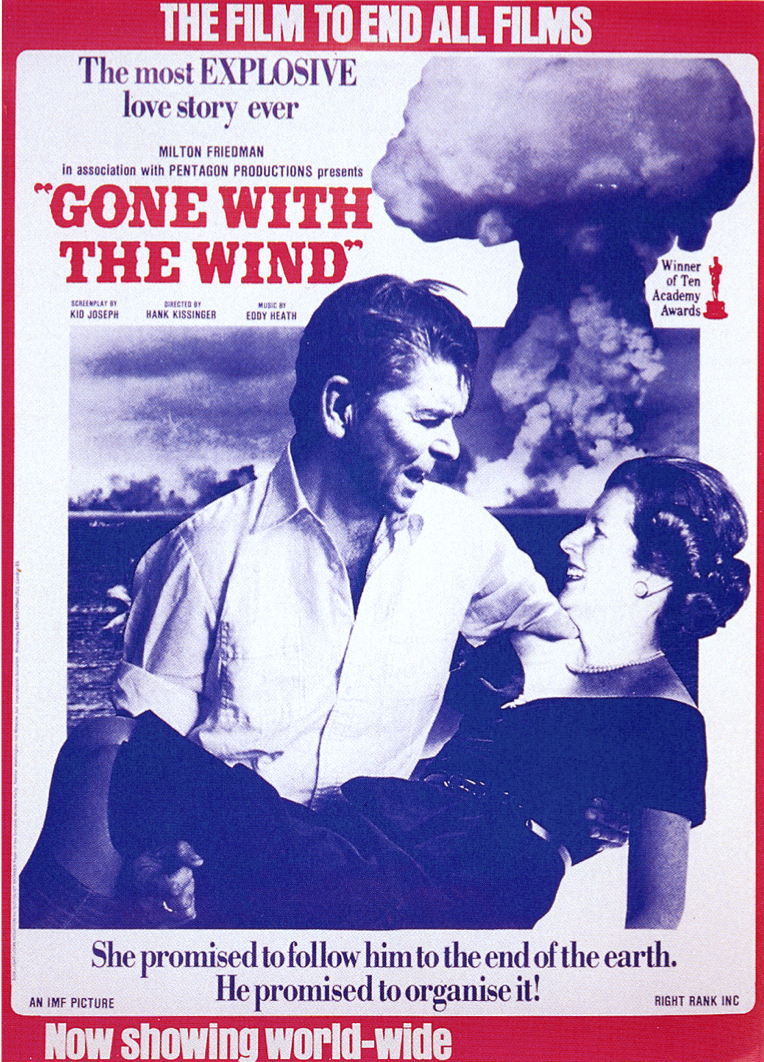
Tomorrow Might Not Be Another Day: The poster which swept the pre-Internet world in the anti-nuclear 80s. Those born in the post-Cold War period have little idea of how pervasive was the fear of nuclear annihilation. Those weapons have not gone away. Vladimir Putin's reassertion of his country's geopolitical interests may yet reacquaint the world with the fears of the 1980s. The Russian bear still has nuclear teeth.
 
IT WAS ONE of the most famous posters of the anti-nuclear 80s. Parodying the 1939 movie poster promoting Gone With The Wind, the 1980s version depicted Ronald Reagan in the role of Rhett Butler, and Margaret Thatcher as Scarlet O’Hara. Instead of rescuing his heroine from the wreckage of a burning Atlanta, Reagan carried Thatcher from the fallout of an ominous mushroom cloud. The anti-nuclear poster’s tag-line read: “She promised to follow him to the end of the earth. He promised to organise it.”
 
Black humour? Undoubtedly. But the worldwide popularity of the poster in those pre-Internet days speaks volumes about the existential fears of ordinary people everywhere that their leaders were impelling them towards a nuclear Armageddon.
 
These globally experienced fears were given specific expression in New Zealand by the nationwide movement to have the country declared nuclear-free. Distracted by the upheavals of the Springbok Tour for most of 1981, the Nuclear-Free New Zealand Movement only began gathering serious political momentum in 1982. By 1984, however, there were very few cities and towns in New Zealand that had not declared themselves nuclear-free. The incoming Labour Government, elected in July 1984, had little option but to go with the flow. Among its rank-and-file members (all 85,000 of them!) anti-nuclear sentiment was as intense as it was immovable.
 
It is difficult for New Zealanders who did not live through the early-1980s to appreciate just how tense the stand-off between the USA and the Soviet Union had become.
 
President Reagan and Prime Minister Thatcher were both implacable cold warriors. Indeed, when asked by a youthful aide to sum up his position on the Cold War, President Reagan breezily replied: “Well, I think we should win it.”
 
Soviet leaders, by contrast, came and went with almost comical speed. Between the death of Leonid Brezhnev in 1982 and the accession of the Soviet Union’s last leader, Mikhail Gorbachev, in 1985, the world welcomed and farewelled in quick succession Yuri Andropov and Konstantin Chernenko.
 
Meanwhile, as the Soviets were casting about frantically for a leader capable of lasting longer than eighteen months in office, Nato forged ahead with its plans to install nuclear-tipped Cruise missiles – a first-strike weapon – along the length of the Iron Curtain. Not surprisingly, the vast nuclear arsenals of the opposing superpowers were on a hair-trigger.
 
To New Zealanders born after 1991, the year the Soviet Union quietly blipped-off History’s screen, the mutual and assured destruction (MAD!) strategies of the Cold War era are mostly experienced as the more-or-less harmless echoes from a far-off, but very-far-from-harmless, historical era.
 
Today’s 24-year-olds may be intellectually aware that substantial stockpiles of nuclear weapons still exist in the United States and the Russian Federation, but the oppressive sense of their parents’ generation, that the slightest political miscalculation (or even a flock of errant geese!) might trigger the utter destruction of human civilisation, has, mercifully, faded from memory.
 
Global Warming, the existential threat du jour, may prove to be equally devastating, but its effects will be experienced over decades – not in the micro-seconds of a nuclear detonation.
 
Meanwhile, as the Millennials battle to prevent runaway global warming, another, all-too-literal battle rages between the forces of the Nato-supported Ukrainian government and the Russian-backed militias of Ukraine’s breakaway eastern provinces. Reported only fitfully in the Western news media, this conflict now threatens to escalate into a general European war. As former Swedish Prime Minister, Carl Bildt, told the Frankfurter Allgemeine Zeitung on Sunday.
 
“Unfortunately, war with Russia is conceivable. We are definitely living through one of the more dangerous historical phases, especially if you view the situation from a European perspective […] What makes the situation so explosive is that there is also great uncertainty about global power relations.”
 
The global uncertainty Mr Bildt speaks of is being fuelled by statements issuing from the United States Vice President, Joe Biden, reaffirming the Obama Administration’s determination to “allow Ukraine to defend herself”. By which the Americans mean – be given access to the heavy weapons necessary to drive back the pro-Russian separatists.
 
The German Chancellor, Angela Merkel, has reacted sharply to the Vice President’s statement, declaring that she could not “imagine any situation in which improved equipment for the Ukrainian army leads to President Putin being so impressed that he believes he will lose militarily.”
 
Only now is the European Union beginning to grasp its reckless folly in allowing anti-Russian extremists within Nato to connive in the fascist-supported overthrow of Ukraine’s democratically-elected President, Victor Yanukovych, in February 2014. Only now, having spent the last 12 months baiting the Russian bear, have the Europeans, the Americans, and the rest of us, belatedly remembered that the Russian bear has nuclear teeth.
 
The Nato powers promise to follow the fascist-backed Ukrainian regime to the end of the earth. Vladimir Putin offers to organise it.
 
This essay was originally published in The Press of Tuesday, 10 February 2015.