Showing posts with label Cold War. Show all posts

Tuesday, 22 October 2019

A Bodyguard of Truths.

One, Two, Many Truths: With the collapse of “actually existing socialism” in 1991, the universities of the West found themselves saddled with a new mission. With their ideological competitors now soundly defeated they were no longer required to demonstrate the superiority of capitalist values. Their job now was to cement in place the crushing victory of free-market capitalism. Intellectual pluralism was out and unchallengeable dogma was in. As far as the academic community was concerned, it was a case of: “We are all commissars now!”

WHAT’S HAPPENED to our universities? That is the question which New Zealanders educated in the universities of the 1970s and early 1980s are asking themselves. Their search for answers has been prompted by the failure of at least two of New Zealand’s academic institutions to defend the principle of free speech on their campuses. Such a dramatic departure from the academic values of the second half of the twentieth century, while disturbing, is surely inseparable from the many other changes that have transformed our universities over the course of the past 35 years. What’s happening on today’s campuses has been brewing for a long time.

What sort of world was it that required our universities to be centres of intellectual pluralism: places where different ideologies contended with one another openly and without undue rancour? First and foremost it was a world in which the struggle between market-driven and market-suppressing ideologies was ongoing. In the 1970s and well into the 1980s the outcome of the Cold War was still in doubt. Vast swathes of the planet and hundred-of-millions of workers remained off-limits to capitalism. No matter how truncated and unfree, there was still an alternative to the free market – and, as any good capitalist will tell you, competition enhances performance.

Universities, like all the other important institutions of capitalist society, had to demonstrate the superiority of capitalist values over communist ideology. If Soviet universities were hidebound bastions of unchallengeable dogma where intellectual unorthodoxy wasn’t simply unwise but punishable by dismissal, imprisonment, or worse, then the West’s universities had to be showcases of intellectual ferment and free debate.

Censorship and the suppression of free speech might be attempted by misguided university authorities (as they were in the early 1960s on the campus of the University of California at Berkeley) but all such attempts were stoutly resisted by staff and students. The Berkeley “Free Speech Movement” marked the beginning of the campus upheavals that made students a by-word for radical dissent throughout the 1960s and 70s.

With the collapse of “actually existing socialism” in 1991, the universities of the West found themselves saddled with a new mission. With their ideological competitors now soundly defeated they were no longer required to demonstrate the superiority of capitalist values. Their job now was to cement in place the crushing victory of free-market capitalism. Intellectual pluralism was out and unchallengeable dogma was in. As far as the academic community was concerned, it was a case of: “We are all commissars now!”

For students, the new regime was even more rigorous. The intellectual leaders of free-market capitalism had noted the effects of heavily state-subsidised or even “free” tertiary education on students. From the perspective of the free-market capitalist, giving young people the space and time to think about the world they were about to enter had proved a near fatal mistake. High fees and crippling student loans were their answer to the radical dissent of the 60s, 70s and 80s. Serendipitously, the policy of “User-Pays” turned out to be a genuine “twofer”. Not only did it transform students from scholars into paying customers; but also, by requiring university staff to give these “customers” what they were paying for, it undermined academic freedom. Students won’t pay for exams that are “too hard”, or enrol in courses that are of “no use”.

That only left the pesky problem of “Truth”. Traditionally, this was the whole point of attending university: learning how to approach, ever more closely, the true nature of things. For the free-market capitalist, however, the only truth worth pursuing was the truth of free-market capitalism. But, how to establish that truth without encouraging the growth of a counter-truth? That was the problem.

The survival strategy free-market capitalism came up with was nothing less than brilliant – and astonishingly successful. To protect the brutal realities of capitalism it was necessary to conceal them behind one, two, many realities. Turn the whole idea of a single truth into a monstrous and authoritarian notion – like the communist ideology of the now defunct Soviet Union. What this meant in practical terms was that while in the STEM disciplines 2+2 had to remain 4; in the humanities 2+2 could equal whatever the hell you liked!

Henceforth, and in perfect conformity with the individualistic ethos of free-market capitalism, each human-being would be given the right to determine their own truths. Naturally, these would be derived from their own insight and experience. The sum total of these insights and experiences constituted an individual’s “identity”. Protecting one’s personal truths and protecting one’s identity were thus made one and the same. Anyone attempting to impose an unwanted and/or false identity upon the individual: one that did not accord with the truths they had derived from their own insight and experience; was to be resisted as an “oppressor”.

Since free-market capitalism can only be overthrown when people are willing to subsume their own individual identities in a collective identity arising out of such all-embracing categories as “human-being”, “citizen”, or “worker”, the irretrievably divisive politics of identity have emerged as free-market capitalism’s surest defence. The only injustice capable of uniting these diverse identities is the wicked lie that there are causes around which it is possible for diverse identities to unite.

This is what the liberal arts faculties of our universities have become: institutions dedicated to the investigation, celebration and protection of personal, sexual, ethnic and gender identity. While the STEM faculties crank out the technologists needed to keep the free-market capitalist machine running, its commissars in the humanities make sure that the monstrous, planet-destroying reality of its existence remains hidden behind a bodyguard of truths. Each of them ready to use the thug’s veto against anyone foolhardy enough to raise their voice in opposition.

This essay was originally posted on The Daily Blog of Friday, 18 October 2019.

Friday, 7 September 2018

A Rainy Afternoon In September.

“I must say it is refreshing to find a person of your years displaying an interest in this part of the world. After all, as Henry Kissinger so crudely put it: ‘Only a handful of people live there Mr President. Nobody cares what happens to them.’”

GEORGE LIFTED HIS HAND in greeting as Martyn entered the bar. At two o’clock on a rainy afternoon in early September the place was virtually empty.

“I took the liberty of ordering you a bottle of cider, dear boy”, said the retired civil servant as Martyn hung his coat over the back of his chair. “Is that right?”

“Is that in my file, George? ‘Drinks cider’?”

Among other things. Although, I have to confess it’s been a while since I actually laid eyes on it. For all I know you may have abandoned your old tipple and embraced the fad for craft beer.”

“No, no. it’s still cider – so, thanks, and your very good health.”

“Don’t mention it, dear boy. It’s the least I can do for the man who winkled me out of my retirement shell on this inclement afternoon. I have to acknowledge that I was more than a little impressed that you had my number.”

“You’re not the only person with informants, George, or files for that matter.”

“Indeed.” George took a thoughtful sip of his single malt and waited for the younger man to speak.

“I’m told that you were, for many years, ‘Our Man in the Pacific’. And that there’s very little you don’t know about New Zealand’s back-yard – and what has gone on there since the Americans drove the Japanese back into a more manageable set of boundaries.”

“A trifle exaggerated, but essentially correct. I did, indeed, hold the South Pacific Desk for a number of years. I must say it is refreshing to find a person of your years displaying an interest in this part of the world. After all, as Henry Kissinger so crudely put it: ‘Only a handful of people live there Mr President. Nobody cares what happens to them.’ Why do you care, Martyn?”

“I care because the Chinese care. I thought you might have some insights as to why.”

George’s face broke into an avuncular grin. “Ah, yes! Our very, very, very good friends the Chinese. Their mission is not so much to show the peoples of the South Pacific how much they care, as it is to find out how much the United States, Australia and New Zealand care about the Pacific’s ‘handful of people’. That’s the way Chinese diplomacy works: they test; judge the target’s response; then test again. If they encounter strong resistance, the Chinese retreat. If they are met with indifference, they advance. If they are welcomed with open arms, they advance very fast.”

“How far would you say China has advanced in the last decade?”

“Quite a long way, dear boy, quite a long way. Of course her task was made easier by the fact that the West had got itself into such a horrible mess in the Middle East. While the fat American cat has been away, the oriental mice have been playing hard for the hearts and minds of our Pasifika brothers and sisters – and even harder for the wallets of their infinitely corruptible leaders. They have yet to discover that the trick with Pacific politicians is not just to buy them, but to persuade them to stay bought. We have slightly more experience in these matters, but the Chinese are nothing if not fast learners.”

“You don’t sound all that enamoured of the South Pacific political class. What ever happened to the ‘Pacific Way’?”

George took another sip of his whiskey and absently pattered his impressive head of silver hair into place.

“‘The Pacific Way’. Ah yes, that was a durable and extremely useful fiction. We turned a blind eye to the small and large scale corruption that dogged every one of the South Pacific’s post-colonial regimes, and, in return, they kept their people safe from the anti-imperialist virus that laid low so many Third World countries in the 1960s and 70s. Their non-viable economies were kept afloat by US, Australian and New Zealand aid, and by the money remitted from the thousands of Pasifika who had taken jobs in the Palangi’s factories and offices. It was the Cold War, Martyn, and we worked on the principle that although practically all of the Pacific leaders were a corrupt pack of bastards, they were, when all was said and done, our corrupt pack of bastards – and not the Chinese’ of the Soviets’ corrupt pack of bastards.”

Martyn stared at the old man, eyebrows raised, and slowly shook his head.

“But the Cold War is over, George.”

“Indeed it is, Martyn, indeed it is. For a few years, relieved of the need to keep the Russian’s out, we told the Pacific leaders that they would have to adapt to George Bush Senior’s ‘New World Order’ of globalisation, free markets and the sudden recovery of blind eyes. Needless to say, all hell broke loose politically in the South Pacific. The days of corrupt-but-stable governments were replaced by the days of corrupt-but-bloody-mad-and-unstable governments. What every leader was looking for was a diplomatic sugar-daddy – and, of course, as China’s economic strength grew by leaps and bounds, Beijing was only too happy to oblige.”

“Or, in the case of Nauru, the Australians.”

George set his glass down on the glass table-top with a loud crack.

“Don’t talk to me about Nauru and the bloody Aussies! That god-forsaken quarry was a condominium in which the Brits, the Aussies and the Kiwis were supposed to have an equal say. Fat chance! Even before their bloody awful ‘Pacific Solution’ came into play, Canberra had decided that Nauru was theirs to do with as they pleased. Something to stash away for a rainy day. Do you know, Martyn, I remember advising Clark, back at the time we signed the FTA with China, to convince our new-found friends that New Zealand could act as the cut-out for a Chinese takeover of Nauruan politics. Remember what I said about Pacific leaders being notorious for not staying bought? We could have left the Aussies high and dry!”

“Imagine the songs they’d be willing to sing for Jacinda if Nauru was a New Zealand-Chinese condominium – instead of an Australian concentration camp!”

“Imagine!”

George rose from his chair and reached out his hand to Martyn.

“That’s enough for one rainy afternoon, dear boy. Plenty to be going on with there.”

“Thanks, George. We must do this again.”

George was already at the door. Wobbling his hand in a farewell salute.

“You’ve got my number.”

This short story was originally posted on The Daily Blog of Friday, 7 September 2018.

Sunday, 8 April 2018

Why I'm A 'Russlandversteher' - A 'Russia Understander'.

Political Hard Man: Is Vladimir Putin, a former KGB colonel, a hard man? Yes, he is. But after the democratic delights of the Yeltsin years, a hard man was exactly what the Russian people were looking for - and are happy to keep voting for.

BEFORE CRITICISING THOSE who continue to treat Russia as an “evil empire”, I should first explain why I am happy to embrace the German title of Russlandversteher - Russia Understander. It’s not only because I know that without the extraordinary sacrifices of the Russian people during the Second World War (twenty million dead!) the United States and British Empire losses would have been much, much higher. It is also because our side – the West – has consistently demonstrated the most appalling bad faith towards the Russians. How any nation on the receiving-end of such strategic malevolence could end up being anything other than defensive and mistrustful is difficult to imagine.

Consider the fact that the Manhattan Project (the United States and British effort to create an atomic bomb) was deliberately kept secret from the Soviets. A weapon which, had it been used against Nazi Germany, could have saved millions of Russian lives (as it almost certainly saved millions of American lives when used against the Japanese) was withheld from the nation that was doing all of the heavy-lifting against fascism.

How would you have reacted to the news that your allies were developing a new super-weapon without you? Do you think it would have increased your level of trust in the USA and the British Empire? Or, would it have pushed your paranoia to new heights? Would it have caused you to be relaxed about the political complexion of post-war Eastern Europe? Or, would it have led you to create a series of socialist buffer-states under strict Russian control?

Never forget, the Cold War began at a time when the Soviet Union lay in ruins: its people and economy utterly exhausted; and its armed forces completely vulnerable to the USA’s growing stockpile of atomic weaponry. Was Joseph Stalin really going to risk the total annihilation of what remained of the Soviet population by ordering the Red Army to advance all the way to the English Channel?

It is also worth remembering that even after the Soviet Union acquired its own atomic weapon in August 1949, not one Russian combat-boot was ever stamped upon the soil of the so-called “Free World”.

Fast forward to the collapse of the Soviet Empire between 1989 and1991. Was there ever a more auspicious moment to turn the page on mutual and assured destruction and demilitarise the entire European continent? The last Soviet leader, Mikhail Gorbachev, certainly believed that such a moment was at hand. He sought – and was given – the personal assurance of the American president, George H.W. Bush, that the Nato powers would not attempt to fill the power vacuum created by the collapse of the Warsaw Pact.

Did Nato keep its promise? Like hell it did! Within the space of a very few years, new Nato members ringed the territory of the Russian Federation. Stalin’s worst fears had become the Russian Federation’s strategic reality.

And that wasn’t the worst of it. With the collapse of Communist Party rule, the Russian state and its vast portfolio of publicly-owned industries and natural resources was asset-stripped bare. With the “help” of the West’s economic “shock therapists”, the Russian Federation was transformed into a corrupt kleptocracy: a “mafia-state” ruled by a collection of “oligarchs” whose twisted characters Dostoevsky would have struggled to depict. Not surprisingly, the life-expectancy of the average Russian began to track backwards.

This was the Russia that greeted Vladimir Putin when he was finally in a position to replace the Western powers’ favourite drunk, Boris Yeltsin. Was Putin, a former KGB colonel, a hard man? Yes, he was. But after the democratic delights of the Yeltsin years, a hard man was exactly what the Russian people were looking for. Was his arrival generally considered to be bad news for Russia’s oligarchs? You bet! Especially after Putin arranged for one or two of them to be put on trial in cages – to encourage the others. Was anybody in Russia, aside from a handful of Western-aligned politicians and journalists, unduly upset by their President’s actions? Not really. Not when soaring oil and gas prices were delivering higher living-standards to millions of ordinary Russian citizens.

A prosperous and self-confident Russian Federation under strong political leadership was not, however, in Nato’s script. The deep-state denizens of the Western alliance looked at their maps and concluded (as so many geopolitical strategists had done before them) that the best way of getting their hands around Russia’s throat was through Ukraine.

Putin watched with growing alarm as Ukraine’s very own colour revolution (i.e. Western-inspired protests followed by a Western-assisted election campaign) installed an anti-Russian regime just a few hundred kilometres from Moscow. When Putin’s pushback resulted in the creation of a Moscow-friendly government in Kiev, the West upped the ante. With the blessing of European Union leaders, neo-Nazi hoodlums were unleashed on the streets of the Ukrainian capital. The pro-Russian Government fell. For the first time since the end of World War II, the West accorded diplomatic recognition to an overtly fascist regime.

We all know the rest. Russia annexes the Crimean Peninsula. Russian-speaking Ukrainians rise up against the fascists in Kiev. Russian volunteers cross the border in support. The West imposes sanctions and moves armoured units eastwards to “head-off Russian aggression”. Russian hackers of undetermined political status attempt to set off a colour revolution of their own. Donald Trump is elected President of the United States.

Do I really need to write any more about the sort of people who denounce the Russian Federation and its leader? Or why I am so happy to be called a Russlandversteher?

This essay was originally posted on The Daily Blog of Friday, 6 April 2018.

Wednesday, 25 May 2016

Dying For Latvia?

Preparing For War: Nato forces in the former Soviet republic of Latvia as part of the 2014 "Silver Arrow" military exercises in the Baltic states. Such naked demonstrations of Nato's extended reach - right up to the borders of the Russian Federation - risk plunging the world into a full-scale nuclear war. Which poses the question: Is Western Civilisation really prepared to incinerate itself for ... Latvia?
 
A WEEK AGO, in London, the United Kingdom moved a step closer to war with the Russian Federation. Launching his book, 2017: War With Russia, General Sir Richard Shirreff (Retd) exhorted the Nato powers to dramatically increase their military presence along Russia’s borders – or risk its opportunistic invasion of the tiny Baltic state of Latvia. Shirreff’s dire predictions, informed by his time as Nato’s deputy-commander, are intended to be taken seriously.
 
We would be wise to do so: not for the reasons Shirreff is putting forward, but because the appearance of literature such as 2017: War With Russia has a very worrying precedent. In the years leading up to the outbreak of the First World War, the British people were assailed by a deluge of newspaper and magazine articles identifying Germany as Great Britain’s imminent assailant. The virulently anti-German publisher, Alfred Harmsworth, even went so far as to commission anti-German novels. The title of the most popular example, The Invasion of 1910, even bears an unhealthily close resemblance to Shirreff’s novel.
 
The motivation behind this sort of war propaganda – past and present – arises out of concerns in elite circles that military spending has fallen to levels inconsistent with the maintenance of national security. Published in 1906, The Invasion of 1910 was credited by the authors of the 2001 study, Dressing Up For War, with “inducing an atmosphere of paranoia, mass hysteria and Germanophobia that would climax in the Naval Scare of 1908–09”. This latter event, also whipped-up by the British press, precipitated a full-scale (and extremely profitable) arms race with the German Empire.
 
As Deputy-Commander of Nato, Shirreff aroused the ire of the British Secretary of Defence, Phillip Hammond, by publicly declaring the Cameron Government’s cutbacks in military spending to be a “dangerous gamble”. The retired General was not alone. His fear, that inadequate funding will lead to an anaemic Nato, is shared by many other military leaders across Europe.
 
Their greatest fear, however, is irrelevance. That Nato may no longer possess a legitimate purpose has haunted its commanders ever since the fall of the Soviet Union in 1991. US Presidential hopeful, Donald Trump’s, publicly voiced scepticism about Nato’s continued relevance will not have allayed their fear. (It is, surely, no accident that the US President who rides to Europe’s rescue in Shirreff’s novel is a woman!)
 
Of course, the disbanding of Nato would not be a nightmare for its generals only. It would also be a disaster for British, European and American arms manufacturers. In both cases, the prospect of a demilitarised central and eastern Europe could only have been extremely alarming. And yet, this was precisely the undertaking which the last Soviet President, Mikhail Gorbachev, believed he had extracted from US President George H. W. Bush, in return for terminating the Warsaw Pact and allowing a reunified Germany to remain a Nato member.
 
That the Nato alliance has, since 1991, been extended all the way to the borders of the Russian Federation, even incorporating the EU puppet-states of Latvia, Estonia and Lithuania (tiny “countries” which spring into existence during periods of Russian weakness, only to be reabsorbed into the territory of their giant neighbour the moment that weakness passes) is, therefore, strategically highly significant. Indeed, it is difficult to conceive of a more chilling demonstration of the enduring power of what US President Dwight Eisenhower called “the military-industrial complex” – and its European subsidiaries.
 
That Russia remains deeply aggrieved by what it regards (with some justification) as Nato’s anti-Russian expansionism is entirely unsurprising. Neither have its grievances with the West been in any way diminished by what it sees as the Nato powers’ donkey-deep involvement in the so-called “colour revolutions” which overthrew the Russia-friendly regimes of Georgia and Ukraine. In the latter case, Russia’s President, Vladimir Putin, felt sufficiently threatened by the prospect of an openly fascist EU and Nato member on his country’s doorstep, that he first annexed the strategically vital Crimean peninsula, and then extended his nation’s military protection to the Russian-speakers of Ukraine’s breakaway eastern provinces.
 
Clearly Shirreff and his fellow Nato generals felt unmanned by their Russian counterparts’ resolute military action. In provoking Russia’s robust response, however, they did achieve Nato’s over-riding political objective: the reinstatement of Russia as Europe’s (and the World’s?) bogeyman.
 
With the successful precedent of the build-up to the First World War before them, the Nato “war party” is now attempting to leverage public anxiety about Putin’s intentions into the stationing of beefed-up and battle-ready Nato forces on Russia’s borders, provisioned by an EU-wide increase in military spending.
 
After Shirreff’s book, therefore, the question which the peoples of the United States and Europe need to ask themselves is existentially clear: “Are we willing to see ourselves, and the rest of the world, undergo nuclear incineration – for the sake of Latvia?”
 
This essay was originally published in The Press of Tuesday, 24 May 2016.

Tuesday, 10 March 2015

Keeping Watch Over America's Lake.

America's Lake: Emerging from World War II as the undisputed hegemon of the Pacific, the United States has single-mindedly pursued its goal of permanently dominating the region. Since becoming a party to the UKUSA ("Five Eyes") Agreement of 1946, New Zealand has aligned itself, unreservedly, with all of the USA's key strategic objectives in its own "backyard" - the South Pacific.
 
THE PACIFIC OCEAN is singularly ill-named. It’s human history is as raddled with blood as any other. More so, perhaps, considering the extraordinary distances its peoples were obliged to travel in order to kill and plunder their neighbours.
 
The image of the South Pacific which Europeans nurture; of white beaches, swaying palms, and beaming islanders; is the distillation of half-a-millennium of unabashed conquest and exploitation. That this was made more palatable to both conquerors and conquered by the latter’s conversion to Christianity in no way diminishes the reality of Europe’s imperial intervention.
 
The complex and dynamic histories of Hawaii, Fiji, Tahiti, Tonga and Samoa remain mysterious even to the South Pacific’s unofficial “minders” – Australia and New Zealand. Only the most dedicated anthropologists and historians know their stories. The rest of us make do with the half-truths and platitudes of the travel brochures.
 
The endemic corruption of the South Pacific micro-states, so obvious to the sharp-eyed Kiwi tourist, is the inescapable legacy of these Spanish, Dutch, British, French, German and American colonial projects.
 
Co-opting local elites has always been the most effective means of governing people from a distance. The chiefly societies of the South Pacific were thus well-suited to the techniques of imperial governance. Win over the traditional rulers; convert the rest to Christian pacifism; and one’s logistical commitment need extend no further than a handful of colonial administrators dressed in tropical whites and carrying the occasional side-arm.
 
Unfortunately for the peoples of the South Pacific, their decolonisation (a far from complete process, by the way) coincided with the Cold War. The United States’ determination to transform the Pacific Ocean into an American lake (which had triggered its titanic struggle with the Japanese Empire in the early 1940s) was in no way diminished by emerging from World War II as the region’s undisputed hegemon.
 
Unchallenged strategic control of the Pacific Ocean remained a post-war priority for the United States. For the newly independent South Pacific nations this could only mean their effective re-colonisation as biddable and unproblematic US protectorates – hermetically sealed against any form of Soviet and/or (God forbid!) Communist Chinese influence.
 
Crucial to this process was the unflinching co-operation of the United Kingdom, Australia and New Zealand. America had a South Pacific toehold in Samoa, and had inherited the scattered islands of Micronesia from the Japanese at the end of World War II. Nevertheless, it rightly understood that the “management” of the South Pacific’s island states was a responsibility best “contracted out” to its English-speaking allies in the region.
 
Thus was born the “Pacific Way” – effectively a reconstitution of the ruling-through-elites strategy of Victorian colonialism. In practical terms, this policy of elite co-option ensured that graft, embezzlement, nepotism and political corruption swiftly became the norm in the island states. Not that anyone outside those states cared all that much. So long as the “Pacific Way” kept the Pacific nations “communist free”, the United States and its local enforcers were willing to turn a blind eye to their rulers’ excesses.
 
With the weakening and fall of the Soviet Union, and the rise of the neoliberal “Washington Consensus”, in the 1980s and 90s, the obvious shortcomings of the Pacific Way finally prompted the South Pacific’s English-speaking minders to attempt a clean-up and, if possible, a clear-out, of the island states’ corrupt governmental systems. Several coups-d’etat, civil wars and fiery riots later, the USA, Australia and New Zealand reluctantly concluded that stuffing the Pacific Way genie back inside its bottle could not be done.
 
What tipped the balance in favour of corruption was the United States’ policy of self-distraction in the Middle-East. In South Pacific terms, all the Global War on Terror achieved was the Peoples Republic of China moving in to fill the power vacuum created by Uncle Sam’s self-defeating desert excursions. The effects of the vast sums of money which the Chinese poured into the island states were as predictable as they were deliberate. Governance in the South Pacific rapidly defaulted to the highest bidder.
 
Do the English-speaking powers of the Pacific care? Well, yes, they do – but they’re not about to re-colonise the region. Not when they have the technology to observe and, if necessary, subvert every political and economic decision the morally compromised governments of the South Pacific attempt to make.
 
The full-spectrum surveillance capability of the so-called “Five Eyes” intelligence alliance means that not a single electronic mouse in the South Pacific can move without spy-bases bearing such cloak-and-dagger names as Jackknife, Stellar and Ironsand registering their every footfall.
 
Passport fraud, money-laundering, offshore tax havens, the surreptitious purchase of political and economic favours by foreign powers – none of it escapes the Anglo-Saxon panopticon.
 
That Kiwis continue to play such an important role in keeping the South Pacific safe for imperialism should not surprise us. We always have.
 
This essay was originally published in The Press of Tuesday, 10 March 2015.

Tuesday, 3 March 2015

War And Democracy

Gallant Deeds: New Zealand SAS troopers returning from a bitter fire-fight at the Kabul Intercontinental Hotel, Afghanistan, June 2011. The NZ Defence Force is fanatical in its determination to control the totality of information emerging from the theatres in which its personnel are engaged. Independent journalism, of the sort so vital to the workings of a viable democracy, is aggressively discouraged.
 
WAR AND DEMOCRACY do not mix. They never have and they never will.
 
Even during World War II – the “Just War” to beat all Just Wars – a drastic curtailment of domestic civil rights was deemed unavoidable by fascism’s democratic opponents.
 
The Cold War, similarly, engendered a climate of fear and suspicion. Tremendous courage was required to challenge the “Free World’s” interpretation of international affairs. At home, dissidence of any kind was met with vicious persecution. Failure to toe the official line on “the communist threat” could seriously threaten your career; your liberty; even your life.
 
 Governments have always preferred to fight their wars in black and white. Shades of grey are regarded as, at best, confusing, and, at worst, demoralising. In the fraught aftermath of the 9/11 attack on the United States, President George W. Bush made it chillingly clear that the Global War on Terror would be waged uncompromisingly on this crude binary basis. “Every nation in every region now has a decision to make”, intoned the President. “Either you are with us, or you are with the terrorists.”
 
Such statements are hostile to the very essence of democracy, which, since its earliest manifestation in Ancient Athens, has been about the people’s right to deliberate upon all matters relating to their interests; about weighing the options carefully and responsibly; and, most importantly, about their right to disagree.
 
But these, the fundamental tenets of democracy, are not the fundamental tenets of waging war. Soldiers do not deliberate. They are not encouraged to weigh their options. And they are absolutely forbidden to disagree.
 
America’s experience in Vietnam demonstrated how rapidly the efforts of the armed forces can be undermined by democratic disagreement at home. The moral ambiguity of the Vietnam conflict made some degree of tension between the battle front and the home front inevitable. The justifications offered to the American public for the fight against fascism, which had kept them behind the war-effort for the duration, simply weren’t available to America’s leaders in their brutal struggle against Vietnamese peasants. Such justifications as they did attempt were routinely demolished by the uncompromising journalism of America’s war correspondents.
 
Never again. Less than ten years after America’s final, panicked retreat from Vietnam, the British were waging a war in the Falkland Islands from which any chance of independent and uncensored war journalism was being ruthlessly excised. The concept  of “embedded” journalism (if not the expression) ensured that the content and supervision of the war’s media presentation would remain firmly in Mrs Thatcher’s hands. The Americans were only too happy to follow the lead of their British cousins. By the time Uncle Sam was ready to pull on his desert camouflage gear, independent war reporting had joined long hair and flared jeans as just another icon of the seventies.
 
British and American politicians were as keen to apply the new techniques of media management on the home front as the military had been on the frontlines. Understandably so, since the military and civilian impacts of war are impossible to separate. As the British Prime Minister, Lloyd George, said of the horrors of World War I:
 
“If the people really knew, the war would be stopped tomorrow. But of course they don’t know and can’t know. The correspondents don’t write and the censorship wouldn’t pass the truth. What they do send is not the war, but just a pretty picture of the war with everybody doing gallant deeds.”

The True Face Of War:
"If people really knew, the war would be stopped tomorrow" - Lloyd George
 
The depiction of gallant deeds lies at the heart of the New Zealand Defence Force’s media brief. It is what their political masters demand, and their commitment to the task borders on the fanatical. Nothing strikes fear into the NZDF like the news that an independent Kiwi journalist is in the field asking questions, interviewing locals, following leads and painstakingly assembling stories that owe nothing to, and may sharply contradict, the official narrative. Operating in regions where New Zealand forces are deployed, unembedded war correspondents are considered little better than terrorists.
 
This is how New Zealand’s wars are brought back home. Ultimately, “managing” the media means subverting the media. It’s about co-opting and corrupting the profession upon whose independence and integrity a healthy democracy depends. A journalist persuaded to pull his or her punches for the sake of “our men and women on the ground” may prove equally cooperative in relation to other, equally “sensitive”, government policies.
 
And it doesn’t stop there. New Zealand’s coroners will soon be legally prevented from inquiring too closely into battlefield deaths. In the interests of “national security” future investigations will be left to the NZDF. According to an NZDF spokesperson, it is important to strike a balance between independent investigation and ensuring judicial scrutiny does not encroach into “matters of state”.
 
War’s aversion to democracy could hardly be more plainly stated.
 
This essay was originally published in The Press of Tuesday, 3 March 2015.

Tuesday, 10 February 2015

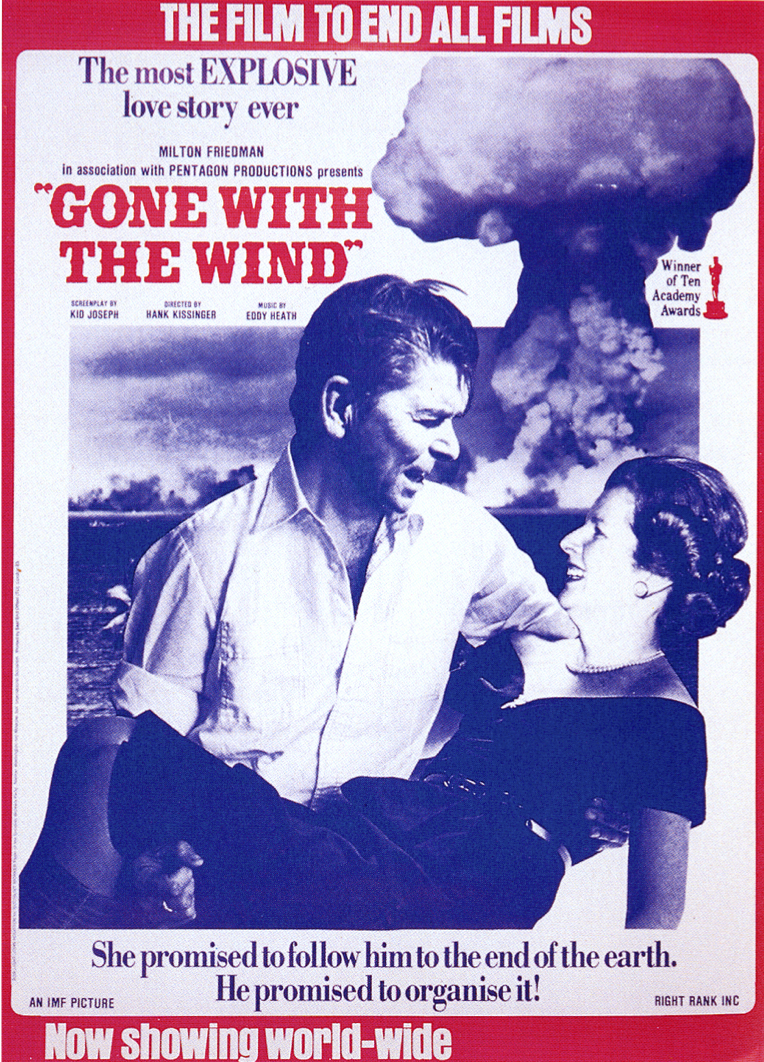
Gone With The Nuclear Wind?

Tomorrow Might Not Be Another Day: The poster which swept the pre-Internet world in the anti-nuclear 80s. Those born in the post-Cold War period have little idea of how pervasive was the fear of nuclear annihilation. Those weapons have not gone away. Vladimir Putin's reassertion of his country's geopolitical interests may yet reacquaint the world with the fears of the 1980s. The Russian bear still has nuclear teeth.
 
IT WAS ONE of the most famous posters of the anti-nuclear 80s. Parodying the 1939 movie poster promoting Gone With The Wind, the 1980s version depicted Ronald Reagan in the role of Rhett Butler, and Margaret Thatcher as Scarlet O’Hara. Instead of rescuing his heroine from the wreckage of a burning Atlanta, Reagan carried Thatcher from the fallout of an ominous mushroom cloud. The anti-nuclear poster’s tag-line read: “She promised to follow him to the end of the earth. He promised to organise it.”
 
Black humour? Undoubtedly. But the worldwide popularity of the poster in those pre-Internet days speaks volumes about the existential fears of ordinary people everywhere that their leaders were impelling them towards a nuclear Armageddon.
 
These globally experienced fears were given specific expression in New Zealand by the nationwide movement to have the country declared nuclear-free. Distracted by the upheavals of the Springbok Tour for most of 1981, the Nuclear-Free New Zealand Movement only began gathering serious political momentum in 1982. By 1984, however, there were very few cities and towns in New Zealand that had not declared themselves nuclear-free. The incoming Labour Government, elected in July 1984, had little option but to go with the flow. Among its rank-and-file members (all 85,000 of them!) anti-nuclear sentiment was as intense as it was immovable.
 
It is difficult for New Zealanders who did not live through the early-1980s to appreciate just how tense the stand-off between the USA and the Soviet Union had become.
 
President Reagan and Prime Minister Thatcher were both implacable cold warriors. Indeed, when asked by a youthful aide to sum up his position on the Cold War, President Reagan breezily replied: “Well, I think we should win it.”
 
Soviet leaders, by contrast, came and went with almost comical speed. Between the death of Leonid Brezhnev in 1982 and the accession of the Soviet Union’s last leader, Mikhail Gorbachev, in 1985, the world welcomed and farewelled in quick succession Yuri Andropov and Konstantin Chernenko.
 
Meanwhile, as the Soviets were casting about frantically for a leader capable of lasting longer than eighteen months in office, Nato forged ahead with its plans to install nuclear-tipped Cruise missiles – a first-strike weapon – along the length of the Iron Curtain. Not surprisingly, the vast nuclear arsenals of the opposing superpowers were on a hair-trigger.
 
To New Zealanders born after 1991, the year the Soviet Union quietly blipped-off History’s screen, the mutual and assured destruction (MAD!) strategies of the Cold War era are mostly experienced as the more-or-less harmless echoes from a far-off, but very-far-from-harmless, historical era.
 
Today’s 24-year-olds may be intellectually aware that substantial stockpiles of nuclear weapons still exist in the United States and the Russian Federation, but the oppressive sense of their parents’ generation, that the slightest political miscalculation (or even a flock of errant geese!) might trigger the utter destruction of human civilisation, has, mercifully, faded from memory.
 
Global Warming, the existential threat du jour, may prove to be equally devastating, but its effects will be experienced over decades – not in the micro-seconds of a nuclear detonation.
 
Meanwhile, as the Millennials battle to prevent runaway global warming, another, all-too-literal battle rages between the forces of the Nato-supported Ukrainian government and the Russian-backed militias of Ukraine’s breakaway eastern provinces. Reported only fitfully in the Western news media, this conflict now threatens to escalate into a general European war. As former Swedish Prime Minister, Carl Bildt, told the Frankfurter Allgemeine Zeitung on Sunday.
 
“Unfortunately, war with Russia is conceivable. We are definitely living through one of the more dangerous historical phases, especially if you view the situation from a European perspective […] What makes the situation so explosive is that there is also great uncertainty about global power relations.”
 
The global uncertainty Mr Bildt speaks of is being fuelled by statements issuing from the United States Vice President, Joe Biden, reaffirming the Obama Administration’s determination to “allow Ukraine to defend herself”. By which the Americans mean – be given access to the heavy weapons necessary to drive back the pro-Russian separatists.
 
The German Chancellor, Angela Merkel, has reacted sharply to the Vice President’s statement, declaring that she could not “imagine any situation in which improved equipment for the Ukrainian army leads to President Putin being so impressed that he believes he will lose militarily.”
 
Only now is the European Union beginning to grasp its reckless folly in allowing anti-Russian extremists within Nato to connive in the fascist-supported overthrow of Ukraine’s democratically-elected President, Victor Yanukovych, in February 2014. Only now, having spent the last 12 months baiting the Russian bear, have the Europeans, the Americans, and the rest of us, belatedly remembered that the Russian bear has nuclear teeth.
 
The Nato powers promise to follow the fascist-backed Ukrainian regime to the end of the earth. Vladimir Putin offers to organise it.
 
This essay was originally published in The Press of Tuesday, 10 February 2015.

Sunday, 2 March 2014

Coup d'état By Crowd

Same Scene, Different Flag: No, it's not Kiev's Independence Square. This "revolutionary" crowd gathered in the Georgian capital of Tbilisi in 2003. Another of the so-called "Colour Revolutions", Georgia's "Rose Revolution" unfolded in a manner remarkably similar to the overthrow the Serbian government in 2000. The same elements were also present in the "Orange Revolution" which convulsed Kiev a year later in 2004 - and again, in 2014.
 
WHAT HAVE WE JUST SEEN? A revolution? It certainly looked like one. There were crowds, vast crowds, singing patriotic songs in Kiev’s Independence Square, their collective breath rising up like smoke in the freezing winter air. There were Riot Police, too, naturally. Hundreds of them – looking for all the world like Roman Legionaries lost in time and space. There were even barricades – just like in Les Miserables.
 
And did we hear the Ukrainian people sing? You bet we did!
 
At least, that is what we thought we heard – and saw.
 
We have such short memories now. Last year is already so last year. Expecting us to remember what happened 14 years ago, in Serbia, would be completely unreasonable. You might as well ask us to remember what happened a thousand years ago in Serbia.
 
It’s useful, this collective historical amnesia. Not to us, but to the sort of people who stage-manage revolutions. If you’re that sort of person, a fully-functioning historical memory is an extremely dangerous thing.
 
A fully-functioning historical memory would instantly recall what happened in Serbia in 2000: the vast crowds; the riot police; the barricades; the fall of the dictator; the flowering of democracy. It would also remember what happened in Georgia three years later: the vast crowds; the riot police; the barricades; the fall of the dictator; the flowering of democracy. Heck! It would remember what happened in Ukraine itself, just ten years ago: the vast crowds; the riot police; the barricades; the fall of the dictator; the flowering of democracy.
 
If you’re noticing a pattern here – well done! And, if you were wondering what to call it, try “coup d’état by crowd”.
 
Blows against the state were once delivered with a mailed fist. In the Cold War period the iconography of “regime change” was very different from what we have just witnessed in Ukraine.
 
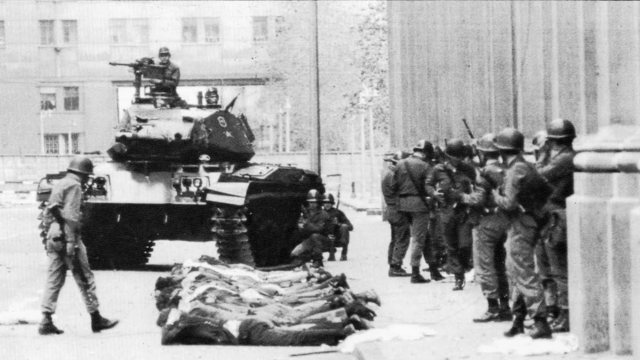
A fully-functioning historical memory would recall vividly the day General Pinochet unleashed the Chilean military against the democratic socialist government of Salvador Allende. On 11 September 1973 the world looked on helplessly as Skyhawk jets bombed the Presidential Palace, tanks rumbled through the streets of Santiago and the national football stadium filled up with bruised and broken political detainees.
 
It wasn’t pretty, but Uncle Sam recalled the Soviet tanks that had rumbled through the streets of Prague just five years earlier and laid claim to a rough-and-ready moral equivalence. “When it’s up against a regime like that,” argued Uncle Sam, “only dictatorship can save democracy.”
 
Regime Change Cold War-style: When only dictatorship could save democracy, the USA was happy to see its enemies deposed by military force. Chile, 1973.
 
But, after the fall of the Berlin Wall and the collapse of the Soviet Union, the old excuses no longer washed. At what Francis Fukuyama dubbed “the end of history” all the great geo-political conundrums were resolvable only by free-market capitalism and liberal democracy. If Uncle Sam wanted regimes to change in Christian lands he’d have to come up with a solution that left a lot less mess than strike aircraft, tanks and mass executions. (In the Islamic world, effecting regime change is still a blood sport.)
 
Enter the “Colour Revolutions” of 2000-2005: regime changes utilising methods that fell somewhere between a soft and a hard application of American power.
 
But, like the proverbial iceberg, “revolutions” of the sort we have just witnessed in Ukraine hide much, much more than they ever let us see.
 
Long before the first student protester’s boot hits the streets of the targeted capital, Uncle Sam has been busy for months. He’s seeded the media with sympathetic journalists; bought and paid for reliable polling agencies; stuffed sympathetic NGO’s bank accounts with cash; and “advised” the armed forces high command (most of them trained in the US) to keep the Government’s troops in their barracks.
 
Only then do the protest leaders, fresh from their “civil resistance” training programmes, fully equipped with state-of-the-art IT and communications equipment and chaperoned by the best and the brightest the CIA can spare, step out to accomplish the fall of the dictator and the flowering of democracy.
 
This essay was originally published in The Dominion Post, The Waikato Times, The Taranaki Daily News, The Timaru Herald, The Otago Daily Times and The Greymouth Star of Friday, 28 February 2014.