Showing posts with label War. Show all posts

Friday, 24 July 2015

Time To Stop "Dribbling" And Start "Clouting"?

Boots On The Ground: The former head of the UK armed forces, General David Richards, suspects in his “bones”, that if the Islamic State is to be defeated, then the armed forces of the West will have to stop "dribbling" and start "clouting". In the General’s words: “tanks would have to roll and there’s going to have to be boots on the ground”.
 
ARE WE AT WAR with the Islamic State – or not? The Prime Minister says “Not”. Our role in the conflict between the Islamic State and its enemies is merely to assist the government of Iraq’s Prime Minister Haider al-Abadi. Sixteen NZ Defence Force personnel are stationed less than an hour’s drive north of Baghdad at Camp Taji – a former US military base. Their mission: to help train Iraq’s army. A further 100 Kiwi troops have been sent to provide them with protection while they get on with it. That’s all.
 
This is what General David Richards, former head of the UK’s armed forces, and current member of the House of Lords, calls “dribbling” – the sort of one-handed military activity soldiers are required to engage in when their political masters would rather not have them wage war with both hands.
 
Lord Richards has warned UK Prime Minister, David Cameron, that, when it comes to defeating the Islamic State, “dribbling” will not be enough. What’s needed against the highly motivated and exceptionally well-led soldiers of the self-proclaimed Caliphate is “clouting”.
 
“Properly brought together with proper leadership and proper command and control it is a very doable proposition”, Lord Richards told the BBC’s Andrew Marr. “But I worry that […] if we dribble, which is really rather what we are doing at the moment, it is simply firing up the problem rather than dealing with it.”
 
The former head of the UK armed forces told Marr that he suspected, in his “bones”, that if IS to be defeated, then its army will have to “clouted” by his country’s soldiers – on the front lines. In the general’s words: “tanks would have to roll and there’s going to have to be boots on the ground”.
 
But the UK could not possibly do this alone. After 14 years of fighting in Afghanistan and Iraq, the UK’s defence force is bruised, battered and in urgent need of repair and replenishment. Lord Richards knows full-well that what he is really calling for is the assembly of another great Western invasion force; comparable in strength to Operation Desert Storm, and guided by similar, strictly limited, objectives.
 
The mission of Operation Desert Storm was to drive the Iraqi Army out of Kuwait. The core mission of this new Western force would be the utter destruction of the Islamic State in Iraq and Syria. To render the defeat of IS permanent, however, it would, almost certainly, be necessary to accomplish the complete pacification of Syria and the disarmament of the Iranian-backed Shite militias operating in Iraq.
 
The elimination of the murderous regime of President Bashar al-Assad, and the disarmament of his many enemies, would lift a huge burden from the shoulders of Syria’s neighbours. Millions of refugees, driven across borders by civil war and religious extremism, would be free to return, and the arduous task of reconstructing their ancient homeland could, finally, begin.
 
An effort of such magnitude on the part of the West – especially the USA and the UK – is the only truly effective means of bringing the multiple tragedies of the last quarter-century in the Middle East to an honourable resolution.
 
The barbarity of IS is an affront, not just to the peoples of the Islamic world but to all humanity. And, in their heart of hearts, the USA and the UK both know its poisonous creed could only have been distilled from the seething cauldron of hatred and resentment which their 2003 invasion of Iraq created. “You break it, you own it”, quipped US Secretary of State, Colin Powell, back in 2003. Well, between them, the USA and the UK smashed Iraq into a thousand pieces, and now they must make her whole again.
 
Do the peoples of the West have the stomach for another great military effort in the Middle East. Many would say “No.” But they should fix their eyes on the tens-of-thousands, desperate and despairing, who daily make their way toward Europe’s borders. If the West does not bring peace to the Middle East, then the Middle East will bring chaos to the West. Lord Richards knows the efficacy of forward defence, that is why he is urging his prime minister to stop dribbling and start clouting.
 
Would it be asking too much of our own defence force, and prime minister, to do the same?
 
This essay was originally published in The Waikato Times, The Taranaki Daily News, The Timaru Herald, The Otago Daily Times and The Greymouth Star of Friday, 24 July 2015.

Saturday, 18 July 2015

One Hand Clapping? Why Ika’s Latest Intellectual Meal Proved Less-Than-Satisfying.

Bring On The Dialectic: Politics without conflict isn’t politics. For Ika's "Table-Talk" evenings to work, there need to be speakers seated on both sides.
 
I’VE BEEN RACKING MY BRAIN ever since Tuesday evening, trying to work out what went wrong.
 
The occasion was another of the Ika Seafood Bar & Grill’s “Table-Talks”. On the face of it, I should have come away from the event feeling intellectually replete. Our hosts for the evening, TV3 journalists Mike McRoberts and Paula Penfold, as seasoned professionals, were well-placed to handle the two-and-fro of discussion. The invited panel of speakers: war correspondent, Jon Stephenson; former Green Party spokesperson on foreign affairs and defence issues, Keith Locke; and the General Manager of the Changemakers Refugee Forum, Tayyaba Khan; brought considerable experience and expertise to the question “New Zealand at War: Where are we and what are we doing there.” And yet, I came away feeling intellectually famished. Why?
 
The answer I’ve arrived at, after mulling the question over for 72 hours, is rather convoluted, so please, bear with me, while I try to explain.
 
In my opinion, all politics is adversarial. So, if I find myself at an event and there’s no conflict, then, whatever’s happening, it isn’t politics. On Tuesday, for example, nobody questioned the fundamental premise of the topic under discussion – that New Zealand is at war. Nor was there any disagreement about why New Zealand military personnel are stationed in the Middle East. It was simply assumed that this was the price of admission to John Key’s “Five Eyes Club”. That this is not a Club New Zealand should belong to, and that, anyway, the admission price is much too high, was not disputed.
 
The audience did not object. Indeed, there was almost complete accord between what the panellists were saying, and what the audience believed to be true. Boiled down to its essentials, this could be summarised as: War is a very bad thing. It inflicts terrible and ineradicable injuries upon bodies and souls. This, in turn, produces a downward spiral into ever more horror and violence. New Zealanders, therefore, should have nothing to do with war – except to offer as much help as possible to its victims.
 
The audience had arrived at Ika with these opinions, and, as far as I could determine, they left with them either unchanged or considerably reinforced. Which meant that, for me, nothing political had occurred. The participants had applauded a series of eloquent and heart-felt reiterations of views with which they strongly agreed. No one was challenged. No one was forced to defend their beliefs.
 
War is, indeed, a very bad thing. Thank you for coming, and have a safe journey home.
 
Consider the impact of the following, counterfactual, Table-Talk.
 
The first speaker, a military historian, openly disputes the assertion that New Zealand is at war. He asserts that the dispatch of a fraction of New Zealand’s small, highly professional, defence force as advisers to the armed forces of the Republic of Iraq, in no way meets the definition of a country at war. He asks his audience to recall what they have been told about life in New Zealand during the first and second world wars, and then to compare the experiences of our parents and grandparents with life in New Zealand today. Can we really say, with any honesty, that this country is at war? Syria, he declares, is at war. New Zealand is not.
 
He then turns his attention to the question: “What are we doing there?”
 
Our oil, their sand? Photo by Jon Stephenson
 
There must be a very good reason, he says, why first Great Britain, and then the United States, have been willing to expend so much blood and treasure over a part of the world distinguished primarily by heat and dust. And, of course, there is a very good reason. A reason which every person in the audience who drove to the restaurant, and who intends to drive home, should be able to guess. The UK and the USA have been interfering in the Middle East for the past 100 years for the very simple reason that – as one American wit put it: “Unaccountably, a huge proportion of our oil has ended up under their sand.”
 
That would have been more than enough. The introduction of a set of perspectives so radically at odds with those of the Ika audience would have transformed the evening from an opportunity for people to bear witness to a set of pre-agreed articles of faith, to a full-scale political engagement between a handful of military and diplomatic realists and a roomful of neutralists and pacifists. Those articles of faith might have been tested. People’s beliefs would, without question, have been challenged.
 
Politics without conflict isn’t politics. For Table-Talk to work, there need to be speakers seated on both sides.
 
This essay was originally posted on The Daily Blog of Saturday, 18 July 2015.

Tuesday, 3 March 2015

War And Democracy

Gallant Deeds: New Zealand SAS troopers returning from a bitter fire-fight at the Kabul Intercontinental Hotel, Afghanistan, June 2011. The NZ Defence Force is fanatical in its determination to control the totality of information emerging from the theatres in which its personnel are engaged. Independent journalism, of the sort so vital to the workings of a viable democracy, is aggressively discouraged.
 
WAR AND DEMOCRACY do not mix. They never have and they never will.
 
Even during World War II – the “Just War” to beat all Just Wars – a drastic curtailment of domestic civil rights was deemed unavoidable by fascism’s democratic opponents.
 
The Cold War, similarly, engendered a climate of fear and suspicion. Tremendous courage was required to challenge the “Free World’s” interpretation of international affairs. At home, dissidence of any kind was met with vicious persecution. Failure to toe the official line on “the communist threat” could seriously threaten your career; your liberty; even your life.
 
 Governments have always preferred to fight their wars in black and white. Shades of grey are regarded as, at best, confusing, and, at worst, demoralising. In the fraught aftermath of the 9/11 attack on the United States, President George W. Bush made it chillingly clear that the Global War on Terror would be waged uncompromisingly on this crude binary basis. “Every nation in every region now has a decision to make”, intoned the President. “Either you are with us, or you are with the terrorists.”
 
Such statements are hostile to the very essence of democracy, which, since its earliest manifestation in Ancient Athens, has been about the people’s right to deliberate upon all matters relating to their interests; about weighing the options carefully and responsibly; and, most importantly, about their right to disagree.
 
But these, the fundamental tenets of democracy, are not the fundamental tenets of waging war. Soldiers do not deliberate. They are not encouraged to weigh their options. And they are absolutely forbidden to disagree.
 
America’s experience in Vietnam demonstrated how rapidly the efforts of the armed forces can be undermined by democratic disagreement at home. The moral ambiguity of the Vietnam conflict made some degree of tension between the battle front and the home front inevitable. The justifications offered to the American public for the fight against fascism, which had kept them behind the war-effort for the duration, simply weren’t available to America’s leaders in their brutal struggle against Vietnamese peasants. Such justifications as they did attempt were routinely demolished by the uncompromising journalism of America’s war correspondents.
 
Never again. Less than ten years after America’s final, panicked retreat from Vietnam, the British were waging a war in the Falkland Islands from which any chance of independent and uncensored war journalism was being ruthlessly excised. The concept  of “embedded” journalism (if not the expression) ensured that the content and supervision of the war’s media presentation would remain firmly in Mrs Thatcher’s hands. The Americans were only too happy to follow the lead of their British cousins. By the time Uncle Sam was ready to pull on his desert camouflage gear, independent war reporting had joined long hair and flared jeans as just another icon of the seventies.
 
British and American politicians were as keen to apply the new techniques of media management on the home front as the military had been on the frontlines. Understandably so, since the military and civilian impacts of war are impossible to separate. As the British Prime Minister, Lloyd George, said of the horrors of World War I:
 
“If the people really knew, the war would be stopped tomorrow. But of course they don’t know and can’t know. The correspondents don’t write and the censorship wouldn’t pass the truth. What they do send is not the war, but just a pretty picture of the war with everybody doing gallant deeds.”

The True Face Of War:
"If people really knew, the war would be stopped tomorrow" - Lloyd George
 
The depiction of gallant deeds lies at the heart of the New Zealand Defence Force’s media brief. It is what their political masters demand, and their commitment to the task borders on the fanatical. Nothing strikes fear into the NZDF like the news that an independent Kiwi journalist is in the field asking questions, interviewing locals, following leads and painstakingly assembling stories that owe nothing to, and may sharply contradict, the official narrative. Operating in regions where New Zealand forces are deployed, unembedded war correspondents are considered little better than terrorists.
 
This is how New Zealand’s wars are brought back home. Ultimately, “managing” the media means subverting the media. It’s about co-opting and corrupting the profession upon whose independence and integrity a healthy democracy depends. A journalist persuaded to pull his or her punches for the sake of “our men and women on the ground” may prove equally cooperative in relation to other, equally “sensitive”, government policies.
 
And it doesn’t stop there. New Zealand’s coroners will soon be legally prevented from inquiring too closely into battlefield deaths. In the interests of “national security” future investigations will be left to the NZDF. According to an NZDF spokesperson, it is important to strike a balance between independent investigation and ensuring judicial scrutiny does not encroach into “matters of state”.
 
War’s aversion to democracy could hardly be more plainly stated.
 
This essay was originally published in The Press of Tuesday, 3 March 2015.

Friday, 13 February 2015

Give War A Chance

Mars Takes The Field: The role warfare has played throughout history in reconciling the irreconcilable and solving the insoluble is beyond dispute. Sometimes, if peace is not in prospect, it pays to give war a chance.
 
THE RUBBLE in Europe and Asia was still smoking when representatives from 51 nations assembled in the undamaged United States city of San Francisco in June of 1945. Calling themselves the “United Nations”, they there inscribed their collective determination, “to save succeeding generations from the scourge of war, which twice in our lifetime has brought untold sorrow to mankind”.
 
Surveying the corpse-strewn landscape which separates us from those hopeful signatories of ‘45, you’d have to say that Peace has failed. Over the past 70 years, barely a day has passed without the scourge of war bringing untold sorrow to at least one unfortunate member of the family of nations somewhere in the world.
 
That the existence of the United Nations has spared us all a third global conflict is less a testimony to the wisdom and forbearance of a chastened humanity, than it is to the certainty that, being waged with nuclear weapons, World War III would’ve had no victors and no survivors.
 
And yet, in spite of the UN’s consistent failure to save succeeding generations from its effects, War continues to be both rejected and condemned as an instrument for the advancement of national policy. Though member states of the United Nations have regularly unleashed war upon their fellow UN members for precisely that purpose, the pious hopes enshrined in the UN Charter remain the official expression of what is – and is not – acceptable international conduct.
 
Is humanity well-served by this extraordinary hypocrisy?
 
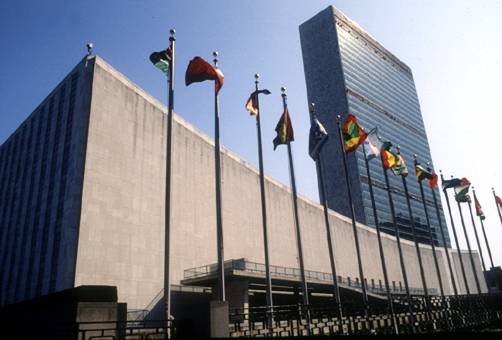
Extraordinary Hypocrisy: The United Nations headquarter in New York City.
 
When a prominent politician from the United States, the nation which, in complete contravention of the UN Charter, launched a full-scale military invasion of Iraq, shamelessly castigates the Russian President, Vladimir Putin, for “violating Ukraine’s national sovereignty”, one struggles to muster any kind of respect for the existing international system.
 
Indeed, one wonders (heretically) whether the world might not be better off if the number of nation states belonging to the United Nations (currently 193) was significantly reduced. With the benefit of hindsight, isn’t it at least arguable that the much-vaunted principle of “national self-determination”, far from making the world a more peaceful place, has actually increased the incidence of organised violence?
 
In a similar vein, wouldn’t it be a lot easier to respond to global crises, such as anthropogenic global warming, if humanity was aggregated into larger, rather than smaller, political units? If it’s possible to construct banks and corporations that are “too big to fail”, might it not also be possible to create states that are “too big to lose”?
 
And where nations are embroiled in bitter conflict, as in the Middle East, shouldn’t it be acknowledged, honestly, by nations outside the region, that war may be the only effective means of re-arranging the pieces on the board?
 
Even more heretically, should we not ask whether nation states are even the most sensible solution to conflicts whose origins lie not in ethnicity or geography but in matters of religious doctrine?
 
Certainly, it is the view of James Traub, from the Centre for International Co-Operation, that what we are witnessing in the Middle East is not a “clash of civilisations”, but clashes within a civilisation. The war, argues Traub, is “not between ‘us’ and ‘them’ but inside the Islamic world.”
 
Would the planet be better or worse off if the outcome of this war inside the Islamic world was the emergence of a political entity roughly akin to the open, tolerant and inclusive Abassid Caliphate that once stretched all the way from Baghdad, in what is now Iraq, to Tunisia? Such an outcome would have less to do with redrawing national boundaries than it would with redefining the way Muslims express their religion.
 
The rules governing the relationships between nation states, as elaborated by we Europeans, are, in part, the product of our own civilisation’s inability to resolve religious schisms. But, whether the conflicts currently tearing the Islamic world apart can be resolved by the principles enshrined the 1648 Treaty of Westphalia, which ended the Thirty Years War between Catholics and Protestants, is highly debateable.
 
Beyond dispute, however, is the role warfare has played throughout history in reconciling the irreconcilable and solving the insoluble. Sometimes, if peace is not in prospect, it pays to give war a chance. Alexander the Great didn’t unravel the impossibly complex Gordian Knot with his fingers. He used his sword.
 
This essay was originally published in The Waikato Times, The Taranaki Daily News, The Timaru Herald, The Otago Daily Times and the Greymouth Star of Friday, 13 February 2015.