Showing posts with label United Nations. Show all posts

Monday, 14 March 2022

Of American Geese And Russian Ganders.

Moral And Diplomatic Failure: Shouldn’t journalists from small nations like New Zealand be reminding the international community of its obligation to not only demand full accountability from those nations that commit crimes against humanity, but also from those that cause them?


SATURDAY NIGHT’S BULLETIN of 1 News featured a very peculiar, and disturbing, item. Put together by journalist Thomas Mead, the item noted with alarm the fact that some New Zealanders were backing Vladimir Putin and Russia against Volodymyr Zelenskyy and Ukraine.

Those involved were described by Mead as “conspiracy theorists”, a term he appeared to be using as a synonym for “evil crazies”. This highly tendentious characterisation was not in the least challenged or repudiated by the two academics Mead consulted. Neither the political scientist, Steve Hoadley, nor the University of Auckland’s “Misinformation Project” spokesperson, Snajama Hattotuwa, challenged Mead’s assumptions about Putin’s supporters.

Were New Zealand at war with the Russian Federation, then this degree of overt media propagandising might, just, be excusable. When the youth of one’s country are locked in an existential struggle with its enemies, balance and nuance tend to fall by the wayside. A war being fought on the other side of the world, however, surely requires plenty of both. Demonising one’s fellow citizens for the “sin” of refusing to view a faraway war through the lens of their own government serves neither journalism nor democracy.

Then again, since the New Zealand Parliament has, unanimously, rushed through all the stages of a bill enabling the New Zealand state, independently of the United Nations Security Council, to impose sanctions on Russian businesses and individuals, perhaps New Zealand really is at war with the Russian Federation.

While the imposition of economic sanctions on another country and its citizens falls well short of ordering one’s armed forces into battle against them, it is difficult to characterise the measure as anything other than a declaration of economic warfare.

An effective sanctions regime, by wreaking havoc on the targeted nation’s economy is intended to inflict non-physical harm on its citizens. It is, unquestionably, an act of coercion. A lesser act of coercion, at least in the short term, than firing artillery shells and dropping bombs, but an act of coercion nonetheless.

This is why the imposition of sanctions, a remedy institutionalised by the League of Nations in the years immediately following World War I, was presented as the most effective international response to aggression – short of all-out war. It amounted to a declaration of economic hostilities upon the aggressor state by the whole world. As such, it made it difficult for the aggressor state to retaliate effectively. It also constituted an unanswerable international moral rebuke of the offending nation’s actions.

Re-adopted by the United Nations following the Second World War, the sanctions option was placed in the hands of the UN Security Council. Providing the five permanent members of the Security Council (USA, Russia, UK, France and China) were in agreement, the world would be empowered to squeeze the economy of an aggressor state until the pips squeaked.

There was, however, an inherent weakness in this arrangement. Since only the world’s most powerful states were ever likely to thumb their noses as the United Nation’s Charter, and since those states could veto any intervention by the UN Security Council, then the application of sanctions as a means of coercing delinquent states into demonstrating an acceptable standard of international conduct became something of a dead letter.

New Zealand has long been a critic of the veto power of the five permanent members of the UN Security Council – depicting it as a fundamental obstacle to the enforcement of the provisions of the UN Charter. A little reflection, however, makes it perfectly clear why the veto power has always been critical to the maintenance of international peace and stability.

What possible reason for retaining their membership of the United Nations would the great powers have if it was possible for a majority of the five permanent members to “gang-up” on the rest? It is the veto that keeps the planet’s most dangerous nations seated around the multilateral table. If the UN Security Council had possessed the power to impose sanctions on the Bush Administration for its unlawful invasion of Iraq, would the USA still be a member of the UN? Of course not.

The problem which now confronts the world is that the preponderant economic and military power of the United States has persuaded its leaders to evade the limitations associated with the veto by imposing swingeing economic sanctions upon its enemies without Security Council authorisation. It masks this dangerous unilateralism by pressuring those states under its sway (which includes most of the world’s nations) into joining its sanctions regimes. Any reluctance on the part of US “allies” to participate in these brazen acts of economic coercion is overcome by threatening to extend the sanctions to any entity deemed guilty of ignoring them.

In a more rational world, the very fact one of the five nuclear-armed permanent members is contemplating exercising its veto would be enough to convince the other four that a full-scale diplomatic effort is required to identify the most fruitful options for easing the tension. Tragically, the most malign legacy of the Cold War, which froze international relations for forty years, is the way in which its “Free World” allies have opted to remain passengers on the United States’ war chariot, and how many of its erstwhile Warsaw Pact enemies have sought its protection from their former Russian suzerain.

That Russia would eventually demand to know why sauce for the American goose was not also sauce for the Russian gander was inevitable. If the Americans could determine that a nation thousands of miles from its shores, which had made no aggressive move in its direction, could nevertheless be invaded by a coalition led by two of the five permanent members of the Security Council – ostensibly to defend themselves – then Moscow was surely entitled to do the same to a nation located on its western border which had voiced its determination to throw in its lot with Russia’s Nato “enemies”.

That the answer: because two wrongs do not make a right; and that it is no more acceptable for Russian missiles to kill Ukrainian children than it was for American missiles to kill Iraqi children; should have been obvious to Vladimir Putin, is, unfortunately, no help at all. Because the chancelleries of the world looked the other way when the USA tore up the UN Charter in 2003, their powers of moral persuasion in 2022 are not as forceful as they should be.

Rather than replicating the McCarthyism of the Cold War, shouldn’t journalists from small nations like New Zealand be reminding the international community of its obligation to not only demand full accountability from those nations that commit crimes against humanity, but also from those that cause them?


This essay is exclusive to Bowalley Road.

Friday, 23 November 2018

If We'd Been Lucky.

The Big IFs: We are so unlucky that it has come to this. Especially when, had things worked out just a little differently we might have had a chance. If Florida’s voters had swung decisively behind Al Gore in the 2000 US Presidential Election. If the Baby Boom Generation hadn’t abandoned their idealism for cycling holidays in France and a renovated kitchen. If the Millennials possessed an attention span just a little bit longer than a goldfish’s. If the Internet hadn’t allowed us all to become so stupid.

NOBODY WANTS TO KNOW. That 150 academics have put their name to a letter urging the government to do something – anything – about  climate change: nobody wants to know. The letter itself is a response to the latest report from the Intergovernmental Panel on Climate Change (IPCC). That report gives the world just 12 years to fundamentally refashion industrial civilisation or face runaway global warming. But, nobody wants to know.

We are so unlucky that it has come to this. Especially when, had things worked out just a little differently we might have had a chance. If Florida’s voters had swung decisively behind Al Gore in the 2000 US Presidential Election. If the Baby Boom Generation hadn’t abandoned their idealism for cycling holidays in France and a renovated kitchen. If the Millennials possessed an attention span just a little bit longer than a goldfish’s. If the Internet hadn’t allowed us all to become so stupid.

Al Gore would almost certainly have got Bin Laden before he got America. (The Democrats recognised Osama as a threat, the Republicans were more focussed on Iraq and Iran.) So, no 9/11. No War on Terror. No invasions of Afghanistan and Iraq. A less crazed world. A real chance that the big global players: the USA, the UK, the EU, China, Japan and the Russian Federation might have trusted each other enough to come together around the science and take climate change seriously.

What would that have looked like? Well, if we’d been lucky, the Big Six would have pooled their resources and “internationalised” the fossil fuels industry. The slow and painful process of weaning the world off oil and coal could have begun – unimpeded by the oil industry’s denialist propaganda.

Encouraged by their success, the Big Six might then have embarked on an equally grand international effort dedicated to moving the world towards the adoption of renewable energy. Unburdened by ruinous levels of military spending, the leading economies would have been free to invest billions in the development of sustainable industrial processes.

The effect on the world’s peoples of all this global co-operation in the name of bequeathing a healthy planet to future generations is readily imagined. The audience for the promoters of jihad would have shrunk away to nothing – especially after the Big Six imposed a just territorial settlement on Israel and the Palestinians and then guaranteed the peace that followed. Rather than the disillusionment and despair that followed the world’s horror-filled descent into post-9/11 extremism, the example of the great powers working together would have engendered a global spring of hope.

Global finance would not have been happy but, in the new atmosphere of “can do” internationalism, the nostrums of neoliberalism would have lost much of their persuasive force. “Globalisation” would have acquired a new and extremely positive set of associations and the electorates of the world’s nation-states would have been quick to punish any political party which set its face against the humane and ecologically-informed values of the new era.

The United Nations, now lavishly funded by the Big Six, would not so much have assumed a greater role in global governance as had that role thrust upon it. At long last, the idea of a single world army was no longer being dismissed out-of-hand by the five permanent members of the Security Council. Indeed, driven by the Big Six, a new World Security Force, composed of contingents contributed by all of the UN’s member states, would soon be standing guard over the Pax Humanitas.

Not that there were very many enemies left to fight. With the production of weapons now a strictly controlled UN monopoly, the promotion and extension of human conflict was no longer a paying proposition. Indeed, because we had been lucky all those years before, the commemoration of World War I became the excuse for a very special international undertaking. On the eleventh hour of the eleventh day of the eleventh month 2018, the last nuclear weapon in the world was decommissioned.

Except, of course, we weren’t lucky. The world has not drawn closer together, it has grown farther apart. In the eighteen years since November 2000 the urgent remedial effort required to slow anthropogenic global warming has not taken place. The scientists see what’s coming. They’re begging us to, please, do something!

But nobody wants to know.

This essay was originally published in The Otago Daily Times and The Greymouth Star of Friday, 23 November 2018.

Tuesday, 17 April 2018

Jacinda Has A Bob Both Ways On Syria.

Hard Choices: When confronted with an unsanctioned military strike against a fellow member of the United Nations, a New Zealand prime minister has two viable choices. Either, she can line up behind New Zealand’s traditional allies and deliver a hearty endorsement of their actions. Or, she can take a stand on principle and distance her country from the justifications, decisions and actions of the aggressors.

THE LATEST STRIKE against Syria [14/4/18] marks a further deterioration in the conduct of international affairs. Of more concern, however, is the quality of the response it elicited from Jacinda Ardern. The New Zealand Prime Minister’s remarks were not the sort to inspire either confidence or respect.

In matters of this kind, a prime minister has two viable choices. Either, she can line up behind New Zealand’s traditional allies and deliver a hearty endorsement of their actions. Or, she can take a stand on principle and distance her country from the justifications, decisions and actions of the nation’s involved.

What a leader should not do is attempt to have a bob each way. Why? Because, as the Ancient Greek storyteller, Aesop, pointed out some 2,500 years ago: “He who tries to please everybody, ends up pleasing nobody.”

New Zealand prizes highly its contribution to the formation of the United Nations. The Labour Prime Minister, Peter Fraser, worked hard to advance the rights of small nations at the San Francisco conference which gave birth to the UN in 1945. Fraser, and just about every Labour PM since 1945, has chafed against the veto-powers of the five permanent members of the UN Security Council – rightly predicting that they would severely constrain the UN’s mandate to keep the global peace. Identifying the UN as the most appropriate forum for resolving the Syrian crisis and decrying the use of the Veto was, therefore, an entirely predictable and consistent position for New Zealand’s present Labour Prime Minister to adopt.

Had Ardern denounced the vetoing, by the United States, of a Russian Federation proposal for an international inquiry into the alleged chemical warfare attack on Eastern Ghouta, as well as the Russians’ tit-for-tat vetoing of a similar proposal put forward by the US, she would have elicited widespread support from UN member states.

That support would have grown if she had further declared her disappointment that military action had been initiated by the US, France and the United Kingdom (all permanent members of the Security Council) before inspectors from the Organisation for the Prohibition of Chemical Weapons (OPCW) had been given a chance to examine the scene of the alleged attack, gather samples, and make their report.

She could also have announced that, if the Eastern Ghouta incident was confirmed by the OPCW as a chemical attack, then New Zealand would be seeking a vote explicitly condemning its perpetrators at the UN General Assembly, as well as a re-confirmation of the UN ban against the deployment and use of chemical and biological weapons.

Such a course of action would have identified New Zealand as an outspoken defender of the UN Charter and encouraged other small states to take a stand against the precipitate and unsanctioned military actions of the United States and the two former imperial powers most responsible for the century of instability which has beset the nations of the Middle East –  France and Britain.

At a more pragmatic level, such a response would undoubtedly have strengthened New Zealand’s relationship with that other permanent member of the Security Council, the People’s Republic of China. The Chinese have consistently and vehemently opposed unsanctioned and unprovoked military attacks against the sovereign territory of fellow UN member states.

Such would have been the high road for New Zealand: coherent, consistent and principled.

Alas, it was not the road Ardern chose to take.

Instead, having lamented the Security Council’s veto-induced paralysis, the statement issued by New Zealand’s prime minister went on to say:

“New Zealand therefore accepts why the US, UK and France have today responded to the grave violation of international law, and the abhorrent use of chemical weapons against civilians.”

Using fewer than 30 words, Ardern telegraphed to the world that New Zealand’s fine words about diplomacy and multilateralism should be dismissed as mere rhetoric. In reality, her country is perfectly willing to set aside its commitment to the peaceful resolution of conflicts between nation states, and the rule of international law, if the United States, the United Kingdom and France ask them to.

The alleged chemical attack in Eastern Ghouta pales into insignificance when set alongside the 1962 Cuban Missile Crisis, and yet, in the latter case, the Americans were eager to present the UN Security Council with photographic evidence of their claims. There has been no equivalent evidential presentation in 2018. Nor should it be forgotten that the Cuban Missile Crisis was resolved peacefully. This time, in spite of the risks, fighter-bombers and cruise missiles have been sent into action.

Rather than take an unequivocal stand for peace, the UN Charter and the rule of international law, New Zealand’s prime minister has chosen to talk out of both sides of her mouth. An opportunity to assume moral leadership and demonstrate political courage has been heedlessly squandered.

This essay was originally published in The Press of Tuesday, 17 April 2018.

Tuesday, 16 February 2016

Capitalism’s Comforter: The Myth That The Free-Market Has Liberated Humanity.

The Choice Fruits Of Capitalism: The Right delights in claiming that the dramatic improvements in the lot of ordinary people in the quarter-century since the fall of the Soviet Union, far from being the result of clean water, mass education and mounting political pressures from below, are to be attributed to the beneficence of free-market capitalism. And yet, wherever untrammelled FMC has been installed - as in the Russian Federation under Yeltsin, or in US-occupied Iraq - the results have been catastrophic.
 
IT’S THE RIGHT’S COMFORT BLANKET. Pressed to present a moral justification for their politics, it’s what they reach for. The unquestionable progress of humanity: out of poverty, ignorance and injustice, and towards prosperity, education and more equitable social arrangements; is held up as proof that their ideology works. They are particularly struck by the global improvements that have taken place in the quarter-century since the collapse of “actually existing socialism” in Russia and Eastern Europe. Capitalism, they insist, is not just good for capitalists – it’s good for everyone.
 
It’s nonsense, of course, but the weakness of the argument is not always apparent to those lacking a strong grasp of modern history. The Right’s trick is to conflate the dramatic expansion in human knowledge and technological prowess with the rise of the capitalist economic system. Only a fool would argue that the two occurrences were not closely related, but it would be much more foolish to claim that the latter caused the former.
 
Advances in agriculture, engineering and medicine have indisputably contributed the most to human welfare. The average human-being lives longer and in much greater health than his or her ancestors, not because they had capitalism imposed upon them, but because civil engineers made possible the supply of pure drinking water, and the safe disposal of dangerous waste. The discoveries of scientists and physicians similarly extended human life-expectancy and vastly increased the productivity of just about every aspect of agricultural activity.
 
The history of capitalism is by no means the story of how these scientific and technological advances were harmoniously integrated into its constant quest for increased profits. Improvements in the quality of life of ordinary people were often made in the teeth of fierce capitalist opposition. Even today, attempts by governments around the world to regulate the worst aspects of capitalist profit-seeking are resisted at every turn.
 
Nevertheless, the steady advancement of humanity has proceeded apace. Not because the big-hearted capitalists have been demanding that their workers be given the best of everything, but because workers and peasants around the world have insisted on translating advances in science and technology into measurable social progress for themselves and their children.
 
Almost always this has been achieved by mass political movements harnessing the power of the state to institute mass public education, health and welfare programmes. If the big capitalist corporations sometimes deigned to get out of their way it was only because they realised that the processes of globalisation proceeded more smoothly (and profitably) if the peasants they were enrolling in their vast new sweatshops knew how to read and write, and if the inevitable injuries they suffered could be patched-up at the host nation’s expense.
 
Nor should the impact of international institutions such as the United Nations, the World Health Organisation, the Food and Agricultural Organisation, the Save the Children Fund, the United Nations Educational, Scientific and Cultural Organisation, the United Nations Relief and Works Agency, and the International Labour Organisation be underestimated. The humanitarian and social-democratic impulses which gave these global agencies of human progress birth, and which for more than 70 years have kept the flag of true internationalism flying, have been the targets of unrelenting right-wing hostility.
 
It was the capitalist triumphalism inspired by the fall of the Soviet Union, however, that stuck (and still sticks) in the throat of left-wingers the world around. To hear them talk, one could be forgiven for thinking that the Union of Soviet Socialist Republics had succumbed to a vast horde of right-wing ideologues brandishing copies of The Economist and The National Review. That the Berlin Wall was toppled by Baroness Thatcher – rather than a border guard who refused to open fire on his fellow citizens. Strange, too, how the Right has forgotten that it was Mikhail Gorbachev, not Ronald Reagan, who set the wheels of political and economic reform in motion, and Boris Yeltsin who turned back the coup-plotters’ tanks without a shot being fired.
 
What they have also forgotten, and what fundamentally undercuts all their boasts about the advances of the last quarter-century being driven by the forces of benevolent capitalist internationalism, is the fate of the Russian people after the fall of the Soviet Union. The United States was quick to offer the new Russian Federation all the advice it needed to apply what Washington insisted was absolutely necessary “shock therapy” to the moribund Russian economy. This was capitalism in its purest form: unpolluted by the slightest taint of socialism, or even social-democracy! And what was the result? What sort of society emerged from this capitalistic “Year Zero”?
 
The answer is that Russia was transformed into a vicious kleptocracy in which bribery, corruption and outright gangsterism rode roughshod over every economic principle Adam Smith ever enunciated. A system which had only just managed to work under the Communists, very quickly ceased to work at all. Unemployment, homelessness and alcoholism soared and even those fortunate enough to keep their jobs and their apartments were lucky to get paid once a month or keep the power on. Most tellingly, human life expectancy – that great reflector of the advances of the modern era – began to fall.
 
This is what happens to a country to which the principles of pure free-market capitalism are applied.
 
So, the next time a right-winger reaches for this spurious comfort blanket, remind him that while Capitalism may be correlated with the economic, social and political progress of humankind, any and all claims that it is the cause of our species’ advancement must be rejected as historically and morally unsustainable.
 
This essay was originally posted on The Daily Blog of Monday, 15 February 2016.

Friday, 13 February 2015

Give War A Chance

Mars Takes The Field: The role warfare has played throughout history in reconciling the irreconcilable and solving the insoluble is beyond dispute. Sometimes, if peace is not in prospect, it pays to give war a chance.
 
THE RUBBLE in Europe and Asia was still smoking when representatives from 51 nations assembled in the undamaged United States city of San Francisco in June of 1945. Calling themselves the “United Nations”, they there inscribed their collective determination, “to save succeeding generations from the scourge of war, which twice in our lifetime has brought untold sorrow to mankind”.
 
Surveying the corpse-strewn landscape which separates us from those hopeful signatories of ‘45, you’d have to say that Peace has failed. Over the past 70 years, barely a day has passed without the scourge of war bringing untold sorrow to at least one unfortunate member of the family of nations somewhere in the world.
 
That the existence of the United Nations has spared us all a third global conflict is less a testimony to the wisdom and forbearance of a chastened humanity, than it is to the certainty that, being waged with nuclear weapons, World War III would’ve had no victors and no survivors.
 
And yet, in spite of the UN’s consistent failure to save succeeding generations from its effects, War continues to be both rejected and condemned as an instrument for the advancement of national policy. Though member states of the United Nations have regularly unleashed war upon their fellow UN members for precisely that purpose, the pious hopes enshrined in the UN Charter remain the official expression of what is – and is not – acceptable international conduct.
 
Is humanity well-served by this extraordinary hypocrisy?
 
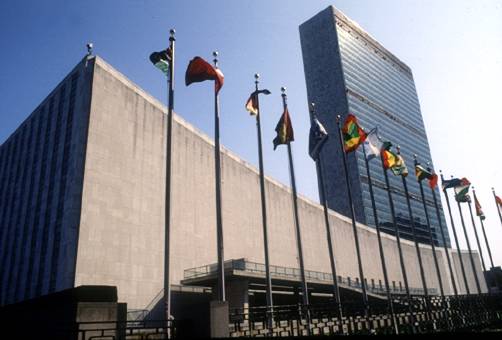
Extraordinary Hypocrisy: The United Nations headquarter in New York City.
 
When a prominent politician from the United States, the nation which, in complete contravention of the UN Charter, launched a full-scale military invasion of Iraq, shamelessly castigates the Russian President, Vladimir Putin, for “violating Ukraine’s national sovereignty”, one struggles to muster any kind of respect for the existing international system.
 
Indeed, one wonders (heretically) whether the world might not be better off if the number of nation states belonging to the United Nations (currently 193) was significantly reduced. With the benefit of hindsight, isn’t it at least arguable that the much-vaunted principle of “national self-determination”, far from making the world a more peaceful place, has actually increased the incidence of organised violence?
 
In a similar vein, wouldn’t it be a lot easier to respond to global crises, such as anthropogenic global warming, if humanity was aggregated into larger, rather than smaller, political units? If it’s possible to construct banks and corporations that are “too big to fail”, might it not also be possible to create states that are “too big to lose”?
 
And where nations are embroiled in bitter conflict, as in the Middle East, shouldn’t it be acknowledged, honestly, by nations outside the region, that war may be the only effective means of re-arranging the pieces on the board?
 
Even more heretically, should we not ask whether nation states are even the most sensible solution to conflicts whose origins lie not in ethnicity or geography but in matters of religious doctrine?
 
Certainly, it is the view of James Traub, from the Centre for International Co-Operation, that what we are witnessing in the Middle East is not a “clash of civilisations”, but clashes within a civilisation. The war, argues Traub, is “not between ‘us’ and ‘them’ but inside the Islamic world.”
 
Would the planet be better or worse off if the outcome of this war inside the Islamic world was the emergence of a political entity roughly akin to the open, tolerant and inclusive Abassid Caliphate that once stretched all the way from Baghdad, in what is now Iraq, to Tunisia? Such an outcome would have less to do with redrawing national boundaries than it would with redefining the way Muslims express their religion.
 
The rules governing the relationships between nation states, as elaborated by we Europeans, are, in part, the product of our own civilisation’s inability to resolve religious schisms. But, whether the conflicts currently tearing the Islamic world apart can be resolved by the principles enshrined the 1648 Treaty of Westphalia, which ended the Thirty Years War between Catholics and Protestants, is highly debateable.
 
Beyond dispute, however, is the role warfare has played throughout history in reconciling the irreconcilable and solving the insoluble. Sometimes, if peace is not in prospect, it pays to give war a chance. Alexander the Great didn’t unravel the impossibly complex Gordian Knot with his fingers. He used his sword.
 
This essay was originally published in The Waikato Times, The Taranaki Daily News, The Timaru Herald, The Otago Daily Times and the Greymouth Star of Friday, 13 February 2015.

Tuesday, 16 December 2014

Sitting On Our Hands

"We Nailed It!" New Zealand's representative to the United Nations, Jim McClay, takes a moment as his country's election to the UN Security Council is announced. Prime Minister Key told reporters that New Zealand got there on the strength of its reputation for being "someone that stands up for what's right". Why then did we, just a few weeks later, refuse to support a resolution condemning neo-Nazism?
 
NEW ZEALANDERS experienced a justifiable surge of national pride when their country was elected to the United Nations Security Council. New Zealand’s UN ambassador (and former Deputy Prime Minister) Jim McClay buried his face in his hands with heartfelt relief. Our foreign minister, Murray McCully, exclaimed “We nailed it!”
 
Speaking outside his Parnell residence, a clearly delighted Prime Minister told reporters that: “It’s a very good result. There’s a lot of responsibility over the next two years. I think it will be quite a challenging time to be on the Security Council. There are some very big issues – as we see in the Middle East at the moment – and it will be a demanding time for New Zealand.
 
Commenting on the outstanding success of the Ministry of Foreign Affairs and Trade’s six-year-long campaign, Mr Key observed: “We put on display the credentials of New Zealand. Which is seen as an honest broker. Someone who stands up for what’s right.”
 
That’s certainly how most Kiwis regard their country. From the very beginnings of the United Nations, New Zealand has stood up for the rights of smaller countries. We made ourselves their champion in the unsuccessful fight to locate the international organisation’s ultimate authority in the General Assembly.
 
In the aftermath of the most destructive war in human history, New Zealand’s Prime Minister, Peter Fraser, argued passionately (but unavailingly) against vesting veto power in the five permanent members of the UN Security Council. He had more success in ensuring that economic and social rights were included alongside civil and political rights in the UN’s Universal Declaration of Human Rights.
 
Why then did New Zealand, the “honest broker”; the country which always “stands up for what’s right”; fail to support a resolution sponsored by the Russian Federation condemning the “glorification of Nazism” and declaring the “inadmissibility of certain practices that contribute to fuelling contemporary forms of racism, racial discrimination, xenophobia and related intolerance”?
 
If ever there was a “no brainer” for New Zealand diplomacy – this was it. Who on earth, apart from the extremist political hoodlums it identifies, could fail to support such a resolution?
 
Well, apparently, we could. When the Russian Federation’s resolution was put to the General Assembly’s Social, Humanitarian and Cultural Affairs Committee on 26 November 2014, New Zealand, along with 56 other UN members, abstained. Included among the abstainers were every member of the European Union (EU). Not even Germany, Nazism’s birthplace and the nation state responsible for the most horrific manifestations of race hatred in human history, was prepared to join the 120 other UN members who voted in favour of the resolution.
 
Only three UN members could be found among neither the supporters nor the abstainers. Canada, Ukraine and the United States of America had voted against the resolution.
 
Why? What could possibly persuade the democratic nations of Europe, North America and Australasia to refrain from declaring their alarm at “the spread in many parts of the world of various extremist political parties, movements and groups, including neo-Nazis and skinhead groups, as well as similar extremist ideological movements”? Or, for that matter, from expressing deep concern at “all recent manifestations of violence and terrorism incited by violent nationalism, racism, xenophobia and related intolerance”?
 
Beating The Tin Drum: Members of the Patriot of the Ukraine party marching to the beat of a neo-Nazi revival in Eastern Europe that New Zealand refuses to condemn.
 
The answer, of course, is to be found in the well-documented involvement of the US State Department and the governments of the EU in the February 2014 overthrow, by armed neo-Nazi demonstrators, of the democratically-elected government of Ukraine. That both the USA and the EU were prepared to recognise, for the first time since World War II, a European government which included openly fascist and neo-Nazi politicians, rendered support for the Russian Federation’s resolution diplomatically implausible.
 
Accordingly, the Western democracies argued strongly that supporting the Russian Federation’s resolution would be tantamount to endorsing the latter’s annexation of Crimea, and ignoring its ongoing military and economic support for the breakaway Russian-speaking provinces of Eastern Ukraine.
 
Utter foolishness.
 
President Vladimir Putin’s Russia is prey to the very same fascistic and neo-Nazi forces that its UN anti-racist resolution condemns. The uncomplicated endorsement of its content would, therefore, have allowed the democratic countries to serve notice on both the Russian Federation and Ukraine that violent racist xenophobia remains totally unacceptable to the United Nations’ membership.
 
Sadly, the United States refused to tolerate even implied criticism of its hard-won Ukrainian protectorate. Canada cravenly concurred. And the EU, rather than alienate the Americans, abstained.
 
As an “honest broker” who “always stands up for what’s right”, New Zealand was gifted an early opportunity to show the 145 UN members who voted for her that their support had not been misplaced. Reminding the world of Nazism’s 20 million Russian victims, and reconfirming its unalterably evil nature would, surely, have done more for international understanding – and our reputation – than sitting on our hands?
 
This essay was originally published by The Press of Tuesday, 16 December 2014.

Wednesday, 26 December 2012

Who Is David Shearer? Revealing The Back-Story To The Back-Story

A Genuine Humanitarian:  But, David Shearer’s back-story has a back-story of its own: an unusual and counter-intuitive fascination with armed force that raises many more questions than it answers.

IT’S SURPRISING how little we know about David Shearer. For most of us, his sudden appearance among the contenders for Helen Clark’s vacated seat of Mt Albert was the first appearance he’d made upon the New Zealand political stage. For Mr Shearer, however, the 2009 Mt Albert By-Election was a case of third-time-lucky. He had already stood for the Labour Party twice before: the first time, in 1999, as a lowly ranked candidate on the Party List; and the second, in 2002, in the safe National seat of Whangarei.
 
Our ignorance of those earlier attempts is forgivable, however, because Mr Shearer has always been a political paratrooper. In contrast to the party foot soldiers who slog their way through the Big Muddy of branch meetings, canvassing exercises, billboard construction and pamphlet deliveries, rising through the ranks to fight the good fight on policy committees or the NZ Council, Mr Shearer’s preference has been to jump into parliamentary candidacies from a great height and out of a clear sky.
 
The reason for this top-down method of delivery is Mr Shearer’s remarkable back-story. It’s not many thirty-five year-olds who are named New Zealander of the Year, and even fewer are awarded an MBE by the British Government. Mr Shearer’s experiences delivering aid on behalf of the Save the Children Fund in war-torn Somalia were genuinely heroic. Here, as far as the rest of the world was concerned, was a genuine humanitarian. But, Mr Shearer’s back-story has a back-story of its own: an unusual and counter-intuitive fascination with armed force that raises many more questions than it answers.
 
Some political observers have drawn comparisons between Mr Shearer and his chief antagonist, Prime Minister John Key. The young Labour activist, Connor Roberts, summed up the pair’s similarities and differences with his now famous quip: “John Key went overseas and made fifty million dollars; David Shearer went overseas and saved fifty million lives.”
 
This focus on Mr Shearer’s and Mr Key’s “overseas” experiences has led many to assume that both men were out of the country during the pivotal years 1984-1993. In Mr Shearer’s case, however, this is untrue. For nearly the whole period of the Fourth Labour Government (1984-1990) he was here, in New Zealand, studying, teaching and consulting. If he was a Labour Party member at any time during those tumultuous years, then he was a very quiet one. He certainly wasn’t among the ranks of those who fought against Rogernomics. He has, however, often spoken to journalists about his admiration for David Lange’s speeches.
 
This inability to get worked up about the core elements of neoliberal “reform”: labour market flexibility; privatisation; deregulation; monetary and fiscal discipline; explains his rather odd belief (for a Labour leader) that the contest between Left and Right is “a phony debate”. Such ideological agnosticism – explained away as good old Kiwi pragmatism – does, however, offer us a way into the most unusual and contradictory aspect of Mr Shearer’s entire career: his support for mercenary armies, or, as they prefer to be known these days: private military and security companies (PMSCs).
 
It is possible to trace this thread all the way back to Somalia in 1992 where Mr Shearer headed up the relief effort of the Save the Children Fund. It is more than likely he enjoyed a close working relationship with the United Nations Mission in Somalia and would, therefore, have been aware of their appeal to the PMSC, Defence Systems Ltd (DSL) for 7,000 Ghurkha mercenaries to protect their relief convoys. In the end DSL turned them down, but it is clear that the notion of PMSC involvement in UN protection work (as opposed to soldiers provided by UN member states) made a deep impression on Mr Shearer.
 
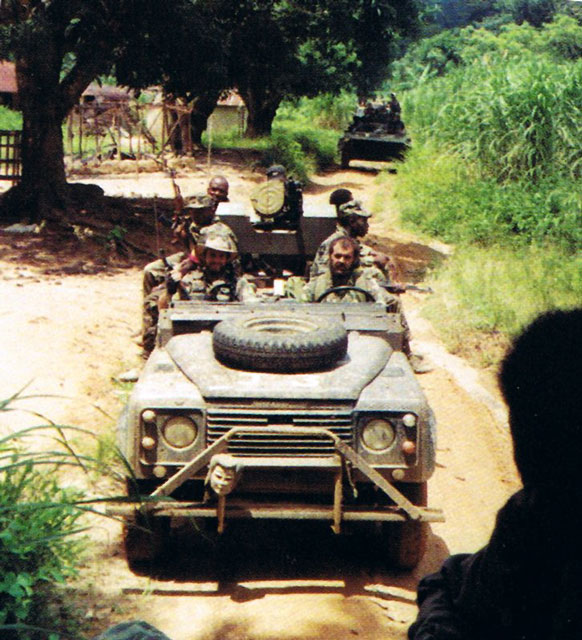
That impression was intensified by Mr Shearer’s experiences three years later as the UN’s Senior Humanitarian Advisor in the West African nation of Liberia. Just across Liberia’s northern border, in the ravaged state of Sierra Leone, the PMSC known as Executive Outcomes had been employed under contract to the Sierra Leone Government. Shearer was deeply impressed by this mercenary army’s lightning-fast defeat of the Liberian-backed forces assailing the ruling regime.

Fast and Furious: In 1995 the PMSC, Executive Outcomes, proved spectacularly successful in restoring order to war-ravaged Sierra Leone.
 
A year later, in 1996, Mr Shearer was advising the UN in Rwanda. It was here, just two years earlier, that a brutal genocide had taken place while the United Nations watched – and did nothing. Trying to stitch the rudiments of civil society back together after a disaster on that scale cannot have been easy.
 
This was followed by what might be called the John Le CarrĂ© phase of Mr Shearer’s career; his two-year stint (1996-1998) as a research associate at the International Institute of Strategic Studies (IISS) in London. Like its sister institute – The Royal Institute of International Affairs, also known as Chatham House – the IISS has always laboured under strong suspicions of being a sort of “front organisation” for Britain’s foreign affairs, defence and intelligence “community”. This was most clearly illustrated in 2003 when the IISS released a report strongly favouring the UK’s participation in a US-led invasion of Iraq. Like the infamous “sexed-up” report released by the Security Intelligence Service (MI6) just two weeks later, the IISS also warned against Saddam Hussein’s (non-existent) “weapons of mass destruction”. Since 2003 the IISS’s Director of Transnational Threats and Political Risk has been Nigel Inkster – formerly the Deputy Director of MI6.
 
It was into this looking-glass world of spooks and former-spooks that Mr Shearer settled himself. His research bore spectacular fruit in 1998 when his article “Outsourcing War” was chosen as the cover-story for the Fall Edition of the prestigious American journal Foreign Affairs. Extremely well-written, the article is a paean of praise for outfits like Executive Outcomes and DSL. A very similar article, “Private Armies & Military Intervention”, was published that same years as Vol. 316 of the IISS’s Adelphi Papers.
 
Mr Shearer’s time at the IISS certainly did not hinder his career prospects in the United Nations. In 1999 he left London’s clubby world of foreign affairs, defence and intelligence cogitation for the considerably less congenial territory of the Balkans. With the Kosovo Crisis in full cry he helped coordinate UN aid in Albania, ultimately winding up in Belgrade as Chief of the United Nations Office for the Coordination of Humanitarian Affairs (OCHA).
 
It’s probably as well to remind ourselves at this point of the dark history of PMSCs in the former Yugoslavia. The relationship between the UN and the private enterprises now responsible for everything from basic logistical services to security personnel was plagued by scandal. Whistle-blowers and journalists together exposed the links between the UN’s private contractors and organised crime. Most progressives would have recoiled from the revelations, but Mr Shearer’s support for the private sector’s increasing participation in UN operations persisted – especially when it took the form of PMSCs.
 
By 2000 Mr Shearer was back in New Zealand and working in the office of fellow Papatoetoe High School old-boy, Phil Goff – now Minister of Foreign Affairs and Trade in the newly-elected Labour-Alliance Government. It was presumably with the latter’s blessing that, in 2001, Mr Shearer penned yet another article – this time for the Chatham House (remember them?) newspaper The World Today entitled “Privatising Protection”.
 
Though the reluctance of sovereign states to sanction the entry of foreign mercenaries into their territory had not changed, Mr Shearer’s article described a world in which private armies were an increasingly common feature:
 
Future troops being offered to peacekeeping forces might well come from private companies rather than states. The US firm Dyncorp, for example, provided the US share of the Organization for Security and Co-operation in Europe monitors in Kosovo. Dyncorp is now training Colombian soldiers in its drug war. Another company, MPRI, also recently in Colombia, continues to train the Bosnia army in sophisticated US weaponry.
 (“Privatising Protection”, The World Today, August/September 2001)
 
By 2003 Mr Shearer was back with the UN, this time in the Middle East. As the Head of OCHA in Jerusalem and then as the UN’s Humanitarian Relief Coordinator during the Israeli assault on Southern Lebanon and Beirut, he distinguished himself as a fiercely independent upholder of the UN’s mission. Few were surprised, therefore, when, in 2007, after four years of negotiating his way through the labyrinth of Israeli-Palestinian relations, the UN Secretary-General, Ban Ky Moon, named David Shearer as his Deputy-Special Representative in Iraq. He was also appointed Head of the UN Development Project Iraq. Holding these two very senior roles in the United Nations Mission in Iraq (UNAMI) Mr Shearer was almost certainly “in the room” when decisions about the use of PMSCs were being made.
 
Lou Pingeot, author of the New York-based Global Policy Forum’s June 2012 publication Dangerous Partnership: Private Military and Security Companies and the UN, has compiled some useful statistics on the amount of money spent on PMSCs by the UN. “Using the highest available numbers,” he writes, “there is a 250 percent increase in the use of security services from 2006 to 2011.”
 
The numbers for UNAMI are particularly interesting. In 2007 UNAMI spent zero dollars on PMSCs. In 2009, when its former 2IC was back in New Zealand campaigning for Helen Clark’s old seat of Mt Albert, UNAMI also spent zero dollars. In 2008, however, the amount spent by UNAMI on PMSC’s was US$1,139,745.
 
It is important to place this expenditure in context. It was in September of 2007 that the US-based PMSC, Blackwater Worldwide, found itself at the centre of war-crimes accusations following the unlawful killing of 17 Iraqi citizens in Baghdad’s Nasour Square by one of the company’s notorious “Personal Security Details”. The outraged Iraqi government had responded by revoking Blackwater’s licence to operate within its borders. It is fair to say that foreign mercenaries were not popular in Iraq in 2008.

Private Solutions? The US-based PMSC, Blackwater Worldwide, earned a fearsome reputation during the Occupation of Iraq.
 
And so we return to Mr Shearer’s preference for private military solutions to low intensity conflicts and his conviction that the United Nations is better able to carry out its humanitarian functions in something resembling safety with private sector support.
 
I raised the matter with Mr Shearer’s parliamentary colleague, Trevor Mallard, at the recent Labour Party Conference and he suggested that it was all about getting help to people quickly. That is certainly an important aspect of Mr Shearer’s own writing on the subject:
 
There is a serious question here: if a private force, operating with international authority and within international law, can protect civilians, how moral is it to deny people protection just because states can’t or won’t find the forces to do it? Or put another way, is the means of response more important than the end for which it is used – particularly where a failure to respond results in the death and abuse of civilians?
 (“Privatising Protection”, The World Today, August/September 2001)
 
Mr Shearer’s position has been explained away as just another case of a good Kiwi bloke, impatient to get the job done, and not being particularly fussed about how things are made to happen – or by whom. And if the universal experience of mercenary involvement in “peace-making” was as positive as Executive Outcome’s foray into Sierra Leone, the argument might have some force. In reality, however, Executive Outcome’s success in Sierra Leone stands out as a very lonely exception to a much darker rule.
 
The actual, on-the-ground, operational conduct of PMSCs over the past decade has demonstrated to the world just how dangerous it is to entrust the delivery of deadly force to individuals and corporations whose primary motivation is profit. Yet even in the face of the PMSCs’ appalling conduct in the Balkans and Iraq, Mr Shearer remains sympathetic towards private armies and mercenaries.
 
The Labour Leader’s on-going support for these private-sector problem-solvers speaks volumes – and very little is to his credit.
 
This posting is exclusive to the Bowalley Road blogsite.