

Mars Takes The Field: The role warfare has played throughout history in reconciling the irreconcilable and solving the insoluble is beyond dispute. Sometimes, if peace is not in prospect, it pays to give war a chance.
THE RUBBLE in Europe and Asia was still smoking when
representatives from 51 nations assembled in the undamaged United States city
of San Francisco in June of 1945. Calling themselves the “United Nations”, they
there inscribed their collective determination, “to save succeeding generations
from the scourge of war, which twice in our lifetime has brought untold sorrow
to mankind”.
Surveying the corpse-strewn landscape which separates us
from those hopeful signatories of ‘45, you’d have to say that Peace has failed.
Over the past 70 years, barely a day has passed without the scourge of war
bringing untold sorrow to at least one unfortunate member of the family of
nations somewhere in the world.
That the existence of the United Nations has spared us all a
third global conflict is less a testimony to the wisdom and forbearance of a
chastened humanity, than it is to the certainty that, being waged with nuclear
weapons, World War III would’ve had no victors and no survivors.
And yet, in spite of the UN’s consistent failure to save
succeeding generations from its effects, War continues to be both rejected and
condemned as an instrument for the advancement of national policy. Though
member states of the United Nations have regularly unleashed war upon their
fellow UN members for precisely that purpose, the pious hopes enshrined in the
UN Charter remain the official expression of what is – and is not – acceptable
international conduct.
Is humanity well-served by this extraordinary hypocrisy?
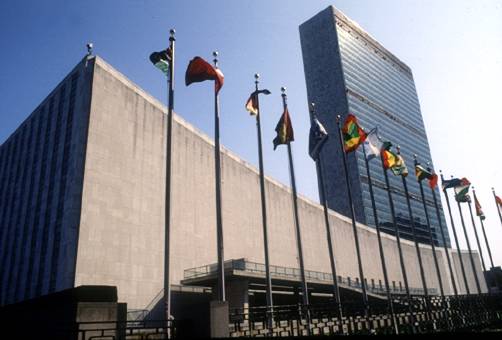
Extraordinary Hypocrisy: The United Nations headquarter in New York City.
When a prominent politician from the United States, the
nation which, in complete contravention of the UN Charter, launched a
full-scale military invasion of Iraq, shamelessly castigates the Russian
President, Vladimir Putin, for “violating Ukraine’s national sovereignty”, one
struggles to muster any kind of respect for the existing international system.
Indeed, one wonders (heretically) whether the world might
not be better off if the number of nation states belonging to the United
Nations (currently 193) was significantly reduced. With the benefit of
hindsight, isn’t it at least arguable that the much-vaunted principle of
“national self-determination”, far from making the world a more peaceful place,
has actually increased the incidence of organised violence?
In a similar vein, wouldn’t it be a lot easier to respond to
global crises, such as anthropogenic global warming, if humanity was aggregated
into larger, rather than smaller, political units? If it’s possible to
construct banks and corporations that are “too big to fail”, might it not also
be possible to create states that are “too big to lose”?
And where nations are
embroiled in bitter conflict, as in the Middle East, shouldn’t it be
acknowledged, honestly, by nations outside the region, that war may be the only
effective means of re-arranging the pieces on the board?
Even more heretically, should we not ask whether nation
states are even the most sensible solution to conflicts whose origins lie not
in ethnicity or geography but in matters of religious doctrine?
Certainly, it is the view of James Traub, from the Centre
for International Co-Operation, that what we are witnessing in the Middle East
is not a “clash of civilisations”, but clashes within a civilisation. The war, argues Traub, is “not between ‘us’
and ‘them’ but inside the Islamic world.”
Would the planet be better or worse off if the outcome of
this war inside the Islamic world was the emergence of a political entity
roughly akin to the open, tolerant and inclusive Abassid Caliphate that once
stretched all the way from Baghdad, in what is now Iraq, to Tunisia? Such an
outcome would have less to do with redrawing national boundaries than it would
with redefining the way Muslims express their religion.
The rules governing the relationships between nation states,
as elaborated by we Europeans, are, in part, the product of our own
civilisation’s inability to resolve religious schisms. But, whether the
conflicts currently tearing the Islamic world apart can be resolved by the
principles enshrined the 1648 Treaty of Westphalia, which ended the Thirty
Years War between Catholics and Protestants, is highly debateable.
Beyond dispute, however, is the role warfare has played
throughout history in reconciling the irreconcilable and solving the insoluble.
Sometimes, if peace is not in prospect, it pays to give war a chance. Alexander
the Great didn’t unravel the impossibly complex Gordian Knot with his fingers.
He used his sword.
This essay was
originally published in The Waikato Times, The Taranaki Daily News, The
Timaru Herald, The Otago Daily Times and the Greymouth Star of Friday, 13 February 2015.
