Showing posts with label Russian Federation. Show all posts

Monday, 27 March 2023

Too Big To Punish.

Too Strong For The Law’s Web: But, if the USA is too big to punish, why isn’t the Russian Federation? Russia’s economy may be roughly the size of Italy’s, but it’s nuclear arsenal is more than capable of laying human civilisation to waste. Threatening to arrest Vladimir Putin - especially when the Russian Federation and the rest of the United Nations are recalling George W. Bush’s illegal invasion of Iraq twenty years ago – is an astonishingly provocative act.

I AM CONSTANTLY ASTONISHED at how blithely unconscious the West is of its own transgressions. That the International Criminal Court (ICC) could announce its decision to issue a warrant for the arrest of Vladimir Putin a mere three days ahead of the twentieth anniversary of the United States’, the United Kingdom’s, Australia’s and Poland’s illegal invasion of Iraq on 20 March 2003 shows just how morally comatose the West has become.

Twenty years ago, President George Bush, Prime Minister Tony Blair, Prime Minister John Howard and the Polish premier, Leszek Miller, ordered a massive airborne attack and an all-out armoured assault upon a nation that was at peace with its neighbours and, which had made no aggressive moves against any of the nations whose armed forces were pouring across its borders. Unsurprisingly, a large number of the world’s nations condemned the invasion of Iraq as a breach of the UN Charter and international law. Millions of people around the world, with considerable justification, branded Bush, Blair, Howard and Miller war criminals. Certainly, the invasion they authorised led directly to the deaths of hundreds of thousands of innocent human-beings.

So, why didn’t the ICC, which had come into formal existence on the 1 July 2002, issue warrants for the arrest of Bush, Blair, Howard and Miller? Were they not guilty of war crimes and crimes against humanity? Had they not involved themselves in what the prosecutors at the Nuremburg Trials called “the crime of crimes” – the planning, preparation and waging of aggressive war? The crime for which the surviving Nazi leaders were hanged in 1946.

From the grim perspective of the world of realpolitik, the reason why the ICC decided not to prosecute the four aggressors is obvious: the United States is simply “too big to punish”. Not only did the USA refuse to recognise the jurisdiction of the ICC over United States citizens, but every diplomat and jurist worthy of the name understood that any attempt to arrest George W. Bush would provoke a reaction of truly biblical proportions.

But, if the USA is too big to punish, why isn’t the Russian Federation? Russia’s economy may be roughly the size of Italy’s, but it’s nuclear arsenal is more than capable of laying human civilisation to waste. Threatening to arrest Putin - especially when the Russian Federation and the rest of the United Nations are recalling the illegal invasion of Iraq twenty years ago – is an astonishingly provocative act.

Now, some of those reading these words will object that they are nothing more than an egregious example of “whataboutism”. If Putin stands accused of illegally deporting thousands of Ukrainian children to Russia, then he should be put on trial for his actions – not let off because Bush, Blair, Howard and Miller were not held accountable for theirs. Crying “What about Iraq?!” is an irrelevant question – it has no bearing on the case against Putin.

Except, of course, it does. The application of justice must not only be even-handed, it must be seen to be even-handed. If the public had witnessed the child of a rich and powerful family engaging in clearly dangerous and illegal activity, and then seen the Police refuse to bring charges against him because his family was simply too rich and too powerful, they would be disgusted. And if they then saw the child of a poor and powerless family brought to trial for exactly the same offences, they would be outraged. Prosecuting the poor, but not the rich, child would, quite rightly, be regarded as a travesty of justice. What’s more, the court responsible would be utterly discredited in the eyes of all fair-minded people.

Two-and-a-half thousand years ago, a Scythian prince named Anacharsis had this to say about Ancient Athens’ celebrated legal code: “Written laws are like spiders’ webs; they will catch, it is true, the weak and poor, but would be torn in pieces by the rich and powerful.”

The USA has proved the truth of Anacharsis’ observation by simply overawing the ICC’s timid prosecutors. Twenty years on from its failure to hold the invaders of Iraq to account, however, the ICC clearly believes that the Russian President is too weak to tear its legal web in pieces.

But who would be the person who arrests Putin? Or the country that tries to hold him?


This essay was originally published in The Otago Daily Times and The Greymouth Star of Friday, 24 March 2023.

Friday, 17 March 2023

Weaponising Illegal Immigration.

Human Destabilisers: Russia now has a new strategic weapon – migratory waves of unwelcome human-beings. Desperate people with different coloured skins and different religious beliefs arriving at, or actually breaching, the national borders of Russia’s enemies can wreak as much havoc, culturally and politically, as a hypersonic missile exploding in the middle of a Ukrainian power station.

THE ITALIAN GOVERNMENT has uncovered what it believes to be a new layer of mendacity in the Russo-Ukrainian conflict. Thousands of kilometres to the south of the fighting in Ukraine’s eastern provinces, deep in the anarchic wilderness of Sub-Saharan Africa, there’s been a grim addition to the criminal infrastructure of human-trafficking and people-smuggling. Russians.

Displaying that formidable mixture of state and private interests the world has learned to recognise in the Wagner Group’s fearsome mercenaries, new groups of highly organised Russian smugglers are hard at work. Unquestionably, these men are motivated by the huge profits to be made out of human suffering and desperation. But, they have not set up shop in these lawless lands entirely of their own volition. Somebody sent them there.

Moscow may not have intentionally propelled a vast wave of Syrian refugees in the direction of the European Union back in 2015. Indeed, it was most likely the German Chancellor’s, Angela Merkel’s, open arms of welcome that caused so many tragic columns of humanity to come bursting through Europe’s border fences in search of “Angela’s Country”. But Moscow looked on with considerable interest as this great wave of refugees broke over the nations of Western Europe.

Startled, at least initially, by the extraordinary welcome extended to the refugees by Europe’s most innocent and idealistic citizens, Russian cynicism was all-too-swiftly confirmed by the vicious racist backlash unleashed against the newcomers. Russia saw Germany riven by animosities its leaders had believed long buried. It watched the rise of far-right political parties disturb the civilised equilibrium of the Federal Republic. With a mixture of horror and delight, Moscow watched the eager ghost of Nazism break free of the stones piled upon its tomb.

Putin’s advisers now had a new strategic weapon to work on and perfect – migratory waves of unwelcome human-beings. Desperate people with different coloured skins and different religious beliefs arriving at, or actually breaching, the national borders of their enemies could wreak as much havoc, culturally and politically, as a hypersonic missile exploding in the middle of a Ukrainian power station.

The first inkling that Moscow had drawn a devastating lesson from the “Syrian invasion of Europe” came at the border of Belarus and Poland in 2021. Operating through his most trusted lieutenant, the Belarusian President, Alexander Lukashenko, Vladimir Putin arranged for Middle Eastern economic refugees, hungry for the peace and abundance of Europe, to be flown from their homelands and bussed to the frigid forests straddling the border of Belarus and Poland. “Over that fence lies freedom and prosperity!”, cried the freezing refugees’ minders – pointing westward.

The Poles, all-too-familiar with mendacity of the Russian bear, were having none of it. Crossing the border in significant numbers, the refugees would find themselves swaddled in the proudly humanitarian laws of the EU. The Polish government decided that under no circumstances could that be allowed to happen. Batons, tear-gas, and the use of water cannons in sub-zero temperatures ensured that the refugees did not make it across the fence.

Two years later, with Europe united against Russian aggression in Ukraine, the next great human wave of refugees is coming up out of the South, crossing the Sahara Desert, setting sail in frail and dangerously overcrowded boats from the coast of lawless Libya for the toe of the Italian boot – where gangsters every bit as ruthless as their Russian confreres are waiting to welcome them ashore. Twenty thousand illegal arrivals this year alone.

Giorgia Meloni, Italy’s first woman prime minister, may now be regretting the strong stand she and her country took against Russian aggression. As the leader of Brothers of Italy, a party of the Italian far-right, she is well aware of the political utility of illegal immigrants. Without them, and the racist tempers they inflame, she and her coalition could not have won power. Meloni promised to turn back the boats, but still they come: more and more. Putin has made a liar of her.

One can only speculate as to whether the British Prime Minister, Rishi Sunak, has been made aware of exactly who the gangster wolves driving Africa’s immigrant lambs over Europe’s borders are working for. Meeting this week with his AUKUS partners in San Diego, did he pull aside Australian Prime Minister Anthony Albanese, and whisper:

“Tell me again, Tony, how Australia stopped the boats.”


This essay was originally published in The Otago Daily Times and The Greymouth Star of Friday, 17 March 2023.

Monday, 6 June 2022

Summer Is Coming.

A Sun-Hardened Road To Victory: The point of maximum danger will come if/when a day arrives when the Russian forces in Ukraine lose all offensive capability and begin to fall back under Ukrainian pressure. That moment is likely to come when the state-of-the-art weaponry currently being dispatched from the United States is effectively deployed on the battlefields of Ukraine. Weapons with the power to shut down the massive artillery barrages Russian military commanders rely upon to take their objectives.

THE AMERICANS are doubling down on their commitment to keep the Ukrainian armed forces in the field against the Russians. The Biden Administration’s decision to dispatch another billion-dollars-worth of state-of-the-art artillery to Kiev has been met with fury in Moscow. The rage of Putin and his mouthpieces is understandable. Washington is giving the Ukrainians the weapons they need to keep the devastating Russian self-propelled guns out of range of the Donbass cities Moscow must take to secure anything remotely resembling victory.

What do the Americans know about Russia’s present military situation that makes them willing to incur Putin’s wrath in this way? The Russian President has warned the United States and its Nato allies repeatedly that the supply of weapons capable of fundamentally altering the strategic balance of its “Special Military Operation” in Ukraine will produce unimaginable consequences. By this, Putin is clearly alluding to the Russian Federation’s nuclear capability. “Give Ukraine too much help,” he is saying, “and I’ll use my nukes.”

That’s a big bluff to call.

To find out why Biden and his Defence and National Security advisors may be willing to call Putin’s bluff, we have to go all the way back to January and February of this year. From the wealth of detail relating to Russia’s offensive plans for Ukraine – subsequently borne out by the facts of the Russian invasion – it is clear that there had been a massive breach of Russian military security. Somehow, the Americans were reading Russia’s political and military leaders’ mail.

Obviously Putin, himself a counter-intelligence specialist, took steps to close up the breach. Senior figures in the political and military hierarchy started blipping off Russian screens.

Job done?

Apparently not.

It is highly doubtful that the Americans would feel confident enough to call Putin’s nuclear bluff if they did not have it on very good authority, from those in a position to do so, that any move toward the tactical or strategic use of nuclear weapons by the Russian President will result in his immediate deposition.

This could mean something thoroughly cinematic – like a patriotic bodyguard drawing his pistol, shooting Putin and his advisers dead, crying “Long Live Russia!” and then turning the weapon on himself. Alternatively, it could involve the commanders of Russia’s Strategic Rocket Forces sending an H-Bomb tipped missile hurtling into Putin’s supposedly blast-proof nuclear bunker. (Spoiler Alert: There’s no such thing.) Or, it could amount to senior officers in the know quietly communicating Putin’s location to the Americans in sufficient time for them to carry out the deposition themselves.

Certainly, there can be little doubt in the minds of senior Russian commanders that the Americans know pretty much exactly where they are at any given moment of the day or night. The sheer number of Russian commanders killed by sniper-fire or drone-strikes since 24 February makes that terrifyingly clear. They will also know that if Putin is insane enough to actually order a tactical nuclear strike, the American response will be a massive, decapitating, counter-strike that will leave Russia leaderless and rudderless. Precisely because Russian nuclear-war-fighting doctrine devolves launch authority, in extremis, to battlefield commanders, the Americans will make damn sure that there are no battlefield commanders left alive.

In the context of this discussion it is important to remember that when the world was literally on the brink of Nuclear Armageddon in October 1962, it was the good sense and humanitarian instincts of the political commissar aboard a Soviet nuclear-armed submarine under attack from US Navy-launched depth-charges, off Cuba, who persuaded the vessel’s commanders not to respond with its nuclear torpedoes. By refusing to put his key in the unlocking mechanism, he saved himself, the crew, and the whole world from nuclear annihilation.

There is absolutely no reason to suppose that Russian patriots have become so extreme that, rather than depose a delusional and potentially genocidal president, they would see the whole of Mother Russia – along with the rest of the planet – reduced to a radioactive ash-heap. Nor is it fanciful to suppose that Russia’s most intelligent and capable citizens have not long since realised that their country has no viable future as an independent nation if it persists in the folly of attempting to “Make Russia Great Again” by force of arms. The only questions that matter now are: How many of those intelligent and capable citizens are there in the upper echelons of the Russian armed forces? And: How many of them have a working back-channel to the US Joint Chiefs of Staff?

The point of maximum danger will come if/when a day arrives when the Russian forces in Ukraine lose all offensive capability and begin to fall back under Ukrainian pressure. That moment is likely to come when the state-of-the-art weaponry currently being dispatched from the United States is effectively deployed on the battlefields of Ukraine. Weapons with the power to shut down the massive artillery barrages Russian military commanders rely upon to take their objectives.

In the hugely popular television series, Game of Thrones, the stark warning that “Winter is coming” struck fear into the hearts of all the peoples of Westeros. Along the bitterly contested battle-lines of the Russo-Ukrainian War, the warning that should strike fear into the Russians’ hearts is the seasonal opposite of the Game of Thrones. Not the bitter snows of winter, but the sun-hardened fields of the Ukrainian plains, across which the Blue and Yellow Walkers can move with deadly speed.

What stark warning should Putin fear?

“Summer is coming.”


This essay was originally posted on The Daily Blog of Friday, 3 June 2022.

Tuesday, 31 May 2022

The World’s Rapidly-Changing Strategic Environment.

In Mandarin, Taiwan is spelt U-K-R-A-I-N-E: It is all very well for President Joe Biden to pledge his country’s military intervention should China invade Taiwan, the real trick is making Beijing believe him. Why would it, when Washington has been so careful to ensure that its own forces, and those of other Nato members, do not come into contact with Russian military units. After all, China’s nuclear arsenal is no less apocalyptic in its potential than Russia’s. 

“TIME IS SPEEDING UP”, says Wigram Capital Advisors’ principal Rodney Jones. His reference is to the speed at which the geopolitical situation is being transformed by the actions of Russia and China. Specifically, Jones is alluding to the presence of the Chinese Foreign Minister, Wang Yi, in the capitals of the South Pacific and the prospect of at least ten of the region’s micro-states being drawn into a “China-Pacific Island Countries Common Development Vision” by Beijing. As Jones forcefully reminds us, the “generally benign strategic environment” in which Prime Minister Helen Clark blithely located New Zealand more than twenty years ago, is long gone.

The Chinese Government, sensing a measure of disarray in US foreign policy, has not lost any time taking advantage of the global confusion and alarm caused by the Russian Federation’s invasion of Ukraine. Looking past the ardent demonstrations of support for the Ukrainian Government’s resolute defence of its territory, Beijing has calculated that this enthusiasm will fade as the economic consequences of the war begin to be felt by the peoples of Europe and North America – not to mention Australians and New Zealanders.

It is all very well for President Joe Biden to pledge his country’s military intervention should China invade Taiwan, the real trick is making Beijing believe him. Why would they, when Washington has been so careful to ensure that its own forces, and those of other Nato members, do not come into contact with Russian military units. After all, China’s nuclear arsenal is no less apocalyptic in its potential than Russia’s. Biden’s monosyllabic tough-talk could only have been a bluff, and the White House’s immediate walking-back of his bellicose pledge into the relative diplomatic safety of “strategic ambiguity” proved it.

Not only that, but Biden’s resort to bluff can only serve to deepen Beijing’s conviction that the United States no longer feels confident that its military strength is equal to the challenge of the emerging Eurasian duumvirate. In this regard, the meeting in Tokyo of “The Quad” (USA, Japan, Australia, India) may not have delivered the geostrategic warning to Beijing that the Americans intended.

Anthony Albanese is not Scott Morrison, and the stance adopted by the new Labor Government of Australia seems likely to be considerably less belligerent than its predecessor. If the global economy continues to weaken, it is also quite likely that the folly of equipping Australia with eight nuclear-powered submarines will be postponed indefinitely.

The announcement of the trilateral AUKUS (Australia, United Kingdom, United States) Pact in September 2021 is unlikely to have impressed China’s military leadership, most particularly since the US’s most powerful Quad allies, Japan and India, were not persuaded to join. To the Communist Party of China, the Anglophone AUKUS will have all the appearance of an absurd imperial anachronism. Once again, the impression conveyed is of a flailing and failing United States.

Of much more interest to the Chinese will be the reaction of the Indian Government to the Russo-Ukrainian War. India’s ties to Russia are strong, making it a less than vehement supporter of the West’s ruinous sanctions regime. Nor can New Delhi be insensible to the potential strategic challenges arising out of the Sino-Russian “entente” of 4 February 2022.

The Indian Prime Minister, Narendra Modi, will be observing with keen interest President Vladimir Putin’s ability to withstand the economic warfare unleashed upon his country by the West. Should the Russian Federation’s military forces begin to gain the upper-hand in Ukraine, and if China’s financial support renders the sanctions regime bearable, then Modi and India’s political class will have some serious thinking to do.

Does it make sense for a non-European nation like India to be perceived as some sort of Western lap-dog? Especially when it could, instead, become a crucial part of the Eurasian superpower fast emerging as the nemesis of the imperialist West?

If India goes, can the oil-rich nations of the Middle East be far behind?

All too aware of the energy vulnerability of the United States – not to mention the acute sensitivity of the American electorate to ‘rising gasoline prices at the pump’ – some US legislators are already attempting to throw their weight around on the question of how much oil the member states of OPEC should be sucking out of the ground. Threats of passing legislation allowing the United States Government to seize the American-based assets of “uncooperative” OPEC states are unlikely to impress the Saudis or their Arab allies. The defection of key oil producers to “Eurasia”, and the end of the US dollar as a fiat currency, would also spell the end of American/Western hegemony.

Even if Eurasia fails to materialise as the new global hegemon, the continued global dominance of the United States still cannot be taken for granted. Beijing will be paying as much attention as Moscow to the outcome of the 2022 mid-term congressional elections. Most political scientists agree that the chances of the Democratic Party retaining control of the House of Representatives and the Senate are close to zero. But, if the Republicans come surging back, then the potential for serious internal disorder breaking out in the United States is very high. Not only can a house divided against itself not hope to stand, but it also cannot possibly bend the rest of the world to its will.

With all of the above potentialities for Western disaster in play, it is not difficult to understand why, all over the world, the Chinese are actively probing for points of weakness. The South Pacific has clearly been identified by the geopoliticians in Beijing as an area ripe for the insertion of Chinese money and influence.

There will be those in the New Zealand foreign affairs community who respond to this probing with all the flatulent bombast of the pith-helmeted imperialists of yesteryear. These are the armchair warriors who are currently urging the Labour Government to tell the Chinese to “Clear orf out of ‘our’ backyard!” As if, like the Russians, we regard nearby, supposedly independent, nation states as falling within our sphere of influence.

Fortunately, however, there are also foreign affairs and trade specialists who understand that ‘national security’ is not simply about military force and the ability to project it aggressively. No nation can call itself secure if its economy is falling apart, and it people falling into poverty. As this country’s largest trading partner and key export market, China is not a country New Zealand should be in any hurry to infuriate and/or alienate. And, there are plenty of Australian politicians and businesspeople who feel the same way.

New Zealand’s “generally benign strategic environment” has not been undermined by the Pacific’s rising superpower. History teaches us that it’s the waning superpowers, edged-off the geopolitical stage by more dynamic rivals, that the world’s small and vulnerable states have most reason to fear.


This essay was originally posted on the Interest.co.nz website on Monday, 30 May 2022.

Friday, 15 April 2022

Where Is The Peace Movement?

Casus Belli: The bodies in the street, the terrible revelations of rape and torture: these only make matters worse. Our instinctive response, when confronted with such images is not to calmly contemplate the best means of extricating all concerned from the horrors of war, but to punish those responsible for such atrocities.

WHY HAS THE RUSSO-UKRAINIAN WAR not generated a global movement for, at the very least, an immediate cessation of hostilities? The aggressor, Russia, possesses nuclear weapons, and has issued thinly-veiled threats that it is prepared to use them if any other power attempts to interfere in its “military operation” in Ukraine. The slightest miscalculation, therefore, could trigger an all-out nuclear exchange – and the end of civilisation as we know it. In such precarious circumstances, mobilising global support for a peaceful resolution to the conflict seems like a good idea. So, why isn’t it happening? Where is the peace movement?

Before attempting an answer to that question, it is worth casting our minds back to the first quarter of 2003. The United States and the United Kingdom were engaged in obvious preparations for a full-scale military invasion of Iraq. All over the world people were gathering in huge demonstrations to oppose the US/UK plans. Over a million protesters flooded the streets of the UK’s largest cities in what was, almost certainly, the largest political protest in the nation’s history. Vast crowds similarly thronged the streets of American cities. In France, Italy and Germany it was the same. Time magazine described the global peace movement as the other great power on the planet.

All to no avail. Like the Russian Federation, the United States was not about to be dissuaded from doing what it believed it had to do. That it would go to war without the sanction of the UN Security Council, and on the basis of intelligence claims that most independent experts dismissed as spurious, was not about to slow the administration of George W Bush down. Peace movement or no peace movement, the invasion would go ahead as planned.

The demonstrable futility of the international protest movement against the Iraq War offers a pretty solid explanation for the absence of a global pacifist response to the Russo-Ukrainian War. Among those coming of age in the first quarter of the Twenty-First Century, it may simply be understood that if a major power is resolved to attack another country, no amount of chanting and placard-waving will stop it. Didn’t the UK Prime Minister Tony Blair’s spin-doctors respond to media taunts that there were a million citizens on out on the streets, by referencing the tens-of-millions who weren’t?

The other obvious lesson to be drawn from the global protests against the US/UK invasion of Iraq is that they would never have happened (or, at least, not on anything like the same scale) had their organisers not been living in democracies. If the Russian Federation showed the same respect for fundamental human rights as the United States, it is possible that a million or more Russians would have turned out to protest the invasion of Ukraine. What the world actually witnessed on the streets of Moscow and St Petersburg was the brutal suppression of every attempt at protest by the thuggish Russian police.

It is these images of suppression and violence that bring us to the heart of the matter. People around the world rose up against the prospect of the invasion of Iraq in part because they believed that the two nations responsible, the USA and the UK, were still, in some hallowed and undefiled place, receptive to the moral case for peace. All the evidence may have pointed in the opposite direction, but, in their heart-of-hearts, the historical friends and allies of the United States and the United Kingdom wanted to – needed to – believe that they were better than the murderous bullies Bush and Blair had turned them into.

Very few people believe that some hallowed and undefiled place exists in the dark monstrosity that is the Russian state. There are no democratic orchards in Russia. The fruits of freedom and justice do not grow there. The conditions are too harsh. Even when the tree of liberty is smuggled in and persuaded to bloom, which is seldom, the flowers fade for lack of warmth. Russia is a hard, cold country, and difficult to love, even if you’ve a mind to. But no people on earth knows more about suffering – and how to share it.

And we are suffering, but not in a way that does Russia any good. Our suffering is vicarious, inspired by the pain and heroism of the Ukrainian people. How else are the people of the West supposed to feel when they are presented with the image of a Ukrainian father, now a soldier, fighting back tears as his wife and son are borne away from him on a westbound train to safety, clutching in his hands his little boy’s toy ambulance – all that is left to him? Are we supposed to be filled with an urge to make peace? Or, are we already part of the war?

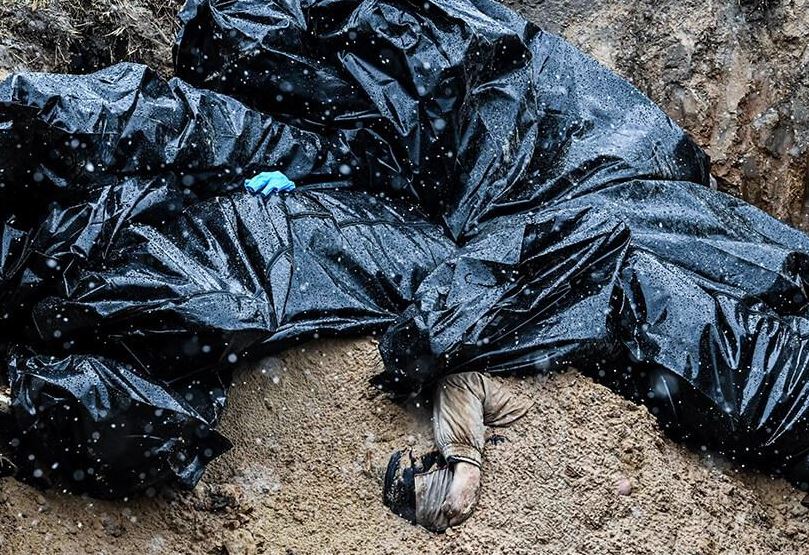
The bodies in the street, the terrible revelations of rape and torture: these only make matters worse. Our instinctive response, when confronted with such images is not to calmly contemplate the best means of extricating all concerned from the horrors of war, but to punish those responsible for such atrocities. Perhaps that’s what they’re intended to do. Perhaps, as the Russians insist, they are fake news. But while such images are all the world is seeing, there will be no global peace movement.

And if there is worse to come: if the wounded Russian Bear tears the Ukraine to pieces; and if the world is bombarded with ever more tragic and terrifying images of Ukraine in extremis; then it will not be a global peace movement that emerges, but a global war movement. Channeling the wild bellicosity of the masses celebrating the outbreak of the First World War, the people of the West, heedless of the nuclear danger, will cry: “Do your worst, Russia – and we will do ours!”


This essay was originally posted on The Daily Blog of Friday, 15 April 2022.

Friday, 8 April 2022

America’s To Lose: But the Outcome Of The “Great Game” Remains Unclear.

Disputed Territory: By 1991 it looked as though America’s geopoliticians had won the Great Game. The Soviet Union had collapsed, Eastern Europe was theirs for the taking, and the People’s Republic of China had allowed itself to be transformed into a giant American factory. No wonder a US State Department analyst, Francis Fukuyama, had jubilantly penned a paper entitled “The End of History”.

THE GREAT GEOPOLITICAL CHALLENGE confronting the United States is that the Americas are separated from Eurasia by two broad oceans. Since the end of the Second World War, from which it emerged as the undisputed global hegemon, this geopolitical challenge has required the American government to transform Western Europe into a military, economic and cultural appendage of the United States.

Had the United States failed to effect this transformation, its own economy would have faltered, and capitalism, as a global system, could very easily have collapsed. Making the nations of Western Europe part and parcel of the American economy – principally as borrowers of American dollars and consumers of American exports – was crucial to preserving the American people’s economic prosperity and, hence, the USA’s political stability.

Had the USA not launched the “Marshall Plan” for European recovery, and intervened aggressively in the domestic politics of France and Italy, it is practically certain that the formidable Communist Parties of those two countries would have come to power, bringing the whole of Europe under the tutelage of the Soviet Union.

And Great Britain?

The United States had taken a majority shareholding in Great Britain Ltd during the darkest days of 1940. In return for the US President, Franklin D. Roosevelt, keeping his country in the war, Winston Churchill, was forced to set in motion the dissolution of the British Empire.

It is likely Churchill consoled himself for this capitulation to necessity with fairy tales about a “special relationship” between the USA and Great Britain. No doubt he truly believed that in the unfolding history of the English-speaking peoples, Britain would be seen to have played the role of Ancient Greece to America’s Ancient Rome: peacefully blending its old empire into something new and altogether larger and more powerful.

The Americans would not have disagreed with the last bit, but they were never foolish enough to believe in the rest. Since becoming the world’s banker during the First World War, US capitalism had been aching to get its hands on the protected markets and resources of the geographically vast British Empire. The only thing the Americans were willing to share with the British was the English language.

As the Brits found out to their cost during the Suez Crisis of 1956, the sun had well and truly set on the British Empire. It had become an expensive joke. The British lion was stuffed.

Which still left the USA facing the problem of Eurasia. The Soviet Union and China might be broken and destitute after years of oppression and war, but beneath the graves and the rubble lay resources that could make them rich enough to one day compete with the United States for the rest of the world’s allegiance.

The geopolitical planners in Washington understood that American hegemony could only be sustained by making damn sure that neither Russia nor China ever arrived at that strategically critical position. What they were in the process of doing to the British Empire, they were determined, eventually, to do to the Russians and the Chinese: break them into pieces and transfer their markets and resources into the safekeeping of Uncle Sam.

By 1991 it looked as though America’s geopoliticians had done it. The Soviet Union had collapsed, Eastern Europe was theirs for the taking, and the People’s Republic of China had allowed itself to be transformed into a giant American factory. No wonder a US State Department analyst, Francis Fukuyama, had jubilantly penned a paper entitled “The End of History”.

But, the clever boys and girls in the State Department, and their moronic friends in the military and the CIA, had not factored in the extraordinary historical resilience of the Russians and the Chinese. Henry Ford had told his fellow Americans that “history is bunk” – and they had believed him. Drunk on the heady brew of their “unipolar world”, US geopoliticians had called their global victory too soon. Eventually, after twenty years of getting its ass kicked in the Middle East, the United States had to confront the inconvenient truth that Eurasia wasn’t beaten yet – not by a long shot.

Inevitably, Russia and China had produced leaders in possession of the requisite political steel to exploit the Americans’ mistaken assumption that they could command the rest of the world to dance – and it would dance. Only when it was too late did Washington understand that Moscow and Beijing has music of their own, and dance-steps with which America was entirely unfamiliar. In the global edition of Dancing With The Stars, Vladimir Putin and Xi Jinping made Bush, Obama, Trump and Biden look like flat-footed rubes.

Snapping out of their premature imperial bender, the Americans did their best to re-energise the Drang nach Osten (Drive to the East) that had been set in motion by the Soviet Union’s collapse. The United States’ geopolitical catspaw, Nato, had been expanded all the way to the borders of the Russian Federation. Washington and its surrogates were stirring up trouble in China’s western border province of Xinjiang. Bait the Bear and Poke the Dragon had become the only games in town.

But these were no sand-blasted Middle-eastern dictators they were facing. Russia and China were nuclear powers. Getting rid of Putin and Xi would require something the Americans have never been over-endowed with – guile.

Regardless, they laid a trap for Putin, baited it with Ukraine, and waited. If Russia took the bait, the United States and Nato would unleash, as one pundit put it: “an economic and cultural Barbarossa”. And if Xi was foolish enough to come to Putin’s aid, then they were quite willing to declare full-scale economic war on the People’s Republic as well. A geopolitical twofer!

Except, the imposition of crippling sanctions cuts both ways. The USA is pinning all its hopes of finally subduing Eurasia on both Russia and China succumbing to the impact of the West’s economic warfare before it blows back into Europe, Africa, the Middle East, South Asia and, ultimately, and perhaps a lot faster than Washington anticipates, into America itself.

The Russian Federation has released a map of the world showing all those nations who have declared themselves “Enemies of Russia” by joining the economic blockade. The most striking thing about the map is that it identifies not only Putin’s (and potentially Xi’s) enemies, but also those parts of the world inhabited by white people.

If Eurasia survives the sanctions; and if, in the process, it creates a new economic order from which the great American hegemon and its hangers-on are excluded; then it will not be the USA that wins the Great Game, it will be Russia and China, the masters of Eurasia.

Because, as the inventor of geopolitics, Sir Halford Mackinder (1861-1947) wrote more than a century ago:

Who rules East Europe commands the Heartland; [Russia] Who rules the Heartland commands the World Island; [Eurasia plus Africa] Who rules the World Island commands the World.


This essay was originally posted on The Daily Blog of Friday, 8 April 2022.

Monday, 14 March 2022

Of American Geese And Russian Ganders.

Moral And Diplomatic Failure: Shouldn’t journalists from small nations like New Zealand be reminding the international community of its obligation to not only demand full accountability from those nations that commit crimes against humanity, but also from those that cause them?


SATURDAY NIGHT’S BULLETIN of 1 News featured a very peculiar, and disturbing, item. Put together by journalist Thomas Mead, the item noted with alarm the fact that some New Zealanders were backing Vladimir Putin and Russia against Volodymyr Zelenskyy and Ukraine.

Those involved were described by Mead as “conspiracy theorists”, a term he appeared to be using as a synonym for “evil crazies”. This highly tendentious characterisation was not in the least challenged or repudiated by the two academics Mead consulted. Neither the political scientist, Steve Hoadley, nor the University of Auckland’s “Misinformation Project” spokesperson, Snajama Hattotuwa, challenged Mead’s assumptions about Putin’s supporters.

Were New Zealand at war with the Russian Federation, then this degree of overt media propagandising might, just, be excusable. When the youth of one’s country are locked in an existential struggle with its enemies, balance and nuance tend to fall by the wayside. A war being fought on the other side of the world, however, surely requires plenty of both. Demonising one’s fellow citizens for the “sin” of refusing to view a faraway war through the lens of their own government serves neither journalism nor democracy.

Then again, since the New Zealand Parliament has, unanimously, rushed through all the stages of a bill enabling the New Zealand state, independently of the United Nations Security Council, to impose sanctions on Russian businesses and individuals, perhaps New Zealand really is at war with the Russian Federation.

While the imposition of economic sanctions on another country and its citizens falls well short of ordering one’s armed forces into battle against them, it is difficult to characterise the measure as anything other than a declaration of economic warfare.

An effective sanctions regime, by wreaking havoc on the targeted nation’s economy is intended to inflict non-physical harm on its citizens. It is, unquestionably, an act of coercion. A lesser act of coercion, at least in the short term, than firing artillery shells and dropping bombs, but an act of coercion nonetheless.

This is why the imposition of sanctions, a remedy institutionalised by the League of Nations in the years immediately following World War I, was presented as the most effective international response to aggression – short of all-out war. It amounted to a declaration of economic hostilities upon the aggressor state by the whole world. As such, it made it difficult for the aggressor state to retaliate effectively. It also constituted an unanswerable international moral rebuke of the offending nation’s actions.

Re-adopted by the United Nations following the Second World War, the sanctions option was placed in the hands of the UN Security Council. Providing the five permanent members of the Security Council (USA, Russia, UK, France and China) were in agreement, the world would be empowered to squeeze the economy of an aggressor state until the pips squeaked.

There was, however, an inherent weakness in this arrangement. Since only the world’s most powerful states were ever likely to thumb their noses as the United Nation’s Charter, and since those states could veto any intervention by the UN Security Council, then the application of sanctions as a means of coercing delinquent states into demonstrating an acceptable standard of international conduct became something of a dead letter.

New Zealand has long been a critic of the veto power of the five permanent members of the UN Security Council – depicting it as a fundamental obstacle to the enforcement of the provisions of the UN Charter. A little reflection, however, makes it perfectly clear why the veto power has always been critical to the maintenance of international peace and stability.

What possible reason for retaining their membership of the United Nations would the great powers have if it was possible for a majority of the five permanent members to “gang-up” on the rest? It is the veto that keeps the planet’s most dangerous nations seated around the multilateral table. If the UN Security Council had possessed the power to impose sanctions on the Bush Administration for its unlawful invasion of Iraq, would the USA still be a member of the UN? Of course not.

The problem which now confronts the world is that the preponderant economic and military power of the United States has persuaded its leaders to evade the limitations associated with the veto by imposing swingeing economic sanctions upon its enemies without Security Council authorisation. It masks this dangerous unilateralism by pressuring those states under its sway (which includes most of the world’s nations) into joining its sanctions regimes. Any reluctance on the part of US “allies” to participate in these brazen acts of economic coercion is overcome by threatening to extend the sanctions to any entity deemed guilty of ignoring them.

In a more rational world, the very fact one of the five nuclear-armed permanent members is contemplating exercising its veto would be enough to convince the other four that a full-scale diplomatic effort is required to identify the most fruitful options for easing the tension. Tragically, the most malign legacy of the Cold War, which froze international relations for forty years, is the way in which its “Free World” allies have opted to remain passengers on the United States’ war chariot, and how many of its erstwhile Warsaw Pact enemies have sought its protection from their former Russian suzerain.

That Russia would eventually demand to know why sauce for the American goose was not also sauce for the Russian gander was inevitable. If the Americans could determine that a nation thousands of miles from its shores, which had made no aggressive move in its direction, could nevertheless be invaded by a coalition led by two of the five permanent members of the Security Council – ostensibly to defend themselves – then Moscow was surely entitled to do the same to a nation located on its western border which had voiced its determination to throw in its lot with Russia’s Nato “enemies”.

That the answer: because two wrongs do not make a right; and that it is no more acceptable for Russian missiles to kill Ukrainian children than it was for American missiles to kill Iraqi children; should have been obvious to Vladimir Putin, is, unfortunately, no help at all. Because the chancelleries of the world looked the other way when the USA tore up the UN Charter in 2003, their powers of moral persuasion in 2022 are not as forceful as they should be.

Rather than replicating the McCarthyism of the Cold War, shouldn’t journalists from small nations like New Zealand be reminding the international community of its obligation to not only demand full accountability from those nations that commit crimes against humanity, but also from those that cause them?


This essay is exclusive to Bowalley Road.

Monday, 28 February 2022

Russia Invades Ukraine: A Crime – And A Mistake.

Be Careful What You Wish For: Putin has conjured into being the very strategic nightmare he spent the last 20 years attempting to forestall. His actions have given all the nations of Western and Eastern Europe a terrifying reminder of the wisdom of banding together against the Russian Bear.

I’M WHAT’S KNOWN, on the Left, as a “Tankie”. That is to say I am not a reflexive opponent of the Russian regime. In the Georgian border regions; in Syria; and until 24 February 2022, in the Ukraine; I have, by and large, been sympathetic to the aims and objectives of the Russian Federation. More specifically, right up until this past week, I have had a sneaking admiration for the way in which President Vladimir Putin, in spite of finding himself in some extremely difficult positions, has nevertheless managed to checkmate his Western opponents.

But that’s all over now. It’s one thing to silence with tanks and artillery the Washington-inspired braggadocio of Georgia’s opportunistic leader. Or, to throw Russia’s military support behind the least worst protagonist in the Syrian civil war. But, to order a full-scale invasion on Ukraine? That’s not Chess, that’s Draughts – and not even very good Draughts. Putin has over-reached himself – quite possibly fatally.

It is difficult to understand why Putin couldn’t understand just how much ground he had made, diplomatically, by staging large-scale military manoeuvres on the Ukrainian border. The increasingly hysterical shrieks and yells emerging from Washington and NATO Headquarters in Brussels were achieving nothing useful for the West – apart from validating Putin’s critiques of NATO’s expansionist doctrine. As prediction after prediction of a Russian invasion of Ukraine proved inexact, Moscow gave every indication of being grimly amused. The Russian talent for irony and sarcasm was on full display.

Even better, the hysterical reactions of Washington and Brussels, were prompting the appearance of some no doubt very satisfying (to Moscow) cracks in the NATO alliance. To the evident delight of the Russian foreign ministry, Germany and France (both of which are guilty of invading Russia in the past, and then paying a terrible price for their aggression) took up their roles as guarantors of the Minsk Accords. For the price of an extended round of annual manoeuvres, the Russian Federation, and its Belarussian ally, were on the verge of reaping a bountiful diplomatic harvest.

So, what went wrong? How was the Kremlin’s master Chess-player suddenly robbed of both his strategic and his tactical senses?

In the harsh light of Russia’s invasion of the Ukraine, during which so many of the predictions and descriptions of the Russian armed forces’ battle-plans have been proved correct, it is surely reasonable to speculate that the Americans may have cracked the Russian military codes, giving them full access to all of the Kremlin’s strategic and tactical conversations. Or, they may have a highly-placed spy on the inside who is relaying to them the same information. They may even have both.

For Putin, a political leader schooled in the security services of the old Soviet Union, the revelation of such a catastrophic security breach would be devastating. The paranoid style of politics that pervaded the old KGB would have been intensified in Putin, the former KGB officer, to the point where he may simply have stopped thinking clearly.

If the debilitating revelation that Russia’s national security had been fundamentally compromised was further aggravated by serious disinformation concerning the character and intentions of the Ukrainian Government, then Putin’s descent into an enraged and murderous paranoia is readily explained.

Whatever happened, it was clear, several days out from the invasion, that something in Moscow had changed. RT, the Federation’s worldwide propaganda arm (now unavailable on New Zealand’s Sky Network, it’s former host) seemed to flounder as it struggled to come to grips with the Kremlin’s rapidly darkening tone.

Up until Putin’s rambling history lecture of 22 February, immediately followed by the recognition of the Donetsk and Luhansk breakaway republics, it had seemed as though RT’s leading lights were perfecting their scornful one-liners for the day Russia’s military forces on the Ukrainian border proved NATO wrong by simply turning around and returning to barracks.

Certainly, that was the outcome for which Putin’s government had been preparing the Russian people over the preceding weeks and months – and, it must be said, it was also the outcome the Ukrainians were expecting. Very few people on either side of the border wanted, or were prepared for, a full-scale invasion. The very fact that spontaneous anti-war rallies erupted all over the Russian Federation bears testimony to the shock and dismay provoked by Putin’s aggression against his fellow Slavs.

It is instructive to contrast Putin’s total failure to prepare his people for a full-scale invasion of Ukraine with the many months George W. Bush spent convincing the American people that his equally illegal invasion of Iraq was both militarily necessary and morally justified.

One is reminded of the decidedly unenthusiastic reception given to the Wehrmacht’s tanks as they rolled through the streets of Berlin in the early stages of the so-called “Munich Crisis” of September 1938. The German people did not want war with Britain and France, which is why they cheered to the echo the peacemaker, Neville Chamberlain, as he made his way through the streets of Munich – much to the disgust of the Fuhrer, who most emphatically did want war with Czechoslovakia.

It is worth contemplating the historical lessons of the Munich Crisis in relation to the crisis currently unfolding in Ukraine. Had Chamberlain, backed by France and Italy, not signed over the largely German-speaking Sudetenland to Adolf Hitler and, instead, warned him that Czechoslovakia would not be abandoned, then it is highly likely that Hitler’s generals (who were quite unconvinced that Germany could win such a war) would have deposed him in a military coup d’état. Had that happened, it is entirely possible that the Second World War could have been avoided.

The Russian Federation’s possession of nuclear weapons rules out any overt military response on the part of NATO, but the harshness of the economic sanctions regime it has imposed is bound to give Putin’s generals and oligarchs pause.

Nothing is more expensive than full-scale war. While, geographically, Russia may be a vast country, economically it is smaller than Italy. Far from heralding the restoration of Russian greatness, a drawn-out war against Ukrainian resistance fighters (supported and supplied by a ferociously united West) coupled with the debilitating economic and political effects of swingeing sanctions (not to mention the financial and human costs of a prolonged occupation) can only weaken the Russian Federation profoundly.

Even from the perspective of hard-line Russian nationalists, Putin’s wild gambit makes no sense. Indeed, those of a Machiavellian disposition among the Russian elites may come to the conclusion that some of Putin’s more rational geopolitical objectives stand a much greater chance of being achieved if Putin is no longer on the scene. Amidst the palpable and near universal relief which a change of regime in Moscow, followed by the withdrawal of all Russian forces from Ukraine, would undoubtedly bring, a comprehensive revision of European security arrangements might end up being welcomed – by all sides.

As matters now stand, however, Putin has conjured into being the very strategic nightmare he spent the last 20 years attempting to forestall. His actions have given all the nations of Western and Eastern Europe a terrifying reminder of the wisdom of banding together against the Russian Bear.

Ironically, the Ukrainians Putin dismissed as “drug addicts and neo-Nazis” stand revealed as heroes and patriots: men and women willing to lay down their lives for their country. Certainly, President Volodymyr Zelensky has demonstrated communication skills even more impressive than those of our own Jacinda Ardern. His social-media broadcast from the heart of besieged Kyiv was nothing short of inspirational. No one, now, is interested in accusations of undue Washington influence, widespread corruption, and neo-Nazi militias.

Russia’s “tankie” support in the West was based on Putin’s moral, political and military jiu-jitsu: his hitherto impressive knack for using the weight and power of his Western antagonists against them; and his skill at exposing the crass hypocrisy of those powers who have never hesitated to commit the very same sins they are forever attributing to Russia.

But, there is nothing clever about Putin’s invasion of the Ukraine. It will achieve nothing but massive material destruction and untold human suffering. Even worse, from the perspective of the unfortunate Russian people, Putin’s invasion has provided an ex post facto justification for their enemies’ most predatory designs .

As the deeply cynical, but nonetheless brilliant, French statesman, Charles Maurice Talleyrand (1754-1838) said of Napoleon’s ill-judged decision to abduct and execute the politically unfortunate Duke d’Enghien:

“This is worse than a crime, it’s a mistake.”


This essay was originally posted on the Interest.co.nz website on Monday, 28 February 2022.

Friday, 25 February 2022

The West Will Ignore Putin’s Weary Anger At Its Peril.

Out Of Patience: Putin’s weary anger said it all. The Ukraine and Russia are one. The West cannot have her. If NATO is determined to fight, then Russia will fight back. And, if Russia falls, she will not fall alone.

ON CHRISTMAS EVE 1991, Germany and Austria, without warning or consultation, recognised the independence of Slovenia and Croatia.

Six months earlier, on 25 June 1991, these hitherto constituent republics of the Federal Republic of Yugoslavia had declared themselves independent states. Naturally, the Yugoslav Government objected in the strongest terms and sent its army north. NATO’s Secretary-General, the former British Foreign Secretary, Lord Carrington, attempted to negotiate a peaceful settlement.

Sufficient progress was being made for the Yugoslav Government to order the army’s tanks back to their bases. Its consternation, when the newly re-united Germany recognised the breakaway republics’ independence, and Austria partially mobilised its armed forces along the Slovenian border, is readily imagined. The Americans, the EU, and the United Nations were equally non-plussed.

Yugoslavia may have been crumbling, but the unilateral recognition of Slovenian and Croatian independence by Germany and Austria undoubtedly hastened its disintegration. The tragic consequences: civil war, murderous ethnic cleansing, NATO’s assault on Serbia (the largest of the Yugoslav successor states) cost tens-of-thousands of innocent lives.

Were Germany and Austria punished for their deliberate fracturing of another European state? Did the United States, the EU and NATO impose a devastating regime of sanctions upon them? Were massive supplies of weapons shipped to Yugoslavia in an attempt to keep its fragile constitutional architecture standing? Was the German Chancellor, Helmut Kohl, vilified across the Western news media as another Adolf Hitler? Did his neighbours manoeuvre hostile battle-groups along his country’s borders?

Of course not. Indeed, it is highly unlikely than more than one in ten of the people reading this post will even remember Germany’s and Austria’s flagrant breach of international law – or care.

Those belonging to the realist school of international diplomacy may have raised an eyebrow at the two German-speaking nation’s uncharacteristic departure from international diplomatic norms, but they didn’t engage in hysterical name-calling or fill the airwaves with dire predictions of European war. (Even if the more perspicacious among them, remembering the fraught history of the Balkan states, foresaw only bad things flowing from Germany’s and Austria’s rash decisions.)

It was clear to everyone that the Yugoslavia forged by Marshall Tito in the white heat of the Second World War and, while he lived, a remarkably successful experiment in multi-ethnic, multi-cultural, and socialist co-operation, was unravelling at an alarming rate. Old crimes were being remembered, vengeful ghosts were rising from the killing fields of the German occupation. Few international scholars, and even fewer experienced diplomats, were surprised that Catholic Slovenia and Croatia wanted out, or that they fell gratefully into the nearest pair of outstretched arms.

The contrast with the present hysterical condemnation of Russia’s recognition of the breakaway republics of Donetsk and Luhansk could hardly be clearer. There is precious little evidence of hard-headed realism in the West’s diplomacy, only inchoate rage at Russia’s stubborn refusal to become the vassal of a declining American super-power and its dangerous kennel of NATO attack-dogs.

Vladimir Putin was absolutely correct to describe the break-up of the Soviet Union as a geopolitical catastrophe. The Russians had done the world an enormous favour in taking responsibility for the cutthroat nations of Eastern Europe and the Baltic littoral.

Few people in the West now recall how many of these states allied themselves with Nazi Germany during World War II. But the Russians have not forgotten whose soldiers were positioned on the flanks of Stalingrad as von Paulus’s Sixth Army closed in for the kill. Nor have they forgotten how eagerly the Latvians, Lithuanians, Estonians and, yes, the Ukrainians, helped the Einsatzgruppen murder two million of their Jewish neighbours.

Setting these bloodlands free was always a risky proposition.

Not that the NATO Alliance had many thoughts to spare for the recent history of Eastern Europe. As the Soviet Union fell apart and the elites of its constituent republics seized the moment to make their fortunes, the Americans and their European vassals could only look on in awe at the world of rich geopolitical pickings opening up before their eyes.

The wildest dreams of Western geopoliticians, dating all the way back to the end of the First World War, could now be realised. Georgia, the Caucasus, Moldova, Belarus, and the geopolitical jewel in the crown, Ukraine: all of them were up for grabs – daggers pointed directly at the heart of Mother Russia. “Come one, come all!” cried Washington and Brussels – “NATO’s door is always open!”

Poor, deluded Mikhail Gorbachev: how could he possibly have been so innocent as to take on trust George H. W. Bush’s pledge that NATO would not advance “one inch” beyond the River Elbe? Had the combat boot been on the other foot, would the Soviet Union have given such a pledge? Or, if it did, would it have felt bound to honour it?

Some have laughed at Putin’s rambling history lesson of 22 February, preliminary to his signing of the documents recognising the breakaway Donbass republics. He was not, however, joking. His criticism of Lenin and the Bolsheviks was entirely serious.

As good socialists they were determined to honour the principles of national self-determination. Putin’s argument is that by doing so they made the later disintegration of the Union of Soviet Socialist Republics a great deal easier than it should have been. Had the Bolsheviks treated Ukraine and the other constituent republics in the same way as the Tsarist regime: beloved provinces of one great, indissoluble nation – Russia – then the almost casual agreement of August 1991 to break up the Soviet Union might have been averted.

But, we are where we are. Like a baited bear, the Russian Federation has watched through small, black eyes as NATO’s attack-dogs crept closer and closer. Unlike the doomed creatures chained by neck and ankle in the bear-pits of yesteryear, however, the Russian Bear is constrained only by how many of these slavering curs it is willing to kill, and how.

Putin’s weary anger said it all. The Ukraine and Russia are one. The West cannot have her. If NATO is determined to fight, then Russia will fight back. And, if Russia falls, she will not fall alone.


This essay was originally posted on The Daily Blog of Thursday, 24 February 2022.

Bear-Baiting.

Unchained: It is certainly fine sport, this high-stakes game of bear-baiting. Ukraine’s dog goes in first, hackles raised, teeth bared. Close behind sidle NATO’s new members – Poland, Romania, Bulgaria and the Baltic States – jaws slavering, US-supplied fangs gleaming. While all around them, wild and eager, the newshounds of the Western media bark and bark and bark. Only France and Germany hang back. They’ve baited this bear before and know from bitter experience how sharp are its teeth, how dangerous its claws.

THE THING TO REMEMBER about bear-baiting is that, like “reality” television, there is very little about it that is real. This cruel spectacle, enjoyed by English kings and commoners alike for nearly 800 years, always weighted the odds heavily against the bear. Had they not, there would have been no one to bet on but the bear. Mastiffs and Bulldogs are fearsome beasts, but neither of them could last five minutes in a fair fight with an angry bear.

The bear simply had to be handicapped. Accordingly, the baiters took care to chain the bear by the leg, or the neck, to an iron stake driven into the middle of the bear-pit. They were also careful to set more than one dog against the bear. Sometimes, to be absolutely certain that the dogs had a fighting chance, the baiters would pull the bear’s canine teeth and pare-back his lethal claws.

Thus was the uncertainty of the encounter heightened, and the range of outcomes upon which to place a wager multiplied. How many dogs would the bear be able to kill or maim before he was brought low? How long could the chained and defanged creature hold out? One hour? Two?

King Henry VIII enjoyed the sport so much he had a bear-pit constructed at his Whitehall palace. It is not recorded how much the sovereign won or lost betting against the bears.

Sad to say, sovereign powers are still engaged in bear-baiting. The bear in question may be the symbolic representative of Russia, but the principle is the same. De-fang it by stripping away all the territories you can trick or bribe into abandoning their homeland. Pare back its claws by means of economic sabotage and diplomatic chicanery. Chain it unfairly behind indefensible borders. And then send in your dogs.

And were there ever dogs so vicious as the dogs of the West? The dogs of NATO? Poor Mikhail Gorbachev: bedazzled by dreams of a democratic and de-militarised Eastern Europe; intoxicated by the idea of a free and mutually supportive association of nation states stretching all the way from the North Sea to the Pacific Ocean; he foolishly neglected to get in writing President George H. W. Bush’s guarantee that NATO would not advance “one inch” beyond the River Elbe.

How could he have forgotten the old Russian proverb that no less a person than Ronald Reagan had quoted to him (in passable Russian) Doveryay, no proveryay: “Trust, but verify.”

Ah, but those NATO dogs are cunning fellows. Thirty-two years after Bush and his Secretary of State, James Baker, gave their word to Gorbachev, they snarl at the Russian bear: “Where’s your proof that NATO ever offered such a guarantee? You have no proof. You lie!”

The Western Media, a dog whose teeth are every bit as sharp as NATO’s, gleefully inserts the word “contested” whenever the Russian President, Vladimir Putin, repeats Gorbachev’s claim.

In this baiting game, however, no dog is more gangrel, greedy or vicious than the puppet-regime purporting to represent the people of the Ukraine. Installed by the Americans in 2014, after their armed gangs of self-avowed fascists had driven the elected government from power, Kyiv’s humble servants have kept a very useful small-war smouldering on Russia’s border for 8 years. Their signature on the Minsk Protocol as worthless as all their subsequent protestations of peace and goodwill.

It is certainly fine sport, this high-stakes game of bear-baiting. Ukraine’s dog goes in first, hackles raised, teeth bared. Close behind sidle NATO’s new members – Poland, Romania, Bulgaria and the Baltic States – jaws slavering, US-supplied fangs gleaming. While all around them, wild and eager, the newshounds of the Western media bark and bark and bark. Only France and Germany hang back. They’ve baited this bear before and know from bitter experience how sharp are its teeth, how dangerous its claws.

But, what is this? What has happened to the chain that the baiters were at such pains to reassure the gamblers remained firmly fastened around the bear’s neck? And surely those claws are much longer than they should be? Dear God! That Ukrainian dog has ventured much too close – can someone not pull him back beyond the reach of those powerful arms?

We have wagered everything on NATO’s dogs. How could we have missed the Russian bear’s nuclear teeth?


This essay was originally published in The Otago Daily Times and The Greymouth Star of Friday, 25 February 2022.

Friday, 21 January 2022

Too Much Intellectual Curiosity – Not Enough Fox News.

Bogeyman On Manoeuvres: Not only would a Russian invasion of Ukraine allow the Ardern Government to join “a largely Western chorus of condemnation” and announce (probably reluctantly) New Zealand’s own autonomous sanctions against the Russian Federation, but it would also vindicate the dominant “Bogeyman School” of New Zealand strategic studies.

WHAT WOULD YOU EXPECT from a course devoted to “Strategic Studies”? A reasonable expectation, surely, of a university course devoted to the study of global strategic issues, is that it would be ideologically neutral. After all, the struggle for global advantage: economically, militarily and diplomatically; is driven by a wide variety of international actors. Breaking down the conduct of nation states by passing it through a single ideological lens (of whatever manufacture) could hardly be described as good scholarship. It would risk turning out students who were singularly ill-equipped to identify and interpret the strategic issues at play on the international stage. That can hardly be the goal of a course called “Strategic Studies” – can it?

Which is not to say that powerful nations, the United States in particular, have not in the past actively rewarded, rather than discouraged, a lack of intellectual curiosity, professional competence, and fundamental human empathy. The administration of George W. Bush, for example, was famously suspicious of fluent speakers of Arabic. They feared that such people might “go native” – i.e. demonstrate too much understanding of the nation the United States was planning, in flagrant disregard of international law, to invade. The government of the United Kingdom similarly distinguished itself by requiring it advisors to provide spurious grounds for joining the US in its illegal invasion of Iraq.

If by “Strategic Studies” is meant the training of students to view international events from a single, thoroughly biased, perspective; and to dutifully supply their employers with material based on falsified data and outright lies; then intellectual curiosity, professional competence, and fundamental human empathy might, indeed, prove prejudicial to rapid advancement in their chosen career.

Having read his Newsroom posting entitled “Russian Aggression Exposes Gap In NZ’s Diplomatic Toolkit”, it is very difficult to avoid the suspicion that Professor Robert Ayson subscribes to something disappointingly close to the above definition of Strategic Studies. It will doubtless come as no surprise that the professor’s perspective on New Zealand’s foreign relations locates the United States of America squarely in the centre of the big picture.

Interestingly, the posting begins with what amounts to a huge sigh of relief that the dangerously heterodox Winston Peters is no longer this country’s Foreign Minister.

The good professor wastes no time in reassuring his readers that: “Labour ceased subcontracting foreign policy to New Zealand First after the 2020 election. Peters’ quest to advance free trade discussions with Russia and its Eurasian economic partners, which was written into the 2017 coalition agreement, is now history.”

The notion that New Zealand might derive considerable benefit from distributing its export eggs across several baskets clearly does not fall within Professor Ayson’s definition of strategic studies. Also excluded, presumably, is the idea that the Russian Federation is a strategic player meriting a level of analysis more rigorous than the shrieking of Fox News.

Clearly, the brand of Strategic Studies favoured at Victoria University relies heavily on setting forth the measures best calculated to disrupt and punish the activities of a frightening cast of international bogeymen, the biggest and baddest of which is, of course, Russia – as it has been, off-and-on, since the late-nineteenth century.

Judging by his enthusiasm for the concept, Professor Ayson appears convinced that the most helpful contribution New Zealand can make to discombobulating the Russian bogeyman is to join with the United States and its other sycophants – sorry, “allies” – in imposing “autonomous” (i.e. unauthorised by the United Nations Security Council) economic and diplomatic sanctions.

In other universities, strategic studies professors might encourage their students to calculate how close such unilaterally imposed sanctions come to actual acts of war. In these other universities, strategic studies professors might even invite their classes to consider the consequences of the economic sanctions imposed on Japan in 1940 – most particularly the “embargo” on oil and scrap-metal exports. To what extent were such strategic gestures intended to produce a strategic response? Did the USA’s “autonomous sanctions” make Pearl Harbour inevitable? Was that their purpose?

Certainly, as one reads the professor’s post, it is difficult to rid one’s mind of the image of him bouncing up and down with excitement at the prospect of a Russian invasion of Ukraine. Not only would an invasion allow the Ardern Government to join “a largely Western chorus of condemnation” and announce (probably reluctantly) New Zealand’s own autonomous sanctions against the Russian Federation, but it would also vindicate the “Bogeyman School” of strategic studies.

That the current Foreign Minister might be a less than fanatical convert to the Bogeyman School clearly concerns Professor Ayson: “Partway through 2021, Nanaia Mahuta – Labour’s replacement for Peters – publicly expressed concerns about Five Eyes auspices being used to criticise the human rights records of other governments (in this case China).”

As well she might! In the eyes of some strategic scholars (although probably not those at Vic) the “Five Eyes” penchant for throwing their weight around descends in a direct line from the egregious Anglophone imperialism that transformed millions of Chinese citizens into opium addicts – reaping super-profits for the same British drug cartel that seized Hong Kong.

Not anymore! Professor Ayson is certain that: “whatever remains of that sentiment is unlikely to stand in the way of New Zealand joining a Five Eyes statement condemning a Russian invasion. Such an act of military aggression by one sovereign state on another is a good fit with the group’s traditional intelligence and security agenda.”

Is Professor Ayson on record demanding an equivalent statement of condemnation when three of the Five Eyes powers engaged in an act of military aggression against the sovereign state of Iraq in 2003? Or, was he one of the depressing number of New Zealand strategists who appeared to regard the waging of aggressive war (for which politicians were executed at Nuremburg) as a “good fit” for this country’s “traditional intelligence and security agenda.” Fortunately for New Zealand’s excellent international reputation, our prime minister, Helen Clark, did not.

It is always possible, of course, that there is at least one student attending Professor Ayson’s classes with sufficient gumption to ask why the United States does not accord to President Vladimir Putin the same right to defend his nation’s sphere of influence as it claims for itself. For very nearly 200 years the “Monroe Doctrine” has warned-off from the entire Western Hemisphere any and all states with designs to project their power into it. So, that same plucky student might ask his professor why sauce for the American goose is not also sauce for the Russian gander? It would certainly be interesting to hear Professor Ayson’s view on the most likely response of the United States to Russian troops taking up positions alongside their Mexican allies along the Rio Grande.

One shudders to think of the grade an essay advancing these ideas and questions might receive from the head of Victoria University of Wellington’s School of Strategic Studies. One suspects, at the very least, a fusillade of academic criticism would rake its author’s position.

Too much intellectual curiosity – not enough Fox News.


This essay was originally posted on The Daily Blog of Friday, 21 January 2022.

Friday, 14 January 2022

What’s Sauce For Monroe’s Goose, Is Sauce For Putin’s Gander.

Not In My Back Yard! If the American President, Joe Biden, has forgotten the lessons of 60 years ago, then the Russian Federation President, Vladimir Putin, has not. Unacceptable in 1962, the stationing of military resources (including tactical nuclear weapons) along Russia’s borders remains unacceptable in 2022.

IT WAS BURIED DEEP in his State of the Union address to Congress. A warning to the great powers of his day that any attempt to once again colonise the Western Hemisphere would be regarded as a direct threat to the national security of the United States of America. The year was 1823. The President delivering the State of the Union address was James Monroe. And the declaration that the entire Western Hemisphere of the globe was an American sphere of influence became known as “The Monroe Doctrine”. It remains a core principle of US foreign policy to this very day.

What amazes historians about the Monroe Doctrine is the sheer affrontery of the United States in declaring half the world off-limits to powers in possession of considerably more wealth and military strength than itself. One can only imagine the lips of the rulers of Great Britain, France, Russia and Prussia curling in contempt at this jackanape of a republic presuming to teach the world its business.

Not that the great powers of the day misunderstood the reasoning motivating President Monroe and his advisers. The Spanish Empire: which had once embraced the whole of the South American continent (except Brazil) Central America and what is now Mexico, the South-Western states of the US and California; had just lost, or was in the process of losing, her American possessions – just as, forty years earlier, Great Britain had lost her thirteen North American colonies. Monroe’s Doctrine warned Europe’s rulers: “Don’t even think about trying to take them back!”

Why, then, is it so difficult, one year from the 200th anniversary of the Monroe Doctrine, for the United States to comprehend why the Russian Federation might want to declare Eastern Europe, the Ukraine in particular, off-limits to the NATO alliance?

Twice, in just over a century, vast armies have swept eastward across the Great European Plain to wreak havoc upon the peoples of, first, the Russian Empire, and then the Soviet Union. In the last invasion, led by Nazi Germany (in alliance with Romania, Hungary and Italy) more than 20 million Soviet citizens lost their lives. Had the Nazis won, it was their plan to starve as many again to death, emptying the broad wheatlands of the Ukraine of human inhabitants in preparation for their permanent “Germanisation”.

It is a melancholy fact that the only American president who truly appreciated what had happened to the Russian people was John F. Kennedy. Hardly surprising, really, since his refusal to tolerate the presence of Soviet nuclear missiles in Cuba, which he deemed to be a violation of the Monroe Doctrine, had brought him face-to-face with the certainty that casualties numbering in the scores-of-millions would be America’s fate if he and General-Secretary Khrushchev did not step back from the brink of Armageddon.

In his famous 1963 speech to the students of the American University, in Washington DC, Kennedy described the Soviet Union’s experience in terms these young Americans could understand:

“[N]o nation in the history of battle ever suffered more than the Soviet Union suffered in the course of the Second World War. At least 20 million lost their lives. Countless millions of homes and farms were burned or sacked. A third of the nation's territory, including nearly two thirds of its industrial base, was turned into a wasteland – a loss equivalent to the devastation of this country east of Chicago.”

The Cuban Missile Crisis was, of course, sparked by the United States decision to install Jupiter nuclear-tipped missiles along the Soviet Union’s border with Turkey – a NATO ally. The quiet withdrawal of those missiles was the quid-pro-quo for Khrushchev’s withdrawal of his Cuban missile batteries.

If the United States President, Joe Biden, has forgotten the lessons of 60 years ago, then the Russian Federation President, Vladimir Putin, has not. Unacceptable in 1962, the stationing of significant military resources (including tactical nuclear weapons) along Russia’s borders remains unacceptable in 2022.

Would the United States tolerate a hostile, Russian-backed, military alliance refusing to rule out inviting Mexico to become a member? Any US President who allowed a nuclear-armed rival to establish a puppet regime just across America’s southern border would be rightly accused of abandoning the Monroe Doctrine, and impeached.

Why, then, can’t President Joe Biden acknowledge that President Putin is asserting no more than President Monroe – and with considerably greater justification?


This essay was originally published in The Otago Daily Times and The Greymouth Star of Friday, 14 January 2022.

Tuesday, 14 December 2021

Democracy In Danger?

Hard Sell: The insurmountable problem facing President Joe Biden’s democratic capitalist missionaries, is that in order to fill the cups of the oppressed with freedom, they will first be required to empty their own pockets.

PRESIDENT JOE BIDEN has just wound up his virtual “Summit For Democracy” and, frankly, I’m none the wiser. The underlying premise of what looked suspiciously like and anti-Chinese, anti-Russian, propaganda exercise: that democracy is threatened by the advance of authoritarianism; was poorly defended by the American President and his supporters.

Our own Prime Minister (whose participation in Biden’s summit was, for a few encouraging moments, a matter of some doubt) certainly failed to advance a credible argument that democracy was under attack. Indeed, her most serious critique was reserved for the disinformation spread by the leading social media platforms. That all of these are based in the Land of the Free and the Home of the Brave, did little to dispel the intellectual confusion characterising the entire summit.

How much more helpful it would have been had Jacinda Ardern chosen to broaden the debate by comparing the present historical moment with that of the 1930s.

Ninety years ago, Democracy, as a political system, was unquestionably under unrelenting ideological attack. From the radical Left came the critique that the democratic system was nothing more than a smoke-screen designed by the ruling classes to hide the true power relationships of capitalist society – which were economic, not political. In the oft-quoted observation of the French writer, Anatole France: “The law, in its majestic equality, forbids the rich as well as the poor to sleep under bridges, to beg in the streets, and to steal bread.”

The Right lamented the weakening effect of democratic party politics on the expression of the national will. The unity of the people and the power of the state could only be undermined by Democracy’s relentless focus on the rights of the individual. The slogan of Benito Mussolini: “Everything in the State, nothing outside the State, nothing against the State.”; summed up the political objectives of the radical Right admirably.

Crucially, these anti-democratic ideas were not the preserve merely of party activists, academic authors, newspaper columnists, and radio personalities – the 1930s equivalent of today’s social media communicators. The assault upon Democracy was led by substantial nation-states.

The Soviet Union, through its mouthpiece the Communist International or “Comintern”, heaped nothing but scorn on Western “bourgeois democracy”. It was condemned for offering no credible response to the poverty and despair unleashed by the Great Depression. Against the dictatorship of Capital, the Comintern offered not democracy, but the dictatorship of the working-class. Its clinching argument: “There are no unemployed in Russia!”

Germany, under Adolf Hitler’s National Socialist German Workers Party – the Nazis – pretended not to feel the loss of the parliamentary democracy that had been swept away by the “National Revolution”. Gone was the vacillation, weakness and political gridlock of the hated Weimar Republic, and in its place stood the volksgemeinschaft – the national peoples community – which was credited with restoring order, unity and prosperity to the German nation.

How do Stalin’s Soviet Union and Hitler’s Germany compare, as anti-democratic proselytisers, with Vladimir Putin’s Russian Federation and Xi Jinping’s Peoples Republic of China – supposed leaders of the authoritarian crusade against which the “Summit For Democracy” set its face?

Frankly, today’s authoritarians aren’t a patch on their 1930s predecessors.

If the Russian Federation had genuinely turned it face against Democracy, deriding it as a failed experiment imposed upon the Russian people by the rapacious nations of the West, why would its leader devote so much time and energy to maintaining the pretence of leading a democratically-elected government? Would someone cast in the mould of Joseph Stalin really feel obliged to rig election after election in the manner of President Putin? Is it not more accurate to observe that the sins committed against democracy in Russia are, in fact, proof of its enduring hold upon the imagination of the long-suffering Russian people?

What about those 100,000+ troops massed along Russia’s border with Ukraine? How “democratic” is that? A better question might be: How would the Russian people react if their President did not do all within his power to keep the military forces of Nato as far from Russia’s borders as possible? If Russia and its allies had military forces ranged along both the Canadian and Mexican borders, and its navy was galivanting around the Gulf of Mexico, how bellicose do you suppose the American people would expect their president to be?

Just for the record: the last time so many foreign troops were massed along the Russian border was June 1941.

Even accepting that the Russian Federation is a deformed democratic state, the same, surely, cannot be said of the Peoples Republic of China? Is it not the case that President Xi Jinping has openly boasted the superiority of “Socialism with Chinese Characteristics” over the failing democracies of the West? Hasn’t he contrasted the extraordinary economic growth of China, and the dramatic improvement in Chinese living standards, with the grotesque inequality and moral disintegration of neoliberal capitalism? For those countries still struggling to join the rich nations’ club, President Xi’s characterisation of authoritarianism as the fast-track to prosperity, must be tempting.

Not least because so many of those aspiring nations are only too aware that the phenomenal growth experienced by China was set in motion by the enthusiasm of Western investors for a nation state that did everything within its power to crush “bourgeois democracy”. The fact that this prime destination for foreign (especially US) capital did not permit a multi-party system, free and fair elections, a free and outspoken news media, or, most importantly, an independent trade union movement, was precisely the reason why they were so keen to relocate their factories in Chinese territory.

China’s great sin isn’t that it maintains rigid control over the lives of its people; or that it represses the Uighurs of Jinjiang Province. (After all, the United States, the UK and Australia invaded, mangled and economically crippled Iraq in the same cause – i.e. combatting “Islamic terrorism”.) No, China’s great sin is that she refuses to allow contemporary Western capitalists to dictate her future in the same way as their nineteenth and twentieth century predecessors.

Viewed from this perspective, President Biden’s “Summit For Democracy” (to which, confusingly, the Philippines were invited, but Singapore was not) begins to look like those great evangelical gatherings of two hundred years ago, where one distressed clergyman after another rose to speak of the unfortunate millions of Africans and Asians dwelling in the darkness of religious error, their souls in peril, and urgently in need of the liberating word of God – followed, after a decent interval, by the not-so-liberating instruments of Mammon.

The great advantage of the Christian missionary movement was that the paradise it promised lay not in this world, but the next. The insurmountable problem facing Biden’s democratic capitalist missionaries, is that in order to fill the cups of the oppressed with freedom, they will first be required to empty their own pockets.

And where’s the profit in that?