
 |
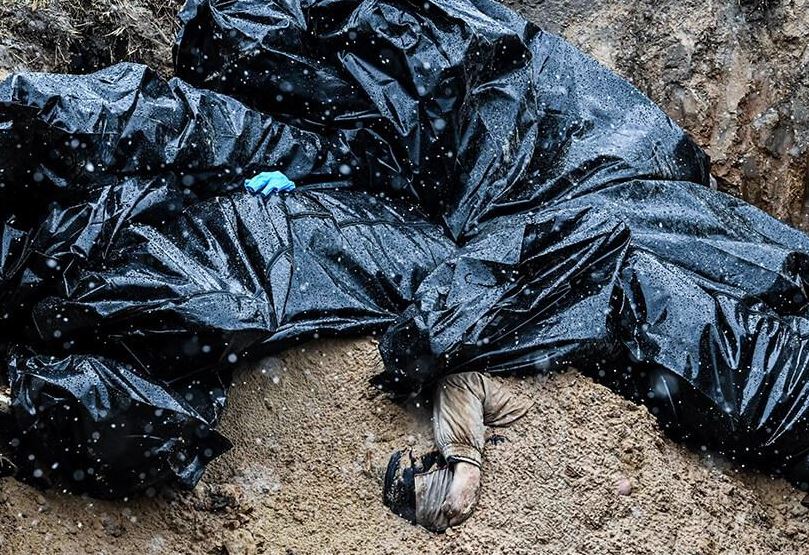
| Casus Belli: The bodies in the street, the terrible revelations of rape and torture: these only make matters worse. Our instinctive response, when confronted with such images is not to calmly contemplate the best means of extricating all concerned from the horrors of war, but to punish those responsible for such atrocities. |
WHY HAS THE RUSSO-UKRAINIAN WAR not generated a global movement for, at the very least, an immediate cessation of hostilities? The aggressor, Russia, possesses nuclear weapons, and has issued thinly-veiled threats that it is prepared to use them if any other power attempts to interfere in its “military operation” in Ukraine. The slightest miscalculation, therefore, could trigger an all-out nuclear exchange – and the end of civilisation as we know it. In such precarious circumstances, mobilising global support for a peaceful resolution to the conflict seems like a good idea. So, why isn’t it happening? Where is the peace movement?
Before attempting an answer to that question, it is worth casting our minds back to the first quarter of 2003. The United States and the United Kingdom were engaged in obvious preparations for a full-scale military invasion of Iraq. All over the world people were gathering in huge demonstrations to oppose the US/UK plans. Over a million protesters flooded the streets of the UK’s largest cities in what was, almost certainly, the largest political protest in the nation’s history. Vast crowds similarly thronged the streets of American cities. In France, Italy and Germany it was the same. Time magazine described the global peace movement as the other great power on the planet.
All to no avail. Like the Russian Federation, the United States was not about to be dissuaded from doing what it believed it had to do. That it would go to war without the sanction of the UN Security Council, and on the basis of intelligence claims that most independent experts dismissed as spurious, was not about to slow the administration of George W Bush down. Peace movement or no peace movement, the invasion would go ahead as planned.
The demonstrable futility of the international protest movement against the Iraq War offers a pretty solid explanation for the absence of a global pacifist response to the Russo-Ukrainian War. Among those coming of age in the first quarter of the Twenty-First Century, it may simply be understood that if a major power is resolved to attack another country, no amount of chanting and placard-waving will stop it. Didn’t the UK Prime Minister Tony Blair’s spin-doctors respond to media taunts that there were a million citizens on out on the streets, by referencing the tens-of-millions who weren’t?
The other obvious lesson to be drawn from the global protests against the US/UK invasion of Iraq is that they would never have happened (or, at least, not on anything like the same scale) had their organisers not been living in democracies. If the Russian Federation showed the same respect for fundamental human rights as the United States, it is possible that a million or more Russians would have turned out to protest the invasion of Ukraine. What the world actually witnessed on the streets of Moscow and St Petersburg was the brutal suppression of every attempt at protest by the thuggish Russian police.
It is these images of suppression and violence that bring us to the heart of the matter. People around the world rose up against the prospect of the invasion of Iraq in part because they believed that the two nations responsible, the USA and the UK, were still, in some hallowed and undefiled place, receptive to the moral case for peace. All the evidence may have pointed in the opposite direction, but, in their heart-of-hearts, the historical friends and allies of the United States and the United Kingdom wanted to – needed to – believe that they were better than the murderous bullies Bush and Blair had turned them into.
Very few people believe that some hallowed and undefiled place exists in the dark monstrosity that is the Russian state. There are no democratic orchards in Russia. The fruits of freedom and justice do not grow there. The conditions are too harsh. Even when the tree of liberty is smuggled in and persuaded to bloom, which is seldom, the flowers fade for lack of warmth. Russia is a hard, cold country, and difficult to love, even if you’ve a mind to. But no people on earth knows more about suffering – and how to share it.
And we are suffering, but not in a way that does Russia any good. Our suffering is vicarious, inspired by the pain and heroism of the Ukrainian people. How else are the people of the West supposed to feel when they are presented with the image of a Ukrainian father, now a soldier, fighting back tears as his wife and son are borne away from him on a westbound train to safety, clutching in his hands his little boy’s toy ambulance – all that is left to him? Are we supposed to be filled with an urge to make peace? Or, are we already part of the war?
The bodies in the street, the terrible revelations of rape and torture: these only make matters worse. Our instinctive response, when confronted with such images is not to calmly contemplate the best means of extricating all concerned from the horrors of war, but to punish those responsible for such atrocities. Perhaps that’s what they’re intended to do. Perhaps, as the Russians insist, they are fake news. But while such images are all the world is seeing, there will be no global peace movement.
And if there is worse to come: if the wounded Russian Bear tears the Ukraine to pieces; and if the world is bombarded with ever more tragic and terrifying images of Ukraine in extremis; then it will not be a global peace movement that emerges, but a global war movement. Channeling the wild bellicosity of the masses celebrating the outbreak of the First World War, the people of the West, heedless of the nuclear danger, will cry: “Do your worst, Russia – and we will do ours!”
This essay was originally posted on The Daily Blog of Friday, 15 April 2022.
