Showing posts with label Iraq War. Show all posts

Thursday, 24 October 2024

Waiting By The River.

Looking Sideways: To the Peoples Republic of China, and its friends around the world, the United States must remind them of the flailing and failing Chinese Empire of 1900.

WATCHING THE SCREEN in Oamaru’s Majestic picture theatre, I struggled to make sense of Fifty-Five Days At Peking. Yes, it was exciting, but it was also, for a seven year-old, extremely confusing. What war was this? Not the First World War, and certainly not the Second. More to the point, why were the nations I had grown up regarding as enemies – the Germans, the Japanese, and the Russians – all counted among the “goodies” in this movie? Turns out that I was not the only person confused by Fifty-Five Days At Peking. In spite of an all-star cast, including Charlton Heston, Ava Gardner, and David Niven, it was not a box-office success.

In 1963, a well-informed New Zealander in their seventies would not, however, have had anything like as much trouble understanding the plot. The blood-curdling “Boxer Rebellion” of 1899-1901; the consequent 55-day siege (20 June-14 August 1900) of the foreign legations in the Chinese capital; and the Eight Nation Alliance that lifted the siege and then proceeded to humiliate and punish the Chinese Empire; that was not an historical sequence any youngster following it in the newspapers was likely to forget. Certainly, it has never been forgotten by the Chinese, whose irreplaceable cultural treasures were destroyed by the armies of the “imperialists”.

Hardly surprising, when one considers how loudly those imperialists boasted of their victory. The intervention of Great Britain, Germany, France, Russia, Austria-Hungary, Italy, the United States, and Japan, had demonstrated to the whole world, or at least those few remaining parts of it not under the Eight’s complete control, what lay in store for any people who dared to raise their “harmonious fists” against them. The deliberate destruction of the Chinese emperors’ beautiful Summer Palace constituted a pretty big hint.

As always, the German Emperor, Wilhelm II, offered the most memorable quote:

Just as the Huns under their king Attila created for themselves a thousand years ago a name which men still respect, you should give the name of German such cause to be remembered in China that no Chinaman will dare look a German in the face.

That was the way the world was in 1900. The German Kaiser merely put into words (the “Huns” reference coming back to haunt him in 1914) what all the other leaders of the great imperial powers were thinking. The nations of Europe (and Japan) dominated the globe. Their cultures, and their technologies, were in every way superior.

Lest any reader assume that all such unabashed imperialist notions, following the horrors of World War II, had been set aside by the “international community”, here’s a memory-jogger from 1990-1991 – the Gulf War.

When Iraq’s Saddam Hussein invaded the oil-rich emirate of Kuwait in 1990, the American President, George H.W. Bush, sternly informed him, and the rest of the world, that “this will not stand”.

He was as good as his word. With China still dealing with the fall-out from Tiananmen Square, and the Soviet Union in the process of disintegration, the United States was able to pull together a “coalition” of 42 nation states to intervene on behalf of the Kuwaiti government and drive the Iraqis back across the border. Dominated, overwhelmingly, by the military resources of the United States, the Coalition made short work of Saddam’s army. It was a stunning demonstration of the USA’s uncontested global hegemony.

Savouring his victory, George H.W. Bush made no reference to the Huns, but he did proclaim the arrival of a “New World Order” – one in which any nation bold and/or foolish enough to flout Washington’s rules of international engagement should expect to pay a very heavy price.

How the events of the last thirty years have changed the world’s geopolitical architecture!

When Bush senior’s “New World Order” still meant something, the idea of a rebel regime in Yemen forcing the world’s shipping companies to abandon the Suez Canal would have been dismissed as absurd.

With the Cold War won, and American hegemony an accomplished fact for most of the 1990s, the idea that the Suez Canal could be closed – as it was for seven years in the wake of the Arab-Israeli wars of 1967 and 1973 – would not have stood. The impact on global oil prices, and the disruption of the international supply-chains so vital to the world’s increasingly interconnected economy, would have been regarded as unacceptable. The United States, the nations of Western Europe, and many of the Arab oil-states, would have unleashed upon Yemen the same overwhelming force that pummelled Iraq.

After 11 September 2001, however, the global game changed dramatically. Al Qaeda’s attack on the United States (itself an outgrowth of the USA’s co-option of the Saudi Kingdom in 1991) took place in an international setting very different from that which prevailed at the time of the Gulf War.

For a start, Russia and China were back in the game, stronger and more focused than they had been ten years earlier. Much of that strength was born out of both nations’ burgeoning trade with the European Union. Other states, Brazil, India and Iran in particular, were impatient to claim a more equitable share of the global economy. The USA remained strong – but not as strong as it had been at the end of the Cold War. It was an open question, in 2001, as to how many countries would respond to an American summons.

While joining the United States in a Global War on Terror made perfect sense in a world containing terroristic forces on the scale of Al Qaeda, partnering-up with Uncle Sam for what were obviously little more than punitive expeditions intended to slake the American thirst for vengeance after 9/11 was much less appealing. While the American overthrow of the Taliban in Afghanistan was given a pass (the regime had, after all, provided a base for Al Qaeda) the invasion of Iraq stepped over a line that most of the rest of the world would, ultimately, refuse to cross.

It would take twenty years for the Americans to comprehend, finally, that they were no longer in a position to issue orders to the rest of the world. Nor could they rely on the sort of racial and religious solidarity that prompted the world’s leading imperial powers to join together for yet another demonstration of White Supremacy on Chinese soil.

After the USA’s disastrous retreat from Afghanistan, the Russians and the Chinese must have exchanged knowing glances, and prepared to up-the-ante. The Russian Federation’s invasion of Ukraine, while demonstrating the astonishing courage and resilience of the Ukrainians, also revealed the vacillation and disunity of the Nato states and, in the aftermath (and facing the possible return) of Donald Trump, of the USA itself.

In Fifty-Five Days At Peking the Chinese were the baddies, and the white imperialists (alongside their plucky Japanese ally) represented the clear moral and technological superiority of Western Civilisation. If, in American, Australian and, increasingly, in New Zealand eyes, the Chinese are still the baddies, the perspective from Beijing, and a large part of the rest of the world, is rather different.

To the Peoples Republic of China, and its friends, the United States of 2024 must remind them of the flailing and failing Chinese Empire of 1900. In their own estimation, however, the Chinese people, once on their knees, have stood up.

And all those great empires that ravaged China in 1900, where are they now? Britain, France, Germany, Russia, Italy, Austria, Japan: all of them have become second-rate powers – at best. Even the United States, the great hegemon, is no longer equal to the task of preserving freedom of navigation along the Suez Canal.

In the words of China’s greatest sage, Confucius: “If you wait by the river long enough, the bodies of your enemies will float by.”


This essay was originally posted on the Interest.co.nz website on Monday, 7 October 2024.

Friday, 15 April 2022

Where Is The Peace Movement?

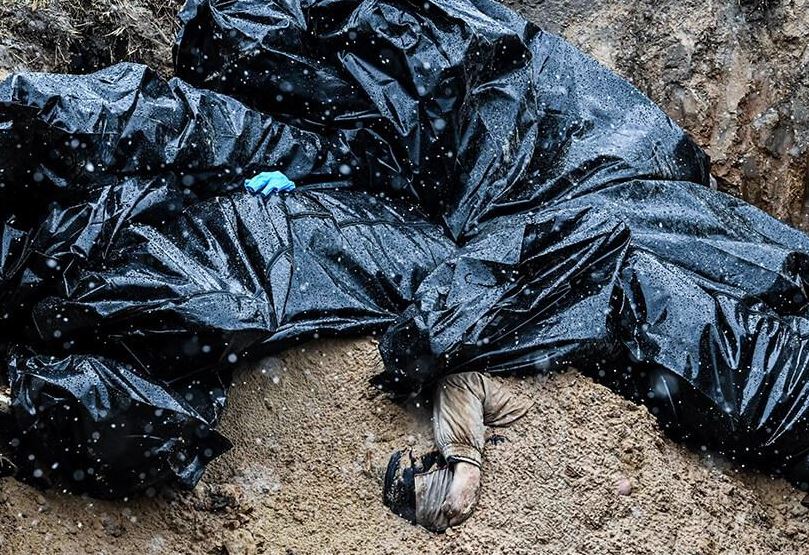
Casus Belli: The bodies in the street, the terrible revelations of rape and torture: these only make matters worse. Our instinctive response, when confronted with such images is not to calmly contemplate the best means of extricating all concerned from the horrors of war, but to punish those responsible for such atrocities.

WHY HAS THE RUSSO-UKRAINIAN WAR not generated a global movement for, at the very least, an immediate cessation of hostilities? The aggressor, Russia, possesses nuclear weapons, and has issued thinly-veiled threats that it is prepared to use them if any other power attempts to interfere in its “military operation” in Ukraine. The slightest miscalculation, therefore, could trigger an all-out nuclear exchange – and the end of civilisation as we know it. In such precarious circumstances, mobilising global support for a peaceful resolution to the conflict seems like a good idea. So, why isn’t it happening? Where is the peace movement?

Before attempting an answer to that question, it is worth casting our minds back to the first quarter of 2003. The United States and the United Kingdom were engaged in obvious preparations for a full-scale military invasion of Iraq. All over the world people were gathering in huge demonstrations to oppose the US/UK plans. Over a million protesters flooded the streets of the UK’s largest cities in what was, almost certainly, the largest political protest in the nation’s history. Vast crowds similarly thronged the streets of American cities. In France, Italy and Germany it was the same. Time magazine described the global peace movement as the other great power on the planet.

All to no avail. Like the Russian Federation, the United States was not about to be dissuaded from doing what it believed it had to do. That it would go to war without the sanction of the UN Security Council, and on the basis of intelligence claims that most independent experts dismissed as spurious, was not about to slow the administration of George W Bush down. Peace movement or no peace movement, the invasion would go ahead as planned.

The demonstrable futility of the international protest movement against the Iraq War offers a pretty solid explanation for the absence of a global pacifist response to the Russo-Ukrainian War. Among those coming of age in the first quarter of the Twenty-First Century, it may simply be understood that if a major power is resolved to attack another country, no amount of chanting and placard-waving will stop it. Didn’t the UK Prime Minister Tony Blair’s spin-doctors respond to media taunts that there were a million citizens on out on the streets, by referencing the tens-of-millions who weren’t?

The other obvious lesson to be drawn from the global protests against the US/UK invasion of Iraq is that they would never have happened (or, at least, not on anything like the same scale) had their organisers not been living in democracies. If the Russian Federation showed the same respect for fundamental human rights as the United States, it is possible that a million or more Russians would have turned out to protest the invasion of Ukraine. What the world actually witnessed on the streets of Moscow and St Petersburg was the brutal suppression of every attempt at protest by the thuggish Russian police.

It is these images of suppression and violence that bring us to the heart of the matter. People around the world rose up against the prospect of the invasion of Iraq in part because they believed that the two nations responsible, the USA and the UK, were still, in some hallowed and undefiled place, receptive to the moral case for peace. All the evidence may have pointed in the opposite direction, but, in their heart-of-hearts, the historical friends and allies of the United States and the United Kingdom wanted to – needed to – believe that they were better than the murderous bullies Bush and Blair had turned them into.

Very few people believe that some hallowed and undefiled place exists in the dark monstrosity that is the Russian state. There are no democratic orchards in Russia. The fruits of freedom and justice do not grow there. The conditions are too harsh. Even when the tree of liberty is smuggled in and persuaded to bloom, which is seldom, the flowers fade for lack of warmth. Russia is a hard, cold country, and difficult to love, even if you’ve a mind to. But no people on earth knows more about suffering – and how to share it.

And we are suffering, but not in a way that does Russia any good. Our suffering is vicarious, inspired by the pain and heroism of the Ukrainian people. How else are the people of the West supposed to feel when they are presented with the image of a Ukrainian father, now a soldier, fighting back tears as his wife and son are borne away from him on a westbound train to safety, clutching in his hands his little boy’s toy ambulance – all that is left to him? Are we supposed to be filled with an urge to make peace? Or, are we already part of the war?

The bodies in the street, the terrible revelations of rape and torture: these only make matters worse. Our instinctive response, when confronted with such images is not to calmly contemplate the best means of extricating all concerned from the horrors of war, but to punish those responsible for such atrocities. Perhaps that’s what they’re intended to do. Perhaps, as the Russians insist, they are fake news. But while such images are all the world is seeing, there will be no global peace movement.

And if there is worse to come: if the wounded Russian Bear tears the Ukraine to pieces; and if the world is bombarded with ever more tragic and terrifying images of Ukraine in extremis; then it will not be a global peace movement that emerges, but a global war movement. Channeling the wild bellicosity of the masses celebrating the outbreak of the First World War, the people of the West, heedless of the nuclear danger, will cry: “Do your worst, Russia – and we will do ours!”


This essay was originally posted on The Daily Blog of Friday, 15 April 2022.

Friday, 8 April 2022

Bloody Anniversaries.

My Lai, Vietnam, 16 March 1968: That was the day two companies of United States infantry descended on what the Americans called “Pinkville” and began killing civilians. The Vietnamese inhabitants of the village, between 300 and 500 of whom would be dead by nightfall, called it My Lai.

WHY, IN THE MIDST of an horrific war between Russia and Ukraine, did we let the anniversary pass? With talk of atrocities and war crimes filling the airwaves, how could we have overlooked the events of 16 March 1968?

That was the day two companies of United States infantry descended on what the Americans called “Pinkville” and began killing civilians. The Vietnamese inhabitants of the village, between 300 and 500 of whom would be dead by nightfall, called it My Lai.

The My Lai Massacre, as the wanton butchery and rape of unarmed men, women and children came to be known, was notable for two extraordinary interventions.

The first occurred on the day of the killings, when Warrant Officer Hugh Thompson and his helicopter crew, witnessing the mass murder taking place just a few hundred feet below them, landed their aircraft close to a group of My Lai villagers cowering in a bunker and organised their safe evacuation, making it clear to the American soldiers menacing them, that he and his men were prepared to use their aircraft’s heavy machine gun to keep the villagers safe.

Returning to base, Thompson told his commanding officer: “It’s mass murder out there. They’re rounding them up and herding them in ditches and then just shooting them.”

The other extraordinary intervention came two years later when the President of the United States, Richard Nixon, intervened to have the only individual convicted for his role in the My Lai Massacre, Lieutenant William Calley Jnr, released from the military jail where he was being held pending his appeal and placed under house arrest. Sentenced to life imprisonment on 22 counts of murder, Calley ended up spending only three-and-a-half years in custody.

In 1971, patriotic Americans could sing along to Terry Nelson’s “Battle Hymn of Lt Calley” – a tribute to the man considered a hero by many of his countrymen. By contrast, Warrant Officer Thompson and his crew were denounced by the then Chairman of the House Armed Services Committee, Mendel Rivers, as “traitors”.

In war, frightened and disillusioned young men are capable of the most atrocious behaviour, especially if encouraged to do so by those placed in command over them. At the outbreak of World War I, for example, German conscripts were ordered to engage in acts of Schrecklichkeit – frightfulness – as a means of deterring civilians from attempting to resist their advance. Thousands of men, women and children died.

In the final days of the First World War, when it was clear that all was lost, and with the Allies advancing rapidly towards the German frontier, there were instances of the retreating German soldiers murdering as many of the inhabitants of the villages and towns they were abandoning as they could find - seemingly out of a combination of petulance and spite. Schrecklichkeit indeed!

The images we have all had to confront this week from the Ukrainian town of Bucha are reminiscent of the scenes that confronted Australian and New Zealand troops in Flanders at the end of 1918.

Our Prime Minister quite rightly described the killing of unarmed Ukrainian civilians by Russian conscripts as “beyond reprehensible”. United States President, Joe Biden, went further, calling the man responsible, President Vladimir Putin, a “war criminal”. National’s foreign affairs spokesperson, Gerry Brownlee, has called for the expulsion of the Russian ambassador.

This latter demand would be easier to endorse if Mr Brownlee had made a similar call when the United States, the United Kingdom and Australia unleashed their “shock and awe” attacks on Iraq in March 2003. Then, too, there were confronting images of a capital city lit up by the explosions of cruise missiles; heart-wrenching scenes of civilians killed as they cowered in bunkers.

That was also an illegal war, launched without UN sanction, against a nation that had not attacked its invaders. The siege, bombardment (with phosphorous shells) and eventual occupation of the Iraqi city of Fallujah certainly bears comparison with the Russian armed forces’ siege and bombardment of the Ukrainian port city of Mariupol.

Why then did Mr Brownlee fail to call for the expulsion of the American ambassador, President Bush’s mouthpiece in Wellington?

No part of humanity, no nation on Earth, carries a “Get Out of Jail Free” card that the Devil will honour.

Every date on the calendar commemorates a crime against humanity.


This essay was originally published in The Otago Daily Times and The Greymouth Star of Friday, 8 April 2022.

Thursday, 7 April 2022

Forgetting To Remember: News Coverage of the Russo-Ukrainian War.

Six O'Clock Stories: The journalism to which we are nightly subjected is not intended to supply information, it is intended to be affective – that is to say it is aimed almost exclusively at arousing our feelings.

WATCHING THE NEWS coverage of the Russo-Ukrainian War is a struggle. The entire Western news media, our own included, have hurled themselves into the fray on the side of “the brave Ukrainians”. There is nothing in the news coverage that encourages us to contrast and compare the events we are witnessing now, with remarkably similar events a great many of us have witnessed in the recent past. There’s nothing that encourages detachment, reflection or the exercise of sober judgement. As the war unfolds, our news bulletins have come to resemble George Orwell’s “Five Minute Hate” from Nineteen Eighty-Four.

The thing to bear in mind as you watch the news coverage is that it is the product of a whole team of journalists and technicians. They are the people who decide what is shown and how it is edited. They are the people who write the autocue script for the news anchor/s to read in front of the cameras.

What you are watching is a carefully constructed narrative which, in its essentials, does not change from broadcast to broadcast. We are supplied with a cast of heroes and villains to cheer on and condemn. An occasional nod in the direction of fairness and balance may be inserted, but any serious challenge to the dominant narrative will be contradicted more or less immediately. Nothing is permitted to blunt the emotional impact of the coverage. The journalism to which we are nightly subjected is not intended to supply information, it is intended to be affective – that is to say it is aimed almost exclusively at arousing our feelings.

Pause here and think about that for a minute or two. At war with Ukraine is a nation in possession of more nuclear devices than any other nation on the planet. With each passing day the Western news media’s portrayal of the President of the Russian Federation, Vladimir Putin, grows increasingly lurid. He has become a devil-like caricature: someone who is clearly either mad or bad – probably both.

The people responsible for our nightly news bulletins do nothing to dispel this characterisation, indeed, they reinforce it. No one anywhere appears to have asked themselves: “Is it wise to go on demonising Vladimir Putin? Is it prudent to promote the imposition of an ever-increasing number of crippling sanctions upon Putin, his supporters and the Russian people? If he truly is as mad and bad as the Western media is suggesting, might such tactics not cause him to lash out with his nuclear weapons?

Take, for example, the massacre of civilians at Bucha. Right across the West, Putin is being branded a war criminal, and calls are growing for him to be put on trial in the manner of Goering and Hess at the end of World War II.

Except that nobody knows what happened in Bucha – apart from the fact that many civilians lost their lives. There has been no independent investigation; no collection of evidence and eye-witness testimony, no patient piecing together of a timeline. The forensic work simply hasn’t been done.

The world simply does not know if the killings were the result of a deliberate policy, formulated by Russian commanders, at the behest of Putin; or, whether they were the awful consequence of terrified and panicky conscript soldiers who had seen dozens of their comrades killed and wounded as their armoured column was blown to pieces by the Ukrainian armed forces – fellow Slavs who, they’d been assured, were their friends and compatriots.

Inasmuch as he ordered the invasion of Ukraine, Putin is culpable. Without his order, the terrible events of the past few weeks would not have happened. In that sense, the Russian President does indeed have blood on his hands. But to hold him guilty of a war crime: without evidence, without witnesses, without a trial; isn’t that asking for trouble?

What incentive is the West giving Putin to negotiate a peace settlement? What is it doing to reduce the chances of the Russian Bear, backed into a corner, lashing out with his thermos-nuclear claws?

Moreover, as John Minto so rightly points out in his latest post, if Putin is a war criminal, then so are the men who launched the illegal invasion of Iraq in 2003. As anyone who has watched the disgusting video, released to the world by Chelsea Manning and Julian Assange, of the crew of an American Apache attack-helicopter opening fire on a group of unarmed Iraqi civilians and journalists in Baghdad, on July 12, 2007, surely understands, there are no “goody” countries and “baddy” countries. The United States is no less guilty than the Russian Federation of plotting and waging “aggressive war” on a fellow member of the United Nations.

But, as John writes:

There were no sanctions against the US, UK and Australia, there were no US soldiers, military leaders or politicians held to account. There were no arms sent to help the Iraqis facing overwhelming odds in their fight against the US and its allies. There were no moves to charge George Bush (US President), Tony Blair (UK Prime Minister) or John Howard (Australian Prime Minister) for war crimes before the International Criminal Court. 

[In fact, the USA refuses to accept the jurisdiction of the International Criminal Court! – C.T.]

As our nightly news bulletins are put together over the course of the day there is scant evidence that anybody on the “team” is raising these sorts of objections, or demanding at least some effort be made to place what is happening in Ukraine in its historical context. While it is true that many younger journalists would only have been children in 2003, that is certainly not true of their senior colleagues. As experienced journalists they should all have vivid memories of the Iraq War and its many crimes.

What that means is that, in putting together their coverage of the Russo-Ukrainian War, New Zealand broadcasters and publishers are either unconsciously, or deliberately, suppressing all recollection of the events that have shaped the last thirty years.

One almost hopes they are doing so deliberately: that, at least, would suggest they believe in something – no matter how bereft it might be of historical understanding and/or moral purpose. The alternative explanation: that the past has simply dropped out of their day-to-day consciousness, and that they receive the Ukraine “story” ready-made from “sources” they see no need to interrogate or challenge; is much, much scarier.

It was the Czech novelist, Milan Kundera, who said it best:

The struggle of man against power is the struggle of memory against forgetting.


This essay was originally posted on The Daily Blog of Thursday, 7 April 2022.

Monday, 14 March 2022

Of American Geese And Russian Ganders.

Moral And Diplomatic Failure: Shouldn’t journalists from small nations like New Zealand be reminding the international community of its obligation to not only demand full accountability from those nations that commit crimes against humanity, but also from those that cause them?


SATURDAY NIGHT’S BULLETIN of 1 News featured a very peculiar, and disturbing, item. Put together by journalist Thomas Mead, the item noted with alarm the fact that some New Zealanders were backing Vladimir Putin and Russia against Volodymyr Zelenskyy and Ukraine.

Those involved were described by Mead as “conspiracy theorists”, a term he appeared to be using as a synonym for “evil crazies”. This highly tendentious characterisation was not in the least challenged or repudiated by the two academics Mead consulted. Neither the political scientist, Steve Hoadley, nor the University of Auckland’s “Misinformation Project” spokesperson, Snajama Hattotuwa, challenged Mead’s assumptions about Putin’s supporters.

Were New Zealand at war with the Russian Federation, then this degree of overt media propagandising might, just, be excusable. When the youth of one’s country are locked in an existential struggle with its enemies, balance and nuance tend to fall by the wayside. A war being fought on the other side of the world, however, surely requires plenty of both. Demonising one’s fellow citizens for the “sin” of refusing to view a faraway war through the lens of their own government serves neither journalism nor democracy.

Then again, since the New Zealand Parliament has, unanimously, rushed through all the stages of a bill enabling the New Zealand state, independently of the United Nations Security Council, to impose sanctions on Russian businesses and individuals, perhaps New Zealand really is at war with the Russian Federation.

While the imposition of economic sanctions on another country and its citizens falls well short of ordering one’s armed forces into battle against them, it is difficult to characterise the measure as anything other than a declaration of economic warfare.

An effective sanctions regime, by wreaking havoc on the targeted nation’s economy is intended to inflict non-physical harm on its citizens. It is, unquestionably, an act of coercion. A lesser act of coercion, at least in the short term, than firing artillery shells and dropping bombs, but an act of coercion nonetheless.

This is why the imposition of sanctions, a remedy institutionalised by the League of Nations in the years immediately following World War I, was presented as the most effective international response to aggression – short of all-out war. It amounted to a declaration of economic hostilities upon the aggressor state by the whole world. As such, it made it difficult for the aggressor state to retaliate effectively. It also constituted an unanswerable international moral rebuke of the offending nation’s actions.

Re-adopted by the United Nations following the Second World War, the sanctions option was placed in the hands of the UN Security Council. Providing the five permanent members of the Security Council (USA, Russia, UK, France and China) were in agreement, the world would be empowered to squeeze the economy of an aggressor state until the pips squeaked.

There was, however, an inherent weakness in this arrangement. Since only the world’s most powerful states were ever likely to thumb their noses as the United Nation’s Charter, and since those states could veto any intervention by the UN Security Council, then the application of sanctions as a means of coercing delinquent states into demonstrating an acceptable standard of international conduct became something of a dead letter.

New Zealand has long been a critic of the veto power of the five permanent members of the UN Security Council – depicting it as a fundamental obstacle to the enforcement of the provisions of the UN Charter. A little reflection, however, makes it perfectly clear why the veto power has always been critical to the maintenance of international peace and stability.

What possible reason for retaining their membership of the United Nations would the great powers have if it was possible for a majority of the five permanent members to “gang-up” on the rest? It is the veto that keeps the planet’s most dangerous nations seated around the multilateral table. If the UN Security Council had possessed the power to impose sanctions on the Bush Administration for its unlawful invasion of Iraq, would the USA still be a member of the UN? Of course not.

The problem which now confronts the world is that the preponderant economic and military power of the United States has persuaded its leaders to evade the limitations associated with the veto by imposing swingeing economic sanctions upon its enemies without Security Council authorisation. It masks this dangerous unilateralism by pressuring those states under its sway (which includes most of the world’s nations) into joining its sanctions regimes. Any reluctance on the part of US “allies” to participate in these brazen acts of economic coercion is overcome by threatening to extend the sanctions to any entity deemed guilty of ignoring them.

In a more rational world, the very fact one of the five nuclear-armed permanent members is contemplating exercising its veto would be enough to convince the other four that a full-scale diplomatic effort is required to identify the most fruitful options for easing the tension. Tragically, the most malign legacy of the Cold War, which froze international relations for forty years, is the way in which its “Free World” allies have opted to remain passengers on the United States’ war chariot, and how many of its erstwhile Warsaw Pact enemies have sought its protection from their former Russian suzerain.

That Russia would eventually demand to know why sauce for the American goose was not also sauce for the Russian gander was inevitable. If the Americans could determine that a nation thousands of miles from its shores, which had made no aggressive move in its direction, could nevertheless be invaded by a coalition led by two of the five permanent members of the Security Council – ostensibly to defend themselves – then Moscow was surely entitled to do the same to a nation located on its western border which had voiced its determination to throw in its lot with Russia’s Nato “enemies”.

That the answer: because two wrongs do not make a right; and that it is no more acceptable for Russian missiles to kill Ukrainian children than it was for American missiles to kill Iraqi children; should have been obvious to Vladimir Putin, is, unfortunately, no help at all. Because the chancelleries of the world looked the other way when the USA tore up the UN Charter in 2003, their powers of moral persuasion in 2022 are not as forceful as they should be.

Rather than replicating the McCarthyism of the Cold War, shouldn’t journalists from small nations like New Zealand be reminding the international community of its obligation to not only demand full accountability from those nations that commit crimes against humanity, but also from those that cause them?


This essay is exclusive to Bowalley Road.

Wednesday, 21 March 2018

A Lively Terror

An Indiscriminate And Reckless Attack: Curiously, the British Prime Minister, Teresa May, does not appear to regard the “indiscriminate and reckless” attacks made against “innocent civilians” living on the soil of other United Nations member-states as being worthy of the unequivocal condemnation contained in her statement to the House of Commons on 12 March 2018. Only when the alleged attacker is the Russian Federation does the UK start screaming blue, bloody murder.

“I AM STRONGLY in favour of using poisoned gas against uncivilised tribes.” So said Great Britain’s Secretary of War, Winston Churchill, in 1920 – and he was as good as his word. That same year, Aylmer Haldane, the commander of British forces in Iraq bombarded the villages of rebellious “uncivilised tribes” with gas-filled shells. The British estimated Arab casualties at 8,450 killed and wounded. The action was deemed a resounding success. The use of chemical weapons had engendered, in Churchill’s telling phrase, “a lively terror”.

It still does.

Much of Southern Iraq remains contaminated with the residue of the depleted uranium shells used by American armoured columns against the Russian-made tanks of the Iraqi army in the Gulf War of 1991. During the first and second battles for the Iraqi city of Fallujah, in 2004, the use of white phosphorus explosives (first developed for anti-personnel purposes in World War I) inflicted hideous burns on hundreds of the city’s inhabitants – civilian as well as insurgent.

The United States and British-led invasion of Iraq in 2003, undertaken in defiance of the United Nation’s Charter and without the authorisation of the UN Security Council was, in the near-unanimous opinion of jurists around the world, an egregious breach of international law.

To date, no nation state, or collection of nation states, has imposed diplomatic or economic sanctions on the United States or the United Kingdom. The individuals responsible for planning and executing the illegal invasion of Iraq are free to travel and conduct business wherever they choose.

The suspected use of an illegal chemical weapon by the Russian Federation has provoked near-universal condemnation. Rightly so, because the deployment of a deadly nerve agent in the picturesque medieval city of Salisbury was an extraordinarily reckless act. The sheer lethality of the substance has inflicted critical injury not only upon the target of the assassination attempt, the Russian double-agent, Sergei Skripal, but also upon his 33-year-old daughter, Yulia, and the local police officer who rushed to their aid. Anyone or anything coming into contact with the Skripals is now being treated as a potential bio-hazard.

The British Prime Minister, Teresa May, has condemned the attack in the most unequivocal fashion. In her 12 March statement to the House of Commons, she unhesitatingly identified the Russian Federation as the source of the nerve agent used in the Salisbury incident. Her concluding remarks made the UK’s position very clear:

Mr Speaker, this attempted murder using a weapons-grade nerve agent in a British town was not just a crime against the Skripals. It was an indiscriminate and reckless act against the United Kingdom, putting the lives of innocent civilians at risk. And we will not tolerate such a brazen attempt to murder innocent civilians on our soil.”

Curiously, Prime Minister May does not appear to regard the “indiscriminate and reckless” attacks made against “innocent civilians” living on the soil of other United Nations member-states as being worthy of an equally forthright parliamentary statement.

Since 2001, armed Predator drones piloted by United States armed forces personnel have patrolled the skies above Africa and the Middle East. Their mission: to track the precise location of individuals and groups whose very existence has been deemed inimical, by the CIA and other intelligence gatherers, to the national security of the United States.

When the location of these “targets” had been pinpointed, the US launched one, or both, of the Hellfire missiles carried under the Predator’s wings. Sometimes these missiles achieved a “clean kill” – “neutralising” only their targets. On other occasions, however, these US drone strikes inflicted “collateral damage” – killing or maiming the “innocent civilians” living inside the blast zone.

It is passing strange, is it not, that the global news media has, to date, seen no need to whip itself into a lather of fury over the fate of these casualties of state-sponsored terrorism? Especially when the death-toll from this US policy, which operates well outside of any reasonable reading of international law – or justice – now numbers in the thousands.

Then again, we are only dealing here with members of those “uncivilised tribes”: human-beings for whom the protection of the law was deemed, as long ago as 1920, and by no lesser authority that Winston Churchill, to be unwarranted.

When set against these current and historical facts, the propensity of Vladimir Putin to engage in “indiscriminate and reckless” acts is suddenly rendered grimly intelligible.

If the West’s use of poison gas, depleted uranium, white phosphorus and Hellfire missiles elicits no outrage in the House of Commons; and if the “international community” is not moved to impose diplomatic and/or economic sanctions against those responsible; then perhaps the only reasonable lesson to be drawn is that “international outrage” has now become just one more “lively terror” to be unleashed upon the “uncivilised tribes” of Planet Earth.

This essay was originally published in The Press of Tuesday, 20 March 2018.

Tuesday, 11 April 2017

Should We Believe Uncle Sam?

Righteous Wrath, Or Unlawful Attack? In light of the Gulf of Tonkin and WMD fabrications, one might have thought that the default position of “responsible” commentators, when presented with US justifications, would be one of extreme scepticism. And yet, in New Zealand and across the Western World, the US assertion that the chemical attack on the rebel-held town of Khan Sheikhoun was the work of the Syrian head-of-state, President Bashar al-Assad, has been accepted without question.
 
THERE IS AN ASSUMPTION among New Zealand foreign policy “experts” that what the United States tells us should be believed. If, to take the most recent instance, the US Government informs the New Zealand Government that the Syrian Government is responsible for using chemical weapons against its own people, then that intelligence should be accepted by all responsible commentators. More importantly, it should reinforce all subsequent commentary concerning New Zealand’s diplomatic and military responses.
 
But, is this willingness to take the justifications of the United States at their face value really all that responsible? Surely, the first obligation of all those in a position to comment on the tragic chemical release at Khan Sheikhoun and President Trump’s retaliatory missile strike on Syria, is to be guided by America’s record? Shouldn’t we be examining past justifications for US military adventures before offering New Zealand support for this latest attack on a sovereign state?
 
Because the United States’ post-war record really isn’t all that flash when it comes to justifying its military assaults on other countries.
 
America’s most costly military engagement of the post-World War II era, the Vietnam War, was justified with what was later exposed as a carefully constructed falsehood. The so-called “Gulf of Tonkin Incident” of 22-24 August 1965, which prompted the “Gulf of Tonkin Resolution” of the United States Congress, which, in turn, authorised President Lyndon Johnson to assist any Southeast Asian  government endangered by “communist aggression”, never happened.
 
That America’s allies, including New Zealand, were somehow persuaded that a US naval force, including a fully-equipped aircraft carrier and at least one destroyer, had been threatened seriously by three North Vietnamese patrol boats, tells us much about the influence of Cold War paranoia on Western decision-making in the mid-1960s.
 
The exposure of the Gulf of Tonkin Incident as a fabricated pretext for US military aggression in Indochina should have encouraged America’s friends to treat any future justifications for US violations of the United Nations’ Charter with considerable caution.
 
To the eternal credit of the Labour-led government of Helen Clark, it was not persuaded by the United States’ repeated claims, peaking in January and February 2003, that the Iraqi dictator, Saddam Hussein, remained in possession of “Weapons of Mass Destruction” (WMDs) and must, therefore, be overthrown by an American-led invasion.
 
Thirty-eight years after the non-existent Gulf of Tonkin Incident, Clark rightfully insisted that any such invasion could not be supported by New Zealand unless and until it had been authorised by a resolution of the United Nations’ Security Council.
 
In an attempt to persuade the UN Security Council to pass such a resolution, the US President, George W. Bush, sent his Secretary of State, Colin Powell, to make the case for military intervention. The hapless Powell appeared before the Council on 5 February 2003, equipped with all manner of diagrams and slides. His “evidence” even included a “model” phial containing the deadly Anthrax virus!
 
The Council was not persuaded and refused to authorise an American-led invasion. A wise decision, as it turned out, because when, in defiance of the United Nations, the US, the UK and Australia invaded Iraq in March 2003, Saddam Hussein’s claims (backed-up by UN Inspectors) that Iraq had destroyed all of its WMDs, turned out to be true. In spite of the most exhaustive searches, the US was unable to locate any WMDs whatsoever.
 
There’s a schoolyard chant: “Fool me once, shame on you! Fool me twice, shame on me!”
 
In light of the Gulf of Tonkin and WMD fabrications, one might have thought that the default position of “responsible” commentators, when presented with US justifications, would be one of extreme scepticism. And yet, in New Zealand and across the Western World, the US assertion that the chemical attack on the rebel-held town of Khan Sheikhoun was the work of the Syrian head-of-state, President Bashar al-Assad, has been accepted without question.
 
Colin Powell and Nikki Haley Show and Tell the UN Security Council ..... Lies?
 
In a diplomatic atmosphere alarmingly reminiscent of Cold War fear and suspicion, the alternative explanation offered by Syria’s ally, the Russian Federation – that Syrian bombs struck a warehouse in which rebel munitions, including deadly chemical agents, were stored – has been dismissed out of hand.
 
New Zealand’s Prime Minister, Bill English, responding to the US missile attack, said:
 
“We of course would rather see the Syrian differences resolved by diplomatic processes but the Security Council hasn’t been able to condemn it or do anything about it.
 
“So we can understand the US taking action to prevent that kind of chemical attack occurring again – and we support action as long as it’s proportionate.”
 
Clearly, the events of 1965 and 2003 have left no trace upon Prime Minister English. Nor, it would seem, upon New Zealand’s “expert” commentators. Neither the lessons of history, nor the UN Charter, count for much against the unchallengeable word of Uncle Sam.
 
This essay was originally published in The Press of Tuesday, 11 April 2017.

Friday, 24 July 2015

Time To Stop "Dribbling" And Start "Clouting"?

Boots On The Ground: The former head of the UK armed forces, General David Richards, suspects in his “bones”, that if the Islamic State is to be defeated, then the armed forces of the West will have to stop "dribbling" and start "clouting". In the General’s words: “tanks would have to roll and there’s going to have to be boots on the ground”.
 
ARE WE AT WAR with the Islamic State – or not? The Prime Minister says “Not”. Our role in the conflict between the Islamic State and its enemies is merely to assist the government of Iraq’s Prime Minister Haider al-Abadi. Sixteen NZ Defence Force personnel are stationed less than an hour’s drive north of Baghdad at Camp Taji – a former US military base. Their mission: to help train Iraq’s army. A further 100 Kiwi troops have been sent to provide them with protection while they get on with it. That’s all.
 
This is what General David Richards, former head of the UK’s armed forces, and current member of the House of Lords, calls “dribbling” – the sort of one-handed military activity soldiers are required to engage in when their political masters would rather not have them wage war with both hands.
 
Lord Richards has warned UK Prime Minister, David Cameron, that, when it comes to defeating the Islamic State, “dribbling” will not be enough. What’s needed against the highly motivated and exceptionally well-led soldiers of the self-proclaimed Caliphate is “clouting”.
 
“Properly brought together with proper leadership and proper command and control it is a very doable proposition”, Lord Richards told the BBC’s Andrew Marr. “But I worry that […] if we dribble, which is really rather what we are doing at the moment, it is simply firing up the problem rather than dealing with it.”
 
The former head of the UK armed forces told Marr that he suspected, in his “bones”, that if IS to be defeated, then its army will have to “clouted” by his country’s soldiers – on the front lines. In the general’s words: “tanks would have to roll and there’s going to have to be boots on the ground”.
 
But the UK could not possibly do this alone. After 14 years of fighting in Afghanistan and Iraq, the UK’s defence force is bruised, battered and in urgent need of repair and replenishment. Lord Richards knows full-well that what he is really calling for is the assembly of another great Western invasion force; comparable in strength to Operation Desert Storm, and guided by similar, strictly limited, objectives.
 
The mission of Operation Desert Storm was to drive the Iraqi Army out of Kuwait. The core mission of this new Western force would be the utter destruction of the Islamic State in Iraq and Syria. To render the defeat of IS permanent, however, it would, almost certainly, be necessary to accomplish the complete pacification of Syria and the disarmament of the Iranian-backed Shite militias operating in Iraq.
 
The elimination of the murderous regime of President Bashar al-Assad, and the disarmament of his many enemies, would lift a huge burden from the shoulders of Syria’s neighbours. Millions of refugees, driven across borders by civil war and religious extremism, would be free to return, and the arduous task of reconstructing their ancient homeland could, finally, begin.
 
An effort of such magnitude on the part of the West – especially the USA and the UK – is the only truly effective means of bringing the multiple tragedies of the last quarter-century in the Middle East to an honourable resolution.
 
The barbarity of IS is an affront, not just to the peoples of the Islamic world but to all humanity. And, in their heart of hearts, the USA and the UK both know its poisonous creed could only have been distilled from the seething cauldron of hatred and resentment which their 2003 invasion of Iraq created. “You break it, you own it”, quipped US Secretary of State, Colin Powell, back in 2003. Well, between them, the USA and the UK smashed Iraq into a thousand pieces, and now they must make her whole again.
 
Do the peoples of the West have the stomach for another great military effort in the Middle East. Many would say “No.” But they should fix their eyes on the tens-of-thousands, desperate and despairing, who daily make their way toward Europe’s borders. If the West does not bring peace to the Middle East, then the Middle East will bring chaos to the West. Lord Richards knows the efficacy of forward defence, that is why he is urging his prime minister to stop dribbling and start clouting.
 
Would it be asking too much of our own defence force, and prime minister, to do the same?
 
This essay was originally published in The Waikato Times, The Taranaki Daily News, The Timaru Herald, The Otago Daily Times and The Greymouth Star of Friday, 24 July 2015.

Tuesday, 17 February 2015

Responsibility To Protect: But Who? And From What?


Cry, Havoc!, And Let Slip The Dogs Of War: If Islamic State has citizens, it is the West that made them.
 
DOES THE INTERNATIONAL COMMUNITY’S “Responsibility To Protect” apply to Islamic State? (IS) Has the violence unleashed by IS against civilians living in Syria and Iraq reached a level of intensity comparable to the genocidal slaughter unleashed against Rwanda’s Tutsi population in 1994? If the present level of military intervention is not maintained, or stepped-up, are hundreds-of-thousands, perhaps millions, of innocent non-combatants in imminent danger of losing their lives?
 
The answer to this question is, clearly, “No.” The IS regime, while indisputably brutal in its treatment of non-Islamic religious minorities, prisoners of war, civilian aid workers, journalists, and persons found guilty of committing homosexual acts, has not (to date) engaged in the indiscriminate mass slaughter of entire populations.
 
The international community’s responsibility to the victims of IS violence is, therefore, to make every attempt to bring those responsible for what are clearly war crimes and crimes against humanity before an appropriately constituted international criminal tribunal (ICT). This would be modelled on of the bodies set up to deal with the massive human-rights breaches in Rwanda and the former Yugoslavia.
 
The prospect of being arraigned before such a tribunal may or may not be acting as a deterrent to the IS leadership, but it is, demonstrably, influencing the personal political calculus of those IS operatives responsible for carrying out its many atrocities. The very fact that these individuals wear masks indicates that they know they are committing heinous crimes and are anxious to escape legal retribution.
 
The contrast between these masked perpetrators and the unmasked American military personnel who allowed themselves to be photographed tormenting Iraqi detainees at the infamous Abu Ghraib prison is instructive. Had the latter known that their actions would one day be made public, most of them would never have participated, or, becoming involved, would’ve made absolutely certain they could not be identified.
 
Like the long-since destroyed videos of CIA waterboarding sessions, the images of Abu Ghraib were never intended to see the light of day. IS propaganda videos, on the other hand, are intended to both terrify the infidels and inspire the faithful. They are, therefore, made with guilty intent, and their creators are well aware of what will happen to them if they are identified and arrested by the agents of international justice.
 
It is as well to remember, however, that IS is by no means the first belligerent power to release video images demonstrating the strength of their will and the power of their weapons. The First Gulf War (1990-1991) is often referred to as “The Nintendo War” on account of the computer-game-like images of United States precision-guided munitions striking their targets.
 
Of course the US armed forces’ public relations team did not allow the audience back home to witness what was happening to the human-beings sheltering inside the buildings that were exploding in such dramatic fashion on their television screens. The carnage wrought upon human flesh by high explosives puts the gruesome efforts of IS executioners to shame.
 
Nor was it the practice of either the American or the international news media to give the military commanders who authorised these precision-guided missile attacks colourful monikers like “Jihadi John”. Soldiers following the lawful orders of their superior officers are generally not regarded as criminals – not even when those orders are publicly acknowledged to have been deliberately formulated to generate “shock and awe” in the civilian population.
 
Those who find themselves outraged and repulsed by IS propaganda videos showing prisoners being beheaded or burned alive should, perhaps, ask themselves if they experienced similar emotions back in March 2003 when the US media was gleefully beaming-out images of Baghdad aflame. The American message back then was as unequivocal as the IS message  is now: “This is what becomes of evil-doers.”
 
The crucial difference being that, in the case of the Americans, the message wasn’t personalised. Innocent people’s bodies were certainly ripped apart and/or burned beyond recognition in the manufacture of America’s message to the peoples of the Middle East, but we only got to see such “collateral damage” occasionally – as when a Cruise missile somehow went astray and incinerated scores of women and children taking refuge in a concrete shelter.
 
Repeat such exercises often enough and it is hardly surprising if the effect upon those in receipt of such explosive communications is brutalisation beyond the reach of pity or remorse.
 
Closer to home, those advocating for the deployment of 100 Kiwi soldiers to Iraq are arguing that the international community has a responsibility to protect the unfortunate inhabitants of Islamic State. But, didn’t that same international community have a responsibility to protect the people of Iraq when the world’s most powerful military machine was rumbling towards its borders in 2003? And wasn’t it that same terrible machine, raining down white phosphorous on the city of Fallujah, that nurtured, with every bomb dropped and bullet fired, the fell creatures who now hold sway across broad swathes of Iraq and Syria?
 
If Islamic State has citizens, it is the West that made them.
 
This essay was originally posted on The Daily Blog of Monday, 16 February 2015.