Showing posts with label Volodymyr Zelensky. Show all posts

Tuesday, 17 January 2023

Is The Prime Minister “Evil”?

She’s Such A Scream! The Prime Minister’s enemies, those who want us to hate her, suffer from the not insubstantial handicap of being more than a little hateful themselves. Rendered nonsensical by their unwavering belief in the most absurd conspiracy theories, and dangerous by their relentless peddling of fake news about the Covid-19 vaccines, they stand exposed to the accusation that they are all exceptionally dark right-wing pots to be calling Labour’s kettle black.

WHAT DOES IT SAY about the state of New Zealand politics that our prime minister is being branded as “evil”? “Nothing good” is the obvious, if insufficient, response. Calling another human-being evil signals that political discussion has veered away from the predictably ideological towards the dangerously metaphysical. Good and Evil are religious – not political – terms.

Escalating the depiction of one’s political opponents from the merely incompetent, simply ignorant and defensively dishonest, to the overtly mendacious, fundamentally corrupt and self-consciously immoral, makes politics, “the art of the possible”, impossible.

After all, competence can be acquired through experience; ignorance can be corrected through education; and the political consequences of dishonesty can be powerfully corrective. But, mendacity, corruption, and the deliberate choice of clearly immoral options, are failings beyond the remedial powers of most ordinary mortals.

I vividly recall watching the Ukrainian President, Volodymyr Zelensky, waxing eloquent on the evil character of his Russian enemy. Zelensky’s depiction of President Vladimir Putin made the Devil himself look like a rank amateur. It was only when the journalist interviewing Zelensky pointed out that if Putin really was as bad as he was saying, then compromise would be impossible. How does one negotiate with pure evil? The question pulled the Ukrainian president up short. If only for a moment, doubt took command of his features. Is it ever possible to make peace with the Devil?

That is the problem with terms like Good and Evil: they tend to shut down the possibility of compromise and negotiation. Indeed, they render compromise and negotiation morally unacceptable. The threat posed by the individuals and/or groups described as evil is transformed into something viscerally existential. If “they” are not overcome, then “we” will be. The only options become: Victory – or Death.

Those who choose to characterise Jacinda Ardern as evil do so with a similarly binary political objective. In the simplest terms, they are hoping to rule out all other political options except the decisive destruction of the Labour Government and its leader.

Certainly, they do not want all those New Zealanders tossing-up whether to cast another vote for Labour to say: “On the one hand, Jacinda and her government have been pretty hopeless at keeping their promises on climate change, child poverty and affordable housing; but, on the other hand, they did a great job keeping the country going under Covid.”

Nor are Jacinda’s foes keen for voters to compare New Zealand’s economic and social performance with those of other nations. Once people grasp the fact that their own country is economically, socially and culturally out-performing a great many of the wealthy nations against which we like to compare ourselves, the idea of returning Labour to power doesn’t seem quite so unthinkable after all.

Transforming Jacinda Ardern into a hateful caricature, and loading her with responsibility for all the nation’s woes, will also serve to distract the electorate from the straightforward and eminently measurable response of her government to the most pressing (and potentially the most politically determinative) “bread and butter” issues bound up with the steadily rising cost-of-living, ballooning mortgage repayments, and the ability of working people to ensure that their wages and salaries at least keep pace with inflation.

If the data emerging from the Treasury and the Reserve Bank over the next 11 months indicates that the Labour Government is making a reasonable fist of managing the economy in unusually trying times, then the Prime Minister will have realistic grounds for electoral optimism. Doubly so, if her Finance Minister, Grant Robertson, is able to announce changes to the tax regime that penalise the rich and reward the poor.

It should also be noted that the Prime Minister’s enemies, those who want us to hate her, suffer from the not insubstantial handicap of being more than a little hateful themselves. Rendered nonsensical by their unwavering belief in the most absurd conspiracy theories; and dangerous by their relentless peddling of fake news about the Covid-19 vaccines; they stand exposed to the accusation that they are all exceptionally dark right-wing pots to be calling Labour’s kettle black.

Should Jacinda Ardern re-fashion herself as a humble witness to her own and her government’s shortcomings, and commit herself to achieving a very small number of extremely useful things, then her enemies’ accusations of evil are most unlikely to stick.


This essay was originally published in The Otago Daily Times and The Greymouth Star of Friday, 13 January 2023.

Friday, 10 June 2022

Our Least Worse Option.

We Can Be Heroes: Ukrainian newly-weds pose for the cameras before heading-off to the front-lines. The Russo-Ukrainian War has presented young people with the inescapable reality of heroism. They see Volodymyr Zelensky in his olive-drab T-shirts; they see men and women their own age stepping-up to do their bit. They have learned that there are some things worth fighting for – worth dying for. They have also learned how to say: Sláva Ukrayíni! – Glory to Ukraine! 

THERE ARE MOMENTS in history when the essential powerlessness of our leaders stands exposed for all their people to see. Moments when they are struck forcefully by the brutal realisation that they have no good options – only the least worse ones. The manner in which they respond to these moments is critical.

Volodymyr Zelensky, for example, presented with the reality of Russian forces rolling across Ukraine’s borders at multiple points, had to accept the reality that his worst nightmare was now upon him. The man who had campaigned on promises of peace, now faced war with an enemy the whole world expected to be rumbling through his capital city within three days.

The Americans famously offered Zelensky a ride out of harm’s way. He refused. Faced with no good options, he chose what was, morally, the least worse: he stayed where he was. Outnumbered and outgunned, he nevertheless vowed to defend his homeland and his people.

And the hearts of the peoples of the West beat a little faster. After the shame of the cowardly flight from Afghanistan, the spirits of Westerners were lifted. Everywhere, from the battlements of Edinburgh Castle, to the rooftops of Dunedin, Ukraine’s blue and yellow banners suddenly blossomed, like bright flowers of freedom.

To the immense relief of their elders, young people were presented with the inescapable reality of heroism. They saw Zelensky in his olive-drab T-shirts; they saw men and women their own age stepping away from their university studies; saying farewell to their workmates; and presenting themselves to be trained in the operation of deadly weapons. They learned that there are some things worth fighting for – worth dying for. They also learned how to say: Sláva Ukrayíni! – Glory to Ukraine!

How much easier it would have been: not only for Vladimir Putin and the Russian Federation, but also for the West itself, if Zelensky had taken that ride. If Kyiv had fallen in three days and a puppet government subservient to Moscow had been installed. Diplomatically, the world would have been confronted with a convenient fait accompli. Western leaders, most particularly, President Joe Biden, would have huffed and puffed. Sanctions of a largely cosmetic nature would have been imposed. And that would have been that.

The waters of the world, briefly disturbed, would have returned to their former placidity. And the children of the West would have received yet more lessons from their leaders. That might makes right. That nothing is worth fighting for. That heroism is dead.

It has taken the example of Zelensky to make us understand, fully, the true political magic of Winston Churchill’s example in 1940. France had fallen, and those who purported to speak the language of realism argued that Great Britain was “irredeemably lost”. The world expected to learn, any day, of Britain’s surrender, confirming the irreversible advance of fascism across the entire globe. But, Churchill said “No!” Refusing to bow to the “inevitable”, he vowed that Britain would “never surrender”.

The flame of freedom, guttering, grew suddenly stronger and brighter. The darkness hesitated and drew back. Hope sang – like a nightingale in Berkeley Square.

So, what do we do now? Now that Ukraine is fighting for us all? Now that we can no longer afford to let her lose? What is the least worse option being offered to our own leader, Jacinda Ardern?

She may already have taken it.

Diplomatically and militarily the game is changing. Russia and China are already allies – and only likely to grow closer together. Against the fluttering complexities of liberty and democracy, they will offer the straight lines and sharp edges of authoritarianism. In place of the heady wines of freedom, they will offer the opium of security.

It would be most unwise to believe that this new Eurasian behemoth will not find friends. The wounds inflicted by the West still bleed in many countries. Among the victims of imperialism, the virtues of democracy and freedom are often obscured by tears.

But, if we would not shed tears of our own, then we must look to our own safety. At the end of this month, Prime Minister Ardern will attend the Nato Summit. Alongside Australia’s Anthony Albanese, she will hear plans for a great Western alliance extending the protections of collective security well beyond the North Atlantic.

Our least worse option.


This essay was originally published in The Otago Daily Times and The Greymouth Star of Friday, 10 June 2022.

Monday, 28 February 2022

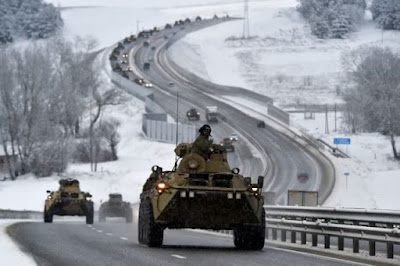
Russia Invades Ukraine: A Crime – And A Mistake.

Be Careful What You Wish For: Putin has conjured into being the very strategic nightmare he spent the last 20 years attempting to forestall. His actions have given all the nations of Western and Eastern Europe a terrifying reminder of the wisdom of banding together against the Russian Bear.

I’M WHAT’S KNOWN, on the Left, as a “Tankie”. That is to say I am not a reflexive opponent of the Russian regime. In the Georgian border regions; in Syria; and until 24 February 2022, in the Ukraine; I have, by and large, been sympathetic to the aims and objectives of the Russian Federation. More specifically, right up until this past week, I have had a sneaking admiration for the way in which President Vladimir Putin, in spite of finding himself in some extremely difficult positions, has nevertheless managed to checkmate his Western opponents.

But that’s all over now. It’s one thing to silence with tanks and artillery the Washington-inspired braggadocio of Georgia’s opportunistic leader. Or, to throw Russia’s military support behind the least worst protagonist in the Syrian civil war. But, to order a full-scale invasion on Ukraine? That’s not Chess, that’s Draughts – and not even very good Draughts. Putin has over-reached himself – quite possibly fatally.

It is difficult to understand why Putin couldn’t understand just how much ground he had made, diplomatically, by staging large-scale military manoeuvres on the Ukrainian border. The increasingly hysterical shrieks and yells emerging from Washington and NATO Headquarters in Brussels were achieving nothing useful for the West – apart from validating Putin’s critiques of NATO’s expansionist doctrine. As prediction after prediction of a Russian invasion of Ukraine proved inexact, Moscow gave every indication of being grimly amused. The Russian talent for irony and sarcasm was on full display.

Even better, the hysterical reactions of Washington and Brussels, were prompting the appearance of some no doubt very satisfying (to Moscow) cracks in the NATO alliance. To the evident delight of the Russian foreign ministry, Germany and France (both of which are guilty of invading Russia in the past, and then paying a terrible price for their aggression) took up their roles as guarantors of the Minsk Accords. For the price of an extended round of annual manoeuvres, the Russian Federation, and its Belarussian ally, were on the verge of reaping a bountiful diplomatic harvest.

So, what went wrong? How was the Kremlin’s master Chess-player suddenly robbed of both his strategic and his tactical senses?

In the harsh light of Russia’s invasion of the Ukraine, during which so many of the predictions and descriptions of the Russian armed forces’ battle-plans have been proved correct, it is surely reasonable to speculate that the Americans may have cracked the Russian military codes, giving them full access to all of the Kremlin’s strategic and tactical conversations. Or, they may have a highly-placed spy on the inside who is relaying to them the same information. They may even have both.

For Putin, a political leader schooled in the security services of the old Soviet Union, the revelation of such a catastrophic security breach would be devastating. The paranoid style of politics that pervaded the old KGB would have been intensified in Putin, the former KGB officer, to the point where he may simply have stopped thinking clearly.

If the debilitating revelation that Russia’s national security had been fundamentally compromised was further aggravated by serious disinformation concerning the character and intentions of the Ukrainian Government, then Putin’s descent into an enraged and murderous paranoia is readily explained.

Whatever happened, it was clear, several days out from the invasion, that something in Moscow had changed. RT, the Federation’s worldwide propaganda arm (now unavailable on New Zealand’s Sky Network, it’s former host) seemed to flounder as it struggled to come to grips with the Kremlin’s rapidly darkening tone.

Up until Putin’s rambling history lecture of 22 February, immediately followed by the recognition of the Donetsk and Luhansk breakaway republics, it had seemed as though RT’s leading lights were perfecting their scornful one-liners for the day Russia’s military forces on the Ukrainian border proved NATO wrong by simply turning around and returning to barracks.

Certainly, that was the outcome for which Putin’s government had been preparing the Russian people over the preceding weeks and months – and, it must be said, it was also the outcome the Ukrainians were expecting. Very few people on either side of the border wanted, or were prepared for, a full-scale invasion. The very fact that spontaneous anti-war rallies erupted all over the Russian Federation bears testimony to the shock and dismay provoked by Putin’s aggression against his fellow Slavs.

It is instructive to contrast Putin’s total failure to prepare his people for a full-scale invasion of Ukraine with the many months George W. Bush spent convincing the American people that his equally illegal invasion of Iraq was both militarily necessary and morally justified.

One is reminded of the decidedly unenthusiastic reception given to the Wehrmacht’s tanks as they rolled through the streets of Berlin in the early stages of the so-called “Munich Crisis” of September 1938. The German people did not want war with Britain and France, which is why they cheered to the echo the peacemaker, Neville Chamberlain, as he made his way through the streets of Munich – much to the disgust of the Fuhrer, who most emphatically did want war with Czechoslovakia.

It is worth contemplating the historical lessons of the Munich Crisis in relation to the crisis currently unfolding in Ukraine. Had Chamberlain, backed by France and Italy, not signed over the largely German-speaking Sudetenland to Adolf Hitler and, instead, warned him that Czechoslovakia would not be abandoned, then it is highly likely that Hitler’s generals (who were quite unconvinced that Germany could win such a war) would have deposed him in a military coup d’état. Had that happened, it is entirely possible that the Second World War could have been avoided.

The Russian Federation’s possession of nuclear weapons rules out any overt military response on the part of NATO, but the harshness of the economic sanctions regime it has imposed is bound to give Putin’s generals and oligarchs pause.

Nothing is more expensive than full-scale war. While, geographically, Russia may be a vast country, economically it is smaller than Italy. Far from heralding the restoration of Russian greatness, a drawn-out war against Ukrainian resistance fighters (supported and supplied by a ferociously united West) coupled with the debilitating economic and political effects of swingeing sanctions (not to mention the financial and human costs of a prolonged occupation) can only weaken the Russian Federation profoundly.

Even from the perspective of hard-line Russian nationalists, Putin’s wild gambit makes no sense. Indeed, those of a Machiavellian disposition among the Russian elites may come to the conclusion that some of Putin’s more rational geopolitical objectives stand a much greater chance of being achieved if Putin is no longer on the scene. Amidst the palpable and near universal relief which a change of regime in Moscow, followed by the withdrawal of all Russian forces from Ukraine, would undoubtedly bring, a comprehensive revision of European security arrangements might end up being welcomed – by all sides.

As matters now stand, however, Putin has conjured into being the very strategic nightmare he spent the last 20 years attempting to forestall. His actions have given all the nations of Western and Eastern Europe a terrifying reminder of the wisdom of banding together against the Russian Bear.

Ironically, the Ukrainians Putin dismissed as “drug addicts and neo-Nazis” stand revealed as heroes and patriots: men and women willing to lay down their lives for their country. Certainly, President Volodymyr Zelensky has demonstrated communication skills even more impressive than those of our own Jacinda Ardern. His social-media broadcast from the heart of besieged Kyiv was nothing short of inspirational. No one, now, is interested in accusations of undue Washington influence, widespread corruption, and neo-Nazi militias.

Russia’s “tankie” support in the West was based on Putin’s moral, political and military jiu-jitsu: his hitherto impressive knack for using the weight and power of his Western antagonists against them; and his skill at exposing the crass hypocrisy of those powers who have never hesitated to commit the very same sins they are forever attributing to Russia.

But, there is nothing clever about Putin’s invasion of the Ukraine. It will achieve nothing but massive material destruction and untold human suffering. Even worse, from the perspective of the unfortunate Russian people, Putin’s invasion has provided an ex post facto justification for their enemies’ most predatory designs .

As the deeply cynical, but nonetheless brilliant, French statesman, Charles Maurice Talleyrand (1754-1838) said of Napoleon’s ill-judged decision to abduct and execute the politically unfortunate Duke d’Enghien:

“This is worse than a crime, it’s a mistake.”


This essay was originally posted on the Interest.co.nz website on Monday, 28 February 2022.