Showing posts with label Angela Merkel. Show all posts

Friday, 24 November 2017

Raising Hitler's Ghost.

Another Wild Ride Through Germany? As Germany struggles to construct a government, Eastern European nationalism, the nationalism of Russia, Poland, Hungary and the Ukraine, is having its revenge. The unabashedly white supremacist and Islamophobic populism that has taken hold in the lands to Germany’s east, is summoning from its grave the ghost of Hitler’s psychopathic god. (Painting: "The Wild Ride", 1889, by Franz Von Stuck.)

GERMANY’S TROUBLES always blow in from the East. Unsurprising really, since, geographically speaking, there’s not a lot to stop them. Those fastnesses of steppe, plain and forest, home to all manner of divine scourges, have haunted the Germanic imagination for centuries. Indeed, “guarding the borders” against the ravages of barbarian Lithuanians, Poles and Russians “from the east” has proved to be one of the most consistent themes of Germanic history. Teutonic Knights and Prussian grenadiers; the warriors of Empire and Reich: all have braved the dragons of the East, until, as Germany’s poet-philosopher, Friedrich Nietzsche, rightly predicted – they turned into dragons themselves.

What began as a mission to protect the volk, eventually morphed into a mandate for conquest. For a thousand years, Germans have inflicted upon their neighbours the very horrors they feared their neighbours were conspiring to inflict upon them. Germanic culture’s unrelenting Drang nach Osten (drive towards the east) stirred up a witches’ brew of ethnic and cultural resentments which continue to trouble the dreams of Europe. The nations born out of the bleeding corpses of the Hohenzollern and Hapsburg empires were never able to transcend the circumstances of their post-World War I creation. Eastern European nationalism remains as extreme in its expression as the German chauvinism which gave it birth.

And now, as Germany struggles to construct a government, all that Eastern European nationalism, the nationalism of Russia, Poland, Hungary and the Ukraine; is having its revenge. The unabashedly white supremacist and Islamophobic populism that has taken hold in the lands to Germany’s east, is summoning from its grave the ghost of Hitler’s psychopathic god. Is it possible that these populist regimes actually believe that a reanimated German fascism will be their friend and ally? That the political genes of the beast which laid waste the physical and human infrastructure of their homelands 75 short years ago, have somehow been altered?

It’s as if the populist governments of Eastern Europe have somehow been persuaded to take seriously Joseph Goebbels’ last ditch propaganda campaigns of 1944-45 – in which the same German armies that had slaughtered millions of Jews and Slavs were re-presented as Europe’s last, best hope against the Asiatic hordes of the Bolshevik East. Are the populists hoping that, in 2017, Germany can be persuaded to undertake another racist crusade: this time against the “Islamisation” of Europe?

Sadly, the unintentional author of this hellish narrative is Germany’s moderate and motherly Chancellor, Angela Merkel. It was she who metaphorically spread wide the arms of her prosperous, post-fascist/post-communist Germany to receive the anguished victims of the Syrian civil war. Upwards of a million refugees poured across Germany’s borders – initially to a warm welcome from tens-of-thousands of generous German citizens. But, even as the new Germany welcomed them in, the flood of Arab refugees prodded awake some of the German nation’s oldest fears. For many of Angela Merkel’s compatriots the refugees represented the archetypal “other”. Syria may be located to Germany’s south, but in the volkish imagination of millions of older Germans they will always be “Easterners”.

Small wonder, then, that the German President, Frank-Walter Steinmeier, is so determined to avoid another federal election. Unike Chancellor Merkel, Steinmeier, the Social-Democratic Party and the Greens, are terrified that if another election is forced, the authoritarian populist Alternative für Deutschland (AfD) already Germany’s third-largest party – will take even more votes off Merkel’s Christian Democrats and its Bavarian sister-party the Christian Social Union.

In the days following the 24 September federal election, it was hoped that a black-yellow-green “Jamaica Coalition” (after the signature colours of the Christian Democrat, Free Democrat and Green parties) could be cobbled together. This ideologically implausible combination of conservatives, neoliberals and ecologists was required because the Social-Democrats had already ruled themselves out of another “Grand Coalition” with Merkel – in part because they did not want to cede the AfD the status of Germany’s largest opposition party.

So corrosive has the anti-immigrant, Islamophobic atmosphere in Germany become, however, that large numbers of rank-and-file members of the leading right-wing parties are falling into step with the AfD’s ideological drummers – forcing their leaders to follow them. The AfD may have secured only 12.6 percent of the Party Vote, but its sympathisers are estimated at three-times that number.

Those rising winds from the East are laden with ashes and tears.


This essay was originally published in The Waikato Times, The Taranaki Daily News, The Timaru Herald, The Otago Daily Times and The Greymouth Star of Friday, 24 November 2017.

Friday, 23 October 2015

A Time Of Fear

Terror Drives Them Westward: Syrian refugees trudge the dusty roads of Serbia en route to "Angela's" country - Germany. It is impossible to view the great throngs of migrants, piling up like driftwood against the newly-erected fences of the European Union, and not recall the Great Migration of uprooted peoples into the Western Roman Empire between 300-800 AD.
 
IT WAS A TIME of fear. People cast worried glances to the East, where rumour reported whole peoples on the move. Travellers said they were fleeing in terror from men who laid waste to villages, towns and cities without scruple or regret. Women, children, the temples of the gods: none were spared. Military commanders looked to the strength of the Empire’s defences: to the mighty walls and high gates that had stood for so long – and they wondered.
 
Between 300 and 800AD successive waves of migrant peoples beat against and washed over the borders of the Western Roman Empire. During these turbulent centuries, the component peoples of the “Great Migration” laid down the ethnic foundations of modern Europe. Some of its most powerful nations still bear the titles of these “Dark Age” migrants. The Frankish tribes settled in what is now France. The Angles gave their name to England. Rome’s empire, however, did not endure. The West fell.
 
It is impossible to view the great throngs of migrants piling up like driftwood against the newly-erected fences of the European Union and not recall the Great Migration. Impossible, too, not to imagine the panicky communications between all those provincial governors and the Emperor’s servants back in Rome. “What are we supposed to do with all these people! Should we feed them – or slay them?”
 
Rome’s answer, then, was the same as Chancellor Angela Merkel’s, now: “Let them in.” Like the ranks of Rome’s fourth century legions, the ranks of Germany’s industrial workers have been thinning of late. Dangerously low birth-rates dictate that the Empire of Porsche and Mercedes Benz admit as many auxiliaries as it can lay its hands on.
 
No doubt the bureaucrats in Rome, fervent believers in the Empire’s ability to make loyal Roman citizens out of the most unprepossessing of barbarian material, reassured their provincial governors that all would be well. These Goths were doughty warriors, they said. Properly trained they would ensure that the Emperor’s legions remained invincible.
 
Chancellor Merkel is equally upbeat. The upwards of a million refugees pouring across Germany’s borders from the civil war in Syria, and all those other great concentrations of misery along the North African coast, will soon be made into “Good Germans”. In the coming decades, the Fatherland’s complexion may grow a few shades darker, but Germany’s culture will survive unscathed.
 
The Romans’ optimism was misplaced. The migrant peoples admitted to the Empire may have swelled the legions depleted ranks, but they were never accepted as equals by “real” Romans. In the years ahead, ethnic rivalries would erupt into riots: blood would be spilled; hatreds flare and burn. The legions, increasingly composed of “barbarians”, would hear of these massacres, and the Emperor’s military resources would haemorrhage like an untended wound. In 410AD, the Visigoth chieftain, Alaric, sacked Rome. Saint Jerome, hearing the news in far off Bethlehem, lamented: “The city which had taken the whole world was itself taken.”
 
Alaric's Visigoths conquer Rome 410 AD.
 
Chancellor Merkel’s confidence may be equally misplaced. As the so-called “Summer of Smiles” – during which trainloads of exhausted refugees were met by Germans beaming with love and goodwill – gave way to Autumn gales and cold driving rain; and the refugees’ tent cities began springing up outside quiet German villages and towns; anti-immigrant demonstrators started appearing in the streets. The German people would appear to be much less confident of their assimilationist capacities than their increasingly unpopular Chancellor.
 
Forty years after the sack of Rome, Visigoth and Roman fought side-by-side on the Catalaunian Plains of Western Gaul against Attila and his Huns. It was from such fierce Asiatic tribesmen, the Huns especially, that so many of the peoples who joined the Great Migration were fleeing. By combining their strength, and defeating Attila, the Roman general, Flavius Aetius, and his Visigothic ally, Theodoric, were able to give the civilised communities of the Western Empire a few more decades of security and stability.
 
Modern day equivalents of Attila's Huns - Soldiers of the Islamic State.
 
How sad it is that the modern-day equivalents of Flavius and Theodoric – Barack Obama and Vladimir Putin – cannot emulate their predecessors’ success by putting aside their differences and combining their strengths against the modern-day equivalent of Attila the Hun – Islamic State and its army of jihadis.
 
What other means is there of stemming the human tide lapping at Europe’s borders? The West looks down from its crumbling walls – and it wonders.
 
This essay was originally published in The Waikato Times, The Taranaki Daily News, The Timaru Herald, The Otago Daily Times and The Greymouth Star of Friday, 23 October 2015.

Friday, 17 July 2015

The Economic Consequences Of Angela Merkel.

Dragons' Teeth: The German Chancellor, Angela Merkel's, torture of Greece marks the end of the European project. Europe's acquiescence at Versailles in 1919 meant that, within 20 years, Europe was, once again, at war with itself. The EU's refusal to stand in solidarity with the Greeks against German aggression (deploying banks this time, not tanks) has set the continent on the path to ever-increasing conflict and economic sclerosis.
 

Once all the Germans were warlike and mean
But that couldn’t happen again.
We taught them a lesson in 1918
And they’ve hardly bothered us since then!


YANIS VAROUFAKIS openly compares the Eurozone’s diktat to Greece with the Treaty of Versailles. The former finance minister’s comparison is well made. The Carthaginian peace imposed upon the German people in 1919 was not only intended to devastate their economy it was supposed to crush their spirit.
 
As punishment for launching the most catastrophic military conflict in human history, the Germans were to be kept in a state of economic servitude for decades to come. Nor was the victorious allies claim that Germany was solely responsible for the outbreak of the First World War a matter of mere rhetoric. The British naval blockade of Germany, which was gradually starving the defeated nation to death, would not be lifted until Germany’s “negotiators” (not that these were, in any genuine sense, negotiations) accepted the Treaty’s “War Guilt Clause”.
 
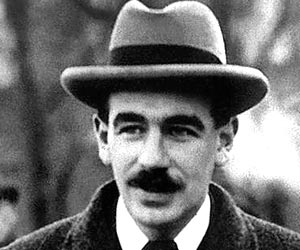
As the brutally punitive intentions of the Versailles diktat gradually emerged, three members of the Imperial British delegation, Harold Nicolson, Jan Smuts and John Maynard Keynes were filled with a terrible sense of foreboding. All three were convinced that nothing good could come from such an inhuman document. Each understood, with a chilling certainty, that the victorious allies were sowing dragons' teeth.
 
John Maynard Keynes: A terrible sense of foreboding.
 
The young economist, Keynes, quit the negotiations and returned to England where he spent the summer months of 1919 writing The Economic Consequences of the Peace. In his book (which instantly became an international best-seller) Keynes argued that the massive reparations demanded of Germany, combined with the Americans’ insistence that all Allied war debts be repaid, could only result in a fundamental derangement of the global economy. Throw in the German people’s Versailles-inspired sense of grievance and disaster was guaranteed. With uncanny accuracy, he predicted that Europe would be at war with itself, again, in just 20 years.
 
Flogging A Dead Horse: The imposition, by the victorious allies of World War I, of impossibly harsh economic conditions on the German people, constituted the first step on the road to World War II.
 
Of course, Greece is not Germany. Her people are not about to pull on jackboots and stomp all over the peace of Europe. But Germany is Germany and it is nothing short of tragic that the nation that went through the experience of Versailles – and all that followed from it – has so easily forgotten how it feels to be ganged-up on by a Europe determined to drive your country to the wall economically and strip it of what little self-respect it has managed to retain.
 
This failure of memory is particularly worrying in the light of what happened in 1953. That was the year in which Germany’s European neighbours, including Greece, wrote off up to 50 percent of her still outstanding Versailles debts. Yes, it was the Cold War. Yes, Germany was divided and it was important to give those Germans living in the West a sense of hope and confidence in the future. Even so, barely 14 years had passed since, as Mick Jagger put it: “the blitzkrieg raged/and the bodies stank”. Europe had considerably more to forgive Germany for in 1953 than it has to forgive Greece for in 2015.
 
Germany's Angela Merkel and Wolfgang Schauble: Executioners of the European dream.
 
The spectacle of Germany’s Chancellor, Angela Merkel, and her flinty-faced Finance Minister, Dr Wolfgang Schauble, squeezing the last drops of blood from the broken stones of Greece has sent a collective shudder through the rest of Europe. It’s a reaction with which Dr Schauble will be well pleased. It has long been the German Finance Minister’s plan to render Germany’s economic hegemony over Europe permanent by turning the continent into a “glorified debtors’ prison”. Greece is to serve as an example of what will befall any Eurozone member foolhardy enough to challenge the one-way flow of wealth to Europe’s biggest banker.
 
Frau Merkel is convinced that by allowing Greece to remain in the Eurozone she has demonstrated her bona fides as a “Good European”. It is, after all, vital that all Europeans understand that debts must be repaid, and that only orthodox economic policies should be pursued. If that requires German technocrats to second-guess the decisions of elected Greek politicians, then so be it. The Greek people need to understand that democracy has its limits; that saying “No” has a price.
 
The economic consequences of Angela Merkel, like the economic consequences of Versailles, will be a Europe at war with itself – within 20 years.
 
This essay was originally published in The Waikato Times, The Taranaki Daily News, The Timaru Herald, The Otago Daily Times and The Greymouth Star of Friday, 17 July 2015.

Tuesday, 10 February 2015

Gone With The Nuclear Wind?

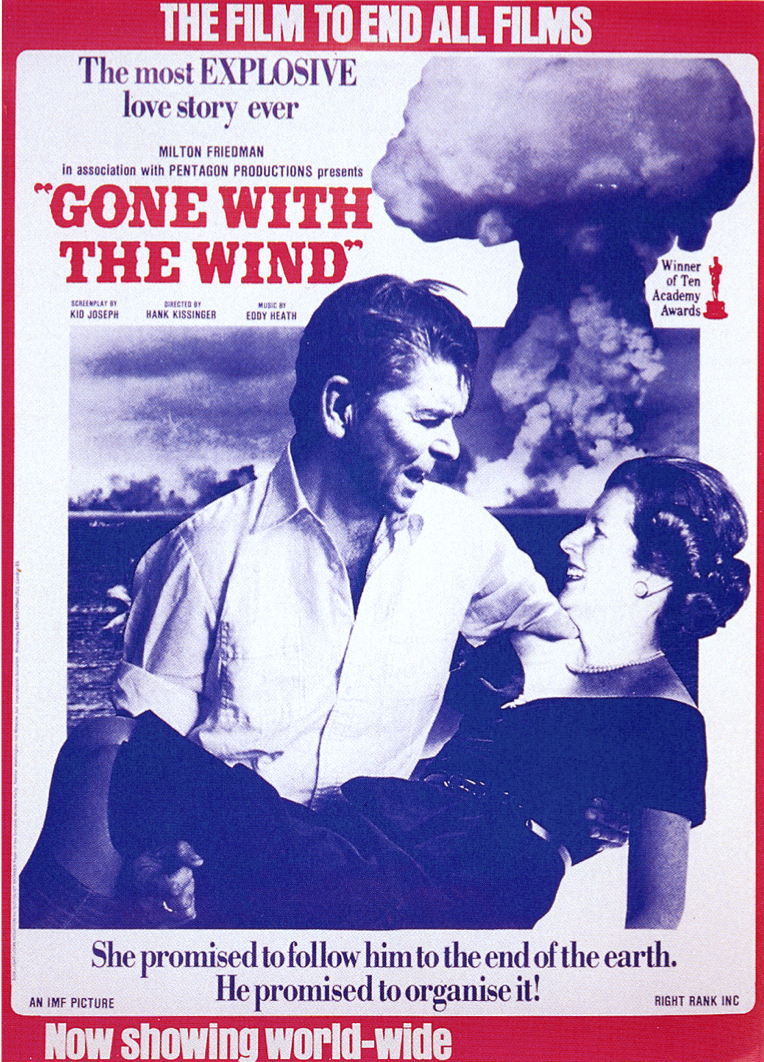
Tomorrow Might Not Be Another Day: The poster which swept the pre-Internet world in the anti-nuclear 80s. Those born in the post-Cold War period have little idea of how pervasive was the fear of nuclear annihilation. Those weapons have not gone away. Vladimir Putin's reassertion of his country's geopolitical interests may yet reacquaint the world with the fears of the 1980s. The Russian bear still has nuclear teeth.
 
IT WAS ONE of the most famous posters of the anti-nuclear 80s. Parodying the 1939 movie poster promoting Gone With The Wind, the 1980s version depicted Ronald Reagan in the role of Rhett Butler, and Margaret Thatcher as Scarlet O’Hara. Instead of rescuing his heroine from the wreckage of a burning Atlanta, Reagan carried Thatcher from the fallout of an ominous mushroom cloud. The anti-nuclear poster’s tag-line read: “She promised to follow him to the end of the earth. He promised to organise it.”
 
Black humour? Undoubtedly. But the worldwide popularity of the poster in those pre-Internet days speaks volumes about the existential fears of ordinary people everywhere that their leaders were impelling them towards a nuclear Armageddon.
 
These globally experienced fears were given specific expression in New Zealand by the nationwide movement to have the country declared nuclear-free. Distracted by the upheavals of the Springbok Tour for most of 1981, the Nuclear-Free New Zealand Movement only began gathering serious political momentum in 1982. By 1984, however, there were very few cities and towns in New Zealand that had not declared themselves nuclear-free. The incoming Labour Government, elected in July 1984, had little option but to go with the flow. Among its rank-and-file members (all 85,000 of them!) anti-nuclear sentiment was as intense as it was immovable.
 
It is difficult for New Zealanders who did not live through the early-1980s to appreciate just how tense the stand-off between the USA and the Soviet Union had become.
 
President Reagan and Prime Minister Thatcher were both implacable cold warriors. Indeed, when asked by a youthful aide to sum up his position on the Cold War, President Reagan breezily replied: “Well, I think we should win it.”
 
Soviet leaders, by contrast, came and went with almost comical speed. Between the death of Leonid Brezhnev in 1982 and the accession of the Soviet Union’s last leader, Mikhail Gorbachev, in 1985, the world welcomed and farewelled in quick succession Yuri Andropov and Konstantin Chernenko.
 
Meanwhile, as the Soviets were casting about frantically for a leader capable of lasting longer than eighteen months in office, Nato forged ahead with its plans to install nuclear-tipped Cruise missiles – a first-strike weapon – along the length of the Iron Curtain. Not surprisingly, the vast nuclear arsenals of the opposing superpowers were on a hair-trigger.
 
To New Zealanders born after 1991, the year the Soviet Union quietly blipped-off History’s screen, the mutual and assured destruction (MAD!) strategies of the Cold War era are mostly experienced as the more-or-less harmless echoes from a far-off, but very-far-from-harmless, historical era.
 
Today’s 24-year-olds may be intellectually aware that substantial stockpiles of nuclear weapons still exist in the United States and the Russian Federation, but the oppressive sense of their parents’ generation, that the slightest political miscalculation (or even a flock of errant geese!) might trigger the utter destruction of human civilisation, has, mercifully, faded from memory.
 
Global Warming, the existential threat du jour, may prove to be equally devastating, but its effects will be experienced over decades – not in the micro-seconds of a nuclear detonation.
 
Meanwhile, as the Millennials battle to prevent runaway global warming, another, all-too-literal battle rages between the forces of the Nato-supported Ukrainian government and the Russian-backed militias of Ukraine’s breakaway eastern provinces. Reported only fitfully in the Western news media, this conflict now threatens to escalate into a general European war. As former Swedish Prime Minister, Carl Bildt, told the Frankfurter Allgemeine Zeitung on Sunday.
 
“Unfortunately, war with Russia is conceivable. We are definitely living through one of the more dangerous historical phases, especially if you view the situation from a European perspective […] What makes the situation so explosive is that there is also great uncertainty about global power relations.”
 
The global uncertainty Mr Bildt speaks of is being fuelled by statements issuing from the United States Vice President, Joe Biden, reaffirming the Obama Administration’s determination to “allow Ukraine to defend herself”. By which the Americans mean – be given access to the heavy weapons necessary to drive back the pro-Russian separatists.
 
The German Chancellor, Angela Merkel, has reacted sharply to the Vice President’s statement, declaring that she could not “imagine any situation in which improved equipment for the Ukrainian army leads to President Putin being so impressed that he believes he will lose militarily.”
 
Only now is the European Union beginning to grasp its reckless folly in allowing anti-Russian extremists within Nato to connive in the fascist-supported overthrow of Ukraine’s democratically-elected President, Victor Yanukovych, in February 2014. Only now, having spent the last 12 months baiting the Russian bear, have the Europeans, the Americans, and the rest of us, belatedly remembered that the Russian bear has nuclear teeth.
 
The Nato powers promise to follow the fascist-backed Ukrainian regime to the end of the earth. Vladimir Putin offers to organise it.
 
This essay was originally published in The Press of Tuesday, 10 February 2015.