
Showing posts with label Wolfgang Schauble. Show all posts

Friday, 17 July 2015

The Economic Consequences Of Angela Merkel.

Dragons' Teeth: The German Chancellor, Angela Merkel's, torture of Greece marks the end of the European project. Europe's acquiescence at Versailles in 1919 meant that, within 20 years, Europe was, once again, at war with itself. The EU's refusal to stand in solidarity with the Greeks against German aggression (deploying banks this time, not tanks) has set the continent on the path to ever-increasing conflict and economic sclerosis.
 

Once all the Germans were warlike and mean
But that couldn’t happen again.
We taught them a lesson in 1918
And they’ve hardly bothered us since then!


YANIS VAROUFAKIS openly compares the Eurozone’s diktat to Greece with the Treaty of Versailles. The former finance minister’s comparison is well made. The Carthaginian peace imposed upon the German people in 1919 was not only intended to devastate their economy it was supposed to crush their spirit.
 
As punishment for launching the most catastrophic military conflict in human history, the Germans were to be kept in a state of economic servitude for decades to come. Nor was the victorious allies claim that Germany was solely responsible for the outbreak of the First World War a matter of mere rhetoric. The British naval blockade of Germany, which was gradually starving the defeated nation to death, would not be lifted until Germany’s “negotiators” (not that these were, in any genuine sense, negotiations) accepted the Treaty’s “War Guilt Clause”.
 
As the brutally punitive intentions of the Versailles diktat gradually emerged, three members of the Imperial British delegation, Harold Nicolson, Jan Smuts and John Maynard Keynes were filled with a terrible sense of foreboding. All three were convinced that nothing good could come from such an inhuman document. Each understood, with a chilling certainty, that the victorious allies were sowing dragons' teeth.
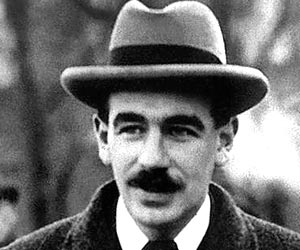
 
John Maynard Keynes: A terrible sense of foreboding.
 
The young economist, Keynes, quit the negotiations and returned to England where he spent the summer months of 1919 writing The Economic Consequences of the Peace. In his book (which instantly became an international best-seller) Keynes argued that the massive reparations demanded of Germany, combined with the Americans’ insistence that all Allied war debts be repaid, could only result in a fundamental derangement of the global economy. Throw in the German people’s Versailles-inspired sense of grievance and disaster was guaranteed. With uncanny accuracy, he predicted that Europe would be at war with itself, again, in just 20 years.
 
Flogging A Dead Horse: The imposition, by the victorious allies of World War I, of impossibly harsh economic conditions on the German people, constituted the first step on the road to World War II.
 
Of course, Greece is not Germany. Her people are not about to pull on jackboots and stomp all over the peace of Europe. But Germany is Germany and it is nothing short of tragic that the nation that went through the experience of Versailles – and all that followed from it – has so easily forgotten how it feels to be ganged-up on by a Europe determined to drive your country to the wall economically and strip it of what little self-respect it has managed to retain.
 
This failure of memory is particularly worrying in the light of what happened in 1953. That was the year in which Germany’s European neighbours, including Greece, wrote off up to 50 percent of her still outstanding Versailles debts. Yes, it was the Cold War. Yes, Germany was divided and it was important to give those Germans living in the West a sense of hope and confidence in the future. Even so, barely 14 years had passed since, as Mick Jagger put it: “the blitzkrieg raged/and the bodies stank”. Europe had considerably more to forgive Germany for in 1953 than it has to forgive Greece for in 2015.
 
Germany's Angela Merkel and Wolfgang Schauble: Executioners of the European dream.
 
The spectacle of Germany’s Chancellor, Angela Merkel, and her flinty-faced Finance Minister, Dr Wolfgang Schauble, squeezing the last drops of blood from the broken stones of Greece has sent a collective shudder through the rest of Europe. It’s a reaction with which Dr Schauble will be well pleased. It has long been the German Finance Minister’s plan to render Germany’s economic hegemony over Europe permanent by turning the continent into a “glorified debtors’ prison”. Greece is to serve as an example of what will befall any Eurozone member foolhardy enough to challenge the one-way flow of wealth to Europe’s biggest banker.
 
Frau Merkel is convinced that by allowing Greece to remain in the Eurozone she has demonstrated her bona fides as a “Good European”. It is, after all, vital that all Europeans understand that debts must be repaid, and that only orthodox economic policies should be pursued. If that requires German technocrats to second-guess the decisions of elected Greek politicians, then so be it. The Greek people need to understand that democracy has its limits; that saying “No” has a price.
 
The economic consequences of Angela Merkel, like the economic consequences of Versailles, will be a Europe at war with itself – within 20 years.
 
This essay was originally published in The Waikato Times, The Taranaki Daily News, The Timaru Herald, The Otago Daily Times and The Greymouth Star of Friday, 17 July 2015.

Tuesday, 7 July 2015

The Power of No: The Greeks Expose Neoliberalism's Anti-Democratic Agenda.

No! The decision of the Greek people has shown us that Neoliberalism can be challenged. Whether it can be beaten will require more than the bravery of a single nation. To defeat the neoliberals’ greed and cruelty, not just Greece but the whole world will have to find the courage to say: “No!”
 
THE UNFOLDING CRISIS in Greece has stripped Neoliberalism of its protective disguise and the world is recoiling from its ugliness. In normal circumstances the true purposes of the world’s neoliberal elites are masked by their use of opaque economic jargon. In the case of Greece, however, the social science of economics has been turned against them by some of its most impressive exponents. Nobel laureates Joseph Stiglitz and Paul Krugman have told the world that what is being done to Greece has nothing to do with economics, and everything to do with politics. A whole country is being driven to the wall in a desperate bid to destroy its left-wing government. Neoliberalism simply cannot allow the Greek Prime Minister’s, Alexis Tsipras’s, powerful lessons in democracy to go unpunished. If his Syriza Party is allowed to defeat austerity in Greece, what is there to prevent Podemos from defeating it in Spain? Or Sinn Fein in Ireland?
 
Hence the ugliness. Deprived of credible economic arguments for insisting that the Greek government persist with an austerity programme that has already shrunk Greece’s GDP by 25 percent and kept upwards of 60 percent of her young people out of the paid work force, the EU’s neoliberal elites – particularly the German holders of the neoliberal franchise – have been forced to resort to outright lies and childish insults.
 
Germany’s 72-year-old Finance Minister, Wolfgang Schauble, has clearly been unable to cope with his 54-year-old Greek counterpart, Yanis Varoufakis. Everything about the free-wheeling Greek economics professor offends the unyielding German ideologue. Varoufakis has been unsparing in his criticism of Germany’s inability to grasp the necessity for Greek debt relief (which even the IMF now acknowledges). It’s an act of insubordination which Schauble and his colleagues are resolutely determined to punish. So unchallenged has neoliberalism’s ideological hegemony been since the collapse of Soviet-style socialism that it finds itself unable to adequately respond to Varoufakis’s neo-Keynesian populist critiques. Their greatest fear is that, like the little boy in the Hans Christian Andersen fairy tale, the Greek Finance Minister will draw the world’s attention to the fact that the neoliberal German Emperor is wearing no clothes.
 
With Schauble and his neoliberal colleagues forced on to the defensive by the combined diplomatic and intellectual onslaught of Tsipras and Varoufakis, mobilisation orders were swiftly issued to neoliberalism’s reserve units located in the global news media. These latter lost no time in launching vicious attacks against the Syriza leadership – especially Varoufakis – and redoubled their blatantly racist denigration of the Greek people as a whole. This latter tactic had been in operation ever since Greece’s creditors had forced successive Greek governments into slashing the living standards of their own people. Cast as indolent Mediterranean grasshoppers (so unlike the hard-working Teutonic ants, whose borrowed Euros they had fecklessly frittered away) the Greek victims of neoliberal extremism were told that they had no one to blame but themselves.
 
Even at a distance of 17,000 kilometres from Athens, New Zealand’s neoliberal journalists and commentators have been working hard to maintain the two central arguments for neoliberalism’s assault on Greece. That the Syriza Government’s position is economically untenable; and that, in any case, the Greek people had it coming and richly deserve everything they have got. To pull this off they have had to studiously ignore the highly critical contributions of leading economists, while attempting to preserve the fiction that Greece has no alternative except to swallow still more of the austerity poison.
 
The most disturbing aspect of the mainstream news media’s adherence to the neoliberal line has been its willingness to go along with ethnic defamation. Just substitute the word “Maori” for “Greeks” in these neoliberal tirades and the full racist character of the attacks becomes clear. Newspapers and networks that would never allow contributors to get away with calling Maori lazy, good-for-nothing, ne’er-do-wells with no one to blame for their poverty but themselves, were quite happy to have it said of the Greeks.
 
It was, however, Tsipras’s decision to put the question of whether or not to persist with the EU’s austerity programme to a referendum that stripped away the last vestiges of Neoliberalism’s technocratic disguise. Now they were required to openly disparage not just Syriza, not just the Greek people, but democracy itself. In extremis, the neoliberals had no choice but to demonstrate, in a fashion that people who value democratic principles could not miss, that the interests of those who are both empowered and enriched by their control of the markets; and the interests of the people whose lives are cheapened and constrained by the operations of those same markets; have always been, and are still, on a collision course.
 
The decision of the Greek people has shown us that Neoliberalism can be challenged. Whether it can be beaten will require more than the bravery of a single nation. To defeat the neoliberals’ greed and cruelty, not just Greece but the whole world will have to find the courage to say: “No!”
 
This essay was originally posted on The Daily Blog of Monday, 6 July 2015.