Showing posts with label Nuclear Free New Zealand. Show all posts

Monday, 7 August 2023

Opting Out Of The Coalition Of Containment.


The dove is never free - Leonard Cohen
 

That there has been no outcry against the decision of the Australian government to purchase eight nuclear-powered submarines from the United States is astonishing. These formidable weapons of war are intended to patrol the waters of the Pacific and Indian Oceans – and their strategic choke-points – and should have occasioned loud protests from “nuclear-free” New Zealand.

RIGHT NOW, New Zealand is in a very awkward geopolitical position. Heedless of its vital economic relationship with China, the United States and its allies in the Indo-Pacific region are pushing New Zealand into a growing coalition of containment aimed at weakening the Chinese state and economy.

The most obvious outcome of this diplomatic pressure (and in all likelihood its purpose) will be a sharp deterioration in the Chinese-New Zealand relationship. Most probably, Chinese displeasure will be expressed through restrictions on New Zealand exports. Not that the United States and its allies will make good any consequential losses to New Zealand’s economy. The Coalition of Containment’s sole purpose in precipitating such a break is to erase the irritating question-mark beside New Zealand’s name on its list of “trustworthy” allies.

New Zealand’s national security apparatus, whose loyalty to the people of New Zealand, as opposed to the decision-makers in Washington, London and Canberra, has always been open to doubt, has been pushing the Labour Government hard in the direction of Uncle Sam’s Coalition of Containment. Its efforts have, as usual, been seconded by all the usual suspects in the mainstream news media. (As well as some interesting recruits from the blogosphere!) The resulting upsurge in Sinophobia must be a source of considerable satisfaction to China’s enemies in New Zealand. It is unusual, these days, to hear a kind word spoken publicly about China – without the guilty party being subjected to the most vehement reproof.

That the Left has allowed itself to be drawn into this anti-Chinese discourse is especially disappointing. There was a time when the machinations of US imperialism were subjected to consistent and sophisticated critique by New Zealand communists and socialists, and even one or two intelligent members of the Labour Party. So effective were these critiques that the left-wing arguments advanced against such imperialistic interventions as the Vietnam War were able to win massive public support. The political upshot of such campaigns was a weakening of New Zealand’s relationship with the United States and its allies. The high-point of the Left’s influence on New Zealand foreign and defence policies came in 1986, when New Zealand withdrew/was excluded from the ANZUS Pact.

What passes for the Left in 2023, however, is, for the most part, content to echo the principal talking-points of US imperialism and its Nato accomplices. The obvious fiction that China is an aggressive power seeking global domination is repeated ad nauseum, along with the absurd charge that the Chinese government is overseeing a genocidal campaign against the Uighur population of Xinjiang. (It is a curious exercise in genocide that leaves twice as many Uighurs in Xinjiang today as there were 50 years ago!) It is no accident, however, that this “softening-up” of an historically ignorant Left, addicted to emotionally-charged international campaigns, preceded the creation of the Australian, United Kingdom, United States (AUKUS) military relationship in 2021.

That there has been no outcry against the decision of the Australian government to purchase eight nuclear-powered submarines from the United States is astonishing. These formidable weapons of war are intended to patrol the waters of the Pacific and Indian Oceans – and their strategic choke-points – and should have occasioned loud protests from “nuclear-free” New Zealand. At the very least, this present Labour Government might have been expected to gather the small nations of the South Pacific behind it in a concerted diplomatic effort to uphold – and enforce – the 1986 anti-nuclear Treaty of Rarotonga.

If New Zealand continues upon its current diplomatic trajectory its economically vital relationship with China cannot help being put at risk. Certainly, the pressure, both from Canberra and Washington, shows no sign of decreasing. Statement-by-statement, in language that demands much but offers little, Wellington is putting more-and-more distance between itself and Beijing. China is hoping that the hard, cold realities of making its living as a very small nation-state in a very large world will continue to keep New Zealand out of the flash new military leg-irons being fastened around the Indo-Pacific region by the United States.

But, hope is unlikely to be enough. Beijing needs to make New Zealand an offer it can’t refuse if it is to prevent the pinkie-finger of the Anglo-Saxon fist from clenching-up tight alongside its bigger brothers. A change of government in October could be just the opportunity Beijing is looking for.

Faced with mounting infrastructural and climate-related problems, and committed to reducing state spending, what might a National-Act coalition not agree to if presented with Chinese promises of massive investment in transport, housing, and climate adaptation/mitigation projects? Roads of national significance, electrification of the railways, extensive and intensive housing developments, taming rivers and hillsides: China’s done it all before, all over the world. Why not here?

And why stop there. Large-scale investment in renewable energy projects would set New Zealand up for a green re-industrialisation of the economy. Chinese companies will not be the only ones seeking-out nation-states with plentiful, cheap and reliable “clean” energy to offer investors in a post-carbon world.

Too much? Not when one considers that New Zealand 1.0 was built, almost entirely, out of British capital. Why shouldn’t New Zealand 2.0 be the creation of massive Chinese investment? Across the broad sweep of human history, imperialism has always been colour-blind.

Such a shift would, of course, entail a diplomatic revolution greater even that New Zealand declaring itself nuclear-free. Canberra, Washington, London and Ottawa would be livid. Accusations of treachery would be hurled at New Zealand by its former allies and, doubtless, all kinds of clandestine efforts would be set in motion to destabilise – even topple – its wayward government. Outright intervention would, however, be unlikely. It is difficult to persuade the world that China is the greatest threat to peace in the Indo-Pacific, when US Marines are splashing ashore on New Zealand beaches.

In the face of New Zealand’s diplomatic realignment, its South Pacific neighbours might also find it expedient to adopt a new stance vis-a-vis the neo-colonial objectives of the USA and its English-speaking allies. Pacific leaders might feel moved to inquire exactly what the United Kingdom thinks it is doing – again – in this part of the world. Were New Zealand to propose the creation of a South Pacific navy, dedicated to protecting and defending the resources within each member-state’s Exclusive Economic Zone, it might be surprised at the level of interest.

Especially if China offered to supply the patrol vessels.

Such a nightmare scenario could, of course, be easily avoided if the United States was willing to offer what China was ready to negotiate with New Zealand 15 years ago – a Free Trade Agreement. It has always been the easiest and, ultimately, the least costly option for the Americans: agree to take whatever New Zealand can send them – just as Great Britain did for the best part of a century. Just as China is doing right now.

But that would require US Imperialism to do what it has never done before: put the word “give” ahead of the word “take”.


This essay was originally posted on The Daily Blog of Friday, 4 August 2023.

Thursday, 29 November 2018

Where Is The Mass Movement Against Climate Change?

The Way We Were: I was seated in the Auckland Town Hall when Jacinda promised to make climate change her generation’s nuclear-free moment. Like everybody else I roared my approval. But where is the nationwide movement demanding change that matches the extraordinary activism and reach of the Nuclear-Free New Zealand phenomenon.

WHEN JACINDA ANNOUNCED she was having a baby, I was thrilled. What better guarantee could we have of serious government action on the big issues than a prime minister with a tiny and vulnerable child’s future to protect? Well, Neve arrived safely, but the urgent action required to secure her future seems as far away as ever.

I was seated in the Auckland Town Hall when Jacinda promised to make climate change her generation’s nuclear-free moment. Like everybody else I roared my approval. But where is the nationwide movement demanding change that matches the extraordinary activism and reach of the Nuclear-Free New Zealand phenomenon. The latter had a lively presence not only in every major city, but also in every sizable town. The evidence was there for everyone to see as, one after the other, the councils of those towns and cities defiantly declared themselves nuclear-free. Many of those councilors were members of, or strongly supported, the Labour Party.

Just how embedded the nuclear-free movement was in the Labour Party is evidenced by the Fourth Labour Government’s unwillingness to stand in its way. No amount of internal resistance to Rogernomics was able to turn the Lange-Douglas Government from its course. But those same politicians were more willing to face the wrath of Ronald Reagan’s America than the New Zealand peace movement. All Labour’s President, Margaret Wilson, had to do was threaten to convene a Special Conference of the Party to reaffirm Labour’s “No Nukes” policy and the Cabinet rolled over.

But, on the calamitous issue of Climate Change, an issue with as much potential to lay waste human civilisation as an all-out nuclear war, there isn’t the slightest sign of a broad mass movement with the will and the power to force the Coalition Government’s hand. Nor is there the slightest evidence of a well-organised group within the Labour Party itself. No one’s willing to advance the cause of fighting Climate Change from either the stage or the floor of Labour’s annual conferences. In 2018, the members look to the top for inspiration and guidance. On Climate Change, however, they look in vain.

The other thing that’s missing is the sort of grass-roots anti-nuclear education effort that both complimented and drove forward the anti-nuclear movement. New Zealanders researched nuclear weapons and nuclear strategy both individually and in groups. Local libraries ordered in specialist literature. Activists organised public seminars. Voters learned about the futility of civil defence measures and shuddered at the threat of “nuclear winter”. The “experts” thrust forward by the government to justify the status-quo were answered by the peace movement’s own. Against an informed and active citizenry both the National and Labour parties found themselves politically helpless.

If Jacinda is truly determined to make Climate Change her generation’s nuclear-free moment there is plenty she could be doing. For a start, she could use the “bully pulpit” of the prime minister’s office to summon her generation to action. She could fund a nationwide series of “Climate Change Forums” preliminary to the establishment of locally-organised Climate Change action-groups. A “Day of Action” could be announced and every young New Zealander invited to add their body to a nationwide demonstration of their generation’s vital interest in fighting Climate Change.

Within the Labour Party itself the rank-and-file membership could be given official encouragement to debate the best means of addressing Climate Change legislatively. What sort of laws does New Zealand need and in what order should they be introduced? A Special Conference could be called to assess the results and the news media invited to attend every session. The relevant ministers could be required to make themselves available for Q+A sessions. The whole event could be broadcast live on the Internet.

A prime minister determined to make Climate Change her generation’s nuclear-free moment could be doing all of this – and more. By the same token, however, a nation determined to “do something” about Climate Change has no need for guidance from above. The threat of an all-out nuclear exchange between the USA and the Soviet Union, a catastrophe from which no human-being on Earth would emerge unscathed, was all it had taken for hundreds-of-thousands of New Zealanders to commit themselves to making their country nuclear-free. Why, then, hasn’t the threat of the planet becoming uninhabitable by human-beings been enough to mobilise New Zealand citizens in the same way?

Does the answer lie in a simple lack of faith in the ability of any one person – any single generation – to make any kind of difference? When a left-wing populist government declines to keep its promise to oppose the TPPA. When a Green Party Minister of Conservation refuses to protect her country’s pristine water resources. What realistic hope is there then that people’s voices, people’s votes, can make anything like the difference made by the nuclear-free movement of the early 1980s? Have we entered an age when words and gestures are as plentiful as sparrows, and deeds as rare as Hector’s Dolphins?

When, on some unbearably hot day in the future, Neve asks her mother what she had to say about Climate Change, Jacinda will be able to answer: “Heaps!”. But, when her daughter follows-up her first question with a second; when Neve says: “That’s good, Mum, because everyone loved the way you talked. But what I need to know now is – what did you do?” How will Jacinda respond?

This essay was originally posted on The Daily Blog of Thursday, 22 November 2018.

Tuesday, 10 February 2015

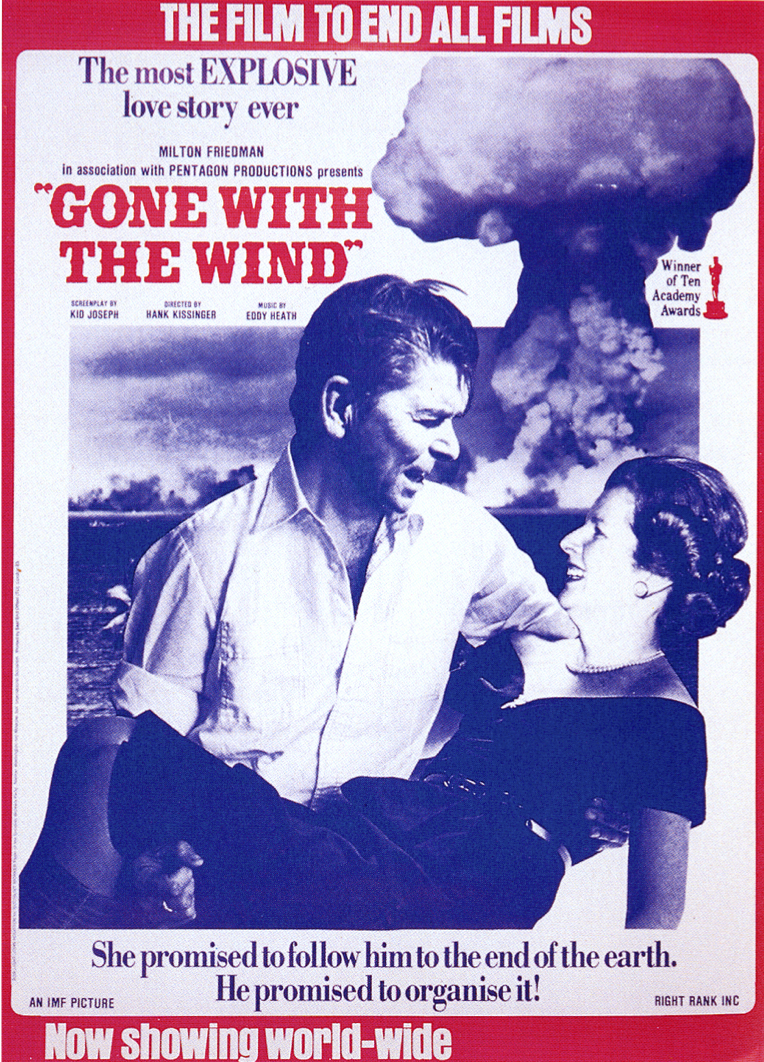
Gone With The Nuclear Wind?

Tomorrow Might Not Be Another Day: The poster which swept the pre-Internet world in the anti-nuclear 80s. Those born in the post-Cold War period have little idea of how pervasive was the fear of nuclear annihilation. Those weapons have not gone away. Vladimir Putin's reassertion of his country's geopolitical interests may yet reacquaint the world with the fears of the 1980s. The Russian bear still has nuclear teeth.
 
IT WAS ONE of the most famous posters of the anti-nuclear 80s. Parodying the 1939 movie poster promoting Gone With The Wind, the 1980s version depicted Ronald Reagan in the role of Rhett Butler, and Margaret Thatcher as Scarlet O’Hara. Instead of rescuing his heroine from the wreckage of a burning Atlanta, Reagan carried Thatcher from the fallout of an ominous mushroom cloud. The anti-nuclear poster’s tag-line read: “She promised to follow him to the end of the earth. He promised to organise it.”
 
Black humour? Undoubtedly. But the worldwide popularity of the poster in those pre-Internet days speaks volumes about the existential fears of ordinary people everywhere that their leaders were impelling them towards a nuclear Armageddon.
 
These globally experienced fears were given specific expression in New Zealand by the nationwide movement to have the country declared nuclear-free. Distracted by the upheavals of the Springbok Tour for most of 1981, the Nuclear-Free New Zealand Movement only began gathering serious political momentum in 1982. By 1984, however, there were very few cities and towns in New Zealand that had not declared themselves nuclear-free. The incoming Labour Government, elected in July 1984, had little option but to go with the flow. Among its rank-and-file members (all 85,000 of them!) anti-nuclear sentiment was as intense as it was immovable.
 
It is difficult for New Zealanders who did not live through the early-1980s to appreciate just how tense the stand-off between the USA and the Soviet Union had become.
 
President Reagan and Prime Minister Thatcher were both implacable cold warriors. Indeed, when asked by a youthful aide to sum up his position on the Cold War, President Reagan breezily replied: “Well, I think we should win it.”
 
Soviet leaders, by contrast, came and went with almost comical speed. Between the death of Leonid Brezhnev in 1982 and the accession of the Soviet Union’s last leader, Mikhail Gorbachev, in 1985, the world welcomed and farewelled in quick succession Yuri Andropov and Konstantin Chernenko.
 
Meanwhile, as the Soviets were casting about frantically for a leader capable of lasting longer than eighteen months in office, Nato forged ahead with its plans to install nuclear-tipped Cruise missiles – a first-strike weapon – along the length of the Iron Curtain. Not surprisingly, the vast nuclear arsenals of the opposing superpowers were on a hair-trigger.
 
To New Zealanders born after 1991, the year the Soviet Union quietly blipped-off History’s screen, the mutual and assured destruction (MAD!) strategies of the Cold War era are mostly experienced as the more-or-less harmless echoes from a far-off, but very-far-from-harmless, historical era.
 
Today’s 24-year-olds may be intellectually aware that substantial stockpiles of nuclear weapons still exist in the United States and the Russian Federation, but the oppressive sense of their parents’ generation, that the slightest political miscalculation (or even a flock of errant geese!) might trigger the utter destruction of human civilisation, has, mercifully, faded from memory.
 
Global Warming, the existential threat du jour, may prove to be equally devastating, but its effects will be experienced over decades – not in the micro-seconds of a nuclear detonation.
 
Meanwhile, as the Millennials battle to prevent runaway global warming, another, all-too-literal battle rages between the forces of the Nato-supported Ukrainian government and the Russian-backed militias of Ukraine’s breakaway eastern provinces. Reported only fitfully in the Western news media, this conflict now threatens to escalate into a general European war. As former Swedish Prime Minister, Carl Bildt, told the Frankfurter Allgemeine Zeitung on Sunday.
 
“Unfortunately, war with Russia is conceivable. We are definitely living through one of the more dangerous historical phases, especially if you view the situation from a European perspective […] What makes the situation so explosive is that there is also great uncertainty about global power relations.”
 
The global uncertainty Mr Bildt speaks of is being fuelled by statements issuing from the United States Vice President, Joe Biden, reaffirming the Obama Administration’s determination to “allow Ukraine to defend herself”. By which the Americans mean – be given access to the heavy weapons necessary to drive back the pro-Russian separatists.
 
The German Chancellor, Angela Merkel, has reacted sharply to the Vice President’s statement, declaring that she could not “imagine any situation in which improved equipment for the Ukrainian army leads to President Putin being so impressed that he believes he will lose militarily.”
 
Only now is the European Union beginning to grasp its reckless folly in allowing anti-Russian extremists within Nato to connive in the fascist-supported overthrow of Ukraine’s democratically-elected President, Victor Yanukovych, in February 2014. Only now, having spent the last 12 months baiting the Russian bear, have the Europeans, the Americans, and the rest of us, belatedly remembered that the Russian bear has nuclear teeth.
 
The Nato powers promise to follow the fascist-backed Ukrainian regime to the end of the earth. Vladimir Putin offers to organise it.
 
This essay was originally published in The Press of Tuesday, 10 February 2015.

Saturday, 24 January 2015

To Lunchtime And Beyond! Why There’s No More Loyal Servant Of The Anglo-Saxon Empire Than The New Zealand National Party.

Put Your Heart In It: The National Party’s visceral attachment to the English-speaking brotherhood has found a more than worthy champion in the present Prime Minister.
 
THERE IS A REASSURING CONSISTENCY about the prejudices of the National Party. No matter how thick the spin-doctors and PR specialists apply the lacquer of moderation to the institution’s exterior, the reactionary timber beneath just keeps rotting away.
 
Nowhere is the utterly unreconstructed nature of National’s political mission more apparent than in the fraught arena of war and peace. The antiquated diplomatic responses these crucial foreign policy issues excite in what passes for the National Party’s intelligentsia are especially disconcerting.
 
The first real hint we got of just how atavistic those instincts might be came with Dr Don Brash’s infamous “gone by lunchtime” quip to a group of US officials back in January 2004. Clearly, the National Party has only ever paid lip-service to New Zealand’s anti-nuclear stance. Yes, it had embraced a Nuclear-Free New Zealand as far back as 1990, but, clearly, the party’s “conversion” to foreign policy independence had, in all respects, been both cynical and cosmetic.
 
Dr Brash’s promise that the policy would be abandoned “by lunchtime, probably” in the event of a National Party victory in 2005, showed that National’s MPs were only willing to wear the “No Nukes!” T-Shirt because that was part of what it took to regain power. The moment they got their feet under the Cabinet Table, however, and well before the next scheduled meal break, all such left-wing fripperies would be headed straight for the incinerator.
 
In marked contrast to Dr Brash’s unabashed impatience, the present National Prime Minister has displayed admirable forbearance in the matter of New Zealand’s anti-nuclear stance. Six years after he was swept into office, John Key has yet to initiate anything resembling a serious review (let alone repeal) of New Zealand anti-nuclear legislation.
 
Is this because Mr Key is a convert to anti-nuclearism? Has the Prime minister embraced the independent spirit of Norman Kirk’s foreign policy and learned, finally, “the trick of standing upright here”? Well, no. His refusal to get all het up about nuclear weapons and nuclear power is because he understands that the big issues of the 1980s are not the big issues of the 20-teens.
 

Nuclear-Free New Zealand: Yesterday's issue?
 
Like any good blitzkrieg general, Mr Key has simply directed his armoured columns around this potentially dangerous obstacle. He knows that if he pushes past it far enough the anti-nuclear policy will begin to look like the diplomatic relic of some long dead foreign-policy consensus. When that eventually occurs, there will only be a handful of people who will notice, and even fewer who will care that, following some distant future lunchtime, the policy has gone.
 
And when it does, be in no doubt, unreconstructed National Party stalwarts will all be displaying wolfish grins of satisfaction. Those forced to live through the anti-nuclear policy’s creation, will be able to mentally tick-off yet another faded remnant of the Left’s policy legacy.
 
Just how eagerly the Right is anticipating that moment was revealed earlier this week (20/1/15) when the NZ Herald published an article by the National MP for Manawatu from 1978 to 1987, Michael Cox. Entitled Clark’s Sad Legacy In ’84 Affair Shrinks UN Hopes, the think-piece positively revels in the presumed unwillingness of the USA and the UK to sanction Helen Clark becoming the next UN Secretary-General.
 
While careful to acknowledge Ms Clark’s undoubted strengths and her eminent eligibility for the United Nations’ top job, Mr Cox informs his readers that this is where “her positives” stop. Because two of “the most powerful members of the Security Council, the United States and Britain, will not have forgotten that she led the charge that weakened Western resistance to the USSR during the Anzus debacle in 1984.”
 
It is difficult to imagine a sentence more weighted-down with National Party ignorance and prejudice than this little gem.
 
Yes, both the US State Department and the Pentagon were pissed-off with New Zealand for breaking ranks in 1984, but they weren’t that pissed-off. By 1984 it was already clear to the Americans that the Soviet Union had no plans to impede seriously the advance of the new, global, market-driven economic order. They were also well aware that when it came to offering examples for the world to follow, New Zealand’s sterling efforts in radical, top-down, market liberalisation were easily outshining (where it mattered) her quaint, bottom-up, ban on all things nuclear.
 
To make his case against Ms Clark, Mr Cox draws heavily on the historical research of Gerald Hensley, Head of the Prime Minister’s Department under David Lange. In his book Friendly Fire, Mr Hensley suggests that it was well understood by the Americans that Ms Clark “accepted Roger Douglas’s right-wing financial policies [because] there had been a trade-off by which those on the Left, led by her, gained the mandate for the anti-nuclear ship policy in return for going along with his economic reform”.
 
If this is true (and as someone who was very active in the Labour Party Left during the 1980s, I’m not sure that it is) then both the Americans and the British will actually be more – not less – likely to back Ms Clark’s bid for the Secretary-General’s job. There is no better qualification for such a position than a proven track-record of making, and sticking-to, such Faustian political pacts.
 
Mr Cox does not see this. Like Mr Hensley, his sensibilities are those of the backwoods conservative raised on the uncompromising slogans of anti-communism, and whose loyalty to the global interests of the English-speaking peoples is absolute and unquestioning. In the eyes of such people, Ms Clark remains an oath-breaker and quasi-traitor, whose disloyalty will never be forgotten, and certainly not forgiven, by the five “fingers” of the Anglo-Saxon fist.
 
Viewed from this perspective, Ms Clark’s 2003 refusal to let New Zealand’s armed forces join in the illegal invasion of Iraq can only have heaped more hot diplomatic coals upon the heads of her country’s erstwhile allies – further compounding her earlier, anti-nuclear, treachery.
 
For the Brits and the Yanks, however, it will be Ms Clark’s diplomatic behaviour in the aftermath of the Iraq War that really counts when they vote for the next UN Secretary-General. Quite how Messrs Cox and Hensley reconcile their blue-stockinged quasi-traitor with the New Zealand Prime Minister whom the US Secretary of State, Colin Powell, described as his “very, very, very good friend” is anybody’s guess.
 
What cannot be doubted, however, is that the National Party’s visceral attachment to the English-speaking brotherhood has found a more than worthy champion in the present Prime Minister. Witness his extraordinary comment that New Zealand’s sending troops to train the Iraqi armed forces for war against Islamic State, should be seen, simply, as “the price” we must pay for membership of the Anglo-Saxon “club”.
 
Making particular reference to the “Five Eyes” intelligence-sharing agreement, to which New Zealand is a signatory, the Prime Minister stated that it was important that his country was regarded as a reliable member of the club. Because, “we do know that, when it comes to the United States and Canada and Australia and Great Britain and others, that we can rely on them.”
 
And clearly, our “very, very, very good friends” (the 1984 anti-nuclear “affair” notwithstanding) can still rely on us. Or, at least, on those of us who continue to vote, unwaveringly, for the New Zealand National Party.
 
A version of this essay was posted on The Daily Blog of Friday, 23 January 2015.