Showing posts with label Barack Obama. Show all posts

Friday, 27 September 2024

Has Government Become A Public-Private Partnership?

Dirty Deals Done In The Dark: There will be times when it is to the considerable advantage of both National and Labour to be able to shrug philosophically and pardon themselves for cooperating in the introduction of controversial and divisive policies by explaining to an outraged public that this is simply the way MMP works. Photo by Lynn Grieveson.

“CAMPAIGN IN POETRY, govern in prose.” It is one of the most memorable political maxims to emerge from American politics. A relic, perhaps, of the era in which the policies of the major parties did not diverge substantially from one another. In those circumstances, the winning of elections is largely reduced to questions of style and performance.

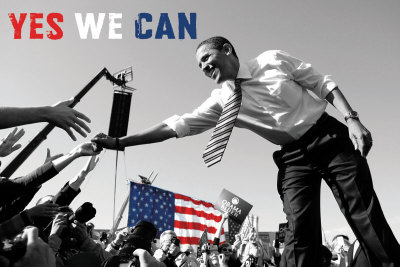
The maxim’s most famous proof came in the presidential election of 2008. Millions of American’s were uplifted by Democratic Party candidate Barak Obama’s soaring rhetoric. Pundits and professors compared his speeches to JFK’s, or even to those of Rome’s greatest orator, Cicero. His campaign poster, emblazoned with just one word: “Hope”, and his campaign slogan: “Yes we can!”, all contributed to the “poetry” of his victory over the Republicans’ John McCain. In office, however, Obama turned out to be a very prosaic president indeed. As McCain’s running mate, Sarah Palin later quipped: “How’s that hopey, changey thing going for ya?”

A large measure of policy consensus, by refocusing attention upon the personalities of contending party leaders, offers the additional benefit of keeping the political temperature agreeably low. Representative democracy works best when the most heated arguments are restricted to the cover art, rather than the content, of the political books on sale. It is only when the personalities presenting the policies begin to matter less than the policies presented, that the prospects for a peaceful transfer of power start to diminish. When a party’s supporters become convinced that they cannot afford to lose an election, they will stop at nothing to win it.

The greatest virtue of the First-Past-the-Post (FPP) electoral system (and it does not possess that many!) is its propensity to, first, generate a broad measure of political consensus, and, second, to deliver the decisive electoral outcomes required to keep that consensus in place. It is only when the voters begin to sense a widening gap between the rules of the traditional democratic game, and the rules of whatever game its leading politicians have taken to playing, that demands for a new set of rules – or even a whole new game – start attracting significant support.

New Zealand’s adoption of the Mixed Member Proportional (MMP) electoral system was driven by the widely-shared voter perception that Labour, followed by National, had been taken over by ideological zealots who made a fetish out of their refusal to be swayed by the policy preferences of either their own party members, or the voters.

Perhaps the most dramatic demonstration of this indifference to public opinion came from Labour Cabinet Minister Richard Prebble, who, upon learning that close to 90 percent of the population opposed the privatisation of Telecom (then a state-owned telecommunications enterprise) declared that New Zealanders should be proud to have a government willing to defy such a powerful pressure-group!

In large measure, MMP prevailed over FPP in the referendum of 1993 because most voters were convinced that the coalition governments made more-or-less obligatory by proportional representation would prevent the politicians responsible for turning Labour and National into ideologically-reanimated zombie parties from imposing upon New Zealanders even more economic and social “reforms” they hadn’t asked for and didn’t want.

What most New Zealand voters failed to grasp, however, is that for this moderating influence on Labour and National to be effective, the new minor parties made possible by MMP would need to possess extraordinary negotiating skills, and, if these proved inadequate and/or unavailing, the political courage to force a new election. That was a very big ask. To date, no minor party has been willing to court the electorate’s wrath by becoming the tail that wagged the dog. Certainly, the conventionally wise have cautioned against such behaviour. Indeed, the pundits’ predictions have never varied: any minor party deemed responsible for forcing a new election will be “wiped out”.

But, the minor parties were damned if they did, and damned if they didn’t. Voters may well have punished any small party that forced them back to the polls, but that didn’t mean those same voters were ready to reward it for refusing to create political instability. Parties opting to enter coalition arrangements with either Labour or National, and agreeing to swallow all manner of dead rats in the process, frequently found themselves falling below the 5 percent MMP threshold at the next election.

Governing in prose came at considerable cost to the minor parties.

Preserving the policy consensus they were elected to unwind, however, was not a strategy the minor parties could afford to pursue indefinitely. The logic of MMP is implacable. Excessive co-operation with a major party is likely to result in the guilty minor party exiting Parliament – as NZ First, the Alliance, and the Māori Party could all attest, and Act, too, would surely have attested, had it not been for the strategic nous of the Epsom voters. In order to survive, a minor party must present to their preferred coalition partner a short list of “must haves” that cannot, under any circumstances, be traded away.

It must, however, do more than that. To get around the problem of what to do if the major party says “No.”, a minor party needs to persuade those with a powerful commercial and/or political interest in seeing specific policies enacted to clear a path for them in either National or Labour well in advance the next scheduled general election. Intensive lobbying, generous targeted donations, probably both, will be deployed to create what amount to “fifth columns” of policy allies inside the major parties. With these in place, the pressure to give the minor parties their “must haves” will likely prove irresistible.

Such arrangements are unlikely to generate serious objections from within the major parties. There will be times, after all, when it is to the considerable advantage of both National and Labour to be able to shrug philosophically and pardon themselves for cooperating in the introduction of controversial and divisive policies by explaining to an outraged public that this is simply the way MMP works.

Naturally, if it was just up to them, they wouldn’t dream of re-writing the Treaty, introducing hate speech laws, relaxing firearm controls, phasing out the internal combustion engine, introducing a Māori upper house, reducing the taxes on tobacco products, or privatising the Cook Strait ferries, but, sadly, the wishes of one’s coalition partners cannot be ignored.

Given the pernicious evolutionary path MMP now appears to be following, does it still make sense to talk about campaigning in poetry, and governing in prose? Sadly, it does not.

Lobbying and donating large sums of money to carefully cultivated politicians in both the major and the minor parties, for the purposes of securing specific policy objectives, is not the sort of behaviour that lends itself to poetry – unless it’s Bob Dylan’s pithy observation that “money doesn’t talk, it swears”.

Governing, too, is changing. No longer written in the dull but honest prose attendant upon raising the money needed to keep the nation solvent and in good heart, government, today, is all about fulfilling private interests’ pre-paid objectives – while attempting to pass them off as your own.


This essay was originally posted on the Interest.co.nz website on Monday, 23 September 2024.

Thursday, 2 September 2021

Beyond Hate.

Mistaken Identity: TV3 journalist Paddy Gower went looking for hate as if it was a criminal that could be brought to justice. He talked about hate as if it was something that could be brought to an end. In short, his televised meditation “On Hate” missed the point entirely.

PADDY GOWER received the answer he was seeking from Christchurch mosque attack victim Wasseim Alsati. “It’s okay to hate, it’s okay to love. This is beyond hate.” Sadly, Gower failed to grasp the meaning of “beyond hate”. It does not mean “extreme hate”, or even “insane hate”. Beyond hate lies the territory of dispassionate political and/or military calculation. A state of being in which a person is able to commit the most appalling crimes because they are intellectually convinced their actions are both justified and necessary.

Actions that are perpetrated in the place “beyond hate” are as old as human history and as contemporary as the drone strike which wiped out most of an innocent Afghan family just a few days ago. Gower went looking for hate as if it was a criminal that could be brought to justice. He talked about hate as if it was something that could be brought to an end. In short, his televised meditation “On Hate” missed the point entirely.

The crimes of Brenton Tarrant are no better or worse than those of Mohammed Emwazi – also known as “Jihadi John” – the ISIS terrorist who allowed himself to be recorded beheading defenceless individuals. Both men killed people publicly and dispassionately because they were absolutely convinced that the deaths of their victims would contribute to the final triumph of their cause. The restoration of the Caliphate was Emwazi’s cause. The precise nature of Tarrant’s cause has been kept from New Zealanders because the Chief Censor deemed his manifesto “objectionable”. That it encompassed an extreme form of ethno-nationalism is, however, indisputable.

Tarrant and Emwazi were presented to the world as monsters because their actions were unsanctioned by any recognised nation state. Had they been sent on their missions by the government of a country New Zealand is friends with (the USA, UK, Australia) they would have been called “special forces” soldiers and their deeds (assuming we ever got to hear about them in any detail) would have been assessed very differently.

That Gower’s programme opted not to explore this aspect of New Zealand’s response to the Christchurch tragedy is unfortunate. It is, surely, important to examine why our shocked and horrified response to the mosque massacres is not repeated when we learn of a wedding party being blown into bloody pieces by a Hellfire missile. Is it really only because it happens far away to people “not of our tribe”, and because we never get to watch, for hours, on live television, the distraught faces of traumatised eye-witnesses; the comings and goings of ambulances and police cars; or hear a prime minister declare: “They are Us”?

Reviewing “On Hate” for The Spinoff, Anjum Rahman, came closest to answering this question, observing in her closing paragraph:

Since March 15 2019, I’ve often thought about how our community has suffered so much from a single event, and what must it be like in those countries where an event like this happens almost every other day. In the name of liberation and spreading democracy, in the name of revenge and retaliation. There are countries who face this number of dead regularly, with no mental health support, no welfare payments, no way out.

At the heart of the monstrousness of the crimes of Tarrant and Emwazi was their determination to let the world see what they were doing. Both men exploited ruthlessly the extraordinary reach and power of the Internet. Conveying to their comrades, via social media, the furious purity of their belief. And, to their enemies, terrifying images of unbearable and unforgettable horror.

Only very rarely are the actions of state-sanctioned killers broadcast to the world. Only very rarely do we get to see the President of the United States and his key advisers watching in rapt attention as the execution of their most wanted enemy is beamed into the White House Situation Room, in real-time. If Gower wants to know what the world “beyond hate” looks like, then he has only to look at that famous photo of Barack Obama, Joe Biden and Hillary Clinton taking-in the killing of Osama Bin Laden.

It is when killing is deemed both morally justified and politically necessary that human-beings move “beyond hate”. 

It’s not that the foreign correspondents and their trusty videographers don’t try to make us understand the horror of suicide bombs and drone-strikes. They send back the images: blood and gore coating everything, shattered limbs, ravaged faces; but they never make our screens. Not suitable for families watching the six o’clock news. Not when people are eating dinner. Gower deserves full credit for allowing Tarrant’s victims to communicate something of the awful reality of defenceless people coming under armed attack.

But going after “white supremacists” and Mark Zuckerburg’s amoral algorithms will not bring an end to hate. Tarrant wasn’t radicalised by the Internet, he was radicalised by reading histories of the Crusades. He was radicalised by his deep-seated fear that “Western Civilisation”, from which he derived so much of his personal identity, was under mortal threat.

Hate is fear externalised. If one would eliminate hate, then one must first eliminate fear. Can Gower promise to do that? Can anyone?

Fear is everywhere in these perilous times. Fear of the Coronavirus. Fear of Climate Change. Fear of Terrorism. But there is another fear that permeates Gower’s televised meditation “On Hate”. Fear of ourselves. Fear that we are not the people we want to be. Fear that all the fulminations against our “colonialist” ancestors are entirely justified. Fear that “White Supremacy” isn’t an extreme ideology embraced by a handful of angry misfits, but basic to the way this society works. Fear that the “the good guys” are actually a pitifully weak minority which “the bad guys” can flick away anytime they want to.

Who is gripped by this fear? Well-meaning people. Loving people. People who believe fervently in equality and social justice. They fear that their hopes will not bear fruit: that racism, populism, fascism, sexism, homophobia, Islamophobia, transphobia will defeat them. And how do they respond to these fears? With hate, of course. They hate what inspires their fear. More than that, they believe that it is their moral duty to rid the earth of it. To wipe it out by any means necessary – even at the price of transforming their country into a police state.

In the grim service of their love, they have moved “beyond hate”.


This essay was originally posted on The Daily Blog of Thursday, 2 September 2021.

Friday, 9 September 2016

Dropping the Ball, or Saving the Game? A Response to Fran O’Sullivan.

Who's In Charge? That it was left to the Chinese President, Xi Jinping, to lead the charge against the rise in protectionism across the globe struck NZ Herald business columnist, Fran O’Sullivan, as particularly galling. Since the 1980s, it has been the West that has set the pace on trade liberalisation – particularly the United States. That this no longer appears to be the case clearly left O’Sullivan unimpressed.
 
THE DEEP ANXIETY of the “Free Trade” lobby was on full display in this morning’s NZ Herald (7/9/16). Fran O’Sullivan, that most indefatigable of the Herald’s free trade advocates, was so moved by the uncertainty currently surrounding the ratification of the Trans-Pacific Partnership (TPP) that she devoted a good chunk of her business column to the global fight against protectionism.
 
That it was left to the Chinese President, Xi Jinping, to lead the charge against the rise in protectionism across the globe struck O’Sullivan as particularly galling. Since the 1980s, it has been the West that has set the pace on trade liberalisation – particularly the United States. That this no longer appears to be the case clearly leaves O’Sullivan unimpressed.
 
Of President Barack Obama’s reticence on the subject – on display at the just concluded G20 meeting in Hangzhou, China – O’Sullivan is scathing:
 
“US President Barack Obama could hardly lead the charge given the two candidates fighting for election to president don’t have the bottle to even support the Trans-Pacific Partnership (TPP). The US previously argued TPP would enhance US economic supremacy and ‘contain’ China's ambitions.”
 
Those scare-quotes around the word “contain” indicate just how sceptical O’Sullivan has become of the United States’ capacity to any longer dictate economic terms to the world’s major economic powers – especially China. Her dismay at this turn of events is clear:
 
“Now Xi is driving the call for a more open economy, yet another sign of how badly ‘the West’ has dropped the ball in the post-Global Financial Crisis era.”
 
But if the West has “dropped the ball” in relation to the GFC, and if its political leaders no longer “have the bottle” to support free trade agreements like the TPP, then it is surely incumbent upon O’Sullivan to tell her readers why. Sadly, no such explanation is forthcoming.
 
There is, of course, a very good reason for O’Sullivan’s silence on the cause of the West’s failure. Even in the business pages of the Herald, blaming the world’s economic problems on democracy is a reputationally risky gambit. And yet, no other explanation suffices. That the very same international trends: free trade, globalisation; whose declining influence O’Sullivan so volubly laments; are also the root causes of the massive upsurge of populism across the USA and the United Kingdom is simply undeniable.
 
It’s not that Donald Trump and Hilary Clinton lack “the bottle” to back the TPP, more a case of them recognising that to do so at this juncture in American history would cost them the election. What O’Sullivan refuses to recognise is that free trade and globalisation have, over the past 30 years, imposed a tremendous economic and social cost upon the populations of the West. That the effects of free trade and globalisation were bound, eventually, to trigger a day of democratic reckoning was something their proponents preferred not to think about.
 
O’Sullivan offers a fine example of this political denial by quoting the words of the Chinese billionaire, Jack Ma. The founder of Alibaba (China’s equivalent of TradeMe) told CNN that: “We should keep on going along the path of globalisation ... globalisation is good ... when trade stops, war comes.”
 
Wa went on to dismiss the strongly antagonistic tone adopted by Donald Trump towards America’s Chinese competitors: “Every time there’s an election, people start to criticise China. They criticise this, they criticise that ... [But] how can you stop global trade? How can you build a wall to stop the trade?”
 
The answer, of course, is by erecting the very same protectionist trade-barriers that Wa’s President, Xi Jinping, was warning the G20 against. As boss of the Chinese Communist Party, Xi clearly struggles to fathom the West’s sudden falling-out-of-love with what used to be called the “Washington Consensus”. Perhaps his political empathy would be enhanced if his party’s policies were subjected to the judgement of the Chinese people every four years – like those of his Western counterparts.
 
2016 may prove to be the year in which the electorates of the West finally demonstrate to their political elites the democratic folly of pursuing trade policies that are free – but not fair. If that is what they do, then, far from dropping the ball, the voters of the West will have saved the whole capitalist game.
 
This essay was originally posted on The Daily Blog of Wednesday, 7 September 2016.

Wednesday, 1 January 2014

"The Defining Challenge Of Our Time"

Progressive Populism: Barack Obama's promise of collective empowerment was crucial to his 2008 election victory. On 4 December he signalled that combatting economic inequality would be the motivating theme of the Democratic Party's 2014 bid to reclaim control of the House of Representatives. If our own David Cunliffe was wise he would make the fight against inequality similarly central to Labour's 2014 election campaign.
 
2014 IS NOT ONLY an election year in New Zealand, it is also the year of the “mid-term” elections in the United States. In both countries the debate between Left and Right will be focus on rising economic inequality and what, if anything, should be done to reduce it.
 
Speaking to a meeting of the Centre for American Progress in Washington DC on 4 December, President Barack Obama described economic inequality as “the defining challenge of our time” – immediately touching off a spirited debate, not only between liberals and conservatives, but between the moderate and radical wings of his own Democratic Party.
 
The rhetorical struggle on the American Left, will be over whether or not the term “economic populism” is presented as being a good thing or a bad thing. The Democratic Senator for Massachusetts, Elizabeth Warren, has seized the initiative by boldly laying claim to the progressive legacy of American populism – a tradition enthusiastically endorsed by the Nobel-Prize-winning economist, Paul Krugman, who ended a recent New York Times blog posting with the words: “go populism go.”
 
The debate in New Zealand has yet to reach this level of noisy excitement, but within the Labour Party a similar struggle between moderates and radicals is underway.
 
At the Party’s annual conference, held in Christchurch in early November, the impetus towards economic populism was readily apparent. Ordinary branch members and the party’s trade union affiliates, fresh from their triumph in the leadership primary, were keen to rally Labour’s traditional support-base around a populist banner.
 
Significantly, their calls for a rethink of Labour’s policy of raising the age of eligibility for NZ Superannuation to 67, and for Labour to distance itself from the Trans-Pacific Partnership Agreement (both of which fall squarely under the rubric of economic populism) were finessed away by party bosses behind-the-scenes.
 
The biggest stumbling blocks to a campaign based on economic populism are Labour’s economic spokesperson, David Parker, and its trade spokesperson, Phil Goff. Both of these senior Opposition politicians believe that if Labour is to win the 2014 General Election, then it must present a moderate and responsible face to both the electorate and (perhaps more importantly) to the country’s opinion leaders.
 
Both men subscribe to the view that elections are won or lost in the middle-ground of politics, where men and women of moderate opinions congregate. Without the endorsement of these moderate voters, runs the argument, a change of government will not happen.
 
At work here is a powerful sub-text in which political moderation is conflated with the middle-class. If only by implication, the Right associates economic populism (which it regards as a form of extremism) with politicians purporting to speak for working-class voters and beneficiaries.
 
And this produces another, more sinister, twist to the idea of the “Moderate Middle”. In both the USA and New Zealand, the non-white population is strongly over-represented among low-paid workers and beneficiaries.  It does not, therefore, take much to persuade the mostly white middle-class voters of either country that economic populist policies designed to uplift Blacks and Latinos, Maori and Pasifika, can only be implemented at their expense.
 
The unacknowledged racism inherent in the strategy of appealing to the “Moderate Middle” forced Barack Obama, the Democratic party’s first black presidential candidate, to pursue a strategy of going around the white middle-class and mobilising those Americans least likely to participate in the electoral process: young people and poor people.
 
The extraordinary power of his campaign rhetoric in 2008 – his famous “Yes We Can” slogan – was designed to persuade those alienated and marginalised citizens who habitually dismissed politics as having nothing in it for them that – this time – they could make a difference.
 
And once they were “in” the electoral process, the Democratic Party’s extraordinary political machine made sure that they remained accessible to President Obama’s appeal for a second term. The Democrats ability to identify and mobilise an unusually large proportion of their 2008 vote was a crucial factor in Barack Obama’s defeat of Mitt Romney in 2012.
 
And now the President’s party is preparing to mobilise those same voters by presenting the 2014 mid-term elections as an opportunity to strike a blow for economic equality by helping “progressive populist” Democrats reclaim the House of Representatives from the far-right “Tea Party” Republicans.
 
If Labour is to retake New Zealand’s House of Representatives it needs to learn from the Democratic Party’s example. A strategy based on competing for the support of the Pakeha middle-class will do nothing to mobilise the 750,000 mostly young and poor voters who sat out the 2011 General Election.
 
Only an unashamedly populist campaign that declares “Yes we can eliminate economic inequality in New Zealand!” offers Labour the slightest hope of convincing the young and the poor that by casting a vote in 2014 they, too, can make a difference.
 
This essay was originally published in The Press of Tuesday, 24 December 2013.

Wednesday, 18 September 2013

Letting The Bad Do Good In Syria

Russia Eclipses America: Sergey Lavrov, the Russian Foreign Minister, seized the initiative over Syria by turning a throwaway comment from the American Secretary of State, John Kerry, into a plan to forestall an American strike against the Assad regime and open the way for peace negotiations.
 
ONE OF THE GREAT QUESTIONS in life is: why do bad things happen to good people? A few days ago the TV news carried a story of an frail Syrian grandfather who had lost his entire family in a bombing raid. The news crew found him sitting outside the ruins of his village.
 
“They are all gone, and I am left behind”, he lamented. “Why did God spare me and not them?”
 
An equally perplexing question, in the light of even more recent developments in the Syrian civil war, is: can good things come from bad people?
 
The Russian Federation, presided over by the autocratic Vladimir Putin, is a dark and menacing state in which persistent critics find themselves imprisoned on trumped-up charges, and effective critics are found murdered in the street.
 
And yet, this vast kleptocracy, with its protective screen of political praetorians, is currently the only permanent member of the United Nations Security Council in possession of a viable plan for preventing a military escalation in Syria. It is even possible that Russia’s plan to collect and destroy President Bashar al Assad’s chemical weapons stockpile could end up establishing the conditions for a negotiated peace.
 
The Russian plan – to which Syria swiftly assented – set the diplomatic machinery in motion at top speed. It also fell like a life-belt over the flailing hands of President Barack Obama, facing imminent defeat and humiliation at the hands of his own legislators.
 
The plan itself was inspired by a throwaway suggestion, elicited by a British journalist’s question addressed to the US Secretary of State, John Kerry, and dismissed by him as impossible in almost the same breath.
 
Asked what Assad could do to avert a military strike, Kerry responded that he could “turn over every single bit of his chemical weapons to the international community in the next week. Turn it over. All of it. Without delay, and allow a full and total accounting before that, but he isn't about to do it and it can’t be done.”
 
The Russian Foreign Minister, Sergey Lavrov, thought differently. With his Syrian counterpart fortuitously in the Russian capital, negotiations were instantaneous and intense. It did not take long for both men to agree that Kerry’s throwaway suggestion offered the framework for a consensus resolution on Syria which all five veto-weilding members of the UN Security Council could sign.
 
Cynical? Opportunistic? Yes, Lavrov’s move was all of those. And yet, without the Russians’ determination to pick up and run with Kerry’s suggestion, the Syrian situation would have remained intractable and the likelihood of an American attack would have grown.
 
Lavrov’s diplomatic flexibility, his capacity to seize upon Kerry’s words and fashion a new and workable alternative to a punishing American attack, owes a great deal to the authoritarian character of the Russian state.
 
The pluralistic nature of American politics; the rigid separation of powers enforced by the US Constitution; the multiple and effective opportunities for democratic engagement available to American citizens: all these contribute to the slow pace US diplomacy.
 
Sergey Lavrov, unlike John Kerry, has only to convince one man before proceeding. The same is true of Syria’s foreign minister. Kerry’s master, however, has many hoops to jump through before shouting: “Go!” Autocracies may be cruel and rapacious, but they can also be extremely efficient.
 
And therein lies history’s terrible irony. The United States of America, the world’s richest and most powerful state, also claims the role of the world’s sole moral arbiter. The American people are encouraged to view their great republic as “the indispensable nation”. To the Americans, and the Americans alone, belongs the responsibility of dividing the world’s nations into the good, the bad and the ugly. When America goes to war it is “to make the world safe for democracy” (Woodrow Wilson) or in defence of “the free world” (Harry Truman).
 
And yet, wherever the beneficent and liberating figure of Uncle Sam has set down his giant combat boots – Vietnam, Iraq – all that he has wrought is greater destruction and more misery. Even America’s “good war”, World War II, was marred by its atomic conclusion.
 
And, of course, the war against the Nazis was won not by that great democrat, Franklin Delano Roosevelt, but by the murderous Joseph Stalin. Evil overcame evil on the killing fields of Russia and Eastern Europe: Good had a supporting role – at best.
 
Winston Churchill grasped this irony: of evil doing good in spite of itself; as only an aristocratic conservative could. “If Hitler invaded Hell,” he quipped to one of his colleagues, “I would at least make a favourable reference to the Devil in the House of Commons.”
 
So, let’s wish Mr Lavrov and his master every success. If the Devil is determined to bring peace to Syria, why would God stand in his way?
 
This essay was originally published in The Press of Tuesday, 17 September 2013.

Friday, 25 January 2013

Doing Something: Obama's Second Inaugural Address

"We, The People": Unburdened by the compromising calculations of re-election, President Barack Obama, in his second inaugural address, challenged his fellow American's to fully realise the clear democratic purpose of those first three words of the United States' Constitution.
 
“WHY DON’T you guys do something?” Those were the words that sparked the Gay Liberation Movement.
 
It was the summer of 1969 and in New York City’s Greenwich Village there was, to quote Bob Dylan, “music in the cafés at night and revolution in the air”. When the New York Police Department raided the mafia-owned Stonewall Inn, a favourite haunt of the Village’s gay community, on Saturday 28 June, trouble was not expected – and yet, trouble came.
 
A young lesbian woman, beaten and manhandled by the NYPD’s finest, challenged the swelling crowd of gay street kids and transvestites to “do something” and all their pent-up frustration and rage at the petty humiliations routinely inflicted by the authorities spontaneously erupted into a series of riotous protests that were not finally brought under control until nearly 72 hours later.
 
It is a measure of the sea-change in American politics that, on Tuesday morning, the re-elected President of the United States, Barack Hussein Obama, included the Stonewall Riots among the seminal moments in the history of the struggle for gender, racial and sexual equality in America.
 
To the nearly one million people gathered in the Washington Mall to witness the second inauguration of America’s first black president, Mr Obama declared:
 
“We, the people, declare today that the most evident of truths – that all of us are created equal – is the star that guides us still; just as it guided our forebears through Seneca Falls, and Selma, and Stonewall; just as it guided all those men and women, sung and unsung, who left footprints along this great Mall, to hear a preacher say that we cannot walk alone; to hear a King proclaim that our individual freedom is inextricably bound to the freedom of every soul on Earth.”
 
Many gay Americans must have wondered if their ears deceived them. Could their President really be saying that the Stonewall riots belonged alongside the world’s first women’s convention, held in the little upstate New York town of Seneca Falls on 19-20 July 1848? The gathering which gave the world a ‘Declaration of Sentiments’ signalling the birth of Feminism and the long struggle for women’s rights? Yes he was. Nor were the billy-clubs that battered the patrons of the Stonewall Inn to be in any way distinguished from the billy-clubs that battered Dr Martin Luther King and the hundreds of black civil-rights marchers he led into Selma, Alabama, on 7 March 1965. They were all instruments of oppression: instruments to be overcome.
 
Could the man standing on the Capitol steps really have said such things? Yes he could. And he said more – much more:
 
“It is now our generation’s task to carry on what those pioneers began. For our journey is not complete until our wives, our mothers, and daughters can earn a living equal to their efforts. Our journey is not complete until our gay brothers and sisters are treated like anyone else under the law – for if we are truly created equal, then surely the love we commit to one another must be equal as well.”
 
"Why Don't You Guys Do Something?" The gay patrons of the Stonewall Inn confront the New York City Police. Greenwich Village, NY, NY. Saturday, 28 June 1969.
 
In the same week that the head of the Sensible Sentencing Trust, Garth McVicar, asserted that Gay Marriage would lead to an increase in New Zealand’s crime-rate, President Obama’s words are not only timely, but inspirational.
 
They give notice to all those who, like Mr McVicar, regard the great struggles for human equality and freedom not as markers of humanity’s progress towards the unconditional love Christ commanded, but as harbingers of Western Society’s imminent collapse, that the crippling social conservatism of the past thirty years is at an end.
 
The “Rainbow Coalition” that Mr Obama has woven out of Blacks, Hispanics, Working Women, Trade Unionists, Gays and Youth: those Americans whom the Republican Right has worked so hard to marginalise and exclude; now have a President who is not only ready but eager to imbue those first three words of the United States’ Constitution – “We, the People” – with all the democratic purpose America’s Founding Fathers intended.
 
Radio New Zealand–National’s Morning Report characterised President Obama’s second inaugural address as a call for unity in a bitterly divided America. It is far from being that. In his own way, President Obama is also asking: “Why don’t you guys do something?”
 
The American Revolution, begun in “a spare Philadelphia hall”, continues.
 
This essay was originally published in The Waikato Times, The Taranaki Daily News, The Timaru Herald, The Otago Daily Times and The Greymouth Star of Friday, 25 January 2013.

Friday, 9 November 2012

Obama's Victory

Call To Arms: "America's never been about what can be done for us. It's about what can be done by us together through the hard and frustrating, but necessary work of self-government." - President Barack Obama

NO MATTER which way you read it Barack Obama’s victory is a progressive triumph. To have emerged the winner after four years of economic hardship, laced with the most toxic political poisons available to the modern communications industry, is nothing short of heroic. Remember all those MSM descriptions of the race as being “too close to call”? Wrong, wrong, wrong. As Nate Silver’s “Five-Thirty-Eight” blog always insisted, a Romney victory was never on the cards.
 
America moved decisively to the left in 2008 – and it stayed there. Everything we have seen since – especially the Tea-Party phenomenon – was the frenzied response of the Republican minority in denial. That frenzy wasn’t manufactured. It was real. But it was also amplified way beyond its actual significance by some of the most malign political forces America has had to contend with since the years immediately preceding the Civil War.
 
Why didn’t the MSM get it? Because it didn’t want to. Taking the leftward shift of the US population seriously would have meant trouble. Trouble with advertisers. Trouble with owners. Trouble with regulators. Rather than face these forces down, mainstream American journalism simply defaulted to the uncritical reporting of a “he said/she said” partisanship and called it “balance”. There were exceptions, of course, Fox News and MSNBC, but these openly partisan outlets only succeeded in pumping-up the volume in the political echo chambers.
 
Which left the Democratic Party, almost alone, as the only force in US politics which truly understood the extent of the shift that had occurred in 2008, and how to keep it. In the key “swing states” Obama’s people kept their offices open. In the backrooms their boffins refined and extended their capacity to mine the nation’s databases for political information the Democrats could use. The channels were kept open to the key components of Obama’s victory: Blacks, Hispanics, Asians, single women, professional men, university students, trade unionists, the LGBT community.
 
And the Pundits missed it. They believed the Tea Party spin. They interpreted the 2010 mid-term elections as a decisive swing to the Right. And they missed the real story – the strategic decision of the Democratic Party not to issue a mobilisation order against the far-Right’s reckless bid for power.
 
Was it simple caution that stayed their hand? Were they not yet confident that 2008 was anything more than an unrepeatable surge of hope after years of war and in the face of the most serious financial crisis since the Great Depression? Was there insufficient money in the war-chest? Or, did they simply underestimate the sheer mendacity of the far-Right Republicans: unable to envisage the extent to which they would gerrymander congressional district boundaries and crank-up the machinery of voter intimidation?
 
Or maybe, just maybe, it was intentional. Maybe Obama and his Machiavellian Chicago Boys played out just enough rope for the Right to hang itself? Maybe they deliberately gave the emerging Democratic majority a chance to witness and absorb just how bonkers the Tea Party crazies really were? Because, in fairness, if they had simply told their followers that Michele Bachmann and Rick Santorum were completely and utterly nuts – rather than letting them prove it by their own words and deeds – who would have believed them?
 
And if the Republicans really were lured into a political version of Muhammad Ali’s infamous “rope-a-dope” strategy, what will Obama do now? Safely returned to the White House, with evidence of the nation’s rejection of the Reagan Era’s social conservatism there for all to read in progressive referendum results from Maine and Maryland, Colorado and Washington, and (most radical of all) California – what’s his next move?
 
The answer was there in the speech he gave to 10,000 cheering supporters at Chicago’s McCormick Centre. Just about everyone who witnessed it remarked on how like the “old” Obama he sounded. On how his passion was back – along with his vision and outreach.
 
It was this passage that pointed the way forward:
 
Tonight you voted for action, not politics as usual.
 
You elected us to focus on your jobs, not ours. And in the coming weeks and months, I am looking forward to reaching out and working with leaders of both parties to meet the challenges we can only solve together. Reducing our deficit. Reforming our tax code. Fixing our immigration system. Freeing ourselves from foreign oil. We've got more work to do.
 
But that doesn't mean your work is done. The role of citizens in our Democracy does not end with your vote. America's never been about what can be done for us. It's about what can be done by us together through the hard and frustrating, but necessary work of self-government. That's the principle we were founded on.
 
Some have interpreted these words as a step back by the President, I read them as a call to arms. Not overt – not yet. But I believe he is telling his followers to rest, yes, but not to disarm. Because the time is coming when the full weight of the majority he has attached to himself and his party will need to be brought to bear against those who would recklessly and with malice aforethought obstruct their will.
 
The new, progressive America has, as their leader warned them, “got more work to do”.
 
This call for his people to take up “the hard and frustrating, but necessary work of self-government” will either be celebrated as the most audacious hope of his presidency, or vilified as Obama’s cruelest deception.
 
I cannot believe the USA’s first black president has led the Democratic Party to such a magnificent triumph on the field, only to pass the spoils of victory to his Republican opponents.
 
As President Obama told his supporters; the American people; and the world:
 
“The best is yet to come.”
 
This posting is exclusive to the Bowalley Road blogsite.

Saturday, 8 September 2012

The Iron Bed Of Procrustean Economics

Made To Order: Like the mythical monster, Procrustes, neoliberal economists are offended by the real world's inability to fit into the iron bed of their assumptions. No matter. Reality can always be "struturally adjusted" to conform to neoliberalism's Procrustean specifications.
 
PROCRUSTES was an exacting host. Travellers offered a night’s rest on his iron bed never fulfilled his expectations. Inevitably, they were a head too short or a foot too tall. No matter. Procrustes had a simple remedy. If his guests proved too short he stretched their bodies until they measured up. If they were too tall, he just lopped off the bits that stuck out. Unsurprisingly, the Athens to Eleusis Road, which passed by Procrustes’ forge, acquired a grim reputation.
 
The Greek hero, Theseus, put an end to Procrustes’ reign of terror by forcing him to lie on his own beds. That’s beds, plural, because, of course, there had always been two: a long bed for the short guests and a short bed for the tall ones. And since not even the monstrous blacksmith, Procrustes, could be both short and tall at the same time, Theseus was obliged to serve him as he had served others. He did not survive the process.
 
His infamous bed, though, has endured – at least in the English language. Whenever we are obliged to conform to someone else’s undifferentiated and unyielding expectations, we say they are fitting us to a “Procrustean Bed”.
 
Never has the term been more appropriately applied than as a metaphor for contemporary economics. Like the unfortunate travellers along the Athens-Eleusis Road, the nations of the world are invited to measure themselves upon the iron bed of Procrustean Economics and, just like the ogre’s victims, they inevitably find themselves being “structurally adjusted”.
 
It was not always so. As the Norwegian economic historian, Erik Reinert, persuasively argues in a paper presented to the New York-based Social Sciences Research Council, there was a time when not only economists, but ordinary members of the public, could choose between a range of radically different and fiercely competing economic theories.
 
Not any more: “Today we are in the extraordinary situation that these economic theories – covering the whole political spectrum – have virtually disappeared from practical use.”
 
What we are confronted with now, Reinert says, is an “academic monoculture” – with all the risk of catastrophic failure that the term implies.
 
Nor can we rely upon the democratic process to rescue us from the consequences of such failure. Unlike the economic crises of the past, when competing economic prescriptions recruited political champions from within the major political parties, the present crisis has generated an astonishingly uniform political response. Between the parties of the Left and those of the Right minor differences of sequencing and emphasis certainly do exist, but there are no politicians of any stature within the world’s significant economic powers willing to identify themselves with a fundamental challenge to the neoliberal paradigm.
 
Barack Obama may have campaigned in the poetry of “Hope” and “Change”, but as President he has governed according to the very same, prosaic, rules as the Bush Administration, and with the assistance of many of the same personnel.
 
The contrast with Franklin Roosevelt could hardly be more striking. Confronted with a financial system in near collapse, Roosevelt called down the wrath of heaven upon the money-changers of Wall Street and embarked on a “New Deal” that both confronted and confounded the conventional economic wisdom of his day. But President Obama, far from driving the money-changers from the Temple, calmly set about reappointing them to the positions from which they had overseen the gravest financial catastrophe since the Great Depression.
 
The situation in New Zealand is little better. Labour makes a great virtue of the fact that it has signed-up to many of the neoliberal Treasury mandarins’ pivotal recommendations. Where Prime Minister Key refuses to touch National Superannuation, David Shearer promises to lift the age of entitlement and sever its relationship to the average wage. Where Bill English rules out a Capital Gains Tax, David Parker promises to introduce one. Unlike its hard-pressed wage and salary earners, the economically orthodox business leaders of this country have little to fear from a change of government.
 
If Procrustes had two iron beds upon which to stretch or truncate his victims, the current neoliberal establishment possesses two political parties to fend off any genuine ideological challenge. Both parties insist that New Zealand measures-up to the financial markets, and if it’s found wanting, both are ready to lop off a billion or two.
 
Where is Theseus when you need him?
 
This essay was originally published in The Waikato Times, The Taranaki Daily News, The Timaru Herald, The Otago Daily Times and The Greymouth Star of Friday, 7 September 2012.

Friday, 18 May 2012

Same Sex Marriage - A Turning Point

The Man Of The Moment: President Barack Obama's public affirmation of same-sex marriage, like LBJ's famous 1965 civil rights speech to Congress in which he pledged "We shall overcome.", marks an important turning point in the quest for full civil equality for all Americans.

HE WASN’T ALWAYS A GOOD MAN, in fact Lyndon Baines Johnson was very often a bad man. He was from Texas, of course, which explains a lot. In Texas’s primary elections, which were the only electoral contests that really mattered in the “one party” states of the Democratic South, political bosses would ask their candidates: “Do you want us to vote ‘em, or count ‘em?” By this they meant: do you want us to bring in actual people to pad your vote; or do you want us to stuff the ballot boxes? LBJ won the 1948 Democratic Party primary for the US Senate by “counting ‘em”. He never looked back.

But if LBJ was a byword for the sort of “dirty deals done dirt cheap” that made the US Senate such an august example of republican virtue, he did have one truly great redeeming feature: he loved the poor. And in the United States of America, and most especially in the southern states of the old Confederacy, that meant loving black people. Not enough, it is true, to seat the integrated “Mississippi Freedom” delegation at the Democratic Party’s National Convention of 1964. But enough to put his Presidential signature on the Voting Rights Act of 1965.

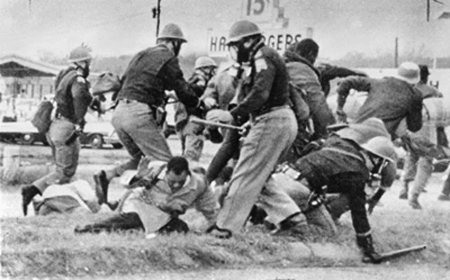
To be fair, he did more than simply sign the crucial piece of legislation giving teeth to the Civil Rights Act of the previous year. President Johnson came to Congress on 15 March 1965 (just one week after a murderous attack on civil rights marchers in Selma, Alabama) and delivered what was, arguably, the greatest speech of his life.

"We Shall Overcome." On 15 March 1965, just one week after civil rights marchers were attacked by state troopers in Selma, Alabama, President Lyndon Johnson placed the full weight of the executive branch of the US federal government behind the Voting Rights Act.

“I speak tonight for the dignity of man, and the destiny of democracy”, he told the assembled representatives and senators. Speaking to America’s purpose: to the promise of freedom and equality that gave it birth; and to the dignity that is the birthright of every American citizen; LBJ said:

“This dignity cannot be found in man’s possessions. It cannot be found in his power or in his position. It really rests on his right to be treated as a man equal in opportunity to all others. It says that he shall share in freedom, he shall choose his leaders, educate his children, provide for his family according to his ability and his merits as a human being.”

The President brought his address to a close with the words that only a week before, as the dogs and the state troopers were unleashed upon them, the Selma marchers had sung to the world. Openly supporting the demonstrators, LBJ declared:

“Their cause must be our cause too, because it is not just Negroes but really it is all of us, who must overcome the crippling legacy of bigotry and injustice. And we shall overcome.”

Crippling Legacy: State troopers assault civil rights marchers in Selma, Alabama.

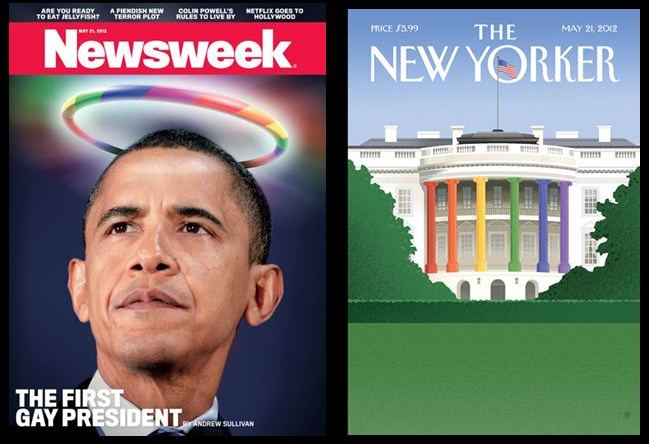
Last week the world heard another American president speak out for civil rights. Barack Obama told his fellow citizens that: “It is important for me to go ahead and affirm that I think same-sex couples should be able to get married.”

How fitting it is that this president offered that affirmation. Because there are still many Americans (some of them in his own party) who refuse to see the question of who can marry whom as anything more than a trivial, second-order issue, and a political diversion. They forget that when Barack Obama’s own mother was born there were still places in the United States where not only marriage, but even sexual intercourse, between a black man and a white woman could land them in jail – or worse. The union between President Obama’s white mother and his black, Kenyan, father, in many American states would have seen outraged Klansmen reaching for their robes, and their ropes.

Presidents are not saints, but neither are they wholly sinners. Light and dark may have been blended in LBJ’s soul to an unsettling degree, but that 1965 pledge to Congress: “We shall overcome”; was a vital step towards the full emancipation of Black Americans.

The question of “Who can marry whom?” is not a trivial, second-order issue. It’s about human dignity and human rights.

There are occasions, said President Johnson, when “history and fate meet at a single time in a single place to shape a turning point in man’s unending search for freedom.”

President Obama’s affirmation of same sex marriage tells us: that time is now.

This essay was originally published in The Otago Daily Times, The Waikato Times, The Taranaki Daily News, The Timaru Herald and The Greymouth Star of Friday, 18 May 2012.

Friday, 14 January 2011

"This Mighty Scourge" - Reflections On The Tucson Shootings

As American As Apple Pie: Political violence is the inevitable consequence of so many Americans' refusal to accept the social and economic implications of political equality.

POLITICAL VIOLENCE is as American as apple pie. It has always been and remains the weapon of first resort in a nation dedicated to the proposition that "all men are created equal". By what other means could "the blessings of liberty", and the "general welfare" of the American people have been so consistently denied? Without political violence the United States, as we know it today, could not exist.

The tragedy in Tucson, Arizona, which left six people dead, and Congresswoman Gabrielle Giffords fighting for her life, is by no means extraordinary. Such attacks occur whenever Americans attempt to use the political rights guaranteed in their Constitution to secure the economic and social rights so clearly implied by expressions like "a more perfect union" and "the general welfare". Concepts upon which the Founding Fathers preferred to remain uncharacteristically silent.

Silence was, of course, the price which the more radical American revolutionaries had to pay to secure any sort of union. Because the institution of slavery, which underpinned the new nation’s economy, cast a fatal veto over any further constitutional elaboration of the sentiments contained in the Declaration of Independence. It was this – the institutionalised violence of human trafficking and forced labour – that cursed the infant United States in its cradle.

The American Right cannot, however, acknowledge this fundamental historical truth without endorsing the liberal school of constitutional interpretation they have so vehemently sworn to oppose.

It’s why the Republican Party-dominated House of Representatives began its first sitting by reading the Constitution into the Congressional Record. Not the original Constitution, mind you, which states, in Article I Section 2:

"Representatives and direct Taxes shall be apportioned among the several States … according to their respective Numbers, which shall be determined by adding to the whole Number of free Persons … three fifths of all other Persons."

Those "other persons" were, of course, the African slaves - reckoned by America’s founders to be only 60 percent human.

Such wilful historical blindness is necessary to avoid the one, great, inescapable conclusion of US history: that the American Republic was only preserved by subordinating the oppressive letter of the Constitution to its egalitarian and democratic spirit.

Abraham Lincoln understood this. It’s why he spoke, at Gettysburg, of America experiencing "a new birth of freedom". Had he lived, the world may have learned much earlier what government "of the people, by the people, for the people" actually looks like.

But the South didn’t want to know. Steeped in the violence of slavery and the perverted social relations it spawned, the defeated Confederacy struck back through the trigger-finger of John Wilkes Booth.

Though it had been defeated on the battlefield, it was the South’s twisted version of freedom that ultimately prevailed. The same witches brew which had poisoned the first 70 years of American history was, with only minimal changes, permitted to contaminate the rest. Overweening corporate and financial power may have supplanted the "sovereign" power of the states, but the iron injunction against federal (i.e. democratic) interference endured.

In today’s America, the historic promises of the Constitution remain as elusive as ever. The victory of Barack Obama, far from closing the book on the Civil War, merely reveals the extent to which the Union’s victory over the Confederacy has been compromised. Behind the hopeful painted scenery of 21st Century America’s political stage stride the same dark forces that stalked the corridors of the Ford Theatre that fateful night in April 1865.

Speaking to the American people on the evening of Gabrielle Giffords’ attempted assassination, President Obama stood at a podium placed squarely beneath a portrait of a brooding Abraham Lincoln. His appeal, like Lincoln’s was to America’s "better angels". But I wonder whether, in his heart, President Obama did not recall the grim prophecy of his predecessor’s second inaugural address:

"Fondly do we hope, fervently do we pray, that this mighty scourge of war may speedily pass away. Yet, if God wills that it continue until all the wealth piled by the bondsman's two hundred and fifty years of unrequited toil shall be sunk, and until every drop of blood drawn with the lash shall be paid by another drawn with the sword, as was said three thousand years ago, so still it must be said ‘the judgments of the Lord are true and righteous altogether’."

This essay was originally published in The Timaru Herald, The Taranaki Daily News, The Otago Daily Times and The Greymouth Star of Friday, 14 January 2011.

Friday, 5 June 2009

Re-defining Empathy

Barack Obama: "The empathy to understand what it's like to be poor."

IT was one of those throwaway lines that sets an alarm-bell ringing in the back of your mind. A sneering, belittling tone which makes you wonder. "What was that all about?" Or ask: "Who rattled his cage?"

The line in question appeared in an article by William Langley, a conservative political correspondent for the right-wing British newspaper, The Sunday Telegraph. He was writing about President Obama’s nominee for the US Supreme Court, Sonia Sotomayor, and how she exemplifies the human quality the new American President prizes most: Empathy.

"The word – ", wrote Mr Langley, "a longstanding pop-psychology and self-help manual standby – has been heavily in play since Obama last week proposed Sonia Sotomayor, a New York appeals court judge, as his first Supreme Court pick."

"Whoa there, Billy Boy!" I thought to myself, as I read those words. Since when has "empathy" connoted something as frothy and ultimately superfluous as "pop psychology"? And who, exactly, has decided that the moral impulse which lies at the root of all the world’s great religions; the defining quality of the most exalted human behaviour, should be downgraded to the status of a "self-help manual standby"?

I didn’t have to read much further to discover the answer. According to the man who scripted most of the George Bush Jnr presidency, Karl Rove: "Empathy is the latest code word for liberal activism, for treating the constitution as malleable clay to be kneaded and moulded in whatever form justices want."

Aha! So that’s the caper. President Obama, in the tradition of America’s greatest presidents, is attempting to infuse his countrymen’s’ political discourse with a moral language more nuanced and sophisticated that the Bush Administration’s crude division of the world into a Manichean "Us" (the good guys) versus "Them" (the evil-doers).

This sort of language:

"We need somebody whose got the heart, the empathy, to recognise what it’s like to be a young teenage mom. The empathy to understand what it’s like to be poor, or African-American, or gay, or disabled, or old. And that’s the criteria by which I’m going to be selecting my judges."

Good Lord! No wonder the Right is all a-twitter. For the past thirty years they have enjoyed a virtual monopoly over the use of religious rhetoric. Never mind that it was Old Testament rhetoric – full of "thou shalt nots", and trailing the fire and brimstone of the Pentateuch God. So long as the Left refused to plough this most fertile of all political fields, the Right couldn’t lose.

But President Obama is only too happy to toil in the fields of the Lord, and to confront the Republican Party’s Old Testament rhetoric, with the emancipatory and, yes, empathic language of the New.

It’s there in his Inaugural Address, when he talks about the contribution of the men and women "obscure in their labour, who have carried us up the long rugged path towards prosperity and freedom".

Who can hear those words and not be reminded of Christ’s: "straight is the gate and narrow is the way, that leadeth unto life, and few there be who find it"?

Consider, too, President Obama’s Georgetown University speech, in which he draws explicitly from the Sermon on the Mount:

"We cannot rebuild this economy on the same pile of sand. We must build our house upon a rock."

The President’s New Testament rhetoric strikes at the heart of the Right’s political project in a way that is peculiarly American – and peculiarly effective.

In a nation whose visceral fear and hatred of "Godless Communism" is legendary, Christ’s liberating theology of love and justice has long supplied the American Left with a potent alternative to the class-ridden rhetoric of Marx and Lenin. When that great American revolutionary, Dr Martin Luther King, made out the case for racial emancipation and social solidarity, he did so using the language of the Bible – not Das Kapital.

Empathy – the ability to put yourself in another person’s shoes – is fundamental to President Obama’s redemptive project. By recruiting Jesus to the Democratic cause, and setting him against the Republican’s Jehovah, The President has forced the Right into a theological and political battle it cannot win.

Unless, of course, it first persuades us that empathy – the attribute without which we cannot truly be called human – is nothing but "pop psychology" and a "self-help manual standby".

A version of this essay was originally published in The Timaru Herald, The Taranaki Daily News, The Otago Daily Times and The Greymouth Evening Star of Friday, 5 June 2009.

Friday, 23 January 2009

The Choice of Hercules

The 44th President of the United States of America - Barack Hussein Obama.

IT was moving – how could it not be? To see an African-American standing on the steps of the Capitol Building, fulfilling the dream enunciated by Dr. Martin Luther King Jnr on the steps of the Lincoln Memorial, just two-and-a-quarter miles distant, but forty-six long years ago, was a sight to gladden the heart of all but the most convinced cynics.

And yet … and yet … there was something missing from the inaugural address which Barack Obama delivered to the million-and-a-half Americans who had gathered in Washington’s winter sunshine to bear witness to their new president’s historic triumph.

What was it – this absent, but crucially important, element? It was only after downloading the address from the Internet and reading it through several times that I realised what was missing. Change. Where were the references to change?

In spite of running on the slogan "change you can believe in", in the nearly two-and-a-half thousand words of Obama’s inaugural address the word "change" appears only once. And the context in which the word appears hardly celebrates the power of the human will to transform and/or transcend the circumstances which constrain it. On the contrary, when Obama declares: "For the world has changed, and we must change with it", he is telling his people that when it comes to change they have no choice. A case not so much of "yes we can", as "yes we must".

Why this reluctance to promote the cause of radical change in America – Lord knows if anyone has a mandate to transform the United States of America it is Barack Obama. And who can doubt that a man of his oratorical power could have had that record crowd of citizens chanting "Yes we can!" until the marble halls of the Capitol building echoed with the people’s voice.

The answer, of course, is because a President cannot always have 1.5 million supporters standing ready to endorse his every word. The American republic is a representative democracy like our own, and in practice that means the executive power, when determining policy, is obliged to balance the many and often competing interests of a large and complex society. One can govern neither effectively nor democratically by heeding only your own echo – your opponents have rights too.

And Obama has many opponents – among both the people and the elites – whose opinions and likely reactions need to be carefully weighed and factored into his administration’s decision-making. In this respect the burden Obama has assumed is every bit as great and no less daunting than the one assumed by John F. Kennedy on the Capitol steps 48 years ago.

The man against whose formidable rhetorical skills Obama’s are most frequently compared was sworn in as president at the very peak of the ideological, military, scientific and economic competition between the capitalist and communist blocs. As the leader of the "Free World", Kennedy was required to demonstrate that the USA remained committed to the "revolutionary" ideals of its founders (the words ‘revolution’ and ‘revolutionary’ appear over and over again in his inaugural address) and to reassure the post-colonial regimes of the Third World that America was on their side. Indeed, the bulk of Kennedy’s address is directed not at his domestic, but at his foreign audience. At home the economy was booming, and the great post-war economic and social consensus had never been stronger. The most famous line from Kennedy’s speech: "ask not what your country can do for you, ask what you can do for your country" acknowledges this rampant materialism even as it summons America’s youth to the ideals of public service and personal sacrifice.

Obama takes up the office of president at a time of acute economic crisis and ideological uncertainty in America. The great republic’s military power – vast and unchallengeable – has been revealed as an altogether inadequate substitute for intelligent and solidaristic global conduct. At the same moment, the hitherto triumphant dogma of the free market has been revealed as a tawdry exercise in untrammelled individual greed and rampant social irresponsibility. As President, it falls to Obama to lead his people out of this Slough of Despond and back into the light. If his oratory lacked the snap and sparkle of Kennedy’s, it was only because his task was not to prove that the United States was as vital and vigorous as the young man who delivered it, but to bring home to Americans the sombre realities of the crisis their years of heedless narcissism have unleashed upon themselves – and the world.

My old comrade and occasional mentor, Rob Campbell, sensing the magnitude of the task Obama faces, forwarded to me a posting from "The Epicurean Dealmaker" blogsite, based on a classical fable entitled "The Choice of Herakles". Written more than 2,000 years ago by the philosopher Xenophon, the choice which Herakles (or Hercules, to give him his Latin title) must make is between Virtue and Vice. It is a fascinating dialogue, and be it by accident or design it’s ancient themes echo powerfully through Obama’s inaugural address.

Lasting fame and true nobility come not to mortals save through pain and labour. If thou, O Hercules, seekest the gracious gifts of Heaven, thou must remain constant in prayer; if thou wouldst be beloved of thy friends, thou must serve thy friends; if thou desirest to be honoured of the people, thou must benefit the people; if thou art anxious to reap the fruits of the earth, thou must till the earth with labour; and if thou wishest to be strong in body and accomplish heroic deeds, thou must teach thy body to obey thy mind. Yea, all this and more also must thou do.

Thus wrote Xenophon. Now hear Obama:

In reaffirming the greatness of our nation, we understand that greatness is never a given. It must be earned. Our journey has never been one of short-cuts or settling for less. It has not been the path for the faint-hearted – for those who prefer leisure over work, or seek only the pleasures of riches and fame. Rather, it has been the risk takers, the doers, the makers of things – some celebrated but more often men and women obscure in their labour, who have carried us up the long, rugged path towards prosperity and freedom.

Obama knows that if he is to carry his people – supporters and opponents – with him, then he must first convince them that the foundational ideals of the American republic have found a safe custodian. More than that, he must instil in them the understanding that it is only by adhering to those ideals that their nation can grow and prosper. That is why the word ‘change’ appears only once in his inaugural address: because there is only one change that matters; only one change Americans can safely believe in – and that is the change they must make in themselves.