
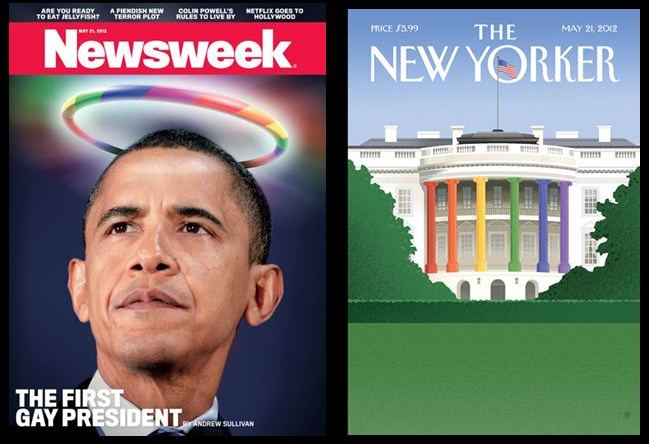
The Man Of The Moment: President Barack Obama's public affirmation of same-sex marriage, like LBJ's famous 1965 civil rights speech to Congress in which he pledged "We shall overcome.", marks an important turning point in the quest for full civil equality for all Americans.
HE WASN’T ALWAYS A GOOD MAN, in fact Lyndon Baines Johnson
was very often a bad man. He was from Texas, of course, which explains a lot.
In Texas’s primary elections, which were the only electoral contests that
really mattered in the “one party” states of the Democratic South, political
bosses would ask their candidates: “Do you want us to vote ‘em, or count ‘em?”
By this they meant: do you want us to bring in actual people to pad your vote;
or do you want us to stuff the ballot boxes? LBJ won the 1948 Democratic Party
primary for the US Senate by “counting ‘em”. He never looked back.
But if LBJ was a byword for the sort of “dirty deals done
dirt cheap” that made the US Senate such an august example of republican
virtue, he did have one truly great redeeming feature: he loved the poor. And
in the United States of America, and most especially in the southern states of
the old Confederacy, that meant loving black people. Not enough, it is true, to
seat the integrated “Mississippi Freedom” delegation at the Democratic Party’s
National Convention of 1964. But enough to put his Presidential signature on
the Voting Rights Act of 1965.
To be fair, he did more than simply sign the crucial piece
of legislation giving teeth to the Civil Rights Act of the previous year.
President Johnson came to Congress on 15 March 1965 (just one week after a
murderous attack on civil rights marchers in Selma, Alabama) and delivered what
was, arguably, the greatest speech of his life.

"We Shall Overcome." On 15 March 1965, just one week after civil rights marchers were attacked by state troopers in Selma, Alabama, President Lyndon Johnson placed the full weight of the executive branch of the US federal government behind the Voting Rights Act.
“I speak tonight for the dignity of man, and the destiny of
democracy”, he told the assembled representatives and senators. Speaking to
America’s purpose: to the promise of freedom and equality that gave it birth;
and to the dignity that is the birthright of every American citizen; LBJ said:
“This dignity
cannot be found in man’s possessions. It cannot be found in his power or in his
position. It really rests on his right to be treated as a man equal in
opportunity to all others. It says that he shall share in freedom, he shall
choose his leaders, educate his children, provide for his family according to
his ability and his merits as a human being.”
The President
brought his address to a close with the words that only a week before, as the
dogs and the state troopers were unleashed upon them, the Selma marchers had
sung to the world. Openly supporting the demonstrators, LBJ declared:
“Their cause must
be our cause too, because it is not just Negroes but really it is all of us,
who must overcome the crippling legacy of bigotry and injustice. And we shall overcome.”
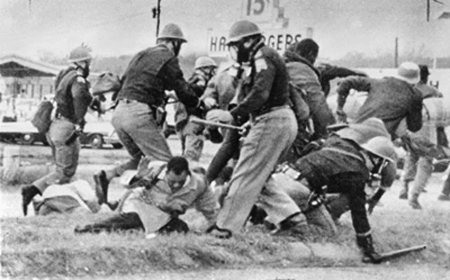
Crippling Legacy: State troopers assault civil rights marchers in Selma, Alabama.
Last week the
world heard another American president speak out for civil rights. Barack Obama
told his fellow citizens that: “It is important for me to go ahead and affirm
that I think same-sex couples should be able to get married.”
How fitting it is
that this president offered that affirmation. Because there are
still many Americans (some of them in his own party) who refuse to see the
question of who can marry whom as anything more than a trivial, second-order
issue, and a political diversion. They forget that when Barack Obama’s own
mother was born there were still places in the United States where not only
marriage, but even sexual intercourse, between a black man and a white woman
could land them in jail – or worse. The union between President Obama’s white
mother and his black, Kenyan, father, in many American states would have seen
outraged Klansmen reaching for their robes, and their ropes.
Presidents are
not saints, but neither are they wholly sinners. Light and dark may have been
blended in LBJ’s soul to an unsettling degree, but that 1965 pledge to
Congress: “We shall overcome”; was a vital step towards the full
emancipation of Black Americans.
The question of
“Who can marry whom?” is not a trivial, second-order issue. It’s about human
dignity and human rights.
There are
occasions, said President Johnson, when “history and fate meet at a single time
in a single place to shape a turning point in man’s unending search for
freedom.”
President Obama’s
affirmation of same sex marriage tells us: that time is now.
This essay was originally published in The Otago Daily Times, The Waikato Times, The
Taranaki Daily News, The Timaru
Herald and The Greymouth Star of Friday, 18 May 2012.
