Showing posts with label Lyndon Baines Johnson. Show all posts

Monday, 4 July 2022

Forwards And Backwards.

The Right In Action: Nothing in politics is ever settled. The hands of History’s clock can go backwards, as well as forwards.


IT REALLY WAS THE BEST OF TIMES. The brief recession of the late-1950s was over. The United States was led by a young, Harvard-educated war hero, with the dashing style and good-looks of a Hollywood movie star.

The Kennedy Administration had made idealism sexy, and politics heroic. “Ask not what your country can do for you,” John F. Kennedy had declared in his Inaugural Address of 20 January 1961, “ask what you can do for your country.”

The Cuban Missile Crisis of October 1962, and its peaceful resolution, offered proof positive that “the best and the brightest” of the “Free World” were more than a match for the hard men of Soviet Communism. There was a confidence and purposefulness about the United States that not only lifted the spirits of Americans, but fuelled the hopes of people all over the world.

Even the great American scars of racism and poverty no longer seemed beyond remedy. Dr Martin Luther King’s non-violent civil rights movement was galvanising young Americans of all colours in ways not seen since the Civil War of the 1860s. It recalled the high idealism of the Abolitionists: that extraordinary fervour for racial justice reflected in the words of The Battle Hymn of the Republic: “As [Christ] died to make men holy, let us die to set men free.”

Kennedy had also invited Michael Harrington, democratic socialist and author of the 1962 best-seller, The Other America, to the White House for a briefing on those pockets of poverty Roosevelt’s “New Deal” had left in place, and how, finally, they might be eradicated.

Underlying all this optimism and idealism was a rising tide of Keynesian-inspired economic prosperity that had lifted all boats high enough for the usual hardscrabble, hand-to-mouth priorities of ordinary Americans to be temporarily set aside. If the United States was rich enough to contemplate putting a man on the moon by 1970, then perhaps the elimination of racial inequality and poverty could be overcome.

Paradoxically, Kennedy’s assassination only hardened the resolve of Americans to meet the challenges their fallen leader had set before them.

President Lyndon Baines Johnson pledged unreservedly to make good his predecessor’s promises. In January 1964, just weeks after the tragedy in Dallas, “LBJ” used his first State of the Union Address to declare an unconditional “war on poverty”. In November of that same year, Johnson handed Barry Goldwater, the presidential candidate of a Republican Party hi-jacked by its far-right lunatic fringe, a stunning and humiliating defeat.

In his most effective campaign ad’, Johnson said, simply: “Either we must love each other, or we must die.” Less than sixty years ago, an American President had secured a landslide victory on a platform of delivering racial justice, ending poverty, and keeping America at peace.

In the bitter aftermath of the US Supreme Court’s revocation of Roe v. Wade, the above history lesson should serve as a sharp reminder of just how tenuous, and temporary, political progress can be. In the space of just four tumultuous years, the United States had retreated so far from its progressive high-water mark, that Richard Nixon was able to re-take the White House for the Republican Party. Nothing in politics is ever “settled”. The hands of History’s clock can go backwards, as well as forwards.

Nor are such dramatic political reversals peculiar to the United States. In 1972, the New Zealand electorate swung sharply left, propelling the Labour Party into power with 48.4 percent of the popular vote and a whopping 23-seat majority. The professors and the pundits of the time were unanimous in their opinion that a majority of 23 could not be overturned in the space of a single term. Labour, they insisted, was good for at least six years.

They couldn’t have been more wrong. Between 1972 and 1975, the mood of the New Zealand electorate soured to the point where National’s right-wing populist leader, Rob Muldoon, was able to exactly reverse the 1972 election result. Politically and socially, New Zealand voters had swung as sharply to the right as, only 36 months before, they had swung to the left.

Fear was the key: fear and its associated need for reassurance and protection. Muldoon’s success was built on the sudden failure of the New Zealand economy. Rampant inflation, rocketing petrol prices, and the widespread conviction that something very serious had gone wrong with the stable (some might say smug) New Zealand so gently mocked in Austin Mitchell’s in/famous bestseller The Half-Gallon, Quarter-Acre, Pavlova Paradise.

Which is why, when professors and pundits glibly reassure us that there is no way New Zealanders could turn against a woman’s right to choose an abortion, we are entitled to a small snort of derision.

Four years ago, approximately 65-70 percent of New Zealanders were in favour of legalising cannabis. That’s roughly the same percentage of the population that supports the current abortion law. After 18-months-to-a-year of extremely sophisticated campaigning by the anti-cannabis lobby, however, the percentage of voters supporting marijuana law reform had plummeted to just under 50 percent – a fall sufficient to cost the reformers the 2020 referendum. Public opinion doesn’t just change, it can be made to change.

With most economists predicting an imminent recession, many New Zealanders will enter 2023 in fear of what lies in store for them, and resentful of a Labour Government they believe has let them down. If extra-parliamentary forces like the Family First organisation are able to associate Labour’s political leadership with an ideology that despises and derides the beliefs and values of ordinary people, linking their lack of empathy with New Zealanders’ declining economic fortunes, then the chances of them producing a dramatic shift in the electorate’s thinking are relatively high.

In a commentary-piece written for The Conversation, the Auckland academic Suze Wilson warns New Zealanders against placing too much stock in Opposition Leader, Christopher Luxon’s, reassurances that National would not pursue a change to this country’s abortion laws should it win government.

“Even if Luxon’s current assurance is sincerely intended,” writes Wilson, “it may not sustain should the broader political acceptability of his personal beliefs change. And on that front, there are grounds for concern.”

Wilson draws particular attention to the sharp rightward drift set in motion by the Covid-19 Pandemic and the measures adopted by Jacinda Ardern’s Labour-led Government to protect New Zealanders from its worst effects. The early success of those measures, sufficient to secure Labour’s landslide victory in 2020, has not been maintained. Voters who, just 18 months ago looked upon “Jacinda” as a national hero, are daily falling prey to extreme right-wing conspiracy theories depicting her as a power-crazed tyrant.

“If these kinds of shifts in public opinion continue to gather steam, it may become more politically tenable for Luxon to shift gear regarding New Zealand’s abortion laws”, Wilson warns.

The same America that gave us JFK, also gave us Richard Nixon and Donald Trump. The same New Zealand that gave us Norman Kirk, also gave us Rob Muldoon. Except they weren’t really the same countries, were they? Because, when Prosperity leaves the building, Empathy is seldom very far behind.

Nothing in politics is ever settled.


This essay was originally posted on the Interest.co.nz website on Monday, 4 July 2022.

Friday, 27 October 2017

Can Jacinda Ride “Hirschman’s Cycle” Without Falling Off?

Good Will Receiving: If New Zealanders are in a mood to promote the public good, then there is every chance that the Ardern-led government will succeed. If they are more concerned with promoting their own, private, welfare, then the resistance to the new government’s redistributive ambitions is likely to be very fierce indeed.

WILL THIS NEW GOVERNMENT SUCCEED? Across the political spectrum, that is the question. Will Jacinda Ardern and her NZ First and Green Party allies find their fellow New Zealanders broadly accommodating of, or fiercely resistant to, her government of change?

If New Zealanders are in a mood to promote the public good, then there is every chance that the Ardern-led government will succeed. If they are more concerned with promoting their own, private, welfare, then the resistance to the new government’s redistributive ambitions is likely to be very fierce indeed.

A sociologist might attempt an answer to this question by asking where New Zealand currently stands in the “Hirschman Cycle”.

Named after the much-admired American sociologist, Albert Hirschman, the Cycle describes those recurring historical transitions from periods in which society is predominantly concerned with maximising private consumption and individual well-being; to periods characterised by a general willingness to accommodate public programmes aimed at uplifting those in need and dedicated to reaffirming the nation’s core values and aspirations.

The period of US history most proximate to Hirschman’s research was the period known as “The Great Society”. After nearly two decades of rapidly rising incomes and growing affluence, Americans entered the 1960s more willing to embrace public policies of uplift and altruism than at any time since the “New Deal” of the 1930s.

The architect of The Great Society, President Lyndon Baines Johnson, attempted to sketch out his administration’s response to inequality – especially racial inequality – in his famous “To Fulfil These Rights” speech to Howard University’s commencement class on 4 June 1965:

“There is no single easy answer to all of these problems”, the President told his audience of mostly African-American students. “Jobs are part of the answer. They bring the income which permits a man to provide for his family. Decent homes in decent surroundings and a chance to learn – an equal chance to learn – are part of the answer. Welfare and social programs better designed to hold families together are part of the answer. Care for the sick is part of the answer. An understanding heart by all Americans is another big part of the answer. And to all of these fronts – and a dozen more – I will dedicate the expanding efforts of the Johnson administration.”

This, the high-water mark of social-democratic liberalism in the United States, is made even more luminous by the darkness currently enveloping Trump’s America. Born out of one of V.O. Key’s, “permissive” political consensuses, Johnson’s “Great Society” would not survive the public’s rapidly declining faith in Washington-based solutions. The race-riots of the mid-60s, a steadily escalating war in Vietnam, and the fast-deteriorating US domestic economy soon ushered America into the selfish phase of Hirschman’s Cycle.

The question Jacinda and her colleagues have to ask themselves, therefore, is whether or not such a “permissive” political consensus exists in New Zealand. Is her “administration” entering office at a point in the Hirschman Cycle roughly analogous to where the US was when President Johnson was inaugurated in January 1965?

The answer, sadly, is: “No.” Far from being swept into office on an historic landslide, Jacinda’s victory is both electorally narrow and politically controversial. If a US precedent is being sought, it isn’t to be found in the Johnson Administration, but in the politically and economically fraught administration of President Jimmy Carter.

Massive problems have grown up during the nine-year period of National Party rule. Escalating social inequality has fuelled poverty and homelessness: leading to rising levels of mental illness, suicide, violent crime and a record number of incarcerated citizens. The social and economic climate is, therefore, very different to that which prevailed when Norman Kirk was swept to victory in the golden year of 1972.

Like the Johnson Administration, the Kirk Government inherited a “permissive” political consensus of unprecedented scope. Jacinda’s political environment, by contrast, has all the room for manoeuvre of Jimmy Carter’s and Helen Clark’s. Hirschman’s Cycle-wise, New Zealand remains deeply mired in its individualistic/private consumption phase. Moreover, as Winston Peters soberly observed, there is little prospect of the country enjoying, anytime soon, the expansive economic and social conditions capable of persuading an electorate to embrace a government committed to the public good.

And yet, out-of-phase though New Zealand may be, Hirschman Cycle-wise, Jacinda and the public good have no choice but to deliver each other.


This essay was originally published in The Waikato Times, The Taranaki Daily News, The Timaru Herald, The Otago Daily Times and The Greymouth Star of Friday, 27 October 2017.

Thursday, 23 February 2017

Labour's Not Burning Crosses - It's Gathering Votes.

Double Act: Andrew Little and Willie Jackson have signalled that, as far as the Maori Party is concerned, the political gloves are off. If Jackson’s comments encourage other Maori to speak out in similarly blunt terms about the true agenda of the Maori Party and the Iwi Leadership Group, then the electoral dividend for Labour is likely to be substantial.
 
WHAT I HEARD from Willie Jackson and Sandra Lee this morning (22/2/17) didn’t sound at all like “cross burning”. What I heard on RNZ’s “Morning Report” was a discussion about Maori need and the most effective ways to address it. I also heard some pretty frank criticism of the Maori elite and its principal political mouthpiece.
 
Neither Lee nor Jackson were willing to repudiate Andrew Little’s blunt refusal to accept the Maori Party’s political credentials. What they did repudiate was the selective historical memory of Tariana Turia and her ilk.
 
If Jackson’s recruitment encourages other Maori to speak out in similarly blunt terms about the true agenda of the Maori Party and the Iwi Leadership Group, then the electoral dividend for Labour will be substantial.
 
Because no amount of social-liberal outrage can obscure the fact that the Maori Party long ago abandoned the cause of working-class Maori in favour of a neo-tribal capitalist system which is busy swelling the ranks of a new Maori professional and managerial class.
 
Not that such outrage isn’t extremely helpful. Without it, the crucial role which the Maori Party plays in blurring the edges of the National Party’s continuing assault upon the brown working-class might come into sharper focus.
 
By interposing themselves between National’s neoliberal economic policies and the people they purport to represent, the Maori Party not only protects its political patron from the consequences of its own social aggression; but it also furnishes its voters with “proof” of “their” party’s relevance and effectiveness.
 
The message is as simple as it is cynical: “Just imagine how bad things would be if we weren’t here to keep all those crazy conservative Pakehas from running wild!”
 
The Ratana Church’s Depression-era alliance with Labour was likely born out of a similar rationale. The big difference, of course, was that Tahupōtiki Wiremu Rātana joined forces with the Pakeha poor to end their common marginalisation at the hands of a ruling class made vicious by social fear and political rage. He knew that the ruling elites of both peoples could only be controlled by “the survivors” of colonialism and capitalism, brown and white, working together.
 
The Maori Party, by contrast, almost immediately shed its mass base in favour of a cross-cultural class alliance between the Maori and Pakeha elites. While the National Party’s accelerated Treaty settlement process helpfully expanded the Maori middle-class, the Maori Party maintained a deafening silence as neoliberal economic and social policies wreaked havoc upon its own people. It was a Devil’s bargain: in return for abandoning the constituency which had given the Maori Party birth, the National Party was growing it a new one.
 
It was this shameless collaborationism that drove Hone Harawira out of the Maori Party and into the cross-cultural alliance of Maori and Pakeha socialists that used to be Mana. Harawira wagered that his tactical association with Kim Dotcom’s Internet Party would provide Mana with a parliamentary beach-head larger than Te Tai Tokerau and sufficient List MPs to make a difference. He lost.
 
The kindest thing that might be said about Harawira’s latest gambit is that it is motivated solely by his determination to get Mana back into Parliament. The less kindly among us, however, might wonder aloud, as Sandra Lee did this morning, about the political efficacy of an agreement which debars Mana from standing in any Maori seat but Te Tai Tokerau, and which prohibits criticism of both the Maori Party’s record and its policies. Hone Harawira owes his followers a clearer explanation.
 
Social-liberal criticism (backing-up that of Turia and Pita Sharples) will, of course, focus on Labour’s handling of the foreshore and seabed issue.
 
In the best of all possible worlds the Court of Appeal’s unexpected decision would have been welcomed with open arms by a Labour Party determined to build upon and strengthen the Maori renaissance. Conveniently forgotten by Labour’s Maori and Pakeha critics, however, is the hostile political reception given to Helen Clark’s attempt to do just that.
 
The National Party had attacked Labour’s “Closing the Gaps” policy relentlessly – not hesitating to wake up the sleeping dogs of Pakeha racism if that was what it took to reclaim the Treasury Benches.
 
Already spooked by the “Winter of Discontent” of 2000 (when New Zealand’s leading capitalists threatened the new Labour-led government with a full-scale investment strike if Clark and her Finance Minister, Michael Cullen, refused to rein-in the radical expectations of their Alliance coalition partner) the Labour prime minister took another step back and hastily abandoned the term, if not the substance of, “Closing the Gaps”. She was in  no mood to let the National Party hang the Court of Appeal’s judgement around her neck and sink Labour’s chances of winning the 2005 election.
 
That Labour’s Foreshore & Seabed Act (2004) was in practical terms indistinguishable from the Marine & Coastal Area (Takutai Moana) Act (2011) which Tariana Turia accepted without protest from her National Party allies seven years later, speaks volumes about the lengths to which Clark, Cullen and Labour’s Maori caucus were prepared to go to protect Maori interests – even as they were being pilloried as the reincarnation of the nineteenth century’s most hateful colonialists.
 
Those who have spent the last 48 hours condemning Andrew Little for his attack on the Maori Party would undoubtedly benefit from watching the movie All The Way. Covering Lyndon Johnson’s first year as President of the USA (1963-1964) it is a riveting portrayal of just how difficult it is to challenge the racist expectations of an overwhelmingly white electorate – let alone overcome them.
 
To remind passionate seekers-after-change that politics is “the art of the possible” is to repeat a cliché they have heard many times before. Repetition does not, however, make it any the less true. To win power, Andrew Little needs the Maori working-class to remain loyal to Labour. That will not happen if the Maori Party is allowed to paint every expression of Pakeha political criticism as “racist”, and to dismiss every left-wing Maori critic as an “Uncle Tom”.
 
As Lyndon Johnson put it to his tender-hearted liberal running-mate, Hubert Humphrey: “Principles? Principles! Dammit! This isn’t about principles – it’s about votes!”
 
This essay was originally posted on The Daily Blog of Thursday, 23 February 2017.

Friday, 18 May 2012

Same Sex Marriage - A Turning Point

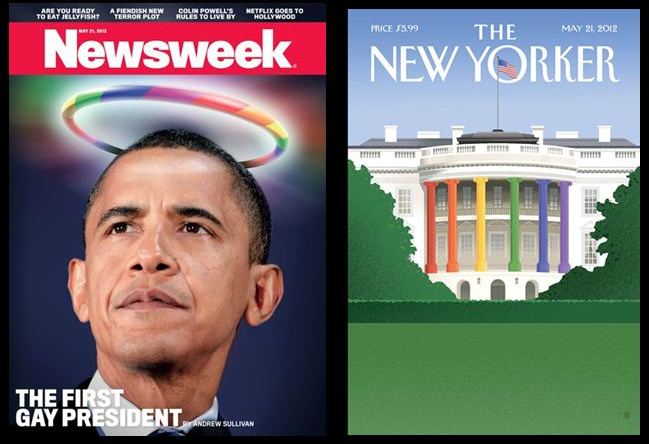
The Man Of The Moment: President Barack Obama's public affirmation of same-sex marriage, like LBJ's famous 1965 civil rights speech to Congress in which he pledged "We shall overcome.", marks an important turning point in the quest for full civil equality for all Americans.

HE WASN’T ALWAYS A GOOD MAN, in fact Lyndon Baines Johnson was very often a bad man. He was from Texas, of course, which explains a lot. In Texas’s primary elections, which were the only electoral contests that really mattered in the “one party” states of the Democratic South, political bosses would ask their candidates: “Do you want us to vote ‘em, or count ‘em?” By this they meant: do you want us to bring in actual people to pad your vote; or do you want us to stuff the ballot boxes? LBJ won the 1948 Democratic Party primary for the US Senate by “counting ‘em”. He never looked back.

But if LBJ was a byword for the sort of “dirty deals done dirt cheap” that made the US Senate such an august example of republican virtue, he did have one truly great redeeming feature: he loved the poor. And in the United States of America, and most especially in the southern states of the old Confederacy, that meant loving black people. Not enough, it is true, to seat the integrated “Mississippi Freedom” delegation at the Democratic Party’s National Convention of 1964. But enough to put his Presidential signature on the Voting Rights Act of 1965.

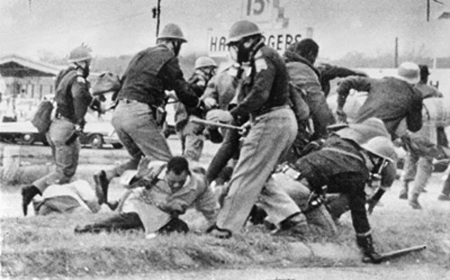
To be fair, he did more than simply sign the crucial piece of legislation giving teeth to the Civil Rights Act of the previous year. President Johnson came to Congress on 15 March 1965 (just one week after a murderous attack on civil rights marchers in Selma, Alabama) and delivered what was, arguably, the greatest speech of his life.

"We Shall Overcome." On 15 March 1965, just one week after civil rights marchers were attacked by state troopers in Selma, Alabama, President Lyndon Johnson placed the full weight of the executive branch of the US federal government behind the Voting Rights Act.

“I speak tonight for the dignity of man, and the destiny of democracy”, he told the assembled representatives and senators. Speaking to America’s purpose: to the promise of freedom and equality that gave it birth; and to the dignity that is the birthright of every American citizen; LBJ said:

“This dignity cannot be found in man’s possessions. It cannot be found in his power or in his position. It really rests on his right to be treated as a man equal in opportunity to all others. It says that he shall share in freedom, he shall choose his leaders, educate his children, provide for his family according to his ability and his merits as a human being.”

The President brought his address to a close with the words that only a week before, as the dogs and the state troopers were unleashed upon them, the Selma marchers had sung to the world. Openly supporting the demonstrators, LBJ declared:

“Their cause must be our cause too, because it is not just Negroes but really it is all of us, who must overcome the crippling legacy of bigotry and injustice. And we shall overcome.”

Crippling Legacy: State troopers assault civil rights marchers in Selma, Alabama.

Last week the world heard another American president speak out for civil rights. Barack Obama told his fellow citizens that: “It is important for me to go ahead and affirm that I think same-sex couples should be able to get married.”

How fitting it is that this president offered that affirmation. Because there are still many Americans (some of them in his own party) who refuse to see the question of who can marry whom as anything more than a trivial, second-order issue, and a political diversion. They forget that when Barack Obama’s own mother was born there were still places in the United States where not only marriage, but even sexual intercourse, between a black man and a white woman could land them in jail – or worse. The union between President Obama’s white mother and his black, Kenyan, father, in many American states would have seen outraged Klansmen reaching for their robes, and their ropes.

Presidents are not saints, but neither are they wholly sinners. Light and dark may have been blended in LBJ’s soul to an unsettling degree, but that 1965 pledge to Congress: “We shall overcome”; was a vital step towards the full emancipation of Black Americans.

The question of “Who can marry whom?” is not a trivial, second-order issue. It’s about human dignity and human rights.

There are occasions, said President Johnson, when “history and fate meet at a single time in a single place to shape a turning point in man’s unending search for freedom.”

President Obama’s affirmation of same sex marriage tells us: that time is now.

This essay was originally published in The Otago Daily Times, The Waikato Times, The Taranaki Daily News, The Timaru Herald and The Greymouth Star of Friday, 18 May 2012.