Showing posts with label Franklin Delano Roosevelt. Show all posts

Tuesday, 20 February 2024

Is Applying “Tough Love” To A “Fragile” Nation The Right Answer?

The Question Christopher Luxon Needs To Ask –  And Answer: How was it possible for a nation of barely three million citizens to create and maintain an infrastructure that functioned, schools and universities that turned out well-educated and enterprising citizens, a health system that kept its people healthy, and a workforce whose members could afford their own home and enjoy the weekend with their families? 

“THE STATE OF THE NATION IS FRAGILE.” Such was Prime Minister Christopher Luxon’s sobering verdict on the state of the nation. It was delivered in an address to the National Party faithful that left many questions unanswered – and even more unasked.

How, for example, does one strengthen a state when those charged with administering it believe the elected government is guided entirely by the wrong beliefs? How is public morale to be lifted when the nation’s key influencers hold huge swathes of the population in contempt? How is New Zealand’s crumbling infrastructure to be remedied in the absence of the sort of publicly-owned design and construction agency that oversaw the creation of so much of New Zealand’s key infrastructure from the 1940s to the 1980s? How can the nation’s productivity be lifted without a wholesale reduction in the size and influence of the professional-managerial class across both the public and private sectors?

Christopher Luxon had distressingly little to say about these issues.

It is not as though he doesn’t recognise the hostility of the political class towards the Coalition Government’s plans, or the obstructions being raised against them, it is just that he is unwilling to say much more about this resistance than that his policies “won’t be popular with everyone – I get it.” Someone should tell the Prime Minister that allowing your programme to be defined by the objections of its critics is never a good idea.

It is all very well to describe the state of the nation as “fragile”, but if you don’t then explain why it’s fragile and how you intend to make it more resilient, then all you’ve achieved is a further demoralisation of the population. What the people of New Zealand need more than anything at this historical moment is inspiration. Telling them that their government’s policies won’t be popular will likely be judged as a pretty uninspiring prime-ministerial offering.

Most voters would agree that it is a good thing for an incoming government to carry out its election promises in a timely fashion, but the fortunes of a “fragile” state cannot be turned around in 100 days – or even 1,000 days. Indeed, as a figurative device, this focus on “The First 100 Days” has drifted a long way from its historical origins in the rush of remedial legislation that distinguished the first three months of Franklin D. Roosevelt’s administration.

These bills, many of them unread by members of congress, were passed in what was dangerously close to a state of panic. Roosevelt had delivered his inaugural address on a day when the doors of virtually every bank in the United States remained firmly closed to its distraught depositors. When FDR told his fellow Americans that: “The only thing we have to fear – is fear itself.”, he was not being rhetorical. There were many who believed that American capitalism stood on the brink of complete collapse, and that if the future didn’t belong to the communists, then it belonged to the fascists.

Roosevelt’s avalanche of legislation was not about ticking-off promises made during the presidential election campaign of 1932, it was about showing the American people that he would do just about anything to haul the American economy out of the hole into which it, and the millions of Americans it sustained, had fallen. Those action-packed “first one hundred days” were immortalised by America’s leading political columnist, Walter Lippman, after – not before – Roosevelt acted.

And action was the key. As Roosevelt declared: “The country needs and, unless I mistake its temper, the country demands bold, persistent experimentation It is common sense to take a method and try it: If it fails, admit it frankly and try another. But above all, try something.”

It is this commitment to “bold, persistent experimentation” that is missing from Luxon’s State of the Nation speech. Present in spades, however, is Luxon’s condemnation of his predecessor’s experiments, and his delight at being able to purge them from the nation’s statute books. But, public gratitude for an incoming government’s repeal of unpopular legislation, and for its termination of unpopular policies, has a very limited political shelf-life. Eventually, as Roosevelt so rightly said, a government has to “try something”.

What Roosevelt’s admonition does not envisage, however, is trying something that you and/or your party have tried before – many times – only to discover, each time, that it doesn’t work.

What is it about National that leads them, inexorably, to the poorest and most vulnerable people in New Zealand society? The beneficiaries to whom they then insist on delivering fatuous speeches about “welfare dependency”? Luxon was certainly playing true to his party’s form on Sunday (18/2/24) when he declared to his anything-but-dependent audience: “We’ll do everything we can to help people into work, but if they don’t play ball the free ride is over.”

Free ride? As if attempting to survive on a benefit in New Zealand is a matter of sitting back in your taxpayer-funded limousine, peeling-off $100 bills from your bankroll, and using them to light your fat Cuban cigars. That the constant deprivation, the acute humiliation, and the unrelenting stress of never having enough money to live on, is something beneficiaries actually enjoy; something they seek out; something they’ll do everything they can to prolong.

Has Luxon ever done what every prime minister of New Zealand should do – sit down with a group of unemployed New Zealanders for a day and just listen to their stories? The chances are high that he hasn’t. A poll of National Party members revealed that 70 percent of them knew no one who was living on a benefit. Presumably, this is why Luxon is able to describe National’s latest effort at punishing the poor as “tough love”. Well, the “tough” is certainly there, but where is the love?

The fragile state of our nation will not be strengthened by applying pressure to its weakest citizens. If New Zealanders really are the people Luxon describes: a people “big enough and smart enough to face reality when we need to”, then the questions he needs to put to them are pretty simple.

How was it possible for a nation of barely three million citizens to create and maintain an infrastructure that functioned, schools and universities that turned out well-educated and enterprising citizens, a health system that kept its people healthy, and a workforce whose members could afford their own home and enjoy the weekend with their families?

This is the nation that Luxon celebrates in his State of the Nation speech for splitting the atom and climbing Everest. The New Zealand that nurtured its citizens “from the cradle to the grave”, and where the Prime Minister knew the unemployed by name.

At their simplest, the questions Luxon needs to ask boil down to just two: What made that earlier New Zealand possible? And what will it take to make it possible again?


This essay was originally posted on the Interest.co.nz website on Monday, 19 February 2024.

Thursday, 15 October 2020

Let's Make Jacinda Break Her Promises.

Make Her An Offer She Can't Refuse: Expecting Jacinda and her colleagues to break their promise not to introduce a Wealth Tax is not only unfair it is unwise. A consensus for change has never arisen out of a series of polite discussions - or base betrayals. A better New Zealand becomes possible only when its citizens muster sufficient democratic force to guarantee themselves a fair hearing. Change will only come when New Zealanders are strong enough to make Jacinda break her promises.
 
IF THE ACTUAL RESULT on Saturday evening is anything like the latest UMR poll, Jacinda Ardern will have a problem. UMR has Labour on 50 and the Greens on 6 percent. Replicated in the polling-booths, those numbers would give the centre-left a higher percentage of the votes cast than Mickey Savage’s government received in 1938. Jacinda would have a problem because, unlike Mickey Savage, she lacks a clear and comprehensive plan for economic and social change.

It gets worse. In assembling her unbeatable electoral coalition, and holding it together, Jacinda has had to give an explicit promise not to enact the sort of urgent fiscal programme the country requires. This will be the new government’s dilemma. How to do what needs to be done without breaking its word, and without breaking up the cross-class alliance of voters that brought it to power.

To overcome this dilemma, the prospective Labour-Green Government will have to devise some way of persuading its working-class, middle-class and ruling-class supporters to pursue change together. The Government’s objective: to create a broad-based consensus around the policies needed to steer New Zealand through the Covid Recession to the point where a united and purposeful response to Climate Change can begin. Jacinda and her team will have to lead this discussion, but they must not be left to lead it alone.

Peter Dreier, writing in the Huffington Post, recalled an important anecdote from the early years of President Franklin D. Roosevelt’s “New Deal” (FDR’s administration’s broad programme to meet the multiple challenges of the Great Depression.)

“FDR once met with a group of activists who sought his support for bold legislation. He listened to their arguments for some time and then said, ‘You’ve convinced me. Now go out and make me do it.’”

Fifty years ago, the institutions upon which a centre-left government could rely for that sort of coercion would have been the Federation of Labour, the NZ University Students Association, the major Christian denominations’ social service organisations, the universities, and a host of NGOs and progressive pressure groups. Today, virtually none of these institutions (or, at least, those that have survived!) could be relied upon to avail themselves of such a huge opportunity.

The successor organisation to the Federation of Labour, the NZ Council of Trade Unions, which should be chomping at the bit to “go out and make” a centre-left government do its duty, is a morally and organisationally moribund organisation. The vast majority of New Zealand workers are employed in the private sector, but only 8 percent of private-sector workers are unionised. Most unionised workers are public servants of one kind or another, and the unions they belong to dominate the CTU completely. In practical terms, this leaves the majority of New Zealand workers not only unprotected but unrepresented.

What this suggests is that one of the most useful initiatives the new Labour-Green Government could take would be to radically re-constitute the New Zealand labour movement. On this very blogsite, Matt McCarten has published a series of articles detailing the atrocious exploitative practices already deeply embedded in the New Zealand workforce. Along with the workplace reforms already promised, legislation to dramatically increase union density in the private sector would go a long way toward bringing the NZ working-class back on to the political stage.

The effectiveness of this reform would be further enhanced by facilitating the creation of a national organisation composed exclusively of unions representing private sector workers. The history of the CTU has demonstrated conclusively that the interests of public and private sector workers cannot be reconciled within a single organisation. It has also shown that ruthless centralisation and democracy make for extremely uncomfortable bedfellows.

It is difficult to imagine a more enthusiastic activist ally for a centre-left government than a working-class once again recognised as a vital part of New Zealand society. If Covid taught us anything, it’s that this country’s most essential workers do not wear suits and ties!

Another re-constitution more-or-less guaranteed to produce enthusiastic activist allies for a centre-left government would be the restoration of universal membership provisions to the nation’s university student associations, and, in the spirit of the union reforms, a revitalisation of democracy on the nation’s campuses. This would not stop at the radical re-organisation of student representation. Democratisation would occur across the whole university system, restoring the decision-making powers of academic staff in the management of the nation’s institutions of higher learning. Universities are not businesses and they should not be run as if they are.

These sectional reforms would be matched by a general restoration and reinvigoration of citizens’ rights generally. The powers of employers to gag their employees are in need of radical curtailment. Freedom of expression shouldn’t be restricted to a citizen’s spare time in their own home. Human rights do not cease to apply simply because workers are required to operate on their bosses’ real estate. By the same token, access to the courts should not be rationed according to the size of a citizen’s bank balance. Nor should the prohibitive cost of legal representation deprive ordinary New Zealanders of their day in court.

Jacinda and her team have given no irrevocable promises in regard to any of the above. Interestingly, very similar reforms were undertaken by the First Labour Government (1935-1949). The Labour Party acted as midwife for The Federation of Labour, and the associated legislation mandating universal union membership (via the closed shop) made the FoL a real and admirably democratic force for the advancement of workers’ interests for 50 years. FDR, likewise, through his radical Secretary of Labour (and only woman in his cabinet) Frances Perkins, made sure that the drive towards union organisation would be assisted by strongly facilitative legislation. It didn’t hurt that the President, himself, was willing to publicly declare that if he was an industrial worker, then he would most certainly be a union member.

As Peter Dreier put it in his Huffington Post article:

“Even in the middle of the Depression, Roosevelt understood that the more effectively people created a sense of urgency and crisis, the easier it would be for him to push for progressive legislation — what we now call the New Deal. FDR used his bully pulpit, including radio addresses, to educate Americans about the problems the nation faced, to explain why the country needed bold action to address the crisis, and to urge them to make their voices heard.”

Because one thing is absolutely certain: the representatives of business, the leading civil servants, think tank policy researchers, lobbyists and right-wing journalists (is there any other kind?) will be making their voices heard. A consensus cannot be forged where agreement is already unanimous. New Zealand has suffered from one-sided conversations for far too long. Helping to create a two-sided conversation should be Labour’s and the Greens’ top priority.

Expecting Jacinda and her colleagues to break their promise not to introduce a Wealth Tax is not only unfair it is unwise. A consensus for change has never arisen out of a series of polite discussions - or base betrayals. A better New Zealand becomes possible only when its citizens muster sufficient democratic force to guarantee themselves a fair hearing.

Change will only come when New Zealanders are strong enough to make Jacinda break her promises.


This essay was originally posted on The Daily Blog of Thursday, 15 October 2020.

Monday, 13 April 2020

The ‘What’ And The ‘How’.

Capitalism Driving The People: Standing in the way of “bold persistent experimentation” are the ideas, organisations and orthodoxies that constitute its deadliest foes. The idea that human-beings are made to serve the economy, rather than the economy being made to serve human-beings. Unregulated capitalism is the organisational expression of this idea, and neoliberalism is its orthodoxy. Post Pandemic, these are the things we can lose.

“EVERYTHING MUST CHANGE so that everything can stay the same.” So says the Rabelaisian hero of Prince Giuseppe Tomasi di Lampedusa’s novel “The Leopard”. Published in 1958, Lampedusa’s unfinished, posthumously-published novel catalogues the efforts of the fictitious Prince of Salina to preserve his aristocratic way of life amidst the tumultuous social, economic and political upheavals attendant upon the nineteenth century unification of Italy.

Like the Prince of Salina, New Zealand also faces a Herculean effort to preserve its way of life in the midst of tumultuous events. As the nation emerges from its Covid-19 Level-4 lockdown and into the economic havoc which the Pandemic has wrought, its citizens will need all the guile and flexibility of Lampedusa’s hero. But, before dealing with the “how” of national recovery, New Zealanders will need to address the “what”.

What, precisely, do we need to preserve? What beliefs, institutions and values must remain non-negotiable? More importantly, what ideas, organisations and orthodoxies should we be ready to let go? Only when we have sorted out the answers to these questions can the practical work of recovery and resurgence begin.

Each of us will present a slightly different set of “must haves” and “no longer requireds”. Here, for what they’re worth, are mine.

The core belief of the archetypal Pakeha New Zealander is that Jack and Jill are as good as their masters. If you are looking for the reason why so many people travelled half way around the world to settle these islands, then you will find it in the settlers’ desire to begin again in a new land where people’s hopes aren’t circumscribed by the circumstances of their birth. Where personal success and fulfilment no longer depend on who your parents are. Where it is possible for ordinary people to make something of themselves on their own terms. Where the future is fashioned by “us” – not “them”.

It is this core belief that undergirds New Zealand’s core institutions: a House of Representatives, democratically elected; independent courts of law; publicly funded health and education providers; a welfare safety-net to support us through times of adversity; an independent news media to keep us informed and hold our leaders to account; trade unions to defend workers’ rights on the job. Take away these core institutions and Jack and Jill’s masters will very soon reign supreme.

The core value animating these institutions is Fairness. For the overwhelming majority of New Zealanders nothing can be good if it is not also fair. A more high-falutin people might have designated Justice as their core value: but for Kiwis the notion that everybody is entitled to “a fair go” says it just fine.

It is interesting to speculate about the extent to which these Pakeha beliefs, institutions and values have been influenced by the Maori concepts of Kotahitanga (Unity), Whanaungatanga (Kinship), Kaitiakitanga (Stewardship) and Wairuatanga (Spirituality). What is not in dispute, however, is that the ultimate sources of well-being in both cultures have complimented and reinforced each other down the years.

This, then, is the “what” that I would be willing to change everything to keep the same. As to the “how”, I can think of no better example to cite than Franklin D. Roosevelt, the American President who guided his people out of the very depths of the Great Depression.

The day he was inaugurated, most of America’s banks had closed their doors. Hundreds-of-thousands of his fellow citizens had lost their life’s savings. Millions more had lost their jobs. The line from Roosevelt’s inaugural address that is most often quoted is: “The only thing we have to fear is fear itself”. But, the FDR quote that captures my imagination, and which is most relevant to our own time, is this.

“The country needs and unless I mistake its temper the country demands bold persistent experimentation. It is common sense to take a method and try it. If it fails admit it frankly and try another. But above all try something.”

Standing in the way of “bold persistent experimentation”, however, are the ideas, organisations and orthodoxies that constitute its deadliest foes. The idea that human-beings are made to serve the economy, rather than the economy being made to serve human-beings. Unregulated capitalism is the organisational expression of this idea, and neoliberalism is its orthodoxy.

These are the things we can lose.

This essay was originally published in The Otago Daily Times and The Greymouth Star of Thursday, 9 April 2020.

Friday, 1 February 2019

There Can be Only One Green Party.

Spoiler Alert: If the Greens and NZ First fall below the MMP threshold – if only by a sliver of a percentage point – and Labour fails to attract more votes than National, then there is a very good chance that National would find itself with sufficient List seats to govern alone. If the founder of a Blue-Green Party (such as Vernon Tava - pictured above) could demonstrate that his creation had played a crucial role in securing such a satisfactory result for the New Zealand Right, then it would surely not be unreasonable of him to anticipate a very substantial reward.

VERNON TAVA seems content to remain an electoral pawn if, by doing so, he can become a political king-maker. All of the most recent and credible research relating to the study of New Zealand elections suggests that the potential support-base for a “Blue-Green” political party is much too small to carry it into Parliament. The defection of 1 or 2 percent of electors who had formerly voted Green, however, might be just enough to drive an unpopular, ultra-left, “Red-Green” party below the five-percent MMP threshold. And that, in the opinion of many political observers, is the Blue-Green Party’s true electoral objective.

If the Greens and NZ First fall below the MMP threshold – if only by a sliver of a percentage point – and Labour fails to attract more votes than National, then there is a very good chance that National would find itself with sufficient List seats to govern alone. If the founder of a Blue-Green Party could demonstrate that his creation had played a crucial role in securing such a satisfactory result for the New Zealand Right, then it would surely not be unreasonable of him to anticipate a very substantial reward. A high-ranking on the 2023 National Party List, for example? Sometimes, in politics, it pays to play the long game.

It is, therefore, not just National which has a vital interest in Tava’s putative Blue-Green Party; the Greens, themselves, should take his words and deeds very seriously indeed. The party’s uncomfortably close proximity to the all-important five-percent threshold in the latest One News/Colmar-Brunton opinion poll should, of itself, have been enough to provoke some very serious re-thinking about the way it is presenting itself to the electorate.

The Greens leadership needs to decide which of the two dominant perceptions is the more likely to keep it on the right side of the MMP threshold. The perception generated by its Ministers, James Shaw, Julie Anne Genter and Eugenie Sage: one which is, for the most part, of competence, diligence and a somewhat muted commitment to the Greens’ core environmental objectives. Or, the perception reinforced by the party’s co-leader, Marama Davidson, and its foreign affairs spokesperson, Golriz Ghahraman, of a party driven by white-hot radicalism and uncompromisingly “woke” political correctness.

From the hints he has so far thrown out to the news media, Tava’s strategy would appear to be to match the Greens in the “responsible environmentalists” stakes, while highlighting the outlandish and seriously alienating words and deeds of the Greens’ social revolutionaries. The more of the latter he is able to bring to the electorate’s attention, the more likely Tava is to detach at least some of the Greens’ more conservative supporters. The Greens leaders should be aware that there will be no shortage of generous right-wing donors lining-up to resource a Blue-Green Party dedicated to dividing and demoralising the Greens’ electoral base.

Political common-sense suggests that the perception for the Greens to promote is that of competent, diligent and responsible environmentalism. In the interests of presenting Tava with a much smaller target, Davidson and Ghahraman should undertake to turn down the heat and intensify the light. In this regard, their role model should be Chloe Swarbrick who, on the issue of cannabis law reform, has been highly successful at projecting an image of courageous and uncompromising rationality.

Clearly articulated and evidence-based policy is the surest way of countering Tava’s threat. That, and a laser-like focus on the issues around which more and more New Zealanders are demanding urgent action: climate change and the nation’s polluted waterways.

In the words spoken by the US President, Franklin D. Roosevelt, more than 80 years ago in the depths of the Great Depression: “The country needs and, unless I mistake its temper, the country demands bold, persistent experimentation. It is common sense to take a method and try it: If it fails, admit it frankly and try another. But above all, try something.”

The fatal weakness of Tava’s plan is that, among the sort of people and organisations to whom he and his party will have to turn for funds and expertise, the very notion of “bold, persistent experimentation” is anathema. For the Right, a Blue-Green Party is not about trying something; it’s about ensuring nothing is tried.

When it comes to saving the planet, there’s justification for only one Green Party.

This essay was originally published in The Otago Daily Times and The Greymouth Star of Friday, 1 February 2019.

Saturday, 12 May 2018

America's Bitter Legacy In The Middle East.

Bitter Lake, Bitter Legacy: The Saudi King, Abdul Aziz, guarantees the United States access to Arabia's almost limitless oil reserves and, in return, President Franklin Roosevelt guarantees the Saudi monarchy's security. The photograph was taken aboard the USS Quincy, moored in the Great Bitter Lake, on 14 February 1945. The so-called "Quincy Agreement" set the course of US policy in the Middle East for the next 70 years.

THE QUESTION CONFRONTING the Democratic Party when it next takes control of the White House will, simply, be: “What now?” The next Democratic President will likely enter office with the two most powerful Islamic nations in the Middle East, Iran and Saudi Arabia, locked in a nuclear arms race. Faced with the prospect of two bitter foes acquiring the means to wipe it off the face of the earth, Israel (which already possesses its own nuclear arsenal) will be screaming at the new Democratic administration to: “Do something – or we will!” Doing something will be unavoidable – but what is it that the United States should do?

On his way home from the Yalta Conference aboard the USS Quincy, in February 1945, President Franklin Roosevelt paused briefly in the Great Bitter Lake (half-way along the Suez Canal) to meet with Abdul Aziz, King of Saudi Arabia. In many respects this meeting on Great Bitter Lake was as important to the world’s future as Roosevelt’s meeting at Yalta with Winston Churchill and Joseph Stalin. Arising out of the secret conclave between President and King was the so-called “Quincy Agreement”, by which the United States guaranteed the security of the Saudi monarchy, and the Saudi monarchy guaranteed the United States access to its almost limitless oil reserves.

The tragedy of the Quincy Agreement is that it simply wasn’t necessary. In 1945 the US was the most powerful nation on earth and just a few months away from producing the world’s first nuclear weapons. Under Roosevelt, the Americans had already set in motion the dismantling of the British Empire: a process which would, in the space of two years, force Great Britain to relinquish the “jewel” in its imperial crown – India. That Roosevelt, the Roosevelt of 1940, would not have vouchsafed US protection to the deeply reactionary Saudi dynasty; not when he could have had it swept away by forces dedicated to establishing a modern, secular, democratic republic with just a flick of Uncle Sam’s finger. Unfortunately, that Roosevelt no longer existed. In his place was the gaunt, exhausted figure of the Yalta newsreels: a man barely two months away from death.

It was this dying Roosevelt who resigned himself to preserving not only the Saudi king (and his oil) but also the King of Egypt and the Emperor of Ethiopia. Churchill and the British had convinced him that US strategic interests would be best served by keeping in place every one of the petty kings and potentates that Britain had installed across the Middle East in the aftermath of World War I.

It was a fatal error. For the next seventy years the Americans (aided and abetted at every turn by the British) found themselves obliged to prop-up a corrupt collection of quasi-medieval reactionaries who had set their faces against all the emancipatory forces of the nineteenth and twentieth centuries, and who were doing everything in their power to advance the most extreme and retrograde interpretations of the Prophet Mohammed’s religious teachings.

The alternative course of action: the road not taken; would have seen the full weight of the US thrown behind the secular forces of Middle Eastern nationalism and their quest for cultural and economic independence. Yes, many of these nationalist leaders may have been mildly socialist, like Gamal Abdel Nasser of Egypt and Mohammad Mosaddegh of Iran, but no more so that the leaders of Sweden or India. With the encouragement and support of the United States, the Arab and Iranian peoples could have constructed modern, open societies to match the magnificent civilisations of their past. Moderate Islamic democracies, forever beholden to the United States for underwriting their freedom, prosperity and independence.

What actually happened, of course, was that when the aforementioned Mosaddegh attempted to establish just such a government in Iran, the CIA (represented, ironically, by Roosevelt’s son, Kermit) and the British secret service, MI6, colluded in mobilising the reactionary Muslim clergy against him and restored to the Peacock Throne the craven and vicious Mohammad Reza Pahlavi – Iran’s hereditary (and now absolute) ruler.

That this anti-democratic behaviour has remained a constant of US policy in the Middle East is due in no small part to the State of Israel. Born out of the acquisition and, later, the expropriation of Arab properties in the former British mandate of Palestine, Israel’s existence has always constituted a major obstacle to the peaceful evolution of a modern and moderate Middle East.

Had the US and Britain been willing to stand behind secular Arab nationalism and the establishment of democratic governments in Egypt, Jordan, Syria, Iraq, Arabia, the Gulf States and Iran, it is possible that Israel may have felt sufficiently secure to negotiate a lasting modus vivendi between the Palestinian Arabs and Israeli Jews. From 1956 onwards, however, Britain and America were happy to use Israel as a battering ram against Arab nationalism and, at need, the entire Muslim world. A strategy which has positioned Israel as a nuclear-armed obstacle squarely athwart every path to Middle Eastern peace.

How to respond when the next Democratic President of the United States asks: “What now?” Tell her to reverse every policy the United States has followed in the Middle East since the USS Quincy hove-to in the Great Bitter Lake in February 1945. Yes, it’s a little late for such a radical realignment of US policy – but better late than never.

This essay was originally posted on The Daily Blog of Friday, 11 May 2018.

Tuesday, 21 March 2017

John Key's Legacy - A Protected Status Quo.

Shhhh! Don't Frighten The Horses! And that, in essence, is the story of John Key’s prime-ministership. For National Party voters the status quo of 2008 has been protected and extended. The lives of most New Zealanders have not been subjected to sudden and dramatic changes.
 
INCREMENTAL CHANGE is, generally-speaking, the most effective expression of democratic government. Most human-beings are uncomfortable with sudden and dramatic change. They can live with it, and through it, if they have to. (Just ask the citizens of Christchurch and Kaikoura!)  But most people, given a choice between the status quo and massive upheaval, will opt for the status quo.
 
Understanding the New Zealand electorate’s sensitivity to change is what made John Key such a successful prime minister. Like all clever politicians, he approached the whole fraught business of change with the wary circumspection of someone handling nitro-glycerine.
 
There are, of course, exceptions to this general rule about change. If, for example, the status quo has become unbearable, then the prospect of dramatic change acquires a much less frightening aspect. In these circumstances, the smart politician not only embraces the necessity for “Big Change”, but he also does everything he can to cast the dog-in-the-manger defenders of the status quo as “enemies of the people”.
 
On 4 March 1933, the day Franklin Delano Roosevelt was sworn-in as the thirty-second President of the United States, nearly one in every three adult American males was out of work and most of America’s banks had closed their doors. For many millions of Americans the status quo had, indisputably, become unbearable, and they were hungry for change.
 
Nevertheless, Roosevelt was mindful of the need to reassure his fellow citizens that he understood their anxieties concerning both the magnitude of the economic crisis gripping their country and the radical scope of the measures required to fix it. “So, first of all,” he told the American people, “let me assert my firm belief that the only thing we have to fear is fear itself”.
 
By the time John Key became prime minister on 19 November 2008 there were many who believed that Big Change would be the defining characteristic of his ministry. His election victory had coincided with the full onset of the Global Financial Crisis and the world was teetering on the brink of an economic calamity every bit as transformative as the Great Depression.
 
New Zealand’s free-market enthusiasts were as eager for Key to take advantage of this real crisis as they had been for David Lange to take advantage of the 1984 speculator-driven financial crisis triggered by Labour finance spokesperson, Roger Douglas’s, leaked promise to devalue the New Zealand dollar by 20 percent. Their hope was that the incoming Key government would seize the opportunity provided by the Global Financial Crisis to announce a raft of savage spending cuts and launch yet another round of radical deregulation.
 
But John Key was made of considerably sterner stuff than the politically inexperienced and economically illiterate David Lange. The new National Party prime minister understood that for most New Zealanders – especially those who had been kind enough to vote for him – the status quo was a very long way from becoming unbearable. Quite the reverse, in fact. A lengthy period of economic buoyancy had turned the status quo into something to be protected and, if possible, extended for as long as possible.
 
And that, in essence, is the story of John Key’s prime-ministership. For National Party voters the status quo of 2008 has been protected and extended. The lives of most New Zealanders have not been subjected to sudden and dramatic changes.
 
For those Kiwis living on the margins, however: the unemployed, solo mums, unskilled workers, homeless people; the changes have been wrenching and unceasing. Unfortunately, a majority of New Zealand’s more secure and contented citizens have been willing to accept the suffering of this marginalised underclass as the price to be paid for maintaining their own, very comfortable (and increasingly valuable) status quo. Had the poor mobilised politically against the unbearable conditions of their daily lives, the status quo might have changed. But they didn’t – and it hasn’t.
 
All the evidence points to Andrew Little and (most) of the Labour Party having, finally, absorbed the key political lesson of the past nine years. That a clear majority of voting New Zealanders remain unconvinced that New Zealand faces anything remotely resembling the conditions that confronted Franklin D. Roosevelt in 1932, or Michael Joseph Savage in 1935. The status quo, for most Kiwis, remains far from unbearable. Big Change is not required.
 
Certainly, the multiplying number of government failures: the lack of affordable housing; declining water quality; land sales to foreigners; overcrowding in primary school classrooms; the sorry state of New Zealand’s mental health services; is fast reaching the point where, after nine years, the voters are ready for “an orderly rotation of political elites”. What the electorate (as presently configured) is not ready for, however, is revolution.
 
The contemplation of six impossibly big changes before breakfast can safely be left to the TOP of Gareth Morgan’s head.
 
This essay was originally published in The Press of Tuesday, 21 March 2017.

Friday, 12 August 2016

Hillary Clinton, Progressive.

Neoliberal War Goddess, Or Stalwart American Progressive? Why is this woman, this feminist, this progressive, demonised as some sort of fanatical neoliberal war goddess? Why do even New Zealanders who identify as “left-wing” claim to see no meaningful difference between Clinton and her Republican rival, Donald Trump? How has the woman who campaigned for George McGovern – the most radical presidential candidate in recent American history – been so egregiously defamed?
 
“WHAT WE HAVE TO DO every so often in America is save capitalism from itself.” Hillary Clinton’s take on capitalism is pretty much the same as Franklin Delano Roosevelt’s take on capitalism. If that doesn’t justify placing Clinton among America’s progressives, then the definition of “progressive” must have been changed when the world’s political scientists weren’t looking.
 
Only the most extreme denizens of the Far Right would dispute that Roosevelt’s “New Deal” rescued American capitalism from the looming political consequences of the Great Depression. Certainly, that remains the firm judgement of practically all American socialists. Indeed, the great tragedy of American socialism is that the progressive movement (almost always in the guise of the Democratic Party) has unfailingly stepped up to defuse those economic and social bombs which, left undefused, might so easily have exploded into revolution.
 
Clinton fits very comfortably into that Democratic tradition. Ideologically-speaking she rates as a fairly staunch American “liberal” (New Zealand political scientists would call her a social-democrat). United States experts locate her on the same section of the left political spectrum as President Barack Obama and Senator Elizabeth Warren, and only marginally to the right of Senator Bernie Sanders who, in spite of calling himself a “democratic socialist”, has devoted his life to promoting a social and economic programme indistinguishable from Roosevelt’s New Deal.
 
So why is this woman, this feminist, this progressive, demonised as some sort of fanatical neoliberal war goddess? Why do even New Zealanders who identify as “left-wing” claim to see no meaningful difference between Clinton and her Republican rival, Donald Trump? How has the woman who campaigned for George McGovern – the most radical presidential candidate in recent American history – been so egregiously defamed?
 
The answer is simple. Hillary Clinton has been demonised by the most reactionary elements of the American Right ever since she and her husband looked set to claim the White House in the presidential election of 1992. For nearly quarter-of-a-century she has been the target of an unrelenting campaign of false accusations, scurrilous rumours and outright lies. Recall the disgraceful campaign to undermine the prime-ministership of New Zealand’s own Helen Clark, multiply it by 10, and you will have some idea of the magnitude of what Clinton quite correctly described as “a vast right-wing conspiracy” dedicated to her and her husband’s destruction.
 
Those who were not yet born in 1992 find it difficult to fathom the depths to which the American Right was (and is) willing to sink in order to neutralise any and all threats posed to the legacies of Reagan and Bush by the Democratic Party and its more electable leaders.
 
That Hillary Clinton, as the Junior Senator from New York, voted for the invasion of Iraq has been parlayed by Sanders’ millennial supporters into proof positive of her war-mongering instincts. That dozens of her fellow Democratic senators did the same, is simply ignored. So, too, is the historical fact that ever since the days of the red-baiter, Joseph McCarthy, the Democratic Party has felt obliged to out-perform the Republicans on issues of national security.
 
The Millennial Left’s refusal to put the behaviour of politicians into some semblance of historical context is also evident in the their criticism of Clinton’s actions in regard to Libya. As US Secretary of State, Clinton was acutely aware of how much her country owed to its Nato partners for their unwavering support of the USA’s military commitment to Afghanistan. That was why she was willing to recommend to President Obama that he lend his support to British and French efforts in the UN Security Council to provide air support to Libyan rebels fighting Muamma Gaddafi. Clinton’s critics conveniently forget that it was the Security Council, not the US Secretary of State, who subsequently authorised the “humanitarian” bombing of Libya.
 
Unfortunately, this is not the sort of argument that sways Clinton’s younger critics in the slightest. Anyone who takes money from Goldman Sachs and their Wall Street partners-in-crime is obviously guilty beyond redemption. As is anyone who acknowledges the extraordinary electoral power of the Jewish Vote in US politics by making favourable references to Israel. (Did anyone hear Bernie condemn “Israel’s apartheid regime”?)
 
The “Bernie-or-Bust” die-hards who, unlike their mentor, refuse to recognise the brute realities of American presidential politics, have proved to be fast learners when it comes to orchestrating exactly the same phantasmagorical parade of falsehoods that, hitherto, Clinton only had to fend off from the Right.
 
Hillary has become “Killary”. Bumper-stickers scream “Liar, liar, pants-suit on fire!” Never mind that the US media’s fact-checkers have pronounced Clinton the most truthful of all the major primary contenders. Or that on her watch as Secretary of State the USA markedly improved its global conduct.
 
The only conclusion to be drawn from the above is that, in the minds of politicised Millennials, the meaning of “progressive” has changed. It now means: “Somebody who could not possibly be elected President of the United States.”
 
This essay was originally posted on The Daily Blog of Thursday, 11 August 2016.

Friday, 17 October 2014

What A Genuinely Progressive Leader Sounds Like


I FOUND THIS extraordinary recording while searching for something quite unrelated on Google. It contains excerpts from Franklin Delano Roosevelt's speech to Democratic Party supporters gathered in their thousands at New York's Madison Square Garden during the presidential election campaign of 1936.

Under the rubric of Roosevelt's "New Deal", the United States was passing through what was undoubtedly the most radical period of economic and social reform in its history. After four years in the White House, Roosevelt, as is plain from this recording, was at the peak of his powers as a reforming (as opposed to his later role as America's wartime) president.

Of most interest - at least to me - is the way Roosevelt confronts head-on his enemies in the ruling-class. "They are unanimous in their hatred for me," he bellows defiantly, "and I welcome their hatred!" It is difficult to imagine any American (or New Zealand!) politician uttering such a statement in the Twenty-First Century. Nor was Roosevelt willing to step back one inch from his programme of reform: "Of course we will continue ...", he repeatedly assures his followers ("Yes we can!"?) and then proceeds to reiterate every radical plank in the Democratic Party's platform.

Yes, times have changed. And, yes, we might approach social and economic crises on the scale of those of the early 1930s differently in 2014. But the need for, and the inspirational effect of raw political courage and an unswerving commitment to the needs of ordinary people: that does not change.


Video courtesy of YouTube.
 

This posting is exclusive to the Bowalley Road blogsite.

Saturday, 8 September 2012

The Iron Bed Of Procrustean Economics

Made To Order: Like the mythical monster, Procrustes, neoliberal economists are offended by the real world's inability to fit into the iron bed of their assumptions. No matter. Reality can always be "struturally adjusted" to conform to neoliberalism's Procrustean specifications.
 
PROCRUSTES was an exacting host. Travellers offered a night’s rest on his iron bed never fulfilled his expectations. Inevitably, they were a head too short or a foot too tall. No matter. Procrustes had a simple remedy. If his guests proved too short he stretched their bodies until they measured up. If they were too tall, he just lopped off the bits that stuck out. Unsurprisingly, the Athens to Eleusis Road, which passed by Procrustes’ forge, acquired a grim reputation.
 
The Greek hero, Theseus, put an end to Procrustes’ reign of terror by forcing him to lie on his own beds. That’s beds, plural, because, of course, there had always been two: a long bed for the short guests and a short bed for the tall ones. And since not even the monstrous blacksmith, Procrustes, could be both short and tall at the same time, Theseus was obliged to serve him as he had served others. He did not survive the process.
 
His infamous bed, though, has endured – at least in the English language. Whenever we are obliged to conform to someone else’s undifferentiated and unyielding expectations, we say they are fitting us to a “Procrustean Bed”.
 
Never has the term been more appropriately applied than as a metaphor for contemporary economics. Like the unfortunate travellers along the Athens-Eleusis Road, the nations of the world are invited to measure themselves upon the iron bed of Procrustean Economics and, just like the ogre’s victims, they inevitably find themselves being “structurally adjusted”.
 
It was not always so. As the Norwegian economic historian, Erik Reinert, persuasively argues in a paper presented to the New York-based Social Sciences Research Council, there was a time when not only economists, but ordinary members of the public, could choose between a range of radically different and fiercely competing economic theories.
 
Not any more: “Today we are in the extraordinary situation that these economic theories – covering the whole political spectrum – have virtually disappeared from practical use.”
 
What we are confronted with now, Reinert says, is an “academic monoculture” – with all the risk of catastrophic failure that the term implies.
 
Nor can we rely upon the democratic process to rescue us from the consequences of such failure. Unlike the economic crises of the past, when competing economic prescriptions recruited political champions from within the major political parties, the present crisis has generated an astonishingly uniform political response. Between the parties of the Left and those of the Right minor differences of sequencing and emphasis certainly do exist, but there are no politicians of any stature within the world’s significant economic powers willing to identify themselves with a fundamental challenge to the neoliberal paradigm.
 
Barack Obama may have campaigned in the poetry of “Hope” and “Change”, but as President he has governed according to the very same, prosaic, rules as the Bush Administration, and with the assistance of many of the same personnel.
 
The contrast with Franklin Roosevelt could hardly be more striking. Confronted with a financial system in near collapse, Roosevelt called down the wrath of heaven upon the money-changers of Wall Street and embarked on a “New Deal” that both confronted and confounded the conventional economic wisdom of his day. But President Obama, far from driving the money-changers from the Temple, calmly set about reappointing them to the positions from which they had overseen the gravest financial catastrophe since the Great Depression.
 
The situation in New Zealand is little better. Labour makes a great virtue of the fact that it has signed-up to many of the neoliberal Treasury mandarins’ pivotal recommendations. Where Prime Minister Key refuses to touch National Superannuation, David Shearer promises to lift the age of entitlement and sever its relationship to the average wage. Where Bill English rules out a Capital Gains Tax, David Parker promises to introduce one. Unlike its hard-pressed wage and salary earners, the economically orthodox business leaders of this country have little to fear from a change of government.
 
If Procrustes had two iron beds upon which to stretch or truncate his victims, the current neoliberal establishment possesses two political parties to fend off any genuine ideological challenge. Both parties insist that New Zealand measures-up to the financial markets, and if it’s found wanting, both are ready to lop off a billion or two.
 
Where is Theseus when you need him?
 
This essay was originally published in The Waikato Times, The Taranaki Daily News, The Timaru Herald, The Otago Daily Times and The Greymouth Star of Friday, 7 September 2012.

Friday, 15 June 2012

In Praise Of Heresy

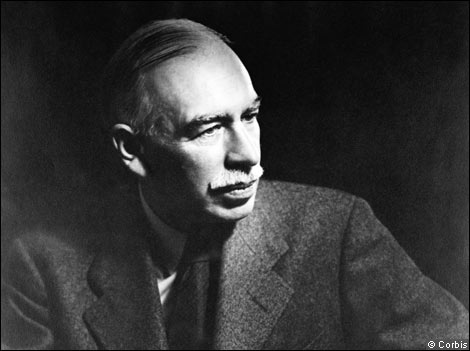
The Arch-Heretic of Twentieth Century Economics: John Maynard Keynes was one of those rare heretics whose ideas worked so well in practice that they became (for thirty extraordinary years) the new orthodoxy. His radical economic thinking inspired everyone from Adolf Hitler to Mickey Savage.

IS IT POSSIBLE to be both a politician and a heretic? With the times so out of joint it’s a question more and more voters around the world are asking. Observing the peculiar unanimity with which the international political class has responded to the global financial crisis, this voter scepticism appears entirely justified. In only a handful of countries (the most obvious being Greece) have politicians either voluntarily, or by the sheer force of public opinion, promoted policies unsanctioned by the global guardians of economic and political orthodoxy.

This was certainly not the case the last time the world was mired in economic catastrophe. One of the most intriguing historical aspects of the Great Depression of the 1930s is the willingness of contemporary political leaders to challenge the economic orthodoxy of their day.

On the Right, in Germany, Hitler tackled his country’s massive unemployment and stagnant industry by embarking on a programme of comprehensive rearmament – what later came to be known as “militarised Keynesianism”. On the Left, in the Soviet Union, Joseph Stalin’s “Five Year Plans” mobilised the entire population behind a crash programme of industrialisation. Somewhere between these two extremes, Franklin D. Roosevelt’s “New Deal” put hundreds-of-thousands of Americans to work on bold public infrastructure projects such as the Tennessee Valley Authority and the Grand Coulee Dam.

Spend, FDR, Spend! The Grand Coulee Dam became one of the enduring symbols of the New Deal's massive investment in US infrastructure. When everyone else is broke, the state is both practically and morally obliged to stimulate the economy out of trouble.

What made these programmes so unorthodox was the way they were paid for. Herr Doktor Hjalmar Schacht, Hitler’s Minister of Economics, deployed his infamous “Mefo Bills” to pump-up the German arms industry. This financial device was somewhat akin to our first Labour government’s use of “Reserve Bank credit” to fund its state housing programme – only bigger. FDR was similarly persuaded to pay for his public works schemes by sending the United States’ budget into the red. By contrast, Stalin’s economic success was based on the super-exploitation of his own unfortunate people – especially the unpaid labour of the millions of political prisoners his secret police had poured into the “gulags” (Soviet concentration camps).

While Stalin followed the brutal methods adopted by Western capitalists in the early stages of the industrial revolution, and then throughout the wretched territories of their sprawling colonial empires during the late-nineteenth and early-twentieth centuries (check out the history of the “Belgian” Congo for the most gruesome example of pre-Soviet super-exploitation) both Roosevelt and Hitler were inspired (either directly or indirectly) by the thinking of the greatest economic heretic of the twentieth century, John Maynard Keynes.

Defying his orthodox colleagues’ advocacy of austerity measures to bring their respective governments’ books into balance, Keynes argued that politicians must counter the “paradox of thrift” by borrowing and spending their way back to prosperity: “For Government borrowing of one kind or another is nature’s remedy, so to speak, for preventing business losses from being, in so severe a slump as the present one, so great as to bring production altogether to a standstill.” His 1933 book, The Means to Prosperity, was read with great enthusiasm by FDR’s “Brains Trust” of economic advisers. German economists read it too.

So effective were Keynes’ heretical ideas at relieving the misery of the Great Depression and financing the Allies’ victory in World War II that, by 1946, they had become the new economic orthodoxy. And, if the proof of his theoretical pudding was in the eating, then the extraordinary longevity of the post-war boom (1945-1975) provides ample evidence for the efficacy of Lord Keynes’ economic recipes. Indeed, one could argue that the concerted (and unfortunately successful) campaign by corporate capitalism’s intellectual apologists to convince the world that the classical economists’ 1930s critique of the Keynesian “heresy” was correct, lies at the root of all our present evils.

It is tempting to say that what the world needs is “another Keynes” to lead it out of its present economic woes. But that would be wrong and foolish. Keynes’ ideas are there on the bookshelves: just waiting for a politician with the will to use them. Our world’s predicament lies precisely in the fact that its self-serving and morally compromised political class is simply too gutless and too heartless to risk the accusation of heresy.

As Keynes himself observed, these peddlers of neo-classical orthodoxy “resemble Euclidean geometers in a non-Euclidean world who, discovering that in experience straight lines apparently parallel often meet, rebuke the lines for not keeping straight”.

This essay was originally published in The Otago Daily Times, The Waikato Times, The Taranaki Daily News, The Timaru Herald and The Greymouth Star of Friday, 15 June 2012.