Showing posts with label Social Inequality. Show all posts

Sunday, 23 October 2022

The Language Of Those With Nothing Left To Say.

Running Wild: Three of the more than 100 young people who trashed and burned a Wawa convenience store in Philadelphia, Pennsylvania, USA, earlier this year. This degree of lawlessness, akin to, but a whole order of magnitude greater than, our own ram-raids, is indicative of a society that has lost all respect for itself. Societies that respect themselves produce citizens who respect their fellow citizens – and their property .

WHILE NEW ZEALANDERS RECOIL in shock from a seemingly endless series of ram-raids, the news from overseas is worse.

According to the UK internet magazine, Spiked: “a few weeks ago, about 100 young people ransacked a Wawa convenience store in Philadelphia. The mob stole merchandise, knocked over shelves and threw food and drinks around, leaving the store looking like a natural disaster had hit it. Many got their phones out to record the madness. As chaos reigned, a young woman twerked on a counter. Fighting spilled out into the parking lot.”

This degree of lawlessness, akin to, but a whole order of magnitude greater than, our own ram-raids, is indicative of a society that has lost all respect for itself. Societies that respect themselves do not produce young people who pillage convenience stores or drive stolen cars into neighbourhood dairies. Societies that respect themselves produce citizens who respect one another.

Those who recall the rioting that accompanied the “Black Lives Matter” protests against the murder of George Floyd by a white police officer back in 2020, may also recall the number of times journalists and politicians repeated the words of Martin Luther King:

“Let me say as I’ve always said, and I will always continue to say, that riots are socially destructive and self-defeating. But in the final analysis, a riot is the language of the unheard.”

What happened in Philadelphia, however, was not the spilling-over of rage at the death of yet another African-American at the hands of the Police. White America heard the rage of the BLM protesters – and the rioters. What happened inside that Wawa store is what happens when White America hears the rage – and ignores it.

Comfortable New Zealand needs to ask itself whether the ram-raids it finds so disturbing are the product of something similar.

Prime Minister Ardern and her Labour colleagues promised action against poverty and homelessness. A government, supposedly driven by “the politics of kindness”, pledged itself to fulfilling a “transformational” programme of social and economic change. Except, the only transformation visible from the mean streets of South and West Auckland was the transition from bad to worse.

The Covid-19 pandemic was undoubtedly a factor in the deterioration of young and marginalised citizens’ life-worlds. For many the habits of schooling were simply lost. That so many of them remained lost, however, owes a great deal to the fact that so few people came looking for them. An education system that does not crack down hard on truancy sends out a terrible message. It is saying: “We don’t care.” Young people seldom need to be sent that message twice.

Comfortable New Zealand is learning the hard way that its alienated and unwanted young people have some “messages” of their own to deliver.

Earlier this week it was reported that, in the past five years, the number of gang members in New Zealand has doubled from 4,000 to 8,000, and that the recruitment of 18-25 year-olds is up by 75 percent. When the state’s official places of learning breathe a huge sigh of relief that their most disruptive students are no longer in the classroom, does that mean that those truants have given up on being taught? Or, are they simply learning different lessons, from different teachers?

And these lessons are dreadful – made all the more so for having about them the unmistakeable ring of truth. Money is everything. No one cares where it comes from. The Courts can’t cope. If you’re under 17 you won’t go to jail. The Police are powerless. The Law is a joke. Stealing is easy. Don’t worry about getting caught. Always remember who your friends are. Violence works.

Think of the ram-raid as a kind of grim performance art. Like the trashing of the Wawa convenience store in Philadelphia, it offers a terrifying, fun-fair reflection of the hyper-consumerist society we all inhabit. Because, if money and things truly are what define us, then why should our alienated and unwanted youngsters be content to remain undefined, simply for want of cash? If, as they strongly suspect, Comfortable New Zealand has given up on them, then why shouldn’t they make New Zealand uncomfortable?

If rioting is the language of the unheard, then ram-raiding and the trashing of convenience stores is the language of those who no longer believe in talking.


This essay was originally published in The Otago Daily Times and The Greymouth Evening Star of Friday, 21 October 2022.

Thursday, 16 September 2021

The Indiscreet Charmlessness Of Upper-Class Rule-Breakers.

Rules Are For Little People: Those who claim that all human-beings are equal have obviously never encountered a man on horseback when they are travelling on foot!

THE UPPER-CLASS ABSCONDERS from Auckland’s Level 4 Lockdown have done the rest of New Zealand a favour. They have exposed, in the most dramatic terms, the true extent of the social gulf separating the wealthiest New Zealanders from the poorest.

Just for a moment, the “average Kiwi” has been given a glimpse of how the upper-class lives. In this world of thoroughbred horses, bucolic rural estates, powers-that-be parents, and million-dollar holiday homes, the triumphs and tragedies of ordinary people simply do not register.

What has registered with ordinary people, however, is that the importance of following “The Rules” depends entirely on one’s position in the social hierarchy. Rule-following is crucial to the management of the wayward masses, but, for the people in whom the system reposes its greatest trust, playing by the rules is, clearly, optional.

I shall never forget the moment when my confidence in the notion that New Zealand was a country without great extremes of wealth was profoundly shaken. I was on my way north to Christchurch with some Dunedin friends, and we were passing through the North Otago countryside where I grew up. Quite how the subject of “Cosy Dell” came up, I can’t remember, but somehow I persuaded our driver to make a quick detour off Highway One so that we could all view this picturesque holiday spot perched on the banks of the Waianakarua River. When we got there, however, what I had prepared them to see bore no resemblance to the reality that awaited us.

You see, when I was a little lad, Cosy Dell had the sort of holiday homes familiar to all New Zealanders. Scattered amongst the native bush were the modest “cribs” (as South Islanders insist on calling baches) that families had built as more effective protection against the elements than canvass. Off the beaten track, land was purchasable by all but the most indigent souls. And the building codes? Well, they were as ramshackle as the holiday homes themselves. The first five decades of the twentieth century, in New Zealand, were freer and easier times. It was the quaint evidence of these far-off decades that I expected to see. What I actually saw was the 1980s.

Perched on the bush-covered hillsides of Cosy Dell were mansions masquerading as holiday homes. Architect-designed houses that would have graced the fanciest streets of Remuera, Khandallah, Fendalton and Māori Hill. And they were empty! Hundreds-of-thousands-of-dollars-worth of real estate just sitting there among the trees – unoccupied. Everyone in the car stared at these “cribs” open-mouthed.

Scarcely believing my eyes, I exited the vehicle and walked along the road, looking around despondently for the holiday homes of yesteryear. My friends joined me, taking in the rattle of the swift little river and the tinkling calls of bellbirds in the branches. Eventually, we spotted what was left of a genuine crib – looking like a tramp at the Ritz. Shaking our heads in disbelief, we got back in the car, and re-joined the highway to Christchurch.

That was when I first grasped what was happening to New Zealand. Even before the sweeping changes of Rogernomics, the gap between the rich and the poor was widening. I knew all about Wanaka and Lake Hayes, the places where Dunedin’s wealthiest citizens spend their summers. I’d heard the stories about swimming pools, private tennis courts and palatial retreats. But all that was no more than I expected. Elites discreetly showing off to members of their own class, in the places where their class went to show off. That sort of conspicuous consumption was as old as Pompeii. But Cosy Dell! Who the hell had enough money to build a mansion in Cosy Dell? Who was going to see it?

I suppose I should have been grateful that the upper-class still felt it advisable to exercise discretion when it came to displaying their wealth. It was only out of the purest nostalgia that I had returned to Cosy Dell. That this tiny, virtually unheard of, holiday resort had, in the 16 years I had been away, become a place of astonishing opulence, took me completely by surprise . Most travellers drove straight past the turn-off without a second glance, blissfully unaware of its existence.

That was all about to change, of course. All that upper-class discretion, which hid the family pile behind high walls and mature trees. After 1984, it lasted about as long as an asset-rich private company in the sights of Brierley Investments. By the late-1980s the cry of the nouveau riche was: “If you’ve got it, flaunt it! Fuck the poor!”

And they did – royally.

And they still are, it seems, and not just the poor, but the middle-classes as well! Indeed, it’s hard to know who was more pissed-off with the Auckland Absconders – the very poor or the moderately well-off? Historically, at least, it is the furious ambivalence of the middle-classes which those at the very top of the social pyramid should fear the most. The petit-bourgeoisie believes in nothing so much as following the rules, so it is dangerous in the extreme for the upper-class to laugh at their self-righteous obedience. Even more dangerous, however, is setting up a situation in which the story of Anacharsis and his web strikes a raw nerve.

The Web of Anacharsis? Why, I thought you’d never ask!

“Your laws are like cobwebs,” declared the Scythian prince, Anacharsis, to the celebrated Athenian lawgiver, Solon, more than two-and-a-half millennia ago: “for if any trifling or powerless thing falls into them, they hold it fast, but if a thing of any size falls into them it breaks the mesh and escapes.”

Or should that be “absconds”?


This essay was originally posted on The Daily Blog of Thursday, 16 September 2021.

Saturday, 16 April 2016

The New Black Is Blue: National’s Grip On The Electorate Remains A Strong As Ever.

The Winner: Like Dorian Gray’s, National’s sins have left not the slightest blemish upon its public face. No doubt, in some upper room, safe from prying eyes, a cursed canvass portrays it’s true hideousness. So long as it stays there, securely hidden, National’s supporters simply do not care.
 
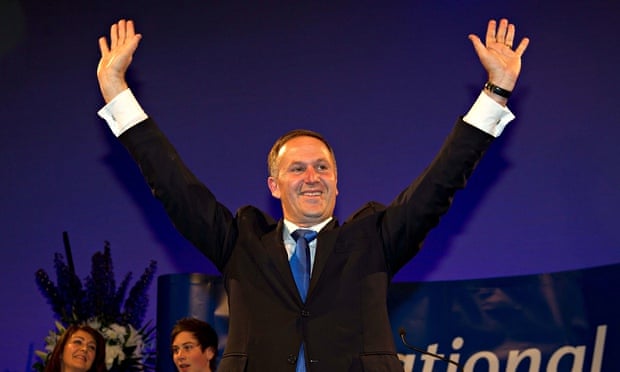
THE NATIONAL GOVERNMENT’S unprecedented run in the polls rolls on. Eight years in office and still the level of support for John Key’s ministry in the New Zealand electorate continues to fluctuate between an unassailable 45 and 55 percent.
 
These would be outstanding numbers even under the old First-Past-The-Post electoral regime. Under a proportional, multi-party system they are extraordinary. In fact, given all the things Key and his colleagues have done, or failed to do, they should be impossible.
 
And yet, like Dorian Gray’s, National’s sins have left not the slightest blemish upon its public face. No doubt, in some upper room, safe from prying eyes, a cursed canvass portrays its true hideousness. So long as it stays there, securely hidden, National’s supporters simply do not care.
 
This state of not caring – evinced by close to half the population – is something new and disturbing in New Zealand politics. It speaks of hardened attitudes and even harder hearts; of an electoral bloc that has simply shut its eyes and ears to the plight of less fortunate and hard-pressed citizens. That they have remained faithful to the Key Government for eight years is because in all sorts of subtle and not-so-subtle ways it has told them that they are right not to care. Not caring is the new black: National’s new blue.
 
It’s important to grasp the fact that this ingrained lack of compassion is in no way reflective of simple bigotry or ignorance. The new National supporter is not the sort of know-nothing backwoodsman from the provinces who hated queers and backed Springbok Tours. Confronted by the Left for their apparent lack of compassion, these new National supporters will round on their accusers and charge them with constructing a soft and dependent society critically lacking in grit and resilience. Their refusal to mollycoddle the poor and work-shy may look like cruelty, they will say, but in the long term it will be revealed for what it is – the most socially productive manifestation of true kindness.
 
That this hard-nosed approach entrenches inequality and widens the social divide is fine by them. People have always needed incentives. Big sticks for the poor. Juicy carrots for the rich. “You don’t make a poor man rich”, they insist, “by making a rich man poor.” A healthy society is one in which the poor person’s burning desire to escape his or her poverty is only equalled by the well-off person’s fear of falling into it. Those who make it into the winners’ circle need to know how hard it is to get there – and stay there.
 
This is the gospel according to John Key’s new National Party, and its capacity to attract and hold close to half the electorate is unprecedented. The professional middle-class, hitherto susceptible to the Left’s appeals for them to join it in the struggle for equality and social justice, must now be counted among the new National Party gospel’s most enthusiastic converts. The better angels to which Labour once appealed have long since been made redundant and let go.
 
Those poll numbers ain’t going to change anytime soon.
 
This essay was originally posted on The Daily Blog of Saturday, 16 April 2016.

Friday, 8 April 2016

"Different From You And Me": Some Thoughts On The Panama Papers.

Sinking In A Sea Of Scandal: If the world has been left open-mouthed by the Panama Papers, it is largely on account of the sudden transition of fiction to fact. No matter how painstakingly John Le Carré or John Grisham construct their plots; no matter how realistically they draw their characters; their readers have, until now, been able to console themselves with the thought that, in the end, it’s only a story. Well, not anymore!
 
THEY’RE CALLING THEM “The Panama Papers”. A vast haul of electronic documents, said to be several orders of magnitude bigger than the infamous Wikileaks “dump” of 2010, which is leaving the world open-mouthed. Stolen from the secretive Panamanian-based law firm, Mossack Fonseca, the Panama Papers have exposed the dodgy financial dealings of the global elites for all to see. Or, at least, read about.
 
But how shocked are we, really? For decades now, novelists and screenwriters have been entertaining us with dark tales of criminal law firms and offshore tax havens. We’ve been told, in detail, how arms dealers and drug traffickers launder their ill-gotten gains through the international financial system. We know all about front organisations, dummy companies and blind trusts. In the world of fiction, none of this is new.
 
This coming Sunday, for example, tens-of-thousands of New Zealanders will watch the final episode of the BBC’s superb thriller, The Night Manager, hoping against hope that the devilish arms dealer, Richard Roper (played to perfection by Hugh Laurie) will get what’s coming to him.
 
But, we will not be surprised (because John Le Carré has taught us not to be) if the villain somehow manages to slip through the hero’s fingers. Happy endings aren’t what they used to be. If the global financial crisis proved that some banks are “too big to fail”, is it really that big a stretch to believe that some people are too big to catch? And, if we’re honest, don’t we find the unrepentant arrogance of the 1 Percenters just a teeny bit thrilling?
 
If the world has been left open-mouthed by the Panama Papers, isn’t it more likely on account of the sudden transition of fiction to fact? No matter how painstakingly Le Carré or John Grisham construct their plots; no matter how realistically they draw their characters; their readers have, until now, been able to console themselves with the thought that, in the end, it’s only a story. They think about the hum-drum nature of their own lives, and, reluctantly file the whole the notion of swashbuckling villainy, enacted on a global scale, under “I” – for implausible.
 
Well, not anymore!
 
It was F. Scott Fitzgerald who wrote: “Let me tell you about the very rich. They are different from you and me.”
 
It’s not something those of us who are not very rich care to admit, but the Panama Papers prove beyond all reasonable doubt that Fitzgerald was right. The very rich are very different from us.
 
It’s not that they’re immoral, more that they are absolutely certain that the morality that constrains the rest of humanity simply doesn’t apply to them. As Fitzgerald put it: “They think, deep in their hearts, that they are better than we are because we had to discover the compensations and refuges of life for ourselves. Even when they enter deep into our world or sink below us, they still think that they are better than we are.”
 
That’s why they need law firms like Mossack Fonseca: to hide their dealings from the eyes of all those silly people who subscribe to the utterly ridiculous notion that we are all equal. People like that, ordinary people, just don’t understand – will never understand – the needs of the very rich.
 
Not that the very rich think about ordinary people very often – why would they? What does get their attention, however, is the frightening news that ordinary people are thinking about them. Nothing turns a genial Bertie Wooster into a ferocious Richard Roper faster than the unwarranted scrutiny of the lower orders. Popular envy the very rich can tolerate, even enjoy: but popular interference; that is another matter altogether.
 
John Key’s reaction to the global release of the Panama Papers has been interesting. Where the Opposition parties have greeted the news that their country’s less-than-robust tax laws are being exploited by the likes of Mossack Fonseca with demands for official inquiries and swift legislative action, New Zealand’s Prime Minister has evinced a lofty nonchalance.
 
There were many, perfectly legitimate, reasons that a foreign investor might set up in New Zealand, Mr Key told journalists. It was quite wrong, he insisted, to call his country a “tax haven”.
 
A very different response from the one people like you and me might expect. But, then, Mr Key is very rich.
 
This essay was originally published in The Waikato Times, The Taranaki Daily News, The Timaru Herald, The Otago Daily Times and The Greymouth Star of Friday, 8 April 2016.

Thursday, 7 April 2016

Shrugging-Off The Panama Papers.

"... What? ...": John Key, when asked which secret trusts were being used for tax dodging, hiding stolen assets and/or laundering money, responded with a nonchalant shrug of his shoulders.
 
THE PANAMA PAPERS have elicited a remarkably low key response from the Prime Minister. The Labour Leader, Andrew Little, has described how John Key, when asked which secret trusts were being used for tax dodging, hiding stolen assets and/or laundering money, responded with a nonchalant shrug of his shoulders. The day before, when challenged about the potential damage to New Zealand’s reputation – now that we’ve been fingered as a simply dandy spot for masking the millions of Mossack Fonseca’s clients – John Key told journalists that there were many, perfectly legitimate, reasons why a foreign investor might park his money in New Zealand, adding that it was quite wrong to call his country a “tax haven”.
 
Key’s “ … what? …” reaction to the colossal data leak which has already claimed the scalp of one prime minister and put the careers of many other world leaders at risk is rather perplexing. Is he not able to predict the impact the Panama Papers are bound to have on the privileged privacy of the global elites? How the 11 million-plus documents are going to be used to prise open the lid of one of the biggest cans of plutocratic worms the world has ever seen. Why doesn’t he get it?
 
There are 55 million answers to that question. For a long time now John Key’s fortune has dulled his otherwise acute political judgement. Six years ago, in May 2010, Key’s government came under heavy criticism for tax cuts conferring huge windfalls of cash upon the wealthiest New Zealanders. Not yet two years into the job, he struggled to grasp the motivation for his critics’ outrage.
 
“We can be envious about these things”, purred the Prime Minister, “but without those people in our economy all the rest of us will either have less people paying tax or fundamentally less services that they provide.”
 
Seldom has so much of the mythology of the very rich been packed into a single sentence.
 
First comes the notion that his fellow citizens’ reaction to his government’s massive transfer of wealth from the poorest to the wealthiest members of their society is motivated not by their keen sense of its manifest injustice, but by simple, old-fashioned envy.
 
Then comes the argument that without such regular transfusions of cold hard cash, the very rich will simply up-stakes and leave for a more congenial jurisdiction. Somewhere that makes them feel welcome – not like lepers.
 
Finally, Key goes for the clincher. The notion that it is the energy and drive, the wisdom and skill, and the hard-earned cash of wealthy entrepreneurs that provides the rest of us “parasites” with the goods and services that we are simply too stupid and/or lazy to provide for ourselves.
 
Ayn Rand couldn’t have put it better.
 
In the light of this earlier demonstration of Key’s deep belief in the superiority of the very rich; and in the very different measures that must be taken of their needs and deeds; should we really be surprised when he struggles to understand exactly what the persons exposed by the Panama Papers have done wrong?
 
If you believed as strongly as John Key does that the very rich are better than you and me; and subject to a very different set of rules; then you would probably shrug-off the Panama Papers too.
 
This essay was originally posted on The Daily Blog of Thursday, 7 April 2016.