
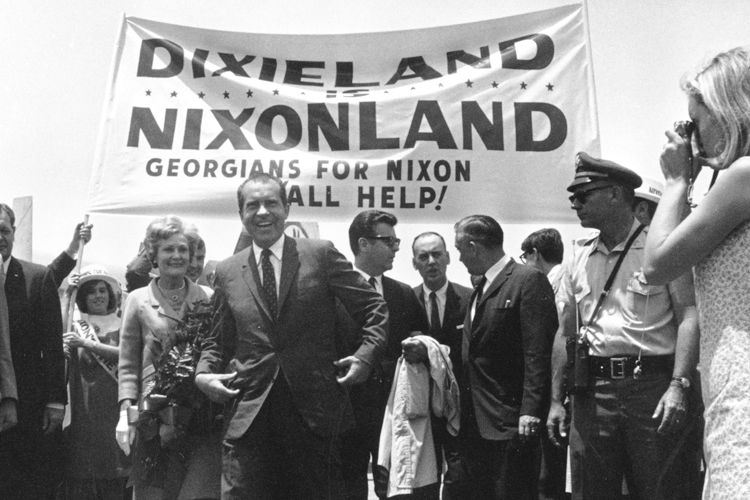
Nixon's Southern Strategy: Persuading White, former Democratic Party voters to change sides and vote Republican in 1972 proved a relatively easy sell for President Richard Nixon in Southern US states forced to grant Black Americans their civil rights in the 1960s. In the mid-1970s, New Zealand's Rob Muldoon made an equally successful pitch for Labour voters alienated by what they saw as their party's capitulation to social liberalism. Wooing, winning and keeping this chunk of the electorate has also played a critical part in John Key's long-term political success.
IT WAS FORTY YEARS AGO on Saturday, 12 December, that Robert
Muldoon was sworn in as New Zealand’s thirty-first prime minister. His
extraordinary success in the 1975 General Election – where he turned a 23-seat
deficit into a 23-seat majority for the National Party – signalled the arrival
of something new and highly disruptive in New Zealand politics. Since 1975,
cultivating the support of a particular (but not especially progressive) type
of Labour voter has proved crucial to the electoral success of both major
parties.
Like so many of the other influences that have shaped New
Zealand society over the past 40 years, Muldoon’s political strategy and
tactics were borrowed from the United States.
The US Democratic Party’s support for black civil rights in the
1960s dislodged millions of hitherto rock-solid white voters in the southern
states of the USA. The Republican Party (the party of Abraham Lincoln!) lost
little time refashioning itself as the new political home for Dixie’s aggrieved
white supremacists. By 1972, these blue-collared “good ole boys” had been drawn
alongside the Republican Party’s traditional conservative base in what
President Richard Nixon called “the great silent majority” – which noisily
swept him back into the White House on a landslide.
The not unnatural assumption of the right-wing political
strategists who had engineered this stunning desertion of formerly “left-wing”
voters to the conservative cause, was that, on economic matters, conservative
leaders would need to tread very carefully.
Nowhere was this determination to preserve the economic
under-pinnings of the welfare state more in evidence than under the National
Government of Rob Muldoon. If Labour’s social liberalism – as evidenced by its
deeply unpopular cancellation of the 1973 Springbok Tour – had caused an
electorally crucial number of socially conservative blue-collar workers to
throw in their lot with “Rob’s Mob”, then, surely, it would be the purest folly
to give in to the “New Right’s” demands to curb the unions, free-up the markets
and dismantle the welfare state?
But Muldoon’s combination of highly divisive social
conservatism and aggressive state interventionism (Springbok Tours and
Wage & Price Controls!) was much too volatile a political mixture to be more
than a stop-gap solution to the deep structural problems confronting post-war
capitalism.
The New Right’s strategists were, accordingly, willing to
gamble that a full-scale assault on the key elements of the social-democratic
post-war economy (unions, nationalised industries and welfare) would so shatter
the political coherence of the Left that the victims of their assault –
especially poorly-educated white males – would remain susceptible to an
aggressively pitched, socially conservative, agenda.
This was certainly the political wager of Margaret Thatcher
and Ronald Reagan, whose domestic assaults on the post-war social-democratic
consensus, coupled with a ruinously expensive upping of the Cold War ante,
broke the Left comprehensively, both at home and in its nominal heartland – the
Soviet Empire. They were blows from which the Left has yet to recover. The
destruction was made even more complete in New Zealand by the Right’s
successful subversion of the parliamentary wing of the NZ Labour Party.
The introduction of Neoliberalism to New Zealand by Labour,
while enormously dislocating in economic and social terms, did mean that it was
social-liberalism, rather than social-conservatism, that set the political tone
throughout the 1990s and into the Twenty-First Century. This is especially true
of Maori-Pakeha relations and immigration policies across that period. In both
contexts, liberal policy settings have facilitated a number of profound
societal shifts and apparently irrevocable changes.
Certainly, when Dr Don Brash attempted to harness a mass
political following to an indisputably radical revision of race relations in
New Zealand, he was unable to duplicate the success of Rob Muldoon in 1975. His
in/famous “Orewa Speech” on nationhood was, however, to prove astonishingly
successful in uniting virtually the entire right-wing vote behind the National
Party. To the point where only a very small shift in the allegiances of Labour
voters would be sufficient to usher a National-led Government into office.
In the eighth year of John Key’s National-led Government,
his success in wooing back those National Party voters who had defected to
Labour under the “competent” governance of Helen Clark, as well as holding on
to those Labour defectors, for whom Clark’s progressive policy agenda –
especially during her third term – had become insupportable, is without
historical precedent.
Key may not remember which side he was on during the
Springbok Tour, but he knows better than to engage in such divisive political
behaviour. Nor is his political survival predicated (as Muldoon’s was) on
making such ideologically aggressive gestures. Labour’s defectors are nothing
like the angry white males to whom Donald Trump is currently appealing in the
United States. Key’s winning strategy has been to convince the a-little-bit
racist, a-little-bit sexist, a-little-bit homophobic “Waitakere Man” that, on
his watch, nothing will be done to make him change sides.
This essay was
originally published in The Press of Tuesday,
15 December 2015.
