Showing posts with label Richard Nixon. Show all posts

Friday, 13 November 2020

A Very American Coup?

Deconstructing American Democracy: The joy manifested on American streets over the weekend, as the news of Joe Biden’s victory spread, may soon be transformed into incandescent rage. Worse, any mass protest action in support of President-Elect Biden will, almost certainly, be answered by the mobilisation of President Trump’s own supporters – many of whom will arrive on the streets heavily armed. Widespread civil disorder and loss of life is likely to follow.

IT IS MY earnest hope that by the time you read this column, its speculations have been refuted by the facts. If they have not, then we are on the threshold of a very dark period of American history.

Let us begin with an important historical precedent.

In the summer of 1974, the US Secretary of Defence, James Schlesinger, made it very clear to the Joint Chiefs of Staff of the American armed forces that any order from the Commander-in-Chief, President Richard Nixon, to deploy US troops on the streets of the nation’s capital should not be obeyed unless countersigned by himself.

Nixon’s Cabinet had become so alarmed by the behaviour of the President, that Schlesinger’s extraordinary intervention was understood to be both prudent and responsible.

Fast-forward 46 years to 2020. The President of the United States, Donald Trump, defeated in the General Election by his Democratic Party opponent, Joe Biden, is steadfastly refusing to acknowledge his loss. Worse, the President is claiming that the election has been stolen from him by means of wholesale electoral fraud. Accordingly, Republican Party lawyers have begun filing lawsuits in the crucial battleground state of Pennsylvania. Their purpose? To prevent the certification of voting tallies from traditionally “Democratic” counties.

It can only be assumed that the political effect of such a blatant attempt to thwart the will of the American electorate will be inflammatory. The joy manifested on American streets over the weekend, as the news of Biden’s victory spread, will, in an instant, be transformed into incandescent rage. Worse, mass protest action in support of President-Elect Biden will, almost certainly, be answered by the mobilisation of President Trump’s own supporters – many of whom will arrive on the streets heavily armed. Widespread civil disorder and loss of life is bound to follow.

If the President’s behaviour during the Black Lives Matter protests is any guide, Trump will seek to quell such widespread violence and disorder by ordering the US armed forces onto the nation’s streets.

Until Tuesday morning (NZ Time) the only institutional obstacle to such a course of action being followed was Trump’s Secretary of Defence, Mark Esper. Secretary Esper had reacted with dismay to the deployment of federal law enforcement personnel – including military police – to drive protesters from Lafayette Park so that the President could walk the few hundred metres separating the White House from St John’s Episcopal Church in safety. On Tuesday morning, however, the President removed that obstacle by sacking Secretary Esper and replacing him with the Director of the National Counter-Terrorism Centre, Christopher Miller.

By Tuesday afternoon, rumours were sweeping Washington that Esper’s dismissal was about to be followed by the sacking of FBI Director, Christopher Wray, and CIA Director, Gina Haspel.

At the time of writing, both of these key law enforcement and national security officials still held their jobs. If, however, they have been sacked and replaced by Trump loyalists, then, by the time you read these words, the President of the United States will have effectively decapitated what his most fanatical supporters – the followers of the mysterious “QAnon” – call the “Deep State”.

In the eyes of these deluded Americans, their President will have struck a blow for freedom and decency, and they will be looking forward eagerly to his next move: the arrest of senior members of the Democratic Party – including, no doubt, President-Elect Biden and Vice-President-Elect Kamala Harris. If this is what transpires, then the method in the madness of the QAnon conspiracy theory will, finally, be revealed.

To those watching in Moscow and Beijing, Paris and Berlin, Canberra and Wellington, however, the nature of the events unfolding in the United States will be understood very differently. Vladimir Putin, Xi Jinping, Emanuel Macron, Angela Merkel, Scott Morrison and Jacinda Ardern will know exactly what they are looking at: a steadily unfolding coup d’état – its every step retrospectively justified and validated by a lame-duck Republican President and a lame-duck Republican Senate.

If this is the way events have unfolded since Tuesday afternoon, then only one force in American society possesses the strength to defend the US Constitution and uphold American democracy: the armed forces of the United States.

This time, however, they will not be able to rely upon the Secretary of Defence to make the necessary intervention. This time they’ll have to do it themselves. 


This essay was originally published in The Otago Daily Times and The Greymouth Star of Friday, 13 November 2020.

Tuesday, 10 November 2020

Revolution Postponed.

Crisis Averted - Again: In a funny/sad sort of way it’s a pity that Joe Biden won. Once again, Americans will convince themselves that the system, the Constitution, has worked exactly as it should. Yes, that same Constitution did allow a man like Donald Trump to wield full executive power for four years. But, it also gave the American people the opportunity to correct their mistake – which they have just done. So, crisis averted. Time for everyone to stand back and stand down. Sleepy Joe and Kamala have got this. (Are you listening Bernie? Do you hear what we’re saying, AOC?)

THE THIRD AMERICAN REVOLUTION has been postponed, but it has not been cancelled. With the American news media (Fox News included!) calling the Presidential Election for Joe Biden, that part of America which still believes in American democracy is allowing itself “a brief period of rejoicing”.

The followers of Donald Trump, sullen and watchful, have yet to accept the judgement of those powerful social forces for whom the news media speaks. With every day that passes without a clear call-to-arms against the fast-consolidating Biden ascendancy, however, the Red Hats’ stomach for a full-scale uprising will diminish. In the words of Shakespeare’s Macbeth: “If it were done when ‘tis done, then ‘twere well it were done quickly”. For Trump, and Trumpism, delay means death.

That a crushing coup d’état was not unleashed the moment the trend toward a Biden victory became clear bears testimony to Trump’s signature lack of organisational talent. While indisputably the master of improvisational political theatre, the President has never demonstrated the slightest ability to stick to a script – let alone write one! The slow and careful accumulation of the human and material resources necessary to seize the American state has proved, thankfully, well beyond Trump’s capacity. Hence his personal tragedy’s rapid descent into farce – as illustrated to perfection in the Veep-like absurdity of the “Four Seasons” press conference!

Were Trump and his rapidly shrinking band of courtiers to issue orders to the United States Military, demanding the forcible impoundment of the ballots in Pennsylvania, Arizona and Georgia, it is now highly unlikely that they would be followed. Nor can Trump rely upon the Supreme Court to pull his electoral irons out of the fire. The nine justices may not see eye-to-eye on many things, but it’s a safe bet that any request to nullify the largest tally of presidential votes in American history would be met with a polite – and unanimous – refusal.

Possession, they say, is nine-tenths of the law; and right now Biden has what Trump most wants: public acceptance of the “facts on the ground”. Confirmation that he will be the next President of the United States.

Where does this leave the Third American Revolution? The answer, sadly, is stalled. What should have happened in the 1970s; what could have happened in 2009 as Capitalism threatened to expire in the death-grip of the Global Financial Crisis; looks certain to be put off again. Why? Because, once again, just as the American system seemed on the very brink of political catastrophe, it rescued itself.

Think about the last time a malignant, mentally-ill President was holed-up in the White House, asking himself if he dared to strike down American democracy. Richard Nixon, in 1974, was considered so unstable that his Secretary of Defence, James R. Schlesinger, distributed a secret memo to the commanders of the military bases around Washington DC, advising them not to respond to any Presidential order to deploy troops onto the streets of the capital unless it was counter-signed by himself. It turned out to be unnecessary. The US system, the US Constitution, ended up working in precisely the way it was supposed to work. The crisis was averted. The overwhelming majority of Americans stood back and stood down.

But, not all Americans. The effective deposition of a sitting President, by putting the rights contained in the First Amendment to the US constitution to effective use, was the last straw for the most reactionary elements of the American ruling-class. Democracy was out of control. The rapid post-war expansion of the “Middle Class” had raised expectations beyond the capitalist system’s capacity to satisfy them. Organised labour was out of control. Blacks, women, minorities of all descriptions, were demanding their place in the sun. The Third American Revolution: the revolution in which the republican institutions arising out of the First American Revolution (1776-1783) and the efforts of the Second American Revolution, usually referred to as the Civil War (1861-1865), to infuse those institutions with genuine liberty, equality and democracy will finally be vindicated and transformed in a radical re-imagining of American freedom – it simply had to be stopped.

In their essence, this is what the four decades since Watergate have been about: delaying the Third American Revolution. Using this insight as a key, it is relatively easy to unlock the recent history of the Republican Party. It’s increasingly strident efforts to drive back the gains of African-Americans in the 1960s; its cynical alliance with the open misogyny and homophobia of fundamentalist Christianity; its packing of the US judiciary with reactionary judges; its deliberate debasement of US political culture and discourse: all of it has been about putting off the evil day when the full revolutionary potential of American democracy manifests itself.

And the Democratic Party? It’s history, over the past four decades, has been all about convincing both itself, and the American people, that it is not the political vehicle for bringing the Third American Revolution into being – even though anyone who pays the slightest attention to the sort of Americans who are voting for the Democratic Party knows that it must be.

Which is why, in a funny/sad sort of way it’s a pity that Biden won. Once again, Americans will convince themselves that the system, the Constitution, has worked exactly as it should. Yes, that same Constitution did allow a man like Donald Trump to wield full executive power for four years. But, it also gave the American people the opportunity to correct their mistake – which they have just done. So, crisis averted. Time for everyone to stand back and stand down. Sleepy Joe and Kamala have got this. (Are you listening Bernie? Do you hear what we’re saying, AOC?)

Except that the most reactionary elements of the American ruling-class can no more afford to stand back and stand down in 2020 than they could in 1974. Forty years on, they have so much more to lose. In 1972, when Richard Nixon won his second term in a landslide of historic proportions, the top 1 percent of Americans controlled roughly 10 percent of their country’s wealth. After 40 years of more-or-less constant counter-revolutionary success that share has grown to nearly 30 percent!

Their shield and their sword, the Republican Party, is not about to help Biden “heal America’s soul”. On the contrary, it’s going to do everything it can to exacerbate the differences within the Democratic Party and, by doing so, break-up the fragile social unity created by Trump’s anarchic improv theatre.

Deep down, the forces of reaction will be glad to see him go. The Republican president they will need to keep the Third American Revolution at bay for another 40 years must be made of much sterner stuff.


This essay was originally posted on The Daily Blog of Tuesday, 10 November 2020.

Friday, 19 October 2018

Jami-Lee Ross Lets It All Hang Out. Simon Bridges Stonewalls.

Making Him Deny It: Dramatic allegations, of the sort leveled against Simon Bridges by Jamie Lee Ross, are intended to force the targeted person onto the defensive. Requiring one’s opponents to deny the accusations leveled against them, all-too-often produces the paradoxical effect of rendering those accusations more – not less – believable.

PRESIDENT RICHARD NIXON, on 17 November 1973, declared to a gathering of newspaper editors: “I welcome this kind of examination, because people have got to know whether or not their president is a crook. Well, I am not a crook.” This infelicitous sentence would, of course, come back to haunt Nixon as the Watergate scandal that brought down his presidency ground remorselessly on.

Hearing Simon Bridges solemnly reassure the Parliamentary Press Gallery: “I have done nothing wrong”, couldn’t help but remind me of Nixon’s exculpatory performance. Not, I hasten to add, because I believe the Leader of the Opposition to be guilty of the charges leveled against him by his former colleague, Jami-Lee Ross, but because it’s in the nature of such allegations to force the targeted person onto the defensive. Requiring one’s opponents to deny the accusations leveled against them, all-too-often produces the paradoxical effect of rendering those accusations more – not less – believable.

In terms of political theatre, the initial performances of Jami-Lee Ross and Simon Bridges offered some telling contrasts.

As befitted a man with very little left to lose, Ross spoke clearly and compellingly and answered the assembled journalists’ questions with impressive composure and a minimum of prevarication. To borrow once again from the Watergate lexicon, he opted for the “let it all hang-out” approach – openly divulging information which, in the normal course of political events, is kept under wraps.

Bridges’ performance was nowhere near as open, or impressive, as Ross’. Over and over again he declared his former colleague’s accusations to be “baseless”. Over and over again, he referred to Ross as a “liar”, a “leaker” and a “lone wolf” guilty of “appalling behaviour”. What he refused to do, however, was respond in detail to the charges of corrupt electoral practice and political blackmail which Ross had leveled against him.

During Watergate, a refusal to respond expansively to journalists’ direct questions was termed “stonewalling”. It is not a good look. I was disappointed that the Leader of the Opposition did not opt to match Ross’ earlier demonstration of candour. Laying to rest “baseless” charges surely requires nothing more than a frank description of what happened and why. In the United Kingdom, persons charged with an offense are cautioned that “it may harm your defence if you do not mention when questioned something you later rely on in court.” These are wise words, which politicians facing judgement in the Court of Public Opinion would do well to remember.

What remains to be seen is whether or not Simon Bridges and his caucus will be able to “draw a line under Jami-Lee Ross” and “move on”. I suspect the future of the National Party and its leader will turn upon the quality of the “evidence” (a recorded telephone conversation) which Ross promised on Tuesday to place in the hands of the Police. Much, too, will hinge on whether Ross’ allegation that he was threatened with false accusations of sexual harassment (a threat which, he claims, caused him to experience a mental breakdown) can be verified.

If fire is detected among all this smoke, then National faces a grim future. Having voted unanimously to expel Ross from their caucus, National’s 55 remaining MPs have voluntarily roped themselves to their precariously positioned leader. If he falls, they are all at grave risk of falling with him.

Reverting, once again, to the language of Watergate: if Ross is in possession of a “smoking gun” capable of bringing down Bridges; and if his caucus refuses to cut through the rope binding them to his fate; then the possibility opens up for Ross to run for re-election in Botany not as an independent (his current intention) but as the harbinger of a new and uncorrupted conservative movement.

Paradoxically, such an eventuality might ultimately rebound to the National Party’s electoral advantage. A new conservative party, located to National’s right on the political spectrum, would be ideally positioned to supply New Zealand’s dominant right-wing party with what it so sorely lacks at the present moment: a natural coalition partner.

The problem, to date, has been how to set up such a party without the voters dismissing it as a mere National Party contrivance. Well, problem solved. Whatever else may be said about the enmity between Bridges and Ross – it certainly isn’t contrived.

This essay was originally published in The Otago Daily Times and The Greymouth Star of Friday, 19 October 2018.

Saturday, 16 June 2018

The Symptom … And The Cure?

The Art Of The Deal: “[T]he old prejudices and practices worked as obstacles, but we have overcome them and we are here today.” North Korea's Kim Jong Un responds to President Donald Trump's introductory remarks at their historic summit-meeting in Singapore on Tuesday, 12 June 2018.

THE NOTE OF SURPRISE in the voices of the talking heads on CNN was unmistakable. How could this be happening? How could these two men – both of them routinely ridiculed by those claiming expertise in international relations – have gotten even this far? The leaders of USA and the Democratic People’s Republic of Korea, meeting in Singapore on Tuesday, 12 June 2018 and exchanging warm handshakes across the table. The eccentrically-coiffed and generously-fleshed scion of the redoubtable Kim dynasty, Kim Jong Un, offering up to the world the amazing soundbite:  “the old prejudices and practices worked as obstacles, but we have overcome them and we are here today”. How was any of this possible?

One might as well ask – how was the 1972 meeting between Mao Zedong and President Richard Nixon possible? American GIs and the Chinese People’s Liberation Army had been in a shooting war barely 20 years before that historic summit in Beijing. For quarter-of-a-century the US Pacific Fleet had shielded the Nationalist regime on Taiwan from the People’s Republic’s wrath. And yet, it happened.

In Oliver Stone’s movie “Nixon” there is a memorable scene in which Chairman Mao, through his interpreter, asks Nixon: “Is peace all you are interested in? The real war is in us. History is a symptom of our disease.” The dialogue is, of course, the work of the film’s screenwriters: Stephen J. Rivelle, Christopher Wilkinson and Stone himself; but it succinctly captures an essential truth about such extraordinary political figures as Mao Zedong, Kim Jong Un, Richard Nixon and Donald Trump.

Some political leaders are content to be guided by their advisers – like George “Dubbya” Bush. For others, it is the events in which they are caught up that provide the opportunities for extraordinary displays of leadership. Think Winston Churchill in World War II, or, Lyndon Johnson and the struggle for Black civil rights 1964-65.

Then there are the leaders who, for a whole host of reasons, become the authors of events to which all these other, lesser, statesmen must respond. Grandiloquent and narcissistic, often paranoid, they are prey to deep existential fears and driven by inner-demons of unrelenting ferocity. This kind of leader has the power to project the turmoil and tumult of their own psyches onto the world around them. The ability to, in Stone’s memorable formulation, make History a symptom of their disease.

The rest of humanity has every reason to fear such individuals. Who in their right mind would cast themselves as a plaything in someone else’s paranoid fantasy? Democracies, in particular, should reject such individuals, in whose character there is much more of the emperor and dictator than there is the citizens’ humble representative.

Except, of course, History has a way of infecting individuals with the diseases whose morbid symptoms they will subsequently cause it to display. A nation rent by anxieties and resentments can hardly avoid throwing up the exceptional individual in whom those anxieties and resentments have not only been distilled to an uncommon purity, but who is also able to express them with extraordinary clarity and force.

Democracies in decay are particularly vulnerable to such individuals. The causes of a nation’s inner corruption, when given individual political expression, become accentuated and the process of decomposition is speeded-up. A malign feedback loop emerges by which the neuroses of the nation are both fed by – and feed – the person it has made its own. Be it Julius Caesar, Adolf Hitler or Donald Trump, the people’s “drummer” renders a double service: he is both the person who beats – and the person who is beaten.

Is it really so unbelievable, then, that the America which has grown so deeply resentful and untrusting of its political elites should be willing-on the President who has so openly defied them? That the more the experts deplore Trump’s ignorance and denounce his unwillingness to be guided, the more his supporters thrill to his insouciance.

“It’s about attitude. It’s about willingness to get things done”, declared the President, who went on to claim that he would know within the first minute of their meeting whether Kim Jong Un was serious about reaching a deal. When asked how, he replied simply: “My touch, my feel – that’s what I do.”

Encountering this phenomenon, it is hardly surprising that Kim, a genuine emperor, could believe that all the old prejudices, practices and obstacles might – just – be overcome.

This essay was originally published in The Otago Daily Times and The Greymouth Star of Friday, 15 June 2018.

Thursday, 23 February 2017

Deep State. Big Trouble.

Dark Days: The unmistakeable, if unacknowledged, shifting of pieces on the American political chessboard: strategic leaking of intercepted electronic communications; mass media revelations of politically compromising information; all points to the intervention of the same Deep State that brought down Richard Nixon.
 
THE NUMBER OF REFERENCES to “The Deep State” has shot up since Donald Trump became President of the United States. A term previously confined to academic discussions of Turkish politics is beginning to appear in mainstream news stories all over the world.
 
Driving the “Deep State” reference spike to ever-higher levels has been the obvious collusion of US intelligence agencies and key media outlets in the ouster of Michael Flynn, President Trump’s National Security Adviser.
 
So, what is The Deep State? And do New Zealanders have any reason to worry that their own state may not be as shallow as it appears?
 
Turkey is still the best place to start this discussion.
 
The secular republic created by General Mustapha Kemal out of the wreckage of the Ottoman Empire in the years immediately following World War I was very much a top-down affair.
 
Kemal and his army had saved the Turkish heartland from dismemberment at the hands of the victorious allies. For that historic achievement Kemal was not only given the name “Ataturk” – father of the nation – but the army which made it possible was accorded a privileged status in the Turkish state – and its politics.
 
Without the army, Kemal’s modernisation and secularisation of Turkish society could not have succeeded. In the 1920s the Turks were an overwhelmingly rural, poorly-educated and deeply religious people. Had Kemal’s social reforms (the emancipation of women, for example) been put to free and fair vote they would, almost certainly, have been defeated. Accordingly, Kemal’s constitution expressly forbade the politicisation of Islam.
 
Below the surface of the Turkish state’s everyday interactions with its people Kemal and his successors created a deeper structure of permanent state interests and actors. Any political threat to the Ataturkian settlement would be answered by its principal defenders: the armed forces, the secret police, and the ordinary police leadership. This was what Turkish political scientists dubbed “Derin Devlet” – The Deep State.
 
Following World War II, the Turkish Republic (which had remained neutral until the final months of the war) acquiesced in the United States’ diplomatic and military policy of “containing” the Soviet Union and joined the Nato alliance.
 
As a key player in the Cold War, the Turkish Deep State was now obliged to extend its grounds for political intervention to include not only politicised Islam, but any too-aggressive pursuit of socialism. It also stepped up its suppression of Turkey’s minority Kurdish population’s quest for self-determination.
 
Clearly, Turkey is not alone in possessing a deep state apparatus. No modern state considers it prudent to leave its people defenceless against either invasion from without or subversion from within. The more important question, however, is whether or not the core institutions of the state: the armed services, the secret services, police, judiciary and senior civil servants believe there to be certain political aims and objectives so contrary to the constitutive ethos of the state that they must be suppressed – at any cost.
 
There is ample evidence from New Zealand’s brief history that this country possesses a deep state of considerable assertiveness. Any perceived threat to the dominant position of New Zealand’s settler population; its capitalist economic system; or to its status as a member-in-good-standing of the Anglo-Saxon “club”; has been met with decisive and often bloody intervention. From the trumped-up excuses for Governor Grey’s assault on the Maori King Movement in 1863, to the political destabilisation campaign which preceded the 1975 General Election, the machinations of New Zealand’s Deep State are hard to miss.
 
The unmistakeable, if unacknowledged, shifting of pieces on the American political chessboard: strategic leaking of intercepted electronic communications; mass media revelations of politically compromising information; all points to the intervention of the same Deep State that brought down Richard Nixon.
 
President Trump should not be surprised. In the eyes of the American Deep State he is guilty of President Nixon’s “crime” of attempting to supplant its own apparatus. President Trump’s key advisor, Steve Bannon, has made no secret of his intention to engage in a Lenin-like “smashing” of the core institutions of the American state – or, at least, to purging their leadership. This cannot and will not be countenanced.
 
Equally, forbidden is what the American Deep State has deemed an unacceptably dangerous attempt to alter the United States’ geopolitical posture vis-à-vis the Russian Federation. In the National Security Agency and the CIA (if not in the FBI) there is clearly a powerful faction which regards the Trump Administration as having been irretrievably compromised by the government of Russian President Vladimir Putin.
 
This is a very big deal. The present situation in Turkey shows what happens when a populist president believes himself to be in the cross-hairs of the Deep State. The Ataturkian legacy is being smashed to pieces by Turkey’s Islamist President, Tayyip Erdogan.
 
Will America’s democratic legacy be next?
 
This essay was originally published in The Press of Tuesday, 21 February 2017.

Friday, 14 October 2016

Raising Nixon's Ghost.

Political Pathology: Once again, the United States risks falling under the spell of a man pathologically incapable of quarantining his own disreputable impulses from the immense powers of the supreme political office he is seeking.
 
IN THE FINAL, desperate days of the Nixon Administration, a crucial instruction was communicated to the commanders of military bases in or near the American capital. Any  presidential order pertaining to the disposition of units under their command should be obeyed only if it was countersigned by James Schlesinger, the Secretary of Defence.
 
That was how seriously the situation had deteriorated in the early months of 1974. Senior figures in the government of the United States were taking grim precautions against the possibility that Richard Nixon, acting in his capacity as Commander-in-Chief of the armed forces, might attempt to forestall his imminent impeachment by ordering tanks onto the streets of Washington DC.
 
Why was the prospect of such an unprecedented abuse of presidential power considered plausible? The answer lies in what came to be known as the “Saturday Night Massacre”.
 
On Saturday, 20 October 1973, President Nixon ordered his Attorney General, Elliot Richardson, to sack Archibald Cox, the Independent Special Prosecutor appointed by the Justice Department to investigate the Watergate scandal. Cox’s investigation had advanced perilously close to the Oval Office and Nixon wanted him gone.
 
Richardson refused to obey the President’s order and immediately tended his resignation. Upon being given the same instruction, the Deputy Attorney General of the United States, William Ruckelhaus, also refused and resigned. Undaunted, Nixon ordered the Solicitor General of the United States, Robert Bork, brought to the White House. After swearing-in Bork as his new Attorney General, Nixon immediately ordered him to sack Cox. With considerable reluctance, Bork complied.
 
It was the Saturday Night Massacre that finally drove American public opinion towards impeachment. The President’s evident contempt for the US Constitution and the Rule of Law made the Watergate accusations all-too-believable. The events of 20 October also caused a number of senior White House officials and Cabinet members to wonder just how far Nixon would be prepared to go to avoid impeachment, arraignment, almost certain conviction, and, quite possibly, incarceration.
 
For students of American history these forty-year-old events have been pulled into sharp focus by Donald Trump’s threat to put Hillary Clinton in jail. Routinely castigating his opponent as “Crooked Hillary”, Trump used the occasion of last Sunday’s Second Presidential Debate to inform his opponent that: “If I win, I am going to instruct my attorney general to get a special prosecutor to look into your situation.” When Clinton responded: “It’s just awfully good that someone with the temperament of Donald Trump is not in charge of the law in our country.” Trump shot back: “Because you’d be in jail.”
 
This is a chillingly Nixonian exchange. Once again, the United States risks falling under the spell of a man pathologically incapable of quarantining his own disreputable impulses from the immense powers of the supreme political office he is seeking.
 
The attempt to establish an “imperial presidency”, began in 1937 with Franklin Roosevelt’s unsuccessful bid to pack the Supreme Court. By the end of the 1960s, it was threatening to turn the American Constitution into a museum piece.
 
The Watergate scandal and Nixon’s downfall had vindicated the Founding Fathers’ commitment to the doctrine of the  “separation of powers”. Under the US Constitution, a President Trump has no more right to hire a special prosecutor than President Nixon had to fire one. In a democracy, presidents don’t put people in jail, courts do – and only after the accused has been found guilty, at a fair trial, according to law.
 
Unfortunately, two generations of Americans have grown to maturity since the Saturday Night Massacre, and the lessons of Watergate are only now recalled by ageing Baby Boomers.
 
But if the “great silent majority” that re-elected Nixon in 1972 were voting for a strong leader to quell the waning “youth revolt” and restore “law and order” (i.e. repress African-Americans) the ambitions of the marginalised white males currently cheering-on Donald Trump are much more perilous.
 
What Trump’s supporters want is an America purged of all the social gains achieved by blacks, women and gays since the 1960s. An America ready to wall-up Latino immigrants below the Rio Grande. An America in which Muslims are neither seen nor heard.
 
This is the America they bellow for so raucously whenever their putative Emperor/President promises to “Make America Great Again”.
 
And because Hillary Clinton is standing in his way: “Lock her up!”
 
This essay was originally published in The Waikato Times, The Taranaki Daily News, The Timaru Herald, The Otago Daily Times and The Greymouth Star of Friday, 14 October 2016.

Tuesday, 15 December 2015

Changing Sides.

Nixon's Southern Strategy: Persuading White, former Democratic Party voters to change sides and vote Republican in 1972 proved a relatively easy sell for President Richard Nixon in Southern US states forced to grant Black Americans their civil rights in the 1960s. In the mid-1970s, New Zealand's Rob Muldoon made an equally successful pitch for Labour voters alienated by what they saw as their party's capitulation to social liberalism. Wooing, winning and keeping this chunk of the electorate has also played a critical part in John Key's long-term political success.
 
IT WAS FORTY YEARS AGO on Saturday, 12 December, that Robert Muldoon was sworn in as New Zealand’s thirty-first prime minister. His extraordinary success in the 1975 General Election – where he turned a 23-seat deficit into a 23-seat majority for the National Party – signalled the arrival of something new and highly disruptive in New Zealand politics. Since 1975, cultivating the support of a particular (but not especially progressive) type of Labour voter has proved crucial to the electoral success of both major parties.
 
Like so many of the other influences that have shaped New Zealand society over the past 40 years, Muldoon’s political strategy and tactics were borrowed from the United States.
 
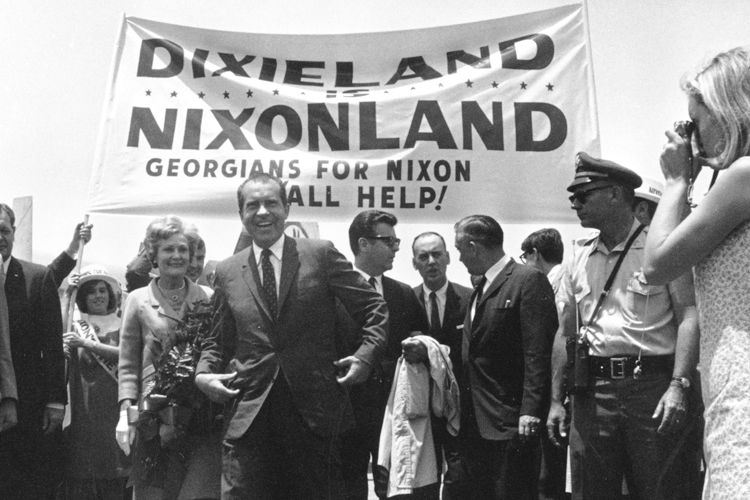
The US Democratic Party’s support for black civil rights in the 1960s dislodged millions of hitherto rock-solid white voters in the southern states of the USA. The Republican Party (the party of Abraham Lincoln!) lost little time refashioning itself as the new political home for Dixie’s aggrieved white supremacists. By 1972, these blue-collared “good ole boys” had been drawn alongside the Republican Party’s traditional conservative base in what President Richard Nixon called “the great silent majority” – which noisily swept him back into the White House on a landslide.
 
The not unnatural assumption of the right-wing political strategists who had engineered this stunning desertion of formerly “left-wing” voters to the conservative cause, was that, on economic matters, conservative leaders would need to tread very carefully.
 
Nowhere was this determination to preserve the economic under-pinnings of the welfare state more in evidence than under the National Government of Rob Muldoon. If Labour’s social liberalism – as evidenced by its deeply unpopular cancellation of the 1973 Springbok Tour – had caused an electorally crucial number of socially conservative blue-collar workers to throw in their lot with “Rob’s Mob”, then, surely, it would be the purest folly to give in to the “New Right’s” demands to curb the unions, free-up the markets and dismantle the welfare state?
 
But Muldoon’s combination of highly divisive social conservatism and aggressive state interventionism (Springbok Tours and Wage & Price Controls!) was much too volatile a political mixture to be more than a stop-gap solution to the deep structural problems confronting post-war capitalism.
 
The New Right’s strategists were, accordingly, willing to gamble that a full-scale assault on the key elements of the social-democratic post-war economy (unions, nationalised industries and welfare) would so shatter the political coherence of the Left that the victims of their assault – especially poorly-educated white males – would remain susceptible to an aggressively pitched, socially conservative, agenda.
 
This was certainly the political wager of Margaret Thatcher and Ronald Reagan, whose domestic assaults on the post-war social-democratic consensus, coupled with a ruinously expensive upping of the Cold War ante, broke the Left comprehensively, both at home and in its nominal heartland – the Soviet Empire. They were blows from which the Left has yet to recover. The destruction was made even more complete in New Zealand by the Right’s successful subversion of the parliamentary wing of the NZ Labour Party.
 
The introduction of Neoliberalism to New Zealand by Labour, while enormously dislocating in economic and social terms, did mean that it was social-liberalism, rather than social-conservatism, that set the political tone throughout the 1990s and into the Twenty-First Century. This is especially true of Maori-Pakeha relations and immigration policies across that period. In both contexts, liberal policy settings have facilitated a number of profound societal shifts and apparently irrevocable changes.
 
Certainly, when Dr Don Brash attempted to harness a mass political following to an indisputably radical revision of race relations in New Zealand, he was unable to duplicate the success of Rob Muldoon in 1975. His in/famous “Orewa Speech” on nationhood was, however, to prove astonishingly successful in uniting virtually the entire right-wing vote behind the National Party. To the point where only a very small shift in the allegiances of Labour voters would be sufficient to usher a National-led Government into office.
 
In the eighth year of John Key’s National-led Government, his success in wooing back those National Party voters who had defected to Labour under the “competent” governance of Helen Clark, as well as holding on to those Labour defectors, for whom Clark’s progressive policy agenda – especially during her third term – had become insupportable, is without historical precedent.
 
Key may not remember which side he was on during the Springbok Tour, but he knows better than to engage in such divisive political behaviour. Nor is his political survival predicated (as Muldoon’s was) on making such ideologically aggressive gestures. Labour’s defectors are nothing like the angry white males to whom Donald Trump is currently appealing in the United States. Key’s winning strategy has been to convince the a-little-bit racist, a-little-bit sexist, a-little-bit homophobic “Waitakere Man” that, on his watch, nothing will be done to make him change sides.
 
This essay was originally published in The Press of Tuesday, 15 December 2015.

Saturday, 31 October 2015

Be Careful What You Wish For: Will Lowering The Voting Age To 16 Really Help The Left?

Other Priorities: Taken in aggregate, young people have consistently demonstrated that they have other, more pressing, priorities than closely engaging with the electoral process. In this respect, the 18-25-year-old “Baby Boomers” of 1975 – the very same people who, forty years later play such a crucial role in determining New Zealand’s electoral outcomes – proved to be no exception.
 
MARTYN BRADBURY’S turbulent political career is notable for its passionate and unwavering commitment to the interests of young New Zealanders. From his stint as the editor of the University of Auckland’s student newspaper, Craccum, to his Sunday night polemics on the youth-oriented Channel Z radio station, “Bomber” Bradbury’s pitch has always been to those condemned to live with the consequences of contemporary politicians’ mistakes.
 
“Bomber” is part old-time preacher. (Who else greets his audiences with an all-encompassing “Brothers and Sisters!”?) But he is also a user of the very latest communications technology. Loud, brash, occasionally reckless, Martyn Bradbury may not be universally liked, or invariably correct, but his determination to mobilise the young in their own defence cannot be disputed.
 
His latest crusade on behalf of younger Kiwis calls for a lowering of the voting age from 18 to 16 years. This radical extension of the franchise would be accompanied by the inclusion of a new and comprehensive programme of civics education in the nation’s secondary school curriculum.
 
In Martyn’s own words: “The sudden influx of tens of thousands of new voters with their own concerns and their own voice finally being heard could be the very means of not only lifting our participation rates, but reinvigorating the very value of our democracy.”
 
Very similar arguments were advanced by the champions of young people’s rights more than 40 years ago. The late 1960s and early 1970s marked the high point of what left-wing sociologists were already calling the “radical youth counter-culture”.
 
The slogan of the so-called “Baby Boom” generation, then in their teens and twenties, was uncompromising: “Don’t trust anyone over thirty!” And, political activists among their ranks were convinced that if 18-year-olds were given the right to vote, then their “revolutionary” generation wouldn’t hesitate to sock-it-to the squares in the Establishment and usher-in the long-awaited Age of Aquarius.
 
Perhaps surprisingly, the Establishment were only too happy to oblige. In 1971, the Twenty-Sixth Amendment to the United States Constitution declared: “The right of citizens of the United States, who are eighteen years of age or older, to vote shall not be denied or abridged by the United States or by any State on account of age.”
 
Outgunned: The older generation of Democratic Party politicians were out-organised by George McGovern's young supporters at the 1972 Democratic Party Convention.
 
Young activists in the Democratic Party wasted little time in flexing their political muscles. At the 1972 Democratic Party Convention, an army of young delegates, veterans of the civil rights and anti-Vietnam War struggles in the streets of America, turned the tables on the old “pols” of the Democratic Party “machine”. (The same machine which, just four years earlier, had unleashed the Chicago Police on anti-war convention delegates.) Using the new party rules which the Chicago debacle had inspired, these youngsters comprehensively out-organised their much older right-wing opponents and secured the nomination for George McGovern, the most left-wing presidential candidate since Franklin Roosevelt.
 
With millions of new voters eligible to participate, and a candidate committed to fulfilling a sizeable chunk of the youth agenda of economic, social and political reforms, the scene seemed set for a sea-change in American politics.
 
If only.
 
In the presidential election of 1968, when the voting threshold was still set at 21-years-of-age, voter turn-out had been 60.8 percent (a high figure by American standards). With 18-year-olds entitled to vote, and a radical candidate for them to vote for, the turn-out in 1972 was 55.2 percent – a participation rate 5.6 percentage points lower than the previous election. To make matters worse, the radical candidate, George McGovern, suffered one of the most humiliating defeats in American political history. His conservative opponent, the Republican Party incumbent, Richard Nixon, was swept back into the White House with 60.7 percent of the popular vote!
 
Eighteen-year-olds got the vote in New Zealand in 1974. The Labour Government of Norman Kirk had not only enfranchised the young, but he had also ticked-off a great many items on the New Zealand youth agenda for change. He’d abolished compulsory military training, withdrawn the last military personnel from Vietnam, sent a frigate to Mururoa Atoll to protest French atmospheric nuclear testing, and called off the 1973 Springbok Tour. And that wasn’t all: Kirk had even subsidised the creation of “Ohus” – rural communes situated on Crown land.
 
How did the newly enlarged electorate respond one year later, at the General Election of 1975?
 
The turn-out in 1972, when the voting age was 20, had been 89.1 percent. Three years later, with tens-of-thousands of “Baby Boomers” enfranchised, the participation rate fell by 6.6 points to 82.5 percent. Even worse, the Third Labour Government (the last to evince genuinely left-wing beliefs) was hurled from office by the pugnacious National Party leader, Rob Muldoon. The swing from left to right was savage: Labour’s vote plummeted from 48.4 percent in 1972, to just 39.6 percent in 1975. [Mind you, what wouldn’t Labour give for “just” 39.6 percent support in 2017!?]
 
Much as I can understand why Martyn believes extending the franchise to 16-year-olds would harm the re-election prospects of John Key and the Right, I’m equally aware that the historical record argues precisely the opposite.
 
Taken in aggregate, young people have consistently demonstrated that they have other, more pressing, priorities than closely engaging with the electoral process. In this respect, the 18-25-year-old “Baby Boomers” of 1975 – the very same people who, forty years later (as Bomber so rightly laments) play such a crucial role in determining New Zealand’s electoral outcomes – proved to be no exception.
 
When they bother to vote at all, it’s true that young people tend to vote for the parties of the Left. But, equally, there is no disputing the fact that their massive and consistent non-participation in the electoral process continues to be of overwhelming benefit to the Right.
 
This essay was originally posted on The Daily Blog of Friday, 30 October 2015.

Tuesday, 2 September 2014

A Not-So-Foreign Country

The Shadow Of The Past: The only positive aspect of Watergate was the way in which the venerable US Constitution was able to defuse what could have exploded into a full-blown “legitimation crisis”. Is New Zealand’s unwritten and historically untested constitution capable of rising to the challenge of this present political scandal as effectively as America’s rose to the challenge of Watergate? Can the Prime Minister and his Cabinet be relied upon to pass judgement on themselves?
 
I’M WRITING THIS COLUMN on the fortieth anniversary of Norman Kirk’s death. As someone who cast his first vote in 1975, it is tempting to eulogise the New Zealand of forty years ago and to compare it, favourably, with the scandal-ridden country of today. Certainly “Big Norm” was an extraordinary political leader against whom very few – if any – of today’s politicians could hope to measure up. One has only to watch his 1973 interview with David Frost (available online at NZ On Screen) to realise just how much the New Zealand electorate once demanded of their prime ministers.
 
We must, however, be cautious, and not only because, as L.P. Hartley wrote: “The past is a foreign country: they do things differently there.”
 
Beset as we are with a rapidly spreading and intensifying political scandal, we would do well to bear in mind that although the New Zealand of forty years ago was very different from the New Zealand of today, it was also, in “dirty politics” terms, surprisingly similar. Hartley’s caution notwithstanding, they did many things the same.
 
Forty years ago, far from being the preferred weapon of the Left (as today’s Prime Minister, John Key, alleges) the political smear campaign was the speciality of the Right. When the newspaper Truth (the Whaleoil blog of its day) published a front-page story alleging Kirk’s involvement in a sinister plot to socialise the New Zealand economy, it was written in exactly the same belligerent style as Cameron Slater’s postings.

Another instantly recognisable aspect of “dirty politics” 1970s-style was the Security Intelligence Service’s leaking of sensitive information to right-wing editors and journalists. Then, as now, they needed no further instruction on how to put such material to good use.

Most of all, however, the period leading up to and following Kirk’s death was characterised by a sense of powerful yet unidentified forces moving unobserved behind the scenes. A very similar characterisation of the political zeitgeist was one of the most memorable parts of Nicky Hager’s speech to a packed hall of interested Aucklanders last Wednesday. In explaining his reasons for writing Dirty Politics he referenced exactly the same feeling of unease about the way politics was being conducted; the same conviction that apparently isolated political events were, in some unrevealed and sinister way, connected.
 
The anxieties of the “screaming left-wing conspiracy theorists” of the mid-1970s concerning the malignant political machinations of the “Kirk Years” were eventually proved right. Fortunately, Hager has not had to wait forty years to have his worst fears confirmed. Thanks to the intervention of a “White Hat” hacker known as Rawshark, New Zealand’s foremost investigative journalist has been able to demonstrate that the dark arts of attack politics are being applied in 2014 with no less devastating effect than in 1974-75.
 
The unfolding revelations, in which so much of the action has been concentrated in the offices of the Prime Minister and the Minister of Justice, have inevitably invited comparisons with the Watergate Scandal. That story also reached its crescendo in August 1974 when, for the first and only time in US history, a serving President was forced to resign his office.
 
It is worth recalling, given the proximity of our own General Election, that the exposure of the Watergate burglary in June 1972 had no impact whatsoever on the outcome of the Presidential Election held in November of that year. Indeed, President Richard Nixon was emphatically re-elected – winning 49 of the USA’s 50 states. The slow unravelling of the scandal and its subsequent cover-up did, however, transform Nixon’s second term into a political and constitutional nightmare. As a result his administration was effectively paralysed and the USA gravely weakened.
 
The only positive aspect of Watergate was the way in which the venerable US Constitution was able to defuse what could have exploded into a full-blown “legitimation crisis”.
 
Democracies, much more than other political systems, depend upon their citizens’ belief that the people they elect to public office are decent, conscientious and law-abiding. If high ethical standards are not maintained; if citizens become convinced that their elected representatives are engaged in large-scale and largely unreproved corruption; then the legitimacy of both the government and the state is called into question.
 
Is New Zealand’s unwritten and historically untested constitution capable of rising to the challenge of this present political scandal as effectively as America’s rose to the challenge of Watergate? Can the Prime Minister and his Cabinet be relied upon to pass judgement on themselves?
 
Nixon resigned on 9 August 1974. Norman Kirk died 22 days later on 31 August. That’s when it began: forty  years ago; that’s when the poisons currently disfiguring our body politic first entered the nation’s bloodstream.
 
In the polling booths on 20 September can we purge ourselves of those poisons? Will we vote to impeach?
 
This essay was originally published in The Press of Tuesday, 2 September 2014.

Friday, 22 August 2014

Abandoning Science - And The Planet

Weeping For The Planet: The famous "Crying Indian" advertisement, produced by Keeping America Beautiful, struck a deep chord with Americans when it first screened on "Earth Day" - 22 April  1971. It was a time when both the Left and the Right respected ecological science and were ready to take action to protect the environment. How times have changed. In 2014, right-wing politicians are unwilling to tolerate "any measures which are socialism masquerading as environmentalism".
 
MANY NEW ZEALANDERS are puzzled by the sudden descent of right-wing political parties into anti-environmentalism. Forty years ago, in the first flush of global ecological awareness, political parties of every ideological stripe were ready to put aside their differences for the sake of the environment. There was a strong bi-partisan agreement that, regardless of whether they were Left or Right, every human-being had a personal vested interest in improving the health of the planet.
 
It was a Republican President, Richard Nixon, who signed into law the National Environmental Policy Act of 1969, which, for the first time, required federal agencies to file environmental impact statements for federally funded programmes.
 
Nixon who oversaw, in 1970, the creation of the Environmental Protection Agency and signed into law the Clean Air Extension Act, imposing strict controls on airborne pollutants known to be hazardous to human health.
 
Nixon who, in 1972 offered whales, dolphins, sea otters, polar bears and seals the protection of the US Government by signing the Marine Mammals Protection Act.
 
Nixon who, likewise, presided over the passage of the 1973 Endangered Species Act and the Safe Drinking Water Act 1974.
 
Though a deeply conservative (and deeply flawed) politician, Nixon was a shrewd enough politician to grasp the electoral heft of the burgeoning environmental movement.
 
By the 1980s, however, political parties of the Right around the world were rapidly distancing themselves from the “environmentally friendly” legislative reforms of the 1970s. Ronald Reagan was no Richard Nixon.
 
The Right’s growing antipathy to environmentalism was fuelled by the world-wide ideological resurgence of laissez-faire capitalism. The so-called “New Right” was hostile to just about every kind of regulatory regime, but it was environmental regulation that earned its special ire. This was because the much admired dynamism of “the free market” was hugely dependent on the capitalists’ ability to “externalise” (i.e. not have to account for or pay for) the environmental and social consequences of their behaviour.
 
If capitalists were required to fully account for and pay for their detrimental impact upon the natural and human environments, then their profitability would be seriously (and in many cases irreversibly) reduced.
 
In the 1970s, political leaders like Nixon still felt obliged to respond to the voters’ pleas to save the planet. By the 1980s, however, the priorities of the Right had changed. The mission of conservative parties everywhere was now to convince voters that capitalism’s ultimate contradiction: the extraction of infinite profits from a finite planet; wasn’t really a contradiction at all, and that industrial capitalism’s most fearsome externality, anthropogenic global warming, was nothing more than “green propaganda”.
 
This was not an easy sell. Historically speaking, the rise of capitalism and the rise of science had coincided, spurring one another on to new discoveries, new applications. Persuading people to reject the science of global warming could only be achieved at the cost of abandoning the rationalist project itself.
 
But it was rationalism and science which had, ever since the eighteenth century, imbued capitalism with its progressive economic, social and political force. To reduce scientific knowledge to the status of exculpatory evidence bought and paid for; and scientists to little more than the servants of big business; would strip capitalism of its intellectual potency. It would mean abandoning what Professor Niall Fergusson calls its “killer apps” – the critical advantages that had enabled capitalism to see off all its ideological rivals.
 
These potentially fatal dangers notwithstanding, by the second decade of the twenty-first century it was possible for right-wing political leaders to win public office in spite of (or even because of) their refusal to accept the findings of environmental science.
 
Across the Tasman, for example, the Cabinet of the Australian Prime Minister, Tony Abbott, has proclaimed, with a straight face, that it is not prepared to tolerate “any measures which are socialism masquerading as environmentalism”.
 

Who Speaks For The Trees? Ancient Huon Pine, Mt Read, Tasmania. These trees are among the oldest on the planet (3,000-10,000 years old).
 
Included among these allegedly “socialist” measures, is the World Heritage Status of both the Tasmanian wilderness and the Great Barrier Reef. In any stand-off between ecological science and Australia’s extractive industrialists it’s not difficult to predict who will win the Abbott Government’s support.
 
We shouldn’t feel too smug and superior, however, when it comes to our Australian cousins. Not when the difference between their right-wing politicians and ours is, as always, more a matter of subtlety than substance.
 
Environmental destruction masquerading as economic growth.
 
This essay was originally published by The Waikato Times, The Taranaki Daily News, The Timaru Herald, The Otago Daily Times and The Greymouth Star of Friday, 22 August 2014.