
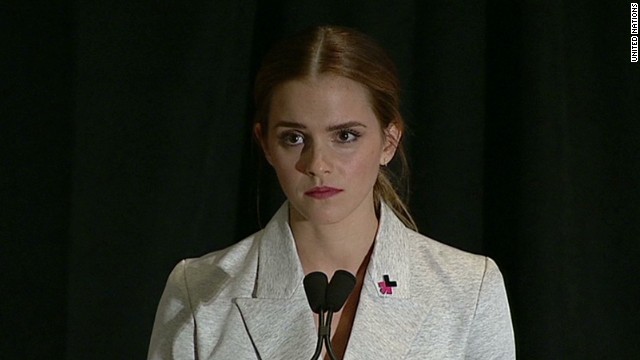
Through A Glass Darkly: Emma Watson's passionate advocacy of Popular Feminism at the UN Women's launch of the "HeForShe" initiative in September 2014 broke with 40 years of feminist process by inviting men and boys to become part of the struggle to end gender inequality. Bitter experience had taught Second Wave feminists that this was a struggle best fought by women, for women, and on women's terms. In the immortal words of Frederick Douglass: "Power concedes nothing without a demand."
“I AM INVITING YOU to step forward, to be seen to speak up,
to be the ‘he’ for ‘she’. And to ask yourself if not me, who? If not now,
when?” That was the challenge thrown down to men and boys around the world by
the British actor, Emma Watson, at the launch of the HeForShe movement in New
York City last year. The brainchild of UN Women, the UN organisation dedicated
to gender equality and the empowerment of women, HeForShe openly solicits the
support of men in the struggle for gender equality – tacitly acknowledging the
success of patriarchal resistance to the further extension of women’s rights
internationally.
Watson spoke movingly
of her own conversion to feminism and of the many “inadvertent feminists” who
had made it seem natural for her to be treated as an equal. But she also made
reference to the declining influence of feminism as a mobilising ideology.
“I was appointed six months ago and the more I have spoken
about feminism the more I have realized that fighting for women’s rights has
too often become synonymous with man-hating. If there is one thing I know for
certain, it is that this has to stop.”
Watson’s speech thus resurrected the line of argument which
some of the early advocates of what came to be known as “Second Wave Feminism”
deployed in their quest for male allies.
“We don’t often talk about men being imprisoned by gender
stereotypes but I can see that that they are and that when they are free,
things will change for women as a natural consequence … Both men and women
should feel free to be sensitive. Both men and women should feel free to be
strong. It is time that we all perceive gender on a spectrum not as two
opposing sets of ideals.”
Subsuming the struggle for women’s rights in a grander
battle for the freedom of both sexes did not, however, strike many 1970s
feminists as a particularly effective strategy for securing their own
liberation. Their personal experiences as political activists told them that
any movement for gender equality in which men participated as full and equal
partners would inevitably end up being dominated by men, and reflect a
masculine view of the world. Women found their own voices much more readily in
groups with a “Women Only” membership rule.
This herstory is well known to the New Zealand spokeswoman
for HeForShe, Sue Kedgely. As one of the Founding Mothers of Second Wave
Feminism in New Zealand, she is well aware of the movement’s organisational
evolution. All the more surprising, then, that she should be the one inviting
all good Kiwi blokes to don their shining armour and ride to the rescue of the
world’s damsels.
Never backward in coming forward, Kedgely kicked off the New
Zealand HeForShe effort, launched in Wellington on Friday (27/11/15) afternoon,
by signing up the realm’s leading knight – and Governor-General – Sir Jerry
Mateparae. Other high-profile fellas signing on to this noble, global quest to
secure gender equality by 2030 include broadcasters Wallace Chapman and Jack
Tane; economist and philanthropist, Gareth Morgan; and comedians Te Radar and
Jeremy Ellwood.
If you’re a bloke and also feel moved to support this new
cause of “Popular Feminism”, then simply pay a visit to the website and sign on.
Just be aware, though, that not every feminist shares Emma
Watson’s views. Responding to her New York speech, feminist columnist,
Clementine Ford, wrote in the Sydney Morning Herald of 27 September
2014:
“It’s true that a person like Watson is very well placed to
inspire people who may still be labouring under the weight of stereotypes
regarding feminism, and that is undoubtedly cause for celebration. I applaud
her for being brave enough to speak out when so many others haven’t. But
feminists have been battling these stereotypes for decades and we will almost
certainly be battling them for years to come because the unfortunate truth is
that gender inequality is about power – who has it, and who wants to retain it.
No amount of window dressing (for that is surely what the HeForShe campaign
amounts to, given its entire breadth seems to be asking men to click a button
and download a twibbon) is going to change the systemic global oppression that
results in women’s degradation, subjugation and death in persistently high
numbers. And it isn’t, as some have suggested, ‘tearing another woman down’ to
want to discuss that reality.”
To which, as a “He”, I am happy to stand and say to that
particular “She”:
“Right-on Sister!”
This essay was posted
on The Daily Blog and Bowalley
Road of Saturday, 28 November 2015.
