
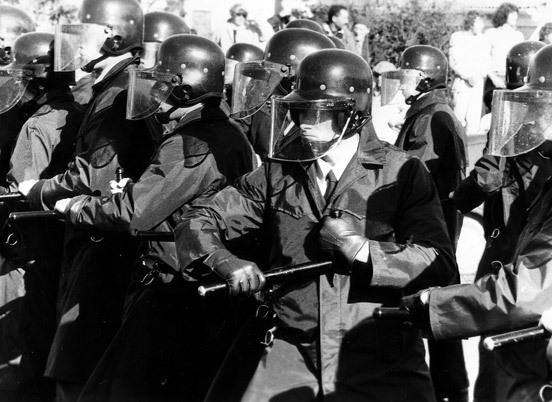
Defining Moment: Non-violent Direct Action provokes overt state violence. It was Rob Muldoon's squandering of the State's moral authority which guaranteed the Anti-Apartheid Movement's ultimate victory. To conflate the alleged actions of the "Urewera 18" with those of the Springbok Tour protesters (as Valerie Morse and John Minto did last Sunday) is to compromise the historical integrity of one of New Zealand's pivotal political events.
THERE ARE EVENTS that stand alone in our history: the ANZAC landing at Gallipoli on 25 April 1915; the 1951 Waterfront Dispute; the 1981 Springbok Tour.
They’re the sort of events which helped to define us as a nation; events which exerted a profound influence on New Zealand society and helped to shape the perceptions and expectations of a generation. Such events merit our respect – and under no circumstances should they become the occasion for political mischief-making.
In seeking to preserve the integrity of these key historical moments we can, of course, only appeal to the innate decency of our fellow citizens.
The Supreme Court of New Zealand recently quashed the conviction of Valerie Morse – the young woman found guilty of disorderly behaviour in the lower courts for setting fire to the New Zealand flag at an ANZAC Day ceremony.
I salute that decision.
A great deal of the meaning we attach to ANZAC Day is bound up with the idea of democracy and the sacrifices New Zealanders have made in its defence.
Ms Morse’s behaviour may have been ill-judged, ill-mannered and emblematic of the infantile solipsism of the Far Left, but the Supreme Court acted correctly in upholding her right to free speech.
But, freedom of speech cuts both ways. Ms Morse may have been attempting to draw attention to New Zealand’s military engagement in Afghanistan by disrupting an ANZAC Day ceremony, but her actions achieved a great deal more than that.
In the eyes of most New Zealanders she’d demonstrated an extraordinary level of ignorance about the country whose good name she was, ostensibly, so determined to defend.
And that’s not all. Ms Morse’s behaviour also rendered the many thousands of Kiwis who shared her disquiet about New Zealand’s presence in Afghanistan guilty, by association, of desecrating their country’s flag.
By cynically exploiting the symbolic power of ANZAC Day, Ms Morse gave offense to thousands, alienated potential allies and deeply compromised the entire anti-war movement.
It is precisely this fear of being lumped in with the extremism of the Far Left that has prevented me from joining in all the ballyhoo surrounding the so-called “Urewera 18” – the individuals arrested, initially on terrorism charges for allegedly participating in military-style training camps in the Urewera Ranges in 2006-2007. [Correction: While the Police intended to lay charges under the Terrorism Suppression Act, the required permission to do so was denied on the advice of the Solicitor-General. The defendants were actually arrested on charges relating to the Arms Act. C.T.]
In what can only be described as a triumph of their defence lawyers’ skills, these defendants (now facing firearms charges) have been transformed into the blameless victims of state oppression.
Within 72 hours of their arrest, they were already being presented as martyrs to freedom; harmless activists caught up in a world-wide, post-9/11, United States-directed campaign to stamp out political activism of all kinds.
As such they have become the cause de jour among that peculiar sub-culture of leftists who simply cannot conceive of anybody taking their ideals seriously enough to die – or kill – for.
“Tame Iti’s not a terrorist,” they declare, snorting derisively into their chardonnay “he’s an artist!”
These are the sort of people who turn out to special screenings of “Operation Eight” – the outrageously one-sided “documentary” about the 2007 “police terror raids”. Or, as they did on Sunday, to a Wellington art auction fronted by “key organiser of the 1981 Springbok Tour protests” (and prospective Mana Party candidate) John Minto, and one of the 18 accused – our old friend, Valerie Morse.
Well, it’s a free country. If Mr Minto and Ms Morse decide to host an art auction – it’s no skin off my nose.
Except that it is.
Because it wasn’t just an art auction that they were fronting, but an event to mark the thirtieth anniversary of the Springbok Tour protests.
And I object to that in the strongest terms.
Because whatever was going down in the Urewera Ranges in 2006-2007 bears no comparison whatsoever with the mass protests of 1981.
Those demonstrations were a testament to the power of mass, non-violent protest.
The only training camps the anti-tour movement sponsored were set up to teach the principles of non-violent direct action; the same principles that animated Te Whiti O Rongomai, Ghandi and Dr Martin Luther King.
For Mr Minto and his “Concerned Citizen” sponsors to conflate the ideals and activities of the 1981 Anti-Tour Movement with the legal defence strategies of the 18 individuals arrested in relation to events alleged to have occurred in the Urewera Ranges in 2006-2007 is political legerdemain of the most cynical kind.
Those who broke the law in 1981 did so openly and proudly, and they wore their sentences as badges of honour. The witness they bore against Apartheid made a real difference and was ultimately morally vindicated by the peaceful political liberation of black South Africa.
Ms Morse has not only burned her country’s flag, with Mr Minto’s help she’s compromised the integrity of one of its great and defining moments.
This essay was originally published in The Press of Tuesday, 7 June 2011.
