Showing posts with label World War II. Show all posts

Wednesday, 4 June 2025

Making Deserts.

Berlin 1945/Gaza 2025
“T
hey make a desert, and they call it peace.
 
-
Tacitus 56-117CE

UNCONDITIONAL SURRENDER doesn’t leave those demanding it very much in the way of wiggle-room. When President Franklin Roosevelt announced to the world that the Allied Powers would accept nothing less than the Axis Powers’ (Germany, Italy, Japan) unconditional surrender, he took the man sitting next to him, Winston Churchill, by surprise. Though the official history of the Casablanca Conference of January 1943 insists otherwise, the journalists present were pretty sure that Roosevelt had caught Churchill on the hop. Ever the wily imperial politician, Great Britain’s wartime prime-minister was a great believer in wiggle-room. Now there was none.

Roosevelt had very good reasons for his decision to eliminate the possibility of compromise. The most important of these was the absolute necessity of convincing the Soviets, then fighting for their lives, that there was no possibility of the USA and/or Great Britain negotiating a separate peace with the Nazis.

The Soviet dictator, Joseph Stalin, whose paranoia was legendary, was fearful that Churchill, a convinced imperialist and passionate anti-communist, might prevail upon Roosevelt to transform the war into an anti-Soviet crusade. There can be little doubt that the thought, at least, had crossed Churchill’s mind.

No Wiggle Room: Franklin Roosevelt tells Winston Churchill, and the world, that the Allies’ war aim is Unconditional Surrender. 

Unconditional Surrender was Roosevelt’s way of reassuring Stalin that his fears were groundless. It was also intended to prevent his Soviet allies, whose backs had been against the wall since June 1941, from themselves negotiating a separate peace with Nazi Germany.

Beneath all this calculation, however, Roosevelt’s demand for Unconditional Surrender reflected his bedrock conviction that the evils of Nazism were too dreadful to be seated at any negotiating table. They could not be set aside in the interests of peace, because Nazism was the antithesis of peace. To end the war, Adolf Hitler and his creed had to be extirpated entirely. Nazi Germany’s surrender to the forces of civilisation had to be unconditional.

But, evil has a way of corrupting even the most noble of intentions – and the demand that it surrender unconditionally to the forces of righteousness is no exception.

When your enemy realises that there is no wiggle-room, the temptation to go on fighting to the bitter end is very hard to resist.

Equally hard to resist, on your own side, is the temptation to increase dramatically the level of punishment inflicted upon the enemy. If their stubborn refusal to acknowledge defeat persists, and the conflict is needlessly prolonged, then a steady escalation in the violence and destruction unleashed upon them is not only deemed morally justifiable, but also morally necessary.

Suddenly, the civilised distinction between combatants and non-combatants: soldiers and civilians; begins to blur. The commitment to waging Total War pronounced by one side, inevitably calls forth an answering commitment from the other.

Everybody and everything is to be considered a target. The sooner the enemy’s critical infrastructure, now deemed to include the houses – and the bodies – of their citizens, is reduced to rubble and torn flesh, the sooner peace will come.

This terrifying, though hardly novel, mode of thought was well understood by the Roman historian Tacitus, who wrote of his own great city-state: “They make a desert, and they call it peace.” In Hamburg and Dresden, Hiroshima and Nagasaki, the Allies’ quest for unconditional surrender would create deserts of its own.

And the making of deserts, if not peace, continues.

In response to the evil of 7 October 2023, Israel demanded the unconditional surrender of Hamas, and the release of all the hostages taken on that dreadful day by its pitiless foe. Hamas was defiant. God loves martyrs, and Hamas has plenty to give him.

Eighty years after the end of the Second World War in Europe, the world watches in despair as those who set forth in righteous wrath to secure the unconditional surrender of evil, have ensnared themselves in the same remorseless escalation of violence and destruction that captured our fathers and grandfathers.

The focus over recent days has been on the grainy images of universal celebration. [The 80th anniversary of VE Day. - C.T.] More difficult to watch are the images of ruined German cities, and how closely they resemble the images of ruined Gaza. Like the Romans and the Allied Powers, the Israelis are determined to bring forth the flower of peace from the desert they are making.

But, surely, the evil whose unconditional surrender Israel should be seeking, is the evil of not knowing when to stop.


This essay was originally published in The Otago Daily Times and The Greymouth Star of Friday, 9 May 2025.

Friday, 24 November 2023

Passing Things Down.

Keeping The Past Alive: The durability of Commando comics testifies to the extended nature of the generational passing down of the images, music, and ideology of the Second World War. It has remained fixed in the Baby Boomers’ consciousness as “The Good War”: the conflict in which, to a far greater extent than any other, the stakes were as high as the morality was simple. 

WHEN “COMMANDO’ WAR COMICS first started appearing in the newsagents of New Zealand, the war depicted was just 16 years ago. Think about that for a moment. Cast your mind back to the events of 2007. Helen Clark was Prime Minister. George W. Bush was President. Tony Blair’s “New Labour” government was still ruling the United Kingdom. Our memories of these people (all of them still alive) and their deeds remain vivid.

Memories of “The War” – everybody knew which war you were referring to – remained equally vivid for the men and women who had lived through it. That their experiences would be passed down to their children – the “Baby Boomers” – was inevitable. Commando war comics were an important part of that passing down.

Commando’s impressive stable of graphic artists worked in black and white. This seemed fitting to their young readers, since the images vouchsafed to them of the War were similarly monochromatic. Indeed, as the comic’s readership aged – peaking in number during the 1970s – they found it difficult to conceive of the past as happening in anything other than black and white.

Perhaps that’s why the war films emerging from the studios of the United States and the United Kingdom in the postwar decades never seemed quite real to their Baby Boomer audiences. Too much colour. Many of them felt the same way about the “colourisation” of film footage shot during the First and Second World Wars. It seemed, somehow, a violation.

The founders of Commando were all veterans of the War, a fact which explains their insistence on accuracy, and their eye for anything that contradicted their own recollection. It mattered to them that their boy readers (not many girls read Commando comics!) imbibed as truthful a representation of their fathers’ and mothers’ experiences as was compatible with compassionate discretion and commercial success. By and large they succeeded – although it is most unlikely that the expletive phrases of the average German soldier under fire were limited to “Gott in Himmel!” and “Donner und Blitzen!”

The durability of Commando comics testifies to the extended nature of the generational passing down of the images, music, and ideology of the Second World War. It has remained fixed in the Boomers’ consciousness as “The Good War”: the conflict in which, to a far greater extent than any other, the stakes were as high as the morality was simple. Unlike Vietnam, Afghanistan and Iraq, the war against the Axis Powers is still accepted as a straightforward battle between Good and Evil.

That so much of the History Channel’s schedule is devoted to programmes about World War II is proof that this colossal, world-shattering event’s absence of moral ambiguity is as much appreciated by Boomers in their old age as it was when they were twelve.

But, as the war-fighters’ children entered their late-teens and early-twenties, the black and white certainties upon which they’d been raised, the anti-fascist ideas they’d imbibed with their mother’s milk, appeared to have been rejected by the very same “good guys” who’d won the war.

When the blood, tears, toil and sweat of Vietnam were captured in all their true colours, and broadcast into the living-rooms of World War II veterans and their families, they arrived from a very different historical place. Everybody knew that these dreadful images no longer came from “then”. They depicted the horrifying realities of “now”. And all the Commando comics in the world could not dismantle the wall behind which the so-called “Greatest Generation” – the men and women who had defeated Hitler – had so irretrievably sundered the past from the present.

For better or worse, the Baby Boomers’ “passing down” has been a mighty warning about the ease with which heroic men and women can pass from the side of the “good guys” to side with the “bad guys”. When the Boomers saw what their parent’s generation was doing to the world they had won – and on whose behalf – they did everything within their power to persuade their own children to question the historical and ethical narratives passed down to them from the past – including those of their own parents.

This is why the comics of the post-Boomer generations are all about deception and betrayal. About superheroes who fail, and turn bad. About the world which the dead heroes of Commando comics could not save.


This essay was originally published in The Otago Daily Times and The Greymouth Star of Friday, 24 November 2023.

Saturday, 28 October 2023

Reaping The Whirlwind.

Mild-Mannered Avenger: “The Nazis entered this war under the rather childish delusion that they were going to bomb everyone else, and nobody was going to bomb them. At Rotterdam, London, Warsaw, and half a hundred other places, they put their rather naïve theory into operation. They sowed the wind, and now they are going to reap the whirlwind.” - Sir Arthur "Bomber" Harris, 1942.

HAD IT NOT BEEN for the intervention of the Queen Mother, Arthur “Bomber” Harris would never have got his statue. While all the other great British commanders of the Second World War were showered with honours and had their likenesses cast in bronze, Air Marshall Harris became someone the British Establishment found it expedient to overlook. Why? Because Harris was responsible – at least in terms of his strategic decision-making – for the deaths of hundreds of thousands of civilians.

Harris’s “Bomber Command” rained down explosives in such quantities that, in the cities of Hamburg and Dresden, they created firestorms. A firestorm takes hold when the combustion site exhausts its supply of oxygen and begins drawing in the surrounding air to keep the inferno alive. The inrushing air soon acquires the speed of a gale-force wind. This not only fuels the flames, it fans them, increasing the size and heat of the conflagration to truly horrific levels. Without oxygen, those huddling in bomb shelters are asphyxiated. Those attempting to flee find their feet sinking into superheated asphalt as, all around them, the streets melt. So hot did it become in Dresden, that school-girls seeking protection from the intense heat in a water tank were boiled alive.

Harris was not in the least bit fazed. In a notorious address, delivered to the British people in 1942, at the start of his no-holds-barred bombing campaign, Harris chillingly declared:

Sir Arthur "Bomber" Harris.

The Nazis entered this war under the rather childish delusion that they were going to bomb everyone else, and nobody was going to bomb them. At Rotterdam, London, Warsaw, and half a hundred other places, they put their rather naïve theory into operation. They sowed the wind, and now they are going to reap the whirlwind.

Challenged to justify the huge civilian losses at Dresden, in the context of a war that was clearly only weeks away from being won, Harris responded:

The feeling, such as there is, over Dresden, could be easily explained by any psychiatrist. It is connected with German bands and Dresden shepherdesses. Actually Dresden was a mass of munitions works, an intact government centre, and a key transportation point to the East. It is now none of these things.

It isn’t difficult to understand why Harris had to wait so long for his statue. But, those who turned their backs on him were the worst kind of hypocrites. In the context of an increasingly brutal global conflict, Harris distinguished himself by refusing to cloak the brutality of war in fine phraseology, or weasel words. The strategy of “carpet bombing” German cities was approved by Britain’s war cabinet because it worked. Home Office researchers had discovered that people coped better with losing their loved ones than they did with losing their homes.

People who say that bombing civilians doesn’t work are, quite simply, wrong.

Nor is it the case that New Zealanders can stand aloof from Harris’s cold-blooded destruction of human life. Six thousand Kiwis flew in those bombers, ofttimes navigating by the terrible red glow in the skies ahead of their aircraft. Nearly 2,000 of them never returned to base.

I rehearse these facts as the Israeli Air Force rains death and destruction upon the defenceless cities of Gaza. The world stands aghast at the horrific scenes filling the screens of its devices. “These are civilians!”, it cries, “Innocent women and children!” From the streets of the Middle East rises the grim accusation: “Israel is guilty of war crimes!”

But if the Israelis are guilty of war crimes, then so were my father’s generation – and my grandfather’s. It was “our side” that blockaded Germany for the duration of World War I. Like the other British Dominions, New Zealand was quite willing to have the Royal Navy starve Germany to death. It was war. You do what it takes to win.

“Bomber” Harris spoke the brutal language of military necessity. Faced with the impossibility of defeating Germany without killing Germans, he point-blank refused to indulge in moral humbug.

Sorting out the guilty from the innocent in the crimson fog of war is beyond the competence of mortal men.

Sir Arthur Harris (he was knighted in 1953) died in 1984, and his statue was unveiled by the Queen Mum in 1992. She was taken aback to hear the jeers and boos of the crowd.


This essay was originally published in The Otago Daily Times and The Greymouth Star of Friday, 27 October 2023.

Saturday, 2 September 2023

Bob Semple's Tank.

Home-Made Armour: It was in the context of the seemingly unstoppable German and Japanese victories of the early-1940s that Bob Semple’s tank rattled into New Zealand folklore. Ponderously heavy, acutely vulnerable, inadequately armed and lethally slow, three of these 25-ton behemoths were made. None (thank God!) saw action.

“BIG BOB” stood tall at 3.6 metres, but that was the full extent of its impressiveness. In virtually every other respect “Big Bob” inspired little more than mirth. The man who commissioned “Big Bob”, New Zealand’s first home-made tank, was Public Works Minister Bob Semple. Never overly fond of being laughed at, he is said to have snarled at his critics: “I don’t see anyone else coming up with any better ideas!”

The irrepressible Semple, one of the most colourful members of the First Labour Government, had a point. At the outbreak of World War II, in September 1939, New Zealand had precisely zero armoured fighting vehicles.

Not that the military was all that worried, not then. If Mother England’s distant daughter needed tanks, then tanks she would have – and they would be “Made in Great Britain” – like just about every other weapon in New Zealand’s tiny arsenal.

This was a perfectly reasonable expectation for a nation of 1.6 million – right up until mid-1940, when Mother England was obliged by Herr Hitler’s armoured blitzkrieg to leave nearly all her tanks in France. If New Zealand wanted an armoured fighting capability, it would now be obliged to manufacture its own. After Dunkirk, every new tank that rolled off Britain’s production lines would be dedicated to homeland defence.

In December 1941, things got considerably worse. Starting with the American fleet at Pearl Harbour, Japan launched her own blitzkrieg across the Pacific Ocean and into South East Asia. For the first few months of 1942, New Zealand was without effective defence. Her army was in the North African desert fighting Germans and Italians. With contemptuous ease, Japanese bombers had sunk the two great battleships sent out by the Royal Navy to “steady” the dominions. Singapore had fallen, and no one was 100% sure the Americans were up to beating the seemingly invincible Japanese.

“Big Bob” may have looked like a corrugated iron outhouse bolted onto the tracks and chassis of a caterpillar tractor (which is pretty much what it was!) but, as Semple rightly observed, nobody else in those terrifying months had a better idea.

Thus it was that Bob Semple’s tank rattled into New Zealand folklore. Ponderously heavy, acutely vulnerable, inadequately armed and lethally slow, three of these 25-ton behemoths were made. None (thank God!) saw action.

THE ONLY THING more important than having the weapons and ordnance you need, is the ability to replace them. War is a voracious beast, gobbling up human-beings and materiel at a speed that makes the logistics of re-supply critically important. As New Zealand discovered between 1940-42, rifles without ammunition are little more than clubs, and artillery without shells no better than scrap metal. Which is why your country’s enemies are, when you come right down to it, also the enemies of the nation supplying your nation with its armaments.

New Zealand may talk about having an “independent” foreign and defence policy, but that’s not much more than spin. Think for a moment about those eye-wateringly expensive “Poseidon” surveillance aircraft purchased by the RNZAF to replace its decades-old “Orions”. Or the super-sized tactical airlifters scheduled to replace our truly ancient C130 “Hercules” aircraft. To whom should New Zealand apply for replacement parts and upgrades for these new aircraft? Why, to the manufacturers, of course. And who are the manufacturers? Boeing and Lockheed Martin – mega-corporations located in our “very, very, very good friend”, the United States of America.

That’s right, Uncle Sam has replaced Mother England as New Zealand’s principal armourer. Had he not, our claim to independence might be more credible. Then again, just imagine the uproar in Washington, London, Canberra and Ottawa if Wellington announced that, henceforth, New Zealand would be armed by the Peoples Republic of China. That instead of the MARS assault rifle from America, our infantry would be armed with QBZ191’s from Norinco. That, instead of the Lockheed Martin “Super-Hercules”, our new tactical airlifter would be the Xi’an Y-20 Kunpeng.

Such an announcement would signal a strategic shift in New Zealand’s foreign and defence policy. Our “Five Eyes” partners would, not unreasonably, assume that New Zealand’s loyalties now lay with the Chinese Communist Party in Beijing.

Alternatively, we could attempt to set up our own armaments industry. Prohibitively expensive, of course, and there’s always the risk of turning out another “Big Bob”!


This essay was originally published in The Otago Daily Times and The Greymouth Star of Friday, 1 September 2023.

Thursday, 11 June 2020

One Cheer For Democracy.

Tough Crowd: The democratic tree’s once wholesome fruit has been poisoned by the malodorous blight of populism. A toxic virus composed of three-parts racism, two-parts misogyny, one-part homophobia and four-parts malignant nationalism. Small wonder that so many young people, struggling to free themselves from the fear of fascist-populist intolerance and violence are increasingly giving up on freedom of speech – which only serves to spread the deadly disease.

GIVING UP ON DEMOCRACY, thankfully, remains unthinkable to most – if not all – New Zealanders. Ever since the triumph of democratic values in 1945, our political system’s moral superiority over all other governmental regimes has simply been assumed by those fortunate enough to live in liberal democratic societies.

The veterans of the global war against fascism needed no persuading. Their children, convinced by the Cold War rhetoric of freedom and justice, demanded its extension into every last corner of the world. Those born in the post-Cold War era, however, seem less enthused; less willing to take Democracy at its face value. Some are even demanding to know if Democracy is worth preserving.

They may have a point. Though the American President who led the United States into World War II, Franklin D. Roosevelt, had promulgated the “Four Freedoms” (Freedom of Speech, Freedom of Worship, Freedom from Want, Freedom from Fear) as the core war aims of the Allies, he did so in a land where those freedoms were neither universally acknowledged nor enforced.

It was Roosevelt himself who had given the order to inter all American citizens of Japanese descent in what were essentially concentration camps. The armies that fought Japanese militarism in the Pacific, and German and Italian fascism in Europe, remained racially segregated throughout. African Americans migrating from the Jim Crow South to the North and West in search of wartime employment were welcomed with white-inspired race riots. A great many of the otherwise progressive American trade unions maintained a rigid colour-bar right up until the 1970s.

Nor was it considered tasteful to acknowledge too forthrightly the indisputable fact that Hitler was not defeated by the democratic armies of the West, but by the armies of the totalitarian Soviet Union. No democratic leader, and certainly not Winston Churchill or Franklin Roosevelt, would have dared to squander human life as carelessly as the Soviet leader, Joseph Stalin. The almost incomprehensible Soviet military and civilian losses – 24 million dead – only hint at the unprecedented ferocity of the fighting on the Eastern Front. In essence, the Second World War turned out to be a titanic struggle between two equally abhorrent dictators. The total number of American and British soldiers who died for Democracy is considerably less than a million.

To make matters worse, the gun barrels had hardly had time to cool before the Western nations decided to interpret the Soviets’ extreme defensiveness vis-à-vis Eastern Europe as proof of their intention to roll Stalinism all the way to the English Channel. As if the Soviets, bled almost white by Hitler’s Wehrmacht and Himmler’s SS; its cities in ruins and its villages charred piles of rubble; were in any state to threaten the sole possessor of the atomic bomb!

The western capitalists states’ deep fear of communist world dominion, however ill-founded, was nevertheless real enough for them to spend the best part of three decades curtailing the democratic rights of their own citizens at home, while denying them entirely to human-beings living abroad.

It was only when the Soviet Union blipped ignominiously off History’s screen in 1991 that the peoples of the West began to understand just how many of their economic and social rights had depended upon its existence. Absent the restraining influence of its principal geopolitical and ideological competitor, free-market capitalism could finally and unceremoniously jettison the “social” democracy which had made the post-war lives of western workers so secure and prosperous. Their unconscionable drag on corporate profits was no longer justifiable.

And so we come to the political environment in which the young people of today are required to contemplate their future. A world in which it is seemingly impossible for the edicts of the market to be gainsaid – at least, not through the ballot-box. No matter which Jeremy or Bernie they vote for, neoliberalism always wins.

The democratic tree’s once wholesome fruit has been poisoned by the malodorous blight of populism. A toxic virus composed of three-parts racism, two-parts misogyny, one-part homophobia and four-parts malignant nationalism. Small wonder that so many young people, struggling to free themselves from the fear of fascist-populist intolerance and violence are increasingly giving up on freedom of speech – which only serves to spread the deadly disease.

Seventy years ago, E. M. Forster could muster only “Two Cheers for Democracy”. Today, it barely rates one.

This essay was originally published in The Otago Daily Times and The Greymouth Star of Friday, 12 June 2020.

Friday, 27 March 2020

A Compelling Recollection.

Broad, Sunlit Uplands: How those words fired my young imagination! Or, perhaps, it is more accurate to say: how those words fused, in my young mind, with the image printed on every packet of Fielder’s Cornflour. Always fascinated by history, especially modern history, I cannot hear Churchill’s wonderfully evocative words, even at more than half-a-century’s distance, without Edmond’s image of morning sunlight, golden fields, and a plentiful harvest gathered in a time of peace, rising unbidden from my store of childhood memories.

IT’S CURIOUS, isn’t it, how words and images fuse into a single compelling recollection? As I look up from my keyboard, my eye alights upon the decades-old packaging art of “Fielder’s Cornflour” – now, alas, replaced by a more up-to-date expression of the graphic designer’s skill.

The original packaging features a brightly rising sun, its broad rays dappling the rolling hillsides in a golden glow, while below a farmer leads a team of draughthorses across his wheatfield. I remember my Mother giving me the name of the peculiar standing bundles of harvested wheat: “Those are ‘stooks’.”

Even then, in the early 1960s, the Edmonds company’s graphic art had an old-fashioned feel. When my Father’s North Otago wheat-fields were ready to be harvested, I looked forward eagerly to the arrival of a gigantic (to my eyes) combine harvester. The days of draughthorses and stooks were long gone.

So much for the image. What of the words?

My Father was 15 years-old, and my Mother was twelve, when World War II broke out in 1939. Old enough to take a deep personal interest in the great events that were now shaping their young lives. Twenty years later, married, with a growing family, both would recall those years with a mixture of pride, sadness and exhilaration. My Mother would entertain us at the piano with “In The Mood” – Glenn Miller’s wartime hit. On Anzac Day, both of them would sing Vera Lynn’s haunting anthems: “The White Cliffs of Dover”; “A Nightingale Sang in Berkeley Square”; “We’ll Meet Again”. And Dad would quote Churchill.

Churchill was still alive in the early 1960s, but failing fast. In the hearts and minds of my parents’ generation, however, he would always be the indomitable “Winnie”, whose stirring wartime speeches – masterpieces of English rhetoric – gave heart to Britain and its empire in the dark days of 1940, when Western Civilisation found itself staring into “the abyss of a new Dark Age made more sinister, and perhaps more protracted, by the lights of perverted science.”

Dad could quote huge chunks of Churchill’s “Finest Hour” speech. Not just its immortal last sentence: “Let us therefore brace ourselves to our duties, and so bear ourselves that if the British Empire and its Commonwealth last for a thousand years, men will still say, ‘This was their finest hour’”, but also many of the sentences that preceded it. It was one of these: the sentence that promised the millions of people whose future then seemed so dark; that they would overcome their enemy; that Europe would be freed from Hitler’s tyranny so that “the life of the world may move forward into broad, sunlit uplands”.

How those words fired my young imagination! Or, perhaps, it is more accurate to say: how those words fused, in my young mind, with the image printed on every packet of Fielder’s Cornflour. Always fascinated by history, especially modern history, I cannot hear Churchill’s wonderfully evocative words, even at more than half-a-century’s distance, without Edmond’s image of morning sunlight, golden fields, and a plentiful harvest gathered in a time of peace, rising unbidden from my store of childhood memories.

“Broad, sunlit uplands”, it was a phrase that resonated not only with me, twenty years after the event, but with the people – most especially with the people – who lived and fought and died in the awful shadow of Hitler’s evil. They were determined that the dreadful experiences of the decades that followed the First World War would not be repeated in the decades that followed the Second. This time all the death and destruction, all the suffering and heartbreak and sacrifice, had to produce something better, something fairer, something that would, indeed, allow the world to move forward into “broad, sunlit uplands”.

It is my hope, as New Zealand once again finds itself in a dark place, beset by the threat of loss and ruin, that we can make our way, as before, into broad, sunlit uplands and a new morning. I am also confident that young New Zealanders, now walking through the Valley of the Shadow of Death, will, like their forebears, emerge from it not unscathed but unbeaten. And that, twenty years from now, they’ll be singing the songs of the Great Pandemic to their own children, and explaining to them proudly why this was their finest hour.

This essay was originally published in The Otago Daily Times and The Greymouth Star of Friday, 27 March 2020.

Friday, 20 March 2020

The Only Way Through This Crisis Is Together.

Together: In leading New Zealand through the Covid-19 Pandemic, the Prime Minister could do a lot worse than allow herself to be guided by the spirit of collective sacrifice and co-operation that animated the New Zealanders of 80 years ago. Most Kiwis alive today have had no opportunity to prove their mettle in the way their parents and grandparents did during the global struggle against fascism. In the weeks and months to come, Jacinda’s Government must do everything it can to ensure that we are given our chance.

THE COALITION GOVERNMENT’S greatest political challenge over the next 6-12 months will be keeping up morale. If it fails to hold the nation together, then it will be swept out of office on a tsunami of fear, anger and recrimination.

Only a very small number of New Zealanders can draw upon historical experience to help them through the unfolding Covid-19 crisis. Assuming people’s coherent memories kick in from around the age of 7, to recall the onset of the Great Depression in 1929 you would need to have been born in 1922 – making you 98! To have clear memories of the outbreak of the World War II, in September 1939, you would need to be 88. Most of us have never experienced anything like the present crisis. If our morale is not to crumble in the face of mass illness, a rising death toll, and something pretty close to economic collapse, then the Government will have to box very clever indeed.

It is, therefore, to be hoped that Jacinda and her colleagues, in addition to being briefed by scientists, physicians and senior civil-servants, call upon the services of New Zealand’s historians – especially those with knowledge of “The Home Front” during World War II. The Government needs to know how this country kept up its morale during six long years of war. Especially important to understand, is how we coped with the first three years of the war – when nearly all the news was bad. What prevented us from falling to pieces when the Germans and the Japanese were winning on just about every front?

Critical to the maintenance of public morale was the near complete control exercised by the wartime government over information and the means of communicating it. The daily newspapers, radio broadcasts, cinema newsreels – even private letters – were strictly censored. The Government’s key objective was to ensure that every citizen received the same information about the war.

While no government can prevent people spreading rumours and speculation, the state does have the power to punish those responsible. During World War II, persons found guilty of spreading “alarm and despondency” faced harsh penalties. To be convicted of attempting to undermine the government and/or the war effort, or, even worse, give “aid and comfort to the enemy” – i.e. commit treason – could mean execution.

There can be little doubt that had the Internet existed in 1940, one of the first things the Labour Party leader and wartime prime minister, Peter Fraser, would have done is bring it under strict state control. Inevitably, Jacinda Ardern will have been briefed by the Security Intelligence Service (SIS) and the Government Communications Security Bureau (GCSB) on the practicalities of controlling the Internet, should the situation deteriorate to the point where such action becomes necessary. If that sounds fanciful, just consider the fact that in 2019, governments around the world shut down the Internet on nearly 200 occasions. Given the Internet’s crucial economic role, the NZ Government would be loath to take such a drastic step. But, if fake news was inciting major unrest: rioting in the streets; a run on the banks; or massive and prolonged panic buying; Jacinda and her colleagues would be left with little choice.

Controlling the crisis “narrative”, however, is just the start. Keeping up public morale is best achieved by encouraging all citizens to “do their bit” for victory. In the present circumstances, “doing our bit” might involve joining neighbourhood units dedicated to assisting the elderly and those in “self-isolation” with food and medicine deliveries. Such groups could also serve as the Government’s “eyes and ears”: reporting possible new cases of infection and enforcing the quarantine. “Doing our bit” might also involve working in the “instant factories” set up to manufacture protective masks and clothing, and construct additional ICU facilities. This sort of state-directed production is already underway in the United Kingdom and the United States. If New Zealanders could lead the world in medical equipment innovation; protective gear, and electrical appliance design, then this manufacturing proposition shouldn’t be beyond our powers!

During World War II, the NZ Government gave itself more-or-less unlimited powers to intervene in and control every aspect of the market. Obviously, this included the labour force. Just about anyone could be “manpowered” (sorry, but this was the 1940s!) anywhere. In 2020, with the supply of immigrant farm labour shut off, keeping up agricultural and horticultural production (our principal source of overseas funds now that tourism and education have been taken out of the export mix) may require those without work to accept being “person-powered” to the nation’s orchards and dairy farms.

When World War II came to an end in 1945 the sense of collective achievement was huge. Clearly, the suffering and dangers endured by New Zealand’s soldiers, sailors and airmen in direct conflict with the enemy could not be shared by everyone, but just about everyone contributed something to the war effort. The women who worked in factories, offices and on the land; the kids who collected waste paper and scrap metal; the grandparents who tended “Victory Gardens” and knitted socks for the “boys overseas”. There had been shortages, rationing, deep fear and agonising loss, but New Zealanders had come through their national ordeal, together, and they were enormously proud of their resilience. Moreover, most of them were equally proud of the government that had guided them through – re-electing Fraser’s Labour Party in 1946.

In leading New Zealand through the Covid-19 Pandemic, Jacinda could do a lot worse than allow herself to be guided by the spirit of collective sacrifice and co-operation that animated the New Zealanders of 80 years ago. Most Kiwis alive today have had no opportunity to prove their mettle in the way their parents and grandparents did during the global struggle against fascism. In the weeks and months to come, Jacinda’s Government must do everything it can to ensure that we are given our chance.

A top-down, government-knows-best approach will not secure the public “buy-in” crucial to keeping the people of this country together. If the response to the Covid-19 Pandemic is not crafted and delivered by all of us, working together, for all of us, then the many hardships and wrenching tragedies that lie ahead will not bind our communities more closely together, they will tear them apart. Good leaders do not attempt to carry their people, they allow themselves to be carried by them.

We can be strong, we can be kind, and we will be okay, Jacinda. Count on it.

This essay was originally posted on The Daily Blog of Friday, 20 March 2020.

Thursday, 5 December 2019

The Birth Of Israel: Wrong At The Right Time.

Before The Birth: Israel’s most fervent supporters set their clocks ticking in Biblical times. They cite the kingdoms of David and Solomon as proof that, in the words of the Exodus movie’s theme-song: “This land is mine.” The majority of Israel’s backers, however, start their clocks in 1933 – the year Adolf Hitler and his Nazis took over Germany – setting in motion the dreadful sequence of events that culminated in the horrors of the Holocaust.

IN ANY DISCUSSION about the morality of Israel’s conduct, the most important question is: “When did you start your clock?” Meaning? In assessing the ethics of the Israeli state, exactly when, historically-speaking, do you begin?

Many critics of Israel start their clocks in 1948, the year of Israel’s birth. Others prefer 1917 – the year in which Lord Balfour, the British Foreign Secretary, declared his government in favour of establishing a “national home” for the Jewish people in what was then the Ottoman province of Palestine. A few even start their clocks in 1897, when Theodore Herzl’s international Zionist movement held its first conference in Basle, Switzerland.

Israel’s most fervent supporters, by contrast, generally prefer to start much further back. Setting their clocks ticking in Biblical times, they cite the kingdoms of David and Solomon as proof that, in the words of the Exodus movie’s theme-song: “This land is mine.” The majority of Israel’s backers, however, start their clocks in 1933 – the year Adolf Hitler and his Nazis took over Germany – setting in motion the dreadful sequence of events that culminated in the horrors of the Holocaust.

Setting the clock ticking in 1933 makes perfect sense. What happened in Germany, and then throughout Europe, between 1933 and 1945, provided incontrovertible proof of the Zionists’ contention that Jews could never be safe in other peoples’ countries. Those who had argued that the national laws emancipating and conferring citizenship upon European Jewry offered sufficient protection against the continent’s endemic antisemitism had been proved tragically mistaken. In a world shocked and stunned by the Nazi death-camps, the argument that only under the protection of their own nation-state could the Jews of the world be safe resonated strongly.

For Israel’s critics, however, the year 1948 offers the most telling evidence of the moral deficiency built into the Israeli state. 1948 was a year of Jewish outrages and massacres: of terrible crimes committed against the Arab population of Palestine by armed Jewish terrorists. The purpose of these attacks was to facilitate what would later be called “ethnic cleansing”. A viable “State of Israel” required the expulsion and dispossession of as many Palestinian Arabs as possible. 1948, the year of the Palestinian “Nakba” (Catastrophe), is thus presented as the source from which flows all the other wrongs committed by Israel over the subsequent 70 years.

The Nakba (Catastrophe) - Palestinian Arabs driven from Israel, 1948.

What Israel’s critics fail to acknowledge about the years immediately following the end of World War II, however, is that, throughout Europe, the displacement of millions of human-beings – most of them ethnic Germans – had been sanctioned and facilitated by the victorious allies.

Ethnic cleansing did not begin in Yugoslavia in the 1990s, it began in the newly liberated countries of Eastern Europe in the 1940s. The victorious powers had witnessed the malign consequences of leaving large ethnic minorities in the midst of other people’s countries. They remembered the trouble caused by the Sudeten Germans. How Hitler’s Germany had exploited their nationalist grievances to break up Czechoslovakia in the late-1930s. Accordingly, it became the official policy of the Allies to eliminate ethnic German enclaves completely from Eastern Europe. Whole communities: families who had lived in Poland, Hungary, Romania and Russia for centuries; were ruthlessly uprooted and “repatriated” to Germany.

Few objected to this brutal exercise. In the minds of most people living in the war’s aftermath, Germany and the Germans had it coming. To secure a peaceful future “inconvenient” communities simply had to be moved on. What strikes us, at the remove of 75 years, as a deeply immoral policy, struck the people of the immediate post-war world as a tough but fair solution. After all, they had just spent 6 years proving the proposition that when reason and persuasion fail, and all-out war becomes the only option, then the over-riding priority is to do whatever is necessary to end it – as quickly as possible.

This was the moral environment in which the State of Israel took shape and was declared. Starting your clock in 1948, as if everything that happened in the preceding 15 years had no bearing on the behaviour of those determined to establish a secure national home for the Jewish people, is not a strategy with high prospects of success. The grim shadow of 1933, and all that followed, will always obscure the foundational sins – if sins they be – of the Israeli state.

For as long as the vast and unprecedented immorality of the Holocaust weighs upon the conscience of the World, the unethical conduct of the Israeli state will continue to be, if not forgiven, then unresisted.

This essay was originally posted on The Daily Blog of Thursday, 5 December 2019.

Tuesday, 3 September 2019

Where We Stood: Chris Trotter Replies To Stevan Eldred-Grigg.

Joining The Fight: Stevan Eldred-Grigg's argument for New Zealand staying out of the Second World War fails not only on the hard-headed grounds of preserving the country’s strategic and economic interests; and not just on the soft-hearted grounds of duty and loyalty to the nation that had given New Zealand birth; but, ultimately, on the grounds of the damage it would have inflicted on New Zealand’s soul – for want of a better word.

SHOULD NEW ZEALAND have declared war on Germany on 3 September 1939? This is the startling question posed by Stevan Eldred-Grigg, one of New Zealand’s more interesting historians, in an essay posted on TheSpinoff. I say “startling” because, while many wish that New Zealand could have stayed out of World War I, the number suggesting we should have stayed out of the existential struggle against fascism is vanishingly small.

The first great global conflict of the Twentieth Century may have been a vicious brawl between competing imperial powers, tricked out in the bunting of King and Country and, later, as a noble crusade “to make the world safe for Democracy”, but the Second World War was the real thing. Adolf Hitler and his regime constituted a clear and present danger to human civilisation which simply had to be stopped.

Eldred-Grigg’s revisionism should not, however, be dismissed out of hand. Nothing is lost by holding the icons of our history up to the light and scrutinizing them closely for flaws and blemishes. Such scrutiny becomes an urgent necessity when the accusation is made that the historical icon in question depicts a lie. Let us then take a closer look at Eldred-Grigg’s argument.

His case against New Zealand’s participation in the war is presented in two parts. The first suggests that the “hard-headed” strategic and economic arguments for joining the fight against Hitler simply do not stack up. Great Britain, he says, was simply too far away to offer the slightest strategic protection, and Nazi Germany too far away to pose a credible threat. Our export trade, he implies, would have prospered regardless of which nation emerged victorious.

The second line of attack is directed at what Eldred-Grigg calls the “soft-hearted” reasons for ranging ourselves alongside the “Mother Country”. Poland, he suggests, wasn’t worth fighting for – being little better than Nazi Germany in terms of its politics. Likewise, the Mother Country, herself. Great Britain remained an imperial power whose hands, vis-à-vis the promotion of freedom and democracy, were still far from clean. “[B]eliefs about freedom and democracy, together with emotions about duty and loyalty”, Eldred-Grigg suggests, were an insufficient justification for plunging New Zealand into someone else’s war.

But, Eldred-Griggs revisionism is wrong on all counts.

Strategically-speaking, Great Britain was not that far away at all. In 1939, the Royal Navy was still capable of considerable force projection – even into the Southern Hemisphere. Moreover, if Britain had been defeated by Germany, and the Royal Navy had fallen into the hands of the Kriegsmarine, how long does Eldred-Grigg think it would have taken the Fuhrer’s reflagged battleships to come a-calling?

As for New Zealand’s economic situation on 3rd September 1939 – well, it was parlous. The Labour Finance Minister had earlier that year visited Britain seeking the continued co-operation of the Bank of England and the City of London in extending New Zealand’s lines of credit. This they were most reluctant to do. Labour’s social welfare reforms and her state house construction programme did not meet with the British bankers’ approval. Had war not broken out in September 1939, it is almost certain that British capital would have put a suffocating financial squeeze on the errant left-wing government of its far-flung economic colony.

The outbreak of war radically shifted the pieces on the economic board in New Zealand’s favour. Michael Joseph Savage’s famous declaration: “Both with gratitude for the past and confidence in the future, we range ourselves without fear beside Britain. Where she goes, we go; where she stands, we stand.”, wasn’t simply a “soft-hearted” acknowledgement of “duty and loyalty”. It was also a hard-headed decision to do what was required to keep the workers’ government in office.

The weakness of Eldred-Grigg’s argument lies precisely in its refusal to acknowledge the political context in which the decision to go to war was taken. Does he really suppose that a left-wing New Zealand government which refused to join Canada, Australia and South Africa at Britain’s side could have endured in office for more than a few days? Has he forgotten that, as Mickey Savage was committing New Zealand to a war against fascism, the Soviet Union was preparing to roll across the Polish border in fulfilment of the secret protocols of the Nazi-Soviet Pact? Can he not see that the National Party and the newspapers would have accused the Labour Party, with ample justification, of taking up a position indistinguishable from that of the Moscow-aligned Communist Party? An historian of Eldred-Grigg’s standing must, surely, acknowledge that Savage, Nash, and the prime-Minister-in-waiting, Peter Fraser, would not have been able to convince their own Labour caucus – let alone the broader New Zealand electorate – that such a position was even remotely tenable?

A decision to remain neutral in September 1939 would have produced only one thing – a crushing victory for the right of New Zealand politics. All of Labour’s work between 1935 and 1939 would have been undone. The state housing programme would have been abandoned, and what the National Party leader, Sid Holland, described as the “applied lunacy” of the Social Security legislation would have been swept away.

That is the price the New Zealand working-class – whose interests Eldred-Grigg has long and honourably championed – would have had to pay. Not for peace, because peace was never on the agenda; but for the utter foolishness of those who thought they could stay out of the most important moral struggle in human history.

And therein lies the clinching argument. Staying out of the war fails not only on the hard-headed grounds of preserving New Zealand’s strategic and economic interests; and not just on the soft-hearted grounds of duty and loyalty to the nation that had given New Zealand birth; but, ultimately, on the grounds of the damage it would have inflicted on New Zealand’s soul – for want of a better word.

No possible outcome of the war could have left us unsullied in the eyes of the civilised world. Had Britain accepted Hitler’s generous surrender terms in 1940, we would have fallen under the sway of the very worst elements in British – and New Zealand – society. Why? Because a British Empire in thrall to Nazi Germany would have been a fascist empire. And, if Britain had won the war without us? What would we be then? Certainly not the widely respected “social laboratory of the world” whose Prime Minister spoke up successfully for the rights of small nations at the San Francisco Conference which gave birth to the United Nations. No, New Zealand would have found itself lumped in with the likes of Eamon De Valera’s Ireland, and Juan Peron’s Argentina: countries not-so-secretly regretful that Hitler had been defeated.

How would Stevan Eldred-Grigg feel, I wonder, writing the history of a nation like that?

This essay was originally posted on The Daily Blog of Tuesday, 3 September 2019.

Friday, 7 June 2019

The Least We Could Do.

Saving What We Could: Had the United States and the British Empire not intervened in June 1944, it is almost a certainty that the Red Army would have rolled on all the way to the English Channel. That was not something either power was willing to countenance. D-Day may have rescued half of Europe from Adolf Hitler, but it could not prevent the other half from falling under the sway of Joseph Stalin - leader of the nation that really won World War II.

ABOUT THIS TIME, 75 years ago, D-Day was at approximately T+24. That is to say, the seaborne invasion of Nazi-occupied Europe was fast approaching being exactly one day old.

In the United States, where most of the resources underpinning the invasion came from; and in what used to be known as the British Empire, which supplied a great many of the troops who spent June 1944 slogging their bloody way inland; D-Day has come to be seen as the pivot-point of the Second World War. The moment when the defeat of Hitler’s Third Reich became inevitable.

Indeed, D-Day is crucial to the mythology of that dreadful conflict. It reinforces the notion that the War was an existential struggle between Good and Evil – which Good won.

Except it wasn’t. And it didn’t.

In all the commemorative literature; in the seemingly endless grainy documentaries playing on the History Channel; in the grossly oversimplified D-Day stories broadcast on radio, television, and the Internet; one brutal fact will be, at best, glossed over, or, at worst (and much more probably) omitted altogether.

On 6 June 1944, as the first landing craft were making contact with the beaches of Normandy, fully nine-tenths of the German armed forces were engaged fighting the Soviet Union’s Red Army on the Eastern Front.

Had they not been, then D-Day would never have been attempted. Neither the United States, nor the British Empire, would have dreamed of sending an invasion force against the full strength of the German Army. Why not? Because it would have been an unmitigated disaster.

Even with 90 percent of Germany’s forces battling the Russians; even with the Allies reading virtually all of the Wehrmacht’s military communications; even with a drugged-up Fuhrer incapable of providing anything remotely resembling competent leadership; D-Day was, to borrow the Duke of Wellington’s terse summary of the Battle of Waterloo: “A damn near-run thing.” Had Erwin Rommel and the other German commanders been permitted the same degree of operational freedom in June 1944 as they had enjoyed in the invasion of France, just four years earlier, then “Eisenhower” might now be a by-word for abject military failure.

As for a battle between Good and Evil. Well. Even if we allow that the British Empire and its American ally represented the forces of justice, tolerance and liberal democracy (and that would be a ridiculously generous allowance!) no such generosity can be afforded to the regime of Joseph Stalin.

The battle that mattered: the one that raged across the Great European Plain following the truly pivotal Battle of Stalingrad (and after that, the epic Battle of Kursk) was not a struggle between Good and Evil; but a fight to the death between two equally evil ideologies: Fascism and Communism.

That Communism won the day was not due to any inherent superiority in its philosophical precepts, but simply because Stalin had a great many more human-beings to hurl into the meat-grinder of the Eastern Front than Hitler did. The Fuhrer also lacked military officers who were willing to countenance the deliberate machine-gunning of their own troops should they falter in the face of withering fire, or, worse still, attempt to retreat. Not even the Nazis dared issue an order that the wives of soldiers who dared to surrender to the enemy be sent to the death camps.

Winston Churchill, questioned about his support of the Soviet Union following the launching of “Operation Barbarossa” in June 1941, famously quipped: “If Hitler were to invade Hell, I would, at least, make a favourable reference to the Devil in the House of Commons.” It was a clever joke, but, as jokes so often do, it contained a hard kernel of truth.

“We” won the Second World War not because we had God on our side, but because we were allied with the second-best approximation of Lucifer to be found this side of the Gates of Hades. Adolf Hitler may have started the War; and his industrialised genocide may have come down to us as its most obscene emblem; but it was the Soviet dictator, Joseph Stalin, who ended it. The combined losses of the British Empire and the United States barely exceeded one million. Soviet losses are estimated at 20-27 million.

In a moral, as well as a military sense: D-Day was the very least we could do.

This essay was originally published in The Otago Daily Times and The Greymouth Star of Friday, 7 June 2019.

Wednesday, 21 January 2015

Twilight Of The West?

Germany Wins And Europe Is Free: As the Nazi regime reeled before Stalin's armies, the focus of its propaganda shifted from glorifying German arms and aims, to one of providing Europe's last desperate defence against the bestial threat from the East. Worrying echoes of this propaganda theme can now be detected on the streets of Dresden and, increasingly, across the entire Western World.

IN THE FINAL desperate months of the Second World War, Nazi propaganda underwent a subtle but significant shift of emphasis. In the glory days of victory, when Europe lay at Hitler’s feet, it was Germany’s triumph that was celebrated. But, as Stalin’s divisions rolled inexorably across the Great European plain, and all prospect of a Nazi victory retreated before them, the war was re-presented as a titanic clash of cultures in which a bestial Bolshevism sought to obliterate 3,000 years of European civilisation and extinguish forever the light of the West.
 
The threat from the East is as old as Europe’s memory of Attila and his marauding Huns. That is to say, a strategic nightmare extending all the way back to the dying days of the Roman Empire. Nor was it an empty threat. In the Thirteenth Century the all-conquering armies of the Mongol Khan stood poised to make their final push to the English Channel. Only the untimely death of the Khan in faraway Mongolia spared Europe from the fate that overwhelmed the civilisation of the Han Chinese.
 
The other great threat from the East arrived in the form of the armies of Islam. The first onslaught came via Europe’s soft underbelly in the Eighth Century. Spain fell, and the armies of the Prophet were only finally halted at Poitiers in Central France in 732AD. The second onslaught, led by the Ottoman Turks, hit its stride in the Fifteenth Century, snuffing out the Byzantine Empire, swallowing Greece and the Balkans and striking deep into Eastern Europe. It was only decisively checked at the gates of Vienna in 1683.
 
Existential threats to the survival of Christendom cannot, therefore, be dismissed as mere fever dreams of the racist European Right. From the Fifth to the Seventeenth Century the survival of Christian Europe was, to quote the Duke of Wellington’s pithy description of the Battle of Waterloo: “A damned near run thing!”
 
Precisely because they were real, these threats have become deeply embedded in Europe’s collective memory and are, thus, available to propagandists of every hue. Though the Nazis were defeated, their imagery of a defiant West holding the line against the Godless Communist threat from the East, slotted seamlessly into the propaganda of the Cold War.
 
Old memes, it seems, die hard. Just over a week ago, in the German city of Dresden, more than 18,000 people participated in a demonstration organised by a political organisation calling itself “Pegida” – which stands for Patriotic Europeans Against the Islamization of the West. Demonstrators wore black armbands in memory of the 12 people slain at the offices of the French satirical newspaper, Charlie Hebdo.
 
Pegida is an odd political phenomenon. Its tactics and slogans borrow heavily from the mass protest movements that contributed to the fall of Communism 1989. This has not, however, prevented Germany’s Chancellor (and fellow former East German) Angela Merkel, from accusing Pegida’s followers of having “hate in their hearts”.
 
Certainly the opinion of the German Left is that Pegida is a manifestation of the extreme “Neo-Nazi” Right. Counter-demonstrations attacking Pegida’s “Islamophobia” have attracted tens of thousands in Berlin, Cologne and other large German cities.
 
Many Germans are worried that their country’s erstwhile deeply-ingrained anti-Semitism, of which the Nazis took such deadly advantage in the Twentieth Century, has mutated into an equally irrational, but no less vicious, hatred of Muslims in the Twenty-First. After all, it’s not as if the modern-day equivalent of Suleiman the Magnificent is encamped in the outer suburbs of Dresden. Or that the self-aggrandizing “Islamic State” (barely the size of a single province of the mighty Ottoman Empire) constitutes an existential threat to European civilisation. Even thirty-five years from now, in 2050, the best demographic projections put Germany’s Muslims at just 7 percent of the German population.
 
What, then, is Pegida so frightened of?
 
Perhaps it’s the realisation that the rest of the world is crowding in on Europe. That European civilisation no longer commands the power and prestige of a century ago, when its empires bestrode the planet like armoured colossi.
 
As refugees from Africa and the Middle East clamour to be admitted to the member countries of the European Union, perhaps its peoples hear faint echoes of the Barbarian hordes clamouring to be admitted to the grandeur that was Rome.
 
Perhaps Europeans have been seized, like the Nazis in 1945, with the terrifying realisation that the world, upon whose resources they have all grown so fat, is very, very large; and that Europe, her 3,000 years of civilisation notwithstanding, is actually rather small.
 
Perhaps, like the Jews before them, Europe’s Muslim population has become an alarming reminder that history does not stand still, and neither do the peoples who make it. For five centuries Europe has been pushing against the world. Now the world is pushing back.
 
This essay was originally published in The Press of Tuesday, 20 January 2015.

Tuesday, 5 August 2014

Reaping The Whirlwind

Dresden, February 1945: Our parents and grandparents received the news of Dresden's destruction with equanimity. We were at war. By 1945 the civilian population of Germany had ceased to be "collateral damage", they were now regarded as legitimate targets. Israel's deliberate targeting of civilians in Gaza is not without precedent.

SUCH A BRIEF RESPITE. Barely time to find water – let alone food. And all around the shelter fires blazing unchecked. She did not tell her children what she had seen in the streets. Could not admit, even to herself, what lay there. Where was God, she wondered, amidst all this death? As if in answer, the sirens wailed again, their harsh note of alarm rising and falling like the cry of some gigantic beast in pain. In the shelter they could already hear the ominous drone of the bombers. And then, the thud, thud, thud of the bombs.
 
God may have been absent from Dresden on St Valentine’s Day 1945, but the Devil was there and he had brought the fires of Hell with him.
 
My wife and I have been arguing about Gaza. She demands to know what benefit Israel could possibly derive from deliberately bombing and shelling innocent women and children? I asked her what benefit our grandparent’s generation derived from ordering the bombing of Dresden – a city packed with refugees posing no threat to either the British, the Americans or the Russians? By February 1945 the Allies were driving Adolf Hitler’s battered armies before them and in less than three months the war in Europe would be over. Why unleash a firestorm on one of Germany’s most beautiful cities? Why kill 25,000 people, most of them women and children, needlessly?
 
Sir Arthur “Bomber” Harris justified the Allies’ terror bombing of German cities in explicitly biblical terms:
 
“The Nazis entered this war under the rather childish delusion that they were going to bomb everyone else, and nobody was going to bomb them. At Rotterdam, London, Warsaw and half a hundred other places, they put their rather naive theory into operation. They sowed the wind, and now they are going to reap the whirlwind.”
 
Those words may sound harsh to New Zealanders living in the twenty-first century, but in the ears of our parents and grandparents they sounded both true and just. In the eyes of Hitler’s enemies, Nazism was an unmitigated evil which had to be destroyed – by any means necessary.
 
Once a nation thrusts itself into the unrelenting horrors of war, its over-riding priority is to end them, on the most favourable terms possible, as quickly as possible.
 
Almost exactly 100 years ago, at the outbreak of the First World War, Great Britain’s first lord of the admiralty, Winston Churchill, ordered the Royal Navy to institute a complete naval blockade of Germany. Of this ruthless strategic decision he would later write: “The British blockade treated the whole of Germany as if it were a beleaguered fortress, and avowedly sought to starve the whole population – men, women, and children, old and young, wounded and sound – into submission.”
 
These are not pleasant facts to dwell upon. The terror-bombing of civilians. The deliberate starvation of whole populations. And yet, these were, indisputably, the tactics employed by “our side” in both world wars. Unsurprisingly, when paying our respects to “the glorious dead” on ANZAC Day, we prefer to draw a veil across the inglorious death we inflicted in return.
 
I wonder, were it possible to travel back in time and confront our parents’ and grandparents’  younger selves about these measures; if we could demand to know their justifications for acquiescing, without protest, in these crimes against humanity: how would they respond?
 
I think they would look at us strangely. I think they would shake their heads in disbelief. I think they would reply, simply: “We are at war.”
 
That same incomprehension is similarly imprinted on the faces of Israelis when the world demands to know why their jets and artillery are pounding Gaza until the rubble bounces; why the whole of the Gaza Strip is being treated, in Churchill’s words, “as if it were a beleaguered fortress” and why “the whole population – men, women, and children, old and young, wounded and sound” are being ruthlessly bombed and shelled and starved into submission.
 
“Does the world not understand that we are at war?” Israel asks.
 
“They that sow the wind, shall reap the whirlwind.” So said the Prophet Hosea. If Bomber Harris could quote the Bible, can Israel not quote the Torah?
 
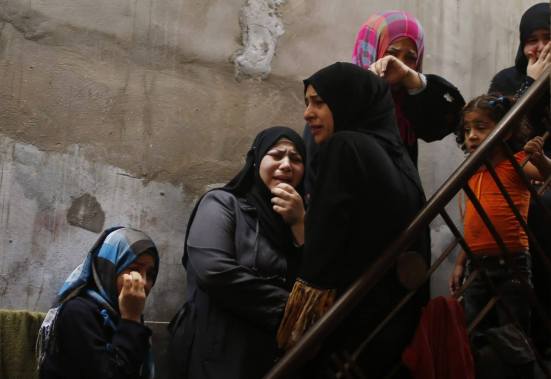
Gaza, July 2014.
 
Such a brief respite. Barely time to find water – let alone food. And all around the UN school fires blazing unchecked. She did not tell her children what she had seen in the streets. Could not admit, even to herself, what lay there. Where was Allah, she wondered, amidst all this death? As if in answer, the sirens wailed, their harsh note of alarm rising and falling like the cry of some gigantic beast in pain. In the shelter they could already hear the hideous screech of the jets. And then, the thud, thud, thud of the bombs …
 
This essay was originally published in The Press of Tuesday, 5 August 2014.

Friday, 25 April 2014

Solemn Falsehoods: ANZAC Day, 2014

Worthy Sons? Every ANZAC Day we tell ourselves that the blood sacrifice of Gallipoli marked the birth of New Zealand nationhood. But as the above poster attests, it was not our independence that George, the King Emperor, acknowledged but our fatal subservience to Britain's imperial interests.
 
THE DEEP SOLEMNITY with which ANZAC Day is commemorated in New Zealand is entirely appropriate. Never before have the people of this country been required to cope with the violent death of so many of their fellow citizens. For New Zealand’s political and military leadership the public’s response to the unprecedented length of the casualty lists was a matter of critical significance.
 
A military disaster on the scale of the Gallipoli campaign can be responded to in one of two ways. Either, the nation recoils in anger and disgust at the unforgiveable failure of both the armed forces and the government to protect its sons; or, it transforms the sordid waste of young lives into an occasion for patriotic and ultimately spiritual exaltation.
 
For the deeply conservative government of the day it, therefore, became a matter of some urgency that the Gallipoli defeat, and its horrific losses, be reconfigured into a blood-sanctified rite of national passage. Having laid upon the altar the “dearest and the best” they had to offer, New Zealanders still at home were told that they had all, by some mysterious patriotic alchemy, been ennobled. Those hundreds of dead Kiwi boys had “stood the test”, and now it was the duty of all those for whom they had made “the final sacrifice” to do the same.
 
This transformation of the botched Dardanelles campaign into a symbol of emergent nationhood was, thus, a stunning example of the most malign and cynical statecraft. By re-presenting the ANZAC defeat as New Zealand’s bloody “coming of age”, the Reform Party Prime Minister, Bill Massey, made certain that the disaster of Gallipoli would never be seriously questioned or criticised. To do so would be tantamount to questioning and criticising “the glorious dead” – and that soon became unthinkable.
 
And so it has continued, down through the ten decades since those ANZAC soldiers first planted their boots on Turkish soil. And in every one of those decades the political and military leadership of New Zealand have reiterated the solemn falsehoods upon which the commemoration of ANZAC Day is founded.
 
That the soldiers died for freedom and democracy.
 
That the battle marked the true birth of the New Zealand nation.
 
That had it been left to the Kiwis and the Aussies, the Gallipoli peninsula could have been secured.
 
The men who died on the unforgiving slopes of Gallipoli were volunteers, brim-full of imperial pride and ready to give their all for their King-Emperor and his empire. Freedom and democracy didn’t come into it. In 1914 Great Britain itself was only barely democratic. Most of the 800,000 British dead gave their lives for a state which did not allow them to vote. New Zealand was a truly democratic state, but the progressive forces which had made it so harboured serious reservations about the war. Conscription was required to keep the blood tribute flowing and the government which oversaw it was brutally authoritarian.
 
Far from marking the birth of the New Zealand nation, the Gallipoli campaign and the subsequent battles in Flanders retarded the development of an independent New Zealand identity. Only in the Second World War could it be truthfully said that New Zealand’s citizen soldiers were consciously fighting for freedom and democracy – along with the job-rich, union-protected, welfare state their votes had brought into being.
 
That the losses in the Second World War were so much less than the First owed a great deal to the lessons drawn from that earlier conflict. Sending farm boys to take the Gallipoli peninsula was always a fool’s errand. The Turks knew it and so did their German advisers. Yes, we took Chunuk Bair, but we couldn’t hold it. Nobody could.
 
Next year we’ll solemnly mark the hundredth anniversary of the Gallipoli landings. I hold little hope that we will do so honestly. Age may not weary those dear, best boys, but while we continue to tell ourselves lies about why they died – they will never rest.
 
This essay was originally published in The Dominion Post, The Waikato Times, The Taranaki Daily News, The Timaru Herald, The Otago Daily Times and The Greymouth Star of Friday, 25 April 2014.

Friday, 28 March 2014

People Like Me

People Like Me: In the English-speaking world the Welfare State was born out of two vast historic events, the Great Depression and World War II. The sense of social solidarity engendered by these all-embracing experiences extended the definition of "community" to include everyone who had lived through them - right up to the British Royal Family.
 
IS IT POSSIBLE to renew our social contract without a sense of community?
 
Heather McGhee, who heads up the Washington Office of the UK-based research and advocacy group, Demos, calls it “the great question of our time”.
 
According to the 33-year-old graduate of Yale and the Berkeley Law School, this is because “if you look at all this hostility and anxiety around public solutions, at its root is the anxiety about who the public is. And I think that’s happened because of the real explosion in diversity.”
 
McGhee is not alone in identifying diversity as one of the most potent solvents of the social contract that underpins our Welfare State. But, as a young African-American, she has a better appreciation than most of how all those “hostilities and anxieties” play out in a non-academic context.
 
Because no matter how earnestly we are encouraged (by people like Ms McGhee) to think otherwise, the ordinary person’s understanding of “community” is generally reducible to just three words: “people like me”.
 
In the English-speaking countries the welfare state was born out of two world-shattering events: Economic Depression and Total War. In both situations it proved virtually impossible for ordinary citizens to remain unaffected by the great happenings in which they found themselves entangled, and these common experiences fostered powerful feelings of social solidarity. Everyone could see they were “all in this together” and relying upon one another to make it through to the “broad sunlit uplands” promised by Winston Churchill in the finest hour of that darkest of years – 1940.
 
So pervasive was the impact of the Great Depression that the experiences of poverty and marginalisation began to lose much of their social stigma. Working-class and middle-class citizens alike were winnowed by the near collapse of the capitalist order, and even those whose material well-being remained unaffected – like the Prince of Wales – could see that “something must be done”.
 
And later, when the bombs were falling, that sense of solidarity only grew stronger. In spite of pleas to remove themselves to safety in Canada, the Royal Family refused to leave the capital. When Buckingham Palace was hit during the Blitz, Queen Elizabeth told the press: “Now, at least, I can look the East End in the eye.”
 
On the battlefields, where men of every rank and station quite literally rubbed shoulders, the essential equality of all human-beings was daily demonstrated. The roughest working-class battler could prove himself a bloody hero and the bloodlines of a thousand years produce nothing more than a craven coward. Nobility came not from class or money but from character. In war, only deeds mattered.
 
This, then, was the historical forge in which the welfare state was fashioned. When people used the word ‘community’; when they thought of people like themselves; the picture included everyone from the King and Queen to the local “night-soil” collector. Everyone who had been through the fire together – and come out the other side.
 
To live for longer than that single generation, however, the social contract that had been fashioned in “blood, toil, tears and sweat” would need to be sent to the forge again. A new generation would need to feel the hammer blows of history.
 
Some did.
 
On union picket-lines. Registering voters in the Deep South. Opposing the obscenity of war. Demanding entry for all those who were not “like me”. Envisioning a more diverse and democratic definition of ‘community’.
 
A More Diverse Definition of Community: America answers Amerika. The Pentagon, 21 October 1967.
 
Too few.
 
The moment the social contract was deemed to include people with darker skins and different gods; the moment people’s taxes were doled out to those whose behaviour flouted the values and conventions of the ‘community’; that was when the solidarities born of depression and war began to fade and wither. The mental picture of who was – and was not – “people like me” narrowed radically. Class and money regained their lost prestige and all the old stigmas attached to poverty and marginalisation returned.
 
A social contract is never for “people like them”.
 
This essay was originally published in The Dominion Post, The Waikato Times, The Taranaki Daily News, The Timaru Herald, The Otago Daily Times and The Greymouth Star of Friday, 28 March 2014.