Showing posts with label ANZAC Day. Show all posts

Friday, 30 May 2025

Mother Countries and Sentinel Sons.

Patriotic Appeal: Zealandia never really caught on. If asked, most Kiwis would scratch their heads and shrug their shoulders. “Never heard of her, mate? Is she in a band?” Some might guess that she’s the Pakeha sheila carrying the flag, and facing the Māori warrior, on New Zealand’s coat-of-arms. But, for the most part, Zealandia, an unoriginal Edwardian attempt at fostering national identity, is long gone.

NEW ZEALANDERS once referred to Great Britain as the “Mother Country”. This was no mere declaration of kinship or affection, it was offered in recognition of Britain’s status as the entity responsible for giving birth to, nurturing, and protecting the young New Zealand state.

Until relatively recently, the notion that Māori might also have had a hand in the creation of New Zealand, or that the Treaty of Waitangi might be viewed as the nation’s birth certificate, would have been dismissed out-of-hand. Obviously, Māori had a past, but beyond the military and legal efforts required to silence those benighted natives demanding a future separate and distinct from that of the Pakeha, it could have no bearing on the colony’s development.

New Zealand was a child of the British Empire. Of that its settlers were as certain as they were proud. The fact that Queen Victoria, titular ruler of an empire greater than any the world had hitherto encountered, was a woman, only reinforced the motherly metaphor.

But if most agreed that Great Britain was the Motherland, did New Zealand’s settler society feel the same way about the nation it was building? If pressed to provide an answer, would the settlers have stuck with the matrilinear option, or would they have opted instead to dub the entity that was rapidly emerging from the overwhelmingly masculine milieu of early colonial New Zealand, the “Fatherland”?

If the statue erected by the people of the little North Otago town of Palmerston in 1903 is any guide, the answer must be an emphatic “No.” This marble personification of the nation, arm uplifted to greet the new twentieth century, was Zealandia – and she was all woman.

Auckland and Christchurch boasted their own versions of Zealandia, and she even makes an appearance in the publicity material produced for the centennial of the signing of the Treaty of Waitangi in 1940. (Which, given the fact that she’s a lightly-clothed Pakeha, is ever-so-slightly, um, racist, and sexist, at least by today’s standards!)

Zealandia 1940
Does that settle the matter? Have Pakeha New Zealanders, guided perhaps by Papatuanuku, the Māori earth mother, always looked upon the nation as female? Or were our colonial forefathers merely aping their European betters? Most obviously Britain’s Britannia, but also France’s Marianne, the USA’s Columbia, and Germany’s Germania: all of them loosely-clad, somewhat stern young women, spoiling for a fight.

Except Zealandia never really caught on, did she? If asked, most Kiwis would scratch their heads and shrug their shoulders. “Never heard of her, mate? Is she in a band?” Some might guess that she’s the Pakeha sheila carrying the flag, and facing the Māori warrior, on New Zealand’s coat-of-arms. But, for the most part, Zealandia, an unoriginal Edwardian attempt at fostering national identity, is long gone.

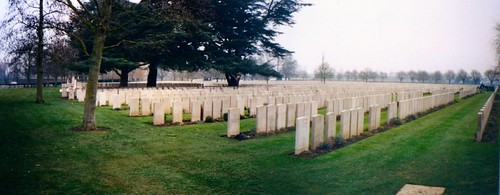
Which is not something one could say about the scores of soldiers keeping watch over the dead of this country’s foreign wars in small towns and large cities all across New Zealand. Statues they may be, some carved out of marble, some cast in bronze, but for the families and friends of the fallen, whose names are often carved on the sides of the monuments they stand atop, these sentinels have kept the collective memory of sacrifice and loss alive for more than a century.

Memorial to the fallen of the Boer War, Oamaru, North Otago.
The first of these structures were raised in commemoration of the New Zealanders who fell “For the Empire” in the Boer War. Their statues strike heroic poses, as befitted their brutal imperial mission. Those of the Great War of 1914-18 embody less belligerent impulses. A soldier stands, rifle thrust forward, protecting his fallen comrade. As much a tribute to Anzac mateship, as martial valor.

New Zealand’s wartime Prime Minister Peter Fraser, believing the country had too many monoliths, to too many dead, opted instead to erect memorial halls to the fallen of World War II. Most still stand, places of community warmth and fellowship, rather than sad piles of cold marble and unflinching bronze.

No. New Zealanders will never refer to their nation as the Fatherland. The term sounds ridiculous – as inappropriate in 2025 as Mother Country. New Zealand is a nation built by daughters and sons. Like settler societies everywhere, it pushes the past behind it, and strides towards the future.

Māori, who have lived here longer, are waiting for us to turn around.

This essay was originally published in The Otago Daily Times and The Greymouth Star on Friday, 25 April 2025.

Monday, 26 April 2021

Anzac Day 2021: Myths Under Pressure.

Imperial Mission: All nations need myths: common narratives – usually heroic, or tragic, or both – with which to bind their citizens to the state with just the right mixture of awe, pity, gratitude and pride. New Zealand’s historical myths were initially crafted to instil loyalty to the imperial British mission, and have maintained a remarkably tenacious grip on the public imagination.

NICHOLAS BOYACK’S controversial commentary piece for Stuff is a harbinger of historical controversies to come. Published just 48 hours before Anzac Day’s dawn parades, Boyack’s “We need an honest debate on Gallipoli and a fresh approach to history”, offers an unashamedly revisionist take on the Gallipoli landings. Not surprisingly, it aroused powerful emotions in Stuff’s readers.

Predictably, many of these emotions reflected the affronted nationalism of adherents to the official version of the Anzac story. More interesting, however, were the responses signalling sympathy with Boyack’s anti-imperialistic views.

With the current government strongly committed to overseeing a revolution in the teaching of New Zealand history, Boyack’s Anzac bombshell looks set to be just the first of many such attacks on our national myths. There are few individuals more subversive of the status quo than historians on a mission.

All nations need myths: common narratives – usually heroic, or tragic, or both – with which to bind their citizens to the state with just the right mixture of awe, pity, gratitude and pride. New Zealand’s historical myths were initially crafted to instil loyalty to the imperial British mission, and have maintained a remarkably tenacious grip on the public imagination. The second great wave of national mythmaking gathered strength in the 1950s and 60s and was aimed at inculcating a robust faith in New Zealand’s “progressive” impulses – the reforms that made “little New Zealand” the “social laboratory of the world”. The grip of this second iteration of “New Zealand-ness” turned out to be considerably weaker than the first.

The proof of the imperial mythology’s enduring strength has just been presented to us in the impressive numbers once-again turning out for the traditional Anzac dawn parades. The devotion of the young to the Anzac Myth has perplexed and delighted not only traditional historians, but the entire New Zealand political class.

It was, after all, the young New Zealanders of the 1970s and 80s who had offered up the first serious challenges to the monolithic imperial mythology of the “RSA Generation”. Provoked, at least initially, by New Zealand’s involvement in the Vietnam War, Anzac revisionism soon expanded into a critique of the deeply-ingrained conservative values, and limited political vision, of the taciturn Kiwi blokes who returned from World War II. The fear was that as those with personal memories of the First and Second World Wars became fewer and fewer the Anzac spirit would also march away, shoulder-to-shoulder, with their ghosts.

The Scotsman-turned-Aussie songwriter, Eric Bogle, summed-up this anxiety in his famous song about Gallipoli “The Band Played Waltzing Matilda”

And so now every April, I sit on me porch
And I watch the parades pass before me
And I see my old comrades, how proudly they march
Reviving old dreams of past glories
And the old men march slowly, old bones stiff and sore
They’re tired old heroes from a forgotten war
And the young people ask, “what are they marching for?”
And I ask myself the same question

But the band plays Waltzing Matilda
And the old men still answer the call
But as year follows year, more old men disappear
Someday no one will march there at all


Except, astonishingly, the thinning ranks of the world war veterans were filled by their children, grandchildren and, by 2021, their great-grandchildren. The Baby Boom generation may have been sceptical of Anzac Day and what it stood for, but Generation X et seq embraced the Gallipoli myth with a passion that was little short of embarrassing. The question is: Why?

Much of the answer is doubtless bound up with the dramatic social and economic transformations of the 1980s and 90s. The free-market reforms that characterised the political histories of both Australia and New Zealand during that critical period effectively put paid to the “progressive” mythologies of the Anzac “brothers” – represented most forcefully by the Labour governments of Gough Whitlam and Norman Kirk.

Globalisation was an important part of the sales pitch of their successors, Bob Hawke and David Lange, and their respective finance ministers, Paul Keating and Roger Douglas. The only problem being that a political project based on giving de-regulated capitalism its head is extremely difficult to reconcile with the tightly regulated capitalism of the social-democratic Australia and New Zealand which Hawke and Lange were in the process of sweeping away. With the costumes of “progressive nationalism” now passé, the Anzac brothers had little other recourse but to reach into the depths of their national memory chests for the imperial paraphernalia of an even older era.

That the Anzac nations did not emerge from this re-invention exercise wearing pretty much the same clobber is due to New Zealand’s nuclear-free policy. Cold-shouldered by Canberra and Washington, and scolded by the British, New Zealand’s embrace of the old imperial myths was tempered by its new status as the scourge of the English-speaking nuclear powers. For a while, at least, this gave to New Zealand’s Anzac Day commemorations a decidedly Blackadder Goes Forth flavour. While the Aussies become increasingly jingoistic (to the point of almost forgetting what the “nz” in Anzac stands for) the Kiwis played up the horror and tragedy of war.

Unfortunately for the New Zealand political class, that doesn’t really work. Play up the horror and tragedy of war too poignantly and people cannot avoid questioning the point of going to war at all. Moreover, it’s only a short step from recognising the futility of war to grasping, as Nicholas Boyack does so persuasively in his commentary, the less-than-honourable motivations of the imperial politicians who refused to stop the war; and the willingness of New Zealand’s politicians to trade so much blood for butter.

And so it is that the rattle of imperial harness has become more and more a feature of Anzac Day commemorations. Youngsters, in particular, will declaim proudly on how the Anzacs went to war for “freedom” and “democracy”, rather than to strengthen the Mother Country’s grip on the oil reserves of the Middle East. One is moved to wonder if the new and compulsory New Zealand history curriculum will appraise these young New Zealanders of the fact that the wartime government of William Massey considered it advisable to lock up freedom and democracy for the duration: conscripting socialist MPs and subjecting the Christian pacifist, Archibald Baxter, to the torture of “Field Punishment No.1”

“It is time for a national debate on our history, focusing on what we can do to lift the standard in schools and universities” says Nicholas Boyack. “We also need to stop peddling myths about Gallipoli and New Zealand nationalism, and take a more honest approach to our history.”

Ah, yes, but that will entail emulating the sorcerer in Aladdin who offered new lamps for old. And when our historians set about exchanging old national myths for brand new ones, who knows what sort of genies will be summoned forth – or what they will be asked to do?


This essay was originally posted on the Interest.co.nz website on Monday, 26 April 2021.

Friday, 20 April 2018

Britain's Interests Nowhere Near The Moral High Ground.

And Never The Twain Shall Meet: Britain’s spoils from the First World War were many, but its greatest prize was indisputably the vast territories formerly controlled by the Ottoman Empire (whose territory we invaded on 25 April 1915). Between them, Britain and her principal wartime ally, France, carved up the Middle East as if it was an oil-soaked Christmas pudding.

IN JUST A FEW DAYS tens-of-thousands of New Zealanders will gather to commemorate the 102nd anniversary of the ANZAC landings. All the usual bromides about heroism, sacrifice, freedom and democracy will be trotted-out. Young people, who are featuring more and more in contemporary Anzac Day ceremonies, will construct their public remarks on the foundational assumption that, in 1915, New Zealand stood on the moral high ground. (By which they mean alongside Great Britain). It does not do to question this assumption. April 25 is this country’s Day of the Dead – and the Dead must be respected.

Let us, therefore, leave the Dead and examine the empire for which they died. Because the lines of British force and British interests that intersected at Gallipoli on 25 April 1915 were not broken there. They survived all that fruitless killing, growing stronger and more extensive as the war wore on. So much so that, by 1919, when most of the peace treaties were signed and sealed, the British Empire controlled considerably more of the earth’s land surface than it had when the conflict began. (As did New Zealand, which found itself in possession of the former German colony of Samoa.)

Britain’s spoils of war were many, but its greatest prize was indisputably the vast territories formerly controlled by the Ottoman Empire (whose territory we invaded on 25 April 1915). Between them, Britain and her principal wartime ally, France, carved up the Middle East as if it was an oil-soaked Christmas pudding.

Nations that are still, more than a century later, providing the world with its blackest headlines: Palestine (now Israel) Iraq, Syria, Saudi Arabia; were all cradled in the intersecting lines of British force and British interests. Young protesters may have waved placards decrying the exchange of young blood for oil during the first Gulf War of 1991 but, rest assured, the idea – if not the slogan – is much, much older than that!

Not that all the people of the region were content to live their lives enmeshed in the lines of British force and British interests. Many of them rose in rebellion against the British Empire – just as T.E. Lawrence, “Lawrence of Arabia”, had encouraged them to do against the Ottoman Empire during the Great War.

In 1920, anxious to conserve British blood and treasure while putting down these Arab revolts, the then British Secretary of State for War, Winston Churchill, recommended that the RAF deploy chemical weapons – mustard gas in particular. Gas, he insisted, was bound to inspire “a lively terror” in the rebel-held territories.

Not that Great Britain restricted itself to terrorising the Arab peoples. In “Arabia” they were only too happy to secure a kingdom for the House of Saud. In a bewildering series of alliances forged and friendships betrayed, the British armed Abdulaziz al Saud and his fanatical Wahhabist militia and allowed them to take control of most of the Arabian Peninsula, including the holy Muslim cities of Mecca and Medina. When the Wahhabists attempted to spread their fundamentalist version of Islam beyond Abdulaziz’s new realm, he had their leaders mown down with British-supplied machine-guns.

It was the beginning of a long and fruitful relationship between Great Britain and the Muslim world. In India the lines of British force and British interests were deliberately drawn between the Muslim and Hindu communities. While the British Raj endured, the purpose of these “divide and rule” tactics remained purely political. Only in 1947, as British rule was coming to an end, did they become geographical. It was the Foreign and Colonial Office that partitioned India and created the Muslim state of Pakistan.

Saudi Arabia, Pakistan, Wahhabism: for the past 70 years these have been the nurseries for all manner of Islamic religious fanaticism and jihadi terrorism. Saudi Arabia gave us Osama Bin Laden, and Pakistan, when it wasn’t busy organising and supplying the Taliban, gave him shelter. And through it all, though increasingly difficult to discern clearly, the lines of British force and British interests have continued to run. Which countries are counted among the biggest importers of British military equipment? Saudi Arabia and Pakistan.

The invasion we celebrate every year on 25 April continues to cast a very long shadow. Wherever Britain and the Anzacs were standing on that day, it was nowhere even remotely near the moral high ground.

This essay was originally published in The Waikato Times, The Taranaki Daily News, The Timaru Herald, The Otago Daily Times and The Greymouth Star of Friday, 20 April 2018.

Wednesday, 26 April 2017

Why They Went To War - Anzac Day 2017

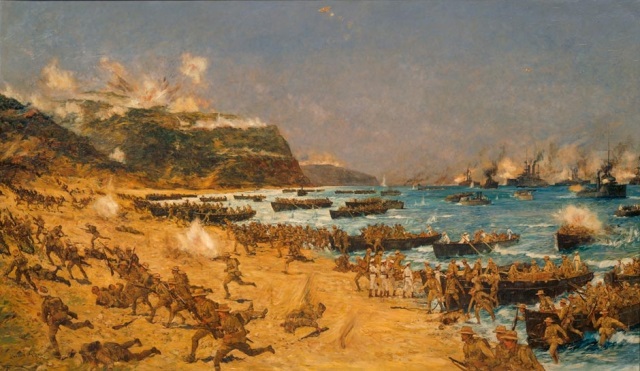
Heroism At ANZAC Cove: Hundreds of young New Zealanders and Australians died on the Gallipoli Peninsula on 25 April 1915. We can ask ourselves whether furthering Great Britain's imperial ambitions was worth the blood sacrifice - confident in the wisdom of hindsight that it was not. It is sobering, however, to reflect that, asked the same question, most the boys coming ashore that fateful morning would have answered with a resounding "Yes!"

“THEY DIDN’T EVEN THINK ABOUT IT.” That was the awestruck assessment of the young man interviewed for Television New Zealand’s Q+A programme. He was one of a small crowd of Wellingtonians gathered around New Zealand’s handsomely refurbished National War Memorial to hear the playing of the Last Post and the ritual recitation of “For The Fallen”. Every one of the 1,560 days of New Zealand’s participation in the First World War, now a hundred years in the past, is being commemorated in this fashion. The great tragedy of that conflict: a tragedy which endures; is that, like the thousands of young men who rushed to join up in August 1914, far too many New Zealanders still decline to even think about why they went to war.

If pressed, most Kiwis will mutter something about defending freedom and democracy. But that is the answer to another question. Defending freedom and democracy was why New Zealand and the other Dominions of the British Empire went to war against Nazi Germany in 1939.

Except, truthfully, it’s a trick question. Because, if the international crisis of June-August 1914 had been handled differently, then there would have been no need to go to war against Adolf Hitler in September 1939. World War I and World War II constitute the bookends of a single conflict. And what New Zealanders were fighting for at the beginning of this calamitous thirty-year struggle was very different from what they were fighting for at its end.

To say that World War I was spawned by imperial rivalries is simply to state the obvious. The question New Zealanders needed to (but didn’t) ask themselves in 1914 was: “Why is the empire we belong to – the British Empire – so willing to invest its blood and treasure in a quarrel between the empires of Russia, Germany, Austria-Hungary and France?”

The answer is simple: because the British Empire was frightened.

It was frightened of Russia’s growing capacity to project its military power in the direction of Britain’s most important, and vulnerable, imperial possession: India. The Royal Navy could not defend the Indian sub-continent from a concerted, land-based, Russian advance. It was, therefore, in Britain’s economic, military and diplomatic interests to keep Russia focused on opportunities for expansion in Europe – not Asia.

The British Empire also feared Germany. Since reunification in 1871, German industrial expansion had been phenomenal. Britain’s pre-eminent economic position, along with her ability to defend it, faced a formidable challenger. Unchecked, Germany would soon become the economic arbiter of Europe (just as it is today!) and that economic power, strapped to her undisputed military prowess, would soon make Germany the most powerful nation on earth.

That was not a position the British Empire was willing to relinquish – not yet.

The diplomatic outcome of all this was the Triple Entente. By aligning herself with Russia and France, Britain was able to neutralise the threat posed by the former, while quietly encouraging the anti-German ambitions of the latter. The designated victims of all this geo-strategic manoeuvring were to be the two weakest members of the imperial club: the Austro-Hungarian and Ottoman Empires. The prospect of dividing-up the territories of these decrepit dynasties (along with those of a defeated Germany) made Russia, France and Britain salivate like hungry dogs.

Not surprisingly, the Germans reacted to the machinations of the Triple Entente with considerable alarm. Faced with the prospect of the Russian “steamroller” lumbering towards them from the East, and the “revanchist” French rushing at them from the West, Germany’s generals applied themselves to devising a plan for fighting a successful two-front war. The one they finally settled on demanded the destruction of the French army before Russia’s could build up steam. It did not require a particularly brilliant strategic brain to realise that this would necessitate a massive flanking manoeuvre through neutral Belgium.

Long before August 1914, therefore, the British understood that Belgian neutrality could only be preserved by ensuring that the military obligations enshrined in the Triple Entente were never activated. In other words, by preventing the outbreak of a full-scale European war.

The British Empire thus found itself in the absurd position of wanting France to recover her lost provinces; Germany to be economically prostrated; Russia to be distracted from any southward push towards India: while, simultaneously, hoping that all these key strategic outcomes could be accomplished without anyone firing a single shot.

By August 1914, however, the British Government had reluctantly accepted that none of its objectives could possibly be secured without committing the peoples of the British Empire to a murderous global conflict. When, 1,560 days later, that conflict ended, Britain’s objectives were secured: Germany crushed; Russia imploding; the Middle-East theirs.

Freedom and Democracy? They could come later.

If we’d thought about it, I wonder, would we still have done it?


This essay was originally published in The Press of Tuesday, 25 April 2017.

Tuesday, 26 April 2016

Only Anger: Thoughts On Anzac Day 2016.

The First World War: A crime so colossal that it simply overpowered the imaginations of those who lived through it and after it.
 
IF YOU WERE ASKED”: What emotion is appropriate for Anzac Day? How would you answer?  Pride? Respect? Gratitude? My answer has always been, and continues to be, Anger. Bitter, searing, righteous anger at the waste of so many young lives, and at the lies told to justify a crime so colossal that it simply overpowered the imaginations of those who lived through it and after it.
 
For more than a hundred years those lies have transformed the terrible losses of the First World War into a perverse source of pride, respect and gratitude. Not only have they kept the truth about the war’s origins and objectives hidden, but they have also made it practically impossible to challenge the official version of events. This is no small achievement when the consequences of those events are still shaping our lives.
 
At the heart of the darkness that sent millions of young men to their deaths was Great Britain’s determination to destroy the thriving German economy and seize the strategic resources of the decrepit Ottoman Empire.
 
Unchecked, the German economy would have dominated the whole of Europe by the second or third decade of the twentieth century (much as it dominates Europe today). Even more worryingly, the German Empire’s increasingly close economic, diplomatic and military relationship with the Ottoman Empire would have ensured its privileged access to the strategic super-fuel of the twentieth century – oil. From the early years of the century, therefore, the reduction of Germany became the idée fixe of British foreign-policy.
 
Great Britain’s natural ally in this policy was France. Decisively defeated by the Germans in 1871, France was acutely aware that its influence in Europe was steadily being eroded by Germany’s dramatic economic growth. It’s only hope of remaining a major player in world affairs was, therefore, to strike its neighbour a crushing blow.
 
France’s key strategic problem, however, was that it could not deliver such a blow on its own – it needed allies. The first of these, the Russian Empire, was made available by the German Emperor, Wilhelm II’s, failure to renew his country’s crucial Reinsurance Treaty with Russia. The French were only too happy to fill the diplomatic vacuum created by the German Emperor’s strategic blunder.
 
This new Franco-Russian “understanding” suited British interests extremely well. Not only was Germany now faced with a war on two fronts, but, by drawing the Russians towards Europe, the French were relieving Russian pressure on the borders of the “jewel” in Britain’s imperial crown – India.
 
All that Britain required to unleash a devastating conflict upon its most dangerous economic rival was a plausible pretext. This it acquired by allowing the French and the Russians a free hand in the Balkans.
 
Europe’s flashpoint, the Balkans were the point of intersection of multiple imperial interests: Austro-Hungarian; Russian; Ottoman; and Serbian. Any move by the Austro-Hungarian Empire against its ultra-nationalist neighbour, Serbia, was bound to draw in the latter’s Russian protectors. A Russian thrust against Germany’s ally, Austria-Hungary, would, likewise, draw Germany into the conflict. German involvement would activate the Franco-Russian alliance – immediately plunging Germany into a strategically perilous two-front war.
 
Britain knew that if Germany was to avoid being caught between the French hammer and the Russian anvil, it would have to deliver a knockout blow to the French before the full weight of Russia’s vast army could be brought to bear on its eastern front. The only effective means of delivering such a blow was to direct Germany’s army through neutral Belgium and come at Paris from the north-west.
 
In other words, to enter the war with “clean hands”, Britain had only to give France its head in the Balkans. It was pretty sure that the French, with Russian connivance, would find a way to set Austria-Hungary at Serbia’s throat – thereby initiating a general European war. The assassination of the heir to the Austro-Hungarian throne in the little Bosnian town of Sarajevo on 28 June 1914 by Serbian terrorists proved to be an admirably serviceable trigger.
 
Once the Germans detected the preparations for a Russian mobilisation against not only their Austro-Hungarian ally, but also themselves, the die was cast. Germany mobilised pre-emptively, her armies smashed their way through neutral Belgium, and Britain was supplied with the morally unassailable excuse for doing what she had been planning to do for the best part of a decade – unleashing war on Germany.
 
It was in pursuit of these blunt imperial objectives that more than 12,000 young New Zealanders were sent to their deaths. Not for democracy: our allies, the Russians, were governed by an absolute monarch; and our enemies, the Germans, boasted a more inclusive franchise that Britain’s. And certainly not for freedom: imperialism and liberty do not mix. As for the “values” New Zealanders were supposedly defending on the slopes of Gallipoli. I’d like to think that these: extreme racism, unthinking obedience to those in authority; and the extension of British power across the globe; would be rejected out-of-hand by the vast majority of modern New Zealanders.
 
As I note in, No Left Turn:
 
A patriotic painting from the depths of the war says it all. Entitled “The Casualty List”, it depicts a grief-stricken mother, her head bowed before the framed photograph of her soldier son on the mantelpiece, a copy of The New Zealand Herald dangling limply from her hand. In the top left-hand corner of the painting we see the moment of his death – the young hero’s body reeling backwards as his comrades press on towards the foe. It is a sombre work, and skilfully rendered, but it does not tell the truth about the war. Captured instead is the sense of loss; the awful ache that clawed at the hearts of practically every New Zealand family in the aftermath of the carnage. That much – but no more – was all the nation was permitted to feel. Questions about what it had all been for were met with the palliative care of capitalised nouns: Justice, Honour, Liberty, Country, Democracy. The unbearable reality – that they had died to preserve the prosperity of those who stayed behind – had to be, and was, suppressed.
 
It is still being suppressed. And if none of the arguments advanced above are sufficient to rouse your indignation, then the ongoing and deliberate suppression of the truth about the origins and objectives of the First World War should make you very angry indeed.
 
This essay was originally posted on The Daily Blog of Monday, 25 April 2016.

Friday, 25 April 2014

Solemn Falsehoods: ANZAC Day, 2014

Worthy Sons? Every ANZAC Day we tell ourselves that the blood sacrifice of Gallipoli marked the birth of New Zealand nationhood. But as the above poster attests, it was not our independence that George, the King Emperor, acknowledged but our fatal subservience to Britain's imperial interests.
 
THE DEEP SOLEMNITY with which ANZAC Day is commemorated in New Zealand is entirely appropriate. Never before have the people of this country been required to cope with the violent death of so many of their fellow citizens. For New Zealand’s political and military leadership the public’s response to the unprecedented length of the casualty lists was a matter of critical significance.
 
A military disaster on the scale of the Gallipoli campaign can be responded to in one of two ways. Either, the nation recoils in anger and disgust at the unforgiveable failure of both the armed forces and the government to protect its sons; or, it transforms the sordid waste of young lives into an occasion for patriotic and ultimately spiritual exaltation.
 
For the deeply conservative government of the day it, therefore, became a matter of some urgency that the Gallipoli defeat, and its horrific losses, be reconfigured into a blood-sanctified rite of national passage. Having laid upon the altar the “dearest and the best” they had to offer, New Zealanders still at home were told that they had all, by some mysterious patriotic alchemy, been ennobled. Those hundreds of dead Kiwi boys had “stood the test”, and now it was the duty of all those for whom they had made “the final sacrifice” to do the same.
 
This transformation of the botched Dardanelles campaign into a symbol of emergent nationhood was, thus, a stunning example of the most malign and cynical statecraft. By re-presenting the ANZAC defeat as New Zealand’s bloody “coming of age”, the Reform Party Prime Minister, Bill Massey, made certain that the disaster of Gallipoli would never be seriously questioned or criticised. To do so would be tantamount to questioning and criticising “the glorious dead” – and that soon became unthinkable.
 
And so it has continued, down through the ten decades since those ANZAC soldiers first planted their boots on Turkish soil. And in every one of those decades the political and military leadership of New Zealand have reiterated the solemn falsehoods upon which the commemoration of ANZAC Day is founded.
 
That the soldiers died for freedom and democracy.
 
That the battle marked the true birth of the New Zealand nation.
 
That had it been left to the Kiwis and the Aussies, the Gallipoli peninsula could have been secured.
 
The men who died on the unforgiving slopes of Gallipoli were volunteers, brim-full of imperial pride and ready to give their all for their King-Emperor and his empire. Freedom and democracy didn’t come into it. In 1914 Great Britain itself was only barely democratic. Most of the 800,000 British dead gave their lives for a state which did not allow them to vote. New Zealand was a truly democratic state, but the progressive forces which had made it so harboured serious reservations about the war. Conscription was required to keep the blood tribute flowing and the government which oversaw it was brutally authoritarian.
 
Far from marking the birth of the New Zealand nation, the Gallipoli campaign and the subsequent battles in Flanders retarded the development of an independent New Zealand identity. Only in the Second World War could it be truthfully said that New Zealand’s citizen soldiers were consciously fighting for freedom and democracy – along with the job-rich, union-protected, welfare state their votes had brought into being.
 
That the losses in the Second World War were so much less than the First owed a great deal to the lessons drawn from that earlier conflict. Sending farm boys to take the Gallipoli peninsula was always a fool’s errand. The Turks knew it and so did their German advisers. Yes, we took Chunuk Bair, but we couldn’t hold it. Nobody could.
 
Next year we’ll solemnly mark the hundredth anniversary of the Gallipoli landings. I hold little hope that we will do so honestly. Age may not weary those dear, best boys, but while we continue to tell ourselves lies about why they died – they will never rest.
 
This essay was originally published in The Dominion Post, The Waikato Times, The Taranaki Daily News, The Timaru Herald, The Otago Daily Times and The Greymouth Star of Friday, 25 April 2014.

Friday, 26 April 2013

The Living And The Dead (ANZAC Day 2013)

Mythos At Work: Collective memorialisation, or mythos, takes our basic values and attitudes and re-fashions them into the patterns of memory and meaning that re-present the past. ANZAC Day's cultural entrenchment is proof that the mythic transformation of this historical moment is almost complete. Waitangi Day, by contrast, remains a living issue whose meaning is yet to be settled.

THE LAST NOTES of The Last Post have faded into the dawn skies of ANZAC Day for another year. The words of Laurence Binyon’s poetic tribute, For the Fallen, have been intoned with due solemnity, and thousands of young New Zealanders, most of them blessedly untouched by war, have again repeated its final pledge: “We will remember them.”
 
Moments of sombre ceremony, in which old and young, past and present, are drawn together in the embrace of collective memorialisation, or mythos, are precious to all cultures. It is why, even in such a resolutely secular nation as New Zealand, christenings, marriages and funerals retain such enormous emotional power. And, almost certainly, it explains why sixty percent of New Zealanders say ANZAC Day means more to them than Waitangi Day.
 
But human memory is a most unreliable transmitter of truth. Indeed, what tends to get transmitted in ceremonies like the ones we engage in on ANZAC Day has almost nothing at all to do with historical reality.
 
Taken Binyon’s famous poem, for example.
 
Loaded upon that final, endlessly-quoted stanza of For the Fallen is all the consciousness of waste and horror that the peoples of the participating nations, ever since the guns fell silent in 1918, have brought to their assessment of World War One. The image conveyed in the words, “at the going down of the sun”, is not merely one of a descending star, but of something much closer to home: of countless fallen sons; a broken generation; the ending of an age.
 
And that is how mythos works. It takes our basic values and attitudes and re-fashions them into the patterns of memory and meaning that re-present the past.
 
Binyon’s poem, written in the thrilling weeks that followed the out-break of war in August 1914, and published a month later in The Times, was romantic nonsense.
 
Consider these lines:
 
Solemn the drums thrill: Death august and royal,
Sings sorrow up into immortal spheres.
There is music in the midst of desolation,
And a glory that shines upon her tears.
 
And then consider how all those thousands of young men, “straight of limb, true of eye, steady and aglow”, actually died. Choking on their own blood. Drowning in pools of stinking mud. Slowly, in agony, on the wire. The only music in no-man’s land was the staccato chatter of the machine-guns. Nothing there you’d call “august and royal”; no “glory that shines”; no one to dry the tears of eighteen year-old boys whose last word was almost always: “Mother.”
 
Binyon’s actual poem, written before World War One took on the hideous aspect that still appals us, bears no resemblance to the poem we recite on ANZAC Day. That poem was written by the men who came back, and by the mothers of the boys who didn’t. It was written by the old men who pondered the empty pews in the local church, the empty tables at the local pub, the empty positions in the local Rugby team.
 
Mythos wrote The Ode of Remembrance.
 
But mythos has not yet re-written Waitangi Day. Unlike ANZAC Day it has yet to congeal into ceremony and solemnity. Waitangi Day is still a living thing: it’s “truths” unsettled. As a nation, we are still working on the patterns of memory and meaning in which the signing of the Treaty of Waitangi will, eventually, be enmeshed.
 
In every community the grim obelisks stand, bearing the names of the fallen and registering the myriad futures that were never fulfilled. In the chill dawn of every ANZAC Day we have a duty to remember them. Not as the tragic, self-sacrificing heroes that mythos has turned them into, but as they really were: teenage boys who died far from home for old men’s dreams of empire and dominion.
 
And on the morning of Waitangi Day, filled as it always is with rancour and resentment, pride and protest, give thanks that New Zealand’s future is still ours to make.
 
This essay was originally published in The Dominion Post, The Waikato Times, The Taranaki Daily News, The Timaru Herald, The Otago Daily Times and The Greymouth Star of Friday, 26 April 2013.

Thursday, 25 April 2013

Live From Gallipoli


Raw Uncensored Images: How long could the slaughter of World War I have continued if the people back home had been able to see what was going on? Could Gallipoli happen today?
 
TRY TO IMAGINE the New Zealand public’s response to a Gallipoli campaign unfolding in the glare of modern communications technology, and being judged according to the Twenty-First Century citizen’s ideas about war, peace, and patriotism.
 
It’s dawn on Sunday 25 April 1915, and more than three thousand New Zealand soldiers are preparing to assault the precipitous flanks of the Gallipoli peninsula. Within 48 hours, 241 of them will be dead and 690 wounded.
 
The electronic media embedded with the New Zealand Expeditionary Force are prevented from broadcasting these facts by Bill Massey’s panic-stricken government. But, to the utter dismay of the Prime Minister, many of the soldiers have smuggled cell-phones ashore in their kit-bags. Almost instantly, vivid images of the carnage are being posted on the Internet.
 
Heart-wrenching messages sent to loved ones by young men dying of terrible wounds shock and horrify their friends and family. The nation reels in horror from the awful evidence of death and disfigurement.
 
All over the country, candle-lit vigils are organised to honour the fallen. Thousands gather in city parks and in front of Parliament. Angry speeches are made by the families and friends of those killed. People are demanding to know why so many New Zealanders are dying in someone else’s country.
 
Increasingly the question is raised: why did the leaders of Britain, France and Russia object to the Austrians’ attempt to shut down the terrorists operating under the protection of the Serbian Government? After all, wasn’t it the heir-apparent to the Austro-Hungarian Empire who was assassinated at Sarajevo last June? If the Prince of Wales had been killed by international terrorists, can anyone imagine the British Government giving up the opportunity to punish those responsible?
 
The television coverage coming in by satellite – though heavily censored – is sufficiently graphic to make clear the enormity of the blunders committed by the British High Command. Landed on the wrong beach. A lack of cover for the troops. The fatal under-estimation of the quality of the Turkish infantry and their German advisers. The pictures beamed back from Gallipoli make it very clear that our troops are trapped in the middle of a full-scale military disaster.
 
And every day more soldiers die. Within a fortnight of the landings, there’s hardly a family in New Zealand who doesn’t know someone who has lost a son or brother in Gallipoli’s twisting gullies, or on the bare, exposed ridges of its sun-baked hills.
 
Awkward questions are being asked. Why are we dying for the Tsar of Russia? Why are we attempting to break open the gates of Constantinople for a man who gunned down thousands of his own subjects in front of the Winter Palace in St Petersburg?
 
What role did the French Government play in the outbreak of war? The French President and his Foreign Minister were both in St Petersburg in the days immediately following the Archduke Franz Ferdinand’s assassination? What did they promise the Tsar? Before embarking for Paris did they secretly promise Russia France’s total support?
 
Was that why Nicholas II (a notoriously indecisive man) felt confident enough to order the mobilisation of his armed forces? And didn’t that require Germany to mobilise in defence of Austria?
 
Faced with a two front war what else could the German High Command be expected to do except attempt to defeat France quickly by attacking through Belgium?
 
Why didn’t Sir Edward Grey act more decisively to prevent the descent into war? Was it because the Foreign Office was determined to prevent Germany exploiting the oil fields of the Ottoman Empire? Were Anzacs killing Turks to prevent Germans building a railway from Berlin to Baghdad?
 
In 1915 no one asked such questions. It was a different world. Young soldiers marched off to die for King and Country, and the nation cheered them on. As the number killed at Gallipoli climbed to a staggering 2,721, and recruitment collapsed, Massey readied the country for conscription. And the stoical New Zealand public endured it all.
 
The idea that their sons were dying in a wrong cause was as inconceivable then, as it is probable now.
 
This essay was originally published in The Dominion Post of Friday, 27 April 2007.

Wednesday, 25 April 2012

A Huge Exercise In National Denial

We're here because we're here because we're here because we're here: These words, sung to the tune of 'Auld Lang Syne' captured the futility of the exercise in industrial scale bloodletting that was the First World War. It would serve as a much more fitting tribute to the slaughtered sons of New Zealand than 'I Vow To Thee My Country'.

“WE’RE here because we’re here, because we’re here, because we’re here …”  This tongue-in-cheek anthem to utter futility was sung with gusto all along the Western Front during World War I. The tune – an adaptation of Auld Lang Syne – was entirely appropriate. Between a third and a half of the men who sang it at the “sharp end” of that pointless conflict never returned to celebrate the fifty New Year’s Eves that were their due.

Sadly, we do not sing “We’re Here” at dawn services on ANZAC Day. It’s lugubrious nihilism would sit uncomfortably alongside the youthful heroism with which the day is still infused. The 18,000 dead of World War I must be shielded from the muck and stink of the killing fields to which they were consigned. For more than ninety years we have bathed their memories in the radiant colours of idealism and self-sacrifice: singing hymns to the “love that never falters, the love that stands the test/That lays upon the altar the dearest and the best.”

But how many of us realise, as we sing the stirring verses of “I Vow To Thee My Country”, that the God who claimed our dearest and our best was not the Christian Yahweh, but Moloch – the insatiable pagan deity into whose fiery bowels the ancient Carthaginians were forced to consign their own precious children?

To sing “We’re Here” would be to acknowledge that between 1914 and 1918 twenty percent of our military age population – some 58,000 young men - were needlessly and pointlessly maimed and slaughtered. More importantly, it would be to identify the commission of a vast and unforgivable crime by the Imperial and Dominion Governments of the day. But that is something which the New Zealand state – and the New Zealand people – will not do. Even after the passage of nine decades, the huge exercise in national denial that is ANZAC Day continues.

It is young New Zealanders I feel most sorry for. Every ANZAC Day they throng to the cenotaphs and memorials, yearning for some sort of mystical communion with the boys who “will not grow old – as we who are left grow old”, and never quite finding it.

When questioned by breathless young reporters, they speak about the soldiers who “fought for peace”, and “died so we could be free”. Freedom? Peace! The invasion of Turkey was intended to open the sea lanes to the Russian Empire. Yes – that’s right – the Russian Empire. Nearly 3,000 young Kiwis died at Gallipoli for the Tsar of Russia – a ruthless autocrat whose Cossacks, just nine years earlier, had massacred hundreds of his own subjects on “Bloody Sunday”. It modern terms, it would be like asking 3,000 young New Zealanders to die for the Chinese politicians who ordered the troops into Tiananmen Square.

Not that the men who volunteered in 1914 objected to invading Turkey. Far from it. Many of them had acquired a taste for action less than a year earlier when they mounted up and rode into Auckland and Wellington to crush the General Strike of 1913. To read the contents of these “special” policemen’s newspaper – “The Camp Gazette” – is to discover the mindset that would later become familiar to the world as fascism. Oh yes, those boys on the slopes of Gallipoli fought for their King and their Country all right: but for “our” freedom? – I think not.

Of course the working class lads whose heads were split open by “Massey’s Cossacks” in 1913, died in considerably greater numbers than the ANZACs of 1915. But the 50,000 casualties of the New Zealand Division didn’t suffer in the mud of Flanders for Peace and Freedom, they suffered because, as conscripts, they were given little choice.

Bill Massey, New Zealand’s ferociously conservative Prime Minister, introduced conscription in 1916. This bigoted Ulsterman fervently believed that the British were descended from the Israelites, and ordained by God to rule the world. The Labour Party was born out of the struggle to make his hideous sacrifice of a whole generation mean something.

“We’re here because we’re here, because we’re here…” the Diggers sang. If we are to celebrate anything on ANZAC Day, let us celebrate the grim gallows humour of men who in the face of political criminality, unspeakable horror, and an overwhelming sense of the utter futility of their conduct, could still go “over the top” with a song on their lips.

They will not grow old. But it is long past time that those of us who are left grew up.

This essay was originally published in The Dominion Post of Friday, 28 April 2006.

Friday, 30 April 2010

In Harm's Way

"And there's another country": Stoicism and sacrifice, the virtues that permitted a nation of barely one million citizens to bear the loss of 18,000 of its children in the First World War, are no longer much valued in the hyper-sentimentalised mass culture of the 21st Century.

THREE YOUNG SERVICEMEN die when a RNZAF Iroquois helicopter crashes into the hills above Pukerua Bay on ANZAC Day, 2010.

The bare facts: Who? What? Where? When?

We’ll wait a little longer, I suspect, for the How? And the Why?

And behind the bare facts – as always – are the torn and floating webs of family and friendship. Stories that could fill volumes. A private grief that never wholly departs. That aching sense of absence, that bitter taste upon the tongue, every time April 25th rolls ‘round.

For the families, friends and comrades left behind, ANZAC Day will never be the same.

There was so much we could have learned from this accident. An opportunity to follow the vivid threads of history back to the events that gave birth to the whole tradition of ANZAC Day commemoration. Tragically, however, we allowed this chance to link the raw emotions of the present with the thoughts and feelings of the past to slip through our fingers.

Instead of displaying the stoicism that a soldier’s death demands, we have been encouraged to wallow in the worst kind of public sentimentality. Our heartstrings have been worn to breaking-point by the news media’s relentless bows. Our capacity for sober reflection overwhelmed by the insistent journalistic clamour for everyone – from the Prime Minister on down – to emote, emote, emote!

We are told that our armed services are "like a family" – whose members have been "stricken" by the ANZAC Day crash. When interviewed shortly after the accident, Lieutenant-General Jerry Mateparae, Chief of the NZ Defence Force, seemed close to tears. The Prime Minister instantly cut short his planned visits to Saudi Arabia and the Middle East in order to be present at the funeral.

What does this tell us about New Zealand’s soldiers and citizens in the 21st Century? What does it say about our resilience? Our willingness to sacrifice? Our capacity to endure loss?

If this past week’s outpouring of grief at the accidental deaths of three servicemen is indicative of New Zealanders’ collective grasp of the brutal realities of military service, then we’re all in very big trouble.

Every nation, for its own safety and security, must regularly and ruthlessly send a percentage of its young men and women into harm’s way: harm from which not all of them will emerge unscathed; harm which an unavoidable and irreducible number will not survive at all.

A defence force that cannot take casualties simply isn’t worthy of the name. And a nation which is no longer able to stoically endure its losses has laid itself open to every kind of enemy assault.

This is not a popular line of argument in 2010. In an age of rampant individualism, the virtues of stoicism and sacrifice are scorned. The idea of "laying down one’s life for one’s friends" only makes sense on Facebook.

But just pause for a moment, and try to imagine the New Zealand which, in the days, weeks and months that followed the landing at ANZAC Cove, was flooded by a never-ending stream of fatal telegrams.

Imagine a nation of just over a million citizens, asked to absorb the loss not of three – but of three thousand – of its children. Imagine the families which, day after day, were torn asunder: the sons, brothers, husbands and sweethearts for whom there could be no funerals, no front pages. Imagine the enormous – the almost superhuman – effort required to hold up one’s head; to dry one’s eyes; to place one foot stubbornly in front of the other. To carry on.

Imagine a grief so vast, so unrelenting, that it escaped altogether the power of ordinary speech. Imagine its dreadful weight as each year’s ANZAC Day services drew near.

We look at the great memorials to the fallen, and we sense in the cold marble, in the endless lists of names, something awful. There’s a terrible void where life and talent should’ve flourished; the abiding absence of a whole generation which, with a stoical endurance that simply outdistances contemporary imagination, traded their present for our future.

Perhaps it’s this, the sense of being part of their country’s unending story, that makes even remotely bearable the sacrifices of military families.

And yet, as those three young airmen are borne to their final resting-place, I ask myself:

Could 21st Century New Zealand survive another Gallipoli?

This essay was originally published in The Dominion Post, The Timaru Herald, The Taranaki Daily News, The Otago Daily Times and The Greymouth Evening Star of Friday, 30 April 2010.

Saturday, 25 April 2009

The Shrine (ANZAC Day 2009)

Children at the Shrine of Remembrance in Melbourne.


CROSSING the Yarra River at Prince’s Bridge it’s impossible to miss. Set at the top of a gentle slope it looms above the road to St Kilda like something from another age. In its physical dimensions Victoria’s war memorial – The Shrine of Remembrance - is huge, but its spiritual dimensions are larger still. Modelled on the tomb of Mausolos – one of the seven wonders of the ancient world – it’s design dwarfs the visitor, deliberately reducing his transient individuality to that of a mere speck before the vast collective sacrifice of "The Fallen". And lest he be in any doubt, letters of bronze, set into the flagstones of the Shrine’s vast forecourt, inform him that THIS IS HOLY GROUND.

They come to this forecourt every year on 25 April to remember the event that did so much to make the nation of Australia. More and more as the years have passed, so that the crowds of today begin to rival the crowds that gathered in the years immediately after the Great War, when the wrench and twist of grief was still new, and the tears for the sixty-two thousand young Australians who fell for "King and Country" had yet to dry.

The buttresses of the mausoleum, vast arrays of granite statuary, identify the young state’s tutelary deities: PATRIOTISM, SACRIFICE, JUSTICE, PEACE & PROSPERITY. Carried upon chariots, drawn by lions, these sixty-foot civic goddesses gaze down upon the city of Melbourne through eyes of stone, unblinking in the bitter Autumn wind. Brown leaves from the adjacent King’s Domain swirl and flutter like unquiet souls around the shrine’s battlements, collecting in anonymous drifts, to be trampled beneath the feet of passing tourists.

And in the very heart of the shrine, set beneath the level of the flagstones so that all who read the words engraved upon it must bow their heads, lies the Remembrance Stone itself. So placed that upon the eleventh hour, of the eleventh day, of the eleventh month – the moment in 1918 when all the guns fell silent – a single shaft of sunlight falls upon the stone. The words chiselled into its surface - "greater love hath no man" - are taken from John 15:13, and recall Christ’s words to his disciples: "Greater love hath no man than this, that a man lay down his life for his friends" On the morning of Remembrance Day it is the word "love" that the solitary sunbeam sets ablaze.

The weight of sorrow and the depth of loss that could build such a structure as Melbourne’s Shrine of Remembrance is difficult for someone of my generation to comprehend. Constructed in the depths of the Great Depression, when every penny was precious, the funds for the Shrine were nevertheless extracted from Victoria’s impoverished citizens in less than six months. Three hundred thousand people attended the opening ceremony in 1934.

But, my most poignant memory of the Shrine is not of the vast mausoleum itself, but of the Cenotaph. Standing in a corner of the Shrine’s forecourt, this stark memorial to the dead of the Second World War seems to mock the vast structure in whose shadow it stands - testifying to the unbearable fact that all the sacrifices of 1914-18 were offered up in vain.

As a New Zealander, it was impossible not to be moved by this sense of the futility of it all, and not to share in pathos of this extraordinary memorial. Impossible, too, not to feel proud of the fact that out of all the blood and pain and slaughter, the "Lion’s cubs" forged a new identity – catching from Lone Pine Ridge and the summit of Chunuk Bair a glimpse of that morning when the encumbering cultural armour of imperial loyalty could finally be laid aside.

Perhaps it is because we were the smaller cub, that we shrugged off the need for Imperial patronage a decade or so earlier than our larger Australian brother. But, if the words of Mark Latham, the Australian Labor leader, can be believed, the day is fast approaching when both of the nations joined by the word ANZAC will feel free to march to the beat of their own drummers. For what New Zealand learned decisively in Vietnam, Australia is only now absorbing in Iraq: that all empires – American as well as British – have an insatiable appetite for blood.

And, when that independence day arrives, we ANZACs will need no shrine but the tawny flanks of Australia’s fruitful valleys, and the deep green pastures of our little southern land.

This essay was originally published in The Dominion Post of Friday, 23 April 2004.

In memory of the fallen of all wars, and in recognition of the ultimate futility of all forms of collective violence, I urge you, this ANZAC Day, to let the following three links take you to what are, in my opinion, the three finest songs about war ever written.

And The Band Played Waltzing Matilda – Eric Bogle
http://www.youtube.com/watch?v=WG48Ftsr3OI

The Green Fields of France – Eric Bogle
http://www.youtube.com/watch?v=ntt3wy-L8Ok&feature=related

And then, this final link to: