Friday, 4 May 2012

Executive Ethics

Mind The Gap: According to our Prime Minister: "There's quite a wide definition of ethics." To which we can only reply: "And it's getting wider!"

RON SUSKIND is a Pulitzer Prize-winning American journalist, best known for his reporting of the Global War on Terror (GWOT). It was while covering GWOT for The Wall Street Journal that Mr Suskind first encountered the ethics of self-created reality.

All wars do violence to human sensibilities, but the war which began on 11 September 2001 was destined to set new benchmarks. Dark practices such as torture, collective punishment, and extra-judicial killings: extreme sanctions which, from the moment of its birth, the United States had proudly and emphatically renounced; suddenly became accepted elements of American state-craft. In order to live with these acts (for which no ethical justifications are available) American military, diplomatic and bureaucratic personnel were forced to devise a whole new way of looking at and explaining the world.

Ron Suskind was the first to report it.

“In the summer of 2002,”, he recalls, “after I had written an article in Esquire that the White House didn’t like about Bush’s former communications director, Karen Hughes, I had a meeting with a senior adviser to Bush. He expressed the White House’s displeasure, and then he told me something that at the time I didn’t fully comprehend – but which I now believe gets to the very heart of the Bush presidency.

“The aide said that guys like me were ‘in what we call the reality-based community,’ which he defined as people who ‘believe that solutions emerge from your judicious study of discernible reality.’ I nodded and murmured something about enlightenment principles and empiricism. He cut me off. ‘That’s not the way the world really works anymore,’ he continued. ‘We’re an empire now, and when we act, we create our own reality. And while you’re studying that reality – judiciously, as you will – we’ll act again, creating other new realities, which you can study too, and that’s how things will sort out. We’re history’s actors  . . . and you, all of you, will be left to just study what we do’.”

It is difficult to overstate the importance of this reported conversation. Not only because its content spoke to the very dark heart of the Bush presidency, but also because it constituted much of the “discernible reality” of contemporary politics – including our own.

In essence, what the Bush Administration official was saying to Mr Suskind was that the exercise of raw executive power, by virtue of its self-evident effects, removes any need for ethical justification. If the United States invades Iraq, then that is the reality the world must face. Questions about its ethics are simply irrelevant. As the 9/11 hijackers demonstrated: if the deed is big enough, it explains and vindicates itself.

Our ethical structures are simply too fragile to contain, or judge, such acts. Like the spider’s web which ensnares small creatures, but whose fragile threads are powerless to hinder larger prey, the “reality-based community” can only “judiciously” report and study – but never stop – what the “Empire” does. As President Richard Nixon notoriously observed to David Frost: “Well, when the President does it, that means that it is not illegal.” Or, in the language of the Roman Emperors: Necessitas non habet legem: Necessity knows no law.

Fish, it is said, rot from the head down. If the most powerful men and women in the most powerful nation on earth were now free to embrace torture and murder with impunity, then how likely was it that those occupying the next steps of the social hierarchy would repudiate these new, self-justifying, realities of executive power? If the President of the United States could now condemn an American citizen to death without trial, what was there to prevent Wall Street looting the American treasury? Or fat Germans beggaring emaciated Greeks?

And, if the exercise of naked power now requires no justification, should we local representatives of the “reality-based community” really be surprised to learn that the rights of film technicians and actors can be cancelled at the urging of an accommodating prime minister? Or that, by building a convention centre, a casino owner can secure a revision of the gambling laws? Or that an “anonymously” funded politician can ride off, Scot-free, into the political badlands on the ass that is New Zealand’s local electoral law?

No. Not when, as our own self-created little emperor says: “There’s quite a wide definition of ethics.”

This essay was originally published by The Otago Daily Times, The Waikato Times, The Taranaki Daily News, The Timaru Herald and The Greymouth Star of Friday, 4 May 2012.

Thursday, 3 May 2012

A "Pessimistic Reformist" Considers The "Aotearoa Is Not For Sale" Demonstration.

Better Than Nothing? Demonstrations can sometimes highlight a movement's weaknesses rather than its strengths. Why did nobody ask the question: Suppose we call for a massive, anti-mining-type, demonstration against the sale of state assets - and only 8,000 people show up?

POLITICAL ACTIVISTS should never be afraid of the truth. Sure, the praise of friends and comrades, good media coverage and inspiring photographs can all make activists feel good about themselves and their achievements. But, when it comes to determining the success or failure of an action, there's no substitute for undertaking a cold, hard analysis of the facts.

Unfortunately, my own cold, hard analysis of the facts of last Saturday’s Aotearoa Is Not For Sale demonstration has led me to the very upsetting (and no doubt highly unpopular) conclusion that, if it was intended to demonstrate to the Government that its “partial” privatisation plans have generated the same level of public opposition as its earlier proposals to permit mining on New Zealand’s conservation estate, then it failed.

The anti-mining march of 1 May 2010, organised by Greenpeace, was estimated by the NZ Herald to have attracted 50,000 protesters, which, if accurate, makes it one of the largest political demonstrations in New Zealand history. The key sentence in the Herald’s report states that: “Marchers left the bottom of Queen St about 11am and by the time the first of them arrived at Myers Park, just below Karangahape Rd, they were still leaving the bottom of Queen St.” That “end-to-end” description is the test of a truly massive Auckland demonstration – and Saturday’s anti-privatisation protest came nowhere near passing it.

So what? With somewhere between 6,000–8,000 participants the anti-privatisation march was still a very large protest. Why shouldn’t its organisers hail those numbers as a resounding success? The answer is brutally simple. A demonstration is called a demonstration precisely because its organisers have something they wish to demonstrate. If your intention is to prevent the Government from privatising state assets, then presumably the purpose of organising a protest march is to demonstrate the scale of public opposition.

And it’s important that the people you mobilise aren’t overwhelmingly representative of groups who would never dream of voting for the governing party. That was one of the most important features of the Greenpeace demonstration. Sure, there were plenty of ageing hippies and lots of young anti-capitalists on the march, but there were also thousands of people who looked and talked like National Party supporters. Greenpeace had mobilised a significant number of well-to-do suburbanites: people with batches on the Coromandel; people who went skiing in national parks; people who just might change their voting behaviour to prevent a mining company from spoiling their “favourite spot”.

Saturday’s protesters were, overwhelmingly, representative of the Left’s opposition to asset sales: people who’d rather die that cast a vote for the Tories.

So, why would the Government pay any attention to the anti-privatisation march? It was less than a fifth of the size of the anti-mining march, and was comprised almost exclusively of people who had voted for the Government’s political opponents. Reporting back to their masters, the Government’s spies undoubtedly reassured them that this was not a cause for which National Party voters were willing to put their feet on the street.

Many of the people I spoke to on the anti-privatisation march realised that there were “not enough” people to give the National-led Government pause, but added cheerily “still, it’s better than nothing”. Not necessarily. I would argue that Saturday’s march was, in fact, worse than nothing. By providing the Government with a vivid glimpse of its most vociferous opponents, and revealing just how few of them there really are (even in the country’s most populous city) the organisers of the anti-privatisation march have told the Government that it can now proceed without serious political risk.

Given the comparatively low turnout, it would have been safer to let the poll data on privatisation do the talking. The latter showed a clear majority of voters (in some polls two-thirds to three-quarters) opposed to “partial” privatisation. Those are scary numbers. But now the Government knows that, unlike the anti-mining sentiment of 2010, the anti-privatisation sentiment of 2012 isn’t strong enough to mobilise more than “the usual suspects”.

Really?

Perhaps anticipating this unfortunate outcome, some of the organisers added a subsidiary slogan to the official “Aotearoa is not for sale”. This new slogan - “What Parliament does, the Street can undo” - implicitly concedes that the Government-sponsored legislation partially privatising our state-owned energy companies and Air NZ has sufficient parliamentary support to become law. Not to worry though, because “The Street” (presumably mass protest on the streets) has the power to “undo” the Legislature’s evil deeds.

Assuming that this slogan is not mere rhetorical bravado, and that it reflects a sober assessment of the relative strength of political forces in New Zealand, how seriously should we take its insurrectionary sub-text?

Well, given the 6,000-8,000 turnout last Saturday, it would be foolish to dismiss it entirely. Six to eight thousand protesters, determined to directly challenge the power of the state, would pose a pretty serious headache for the authorities.

Except, of course, there are nothing like 6,000-8,000 people willing to confront state authority head-on. Of the people who marched up Queen Street on Saturday, I would estimate that no more than 500 would be willing to provoke such a confrontation – and abide the consequences. Saturday’s marchers were members of the Labour, Green and NZ First parties, trade unionists, environmentalists, students and academics: people who, by-and-large, remain attached to the institutions and praxis of our liberal democracy. The state-house tenants from Glen Innes; the radical Maori nationalists from Northland; and the members of the Mana Party and Socialist Aotearoa might sign-up for political insurrection – but that’s all.

And even if we are willing to engage in the thought experiment that concedes the revolutionary sloganeers’ insurrectionary moment. What then? Is the country to be run from “The Street” indefinitely? Are the institutions of the state: its administrative organs; its hospitals and schools; and all of the workers they employ; going to wait for “The Street” to meet their wage-bill? Will “The Street” raise the revenue required to keep society functioning? Will it determine the nation’s spending priorities? Or will the people on the street decide, instead, to elect representatives to do all those things? And, having done so, will these (now successful) insurrectionists be willing to allow a fresh group of revolutionaries (or counter-revolutionaries) from “The Street” to undo them?

The same heedless anarchistic spirit which produced the slogan “What Parliament does, the Street can undo” was clearly evident in the organisation of the anti-privatisation march itself. Its “post-democratic” praxis led to the sort of “issue-creep” that left participants on the day feeling, at best, bemused or, at worst, alarmed. It’s lack of a proper command structure gave rise to simple errors, such as putting an unrealistic figure on the projected turnout, and left the news media uncertain as to who, exactly, they should talk to, both before and after the event. As one veteran left-wing activist said to me: “I hate all this post-democratic shit. You never know who’s calling the shots. One day we’re going to find ourselves marching up Queen Street only to discover that the whole bloody protest’s been organised by the fucking fascists!”

I cannot end this posting without acknowledging that the organisers of Saturday's march put in a Herculean effort. I know that getting 6,000-8,000 people to a protest is no easy matter, and I have nothing but praise for the hard work, creativity and sacrifice that went into the event. What I am saying, however, is that much more thought should have been given to the political consequences of failing to turn out the same sort of numbers as Greenpeace. Why did nobody ask the question: “Suppose we call for a massive demonstration against the sale of state assets – and only 8,000 people show up?”

“Optimism of the will” is all very well, but we should never forget the other half of Antonio Gramsci’s famous formula: “Pessimism of the intellect”. It's important because, like it or not, there are some political occasions when activism for activism’s sake is simply counter-productive. When, sadly, nothing is a lot better than something.

This posting is exclusive to the Bowalley Road blogsite.

Tuesday, 1 May 2012

Braving The Snow

Insufficient Deterrent: Even snow could not dissuade electors from turning out to defeat Sir Robert Muldoon's National Government in the snap winter election of 14 July 1984. If people are given a reason to vote - they'll vote.

IN DUNEDIN, on 14 July 1984, it snowed. One of those raw Southern days when the wind blows straight from the pole, Election Day 1984 arrived with the sort of weather most elderly people could have been forgiven for avoiding. But, bundled up against the cold, I found myself trudging up Carroll Street behind a very old woman. Bent against the wind, with snow in her hair, she put one foot in front of the other, using her walking stick to push her frail body up the hill toward the polling booth. As I overtook her, I paused and asked if I she needed any help.

“No thank you, Dear,” she smiled, “I can get rid of that bastard Muldoon all on my own.”

It was the high water mark of voter participation in New Zealand: never before, and never since, have so many registered voters participated in a General Election. One or two electoral contests had come close, but the turnout of 1984, at 93 percent, was the all-time record.

How, then, to explain the record low participation rate of 2011? Barely two-thirds of eligible voters bothered to cast a vote at last year’s election. For one reason or another, an astonishing one million New Zealanders never made it to a polling-booth. Not since the years prior to the introduction of universal suffrage in 1893 has New Zealand recorded such a poor democratic performance.

Sharp explanatory differences have emerged between political scientists in relation to last year’s abysmal turn-out. The veteran psephologist, and Professorial Fellow in Political Science at Victoria University, Nigel Roberts, seems to think the fault lies with us, the people. Too many of us, he suggests, have failed to fulfil our democratic duty, and for this failure we must be punished by Parliament. That’s right, the former professor believes New Zealanders, like Australians, should be legally required to present themselves at the polling-stations.

Mandatory participation, argues Professor Roberts, would have the (presumably beneficial) effect of negating the political advantages accruing to well-organised and well-funded political parties. If we’re all legally required to turn up at the polling-stations, then all political parties will compete for votes on the same footing: the least effective having as much chance of winning support as the most effective.

This approach doubtless outrages Dr Bryce Edwards, a political scientist teaching at the University of Otago, who places the blame for the low turnout of 2011 squarely on the shoulders of the politicians themselves: “It should be embarrassing for politicians and political parties because they’re the people that aren’t having their product bought.”

The findings of a survey of 272 non-voters conducted on behalf of the Electoral Commission tends to support Dr Edward’s contention. Roughly a third of non-voting respondents stated that they either did not trust politicians, or that they “just [weren’t] interested in politics”.

It is instructive (and not a little depressing) to contrast the findings of the Electoral Commission’s survey with the attitude of that elderly woman trudging up Carroll Street in the snow to cast her ballot.

Clearly, she placed no trust in the Government of Sir Robert Muldoon, but that lack of trust, far from being a reason not to vote, was her prime motivation for weathering the snowstorm. And, equally clearly, this woman was interested in politics, and knew exactly what was at stake in the Snap Election of 1984. Her faith in the power of her vote burned brightly on that grey Dunedin day, and so did her faith in the political alternative to the Muldoon-led National Party Government.

On 14 July 1984, David Lange led a Labour Party which had yet to openly embrace the economic policies of Margaret Thatcher and Ronald Reagan. Not even I – a Labour activist responsible for the publicity of one of Dunedin’s Labour candidates – had any clear idea of the terrible betrayals that lay ahead (although there were disquieting signs). As I made my own way up Carroll Street I was relishing the prospect of New Zealand being declared nuclear-free; of compulsory unionism being restored; of the wage/price freeze being lifted; and of a decisive break with the apartheid regime in South Africa.

And it is here that my own views, and those of Dr Edwards begin to mesh. On Bastille Day 1984, for those who did not subscribe to Sir Robert’s ideas about how to run the New Zealand economy; for those who rejected his interpretation of the ANZUS Treaty and were furious at his refusal to sever all ties with the South African racists; there was a political alternative.

Or, so we thought.

The Chief Electoral Officer, Roger Peden, says he is deeply concerned at the long-term steep decline in voter participation since the record turn-out of 1984.

The year when voting was still worth braving a snowstorm.

This essay was originally published in The Press of Tuesday, 1 May 2012.

Monday, 30 April 2012

Seventies Nostalgia: Song From 1974

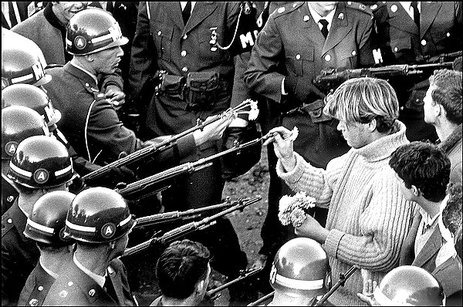
We offered arrogance the virtues of the flower

The Faithful And The True

On the streets of sublimation
Where the scholars make their home,
We came in search of bread
But they left us with a stone.
Engaged in argument of
Pointless points of view,
They offered nothing to
The Faithful and the True.

In the suburbs of the affluent,
In the gardens of the good,
We sang of love and life
But no one understood.
The sirens of the squad-cars
Were the only songs they knew.
They issued warrants for
The Faithful and the True.

In the fortresses of influence,
In the corridors of power,
We offered arrogance
The virtues of the flower.
But the judge's fatal verdict
Sent the soldiers clad in blue
To carry out the sentence on
The Faithful and the True.

On the sidewalks of oblivion,
In the ghettoes of despair,
The few of us who had survived
pretended not to care.
Just litter in the gutter
On the crowded avenue,
And no one there has time to care for
The Faithful and the True.

Chris Trotter
1974

The Journey: A Political Memoir - Posting No. 3

The Voice Of Outraged Reasonableness: Labour Leader, Bill Rowling, opened his party's 1978 election campaign with a speech that both delighted and surprised his electoral base. The man property-tycoon, Bob Jones, called "The Mouse", had roared.

It was supposed to be a book about the birth of the NewLabour Party, but somewhere along the way it became the story of what led me into, and out of, the old Labour Party. In hopes of providing future political studies students with a glimpse of what it was like to be a left-wing Labour activist in the days of David Lange and Roger Douglas I am publishing The Journey on Bowalley Road as a series of occasional postings. L.P. Hartley wrote: “The past is a foreign country, they do things differently there.” May these memoirs, written in 1989, serve, however poorly, as my personal passport.

Tuesday, 31 October 1978

WE WERE ALL VETERANS of one sort or another. Three years of Muldoon had seen to that. Gathered together in that weatherboard slum, we talked of little else but politics. The ordinary Otago students who flatted with us laughed at our intensity – by the late 70s radical politics were on the verge of becoming unfashionable.

Dunedin, hugging its windswept hills, was giving birth to new diversions. Wild enragés like Chris Knox and The Enemy spoke to a generation grown wary of promises. Life was moving to machine-gun rhythms. There were precious few jobs and precious little enthusiasm for brave new worlds. Old and young alike responded to the maniacal Knox’s chorus: “Pull down the shades!”

We were gathered around a black-and-white set; nervously awaiting the televised opening of Labour’s election campaign. I was sceptical about Bill Rowling’s ability to rouse any enthusiasm for a party that had spent the best part of three years stabbing each other between the shoulder blades. My mind went back to the Moyle Affair, the O’Brien Debacle. Could he do it? I was doubtful.

And then Rowling began to speak. The room fell silent. The veterans of anti-apartheid protests, anti-SIS protests, anti-nuclear protests were listening. The little man grasped the podium with both hands, staring calmly out over the heads of his huge and enthusiastic audience. Rowling’s was a serious passion: he spoke with the voice of outraged reasonableness. I recalled his concession speech three years before. “New Zealand will have need of Labour again, and when she does Labour will be ready.”

Somehow he had reached that part of us that still believed in New Zealand. He argued convincingly that what we had all experienced since 1975 represented the worst and not the best of our national character. Labour was the guardian of the best of our political traditions: the tradition of egalitarianism; the tradition of compassion; the tradition of co-operation; the tradition of peace and justice for all humanity.

“There has never been a time in the history of this country when we have been so divided with bitterness and sourness,” declaimed Rowling, “when New Zealander has been turned against New Zealander, when each person tries to keep his place by kicking the other fellow down … the path to recovery will not be easy, but I pledge to you that tomorrow will be brighter … Together, we can make it. Together, New Zealand can make it.” The audience was delighted. The man property-tycoon Bob Jones called “The Mouse”, had roared.

The following day I made my way down to the Labour Party’s North Dunedin office. A chain-smoking young woman, wrapped up against the chill, pushed a membership book in my direction. As I emerged from the office, into the pale spring sunlight, I chuckled to myself. In my hand was a tiny slip of yellow cardboard telling me that I was now a member of the New Zealand Labour Party. I stuffed the card into my wallet and walked on down the street.

This posting is exclusive to the Bowalley Road blogsite.

Friday, 27 April 2012

The Unfortunate Experiment

The Unfortunate Experiment: David Shearer is an immensely likeable bloke, and his work at the UN was truly inspirational, but he ain't anybody's kind of leader.

CONFESSION, THEY SAY, is good for the soul, so I have a confession to make. I was wrong about David Shearer. I made the mistake of believing that a politician with a brilliant back-story couldn’t fail to give us an equally brilliant front-story. Well, as Sportin’ Life tells the true believers in Porgy & Bess:

“It ain’t necessarily so.”

And, now I (and I suspect you) know it ain’t so. David Shearer is a thoroughly likeable, thoroughly decent bloke, and his record at the United Nations is truly inspirational, but, come on, let’s face it: he ain’t anybody’s kind of leader.

David Shearer, like David Lange, is a creature of the factional and personal animosities dividing the Labour caucus. Bluntly: he was put there by an unholy alliance of right- and left-wing MPs to prevent the Labour Party’s choice, David Cunliffe, from taking the top job.

David Lange, however, had one thing going for him that David Shearer does not – a gift for oratory. When David Lange opened his mouth the words flowed out in gorgeous, highly ornamented and persuasive profusion. His soaring rhetoric had the power to transport entire audiences to the vivid world of the Langean imagination. “I see a country”, he would say, and within a few inspirational sentences, we could see it too.

David Shearer, by contrast, can barely string ten words together. And, when he says “I see a country”, he means Finland.

In a funny sort of way, this is a good thing. The problem with David Lange’s remarkable gift for public speaking was that it masked the fact that he was actually the creature of Roger Douglas, Michael Bassett and Mike Moore – the right-wing “Fish & Chip Brigade”. He was just so damned good at painting word pictures that people never stopped to ask themselves how firmly he was attached to the values and traditions of the Labour Party. Or, how well-versed he was in economics. We were all so entranced, so delighted that at long last Labour had someone who could beat Rob Muldoon, that we never bothered to track down the answers to those awkward, but vital, questions ... until it was too late.

David Shearer’s singular lack of political leadership skills has spared us that fate. If the first David’s story was a tragedy, the second’s is pure farce, and everybody can see it. In certain Labour circles his elevation to the leadership was hailed as “the experiment”. In those same circles, it is now being described as “the unfortunate experiment”.

That kind of vicious, stiletto thrust might have been avoided if David Shearer had made up for what he lacked as a speaker with what he offered as a thinker. If only, in his two, much ballyhooed, “direction-setting” speeches he had given the country some juicy, red, ideological meat to chew on. If only he had been able to plainly set forth an over-arching philosophical framework from which later, more specific, Labour policies could be hung, then none of the muttering and stuttering would have mattered.

But those two speeches showed not the slightest trace of “big picture” thinking. On the contrary, they showed every sign of having been inspired by an Auckland-based focus-group, and composed by a Wellington-based committee. The only picture they painted was one that revealed Labour’s deficiencies. That not only did the party lack leadership, but it also lacked ideas. Oh, that Labour possessed speechwriters like The West Wing’s Toby Zeigler and Sam Seaborne. (Oh, that it possessed a President Jed Bartlett!)

So, what have we learned from this debacle? What has Labour learned?

If by “Labour” you mean its caucus, I would say absolutely nothing. If you’re talking about the party itself, nothing it didn’t know already: that Caucus picked the wrong guy.

It’s time for the Labour Caucus to put an end to “the unfortunate experiment” and begin a new one. They could call it “democracy” – and stop taking their party for Grant-ed.

This essay was originally published in The Dominion Post, The Otago Daily Times, The Waikato Times, The Taranaki Daily News, The Timaru Herald and The Greymouth Star of Friday, 27 April 2012.

Thursday, 26 April 2012

The Journey: A Political Memoir. Posting No. 2

In One Hand He's A Golden Coin: Before audiences of thousands, Muldoon cast himself in the role of economic saviour. To the anxious inhabitants of suburbia he promised "New Zealand the way YOU want it" - and on Saturday, 29 November 1975 "Rob's Mob" dutifully swept Bill Rowling's government from power - exactly reversing the Labour landslide of 1972.

It was supposed to be a book about the birth of the NewLabour Party, but somewhere along the way it became the story of what led me into, and out of, the old Labour Party. In hopes of providing future political studies students with a glimpse of what it was like to be a left-wing Labour activist in the days of David Lange and Roger Douglas I am publishing The Journey on Bowalley Road as a series of occasional postings. L.P. Hartley wrote: “The past is a foreign country, they do things differently there.” May these memoirs, written in 1989, serve, however poorly, as my personal passport.


Saturday, 29 November 1975


MY DRINKING COMPANIONS were all old mates from school. Barry and Peter sat with me in my parent’s spacious living room drinking beer and watching the results flash up on the television screen. Labour was being murdered before our eyes and we simply couldn’t believe it.

I stepped out into the fresh air, reeling from a combination of shock and too much beer. Barton Avenue was its usual polite self. I turned and glared at the house next door. National Party president, George Chapman, and his family were not at home that night. I knew where they were. At the National Party headquarters it was already bedlam: Champagne, cheers and kisses all round – I had seen them on TV. I turned and looked towards the house on the right. No doubt Tom Maling, Deputy-Director of the SIS, was quietly celebrating, in a manner befitting an ex-colonial officer, the demise of Bill Rowling’s administration. His friends at the United States’ embassy would be very, very pleased.

How could it have happened? Just hours before, in bright sunshine I had walked with my family to the polling booth at Brentwood School. It was my first vote. Behind the screen I stared down at the ballot paper. One by one I crossed out every name except that of Ron Bailey, Labour’s candidate for Heretaunga. A pang of guilt had run through me as I scored out the name of the Values candidate. But then I remembered Norman Kirk: the cancellation of the Springbok Tour; the HMNZS Otago on its way to Mururoa; the face of Rob Muldoon as he preached to his cheering followers in the Upper Hutt mall. I remembered the ring around the moon. It had to be Labour.

Feelings of foreboding had shadowed me ever since Kirk’s death. Some months before the Election I had attempted to write a campaign song for the Labour Party; what emerged had frightened me:

Oh you who turn your faces
From the poet and the priest,
You are lost amongst the neon
Bloated by the feast.
And the man who shouts the loudest
Is bound to win the strife,
In one hand he’s a golden coin,
The other wields a knife.

And the Sons of Cain are howling
Like wolves beneath the moon.
“Oh when will it be time?”, they cry.
Their master answers: “Soon.”

At the home of the poet Alistair Campbell, just weeks before the election, Barry and I talked with the cream of Wellington’s intelligentsia about the political future of New Zealand. Lauris Edmond, Michael Volkerling, and a host of others talked quietly and authoritatively about the unacceptability of the little man from Tamaki.

Perched high on the Paekakariki cliffs, with the surf crashing relentlessly below and a fresh breeze blowing across Cook Strait off the distant peaks of the South Island, it all seemed so plausible. Seated uncomfortably on the floor of that crowded room I listened and hoped; and hoped and listened. Trevor Edmond, who had been the principal of my old secondary school, Heretaunga College, spoke to me reassuringly: “Don’t worry Chris”, he smiled, “a man like Muldoon is far too far to the right for the majority of New Zealanders. Labour will win.” My fears had subsided.

I returned to the living room. Bill Rowling was on the screen, speaking to a scrum of journalists on the steps of his Election Night headquarters. “New Zealand will have need of Labour again”, he said quietly, “and when she does, Labour will be ready.”

With tears in my eyes I picked up Barry’s guitar and sang the final chorus of my song:

The Sons of Cain are marching,
Before the dawn they bow.
“Oh when will it be time?”, they cry.
Their master answers: “Now!”

This posting is exclusive to the Bowalley Road blogsite.