Showing posts with label Bryce Edwards. Show all posts

Monday, 28 December 2020

When Conservatives Are The Only True Radicals.

Restoration, Not Revolution: Throughout history, the popular call for change has been motivated overwhelmingly by a fervent desire to restore the status-quo ante: to make things the way they were before they went wrong. Only very seldom are masses of human-beings moved to demand a shift towards an entirely new and unfamiliar order of things. 


DR BRYCE EDWARDS, of Victoria University, has proclaimed New Zealand’s Prime Minister, Jacinda Ardern, a “conservative”. Writing in The Guardian, Edwards declares: “Ardern’s instincts have been to protect and conserve. She has trodden cautiously throughout the pandemic, providing reassurance and the promise of normality to those in fear of the worst.”

The key concepts in Edwards’ first sentence are, of course, “protect” and “conserve”. He bolsters these, in the next, with “caution”, “reassurance” and “normality”. Though he does not say so explicitly, Edwards clearly regards these concepts as irreconcilable with any genuinely radical purpose.

Radicalism and left-wing politics are generally held to be inseparable: to describe someone as a left-winger presupposes their possession of a radical disposition – and programme. It is not, however, permissible to argue that the reverse is true: one can be a radical and yet have not the slightest respect for left-wing ideas. Indeed, these days there are arguably many more radicals on the Right, than on the Left.

That being the case, Edwards’ generally negative framing of Ardern’s “conservatism” is more than a little problematic. To be a radical, or, to use Edwards’ own words, “a pioneering progressive or socialist” is not always to be, more-or-less by definition, on the side of the angels. (Or, for that matter, the Proletariat!)

In honour of the season, let us take as our example the “radical” measures adopted by the puritan supporters of the “Commonwealth” – the republican political arrangement held in place by Oliver Cromwell’s New Model Army (think: the Taliban in breastplates!) between 1649 and 1660.

By the puritans’ radical reading of Christianity, festivals such as Christmas were altogether too close to pagan revelry for the comfort of God-fearing men and women. Even before the execution of King Charles I in 1649, the radical protestants who dominated the House of Commons had thought it best to encourage his subjects to treat the mid-winter period “with the more solemn humiliation because it may call to remembrance our sins, and the sins of our forefathers, who have turned this feast, pretending the memory of Christ, into an extreme forgetfulness of him, by giving liberty to carnal and sensual delights’.”

Legislation confirming this puritanical rejection of the sinfully joyous yuletide season soon followed. The feasts of Christmas, Easter and Whitsun were simply removed from the Christian calendar. From 1644 until the Restoration in 1660, celebrating Christmas was illegal. As C.S. Lewis, that devout Christian, keen royalist, Oxford scholar and children’s author puts it in The Lion, The Witch, & The Wardrobe: “Always winter and never Christmas; think of that!”

Leaving Narnia behind, and returning to this considerably less enchanting world, we might further consider the actions of other radical puritans – like those belonging to the now thankfully defunct Islamic State. Or, the radical “Tea Party” Republicans, who saw moderation as treason and prepared the way for the radically disruptive Donald J. Trump. Thirty years on, a great many New Zealanders still resent deeply the radical reforms of Roger Douglas and Ruth Richardson. Even more Kiwis, in 2020, are profoundly grateful that their Prime Minister did not adopt the radically unsuccessful Swedish approach to fighting the Covid-19 pandemic.

Perhaps the strangest observation in Edwards’ Guardian article argues that Ardern’s “self-declared ‘politics of kindness’ isn’t particularly revolutionary, nor very tangible”. In a world where the very idea of kindness has been out of fashion for so long, the Prime Minister’s use of the word generated a public response that was as physical in its consequences as it was revolutionary in its intent. It was kindness that bound together “The Team of Five Million”, and it was their unforced solidarity and unity of purpose that made New Zealand the envy of the world. Tell all those young New Zealanders dancing at this summer’s music festivals; tell all the grandparents who hugged their grandchildren on Christmas Day; that the “politics of kindness” has produced no tangible effect!

Edwards also notes that: “The political left is […] increasingly bristling at the conservatism of Ardern.” To many New Zealanders, however, that will not be interpreted as a bad thing – quite the reverse, in fact. When they think of the political left, the images called to mind are not of Cabinet ministers carrying furniture into the first state house. No, their thoughts are all about the excoriating tweets, outlandish claims and bitter recriminations of “Cancel Culture”; and the equally distressing diatribes against “colonisation”, “hate speech” and “white privilege”. If the Prime Minister has made it her mission to “protect” people like themselves – ordinary Kiwis – from such excesses, and to “conserve” a measure of decency in their country’s political discourse, then they won’t be “bristling” – they’ll be cheering.

Just like the hundreds-of-thousands of Englishmen and women who lined country roads and filled city streets from Dover to London to welcome home Charles Stuart – King Charles II – in the very merry month of May 1660.

The dour regime of the Commonwealth; of Cromwell’s “Protectorate”; may have been radical (certainly they were the only successful republicans in 1,500 years of English history) but they were also dictatorial and joyless. For centuries after the rule of the New Model Army’s “Major-Generals”, Englishmen resisted the idea of a large standing army as a threat to their “ancient liberties”. The restoration of the monarchy (and Christmas!) was indisputably the wish and will of the overwhelming majority of the English people. If they had been given a vote on it in 1660, Charles would have won by a landslide.

If its “conservative” to give the people what they want, then Jacinda Ardern is a conservative. If protecting them from Covid-19 and political extremism is “conservative” then she stands guilty-as-charged. If offering people caution, reassurance, and a semblance of normality as the rest of the world plunges deeper into chaos, makes our Prime Minister a “conservative”, then that’s a badge-of-honour she can wear with pride.

Dr Edwards favours radical change, but he does not appear to be aware of what motivates people to seek change. Throughout history, the popular call for change has been motivated overwhelmingly by a fervent desire to restore the status-quo ante: to make things the way they were before they went wrong. Only very seldom are masses of human-beings moved to demand a shift towards an entirely new and unfamiliar order of things. Certainly, history is studded with minorities who were absolutely certain about the proper ordering of paradise. Most people, however, hanker after the good times they remember – and not for H.G. Wells’ “Things To Come”. Radicals would do well to remember that the winning slogan in the 2016 Brexit Referendum was “Take Back Control”. It was the back wot won it!

Which leaves me wondering whether, in these peculiar times, the only true radicals are conservatives. If the only way to ensure that the voters’ lives remain the same, is for everything to be changed, then I strongly suspect that Jacinda Ardern is the ideal politician for the job.


This essay was originally posted on the Interest.co.nz website on Monday, 28 December 2020.

Tuesday, 1 October 2019

Keeping The Hope Of “Delivery” – And “Jacinda” – Alive.

Don't You Dare Let Them Down, Jacinda! Many New Zealanders, especially young New Zealanders, continue to believe that change – real change – is possible. Do we have criticisms about the way in which Jacinda’s government has gone about “transforming” New Zealand? Of course we do. But the very fact that so many of us are critical of the way she and her government have set about their task, surely implies that a more direct route to transformation exists, and that there is yet a chance that a progressive government might find it?

AS THE “YEAR OF DELIVERY” draws to its end, what have Jacinda Ardern and her colleagues delivered us? Well, they have not delivered 100,000 affordable houses. Nor have they brought Climate Change to a shuddering halt. Child poverty has not been ended. Our rivers and streams remain unswimmable. New Zealand’s farmers have yet to assume a measure of responsibility commensurate with their contribution to anthropogenic global warming. The number of ticks on Jacinda’s “To Do List” is far from impressive.

And yet, unlike my friend, Bryce Edwards, I am reluctant to rebuke Jacinda too harshly. Why? because a surprising number of New Zealanders remain hopeful that what Jacinda promised to deliver remains deliverable. Many of us continue to believe that change – real change – is possible. Do we have criticisms about the way in which Jacinda’s government has gone about “transforming” New Zealand? Of course we do. But the very fact that so many of us are critical of the way she and her government have set about their task, surely implies that a more direct route to transformation exists, and that there is yet a chance that a progressive government might find it?

Bryce’s criticism of Jacinda’s performance on the international stage struck me as particularly unfair. Does he seriously believe that anyone would have been impressed by a New Zealand Prime Minister deliberately sabotaging her country’s relationship with the United States by criticising President Trump’s stance on Climate Change directly to his face? New Zealand’s diplomats have spent the best part of 35 years repairing the damage done to the US-NZ relationship by the Lange Government’s refusal to admit the USS Buchanan in 1985. What would she have gained for her country by rebuking publicly the most errant and volatile individual to occupy the White House in the entire history of the United States? When Trump’s inevitable retribution came – swift and devastating – wouldn’t the response of most New Zealanders have been: “What on Earth did you do that for?”

Nevertheless, Bryce insisted (in The Guardian, no less)  that Jacinda, as the political leader dubbed the “Anti-Trump” by a handful of globally-syndicated political commentators, had only two viable alternatives in New York. Not to meet with Trump at all. (Thereby preserving her progressive reputation at home.) Or, if she did meet with him, to “speak truth to power” by upbraiding him publicly for his refusal to come to terms with the reality of Climate Change. (Thereby enhancing her progressive reputation abroad.) That either course of action, if followed, would have proved diplomatically disastrous for New Zealand mattered less to Bryce than Jacinda forfeiting her “Anti-Trump” image. Fortunately, the opinions of political commentators are not the only ones prime ministers are obliged to consider. Equally fortunately, Jacinda was persuaded that foreign policy is much too important to be guided by nick-names.

Certainly, it is my view that Jacinda acquitted herself brilliantly in New York. In her meeting with Trump she did nothing to undermine the efforts of her key coalition ally (and Foreign Minister) Winston Peters to preserve and, if possible, enhance the laboriously assembled rapprochement between Washington and Wellington. Jacinda’s open and engaging personality clearly charmed the notoriously thin-skinned Trump. The process of initiating formal negotiations for a US-NZ Free Trade Agreement was nudged forward – much, it must be presumed, to MFAT’s delight. The President even had questions about the NZ Government’s gun buy-back scheme. Remarkable!

Bryce also comments on how unfortunate it was for Jacinda to follow Greta Thunberg (whom he dubs the “New Anti-Trump”) at the Climate Action Summit. Truthfully, however, it is difficult to see how anyone could have “followed” Greta. Moments like hers are rare in human history. The best any political leader can hope to do is respond to “the voice of a generation” with grace and dignity. Jacinda did not let her country down.

What Bryce did not devote anything like enough attention to in his commentary was the gap between Jacinda’s extraordinarily adroit performances abroad and her less-than-stellar accomplishments at home. In explaining this increasingly significant discrepancy, however, we cannot avoid touching upon the real cause of Jacinda’s domestic failures. This has much less to do with the Prime Minister’s alleged “flakiness” than it does with the fact that when she goes abroad Jacinda is in control. Success or failure is hers to determine: the product of her own wit and intuition. Back home, the situation is very different. Back home the Labour leader is not free to set and execute her own agenda – none of her Cabinet are. The Coalition Government simply cannot be more radical or innovative than its most conservative member – NZ First.

It will require every bit of her diplomatic talent, but Jacinda must, somehow, make it clear to Winston Peters, and his caucus that, by their decision to bring into being a coalition government with the Labour Party (supported by the Greens) NZ First was throwing its weight behind the cause of progressive politics in New Zealand. By the same token, the party’s repeated refusals to allow Labour’s and the Greens’ progressive agenda to be advanced – be it the Capital Gains Tax, Climate Change, Workplace Relations and, only this past weekend, Drug Reform – are making it impossible for the Coalition to advance together into the next General Election as a united force for change.

There are ways to protect NZ First from political oblivion (offering Shane Jones the Northland seat, for example) but if Labour is to do that, then it can only be on the strength of a solemn promise to give progressivism its head; to allow Labour and the Greens to be Labour and the Greens; and, most importantly, to let Jacinda be Jacinda.

If NZ First is to survive. If the progressive agenda of Labour and the Greens is to survive. If the amazing stroke of political good fortune that is “Jacinda” is to survive. Then the hope of “delivering” a more just, a more free, a more equal, and a more restorable New Zealand must not be allowed to die.

This essay was originally posted on The Daily Blog of Monday, 30 September 2019.

Thursday, 23 July 2015

Friends And Allies: What Is The “Comprador Bourgeoisie” When It’s At Home?

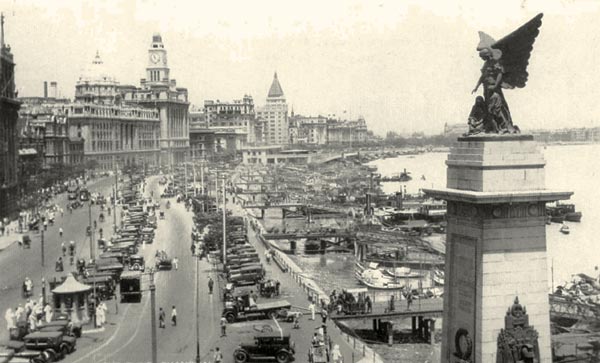
Imperial Façade: Shanghai's famous "Bund", where Western and Japanese capitalists rubbed shoulders with what Mao's communists called the "bourgeois comprador class" - the local capitalist intermediaries who built and maintained the crucial links between the Chinese people and the foreign investors, multi-national corporations, bankers and military interests of the imperial powers. Ironically, a reinvigorated China is now cultivating comprador capitalism in the societies of its dependent trading partners.
 
CHINA’S RAPID RISE to superpower status (at least economically) is producing some delicious political ironies. Eighty years ago, Mao Zedong’s communists wrote scathingly about China’s “bourgeois comprador class”. These were the local Chinese capitalists who acted as intermediaries between the Chinese people and the foreign-controlled enterprises and investors then operating in China under the protection of the major imperialist powers (Great Britain, Japan, France and the USA). The expression eventually entered the broader Marxist lexicon as “comprador bourgeoisie” and is defined as: “A section of an indigenous middle class allied with foreign investors, multi-national corporations, bankers and military interests.” The political irony lies in the fact that today’s comprador bourgeoisie is no longer located in China, but in the societies of her increasingly dependent trading partners.
 
As New Zealand’s largest trading partner, China is steadily wooing our own bourgeois comprador class away from its traditional friends and allies among the foreign investors, multi-national corporations, bankers and military interests of the UK, the USA and Australia. Already, a number of large Chinese banks have set up shop in New Zealand and have thought it politic to recruit both a former prime-minister, and a former leader of the opposition, to sit on their boards of directors. In light of the on-going furore about offshore investment in Auckland residential property, it is clear that this country’s largest real estate agencies must also be numbered among the more prominent members of our comprador bourgeoisie.
 
The Chinese surnames controversy has also exposed the role played by what might be called “cultural compradors”. The penetration of foreign capital, and the political leverage that goes with it, is only very occasionally accomplished at the point of an imperial bayonet. By far the most common method of establishing foreign influence is by using religion and/or ideology to recruit a local following to perform the role of domestic friends and allies. Such people constitute an invaluable bulwark against any attempt by the opponents of foreign influence and control to reassert national values and interests.
 
The extraordinary attacks on the Labour Party: the vicious accusations of “racism” levelled against Andrew Little and Phil Twyford; both provide grim evidence of the cultural compradors’ reckless hatred of the bourgeois compradors’ deadliest foe – the national bourgeoisie.
 
The word “national” notwithstanding, it is the Labour Party which has always represented New Zealand’s national bourgeoisie most effectively. As one of this country’s foremost public intellectuals, the late Bruce Jesson, shrewdly observed: “National knows how to govern for capitalists; but only Labour knows how to govern for capitalism.” The National Party may be “relaxed” about foreign investors pushing the price of a house beyond all but the wealthiest Kiwi’s reach, but Labour, by promising to restrict the rights of foreigners to purchase land, indicates its willingness to put the interests of New Zealanders first.
 
Dr Bryce Edwards: "Global Cosmopolitan".
 
The University of Otago political studies lecturer, Dr Bryce Edwards, frames the struggle of comprador against national capitalists as a contest between what he calls “Economic Nationalists” and “Global Cosmopolitans”. It’s a neat trick. Rather than dealing with the very hard choices New Zealanders are going to face as the economic and cultural power of China and its local facilitators waxes ever greater, Bryce has simply re-cast the drama as an existential confrontation between ageing patriots, clinging stubbornly to the outdated shibboleths of the nation state; and free-wheeling global citizens of the twenty-first century, possessed of an impressive collection of internationally marketable skills – but no country.
 
Bryce would also like to cloak his cultural comprador allies in the frayed costume of twentieth century socialist internationalism. He is hardly alone in this. All over the world, the Left is engaged in a bitter debate over whether nationalism can ever be turned to progressive purposes; and if it is still (or ever was) possible to construct socialism in one country.
 
Bryce is, however, wrong to try and smuggle those who would prepare the way for Chinese state capitalism in New Zealand into the honourable precincts of progressive disputation. Cultural compradors, like the comprador bourgeoisie, of which they are part, have no interest in constructing a political space in which the future of New Zealand can be reasonably debated. In their eyes, the future of New Zealand has already been decided – and not by New Zealanders.
 
This essay was originally posted on The Daily Blog of Thursday, 23 July 2015.

Sunday, 21 June 2015

Dirt And Squalor: The Housing Crisis Comes Full-Circle.

Planned Response: Squalor and dirt was the market’s solution to the acute shortage of affordable housing, and the First Labour Government’s heroic, state-organised, response has become the stuff of political legend. How Mickey Savage, keen to find an outlet for the restless energy of John A. Lee, his great rival for the masses’ affections, gave him responsibility for organising a massive programme of state house construction. And how Lee, by mobilising both the public and private sectors, built thousands of houses for the working poor.
 
THOUSANDS OF NEW ZEALANDERS are at the mercy of a “slum landlord”. Unfortunately, that slum landlord is the Government. The person who put into words what so many people have, for the best part of a fortnight, been feeling, was Dr Bryce Edwards. The political studies lecturer from Otago University was speaking as panellist on Television New Zealand’s Q+A programme.
 
It is a measure of how fraught the housing issue has become that TVNZ was only able to persuade the Housing Minister, Dr Nick Smith, to appear on the programme if he was interviewed alone, and was given the right-of-reply to the following interview with Labour’s housing spokesperson, Phil Twyford.
 
There was a time when Government and Opposition spokespeople felt up to the job of defending their respective positions in head-to-head debates, live, on national television. To my knowledge, guaranteeing a Government Minister a separate right-of-reply constitutes an editorial concession without precedent on either of this country’s free-to-air networks.
 
The Minister’s sensitivity was, of course, understandable in a week when New Zealanders learned that sub-standard conditions in a solo mother’s state house accommodation had materially contributed to the death of her infant daughter. Then to learn, just days later, of another death attributable, at least in part, to sub-standard state accommodation. When asked by journalists to comment on these tragedies, Dr Smith responded that: “People dying in winter of pneumonia and other illnesses is not new.”
 
This was the context in which Dr Edwards’ “slum landlord” comment was able to strike such a raw public nerve.
 
How has it come to this? What has permitted the housing conditions wheel, over the course of 80 years, to come very nearly full-circle?
 
In his book, We Call It Home: A History of State Housing in New Zealand, Ben Schrader describes how the Truth newspaper, just one week after the election of the First Labour Government, in 1935, began campaigning against “the slum problem”.
 
“The article began”, writes Schrader, “by vividly juxtaposing the newly completed National War Memorial with its sordid surroundings.” Truth compared this “beautiful piece of architecture”, erected to ensure that the “supreme sacrifice” of the Great War was not forgotten, with that of the Wellington slums, standing “a stone’s throw away” from the Memorial’s tower. In these dwellings, Truth observed: “men, women and children are making a different kind of sacrifice. They live in squalor and dirt, in little shacks lacking even the ordinary comforts of existence.”
 
Squalor and dirt was the market’s solution to the acute shortage of affordable housing, and the First Labour Government’s heroic, state-organised, response has become the stuff of political legend. How Mickey Savage, keen to find an outlet for the restless energy of John A. Lee, his great rival for the masses’ affections, gave him responsibility for organising a massive programme of state house construction. And how Lee, by mobilising both the public and private sectors, built thousands of houses for the working poor.
 
So successful was Labour’s scheme that the town planner, Cedric Firth, could write, more than a decade later, about the citizen’s right to a “decent dwelling being regarded as on the same level as the right to education, sanitation, to good and abundant water supply, to an adequate road system and a certain amount of medical care.”
 
These are no longer the expectations of either those responsible for supplying social housing, nor, sadly, of those obliged to seek shelter in New Zealand’s decaying stock of state houses. Having forgotten (if he ever knew) how manifestly inadequate the market’s “solutions” were to the problems of the 1930s, Finance Minister, Bill English, appears hell-bent on resurrecting a social housing market – even if he has to dig up the corpse with his bare hands!
 
Commentators across the political spectrum, joined just this week by economists from the OECD, are urging John Key’s National Government to launch a state-financed and directed effort to address directly the lack of affordable houses for the poorest New Zealanders. As Dr Edwards’ fellow panellist on last Sunday’s Q+A programme, Fran O’Sullivan, put it: “It’s been done before in our history.”
 
The problem, says Dr Edwards, is that the political parties’ housing agendas are “a bit deluded and empty”. National and Labour are “still quite timid” when it comes to committing themselves to the sort of low-cost housing construction effort that offers the only truly effective solution to New Zealand’s twin housing crises. The first, which condemns far too many Kiwis to lives of “squalor and dirt”. And the second, fuelled by the speculative mania currently gripping Auckland’s runaway housing market.
 
Market delusions and political timidity allowed slum landlords to thrive in the 1930s. Eighty years later, identical failings on the part of their state-owned successor have added an ironical twist to the community’s demand for radical housing reform.
 
This essay was originally published in The Press of Tuesday, 16 June 2015.

Wednesday, 21 May 2014

Shouting From Beyond The Crossroads

Green Marx: The growing awareness that Capitalism, unchecked, will ultimately consume the life-giving properties of the planet itself is challenging Green parties' reliance on "Green Technology" and the technological fix. Karl Marx saw the overthrow of the capitalist system as a social and ethical necessity, but it is now clear that revolution and human survival are no longer separable.

DO YOU SHOUT at the television? Indulge in lengthy harangues at the radio? I’m afraid I do. Increasingly so, given that it’s an election year and there’s a growing number of things to shout at television about. Time was when I’d have attributed this habit of berating inanimate objects to advancing years. But young people assure me that nowadays they do it too.
 
Last Sunday I gave my lungs a good workout during TVNZ’s current affairs programme Q+A. Bryce Edwards, the University of Otago’s peripatetic commentator on all things political (and compiler of that utterly invaluable compendium of political news and commentary, NZ Politics Daily) was criticising the Greens for attempting to use Green Capitalism to save the planet.
 
“Awh, jeez, Bryce, give us a break!”, I yelled at the offending collection of electronic circuitry, “How many viewers do you suppose are going to hold that against them? And how many extra votes do you reckon they’ll attract by decking out Karl Marx in a green suit?”
 
Later that morning, however, after my blood pressure had returned to normal, I began to think more carefully about Bryce’s criticism. By mid-afternoon I’d already half-convinced myself that the young political studies lecturer was right.
 
If even the Greens aren’t prepared to call things by their true names – who is?
 
Can you really prefix “Green” to the global phenomenon that’s pouring more and more Carbon Dioxide into the Earth’s atmosphere? From Brazil to Indonesia: in all the world’s denuded tropical rainforests, what else but Capitalism is powering the chainsaws of the tree-fellers? Could the gaunt and exhausted construction workers recruited from across the Muslim world really distinguish between the Capitalism that vomited up their squalid shanty towns and the Capitalism that’s erecting Dubai’s towering “eco-friendly” architecture? And, much closer to home, can Green Capitalism really displace the Cow-Cockey Capitalism pouring nitrates and phosphates into our waterways? Or the Carbon Capitalism sinking drill-shafts into our deepest seas?
 
Green Capitalism? You might as well speak of Green Cancer. But, if you’re looking for alternatives – why not ‘Man Crusher’? Or, ‘Earth Eater’?
 
I’m old enough to remember when the first whispers began to spread about the limits to capitalist growth. When individuals like Rachel Carson and groups like the Club of Rome first connected the insatiable appetites of industrial capitalism with the gaping rents that were appearing all around the globe in the fragile webs of life we were only just beginning to call ecosystems.
 
It was around the time when, in the manner of a glittering cosmic cue, the Apollo astronauts began sending back to humankind the first images of its tiny blue planet floating – so beautiful, so vulnerable and so alone – in the infinite reaches of space.
 
And it was here, in New Zealand, that those whispers first cohered into an audible political voice. Formed in 1972, the Values Party was the first to openly question the idea that economic growth could be pursued endlessly and without cost.
 
It was heresy, but it stuck. Tens-of-thousands had just signed the ‘Save Manapouri’ petition. The Labour Party’s election ads depicted the environment in an Agee preserving jar! Tantalisingly close to the surface of the voters’ minds, not only in New Zealand but all across the developed world, a realisation of extraordinary power was taking shape. That humanity had reached a cross roads.
 
Down one road lay something new, something transformative. A new, lighter and less destructive way of being human. Charles Reich called it “The Greening of America”. Values promised to take us "Beyond Tomorrow".
 
Down the other road lay more: much more; unbelievably more. Waiting for us was a cornucopia of technological wonders that also offered something new and transformative. A human society increasingly wired to its machines, and those machines becoming more and more human.
 
But such magic technology could only ever be the distillation of processes fatally destructive of the planet’s capacity to maintain ecosystems conducive to human survival.
 
Capitalism’s technological fix, founded upon the shifting sands of cheap energy, finite resources and cheap labour is, ultimately, unsustainable. Its ever-more miraculous industrial alchemy can only be sustained by cannibalising its own children and heating up the planet’s atmosphere.
 
These are unglad tidings for any political party to bear. Values tried to warn New Zealand about the ultimate cost of Capitalism but only succeeded in splitting itself apart. Like the rest of us, Values’ members (and now the Greens’) have found it easier to believe in the power of science to resolve all contradictions.
 
Hence Russel Norman’s promise that Green Capitalism, wielding Green Technology, will rescue us from the twin threats of Global Warming and critical resource depletion. I suspect he knows this is nonsense. The Devil is not defeated by weapons manufactured in Hell.
 
From the road we’ve chosen there is no turning.
 
This essay was originally published in The Press of Tuesday, 20 May 2014.

Tuesday, 1 May 2012

Braving The Snow

Insufficient Deterrent: Even snow could not dissuade electors from turning out to defeat Sir Robert Muldoon's National Government in the snap winter election of 14 July 1984. If people are given a reason to vote - they'll vote.

IN DUNEDIN, on 14 July 1984, it snowed. One of those raw Southern days when the wind blows straight from the pole, Election Day 1984 arrived with the sort of weather most elderly people could have been forgiven for avoiding. But, bundled up against the cold, I found myself trudging up Carroll Street behind a very old woman. Bent against the wind, with snow in her hair, she put one foot in front of the other, using her walking stick to push her frail body up the hill toward the polling booth. As I overtook her, I paused and asked if I she needed any help.

“No thank you, Dear,” she smiled, “I can get rid of that bastard Muldoon all on my own.”

It was the high water mark of voter participation in New Zealand: never before, and never since, have so many registered voters participated in a General Election. One or two electoral contests had come close, but the turnout of 1984, at 93 percent, was the all-time record.

How, then, to explain the record low participation rate of 2011? Barely two-thirds of eligible voters bothered to cast a vote at last year’s election. For one reason or another, an astonishing one million New Zealanders never made it to a polling-booth. Not since the years prior to the introduction of universal suffrage in 1893 has New Zealand recorded such a poor democratic performance.

Sharp explanatory differences have emerged between political scientists in relation to last year’s abysmal turn-out. The veteran psephologist, and Professorial Fellow in Political Science at Victoria University, Nigel Roberts, seems to think the fault lies with us, the people. Too many of us, he suggests, have failed to fulfil our democratic duty, and for this failure we must be punished by Parliament. That’s right, the former professor believes New Zealanders, like Australians, should be legally required to present themselves at the polling-stations.

Mandatory participation, argues Professor Roberts, would have the (presumably beneficial) effect of negating the political advantages accruing to well-organised and well-funded political parties. If we’re all legally required to turn up at the polling-stations, then all political parties will compete for votes on the same footing: the least effective having as much chance of winning support as the most effective.

This approach doubtless outrages Dr Bryce Edwards, a political scientist teaching at the University of Otago, who places the blame for the low turnout of 2011 squarely on the shoulders of the politicians themselves: “It should be embarrassing for politicians and political parties because they’re the people that aren’t having their product bought.”

The findings of a survey of 272 non-voters conducted on behalf of the Electoral Commission tends to support Dr Edward’s contention. Roughly a third of non-voting respondents stated that they either did not trust politicians, or that they “just [weren’t] interested in politics”.

It is instructive (and not a little depressing) to contrast the findings of the Electoral Commission’s survey with the attitude of that elderly woman trudging up Carroll Street in the snow to cast her ballot.

Clearly, she placed no trust in the Government of Sir Robert Muldoon, but that lack of trust, far from being a reason not to vote, was her prime motivation for weathering the snowstorm. And, equally clearly, this woman was interested in politics, and knew exactly what was at stake in the Snap Election of 1984. Her faith in the power of her vote burned brightly on that grey Dunedin day, and so did her faith in the political alternative to the Muldoon-led National Party Government.

On 14 July 1984, David Lange led a Labour Party which had yet to openly embrace the economic policies of Margaret Thatcher and Ronald Reagan. Not even I – a Labour activist responsible for the publicity of one of Dunedin’s Labour candidates – had any clear idea of the terrible betrayals that lay ahead (although there were disquieting signs). As I made my own way up Carroll Street I was relishing the prospect of New Zealand being declared nuclear-free; of compulsory unionism being restored; of the wage/price freeze being lifted; and of a decisive break with the apartheid regime in South Africa.

And it is here that my own views, and those of Dr Edwards begin to mesh. On Bastille Day 1984, for those who did not subscribe to Sir Robert’s ideas about how to run the New Zealand economy; for those who rejected his interpretation of the ANZUS Treaty and were furious at his refusal to sever all ties with the South African racists; there was a political alternative.

Or, so we thought.

The Chief Electoral Officer, Roger Peden, says he is deeply concerned at the long-term steep decline in voter participation since the record turn-out of 1984.

The year when voting was still worth braving a snowstorm.

This essay was originally published in The Press of Tuesday, 1 May 2012.

Friday, 8 July 2011

Dr Edwards' Beguiling Diagnosis

But Somebody Rules: Dr Bryce Edwards argues that New Zealand has become an anti-ideological, anti-political nation, but what he doesn't tell us is why. His political sociology offers a reasonable description of our situation, but for a credible explanation we must interogate our history.

IT’S A BEGUILING DIAGNOSIS. According to Dr Bryce Edwards, we live in an “anti-political, anti-ideological age”. What’s more, this condition of near universal political scepticism, is one which New Zealand’s current prime minister, Mr John Key, “almost perfectly personifies”.

Dr Edwards, whose pithy commentaries on current affairs are regularly featured in the news media, is a lecturer in Political Studies at the University of Otago. His expert testimony on New Zealand’s political condition should not, therefore, be dismissed out-of-hand.

But, is Dr Edwards right? Has the very mention of “ideology” – a term which he claims “used to have positive connotations” – now become “almost abhorrent” to many New Zealanders?


TO BEGIN WITH, I must challenge Dr Edwards’ contention that the term “ideology” ever resonated positively in the minds of most New Zealanders.

It was following a visit to Australia and New Zealand in 1899 that the young French socialist, André Métin, coined his memorable description of Australasian politics as “socialism without doctrines”.

“Australasia”, he said, “has contributed little to social philosophy, but she has gone further than any other land along the road to social experimentation.”

Monsieur Métin’s observations strongly suggest that New Zealanders’ political pragmatism (not to mention their impatience with “social philosophy) is part of a cultural tradition extending back more than a century into our history.

The late Bruce Jesson explained this impatience with theory, and our general reluctance to think ideologically,  in terms of colonial New Zealand society’s essential artificiality:

“New Zealand was a state-created society in that the state did not emerge from some already-existing social order, some civil society, but instead created it. The state was responsible for creating the infrastructure of the country – a social infrastructure, as well as an economic infrastructure. And while this was unavoidable, it meant New Zealand was a society without texture. New Zealand might without exaggeration be thought of as a hollow society.”

To which I would add the chilling effect of the Cold War on such fragile ideological flowers as had, somehow, managed to find a way through the concrete, brick and Bakelite shell of the First Labour Government.

As Bill Pearson’s seminal 1952 essay, Fretful Sleepers, makes depressingly clear, it was a very brave Kiwi indeed who was prepared, in the oppressive political and cultural atmosphere which settled over New Zealand in the aftermath of the 1951 Waterfront Lockout, to own up to ideological tendencies of any sort.

It is to this ideologically inert society that Greg McGee’s hero addresses his last excoriating soliloquy in the 1981 stage-play Foreskin’s Lament:

“Whaddarya? Whaddarya! Whaddarya!!!”

New Zealanders lack of interest in all things ideological is, therefore, very far from being a recent, or a new, phenomenon.


HOW THEN, are we to explain Dr Edwards insistence that we are living in an “anti-political, anti-ideological age”?

Paradoxically, New Zealanders allergic reaction to what might be called “ideological politics” is actually a manifestation of that same doctrinally-uninflected socialism which Monsieur Métin observed 112 years ago.

It was the vicious, right-wing ideology driving Rogernomics and Ruthanasia, and the cynical devaluation of “politics” (as in people voting for “A” but getting “Z”) which accompanied it, that made the term so “abhorrent” to so many New Zealanders.

The Right then counter-attacked with increasingly shrill condemnations of what it called “political correctness gone mad”.

The result is a form of political discourse whose vituperative content is only exceeded by the volume of its expression.

Small wonder people shy away.

Nor should we be surprised that Mr Key’s easy-going personality, and his ability to channel the public’s weariness of “big ideas”, have made him one of this country’s most popular political leaders. Bruce Jesson’s “hollow society” has embraced Nicky Hager’s “hollow man”.

That’s why only practical actions will undo John Key: privatisation; attacking the vulnerable; gutting state housing.

Dr Edwards needs to remember, and National should never forget, that although New Zealanders have never been socialists of the head; we remain socialists of the heart.

This essay was originally published in The Dominion Post, The Timaru Herald, The Taranaki Daily News, The Otago Daily Times and The Greymouth Star of Friday, 8 July 2011.

Sunday, 21 December 2008

Left of Labour, or Bereft of Sense?

Oliver Woods

THE extraordinary success of the Alliance in the 1990s was both a blessing and curse for the New Zealand Left. A blessing, because, by its very existence, the Alliance forced the Labour Party to purge itself of the most dangerous elements of the neo-liberal clique which had seized control of the Parliamentary Labour Party in the 1980s (after which it was able to pressure Helen Clark and her colleagues to return to a more recognizably social-democratic policy course). A curse, because the Alliance’s undoubted (although limited) achievements have convinced individuals and organisations to the left of the Labour Party that the creation of a viable left-wing electoral option to Labour is a viable political project.

A good example of this flawed thinking is contained in this posting by Oliver Woods, the Residents’ Action Movement (RAM) candidate for the seat of Auckland Central in the last election. Joining the debate initiated here by Bryce Edwards, a left-wing political studies lecturer at the University of Otago, and taking strong issue with my response ("You Say You Want A Revolution?" – see below) Oliver writes:

There seems to be a major underlying problem in the post he made. Namely, he has conveniently forgotten his own political background. He omits that he was part of the current of people that quit Labour during the late 1980's because of the party's swing to the extreme libertarian right. He quit Labour because it was no longer a party that helped the working class. Chris was a staunch NewLabour and Alliance Party supporter, remaining true to New Zealand's social democratic tradition.
In a depressingly crude argument, he attacks the Workers Party based on how many votes they received and uses Labour's high votes to illustrate that it is the "true" Workers Party. This is the crass argument of a bully, not Chris' usual intelligent analysis and commentary.
Even more bizarrely for Chris' normally very coherent work, his argument is fundamentally illogical. He manipulates the Alliance into his pro-Labour story. He argues the Alliance's influence on Labour as an argument to prove that Labour is really left wing. Yet he argues that without the Alliance in coalition, Labour would not have followed a pro-worker, left program.
Which leaves me bemused. How can he simultaneously argue that Labour isn't really for the workers, yet really it is?

Well, the first thing to acknowledge is that Oliver is quite correct in identifying the lacunae in my earlier posting. I was wrong to assume so much willing compression of the historical and political narrative concerning Labour and the Alliance on the part of my readers.

Let me remedy that now by making explicit what I mistakenly believed was implicit in the posting: i.e. that the Alliance (and the NLP before it) were born out of, and were, in fact, all about – the Labour Party. What they represented was not a departure from the social-democratic project in New Zealand, but a reaffirmation of its centrality to the nation’s political life.

As I wrote in 2001 (in Ray Miller’s New Zealand Government & Politics):

"With only 8 percent of the 1999 popular vote, the Alliance has made its future utility to Labour highly questionable. If the organisation’s historical task was to act as a transitional vehicle – from the aberration of the 1984-90 Labour Party, to the much more recognisable social democratic force that Helen Clark has fashioned – then surely that task has been accomplished? Its constituent membership notwithstanding, the Alliance’s future may now lie in a more-or-less amicable reabsorption by Labour – the party it devoted so much energy to destroying, and then saved."

There is nothing illogical, therefore, in citing the Alliance as evidence of the futility of attempting to establish an electoral organisation, anchored in the New Zealand working-class, with a programme well to the left of Labour’s. On the contrary, the ultimate fate of the Alliance demonstrates quite conclusively the very real constraints that will inevitably be brought to bear on all those radical social-democrats (not to mention revolutionary socialists) who attempt to extend the boundaries of political praxis beyond what the majority of their own party comrades, their party’s leadership, their coalition partner’s leadership, the capitalist ruling class, and public opinion generally, are willing to tolerate.

The Alliance split over the US invasion of Afghanistan – an issue singularly ill-suited to the purposes of those who wished to boost the Alliance’s dwindling electoral fortunes. And to those who say: "Oh, if it hadn’t been Afghanistan, it would have been something else.", I would only reply: "Well, I wish it had been something else!"

Splitting the Alliance over making the restoration of free tertiary education a non-negotiable element of the 2002 Labour-Alliance coalition agreement, for example, would, at the very least, have offered the prospect of bringing a significant number of the public in behind the radical faction’s demands – thereby applying maximum political pressure to Anderton and Clark.

Dying in a ditch for the Taleban never did strike me as the radical Left’s best way of convincing the Alliance’s 200,000 voters that it was anything other than a collection of self-indulgent, terrorist-appeasing, twits.

I fear Oliver will again accuse me of adopting a bullying tone, but really, what does the radical Left expect? Its blunt refusal to face political realities is not something it is in any left-leaning individual’s interest to ignore. Take Oliver’s own "party" – RAM – as a case in point. Earlier in the year a critic of RAM’s decision to contest the 2008 General Election wrote:

Any attempt by RAM to break into the national political scene will, therefore, almost certainly end in failure. Thousands of person hours, and tens-of-thousands of dollars, will be expended for what, when all the votes have been counted, is likely to be a tally well short of one percent of the Party Vote. Not only will this outcome prove profoundly demoralising for those candidates/activists who participated in the election campaign, but it will also constitute a significant opportunity cost for the Left as a whole – and for the Far Left in particular.

The history of New Zealand elections is studded with examples of Far-Left groups who put their policies to the democratic test and were aggressively rebuffed by the electorate. The consequences of these repeated rejections have been very damaging in at least two important respects.

First: the derisory election results powerfully reinforced the entrenched Centre-Left belief that Far-Left parties have no genuine constituency of any size among the New Zealand population. Centre-Leftists were, therefore, further encouraged to write-off ‘revolutionary’ political aspirants as Quixotic – at best, or dangerous nutcases – at worst.

Second: among the revolutionaries themselves, poor election results powerfully reinforced the argument that the ‘masses’ were suffering from ‘false consciousness’. They – the ‘Genuine Left’ – had seen the issues all-too-clearly, but, up against the lies of the news media, the schools and universities, and the ‘treacherous mis-leaders of the working-class’ the ‘truth’ was unable gain a hearing. This self-pitying attitude only served to widen the distance between the Far- and Centre-Left, and the electorate as a whole.

Sadly, these predictions have all been borne out – practically to the letter. Oliver, in spite of the investment of hundreds of hours, and the expenditure of huge amounts of emotional energy (and, I suspect, a not inconsiderable amount of his own cash) attracted just 132 votes, a figure which, to his credit, was eight times higher than the number of Party Votes cast for RAM in Auckland Central. (Indeed, across the country, RAM managed the extraordinary feat of actually attracting fewer Party Votes (435) than the 500 members required to register it as a political party!)

Oliver, a young comrade of enormous political potential, would be far better engaged in the vital process of building up the growing strength of the progressive forces within the Labour Party. Joining with new MPs like Grant Robertson, Clare Curran and Phil Twyford to develop practical solutions to crucial issues like child poverty, the strengthening of the trade unions, the introduction of a universal student allowance, and the revitalisation of our public broadcasting services.

Men and women of Oliver’s intelligence, erudition and commitment are rare enough in New Zealand politics, without pissing their energies into the wind by cynically involving them in attempts to establish electoral options for the working-class to the left of Labour – a project as bereft of sense as it is lacking in even the remotest possibility of success.

Thursday, 18 December 2008

You Say You Want A Revolution?

Lenin instructs the masses, as Trotsky looks on. Revolution was far too important to be left to ordinary working people.

IT is always a pleasure to respond to the critical writing of left-wing comrades – even when it is my own newspaper columns that are being critiqued!

Bryce Edwards, here, has taken me to task for a series of satirical jibes which I directed at the far-Left in my Dominion Post "From the Left’ column published on Friday 12 December 2008.

What appears to have upset Bryce most about the column was its underlying assumption that in New Zealand the revolutionary Left enjoys (if that is the right word) a reputation for being a motley collection of political Jeremiahs, who delight in the misery of the working class and positively welcome hard economic times on the grounds that such adverse conditions can only "heighten the contradictions" inherent in all capitalist societies and, hence, hasten their demise.

Bryce also takes exception to the other big assumption in my column: that the NZ Labour Party has always enjoyed, and will continue to enjoy, much greater success than the revolutionary Left in attracting mass working-class support - especially during periods of economic hardship.

Like many revolutionary socialists, Bryce regularly condemns the Labour Party for being a "right-wing" and "anti-worker" party.

On the face of it, this is a rather absurd charge. As I pointed out in my column, the Labour Party attracted 796,880 Party Votes in the recent election - most of them from working-class voters. (By way of comparison, the far-Left Workers' Party received just 932 Party Votes.) What Bryce's characterisation of the Labour Party as right-wing and anti-worker implies, therefore, is that the working-class is either blind (or has been blinded) to its own self-interest; or has itself become a hot-bed of right-wing and anti-worker beliefs.

Now, I don’t know for sure, but I'm assuming that Bryce, like most of those who adhere to the revolutionary socialist tradition, still subscribes to the principles of Marxism-Leninism. If so, his rather condescending attitude toward the working-class is perfectly consistent with the revolutionary model he espouses. As Lenin so arrogantly expressed it in What Is To Be Done?:

"The history of all countries shows that the working class exclusively by its own effort is able to develop only trade-union consciousness."

In other words, revolution is much too important to be left to ordinary working people! Far better to leave it to, oh, I don’t know – university lecturers – perhaps?

Sometimes, however, ordinary working people see the world a great deal more clearly than revolutionary academics. Ordinary working people just might, for example, regard advice from Rosa Luxemburg and Leon Trotsky as something to be taken with a very large grain of salt.

After all, if Rosa was such a visionary, how come in January 1919 she allowed a troop of demobbed soldiers, now serving in the notorious Garde-Kavallerie-Schützendivision Freikorps, to abduct her off a Berlin street, club her senseless, fire a bullet into her brain, and throw her lifeless body into the Landwehr Canal? And if Leon Trotsky was such a socialist seer, how was Stalin’s special assassin, Ramon Mercader, able to disaggregate his skull with an ice-pick in Mexico City in 1940?

I ask these brutal questions with a serious purpose. Because it is almost always posterity which invests individuals with the extraordinary qualities for which they are remembered. Luxemburg and Trotsky were both immensely talented revolutionary politicians, but just as prone to getting caught up in the day-to-day exigencies of their craft as the rest of us – and equally blind to their ultimate fates.

It is as foolish to abstract from their political context the political writings and observations of Luxemburg and Trotsky, as it is to quote at random from the commentary of a left-wing political columnist like myself.

Luxemburg was wrong about the revolutionary potential of the German working-class, and she paid for that misjudgement with her life. What she correctly identified, however, were the elitist and ultimately tyrannical tendencies within the Leninist revolutionary model – and for that she is justly remembered.

Trotsky, too, was wrong in his assessment of capitalism’s strengths and weaknesses. Far from being a brief respite, the economic recovery noted in his 1921 pamphlet marked the beginning of a capitalist boom lasting almost a decade. What’s more, when boom turned to bust, it was not the socialists who benefited, but the fascists.

What today’s revolutionaries always seem to overlook, when quoting Luxemburg and Trotsky, is the signal fact that their respective assassinations were not the work of the Right, but of their fellow socialists (Noske in the case of Luxemburg, Stalin in the case of Trotsky). They died because they refused to accept that the revolutions in which they’d played such an important role had reached the limits of what was politically and economically feasible.

And it is this, the recognition of what is – and what is not – politically and economically feasible, that distinguishes the political movements capable of attracting 796,880 votes, from those capable of attracting just 932.

As I recall, Bryce was, for a period, a member of Jim Anderton’s NewLabour Party (and worked for a while in the Alliance's parliamentary office). For more than a decade these organisations represented the most successful parliamentary assertion of democratic socialism in the Western world. That the Alliance, in 1999, secured four Cabinet seats in what was internationally regarded as the most left-wing Labour government in the world, was a huge achievement.

Indeed, such was the pull of its political gravity that the Alliance carried Helen Clark’s government several degrees further to the left than, left to itself, it would ever have felt comfortable travelling.

Would the renationalisation of ACC, the restoration of income related state-house rentals, the repeal of the Employment Contracts Act, the creation of a state-owned bank, and the introduction of paid parental leave and four weeks annual leave have occurred without the Alliance? Certainly not as quickly, and possibly not at all.

Were these reforms of benefit to working people? Absolutely.

Would a right-wing, anti-worker government (such as the one we have now) have introduced such measures? Never.

As it was, in threatening a full-scale investment strike, New Zealand’s capitalist ruling class, in "The Winter of Discontent" of 2000, signalled how very close to the limits of what was politically and economically feasible the Labour-Alliance coalition had come. When, in 2002, the Alliance Left indicated that it intended to test those limits further , Clark and Anderton (like Noske and Stalin before them) ruthlessly organised its destruction.

And when Labour, itself, took the revolutionary step of illegally appropriating sufficient public funds to mobilise its working-class base against the threat of a Don Brash-led National Government in 2005, the New Zealand ruling class made it very clear that the limits of its tolerance had been exceeded.

What followed Labour’s 2005 election victory: the "Establishment’s" three-year campaign of non-stop political aggression against the entire parliamentary Left and its NZ First allies; stands as an object lesson in what happens to social-democratic governments which mobilise their core working-class vote without a coherent plan for keeping it mobilised.

For Bryce should make no mistake, it is the latter variety of social-democratic governance that I have always stood for – and fought for. But, to pull off that sort of governance you have to box clever – very clever.

In my book, No Left Turn, I used a classical myth to illustrate the method adopted by the First Labour Government for slaying the capitalist monster:

"The conduct of Savage, Nash and Fraser calls to mind the legend of Perseus and Medusa. Befriended by Athena, the goddess of wisdom, and Hermes, the keeper of secrets, Perseus is provided with the weapons necessary to slay Medusa. But the gods also warn the hero that when the critical moment arrives for him to put an end to tyranny by striking off the monster’s head, he must be guided only by Medusa’s bright reflection mirrored in the metal of Athena’s shield. It was fatal to confront the Gorgon face-to-face: any man who gazed directly upon the true horror of her countenance was instantly turned to stone.

"Like Perseus, the first Labour government’s heroic achievements were secured by its wise refusal to confront its enemy directly. Capitalism in New Zealand was mastered not by staring it down, but by addressing its many institutional reflections: the private control of credit creation; the private provision of health and housing; the master-servant relationship in the workplace; the disciplinary effects of mass unemployment; and the class-based allocation of educational and cultural resources. By concentrating their reforming zeal on these institutional representations of capitalist power, Savage, Nash and Fraser avoided the massive social resistance which would inevitably have attended the wholesale expropriation of private property."

New Zealand politics, since the end of the long post-war boom in the mid-1970s, has been about little else apart from the New Zealand ruling-class’s single-minded determination to tear down the institutional walls in which social-democracy had immured it. The ferocity of that effort, and the limited nature of its success, reveals the deadly efficacy of Savage’s strategy.

It is also highly significant that in order to breach those walls, it was first necessary to subvert the Labour Party. No other political movement in New Zealand could have done it.

And no other movement in New Zealand will ever rebuild those walls. Only the labour movement – political and industrial – possesses the historical and cultural power to lead the counter-attack against the Right’s counter-revolution.

Ultimately, it is the wisdom and courage of ordinary working people – not academic Marxist-Leninists, or even erratic newspaper columnists – that will re-imprison the capitalist beast.

And the party they turn to for that purpose will be Labour – the real workers’ party.