Showing posts with label Sino-New Zealand Relations. Show all posts

Monday, 26 July 2021

A Conversation That Never Happened.

Attribution Error: “Well, Sir, the Ministry of State Security has absolutely nothing to gain by going after Microsoft Exchange. It’s not its style – way too public. The MSS would never draw attention to its activities in so dramatic a fashion. I mean, there is absolutely nothing in it for them to have the world believing Beijing is reading its e-mails. The motto of the MSS has always been: ‘Nobody knows that we went in, and nobody knows what we took out’. I just don’t believe it was them.”

WELLINGTON HARBOUR was always worth looking at. Sipping thoughtfully at his cup of Earl Grey, Adam Freeman took in the comforting vista. He was in need of comfort, he told himself, after what he could only describe as a very odd meeting. Bamboozling the public was one thing, the preservation of national security more or less required a certain amount of economy with the truth. But bamboozling ourselves, he thought, not to mention our Minister, that’s dangerous. Seeing things clearly, he had always assumed, was the Alpha and the Omega of keeping the nation secure.

A gentle knock on his office door, interrupted these uneasy musings. He looked up to see the youthful countenance of Matthew Stubbs. Youthful but full of care, Adam thought to himself. The young IT wizard looked as worried as he felt.

“Come in, Matthew,” he said placing his teacup carefully on its saucer. “What can I do for you?”

“Forgive the interruption, Sir,” the young man replied, “but I was wondering if I could share some thoughts with you in confidence.”

“Depends on the thoughts, Matthew. Depends on the thoughts.”

The young man smiled wanly. “I suppose it does, Sir, yes.”

“Sit down, boy, and let’s find out.”

Matthew seated himself in the nearest of the comfortable leather chairs positioned to one side of his superior’s desk. Adam swung round to face him.

“Well then, let’s have it. What are these thoughts that require my confidence and discretion?”

“All that stuff about the Microsoft Exchange hack being sponsored by the Chinese Ministry of State Security that we fed to the Minister.”

“Yes?”

“Well, I just don’t think it’s true, Sir. I mean, I don’t see how it could possibly be true.”

“Go on.” Inwardly, Adam breathed a huge sigh of relief. He wasn’t the only one who thought this intel was dodgy.

“Well, Sir, the MSS has absolutely nothing to gain by going after Microsoft Exchange. It’s not its style – way too public. The MSS would never draw attention to its activities in so dramatic a fashion. I mean, there is absolutely nothing in it for them to have the world believing Beijing is reading its e-mails. The motto of the MSS has always been: ‘Nobody knows that we went in, and nobody knows what we took out’. I just don’t believe it was them.”

“You’re not buying the ‘Advanced Persistent Threat 40’ linkage, Matthew?”

“APT 40? No, Sir. They’re just a bunch of varsity students, MSS interns probably, looking to earn brownie points with their future bosses. They’d never dream of hacking Microsoft without the express backing of the highest military and party authorities. And, as I said, the highest authorities would never expose the PRC to the sort of global outrage that the disclosure of such an operation would inevitably entail.”

Adam leaned forward, fixing the young man with his best basilisk glare. “So, if it wasn’t the MSS, and it wasn’t APT 40, then who was it?”

“Best guess, Sir? It wasn’t the Chinese at all. My money, as always, would be on the Russians. Oh, I know, I know, it’s possible that the hack could have been the work of a Chinese criminal operation. Thing is, Sir, crime gangs like that don’t really exist in the PRC. Security and surveillance is just too all-enveloping. Which isn’t to say that corruption isn’t rampant throughout Chinese society. But acquiring and selling real estate by illegal means is one thing; endangering the security of the state by going after a software giant like Microsoft, well, that’s something else altogether. Get caught doing something like that, and it’s bullet-in-the-back-of-the-head time – no mucking ‘round.”

Adam, nodded grimly.

“But, Russia’s different.” Matthew continued – warming to his subject. “In Russia, corruption isn’t a bug – it’s a feature. Where the Chinese still believe in the possibility of a perfected world, the Russians have embraced chaos as their friend. Russian nationalists know that with the break-up of the Soviet Union, the geopolitical heft required to claim – let alone maintain – great power status just isn’t there anymore. The people who matter in the Russian Federation know their country is getting weaker, and that there’s not a lot they can do to stop it. So, they have, quite correctly, concluded that the only viable geopolitical strategy available to them is to make their principal rivals even weaker. To tip them into an even tighter spiral of decline.”

“Am I to take from that, Matthew, that you buy into the ‘Trump As Russian Trojan Horse’ argument?”

“To a certain extent, Sir. But, honestly, I don’t think Putin and the FSB are all that interested in complex plans. Their strategy is much more one of manufacturing as many dragon’s teeth as they can, and sowing them wherever they can. That’s why it’s so difficult to separate the Russian state from the Russian criminal fraternity. The Kremlin likes – and needs – a revolving-door of plausibly deniable cut-outs. If a plan works, they’ll claim it as their own. If it fails, then those involved will either be made examples of in a courtroom cage, or buried in a lonely forest clearing.

“So, if you’re ‘Chaos Theory’ is correct, Matthew, then the Russians wouldn’t hesitate to penetrate and disable Microsoft Exchange. The more mayhem the merrier?”

“Exactly, Sir.”

“And the same strategy isn’t available to the Chinese?”

“Not really, Sir. Above all else, the Chinese prize order. Chaos terrifies them. Chaos is what follows when the Mandate of Heaven is withdrawn. Chaos is proof that you’ve failed. And, from what I’ve observed over the past few years, the Communist Party of China doesn’t really ‘do’ failure. Which is why I was so surprised to hear the Director-General attribute the Microsoft hack to the Chinese Government with such certainty – to the Minister, of all people! I mean we don’t really ‘do’ certainty – do we Sir?”

Adam leaned back in his chair and chuckled. He’d picked Matthew Stubbs as a high-flyer from the day he joined the Bureau, and he was congratulating himself heartily for his perspicacity. Had he not been feeling quite so pleased with himself, then perhaps he would not have responded to Matthew’s question so fulsomely.

“No, Matthew, you’re quite right, we don’t ‘do’ certainty – not in matters of national security – not unless we’re told.”

Matthew’s brow furrowed theatrically. “I’m sorry, Sir?”

“Oh come on, Matthew, join the dots?” Truth to tell, Adam was only just joining the dots himself. Even so, he was quite sure he’s solved the puzzle that had been confusing him and his young protégé.”

“ Think, Matthew, think! The news about the ‘Pegasus’ intercepts hits the front pages all over North America and Europe. The whole world is treated to a cautionary tale involving the Israelis, one of their plausibly deniable cut-outs – the mysterious NSO Group – and a piece of spyware that allows all manner of dubious regimes to take over the cellphones of political and/or journalistic irritants and transform them into more-or-less continuous transmitters of high-grade, and potentially fatal, intelligence.”

“Fatal, Sir?”

“Fatal, Matthew. How do you think the Saudi Crown Prince knew exactly where to send his team of assassins to chop up poor old Jamal Khashoggi? Pegasus, Matthew, Pegasus. Not the sort of story that reflects too well upon our Five Eyes friends and their friends – is it? Especially when all of us are using Pegasus – or something as close to it as makes little difference – to keep tabs on our own ‘irritants’. Besides, start people thinking about Western-sponsored hacking, and pretty soon they’ll be remembering Stuxnet and all the fun the Israelis and Americans had wrecking the Iranians’ centrifuges.”

“Ah.”

“Yes, Mathew, ‘Ah.’ Ah, with bells on! So, what is the standard operating procedure when the misdeeds of the West’s intelligence gathering agencies start making headlines?”

“Distraction by way of Projection, Sir. We immediately accuse our enemies of doing exactly what we’ve been doing. Nothing resonates so forcefully with the mainstream news media like an accusation packed with the raw emotional power of psychological projection. Lay a trail using that as bait and the newshounds are off like foxhounds.”

“Matthew, I am supremely confident that you have a very bright future with the Bureau – providing you remember one thing.”

“What’s that, Sir?”

“Conversations like this one never happen.”

“What conversation, Sir?”


This short story was originally posted on The Daily Blog of Friday, 23 July 2021.

Monday, 9 September 2019

Who Shall We Turn To When God, And Uncle Sam, Cease To Defend New Zealand?

Bewhiskered Cassandra? Professor Hugh White’s chilling suggestion, advanced to select collections of academic, military and diplomatic Kiwi experts over the course of the past week, is that the assumptions upon which Australia and New Zealand have built their foreign affairs and defence policies for practically their entire histories – are no longer valid.

WHO IS HUGH WHITE and why is he so determined to alarm us? Formally, Hugh White is the Emeritus Professor of Strategic Studies at the Australian National University in Canberra. Informally, he’s a disrupter of cherished fictions. Unwilling to further embellish the orthodox accounts of Australia’s and New Zealand’s strategic obligations, White dares to ask the sort of questions that make his audiences either bristle with indignation or recoil in horror. In short, White possesses the Devil’s imagination: that terrifying ability to interrogate a worst case scenario without flinching.

White’s chilling suggestion, advanced with bewhiskered geniality to select collections of academic, military and diplomatic Kiwi experts over the course of the past week, is that the assumptions upon which Australia and New Zealand have built their foreign affairs and defence policies for practically their entire histories – are no longer valid.

Both nations are the offspring of empire: peripheral adjuncts to a core imperium powerful enough to guarantee the security of both. Accordingly, the unwavering principle of Australian and New Zealand statecraft has been to keep strong the ties that bind them to their distant protectors. Up until the Second World War that meant listening intently to the voice of London. After HMS Prince of Wales and HMS Repulse were sent to the bottom of the South China Sea by Japanese bombers in 1942, however, Canberra and Wellington found it more expedient to tune-in to Washington.

The key image to keep in mind is that of the “young lions”. A poster depicting Canada, Australia, South Africa and New Zealand answering the summoning roar of the leader of the imperial pride, Great Britain. Alone, not one of the so-called “White Dominions” was strong enough to see off either Hitler or Hirohito. That is why they answered the call. The British Empire would face the “audit of war” as a unit: Albion’s “pride” would stand, or fall, together.

In the words of the New Zealand Prime Minister, Michael Joseph Savage, broadcast to the nation almost exactly 80 years ago: “Both with gratitude for the past and confidence in the future, we range ourselves without fear beside Britain. Where she goes, we go; where she stands, we stand.”

It was the same (minus the eloquence) with Uncle Sam. When he hollered, the Aussies and the Kiwis came a-runnin’. Korea, Vietnam, the Persian Gulf, Afghanistan, Iraq: one way or another both countries made it their business to show up. The Australians were always more demonstrative of their love for Uncle Sam than the Kiwis. Even before the break with Washington in 1985, occasioned by New Zealand’s anti-nuclear policy, Wellington generally contrived to contribute only the very least it could get away with. Where Robert Menzies sent thousands of young Australian conscripts to South Vietnam, Keith Holyoake sent a few hundred volunteers – albeit with Howitzers.

White’s unnerving propositions posit a strategic situation in which not only does Uncle Sam cease to holler, but also – and much more alarmingly – ceases to come when called. He sees a new, multi-polar, world in which the principal nation-states have withdrawn behind their nuclear-fortified walls in watchful suspicion. A world frighteningly similar to that of the 1930s, in which a feeble and increasingly despised League of Nations simply ceased to matter. When leaders closed their mailed fists around the hilts of their swords and no longer bothered to pay even lip-service to the principles of international law.

This grim strategic position, so far from the “amazingly benign strategic environment” inherited by Helen Clark in the dying days of American hegemony, is made much worse by the USA’s ability to cast-off the ties that bind without significant cost. Great Britain depended on the food and raw materials of its far-flung dominions in a way that the USA, a vast continental power, does not. Abandoning the Western Pacific will not break the American economy, nor will it cause its people to starve. Indeed, the reverse may be true!

Which leaves us facing the one power which does evince an interest in what Australia and New Zealand have to offer – the Peoples Republic of China. White taxes his audience with questions about how far we Anzacs are prepared to go to preserve a modicum of freedom of action within the new imperium radiating from Beijing.

More importantly, how much are we willing to pay?

This essay was originally published in The Otago Daily Times and The Greymouth Star of Friday, 6 September 2019.

Thursday, 23 July 2015

Friends And Allies: What Is The “Comprador Bourgeoisie” When It’s At Home?

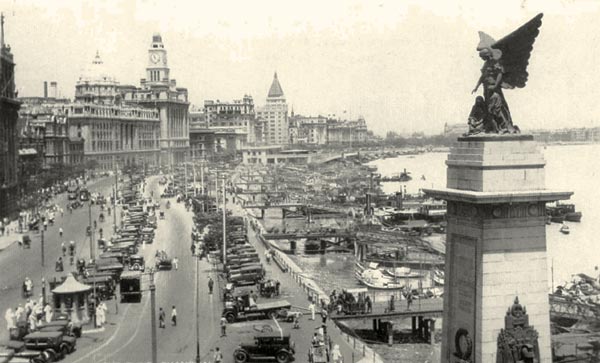
Imperial Façade: Shanghai's famous "Bund", where Western and Japanese capitalists rubbed shoulders with what Mao's communists called the "bourgeois comprador class" - the local capitalist intermediaries who built and maintained the crucial links between the Chinese people and the foreign investors, multi-national corporations, bankers and military interests of the imperial powers. Ironically, a reinvigorated China is now cultivating comprador capitalism in the societies of its dependent trading partners.
 
CHINA’S RAPID RISE to superpower status (at least economically) is producing some delicious political ironies. Eighty years ago, Mao Zedong’s communists wrote scathingly about China’s “bourgeois comprador class”. These were the local Chinese capitalists who acted as intermediaries between the Chinese people and the foreign-controlled enterprises and investors then operating in China under the protection of the major imperialist powers (Great Britain, Japan, France and the USA). The expression eventually entered the broader Marxist lexicon as “comprador bourgeoisie” and is defined as: “A section of an indigenous middle class allied with foreign investors, multi-national corporations, bankers and military interests.” The political irony lies in the fact that today’s comprador bourgeoisie is no longer located in China, but in the societies of her increasingly dependent trading partners.
 
As New Zealand’s largest trading partner, China is steadily wooing our own bourgeois comprador class away from its traditional friends and allies among the foreign investors, multi-national corporations, bankers and military interests of the UK, the USA and Australia. Already, a number of large Chinese banks have set up shop in New Zealand and have thought it politic to recruit both a former prime-minister, and a former leader of the opposition, to sit on their boards of directors. In light of the on-going furore about offshore investment in Auckland residential property, it is clear that this country’s largest real estate agencies must also be numbered among the more prominent members of our comprador bourgeoisie.
 
The Chinese surnames controversy has also exposed the role played by what might be called “cultural compradors”. The penetration of foreign capital, and the political leverage that goes with it, is only very occasionally accomplished at the point of an imperial bayonet. By far the most common method of establishing foreign influence is by using religion and/or ideology to recruit a local following to perform the role of domestic friends and allies. Such people constitute an invaluable bulwark against any attempt by the opponents of foreign influence and control to reassert national values and interests.
 
The extraordinary attacks on the Labour Party: the vicious accusations of “racism” levelled against Andrew Little and Phil Twyford; both provide grim evidence of the cultural compradors’ reckless hatred of the bourgeois compradors’ deadliest foe – the national bourgeoisie.
 
The word “national” notwithstanding, it is the Labour Party which has always represented New Zealand’s national bourgeoisie most effectively. As one of this country’s foremost public intellectuals, the late Bruce Jesson, shrewdly observed: “National knows how to govern for capitalists; but only Labour knows how to govern for capitalism.” The National Party may be “relaxed” about foreign investors pushing the price of a house beyond all but the wealthiest Kiwi’s reach, but Labour, by promising to restrict the rights of foreigners to purchase land, indicates its willingness to put the interests of New Zealanders first.
 
Dr Bryce Edwards: "Global Cosmopolitan".
 
The University of Otago political studies lecturer, Dr Bryce Edwards, frames the struggle of comprador against national capitalists as a contest between what he calls “Economic Nationalists” and “Global Cosmopolitans”. It’s a neat trick. Rather than dealing with the very hard choices New Zealanders are going to face as the economic and cultural power of China and its local facilitators waxes ever greater, Bryce has simply re-cast the drama as an existential confrontation between ageing patriots, clinging stubbornly to the outdated shibboleths of the nation state; and free-wheeling global citizens of the twenty-first century, possessed of an impressive collection of internationally marketable skills – but no country.
 
Bryce would also like to cloak his cultural comprador allies in the frayed costume of twentieth century socialist internationalism. He is hardly alone in this. All over the world, the Left is engaged in a bitter debate over whether nationalism can ever be turned to progressive purposes; and if it is still (or ever was) possible to construct socialism in one country.
 
Bryce is, however, wrong to try and smuggle those who would prepare the way for Chinese state capitalism in New Zealand into the honourable precincts of progressive disputation. Cultural compradors, like the comprador bourgeoisie, of which they are part, have no interest in constructing a political space in which the future of New Zealand can be reasonably debated. In their eyes, the future of New Zealand has already been decided – and not by New Zealanders.
 
This essay was originally posted on The Daily Blog of Thursday, 23 July 2015.

Tuesday, 21 July 2015

Foreign Investors.

Foreign Investment: The Native Land Court transferred more land from Maori to Pakeha than Queen Victoria's regiments ever managed. Without land, no people may be counted free. Restricting the access of foreigners to New Zealand real estate isn't about racism - it's about the preservation of our national sovereignty.
 
IT IS THE EARLY 1860s in the Waikato. A Maori newspaper editor, and fervent supporter of the Kingitanga movement, has a great idea for a story. He summons his best journalist and explains what he has in mind.
 
“I want you to travel to all the major cities,” he says, “visit the Land Registry offices, and discover the identity of everyone who’s been purchasing land that formerly belonged to Maori.”
 
“That’s a pretty expensive exercise, Boss”, the young journalist replies, “especially when we both know what the answer will be.”
 
“You’re right,” says the editor, “but I need more than mere conjecture, more than just anecdotal evidence. What I’m looking for are cold, hard facts! Under the Treaty of Waitangi, we Maori can only sell land to the Crown. But who is the Crown selling it to? Is it being sold to New Zealanders? Or is it being purchased by foreigners with huge sums of money to invest? That’s what I want you to find out.”
 
“Hmmmm?” The journalist responds, doubtfully. “I’m not sure the Pakeha keep that sort of information.”
 
“Yes, yes, I’ve thought of that. What I want you to do is look at the surnames of the purchasers. That’ll give you are reasonably good steer. After all, somebody called McKenzie is unlikely to be of Tainui descent, is he?”
 
“No. But, there are quite a few McKenzies already here in New Zealand. How are we supposed to sort out the local sheep from the foreign goats?”
 
“I’ve thought about that, too”, says the Editor, warming to his theme. “What percentage of the total population do you think the Pakeha currently comprise – especially here in Te Ika A Maui?”
 
The young journalist scratches his head. “Surely not much short of 4 in 10? With more arriving all the time. It would be higher in Te Wai Pounamu.”
 
“Exactly so!”, says the Editor. “So, if your research shows that 8 out of 10 purchasers of former Maori lands has a surname like McKenzie, or O’Reilly, or Twyford, then doesn’t it stand to reason that overseas British investors are disproportionately involved in buying up this country from under the feet of its original inhabitants? That we Maori are fast becoming tenants in our own land?”
 
“Actually, Boss, I’m not sure it does. Couldn’t it mean that the British settlers already here are just buying up as much land as they can – as quickly as they can get their hands on it?”
 
“Oh come on!”, the Editor snorts derisively. “Most of the Pakeha disembarking at the ports don’t have a pot to piss in! Where are they going to get the money to buy land?”
 
“I’m not talking about the ones who come in steerage, Boss. I’m talking about the ones who make the voyage in private cabins. The youngest sons of good English and Scottish families who arrive here with a very healthy bank balance – courtesy of Papa back in London or Edinburgh. They’ve got plenty to spend.”
 
“Alright. But even if that’s true, the result is exactly the same – isn’t it? They apply to the Crown, and the Crown obliges them – at our expense.”
 
“But only so long as we go on selling our lands to the Crown, Boss. I mean, who else are they going to buy land from in these islands – if not from Maori? Isn’t that the whole point of the Kingitanga? To stop the sale of any more Maori land to the Crown?”
 
“Yes, of course it is! Which is why I want you to write this story for me. To give the Kingitanga the facts about what’s happening to their whenua – to their future!”
 
“The Settler Government in Auckland isn’t going to like a story that singles them out on the basis of their surnames”, the young journalist observes, ruefully. “They’re going to point to it as yet more evidence of Maori mischief-making. Yet another reason why the Governor should send troops south to destroy the Kingitanga.”
 
“No! No! Governor Grey will never make war upon the Maori people. He is a good man. He believes this country can only be improved by British capital and Maori enterprise. He also recognises the importance of Maori autonomy – he made provision for it in the Constitution Act!”
 
“He did, Boss. Yes. But the settlers seem ill-disposed to granting us that autonomy. And, I think I know why.”
 
“Tell me.”
 
“Because they want everything, Boss. Not just what Maori consent to sell them – but everything. Just think of how much we depend on them for already – and it’s only going to get worse. There’s millions of them, Boss – numbers our language has no words for. And we’re in their way.”
 
The Editor turned and gazed out over the lush Waikato countryside. There were tears in his eyes.
 
This essay was originally published in The Press of Tuesday, 21 July 2015.

Tuesday, 14 July 2015

Chinese Whispers.

New Imperiums For Old: China now stands where Britain stood: an economic colossus with expectations of this country that New Zealanders are only reluctantly beginning to comprehend. The thought that the Chinese might want something in return for opening up their market to our milk powder and baby formula has come very late to the ordinary Kiwi.
 
SONJA DAVIES was only in Parliament for six years. But, she could hardly have chosen a worse six-year period to be a Labour MP. Her time as MP for the Wellington seat of Pencarrow (1987-1993) coincided with the crescendo of Rogernomics and the splitting of the Labour Party. It was not a happy time for the celebrated feminist and trade union fighter, and she was only too happy to hand her seat over to Trevor Mallard and get out.
 
It wasn’t just the awfulness of life in the Labour Party in the late-1980s and early-90s that depressed Sonja Davies. As a shrewd observer of both local and international politics, she rapidly became aware that New Zealand was passing through a period of fundamental cultural and economic re-orientation. What concerned her most was how little New Zealanders were being told and, therefore, how little they knew, about the changes that were radically reshaping what it means to be a New Zealander.
 
“If people had any idea about the scale of these changes,” she confided to me early in her first term as MP for Pencarrow,” they’d be horrified. It’s been decided that New Zealand’s future lies in Asia. That’s got massive implications – but most people haven’t a clue. No one asked them and certainly no one’s telling them.”
 
Sonja Davies: People would be horrified.
 
New Zealand’s embrace of Asia (remember Jim Bolger’s startling comment that “New Zealand is an Asian country”?) was a policy driven by the same elite group of bureaucrats and businesspeople that had sponsored Roger Douglas’s “Quiet Revolution”. New Zealand’s once heavily-protected economy had been thrown open to the world in anticipation of the world’s major economies doing the same.
 
Significantly, the corollary of the free movement of capital, goods and services across international borders – the free movement of peoples – remained largely unexamined. Most New Zealanders simply did not realise that if their country was determined to trade freely with the whole world, then, more and more, its population would come to resemble the people with whom it was trading. If most of those people hailed from Asia, then New Zealand would, indeed, become “an Asian country”.
 
Why Asia? Simply because the traditional destinations for New Zealand’s exports, Europe and the United States, were largely satiated markets. Even worse, they remained highly protected markets. Throughout Asia generally, however, and, more specifically, in China, it was evident that millions of hitherto poor peasants and workers would soon be entering the ranks of a new and materialistically inclined “Middle Class”.
 
And, if history was any guide, one of the principal effects of these millions of Chinese becoming wealthy would be a dramatic change in their dietary habits. The demand would go up for protein, protein and more protein. And protein was – and is – what New Zealanders do best. Increasingly, the diplomatic and trade focus shifted from the global free trade chimeras of APEC and the Doha Round of the WTO, to the golden prize of a single, bilateral, free trade agreement with the People’s Republic of China.
 
That agreement was the crowning achievement of the Helen Clark-led Labour Government (1999-2008) and there can be no disputing its enormous and beneficial impact on the New Zealand economy. Equally indisputable, however, are the profound socio-cultural and political impacts of China becoming this country’s largest trading partner.
 
The New Zealand historian, James Belich, describes the political and socio-cultural effects of New Zealand being transformed into Britain’s “protein factory” as “The Great Tightening”. Essentially, this country was re-colonised by British capitalists and its population re- educated accordingly. That the process was carried out by people who looked like us and talked like us – our own kith and kin, as it were – did not make it any less destructive of our national sovereignty. More than 18,000 young New Zealanders’ died in World War I: their blood exchanged for our butter’s guaranteed access to the British market. New Zealand’s Prime Minister, William Massey, was happy to pay the butcher’s bill.
 
China now stands where Britain stood: an economic colossus with expectations of this country that New Zealanders are only reluctantly beginning to comprehend. The thought that the Chinese might want something in return for opening up their market to our milk powder and baby formula has come very late to the ordinary Kiwi.
 
That Labour is leading the discussion about how much, precisely, the Chinese have a right to expect from New Zealanders is entirely fitting. After all, it was Labour who sealed the deal. It was Labour, too, who presided over the electorally unmandated “turn” towards Asia in the late-80s. That they are, at last, addressing the misgivings expressed to me by Sonja Davies’ all those years ago, is to be applauded – not condemned.
 
Labour’s Chinese whispers have nothing to do with racism. They’re about national sovereignty and the people’s will.
 
This essay was originally published in The Press of Tuesday, 14 July 2015.

Thursday, 8 May 2014

Different Address: Mai Chen Assesses Auckland's Future

Mother Of Dragons: Public law specialist, Mai Chen, argues that "Auckland is now the leader and its fast-growing and multicultural population has to be addressed differently from other parts of the country." Could this lead to New Zealand's largest city becoming a Chinese financial enclave and entrepot dominated by local agents of the vast (and globally expanding) Chinese diaspora?

BY 2040 AUCKLAND’S POPULATION is projected to reach 2.5 million – with half of that number being first generation immigrants. Billions of investment dollars will accompany these new residents, conferring upon them a disproportionate amount of national power and influence. From whatever perspective it is viewed: economic, cultural or political; New Zealand’s future development seems certain to be seriously, and quite possibly dangerously, distorted.
 
Public law specialist and author of Transforming Auckland: The Creation of Auckland Council , Mai Chen, seems less concerned about the possible consequences for New Zealand of having so much of its population and economic wealth concentrated in a single city than she does with ensuring the tax dollars of her fellow citizens keeping flowing north:
 
“Auckland cannot fund its infrastructure, despite its wealth, without Central Government … We need them … Aucklanders just want to get on with it.”
 
Perhaps, as a Chinese-New Zealander and a former member of the Asia-NZ Foundation, Ms Chen is simply bedazzled by the prospect of Auckland’s future becoming inextricably interwoven with the burgeoning Chinese economy. In the course of a recent newspaper interview, for example, she warned New Zealand’s decision-makers:
 
“The bureaucrats and officials in the capital have to start understanding Auckland’s problems and the importance of its rich human and social capital, as well as its economic impact ….. Auckland is now the leader and its fast-growing and multicultural population has to be addressed differently from other parts of the country.”
 
This statement, when unpacked, contains a rather ominous message for the rest of New Zealand.
 
Essentially, what Ms Chen is saying is that the city of Auckland’s population, made up increasingly of people who were born somewhere else (the explanation, presumably, for the richness of its human and social capital) and whose economic and cultural lives are increasingly disconnected from those of non-Auckland citizens, should, accordingly, be “addressed differently” from other New Zealanders.
 
Hmmm? For many decades now Auckland has boasted a “fast-growing and multicultural population”, and yet very few public law specialists over that time felt brave enough to argue that the thousands of unskilled labourers imported from the Pacific islands (also “rich” in human and social capital) should be “addressed differently” from Maori and Pakeha New Zealanders.
 
Could there be a further sub-text hidden within Ms Chen’s demand that Auckland be afforded special treatment by Central Government? Could she also be referencing the fact that within the city’s fast-growing and multicultural population there is an ethnic group that stands out from all the others? A group whose homeland constitutes New Zealand’s largest single trading partner? A group whose investment in the Auckland (as well as the wider New Zealand) economy is rising dramatically? A group whose cultural and financial networks are more than equal to the challenge of transforming Auckland into an outwardly focussed and essentially Asian city?
 
Could it be that Ms Chen is telling us that Auckland must be treated differently from the rest of New Zealand because the fastest growing segment of its population hails from China? Is she trying to persuade us that Auckland’s fate, like that of so many other cities in the Asia-Pacific region over the centuries, is to become a Chinese financial enclave and entrepot dominated by local agents of the vast (and globally expanding) Chinese diaspora?
 
Surely, as a public law specialist, Ms Chen must know that according special recognition to a non-indigenous ethnic group would immediately raise a plethora of fundamental constitutional problems. One has only to think of the enormous constitutional, political and cultural difficulties that have arisen from successive Governments’ attempts to honour the promises made to tangata whenua in the Treaty of Waitangi to get some inkling of the outcry that would accompany any proposal to address Chinese-New Zealanders “differently”.
 
Not that New Zealanders living in the nineteenth and early-twentieth centuries raised many objections to the very different treatment then meted out to Chinese immigrants by politicians of every ideological hue.  A century ago, anti-Chinese prejudice was as rife in New Zealand as it was in Australia. Immigration from China was restricted to males who could not vote, were required to pay special taxes and denied the right to send for their wives and families. So great was the fear of being “swamped” by the “Yellow Peril” that negative discrimination against the Chinese was not only applauded – it was demanded.
 
Such prejudice may have been buried by twenty-first century politicians, but only in a very shallow grave. It is, therefore, highly unlikely that Ms Chen anticipates anything so problematic as a positively-framed de jure recognition of China’s special interests in New Zealand. Indeed, the only message readers of her book should take away is the very high probability that Central Government will eventually have no option but to grant an Auckland economy increasingly dependent on the inflow of both Chinese immigrants and Chinese capital de facto special status.
 
After all, it was no lesser luminary that the former Commonwealth Secretary-General, onetime National Deputy-Prime Minister, and current Chairman of the New Zealand China Council, Sir Don McKinnon, who warmly greeted “New Zealand’s China Century”:
 
“China is our largest trading partner, our fastest growing source of tourists, our largest source of overseas students, and our greatest source of net migration … Our prosperity, our social cohesiveness, our sense of who we are as a nation is increasingly dependent on how well we integrate this new Chinese dimension into New Zealand’s economic and cultural life.”
 
If you want to know what that means, just ask Judith Collins and Maurice Williamson.
 
This essay was originally posted on The Daily Blog of Wednesday, 7 May 2014.

Tuesday, 28 May 2013

A Place At The Table

Showtime! Winston Peters knows how to exploit New Zealanders' long-standing fear of all things Chinese. But he also knows better than to seriously threaten New Zealand's increasing reliance of the Chinese markets - or to undermine the thirty-year effort it has required to ensure this country's continued access to them.
 
IT’S “SHOWTIME!” for Winston Peters. Once again New Zealanders’ fears have found an obliging political impresario. In his latest speech, to a Grey Power audience on Auckland’s North Shore, Mr Peters has targeted New Zealand’s rapidly changing demographic profile – most particularly the burgeoning rate of Chinese immigration. For those accustomed to thinking of New Zealand as the “last, loneliest, loveliest” outpost of European civilisation, this dramatic change in the shape of their country’s population is confusing, alarming – even threatening.
 
Mr Peters’ critics have attempted to characterise his latest observations as “racist” and “xenophobic”. These are easy shots to take. Any immigration trend which suggests that the balance of ethnic power within the national community is shifting will inevitably inspire all manner of racially-inflected political discussions. To condemn such discussions as “racist” is tantamount to ruling all but positive assessments of New Zealand’s current population policy out-of-bounds.
 
There are plenty of Kiwis who would insist that such mandatory positivism is – and has been for years – the firm policy of New Zealand Governments. Regardless of their partisan composition, successive administrations have extolled the virtues of immigration policies that focus almost exclusively on the economic value of each new immigrant. Any consideration of the socio-cultural dislocations historically associated with such policies has always come well behind the professed priorities of reducing New Zealand’s skills deficit and stimulating domestic demand.
 
Which is not to say that there weren’t those within the Department of Immigration anxious to forestall any rebirth of the atavistic anti-Chinese sentiment that shaped the immigration policies of nineteenth and early-twentieth century New Zealand. And these efforts to supress all forms of Kiwi Sinophobia would have been strongly supported by the Ministry of Foreign Affairs and Trade. Preparing for the increasingly important role the People’s Republic of China was going to play in the New Zealand economy has been a central feature of this country’s foreign and trade policies for the last thirty years.
 
The final triumph of the Chinese Communist Party’s “capitalist roaders” over Mao Zedong’s “iron rice bowl” socialists in the late-1970s anticipated the emergence of the so-called “Washington Consensus” favouring neoliberal capitalism and globalisation in the 1980s. The British called it “Thatcherism”, the Americans “Reaganomics”, and New Zealanders dubbed it “Rogernomics”. At the heart of the new economic paradigm was a vision of the future in which capital, goods (and, ultimately, even labour) would flow freely across a borderless planet.
 
Ever since both of New Zealand’s major political parties accepted globalised neoliberalism as the fixed shape of the future, the policy mandarins at MFAT have worked tirelessly to ensure that New Zealand would have a place at the table of the economic behemoth China promised to become.
 
Viewed from this perspective, the vast influx of Chinese nationals to New Zealand makes perfect sense. Whether in the form of fee-paying students, highly-skilled workers, property speculators or financial investors, official New Zealand has consistently welcomed the people upon whose complex personal, business and political networks this country’s economic prosperity has, increasingly, come to depend.
 
Mr Peters’ North Shore Grey Power audience would undoubtedly receive this largely untold recent history of New Zealand with considerable alarm and dismay. But, tellingly, it’s not the story Mr Peters told. (Even though, as a former Minister of Foreign Affairs, he will know it inside out). Instead, the NZ First leader chose to scratch the familiar itches of Chinese property speculation and the involvement of a very small number of Chinese businessmen in the gambling and sex industries.
 
Mr Peters knows there are votes to be won from the older generations of New Zealanders (especially those living in Auckland) who are having a harder and harder time reconciling the New Zealand they grew up in with the New Zealand they see all around them today. No doubt he has studied recent political trends in the United States and recognised the huge electoral rewards that can flow to a political party willing to identify itself with those ageing, comfortably-situated, conservative whites who, in one form or another, are feeling the demographic pinch.
 
What has clearly been a failing strategy for the far-right-driven Republican Party in the United States (where there are now simply too few conservative whites to win the presidency without at least some ethnic allies) it promises to be a real winner for Mr Peters. NZ First is not in a two-party, FPP, fight to the finish. As the consummate MMP politician, Mr Peters will be perfectly content with anything between five and 10 percent of the Party Vote. A few more, carefully calibrated, appeals to “Old New Zealand’s” Sinophobia ought to do the trick.
 
But Mr Peters remains too much the steadfast patriot to seriously put at risk the place Labour and National have laid for New Zealand at the Chinese table.
 
This essay was originally published in The Press of Tuesday, 28 May 2013.

Friday, 24 May 2013

Borderline Call (With Apologies To "Yes, Minister")

Nothing On Paper: “It seems that the Chinese customs people are having trouble recognising our new stationery.”
 
“AH, MINISTER, thank you for getting back to us so swiftly. We appear to be having a wee bit of a problem getting our sheep meat consignments across the Chinese border.”
 
“Oh? What sort of problem?”
 
“Well, it seems that the Chinese customs people are having trouble recognising our new stationery.”
 
“I’m sorry? Did you say stationery?”
 
“Yes, Minister. It seems they don’t recognise the forms and certificates issued by our new Ministry of Primary Industry.”
 
“Oh, for God’s sake! Our people in Beijing did advise them of the change – didn’t they?”
 
“Oh yes, Minister, of course – months ago.”
 
“Well, what’s the bloody problem then?”
 
“I can’t say for sure, Minister, but one or two of our people in Beijing – and one or two of us here in Wellington, for that matter – are of the view that the Chinese government may be sending us a little message.”
 
“Message? What on earth do you mean? What sort of message!”
 
“Well, you know the Chinese, Minister. Their messages can be very subtle – oblique even.”
 
“They’re not the only ones, mate! So, come on, that’s enough beating about the bush, what message are the Chinese trying to send – and to whom?”
 
“We think there may be a number of intended recipients, Minister. First and foremost there’s the Government. And, after the Government, we suspect there’s the whole primary production sector: dairying, meat and wool, kiwifruit – the whole shebang. And there may be a number of individuals. The Prime Minister, obviously, but also the Minister of Foreign Affairs and Trade, the Minister for Trade Negotiations, and yourself, of course.”
 
“Bloody hell! Go on.”
 
“We are of the view, Minister, that the timing of the current difficulties with Chinese customs may have more than a little to do with the meeting of the US/NZ Partnership Forum in Washington. You’ll be aware, Minister, that there is growing unease in Beijing about the pressure the Obama Administration is applying to those involved in the negotiation of the Trans-Pacific Partnership Agreement.”
 
“Yes. Obama wants it wrapped-up by October.”
 
“Er, yes, Minister. Quite. The President is noted for his optimism on these matters.”
 
“What? You think that deadline’s optimistic?”
 
“Suffice to say, Minister, that there’s about as much chance of a squadron of pig-shaped American drones flying over the Beehive in formation as there is of the TPPA being concluded by October. But that is by-the-by. It’s not President Obama’s enthusiasm for the TPPA that has the Chinese vexed, Minister, it’s ours.”
 
“What? But that’s ridiculous! The TPPA was our idea – of course we’re enthusiastic about it!”
 
“To be fair, Minister, what New Zealand had in mind, originally, was a small trade agreement involving a small number of small countries. What the TPPA has grown into, at least as far as the Chinese are concerned, is a large trading bloc, dominated by the United States, and pointed like a dagger at China’s export-dominated economy.”
 
“Nonsense!”
 
“Yes, Minister, but not to the Chinese. In their eyes the People’s Republic conferred upon New Zealand the singular honour of being the recipient of its very first Free Trade Agreement with a modern capitalist economy. In very short order that agreement has made China New Zealand’s largest and most important trading partner. Laid before us are 250 million middle-class Chinese consumers, and the prospect of the People’s Republic becoming this country’s twenty-first century equivalent of the insatiable British market. Of Shanghai and Guangzhou becoming the oriental versions of Tooley Street and Smithfield.”
 
“So?”
 
“So, perhaps, Minister, the Chinese are wondering if we really want a new Tooley Street and Smithfield. Perhaps, they hear Mr McCully waxing eloquent in Washington over the TPPA, and wonder if he’s convinced the USA’s about to offer us a much better FTA. Perhaps, Minister, the message China’s sending us is that if the Americans are now so willing to accept our agricultural exports, then China will happily leave them sitting on the docks for Uncle Sam to collect.”
 
This essay was originally published in The Dominion Post, The Waikato Times, The Taranaki Daily News, The Timaru Herald, The Otago Daily Times and The Greymouth Star of Friday, 24 May 2013.

Tuesday, 16 April 2013

Testing The Anglo-Saxons

Know Thy Enemies: China's Nineteenth Century history recommends a thorough process of getting to know exactly who and what you're dealing with. The Celestial Kingdom's disdain for "Foreign Barbarians" did not work out so well. New Zealand offers the Chinese Government a risk-free environment in which to master the idiosyncrasies of the Anglo-Saxon cultures challenged by its rising economic power.
 
THE PRIME MINISTER has given his recent trip to China a perfect score.
 
“They have really given us great access, they are totally committed to moving the relationship on, there has been a real opportunity to renew friendships and understandings with the new leadership team and we’ve announced things that will make a difference here.
 
“I think it’s a 10 out of 10.”
 
There can be no disputing the value which the People’s Republic places upon its relationship with New Zealand. What we offer our now pivotal trading partner is access to a fully developed, English-speaking, democratic, capitalist society. With our tiny population and strategic irrelevance, China can test and refine here the techniques it must perfect if its increasingly up-close-and-personal interactions with the United States, the United Kingdom, Canada and Australia are to bear diplomatic and commercial fruit.
 
More bluntly, China has chosen New Zealand as its testing-ground. Mistakes made here can simply be written-off to experience. New Zealand is too small (and too dependent on the Chinese demand for its dairy products) to impose any kind of effective sanctions on the Chinese state.
 
What we do have, however, is the ability to reveal the pitfalls awaiting China in jurisdictions large enough to inflict serious damage on both its government and economy. Though we may only be its smallest digit, New Zealand remains one of the five fingers of the Anglo-Saxon fist. And if the exponential growth of China’s productive capacity has reduced its economic power, the Anglo-Saxon Fist still packs an unanswerable military punch.
 
As a policy, pissing-off the Anglo-Saxon’s has not served the Chinese state well in the past, and is most unlikely to do so for the foreseeable future.
 
And that’s where we come in.
 
How will the citizens of the Anglo-Saxon states respond to large-scale land purchases by state-owned, or capitalised, Chinese corporations? That is something the big-wigs in Beijing should probably know before allowing their surrogates to buy up half of Herefordshire or Ohio.
 
And, thanks to New Zealand, they have been given a pretty good idea. Though far greater chunks of the New Zealand landscape had been hocked-off to Americans, Canadians, Indonesians and Israelis, the very idea that even a tiny amount of New Zealand farmland might end up in Chinese hands was enough to bring Kiwis out in a rash.
 
New Zealand’s bi-partisan commitment to keeping Sino-New Zealand relations harmonious was sufficient to prevent any large-scale political exploitation of that popular antagonism. Even so, China’s rulers had been given a taste of the sort of reaction likely to greet large-scale Chinese land purchases in English-speaking countries containing political classes less constrained by considerations of size and economic dependence. The far-right of the US Republican Party, for example. Or, the frankly xenophobic “backwoodsmen” of the British Conservative Party.
 
A recent news-story (published in The Sunday Star-Times of 14 April 2013) offers the Beijing authorities another opportunity to test the political and social reactions of Anglo-Saxons to Chinese ideas and aspirations.
 
Mr Easter Wu, a prominent figure in the New Zealand Chinese business community, has apparently been campaigning for the right to pay immigrant workers less than the statutory minimum wage. In advocating that his compatriots engage in what is a clear breach of New Zealand employment law, Mr Wu confined himself to Chinese-language media outlets.
 
Now that his comments: “How much you are worth is how much you get. You got an $8 skill, I pay you $8.”, have been translated into English, the response of ordinary New Zealanders is likely to be extremely hostile.
 
Not only has Mr Wu been using his high media profile in the expatriate Chinese community to suggest that Chinese employers should ignore the laws of the country in which they have been permitted to operate, but he has also, wittingly or unwittingly, raised up the spectre, in the minds of native-born New Zealanders, that Chinese business leaders are conspiring to undermine their wages and conditions. With New Zealand currently experiencing high levels of unemployment, such behaviour has the potential to produce an ugly and diplomatically unhelpful anti-Chinese backlash.
 
Perhaps the most worrying aspect of Mr Wu’s campaigning is that China’s diplomatic representatives in New Zealand appear to have made no attempt to rein-in their wayward compatriot. Within the Chinese Embassy there will certainly be officers tasked with the close monitoring of the local Chinese-language news media. It is very puzzling (to say the least) that the Embassy does not appear to have taken Mr Wu aside and warned him about the very serious consequences his campaigning risked unleashing.
 
Then again, it’s possible this unwillingness to intervene reflects the Chinese Government’s interest in discovering how Anglo-Saxons react to the idea that Chinese employers should be allowed to operate outside the law.
 
If so, we should let them know.
 
This essay was originally published in The Press of Tuesday, 16 April 2013.