
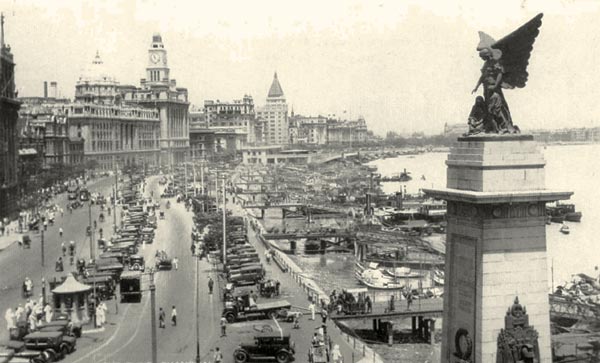
Imperial Façade: Shanghai's famous "Bund", where Western and Japanese capitalists rubbed shoulders with what Mao's communists called the "bourgeois comprador class" - the local capitalist intermediaries who built and maintained the crucial links between the Chinese people and the foreign investors, multi-national corporations, bankers and military interests of the imperial powers. Ironically, a reinvigorated China is now cultivating comprador capitalism in the societies of its dependent trading partners.
CHINA’S RAPID RISE to superpower status (at least
economically) is producing some delicious political ironies. Eighty years ago,
Mao Zedong’s communists wrote scathingly about China’s “bourgeois comprador
class”. These were the local Chinese capitalists who acted as intermediaries
between the Chinese people and the foreign-controlled enterprises and investors
then operating in China under the protection of the major imperialist powers
(Great Britain, Japan, France and the USA). The expression eventually entered
the broader Marxist lexicon as “comprador bourgeoisie” and is defined as: “A
section of an indigenous middle class allied with foreign investors,
multi-national corporations, bankers and military interests.” The political
irony lies in the fact that today’s comprador bourgeoisie is no longer located
in China, but in the societies of her increasingly dependent trading partners.
As New Zealand’s largest trading partner, China is steadily
wooing our own bourgeois comprador class away from its traditional friends and
allies among the foreign investors, multi-national corporations, bankers and
military interests of the UK, the USA and Australia. Already, a number of large
Chinese banks have set up shop in New Zealand and have thought it politic to
recruit both a former prime-minister, and a former leader of the opposition, to
sit on their boards of directors. In light of the on-going furore about
offshore investment in Auckland residential property, it is clear that this
country’s largest real estate agencies must also be numbered among the more
prominent members of our comprador bourgeoisie.
The Chinese surnames controversy has also exposed the role
played by what might be called “cultural compradors”. The penetration of
foreign capital, and the political leverage that goes with it, is only very
occasionally accomplished at the point of an imperial bayonet. By far the most
common method of establishing foreign influence is by using religion and/or
ideology to recruit a local following to perform the role of domestic friends
and allies. Such people constitute an invaluable bulwark against any attempt by
the opponents of foreign influence and control to reassert national values and
interests.
The extraordinary attacks on the Labour Party: the vicious
accusations of “racism” levelled against Andrew Little and Phil Twyford; both provide
grim evidence of the cultural compradors’ reckless hatred of the bourgeois compradors’
deadliest foe – the national bourgeoisie.
The word “national” notwithstanding, it is the Labour Party
which has always represented New Zealand’s national bourgeoisie most
effectively. As one of this country’s foremost public intellectuals, the late
Bruce Jesson, shrewdly observed: “National knows how to govern for capitalists;
but only Labour knows how to govern for capitalism.” The National Party may be
“relaxed” about foreign investors pushing the price of a house beyond all but
the wealthiest Kiwi’s reach, but Labour, by promising to restrict the rights of
foreigners to purchase land, indicates its willingness to put the interests of New
Zealanders first.

Dr Bryce Edwards: "Global Cosmopolitan".
The University of Otago political studies lecturer, Dr Bryce
Edwards, frames the struggle of comprador against national capitalists as a
contest between what he calls “Economic Nationalists” and “Global
Cosmopolitans”. It’s a neat trick. Rather than dealing with the very hard
choices New Zealanders are going to face as the economic and cultural power of
China and its local facilitators waxes ever greater, Bryce has simply re-cast
the drama as an existential confrontation between ageing patriots, clinging stubbornly
to the outdated shibboleths of the nation state; and free-wheeling global citizens
of the twenty-first century, possessed of an impressive collection of
internationally marketable skills – but no country.
Bryce would also like to cloak his cultural comprador allies
in the frayed costume of twentieth century socialist internationalism. He is
hardly alone in this. All over the world, the Left is engaged in a bitter
debate over whether nationalism can ever be turned to progressive purposes; and
if it is still (or ever was) possible to construct socialism in one country.
Bryce is, however, wrong to try and smuggle those who would
prepare the way for Chinese state capitalism in New Zealand into the honourable
precincts of progressive disputation. Cultural compradors, like the comprador
bourgeoisie, of which they are part, have no interest in constructing a political
space in which the future of New Zealand can be reasonably debated. In their
eyes, the future of New Zealand has already been decided – and not by New
Zealanders.
This essay was
originally posted on The Daily Blog
of Thursday, 23 July 2015.
