Showing posts with label Chinese History. Show all posts

Tuesday, 24 January 2023

What Is Co-Governance?

Two Flags, Two Masters? Just as it required a full-scale military effort to destroy the first attempt at Māori self-government in the 1850s and 60s (an effort that divided Maoridom itself into supporters and opponents of the Crown) any second attempt to establish tino rangatiratanga, based on the confiscatory policies required to give it cultural and economic substance, could only be achieved militarily. That is to say, by fighting a racially-charged civil war.

CO-GOVERNANCE presents New Zealanders with the most acute constitutional challenge since the Land Wars of the 1860s. Paradoxically, it would be a considerably less vexing problem if our ancestors truly had been the colonialist monsters of contemporary “progressive” folklore. Had the defeated Māori tribes been driven onto and confined within “reservations” – as happened to the Native Americans of Canada and the United States – instituting co-governance in the 2020s would be a breeze. Likewise, if the National Government of 1990-1999 had opted to create the New Zealand equivalent of “Bantustans” (self-governing ethnic enclaves) instead of instituting the internationally celebrated Treaty Settlement Process.

The central difficulty of the Treaty Settlement Process, as so many Māori nationalists have pointed out, is that it cannot offer more than a fraction of a cent on the dollar in terms of the current value of the Māori lands alienated under the laws of successive settler governments. To recover these from their present owners would require the outlay of hundreds-of-billions of dollars, a sum well beyond the means of even the New Zealand State – let alone individual iwi.

And yet, as the Waitangi Tribunal’s recent finding in relation to the Ngapuhi rohe makes clear, the establishment of authentic rangatiratanga is virtually impossible without the land that gives chiefly authority its political heft. With all but a tiny fraction of New Zealand presently under the control of the New Zealand State, its Pakeha citizens, and a not insubstantial number of foreign owners, any discussion of co-governance is inevitably reduced to sterile arguments over Māori representation on city councils and other public bodies.

That’s why the true underlying agenda of those who preach the gospel of co-governance can only be the re-confiscation of the tribal territories lost since the Land Wars. This may sound far-fetched, but it is not impossible. As Māori discovered in the 1860s, and subsequent decades, all that is required to deprive a people of their lands, forests and fisheries is control of the legislative process, and the military force necessary to enforce the legislators’ will.

While Pakeha New Zealanders remained united in their resolve to construct a “Better Britain” on the lands confiscated and/or acquired (all too often by immoral means) from the country’s indigenous people, the notion of re-confiscation could be dismissed as an absurdity. But, if a substantial portion of the Pakeha population, most particularly those occupying the critical nodes of state power: the judiciary, the public service, academia, the state-owned news-media, and at least one of the two major political parties; were to become ideologically disposed to facilitate the compulsory restitution of confiscated Māori resources, then the idea would begin to sound a whole lot less far-fetched.

To see how it might be accomplished one has only to study the manner in which the government of the newly-declared People’s Republic of China secured effective control of the privately-owned elements of the Chinese economy. The Communist Party of China, in sole control of the nation’s legislative machinery, and assured of a compliant judiciary and civil service, simply required private concerns to make over an ever-larger fraction of their shareholding to the Chinese state. With Boards of Directors dominated by government appointees, and no prospect of ever recovering control of their enterprises, the “owners” reluctantly sold their remaining shares to the state (receiving only a risible fraction of their true worth). The smart capitalists, reading the writing on the wall, sold-up early and fled to Taiwan, Hong Kong, Singapore and the United States. The one’s who hoped for the best, generally fared the worst.

With the news-media firmly under the Communist Party’s control, and the legal climate growing increasingly hostile to any citizen courageous enough to challenge the government’s policies, the transfer of private property into state hands was accomplished by the end of the 1950s – in less than a decade. It would have taken considerably longer if the People’s Liberation Army had not been standing behind the Communist Party’s legislators, civil servants and journalists. But, its willingness to apply military force to enforce the party’s will was never in doubt. In the words of the Chinese Communist leader, Mao Zedong: “All political power grows out of the barrel of a gun.”

How might a New Zealand parliament dominated by political parties favourably disposed towards co-governance set about transferring land held by private Pakeha/foreign interests to iwi authorities? One option might involve imposing all kinds of environmental and cultural obligations on landowners – obligations that could not be fulfilled without rendering the enterprise unprofitable. Crown purchase (at a fraction of the land’s true worth) would follow, allowing the state to amass a vast amount of additional  real-estate. This process would undoubtedly be speeded-up by the consequent catastrophic collapse in agricultural land prices, which only constant and massive Crown purchases could stem.

With most of New Zealand land now in the possession of the Crown, returning it to tangata whenua would be the obvious next step towards meaningful co-governance. The Waitangi Tribunal, or some other, similar, body could be tasked with delimiting Aotearoa’s iwi boundaries as they existed at the time of the Treaty’s signing in February 1840. (Given that many of these boundaries would have been extended, reduced, or eliminated altogether as a consequence of the Musket Wars of the 1820s and 30s, deciding who should get what would likely entail a fair amount of ‘robust’ negotiation!)

The critical question to be settled in order for this process to succeed is whether a pro-co-governance parliament could rely upon the Police and the NZ Defence Force to enforce its legislative will. That there would be considerable resistance to the government’s plans may be taken as given, with such resistance escalating to terrorism and a full-scale armed rebellion more than likely. With the outbreak of deadly race-based violence, the loyalties of the Police and the NZDF would be tested to destruction.

Just as it required a full-scale military effort to destroy the first attempt at Māori self-government in the 1850s and 60s (an effort that divided Maoridom itself into supporters and opponents of the Crown) any second attempt to establish rangatiratanga, based on the confiscatory policies required to give it cultural and economic substance, could only be achieved militarily. That is to say, by fighting a racially-charged civil war.

Some would argue it makes more sense to accept that the historical evolution of the nation of New Zealand has actually allowed Māori to enjoy the best of both worlds. Their language and culture endure alongside their iwi and hapu connections, all very much alive beneath the overlaid institutions of the settler state. 

That they are able to take full advantage of those institutions is due to the historical oddity of the colonists who created New Zealand not following the example of their white settler contemporaries and forcing the remnants of the indigenous tribes onto reservations – entities particularly suited to being “co-governed” in “partnership” with their conquerors. Instead, the Pakeha declared Māori to be full citizens, afforded them parliamentary representation, and laid the foundations of the bi-cultural society fast-emerging in Twenty-First Century Aotearoa-New Zealand.

If co-governance denotes a political system in which an indigenous people and the descendants of the settlers who joined them wrestle together with the legacies of colonisation – as free and equal citizens – then we already have it.


This essay was originally posted on The Daily Blog of Tuesday, 17 January 2023.

Wednesday, 21 February 2018

A New Zealand Political Dissident.

Dangerous Mind: International interest in Professor Anne-Marie Brady’s research into the growing reach of Chinese "soft power" was sharpened recently by her disclosure of the presence of former Chinese nationals in the caucuses of New Zealand’s two largest political parties; most particularly, the fact that one of those Members of Parliament has historical links with the Chinese intelligence community (if only in a pedagogical capacity).

THAT PROFESSOR ANNE-MARIE BRADY has had her home and office broken into, and her lap-top stolen, is deeply troubling. That the perpetrators were brazen enough to warn her that their attack was imminent, only heightens that concern. The most compelling reason for feeling uneasy about Professor Brady’s misfortunes, however, is their obvious potential to seriously damage Chinese-New Zealand relations.

Professor Brady is a China specialist who has won international acclaim for her research into the methods used by the Chinese government to monitor and, where possible, influence the conduct and opinions of Chinese nationals living abroad; as well as for describing the Communist Party of China’s (CPC) efforts to build maximum support for the “Motherland” among the world-wide Chinese diaspora.

What has sharpened international interest in Professor Brady’s work is her disclosure of the presence of former Chinese nationals in the caucuses of New Zealand’s two largest political parties; most particularly, the fact that one of those Members of Parliament has historical links with the Chinese intelligence community (if only in a pedagogical capacity).

Taken together with her itemisation of the appointments of former political leaders of New Zealand to the boards of a number of Chinese financial institutions, the Professor’s revelations were more than sufficient to secure coverage in major media outlets in Australia, the UK and the United States.

The most recent reference to Professor Brady’s research is to be found in the influential US magazine, “Foreign Policy”. Concerned about the links between the Chinese Embassy in Washington and the Chinese Students and Scholars Association operating on the campus of Georgetown University, foreign-policy specialist, Bethany Allen-Ebrahimian, quotes Professor Brady on the information-gathering role of these Chinese Government-supported student groups:

“It’s a deliberate strategy to make sure that the Chinese students and scholars living abroad don’t become a problem.”

That the political and cultural views of young Chinese citizens studying abroad could become a problem for the Chinese Government is readily appreciated. As Bethany Allen-Ebrahimian points out, there are 330,000 Chinese nationals studying in the United States, alone, with scores-of-thousands more at other universities around the world. That’s an awful lot of highly-educated, highly-skilled young people to come home with “problematic” ideas!

This is much more than a theoretical proposition. As an at-least-nominally revolutionary party, the CPC will be well aware of the “Russians in Paris” syndrome.

Following the final defeat of Napoleon Bonaparte in 1815, the armies of the victorious powers – which included the Russian Empire – occupied Paris. Young Russian officers suddenly found themselves in the midst of a free-wheeling culture which prized intellectual and artistic pursuits of all kinds – not least the passionate discussion of political philosophy.

Unsurprisingly, these Imperial Guardsmen returned home to St Petersburg with more than a taste for French cuisine and Parisian coffee. Travelling with them were the core principles of the French Revolution: “Liberty. Equality. Fraternity.” Within ten years, some of them (known as “Decemberists”, after the month in which they rose against the Tsar) were attempting to spark a democratic revolution in Russia.

The last thing the Chinese authorities want is a “Decemberist” revolt of their own. A revolt fuelled by ideas and ideals imported into China from the United States of America in the heads of their best and brightest university graduates. Those among the CPC leadership who had to deal with the consequences of the tragic events of June 1989 will not have forgotten that the symbol of that earlier student revolt was a papier-mâché replica of the Statue of Liberty.

The studied indifference towards Professor Brady’s research (not to mention her personal security) displayed by the New Zealand authorities, speaks to the existence of considerable sympathy within New Zealand’s own ruling circles for the stern measures which the Chinese authorities feel obliged to undertake.

Peoples’ uprisings may be a recurring feature of Chinese history, but they are generally remembered as short-lived periods of chaos and confusion, preparatory to the restoration of order and tranquillity by a centralised, authoritarian government, in whose strong hands the gods have reposed the all-important “Mandate of Heaven”.

It is, clearly, the view of the Ministry of Foreign Relations and Trade, the Ministry for Primary Industries, and Treasury, that an orderly and tranquil China is much to be preferred to a democratic and turbulent China. As a crucial market for its primary production, and an equally important source of foreign direct investment in its industry and infrastructure, China is obviously regarded by the New Zealand Government as an economic partner much too big to rile.

Equally obvious, is Professor Brady’s status as a New Zealand political dissident. Innocent of any crime, but guilty of that most heinous offence – upsetting the apple cart. If she is waiting for the New Zealand authorities to help her, then she will likely be waiting a very long time.

UPDATE: On Monday (19/2/18) came the welcome news that Prime Minister Jacinda Ardern has asked the Security Intelligence Service to investigate the break-ins to Professor Brady's home and office and the theft of her lap-top computer. Welcome, too, the news that the PM's intervention has breathed new life into the hitherto stalled Police investigation. It is, however, noteworthy that the PM has yet to use the word "China" in relation to Professor Brady's case.

This essay was originally published in The Press of Tuesday, 20 February 2018.

Friday, 20 November 2015

Punishing The Barbarians

Imperialism To The Rescue? United States infantry storm the walls of Beijing as part of the Eight Nation Alliance's successful attempt to put down the "rebellion" of Boxer terrorists and restore "civilised values" to the benighted people of China. But, the actions of the imperialist powers in 1900 are regarded very differently with the hindsight of 115 years. How shall the West's imminent actions in the Middle East be judged in 2130?
 
IT WAS CALLED “The Eight Nation Alliance” and it had but one purpose: to punish the Chinese people. In 1899, the Shandong peasantry had resolved to drive all “foreign devils” out of their country, rising in their thousands under the leadership of a secret society known as the Brotherhood of Righteous and Harmonious Fists. The British, with characteristic disdain, referred to these patriots as “Boxers”, and dubbed their uprising the “Boxer Rebellion”.
 
By 1900 the Boxers were close to achieving their goal. They had shamed the Empress Dowager, Cixi, into supporting their movement and with the assistance of the Chinese army had the “foreign devils” bottled up in Beijing’s diplomatic quarter.
 
It was the unthinkable prospect of these legations being over-run, and their terrified inhabitants slaughtered, that persuaded the world’s leading imperialists: Great Britain, France, Russia, Germany, the USA, Austria-Hungary, Italy and Japan; to announce the formation of a joint force to lift the siege and restore the status quo ante.
 
The German Kaiser, Wilhelm II, felt obliged to mark the departure of his own nation’s contingent with a speech. If you ever wondered why, in both world wars, the German’s were referred to as “The Hun” – wonder no more:
 
“Should you encounter the enemy,” said the Kaiser, “he will be defeated! No quarter will be given! Prisoners will not be taken! Whoever falls into your hands is forfeited. Just as a thousand years ago the Huns under their King Attila made a name for themselves, one that even today makes them seem mighty in history and legend, may the name German be affirmed by you in such a way in China that no Chinese will ever again dare to look cross-eyed at a German.”
 
Confronting the Yellow Peril: The Christian West is enjoined by the archangel Michael to strike down the Asiatic threat from the East.
 
Needless to say, the Eight Nation Alliance – whose forces numbered in excess of 45,000 soldiers and marines – made short work of the poorly armed and inadequately led Chinese forces. Beijing was sacked and the Forbidden City ransacked of its treasures.
 
Never again would the imperial powers of Europe and Japan go to war alongside – as opposed to against – one another. Just 15 years after the subjugation of China, the members of the Eight Nation Alliance were tearing themselves to pieces in the First World War.
 
Of course, had you been reading the newspapers of the period, the foreign intervention in China would have seemed entirely reasonable. In an era when the Christian churches of the West were filled-to-bursting every Sunday, the stories of Christian missionary families being beheaded, burned alive, raped and even crucified by the brutal Boxer mobs, left Europeans feeling stunned and sickened.
 
These were not civilised people to be reasoned with. Indeed, the suicidal tactics of the Boxer “rebels” – many of them armed only with swords and spears – charging headlong into the murderous fire of the allies’ Maxim guns (an early type of machine-gun) struck the “reasonable men” of 1900 as the very antithesis of civilisation. In their ears, the bombastic racism of Kaiser Wilhelm did not sound nearly so shocking as it does in our own.
 
Perhaps the leaders of the world’s great powers should pause to contemplate the difference 115 years can make to way people interpret the behaviour of their forebears. In the minds of Presidents Hollande and Putin, the case for bringing together another Eight Nation Alliance to crush the barbaric Islamic State no doubt seems as strong as the arguments for punishing the murderous Boxers and their treacherous Empress Dowager, Cixi.
 
That the egregious behaviour of the imperial powers made such an uprising inevitable would have been dismissed by the political leaders of 1900 as an outrageous slur. The British Government’s open support for the 19th Century opium trade, and its callous indifference to the enormous suffering it inflicted on the Chinese people, went largely unremarked. With the benefit of 115 years hindsight, however, Britain’s culpability is as obvious as it is detestable.
 
How shall our own generation of political and military leaders appear from the perspective of 115 years in the future? Given the West’s numerous interventions in Middle Eastern affairs since World War II, will the atrocities committed by Islamic State strike our great grandchildren as any more worthy of historical condemnation than the atrocities of the Boxers?
 
As China is today, so may the Islamic world be in 2130. What will its judgement be?
 
This essay was originally published in The Waikato Times, The Taranaki Daily News, The Timaru Herald, The Otago Daily Times and The Greymouth Star of Friday, 20 November 2015.

Thursday, 23 July 2015

Friends And Allies: What Is The “Comprador Bourgeoisie” When It’s At Home?

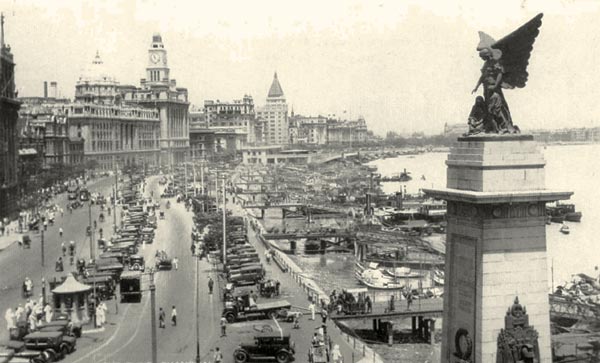
Imperial Façade: Shanghai's famous "Bund", where Western and Japanese capitalists rubbed shoulders with what Mao's communists called the "bourgeois comprador class" - the local capitalist intermediaries who built and maintained the crucial links between the Chinese people and the foreign investors, multi-national corporations, bankers and military interests of the imperial powers. Ironically, a reinvigorated China is now cultivating comprador capitalism in the societies of its dependent trading partners.
 
CHINA’S RAPID RISE to superpower status (at least economically) is producing some delicious political ironies. Eighty years ago, Mao Zedong’s communists wrote scathingly about China’s “bourgeois comprador class”. These were the local Chinese capitalists who acted as intermediaries between the Chinese people and the foreign-controlled enterprises and investors then operating in China under the protection of the major imperialist powers (Great Britain, Japan, France and the USA). The expression eventually entered the broader Marxist lexicon as “comprador bourgeoisie” and is defined as: “A section of an indigenous middle class allied with foreign investors, multi-national corporations, bankers and military interests.” The political irony lies in the fact that today’s comprador bourgeoisie is no longer located in China, but in the societies of her increasingly dependent trading partners.
 
As New Zealand’s largest trading partner, China is steadily wooing our own bourgeois comprador class away from its traditional friends and allies among the foreign investors, multi-national corporations, bankers and military interests of the UK, the USA and Australia. Already, a number of large Chinese banks have set up shop in New Zealand and have thought it politic to recruit both a former prime-minister, and a former leader of the opposition, to sit on their boards of directors. In light of the on-going furore about offshore investment in Auckland residential property, it is clear that this country’s largest real estate agencies must also be numbered among the more prominent members of our comprador bourgeoisie.
 
The Chinese surnames controversy has also exposed the role played by what might be called “cultural compradors”. The penetration of foreign capital, and the political leverage that goes with it, is only very occasionally accomplished at the point of an imperial bayonet. By far the most common method of establishing foreign influence is by using religion and/or ideology to recruit a local following to perform the role of domestic friends and allies. Such people constitute an invaluable bulwark against any attempt by the opponents of foreign influence and control to reassert national values and interests.
 
The extraordinary attacks on the Labour Party: the vicious accusations of “racism” levelled against Andrew Little and Phil Twyford; both provide grim evidence of the cultural compradors’ reckless hatred of the bourgeois compradors’ deadliest foe – the national bourgeoisie.
 
The word “national” notwithstanding, it is the Labour Party which has always represented New Zealand’s national bourgeoisie most effectively. As one of this country’s foremost public intellectuals, the late Bruce Jesson, shrewdly observed: “National knows how to govern for capitalists; but only Labour knows how to govern for capitalism.” The National Party may be “relaxed” about foreign investors pushing the price of a house beyond all but the wealthiest Kiwi’s reach, but Labour, by promising to restrict the rights of foreigners to purchase land, indicates its willingness to put the interests of New Zealanders first.
 
Dr Bryce Edwards: "Global Cosmopolitan".
 
The University of Otago political studies lecturer, Dr Bryce Edwards, frames the struggle of comprador against national capitalists as a contest between what he calls “Economic Nationalists” and “Global Cosmopolitans”. It’s a neat trick. Rather than dealing with the very hard choices New Zealanders are going to face as the economic and cultural power of China and its local facilitators waxes ever greater, Bryce has simply re-cast the drama as an existential confrontation between ageing patriots, clinging stubbornly to the outdated shibboleths of the nation state; and free-wheeling global citizens of the twenty-first century, possessed of an impressive collection of internationally marketable skills – but no country.
 
Bryce would also like to cloak his cultural comprador allies in the frayed costume of twentieth century socialist internationalism. He is hardly alone in this. All over the world, the Left is engaged in a bitter debate over whether nationalism can ever be turned to progressive purposes; and if it is still (or ever was) possible to construct socialism in one country.
 
Bryce is, however, wrong to try and smuggle those who would prepare the way for Chinese state capitalism in New Zealand into the honourable precincts of progressive disputation. Cultural compradors, like the comprador bourgeoisie, of which they are part, have no interest in constructing a political space in which the future of New Zealand can be reasonably debated. In their eyes, the future of New Zealand has already been decided – and not by New Zealanders.
 
This essay was originally posted on The Daily Blog of Thursday, 23 July 2015.