Showing posts with label Dr Nick Smith. Show all posts

Wednesday, 4 September 2019

A Step Too Far.

A Crown Asset? For reasons relating to its own political convenience, the Crown pretends to believe that “No one owns the water.” To say otherwise would re-vivify the promises contained in the Treaty of Waitangi – most particularly those pertaining to the power of the chiefs and their proprietary rights to the lands, forests and fisheries belonging to their iwi and hapu. 

“WHO OWNS NEW ZEALAND’S freshwater?” In resolving issues as fraught as this one it often helps to engage the imagination. Picture these islands before the arrival of human beings roughly 700 years ago. Who owned the water then? Ask the same question of the period between 1300 and 1769 when this country was occupied exclusively by Maori. Finally, ask the present inhabitants of Aotearoa-New Zealand: “Who owns the water?” To offer the same answer to all three of these questions invites ridicule. Clearly, each answer will be different.

When these islands were the exclusive preserve of the flora and non-human fauna which lived in, on, above and around them, the ownership of freshwater wasn’t an issue. Every living thing which dwelt here needed water, but none of them owned it. Ownership is a human concept. It arrived here with the Maori. That makes it very difficult to argue that Maori were not freshwater’s first owners. It is equally difficult, however, to argue that they are still its owners. Not after 250 years of European colonisation.

Even according straightforward “ownership” of freshwater to the Maori of the pre-European contact period is problematic. “Maori” is one of those collective nouns that only come into existence in response to the creation of another collective noun – in this case “Pakeha”. Before the arrival of Europeans the people who now call themselves “Maori” called themselves something else – the collective nouns iwi, hapu and whanau spoke to their tribal, clan and family identities. In 2019, we use the word “Maori” to designate a race, or, as we prefer to say nowadays, an ethnicity. But race and ethnicity are concepts that came ashore from sailing ships, not ocean-going waka.

The owners of freshwater in pre-European Aotearoa-New Zealand were, therefore, iwi and hapu. Access to freshwater was basic to their survival. Not only did springs, streams, rivers, marshes and lakes supply these groups with drinking water, but they were also important sources of food, as well as the raw materials necessary for making clothing, tools and weapons. Obviously, once secured, these water resources had to be defended. They may not have been tribal or clan “property” in the European sense, but woe betide the person or persons who attempted to convert these resources to their own use. Stealing another clan’s freshwater was an act of war.

The protection guaranteed to the chiefs’ “lands, forests and fisheries” in the Treaty of Waitangi is difficult to interpret as anything other than a recognition of tribal and clan property rights. Equally difficult, one would think, would be to separate the proprietorship of freshwater from the proprietorship of  the springs, streams, rivers, marshes and lakes in which fish tend to be found. The Waitangi Tribunal’s argument that iwi and hapu retain a proprietary interest in water is, accordingly, well-founded. Whether “Maori” own the water is, however, much less certain.

The nearer iwi and hapu came to transforming themselves into a united political and economic entity – a Maori realm or nation – the more urgently did the Pakeha colonisers petition London for the means to disrupt, defeat and disinherit Aotearoa-New Zealand’s indigenous inhabitants. They were only too aware that the moment the traditional property rights of the many tribes and the clans were codified into a specifically Maori system of land and freshwater ownership, then the whole process of colonisation would come to a shuddering halt. The idea of two distinct political and economic entities – one Maori and the other Pakeha – held in place by the promises of the Treaty was anathema to the new-born settler state.

For traditional British forms of land ownership and resource use to prevail, the Crown’s writ had to run from Cape Reinga to the Bluff. There could be only one legal system: one means of determining who owned what; one method for transferring titles of ownership; one code for protecting the freshwater that falls and runs freely upon the earth; and one means of granting persons the right to use this vital resource.

It was to establish these, the preconditions for a unitary and sovereign state, that the colonial government of Sir George Grey, in 1863, sent 12,000 imperial troops into the Waikato to destroy the nascent Maori realm that was taking shape under the Kingitanga. And when the guns finally fell silent in the 1870s, so too did the voice of the Treaty – for close to 100 years.

This, then, is the answer we must give to the question “Who owns this country’s freshwater in 2019?” It is the New Zealand State – a.k.a “The Crown”.

For reasons relating to its own political convenience, the Crown pretends to believe that “No one owns the water.” To say otherwise would re-vivify the promises contained in the Treaty – most particularly those pertaining to the power of the chiefs and their proprietary rights to the lands, forests and fisheries belonging to their iwi and hapu. Were the Crown to keep the promises of 1840, it would be forced to acknowledge the very same truth it fought a war to deny: that in Aotearoa-New Zealand sovereignty is shared between two peoples – not exercised exclusively by one.

This is precisely what the Waitangi Tribunal’s Stage 2 Report on the National Freshwater and Geothermal Resources Claims makes clear.

Unsurprisingly, the Opposition spokesperson on Crown-Maori Relations, Dr Nick Smith, has come out swinging:

“National rejects the proposals for Maori being given an ownership interest in freshwater as proposed by the Waitangi Tribunal”.

Dr Smith goes on to reiterate the position taken by his party when in government:

“National has consistently and sensibly maintained that no one owns freshwater. We urge the Government to reject the more radical recommendations in this report on water ownership. The Government is creating uncertainty and confusion by not clearly ruling out Maori having an ownership interest in freshwater.

“Water is a public resource, like air. Maori have a right to be involved in decision making on freshwater and National provided for that in changes to the Resource Management Act and Treaty Settlements. Transferring ownership or providing a veto to iwi over water is a step too far.”

Hapu and iwi leaders are hoping that Jacinda Ardern’s government will have the “balls” to heed the Waitangi Tribunal’s report’s recommendations. But that would require of Labour, NZ First and the Greens more courage than any of them have shown to date. If you can picture David Parker, Andrew Little and Winston Peters bravely contradicting the statements of Dr Smith, then you possess a much more vivid imagination than I do!

This essay was posted on The Daily Blog of Friday, 30 August 2019.

Thursday, 15 September 2016

“So Long – And Thanks For All The Fish.” National Abandons Green For Brown.

Pristine And Unique: The Kermadec Ocean Sanctuary covers one of the most pristine and unique environments on Earth. Its 10km ocean trench is the second deepest in the world and is deeper than Mt Everest is tall, while its arc of 30 underwater volcanoes is the longest anywhere on earth. It is home to six million seabirds of 39 different species, more than 150 species of fish, 35 species of whales and dolphins, three species of endangered sea turtles and many other marine species such as corals, shellfish and crabs unique to this area. Prior to the arrival of Europeans in the Eighteenth Century, Maori never fished these waters.
 
JOHN KEY’S DECISION to suspend the passage of the Kermadec Ocean Sanctuary legislation marks an important turning point in the life of his government. Rather than pass Nick Smith’s environmentally vital bill with Green votes, the Prime Minister has, apparently, capitulated to the greed of rent-seeking Iwi leaders, and the schoolboy political philosophising of Act’s David Seymour.
 
Clearly, Key has his eyes fixed on the likely outcome of next year’s election, when the votes of his current Confidence and Supply partners may, once again, constitute the margin between victory and defeat.
 
In this respect, the fate of the Maori Party is of particular relevance. If Tukoroirangi Morgan can unite the Maori and Mana parties against Labour in the Maori electorates to claim Tamaki Makaurau, Te Tai Hauauru, Te Tai Tokerau and (if Nanaia Mahuta can be persuaded to step down) Hauraki-Waikato, then Key’s hold on power will likely endure.
 
That will most certainly not be the outcome, however, if the Kermadec Ocean Sanctuary Bill is made law over the loud objections of practically the whole of Maoridom. Hence Key’s determination to keep Maoridom (and the Maori Party) sweet.
 
It is even possible that Seymour’s posturing on the Bill is less about standing up for “the existing property rights of fishing operators” and more about providing some cover for Key’s capitulation to Iwi anger. Better to have National Party voters scolding Seymour for his disloyalty than upbraiding the Prime Minister for “pandering” to Maori interests.
 
Key will be especially keen that his electoral base is kept as far away as possible from the words of his own Environment Minister, Dr Nick Smith.
 
In a media statement released earlier today (14/9/16) Smith angrily rejected Maori criticism of the Kermadec Ocean Sanctuary Bill:
 
“We have tried very hard to find a resolution with TOKM [Te Ohu Kaimoana], with 10 meetings involving ministers during the past 10 months. TOKM wanted to be able to maintain the right to fish and the right to exercise that at some time in the future. We wanted to protect the integrity of the sanctuary as a no-take area.
 
“The claimed consequences for TOKM are way overstated. Māori have caught more than three million tonnes under the fisheries settlement since 1992, but not a single tonne in the Kermadecs. There are five fishing companies affected, none Māori, but who collectively have only caught about 20 tonne per year, out of an annual total fishing industry catch of 450,000 tonnes.
 
“The claim that this new sanctuary undermines the 1992 fishery settlement is incorrect. The Government always retained the right to create protected areas where fishing would be disallowed and has done so in over 20 new marine reserves, many of which had far more impact on settlement and customary fishing rights. New Zealand is a signatory to the United Nations Convention on Biodiversity and the Aichi targets of setting aside at least 10 per cent of our oceans in marine protected areas.
 
“The proposed sanctuary is part of a Pacific-wide effort to provide large-scale Marine Protected Areas, with the United States announcing the Eastern Hawaiian Islands Reserve and the United Kingdom proposing a large reserve around Pitcairn Island.”
 
Smith’s statement was released shortly after 1:00pm and betrayed not the slightest awareness that its author and his bill was about to be left twisting slowly in the wind by the Prime Minister. Less than an hour later, at 2:00pm, Seymour issued a media release announcing his party’s decision to pull its support for the Bill. By 3:00pm, Key was telling the Parliamentary Press Gallery that:
 
“We’re absolutely sure we can get the numbers with the Greens but we’re very disappointed that negotiations with [Te Ohu Kaimoana] have broken down at this point. The government would restart discussions with the Māori Party to see whether it would support the bill. So it is just going to take a bit longer.”
 
How much longer? The smart money would be on ‘Sometime After The 2017 Election’.
 
Key emerges from this whole episode with very little honour. Such craven compromising is a very long way from the extraordinarily bold behaviour of the John Key who took up the Opposition leader’s role in 2007. That John Key would have weighed the Greens’ 13 percent of the Party Vote against the Maori Party’s 2 percent and adjusted his strategy accordingly.
 
A National Party that was serious about a fourth term would have welcomed the chance to do something environmentally important with the support of the Greens. In a century defined and dominated by environmental perils, the political salience of Green Party issues can only increase. In recognition of that salience, Labour has been willing to forfeit any chance of recovering its former electoral dominance. That is because Labour understands what Key clearly does not: that a party which rejects every opportunity to govern with the Greens, will eventually render itself incapable of governing at all.
 
This essay was originally posted on The Daily Blog of Wednesday, 14 September 2016.

Friday, 27 November 2015

Build Now - Save Later

Little Edens: These new houses bear testimony to the success of the Waimahia Inlet Special Housing Area in Weymouth, Auckland. At between $350,000 and $540,000 each, however, these houses are still far beyond the resources of those in the most urgent need of accommodation. Houses for the poorest New Zealanders are still in critically short supply. Tackling homelessness now will reap significant social benefits in the years to come.
 
WHY IS THE GOVERNMENT so reluctant to get its hands on the housing crisis? Reviewing its performance over the past seven years, it is clear that John Key is prepared to do just about anything to reduce homelessness – except build the houses that people so desperately need.
 
In Auckland, where the crisis is most acute, Dr Nick Smith keeps announcing the creation of Special Housing Areas (SHAs) to streamline the building consent process. Nine more of these were promulgated by the Minister for Building and Housing on Monday, bringing the tally to 106 SHAs – space for upwards of 48,000 new homes!
 
Dr Smith is inordinately proud of his creation. But, having made space for all these mini-Edens, the Minister, like the Creator God of the Book of Genesis, has simply blessed the property developers, instructed them to “be fruitful and multiply”, and withdrawn from the scene.
 
Actually building houses, in numbers sufficient to significantly reduce homelessness, is not something this government believes the state should be doing. It is the National Party’s firm belief that the actual process of house construction should be left to the market’s “invisible hand”. (Presumably, the one wielding the invisible hammer!)
 
Unfortunately for Dr Smith, the Market has so far displayed minimal interest in constructing homes for poor people. (Or even, it must be said, for tolerably well off people.) According to the Labour Party’s Housing Spokesperson, Phil Twyford, the Auckland City Council has been able to account for only 102 houses completed in Dr Smith’s SHA’s since 2013.
 
“We now officially have more Special Housing Areas than actual houses built in them”, quips Mr Twyford. “The consenting rate still languishes at 4300 below the 13,000 new homes Auckland needs every year just to keep up with population.”
 
It’s important to understand that this exchange between Dr Smith and Mr Twyford is not about homes constructed for the poorest New Zealanders. These two politicians are merely debating the building of homes per se. In some parts of Auckland, the average price of one of these per se homes is fast approaching (or long ago exceeded) $1 million dollars. Hardly the sort of small change your average, poverty-stricken Kiwi family is likely to find down the back of the sofa!
 
Labour’s housing policy (assuming it remains Labour’s policy) is called Kiwibuild. It envisions the construction (by private developers) of 100,000 “modern affordable homes” over ten years for first-home-buyers.
 
Just how the very poorest New Zealanders are supposed to pay for a “modest entry-level home” priced at around $300,000 Labour does not explain. (And that $300,000 figure, cited when the policy was first released back in 2012, has likely inflated to around $500,000 in the current Auckland property market.)
 
Kiwibuild would, however, assist a great many young, middle-class couples into their first home – which is, unquestionably, a good thing. But, it would do little to address the acute shortage of low- and no-cost emergency accommodation which is presently forcing Maori, Pasifika and immigrant families into doubling- or tripling-up with relatives and friends. That’s when they’re not driven to sleep in caravan parks, under bridges, or in their cars.
 
The Finance Minister, Bill English, has, for some time, been arguing for a whole new approach to managing the burgeoning cost of New Zealand’s welfare state. By intervening early, says English, the State can save millions – quite possibly billions – of taxpayer dollars. Children raised in poverty, whose lack of a stable home environment often requires a host of extremely costly state interventions in later life, could, if targeted early for state assistance, end up becoming net contributors to society.
 
The rapid construction by Housing New Zealand of thousands of units of emergency accommodation would not only contribute to the well-being of thousands of New Zealand’s poorest and most vulnerable citizens, but would also largely pay for itself. Well-designed, warm, and energy-efficient, such units could be provided free-of-charge – at least initially – while their occupants lives were restored to some sort of order. Once family life had stabilised, regular rental payments could begin.
 
English’s actuarial approach to welfare would require considerable political courage to implement. The trick, electorally speaking, would be to demonstrate the huge potential savings in Vote Health, Vote Education and Vote Corrections. National’s slogan could be: “A tax-cut to every voter who provides a future for every child.”
 
This essay was originally published in The Waikato Times, The Taranaki Daily News, The Timaru Herald, The Otago Daily Times and The Greymouth Star of Friday, 27 November 2015.

Sunday, 21 June 2015

Dirt And Squalor: The Housing Crisis Comes Full-Circle.

Planned Response: Squalor and dirt was the market’s solution to the acute shortage of affordable housing, and the First Labour Government’s heroic, state-organised, response has become the stuff of political legend. How Mickey Savage, keen to find an outlet for the restless energy of John A. Lee, his great rival for the masses’ affections, gave him responsibility for organising a massive programme of state house construction. And how Lee, by mobilising both the public and private sectors, built thousands of houses for the working poor.
 
THOUSANDS OF NEW ZEALANDERS are at the mercy of a “slum landlord”. Unfortunately, that slum landlord is the Government. The person who put into words what so many people have, for the best part of a fortnight, been feeling, was Dr Bryce Edwards. The political studies lecturer from Otago University was speaking as panellist on Television New Zealand’s Q+A programme.
 
It is a measure of how fraught the housing issue has become that TVNZ was only able to persuade the Housing Minister, Dr Nick Smith, to appear on the programme if he was interviewed alone, and was given the right-of-reply to the following interview with Labour’s housing spokesperson, Phil Twyford.
 
There was a time when Government and Opposition spokespeople felt up to the job of defending their respective positions in head-to-head debates, live, on national television. To my knowledge, guaranteeing a Government Minister a separate right-of-reply constitutes an editorial concession without precedent on either of this country’s free-to-air networks.
 
The Minister’s sensitivity was, of course, understandable in a week when New Zealanders learned that sub-standard conditions in a solo mother’s state house accommodation had materially contributed to the death of her infant daughter. Then to learn, just days later, of another death attributable, at least in part, to sub-standard state accommodation. When asked by journalists to comment on these tragedies, Dr Smith responded that: “People dying in winter of pneumonia and other illnesses is not new.”
 
This was the context in which Dr Edwards’ “slum landlord” comment was able to strike such a raw public nerve.
 
How has it come to this? What has permitted the housing conditions wheel, over the course of 80 years, to come very nearly full-circle?
 
In his book, We Call It Home: A History of State Housing in New Zealand, Ben Schrader describes how the Truth newspaper, just one week after the election of the First Labour Government, in 1935, began campaigning against “the slum problem”.
 
“The article began”, writes Schrader, “by vividly juxtaposing the newly completed National War Memorial with its sordid surroundings.” Truth compared this “beautiful piece of architecture”, erected to ensure that the “supreme sacrifice” of the Great War was not forgotten, with that of the Wellington slums, standing “a stone’s throw away” from the Memorial’s tower. In these dwellings, Truth observed: “men, women and children are making a different kind of sacrifice. They live in squalor and dirt, in little shacks lacking even the ordinary comforts of existence.”
 
Squalor and dirt was the market’s solution to the acute shortage of affordable housing, and the First Labour Government’s heroic, state-organised, response has become the stuff of political legend. How Mickey Savage, keen to find an outlet for the restless energy of John A. Lee, his great rival for the masses’ affections, gave him responsibility for organising a massive programme of state house construction. And how Lee, by mobilising both the public and private sectors, built thousands of houses for the working poor.
 
So successful was Labour’s scheme that the town planner, Cedric Firth, could write, more than a decade later, about the citizen’s right to a “decent dwelling being regarded as on the same level as the right to education, sanitation, to good and abundant water supply, to an adequate road system and a certain amount of medical care.”
 
These are no longer the expectations of either those responsible for supplying social housing, nor, sadly, of those obliged to seek shelter in New Zealand’s decaying stock of state houses. Having forgotten (if he ever knew) how manifestly inadequate the market’s “solutions” were to the problems of the 1930s, Finance Minister, Bill English, appears hell-bent on resurrecting a social housing market – even if he has to dig up the corpse with his bare hands!
 
Commentators across the political spectrum, joined just this week by economists from the OECD, are urging John Key’s National Government to launch a state-financed and directed effort to address directly the lack of affordable houses for the poorest New Zealanders. As Dr Edwards’ fellow panellist on last Sunday’s Q+A programme, Fran O’Sullivan, put it: “It’s been done before in our history.”
 
The problem, says Dr Edwards, is that the political parties’ housing agendas are “a bit deluded and empty”. National and Labour are “still quite timid” when it comes to committing themselves to the sort of low-cost housing construction effort that offers the only truly effective solution to New Zealand’s twin housing crises. The first, which condemns far too many Kiwis to lives of “squalor and dirt”. And the second, fuelled by the speculative mania currently gripping Auckland’s runaway housing market.
 
Market delusions and political timidity allowed slum landlords to thrive in the 1930s. Eighty years later, identical failings on the part of their state-owned successor have added an ironical twist to the community’s demand for radical housing reform.
 
This essay was originally published in The Press of Tuesday, 16 June 2015.

Tuesday, 24 March 2015

Shaken - But Not Stirred: Canterbury Is Denied Democracy For The Third Time.

Water and Grass: The economic value of productive pastures is deemed by the National Government to be more important than popular political control over the water that keeps them green. In Canterbury this has led to a third delay in the return of full democracy to the region.
 
THE GREAT CANTABRIAN RIGHTS ROBBERY continues. With six of the thirteen Regional councillors set to be appointed, until at least 2019, by the Environment Minister, Dr Nick Smith, Canterbury’s long-promised return to democracy has, once again, been delayed.
 
And still the streets are empty.
 
That the people of Christchurch have been a little preoccupied since 2010 is acknowledged. But the same high-handedness that prompted the elimination of Cantabrians’ regional democracy has also been a frustrating feature of their city’s rebuild.
 
And still the streets are silent.
 
Large sums of money continue to be extracted from the people of Canterbury by “Commissioners” for whom no one has voted. Practically without a murmur, the oldest principle of democratic governance – that taxes may only be levied by representatives chosen by the people themselves – has been cast aside.
 
“No taxation without representation!”: the principle for which seventeenth century Englishmen were ready to execute their King, and in the name of which eighteenth century Americans proclaimed a revolution; has stirred New Zealanders hardly at all.
 
Where are our John Hampdens? Our John Pyms? Why have we yet to produce an Antipodean version of John Adams? John Hancock? Thomas Jefferson? All of these champions of representative government – the farmers, merchants and lawyers who challenged King Charles I and King George III – were men of substance. They dared to win, even though to lose meant death. But New Zealand’s men of substance; our farmers, merchants and lawyers; what have they dared?
 
Precious little has been risked by those whose screams would, undoubtedly, be among the loudest were Cantabrians rights being abrogated by a left-wing government. Indeed, one could argue that the destruction of regional democracy in Canterbury was undertaken at the behest of farmers, merchants and lawyers. For isn’t it these latter groups that have the gained the most from the elimination of their fellow citizens’ democratic rights? While ordinary Cantabrians retained the capacity to thwart their grand plans for Canterbury’s precious water, how could the region’s farmers, merchants and lawyers possibly have attracted the level of investment required to bring them to fruition?
 
Dr Smith dismisses all such claims as cynical. Rather than a case of careful political engineering, erected in the interests of the farmers, merchants and lawyers who vote National, the destruction of Canterbury’s regional democracy is presented by the Minister as some sort of glorified water conservation measure. Any return to normal democratic governance, argues Dr Smith, would inflict irreparable damage on a process which he clearly believes to be beyond the capabilities of elected citizens.
 
“The fear would be that you’ve got this population divide pretty even between rural and urban, and rather than those commissioners being able to look for the middle way through, that you end up where we were – a highly polarised council not making any progress on these very important issues.”
 
Dr Smith refuses to accept that, by silencing the voice of urban conservationists, he has, in effect, facilitated the water exploitation schemes of rural Cantabrians. His justification hinges on what he considers to be the superiority of technocratic over democratic decision-making.
 
But this justification works equally well for any and all attempts to limit the scope of democratic decision-making. The notion that society would be morally and materially improved if all the important decisions were left to a self-replenishing caste of “philosopher kings” is as old as Plato’s Republic. That every attempt to put Plato’s ideas into practice has very quickly resulted in the decisions of the wise becoming practically indistinguishable from the interests of the wealthy, has always been one of the strongest arguments in favour of democracy.
 
Nor is it reasonable to suppose that Dr Smith’s technocratic problem-solving will remain quarantined in Canterbury. In October 2016 it is likely that the balance of power on the Hawkes Bay Regional Council will shift decisively against the proposed Ruataniwha Water Storage Scheme. But, after what happened in Canterbury, the region’s voters are surely justified in wondering whether their democratic judgement will simply be over-ruled by Dr Smith, and a group of Commissioners installed to make certain that “progress on these very important issues” continues.
 
Would this be enough to see the people’s pitchforks lifted up and their flaming torches lit? One hopes so, but all the evidence so far suggests otherwise. New Zealanders definition of democracy appears to embrace a sort of plebiscitary oligarchy, under which a group of politicians are given the right to govern exactly as they please – subject only to a triennial vote of confidence.
 
But this definition of democracy condemns us all to live under an elected dictatorship where politicians are free to impose decisions of ever-increasing mendacity: ceasing only when a decision of such outrageous awfulness pushes the population beyond its collective pain threshold; and the people remember that they have rights.
 
This essay was originally published by The Press of Tuesday, 24 March 2015.

Friday, 23 January 2015

New Zealand Doesn't Need A "Developers' Charter".

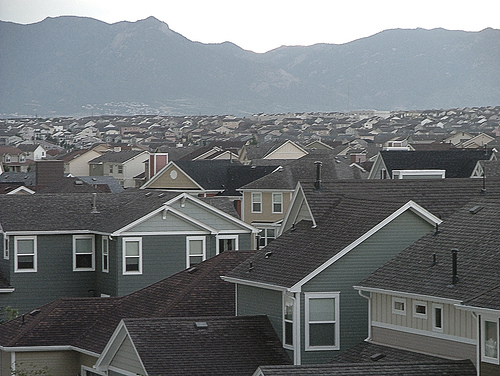
The Never-Ending Suburban Dream: Dr Nick Smith's purported determination to make housing more affordable by "reforming" the Resource Management Act has been widely derided as little more than a National Party recommitment to the urban development model of the 1950s and 60s. In short, to quote Peter Dunne, "a developers' charter".

THE LAWYERS and the environmental lobbyists are already gnawing at Dr Nick Smith’s proposed changes to the Resource Management Act (RMA). Forewarned by the National-led Government’s first, abortive, foray into environmental law reform back in 2013, a forearmed Opposition has this week re-joined the battle with renewed energy.
 
The United Future leader, Peter Dunne, has warned against turning the RMA into a “Developers’ Charter” – a potent political riff upon which his parliamentary colleagues have been only-too-happy to extemporise.
 
Has the Prime Minister, rubbing shoulders with 1 percent of 1 percent of the 1 Percent at Davos, given equal heed to the venerable Member for Ohariu? Given that few politicians’ appreciation of middle-class New Zealanders’ tics and tells is stronger than Mr Dunne’s, if John Key isn’t paying attention to him, then he should – and soon.
 
Not that, in the brutal numbers game that determines whether a piece of legislation succeeds or fails, Mr Key needs the endorsement of Mr Dunne. The parliamentary arithmetic of environmental law reform requires no complicated figuring. The Act Party’s grace-and-favour MP for Epsom, David Seymour, has already signalled (well in advance of any actual shouts of “Division called for!”) that he will be supplying Dr Smith with the single vote necessary (in addition to National’s 60 votes) to ensure the passage of the Government’s environmental reforms.
 
Which is, when you think about it, extraordinary. With sixty MPs, National’s current parliamentary caucus is, by historical standards, a large one. It is also slavishly obedient.
 
Outside of the armed forces and large private corporations, it is remarkable to find a group of sixty strong-willed individuals who can be relied upon absolutely to do exactly as they are told. Especially remarkable when doing exactly what they’re told could very easily cause the seats that a number of them hold to change hands.
 
Readers of a certain age will recall National Party MPs like Mike Minogue and Marilyn Waring, Simon Upton and Ruth Richardson, who were willing, in the absence of any acceptable compromise, to cast their votes against their own Government’s policies.
 
It has been a very long time indeed since a National Party politician “crossed the floor” in any kind of procedurally meaningful context. For many years now absolute caucus discipline has not only been assumed – it has prevailed.
 
Such robotic compliance is not good for the health of National’s caucus; the wider National Party organisation; nor, ultimately, for that of parliamentary democracy itself. Voters need to believe that there are at least some MPs whose definitive allegiance is to values and principles more enduring than the arguments of their Party Whip. On matters crucial to both the social and the natural environments, the practice of representative democracy should rise above the crude calculations of purely partisan arithmetic. It should be about reason and science; about being persuaded by the evidence and securing the greatest good for the greatest number.
 
Replacing New Zealand’s much admired RMA with a “Developers’ Charter” would be about none of those things. On the contrary, it would be about using the legislative process to advance the interests of a section of New Zealand society which has, for more than sixty years, grown extremely wealthy (and dangerously influential) by convincing the National Party to continue following a model of sprawling urban development, based on the single-story detached dwelling and the private automobile. As a template for sustainable urban growth, it was already out-of-date when the First National Government adopted it in 1949.
 
Economically-speaking, the model only works by transferring vast public subsidies into the bank accounts of the private land speculators, property developers, builders and roading contractors who are its indefatigable champions.
 
Unfortunately, the greed of this corrupt system’s beneficiaries has led them, like all racketeers, to jack up their prices to unaffordable levels. The consequential crises, both social and environmental, are dominating the headlines.
 
The solution to the problem of unaffordable housing is not to gut the RMA, as the urban-sprawl lobby would have us all believe, but to make it fit for the purpose of managing the introduction of a more rational, sustainable and affordable model of urban development. Since this model will, inevitably, require massive investment from the public, it must also be answerable to the public.
 
Peter Dunne understands this – even if Dr Smith and Mr Key do not.
 
This essay was originally published in The Waikato Times, The Taranaki Daily News, The Timaru Herald, The Otago Daily Times and The Greymouth Star of Friday, 23 January 2015.

Friday, 23 March 2012

Dr Smith's Discredited Prescription

Predestination? Dr Nick Smith's swansong as Minister of Local Government was a reheated version of the now thoroughly discreditied "Taxpayers' Bill of Rights" (TABOR). By limiting rate rises to the rate of inflation and/or population growth, Smith's legacy will be an increasingly underfunded local government sector. If you want to know what it feels like to be slowly crushed by a sinking-lid budget - just ask the people of Colorado.

IT’S DEPRESSING. Dr Nick Smith always struck me as a reasonable sort of bloke. There were plenty of flinty-faced ideologues in the National Party: politicians impervious to all but their own opinions; unmoveable by evidence, reason, or even (in many cases) by old-fashioned common-sense. But, up until this Monday, I wouldn’t have included Dr Smith among them.

But his swansong leaves us no choice. The departed Minister’s “reforms” of New Zealand local government are driven by pure ideology: ideas already discredited in their country of origin, the United States. The destructive effects of artificially constrained budgets are readily observable in the crumbling infrastructure and moral squalor of the American communities forced to adopt them.

New Zealanders need to understand that if National and its support parties are permitted to introduce this far-right American ideological virus into this country, then our own communities will suffer a similar fate.

Our regional, city and district councils will, when it comes to revenue-gathering, be required to operate what amounts to an unending “sinking-lid” policy. In a surprisingly short period of time, the funds available for public amenities like libraries, art galleries, theatres, swimming-baths and parks will dwindle to the point where all of these public services find themselves struggling to survive. Initially, they will resort to user-charges, but if the experience of the US State of Colorado is anything to go by, such measures will provide only temporary relief. Sooner, rather than later, they will be forced to close.

Local infrastructure will fare little better. Denied the right to raise local taxes (i.e. “rates”) above the level of inflation and/or population growth, our local councils will be unable to embark on the long overdue refurbishment of this country’s water reticulation and sewage systems. The maintenance of roads and footpaths will similarly be allowed to slide. Kerbing and channelling will crumble and our streets will be full of pot-holes. Complaints will be answered with an occasional shovel-full of gravel.

In just a few years our town or city will take on a dishevelled, even decrepit, appearance. Laid-off council workers will drift away. Go-getting entrepreneurs will seek greener pastures. Young people will not return from their studies in wealthier, more exciting places. Our local authority’s rating-base will shrink. With even less money to spend, its ability to maintain services and repair infrastructure will be even further compromised. Our communities’ slide into decrepitude, and the exodus of their populations, will gather pace.

Of course, not everybody will be unhappy at this turn of events. Those lucky enough to own their own homes; those with a healthy investment income; those whose children long ago departed the family home; those who, for a very long time, have regarded the vast majority of their fellow citizens as shirkers and wastrels: these folk will be delighted. They never used the library. They never visited the art gallery or the theatre. Their own private gardens were always preferable to the city’s parks. If they wanted a swim they dived into their own private pool.

In Colorado, from whence National and ACT filched this model of local government, it got to the point where small towns were forced to lay-off a good portion of their fire department and sack most of the Sheriff’s deputies. In some places the authorities went as far as turning-off every other street light. Anything to relieve the relentless pressure on their budgets.

Why is the National-led Government embracing this social, economic and cultural disaster? Why has it refused to be persuaded by, for example, the Productivity Commission’s draft report on housing affordability, which, according to the Greens’ Eugenie Sage, shows that: “rates have been declining in relation to property values, indicating that in terms of household wealth, rates are becoming less significant”.

The answer, like the problem, is contained in the Far-Right’s hatred of collectivism. The city, the civis, remains the fount of civi-lisation. By their very nature, cities are both an exercise, and an experience, in collective living. Consider Christchurch: what was the Canterbury community’s first and most striking endeavour? Their Cathedral.

Would such a structure, constructed at such a cost, and dedicated to such a purpose, be permitted under the Government’s proposed new regime? Of course it wouldn’t.

The Far Right’s intention is to replace the collective infrastructure of “We”, with the private architecture of “I”.

This essay was originally published in The Otago Daily Times, The Waikato Times, The Taranaki Daily News, The Timaru Herald and The Greymouth Star of Friday, 23 March 2012.