Showing posts with label Christmas. Show all posts

Friday, 24 June 2022

Matariki: Thoughts and Questions.

Guided By The Stars? This gift of Matariki, then, what will be made of it? Can a people spiritually unconnected to anything other than their digital devices truly appreciate the relentless progress of gods and heroes across the heavens? The elders of Maoridom must wonder. Can Te Ao Māori be concentrated into the equivalent of spiritual orange-juice – to be distributed freely every June in a handy cultural packet? “Here you are Tau Iwi – just add water!”

HOW DO YOU FEEL ABOUT MATARIKI? Are you delighted that, at last, New Zealand has a holiday entirely unrelated to its colonial heritage? A holiday, moreover, that celebrates the natural cycles of a South Pacific island chain, rather than the western extremities of a vast northern continent. Coinciding with the Winter Solstice, Matariki, like Christmas in its original setting, marks the year’s turning: away from the constraining darkness; towards the liberating light.

Or, do you see Matariki as something contrived and imposed? A festival seized upon for ideological purposes? A holiday with an agenda attached?

And how does that make you feel? Guilty? Do you blame yourself for harbouring sentiments driven, consciously or unconsciously, by racism? Or, does it make you feel angry? Do you blame the Government for creating a holiday that highlights the cultural differences between its citizens? Are you antagonised by the state’s presumption that these differences are something to be celebrated?

Then again, you may be a strong believer in secularism. If you’re “not big on religion”, as most non-religious Kiwis tend to say when subjected to spiritual inquiries, you may be experiencing a twinge or two of impatience when you see, hear and read references to Matariki that embrace without challenge its overtly religious content. Your brow may furrow even more deeply when you consider the likely consequences of attempting such a challenge.

Is it not the height of hypocrisy to laugh along with the atheists who poke fun at the Christian eucharist, only to recoil in horror from the suggestion that there might be something just a wee bit peculiar about offering-up a cooked meal to a random configuration of stars?

For a country which, historically, has eschewed the very idea of a state religion, isn’t it also a little jarring to hear state broadcasters helpfully instructing New Zealanders on the ways in which their new state-sanctioned religious festival can be appropriately celebrated?

As anyone who has ever watched the excellent television programme, Waka Huia, will attest, Te Ao Māori pulses with spiritual life. Mountains, rivers, forests, the stars that fill the sky, all are sentient and powerful entities. One approaches them with reverence – and caution – as is fitting when dealing with ancient and holy ancestors to which one is inextricably and irrevocably connected.

It is to be wondered if the men and women who walk in this world are pleased, or alarmed, when they see Matariki – and all it portends – transformed into a public holiday, thoughtfully supplemented with a handy Cole’s Notes summary of the complex spiritual significance of the nine rising stars. Will they experience the emotions of devout Christians as Christmas and Easter approach?

To those who sincerely embrace the Christian faith, these public holidays have been transformed into crass orgies of commercialism. Santa and the Easter Bunny have ruthlessly shoved aside the manger and the cross. People stuff their faces: they bicker, fight, get drunk; and, just maybe, shed a maudlin tear when a particularly effective rendition of “Silent Night” rises above the hubbub of the shopping-mall.

Not that this bothers the overwhelming majority of Kiwis, for whom Christmas was long ago transformed into a celebration of family and friendship. Not for us the dark of winter. Our Christmas is a secular quest for sunshine and happy release. We Pakeha are a people of the middle: beginnings and endings are not really our style.

This gift of Matariki, then, what will be made of it? Can a people spiritually unconnected to anything other than their digital devices truly appreciate the relentless progress of gods and heroes across the heavens? The elders of Maoridom must wonder. Can Te Ao Māori be concentrated into the equivalent of spiritual orange-juice – to be distributed freely every June in a handy cultural packet? “Here you are Tau Iwi – just add water!”

Too harsh?

Isn’t it possible that Matariki may yet prove a cure for, rather than a cause of, racist contention? Maybe, as the Earth grows warmer, and the pretensions of science and modernity are increasingly laid bare, the hunger of all Aotearoans for gods and heroes will increase. Perhaps, when we realise that these islands are all we’ve got, the thought may grow in our hearts and minds: If all things are, indeed, related and alive, then why not be guided by the stars?


This essay was originally published in The Otago Daily Times and The Greymouth Star of Friday, 24 June 2022.

Monday, 28 December 2020

When Conservatives Are The Only True Radicals.

Restoration, Not Revolution: Throughout history, the popular call for change has been motivated overwhelmingly by a fervent desire to restore the status-quo ante: to make things the way they were before they went wrong. Only very seldom are masses of human-beings moved to demand a shift towards an entirely new and unfamiliar order of things. 


DR BRYCE EDWARDS, of Victoria University, has proclaimed New Zealand’s Prime Minister, Jacinda Ardern, a “conservative”. Writing in The Guardian, Edwards declares: “Ardern’s instincts have been to protect and conserve. She has trodden cautiously throughout the pandemic, providing reassurance and the promise of normality to those in fear of the worst.”

The key concepts in Edwards’ first sentence are, of course, “protect” and “conserve”. He bolsters these, in the next, with “caution”, “reassurance” and “normality”. Though he does not say so explicitly, Edwards clearly regards these concepts as irreconcilable with any genuinely radical purpose.

Radicalism and left-wing politics are generally held to be inseparable: to describe someone as a left-winger presupposes their possession of a radical disposition – and programme. It is not, however, permissible to argue that the reverse is true: one can be a radical and yet have not the slightest respect for left-wing ideas. Indeed, these days there are arguably many more radicals on the Right, than on the Left.

That being the case, Edwards’ generally negative framing of Ardern’s “conservatism” is more than a little problematic. To be a radical, or, to use Edwards’ own words, “a pioneering progressive or socialist” is not always to be, more-or-less by definition, on the side of the angels. (Or, for that matter, the Proletariat!)

In honour of the season, let us take as our example the “radical” measures adopted by the puritan supporters of the “Commonwealth” – the republican political arrangement held in place by Oliver Cromwell’s New Model Army (think: the Taliban in breastplates!) between 1649 and 1660.

By the puritans’ radical reading of Christianity, festivals such as Christmas were altogether too close to pagan revelry for the comfort of God-fearing men and women. Even before the execution of King Charles I in 1649, the radical protestants who dominated the House of Commons had thought it best to encourage his subjects to treat the mid-winter period “with the more solemn humiliation because it may call to remembrance our sins, and the sins of our forefathers, who have turned this feast, pretending the memory of Christ, into an extreme forgetfulness of him, by giving liberty to carnal and sensual delights’.”

Legislation confirming this puritanical rejection of the sinfully joyous yuletide season soon followed. The feasts of Christmas, Easter and Whitsun were simply removed from the Christian calendar. From 1644 until the Restoration in 1660, celebrating Christmas was illegal. As C.S. Lewis, that devout Christian, keen royalist, Oxford scholar and children’s author puts it in The Lion, The Witch, & The Wardrobe: “Always winter and never Christmas; think of that!”

Leaving Narnia behind, and returning to this considerably less enchanting world, we might further consider the actions of other radical puritans – like those belonging to the now thankfully defunct Islamic State. Or, the radical “Tea Party” Republicans, who saw moderation as treason and prepared the way for the radically disruptive Donald J. Trump. Thirty years on, a great many New Zealanders still resent deeply the radical reforms of Roger Douglas and Ruth Richardson. Even more Kiwis, in 2020, are profoundly grateful that their Prime Minister did not adopt the radically unsuccessful Swedish approach to fighting the Covid-19 pandemic.

Perhaps the strangest observation in Edwards’ Guardian article argues that Ardern’s “self-declared ‘politics of kindness’ isn’t particularly revolutionary, nor very tangible”. In a world where the very idea of kindness has been out of fashion for so long, the Prime Minister’s use of the word generated a public response that was as physical in its consequences as it was revolutionary in its intent. It was kindness that bound together “The Team of Five Million”, and it was their unforced solidarity and unity of purpose that made New Zealand the envy of the world. Tell all those young New Zealanders dancing at this summer’s music festivals; tell all the grandparents who hugged their grandchildren on Christmas Day; that the “politics of kindness” has produced no tangible effect!

Edwards also notes that: “The political left is […] increasingly bristling at the conservatism of Ardern.” To many New Zealanders, however, that will not be interpreted as a bad thing – quite the reverse, in fact. When they think of the political left, the images called to mind are not of Cabinet ministers carrying furniture into the first state house. No, their thoughts are all about the excoriating tweets, outlandish claims and bitter recriminations of “Cancel Culture”; and the equally distressing diatribes against “colonisation”, “hate speech” and “white privilege”. If the Prime Minister has made it her mission to “protect” people like themselves – ordinary Kiwis – from such excesses, and to “conserve” a measure of decency in their country’s political discourse, then they won’t be “bristling” – they’ll be cheering.

Just like the hundreds-of-thousands of Englishmen and women who lined country roads and filled city streets from Dover to London to welcome home Charles Stuart – King Charles II – in the very merry month of May 1660.

The dour regime of the Commonwealth; of Cromwell’s “Protectorate”; may have been radical (certainly they were the only successful republicans in 1,500 years of English history) but they were also dictatorial and joyless. For centuries after the rule of the New Model Army’s “Major-Generals”, Englishmen resisted the idea of a large standing army as a threat to their “ancient liberties”. The restoration of the monarchy (and Christmas!) was indisputably the wish and will of the overwhelming majority of the English people. If they had been given a vote on it in 1660, Charles would have won by a landslide.

If its “conservative” to give the people what they want, then Jacinda Ardern is a conservative. If protecting them from Covid-19 and political extremism is “conservative” then she stands guilty-as-charged. If offering people caution, reassurance, and a semblance of normality as the rest of the world plunges deeper into chaos, makes our Prime Minister a “conservative”, then that’s a badge-of-honour she can wear with pride.

Dr Edwards favours radical change, but he does not appear to be aware of what motivates people to seek change. Throughout history, the popular call for change has been motivated overwhelmingly by a fervent desire to restore the status-quo ante: to make things the way they were before they went wrong. Only very seldom are masses of human-beings moved to demand a shift towards an entirely new and unfamiliar order of things. Certainly, history is studded with minorities who were absolutely certain about the proper ordering of paradise. Most people, however, hanker after the good times they remember – and not for H.G. Wells’ “Things To Come”. Radicals would do well to remember that the winning slogan in the 2016 Brexit Referendum was “Take Back Control”. It was the back wot won it!

Which leaves me wondering whether, in these peculiar times, the only true radicals are conservatives. If the only way to ensure that the voters’ lives remain the same, is for everything to be changed, then I strongly suspect that Jacinda Ardern is the ideal politician for the job.


This essay was originally posted on the Interest.co.nz website on Monday, 28 December 2020.

Saturday, 8 December 2018

Raining On The White Tribe’s Parade

Santa Who? What sort of woke, politically-correct bubble would you have to be living in to think this was a good idea? Certainly, it is hard to imagine someone with little brothers and sisters, nephews and nieces; someone who remembers mum or dad reading them The Night Before Christmas, or watching The Miracle On 34th Street – or even Bad Santa – being so insensitive, so utterly unaware of the trouble they were about to cause.

WHAT WERE THEY THINKING? The people who decided it would be a good idea to take Santa out of the Nelson Santa Parade?

A South Island city (and a Wakefield settlement to boot!) filled with Pakeha New Zealanders. Who was it who decided that the Thomas Nast/Coca-Cola Santa-Claus, the one which the English-speaking world has taken to its heart for more than a century, could be replaced by a Maori chieftain in a crimson korowai, without pissing a huge number of people off?

The poor old Nelson City Council, which poured $16,000 of its rate-payers’ money into the parade, had no idea that Santa was about to be indigenised. Neither, if the outrage being expressed on talkback radio and across social media is any guide, were the thousands of Pakeha parents and grandparents whose diminutive charges wandered home with them disconsolately – having been denied their chance to cheer-on jolly old St Nick.

What sort of woke, politically-correct bubble would you have to be living in to think this was a good idea? Certainly, it is hard to imagine someone with little brothers and sisters, nephews and nieces; someone who remembers mum or dad reading them The Night Before Christmas, or watching The Miracle On 34th Street – or even Bad Santa – being so insensitive, so utterly unaware of the trouble they were about to cause.

No, it would have to be someone for whom the Christmas Season holds no precious memories of wonder and joy. Someone who had never read A Christmas Carol by Charles Dickens – let alone the Gospels of Matthew, Mark, Luke and John!

Such people are becoming more and more common in New Zealand as, with every passing census, the number of New Zealanders subscribing to Christianity – or even the Deity, himself – dwindles. Atheism is close to achieving majority status in this country and along with it the justification for purging New Zealand society of every officially recognised Pakeha religious and/or folk festival.

Not (God forbid!) the religious or folk festivals celebrated by New Zealand’s indigenous and immigrant communities. No woke atheist would dream of insulting the members of these communities by interpolating a figure from a completely different cultural milieu into their celebrations. No, it is only those unlucky enough to be born into the culture they (supposedly) share with these arrogant traducers of tradition who will find their special day out with the kids and grandkids ruined.

Perhaps the decision to introduce (unannounced and unauthorised) a Maori Santa Claus was conceived as some sort of payback for the A&P Show float featuring men and women in blackface which so outraged progressive metropolitan New Zealanders a fortnight or so ago?

“Let’s give these provincial deplorables a taste of their own medicine. See how they like it!” Was that the spirit in which the decision to disappoint thousands of eager children was taken? I hope not.

But, even if the decision to dispense with the traditional Santa Claus was taken with the most noble of progressive intentions. Even if it was undertaken as a means of giving the celebration of Christmas a uniquely New Zealand flavour, it nevertheless remains an act of the most aggressive racism.

Why? Because those who made it are guilty of either consciously or unconsciously rejecting the whole notion that the cherished traditions of a specific ethnic community should be considered sacrosanct and worthy of respect. Because the person, or persons, responsible for the decision arrogated to themselves the right to set aside the key cultural element by which a “Santa Parade” is defined: the beaming, white-haired and white-bearded old gentlemen clad in a red suit, edged with white fur, seated in a sleigh piled high with gifts and pulled through the air by flying reindeer. Absurd? Of course it’s absurd! But no more absurd than the Prophet Mohammed being carried to paradise on a flying horse. Or a god with the body of a human-being and the head of an elephant. Racism is no less racism because the contempt on display is being directed at members of one’s own tribe.

There will be consequences, of course. There always are when cultural traditions are traduced. How many little pairs of ears absorbed the angry, racially-charged comments that undoubtedly followed this indigenous interpolation of Santa Claus? How much of the good-will between Maori and Pakeha New Zealand was squandered? The metropolitan elites, who refuse to take what happened in Nelson seriously, are no doubt comforting themselves with the thought that the umbrage taken is a peculiarly “provincial” phenomenon. It is not. Pakeha racism is everywhere and those responsible for so arrogantly raining on Nelson’s Santa Parade have only made it worse.

This essay was originally posted on The Daily Blog of Tuesday, 4 December 2018.

Saturday, 24 December 2016

The Eavesdropper.

‘Behold, I am the handmaid of the Lord.’
 
HE WAS AN EASY CHILD to overlook. Small and wiry, whose rags were the colour of the dust he slept in. His long dead parents had named him Elias, but most of the village just called him Runt. Rabbi Jacob allowed the orphan boy to sleep in a corner of his storehouse and would feed him when others wouldn’t. Which wasn’t often, because Runt was forever making himself useful: running errands, carrying messages, hauling olives to the village press. Occasionally, people tossed him a coin, but mostly Runt worked for food. Rabbi Jacob’s generosity was seldom tested.
 
Which was more than could be said for his patience. Runt was forever asking the old teacher questions. Shrewd questions. Questions inspired by the lad’s uncanny knack for seeing and hearing things that his neighbours, had they but known, would certainly wish he hadn’t seen and heard. Runt kept a detailed mental ledger of the villagers’ good and evil words and deeds. “What that boy knows,” the Rabbi would mutter to himself, “will get him into trouble one of these days – and me, too, I shouldn’t wonder!”
 
But it was only after the village carpenter and his young wife had returned from their travels with a brand new baby boy, that the trouble Jacob had for so long anticipated came calling.
 
“Rabbi, do you think that the carpenter’s wife’s child is truly the carpenter’s son?”
 
“How many times must I warn you, Elias, about asking such questions? What possible reason would you have to doubt that Mary’s baby is Joseph’s son?”
 
The boy poked the fire, sending sparks and shadows flying.
 
“Are you cold, boy? You’re shivering.”
 
“What I saw and heard that night still makes me shiver, Rabbi.”
 
“Tell me, then, Elias – what did you see and hear?”
 
Runt pulled his knees up under his chin and stared into the flames.
 
“Mary was in her father’s garden. Nothing unusual in that, of course, and I was just about to turn the corner when I noticed that she wasn’t alone. A man, clad all in white, was seated on the garden wall. I say white, but to tell the truth I’m not sure what colour it was. All I know is that there was a glimmering in that garden like moonlight, except that the moon had not yet risen. I ducked down, and hidden by the wall’s shadow, crept closer.”
 
“And what did you hear, Elias?”
 
“Words I’ll never forget, Rabbi. The man in white spoke quietly, but I heard every syllable. ‘Do not be afraid, Mary,’ he said, “for you have found favour with God. Very soon you will conceive and bear a son, and you shall call him Jesus. He will be the son of the Most High and of his kingdom there will be no end.’ Mary was taken aback, as you might imagine. ‘But Joseph and I have not yet wed”, she said, ‘and until we do there will be no babies – of that you may be sure!’ The man in white smiled. ‘The Holy Spirit will be with you, and the power of the Most High will overshadow you. A child there will be. A holy child. And he will be the Son of God.’ And as he spoke these words the light about him began to grow brighter. Mary fell to her knees.”
 
“What did she say, boy, what did she say! Jacob’s eyes were wide and flames were reflected in them.
 
Runt looked up into the old man’s eager countenance. “She said: ‘Behold, I am the handmaid of the Lord.’ And suddenly the man wasn’t there anymore. Just Mary on her knees, praying in the dark garden. I rose then to go and there, just a few paces before me, stood the man.”
 
“Did he speak to you, Elias? What did he say?”
 
“He spoke no word, but somehow I knew that I must say nothing of what I had seen and heard until after the baby was born. Then I could speak of it freely, because the whole world must know who has come among them.”
 
The old Rabbi fell to his knees and gathered the boy in his arms: “God is with us, Elias!”, he whispered hoarsely, his eyes fixed upon the single brilliant star flaring in his narrow window. “God is with us!”
 
This short story was originally published in The Waikato Times, The Taranaki Daily News, The Timaru Herald, The Otago Daily Times and The Greymouth Star of Friday, 23 December 2016.

Friday, 25 December 2015

Merry Christmas To All Bowalley Road Readers


"Behold, a virgin shall be with child, and shall bring forth a son, and they shall call his name Emmanuel, which being interpreted is, God with us." - Matthew 1:23
 
This posting is exclusive to Bowalley Road.

Saturday, 27 December 2014

Special Effects: A Christmas Satire

Star Quality: "Seriously, Nuriel, that was a really clever special effect. The mortals will still be talking about your 'Star' two thousand years from now."
 
THE SPECIAL EFFECTS DIRECTORATE of Paradise was located several blocks from the actual Throne of God. Its angelic executives did not enjoy the status of the Heavenly City’s heavy-hitters, Gabriel and Michael, but their spectacular contributions to his Mysterious Way had earned them plenty of commendations from the Boss. Why only this morning the Directorate had received an effusive memo from the Throne praising their dazzling contributions to the night before.
 
Uriel, the Directorate’s CEO, handed the memo to his Creative Director, Nuriel, with one of his famous smiles.
 
“Another job well done, brother. The Boss is over the moon!”
 
Nuriel scanned the memo’s contents and chuckled.
 
“I knew the Choir Effect would do the trick. Always a massive logistical effort, but nothing beats the Heavenly Host singing ‘Hallelujah!’”
 
“So true, Nuriel, so true. Those poor shepherds couldn’t believe their eyes!”
 
“The sudden intrusion of celestial power into the corporeal world will do that”, Uriel laughed. “My personal favourite, however, was the Star. That was a masterstroke. Do you remember how stumped we were when we first got this brief? How in Heaven were we supposed to persuade three Parthian wizards to travel all the way from Saba to Bethlehem without a direct summons?’ It’s a very long way to come without one of Gabriel’s special ‘invitations’.”
 
“True enough, but then we realised that those inveterate star-gazers would not be able to resist the lure of a new light in the sky. Once spotted it was only a matter of time before they unearthed all those “ancient” prophecies we’d taken care to deposit in the Saba library. The moment they realised that the Star portended the birth of their long-awaited ‘Messenger’, they couldn’t saddle-up the camels fast enough.”
 
“Yes, but it was the way you made it travel ahead of them that really brought everything together. Solved the problem of how to ensure that everyone got to the same place at the same time. Seriously, Nuriel, that was a really clever special effect. The mortals will still be talking about your “Star” two thousand years from now.”
 
“Not quite as clever as the Boss’s baby though – eh Uriel?”
 
“Shhhh, Nuriel! You know that matter’s strictly classified. Gabriel will have our wings if we start asking the wrong sort of questions about the new-born ‘Son of God’. Our brief was to handle the special effects aspects of his birth. The Hows and the Whys are well-above our pay grade!”
 
“Sure, sure, Uriel – don’t worry. It’s just that I’m puzzled as to why the Boss would want to manifest himself in something as fragile as a mortal human-being? I mean they’re nowhere near as spectacular as a Burning Bush, the Ten Plagues of Egypt, or a Pillar of Fire in the desert. No mortal could mistake the Boss’s messages when embedded in effects like that.”
 
“Not to mention the Parting of the Red Sea! Now that’s what I call a special effect!”
 
Nuriel smiled proudly at the memory.
 
“The thing is, Nuriel, the Boss is entering a new phase in his relationship with these strange creations of his. The last time we talked, He warned me that the day would come when the Special Effects Directorate would no longer be needed. That we’d be reassigned to new and altogether more complex duties.”
 
Nuriel frowned. “When is the Boss planning to do this?”
 
“Oh, don’t worry, brother, we still have plenty of work ahead of us. I tell you, when this baby grows up the Directorate will have its hands full, special effects wise. Indeed, the Boss is expecting our very best work. Water into Wine, Walking on Water, Loaves and Fishes: there’s plenty yet for us to do!”
 
“Sounds like fun.”
 
“Yes, but as the centuries pass the Boss will call upon our services less and less. That’s this little fellow’s job, apparently. To demonstrate a way to access the Divine without the need for heavenly hosts, travelling stars, or miracles of any kind.”
 
“Really? How does this ‘Jesus’ plan to do that?”
 
“I’m sorry, Nuriel, but that’s classified too. All I know is that his death is destined to be as mysterious as his birth. I pressed the Boss for an answer, but all he said was that it is going to require one last, very special, effect of his own.”
 
This essay was originally published in The Waikato Times, The Taranaki Daily News, The Timaru Herald, The Otago Daily Times and The Greymouth Star of Friday, 26 December 2014.

Wednesday, 24 December 2014

A Song For Christmas Eve


Over By Christmas: This sequence from Oh, What A Lovely War re-enacts the informal Christmas truce of 1914. The generals had said that the conflict that became the First World War would be over by Christmas - and if it had been left to the ordinary men in the trenches, it would have been.

IN THE FROSTY EVENING AIR of Northern France, on 24 December 1914, British troops, hunkered down in their trenches, heard their German enemies' voices raised in song. Peering across No Man's Land they saw lights twinkling from the branches of scores of Christmas trees raised high above the German parapets.

After several tentative approaches, soldiers from both sides met in the middle of No Man's Land where they exchanged cigarettes and shared a swig or two of liquor from proffered bottles.

For close to a week, an informal truce kept Death at bay along miles of the Western Front. "Hey Fritz!" cried the English Tommies, "Merry Christmas!" Out of the mist came the reply: "English soldier! English soldier! Happy Christmas!"

The song the men were singing on both sides of the line that special Christmas Eve was the hauntingly beautiful "Silent Night".

In the spirit of that miraculous moment, 100 years ago, may I wish all the readers of Bowalley Road a very Merry Christmas and a Happy New Year.

Video courtesy of You Tube

This posting is exclusive to the Bowalley Road blogsite.

Monday, 24 December 2012

Remembering The Night: Christmas Story 2012

A Night To Remember: A grand story it was, and with the Galilean now preaching up and down the Jordan Valley, a story that was being re-told more often.
 
THE SUN WENT DOWN as it always did. Red and gold gave way to indigo and the white glitter of stars. Benjamin waited, as he always did, for the prosody of daylight to make way for the poetry of night – and memory.
 
Benjamin’s young companion, Joel, waited with him. Wondering if the older man would recite again his tale of magic and mystery.
 
A grand story it was, and with the Galilean now preaching up and down the Jordan Valley, a story that was being re-told more often – and not only by Benjamin.
 
It was about a king. A saviour born in a stable. The Messiah, no less: announced by angels; attended by Parthian wizards; hunted high and low by Herod; and welcomed into this world by shepherds. Shepherds like Benjamin – just a boy at the time.
 
It was a story that glowed with hope … and danger. Because the Romans crucified anyone they caught telling tales of saviours serving higher powers. The Jews already had a king, and he answered to just one higher power – the Emperor. The ruler of the universe lived in Rome – not Jerusalem.
 
And Rome’s yoke was a heavy one. Taxes – always more and more to pay. And woe betide the man who paid them late. Because when the Romans came collecting they always liked to leave something behind. Something to remember them by. A farmer’s body pierced by the points of their spears. A son’s face laid open by the studded soles of their sandals. A daughter’s belly swelling with the bastard child of some lecherous legionary.
 
Joel still carries the scars, and dreams of the day when he can repay the Romans for their kindnesses. It’s why he’s so fond of Benjamin’s tale. For when the Messiah comes and the prophecies are fulfilled Rome’s might will be as dust in the wind. The Saviour shall drive all before him. His sword will drip with the blood of the oppressor. And Israel will be free.
 
It’s why he still has such doubts of the Galilean: this carpenter’s son from Nazareth; this Jesus. It’s all very well to tell people that the Kingdom of God is at hand. But David’s kingdom is not about to be restored by a handful of farmers and fishermen. Rome’s legions will not be defeated by turning the other cheek.
 
“Describe it to me again, Benjamin. Tell me again of the Messiah’s birth.”
 
The old shepherd smiles into the darkness.
 
“Light and dark, Joel. Grandeur and humility. For a moment the veil that separates the material from the immaterial was lifted. We, the mortal creatures of time, beheld immortality: caught a glimpse of the eternal.”
 
“But it was a king’s birth, Benjamin. There was gold and frankincense and myrrh. Wise men from the East. You were the first to greet the Messiah: the saviour; the redeemer of Israel. You saw him.”
 
“I saw a mewling child still smeared with his mother’s blood. I saw three tired men: travel-stained and weeping. The air was filled with the stench of mortality, Joel. Kings are the children of kings, my young friend. But this child, this Jesus, was the Son of Man.”
 
“But he shall be mighty, Benjamin. He shall lead armies. He shall destroy Rome!”
 
The old shepherd looked up into the night sky: recalling the star’s brilliance; the angels’ shout; the pain of knowing.
 
“There is a kingdom greater than Israel’s, Joel. An empire larger than Rome’s. And he, the Son of Man, the blood-smeared child wrapped not in purple silk, but in the rough swaddling-cloth of a peasant girl, will lead us there.
 
“You look for a warrior-king. A man of might upon a white horse. But all Death’s horses are pale, Joel, and the Devil rides them.
 
“‘Peace on Earth’, the angels said. ‘Good will toward men’. The Galilean says it still.”
 
“And the Romans will kill him for it, Benjamin.”
 
“Yes, Joel. But he will not die.”
 
This short story was first published in The Dominion Post, The Waikato Times, The Taranaki Daily News, The Timaru Herald, The Otago Daily Times and The Greymouth Star of Friday, 21 December 2012.

Friday, 23 December 2011

The Forty-First Day (A Christmas Story)

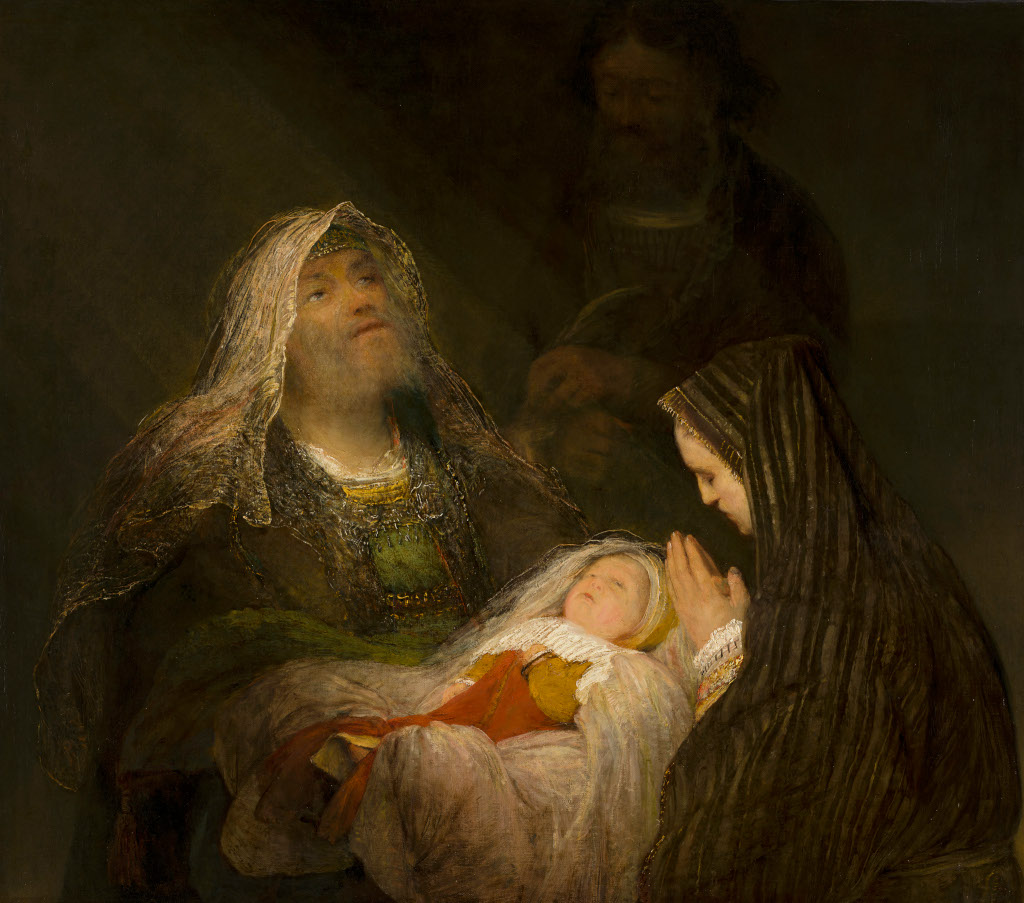
Immanuel - God Is With Us: Tiny, yet huge. Helpless, yet more powerful that all of Caesar’s armies. Simeon and Anna greet the infant Jesus at the Temple in Jerusalem. (Painting by Arent de Gelder)

IT IS FORTY-ONE DAYS since the star cast its light over Bethlehem, and still we wait. Anna and I, in the shade of the cloisters, as the people come and go, and the smoke of the sacrifices rises. As much a part of the temple as the great gilt doors and the smooth marble pillars. Sitting. Waiting.

Anna is old by any man’s reckoning. Fourscore years and four, they say. She remembers the Second Temple before King Herod arrayed it in cold marble and bright gold.

‘The Temple is Israel’s heart’, Anna says, ‘it’s Holy of Holies. But it does not hold its soul.’ Anna never wavers from this. ‘Not even marble and gold’, she says, ‘can house a person’s soul.’

And so we argued, back and forth. Blind Simeon and Ancient Anna. As the world swirled around us and the years piled up like broken sandals. Fixtures of the Temple Court: constant as the money-changers; harmless as the sacrificial doves.

Until the dreams.

A light, growing in the darkness of our slumbers. Every night it shone more brightly – resolving itself, at length, into the image of a great star, drawing ever nearer.

And then we heard the voice. At first, no more than a whisper. Moving through our minds as the wind moves through the Temple Veil, breathing out the sacred consonants. The words were hard to catch – but I recognised them. For had I not made myself blind reading the holy books? Pouring over them by lamplight until the characters swam away into mist and darkness?

“But as for you, Bethlehem Ephrathah, Too little to be among the clans of Judah, from you one will go forth for me to be ruler in Israel. His goings forth are from long ago, from the days of eternity.”

The words of the prophet, Micah. But what could they mean?

Anna dreamt too. In hers a voice spoke clearly from the very heart of the star.

“Therefore the Lord himself shall give you a sign; behold, a virgin shall conceive, and bear a son, and shall call his name Immanuel.”

Immanuel. God is with us.

And then the dream came true. Low in the western sky it shone, night after night, just after the going down of the sun. A star where no star had been before. And every evening it grew brighter, until the night – forty-one days ago it was – when it seemed to hover, lower than ever in the night sky, over Bethlehem.

And the next morning the shepherds came. With wide eyes and stammering tongues they told us of what they had seen: the heavenly host; the stable; the woman; the child. One of the shepherds, eyes wider than all the rest, took me by the arm.

“Death draws near, Blind Simeon. But not before your eyes behold the saviour: God’s true son, here, in the Temple, on the forty-first day.”

And so we wait, Anna and I. Here, in the shade of the cloisters. On the forty-first day.

Anna saw them first. The little family. Rustic and awestruck amid Herod’s splendour. She grabbed me by the sleeve and led me to them.

“Here, at last,” she said, “is one fit to hold men’s souls. Good Lady will you let Blind Simeon, the Rabbi, bless your son?”

I took the babe in my arms. And like a curtain drawn aside, light flooded into my waking mind, and I saw him. Tiny, yet huge. Helpless, yet more powerful that all of Caesar’s armies. I lifted him high above my head, so all could see, and cried out in a voice that echoed off the Temple walls:

“Lord, now lettest thou thy servant depart in peace, according to thy word: for mine eyes have seen thy salvation, which thou hast prepared before the face of all people; a light to lighten the Gentiles, and the glory of thy people Israel.”

Above our heads, a dove flapped wildly, and was gone.

This short story was originally published in The Dominion Post, The Otago Daily Times, The Waikato Times, The Taranaki Daily News, The Timaru Herald and The Greymouth Star of Friday, 23 December 2011.

Wednesday, 22 December 2010

Sing Choirs of Angels (For Julian Assange)

Guardian Angels: Julian Assange, like the prophets of the Old Testament, has called the powerful to account. It is to be hoped that he is afforded the same divine protection.

"HE’S NOT at all like him. How can you even think that?" Gabriel’s pinions flutter with indignation, casting off tiny splinters of golden light into the frigid evening air.

"Oh, I don’t know," replies Raphael, brushing Gabriel’s still glowing sparks from his robes. "If you cast your mind back, you’ll recall that He wasn’t everybody’s favourite activist either. In fact, didn’t just about everyone in high places call him a trouble-maker? A terrorist even?"

"Not the same thing at all – He was a prophet."

"Oh, come on, Gabriel. You know as well as I do that ‘prophet’ is just another name for troublemaker. How do you think the kings of Israel responded to being called to account by the likes of Isaiah and Amos? Do you think they liked having their misdeeds discussed openly in the marketplace? Do you think they appreciated those bearded vagabonds striding into their palaces, pointing their fingers, laying bare their sins? I don’t think so!"

"They were speaking for God, Raphael – that’s what makes the difference. They were His mouthpieces. Their mission was divine."

Gabriel spreads his wings, and with an upward beat brings himself to a position just above a pair of forbidding wrought-iron gates. Gathered in a noisy semicircle around the gateway are the outside-broadcast vehicles and satellite dishes of the world’s media. He counts at least a hundred journalists stamping their frozen feet in the snow-shrouded Suffolk countryside.

"Do they look like God’s mouthpieces to you, Raphael?"

"As individuals? No, not really. But then they are mortals, Gabriel. Sinners, every one. Just like Isaiah. Just like Amos. Just like all the human bearers of God’s word. He fashioned them, Gabriel. Endowing them with the wit and skill to subdue the whole earth: root and branch; fish and fowl. This is how they speak to one another nowadays – twittering and tweeting. Voices in the air, Gabriel. Hasn’t God always spoken thus?"

"And the man they seek, Raphael? He’s no stranger to the sins of the flesh. Does it seem likely that God would place his word in so flawed a vessel?"

Now it was Raphael’s turn to send indignant sparks into the wintry air.

"But isn’t that the point!" With a mighty beat of his wings he propels himself several thousand feet higher into the darkening sky. "Look about you! Look at what they have done to the garden we made for them to dwell in! They are fallen, Gabriel! Fallen! They should be left to freeze – or to burn. And yet here we are – just as we were that night on the hillside above Bethlehem, when we spoke to the shepherds, and just for a moment let them see the splendour of our wings. Because he loves them Gabriel – he loves them. Flawed though they be. Sinners though they are. He would not have them fall."

"But where were the signs? The wonders? Where was the gold, the frankincense, the myrrh? Where were we thirty-nine years ago when this fellow came into the world? I have no memory of a maternity ward in Townsville."

"I don’t think it works like that any more, Gabriel. That first time, remember, they called him Emanuel – "God is with us". And I don’t think he ever left. He remains with them, don’t you see? To be born again in every generation. The same story, Gabriel, told over and over and over again. What was it that Paul said: ‘For we wrestle not against flesh and blood, but against principalities, against powers, against the rulers of the darkness of this world, against spiritual wickedness in high places’."

"That certainly sounds like our friends in Washington", chuckled Gabriel, as the two archangels descended slowly towards the English country house.

I think I understand you now, Raphael", Gabriel smiles, "We’re here to bear witness. From the first betrayal to the final crucifixion. To the whole tragic passion play which, for twenty centuries, these doomed mortals have prepared for anyone who dares bid them be free."

"But we’re not the only witnesses," Raphael replies, spreading his wings protectively around half the house. "For each time the drama is played out there are always more who grasp its meaning. Who hear, as if for the first time, the words we heard Him speak to Pontius Pilate all those centuries ago: "For this purpose I was born and for this purpose I have come into the world – to bear witness to the truth. Everyone who is of the truth listens to my voice."

"And is set free!", Gabriel laughs, wrapping his own wings around the other half.

A great rush of air sends snow flurries whirling among the waiting journalists.

"Christ!", mutters a reporter from The Sun. "Freezing me effing bollocks off for Julian bloody Assange. What a way to spend Christmas!"

This short story was originally published in The Press of Tuesday, 21 December 2010.

Thursday, 24 December 2009

Journey to the West


I WAS ALWAYS the odd one out. The one they stared at. It was my colour, you see, the gift of my seafaring father. Black as the sluggish rivers of his homeland is my skin. Dark as its endless forests. He’d sailed the spice boats, riding the azure waters of the Gulf, exchanging their precious frankincense and myrrh for Persian gold at the white-walled city ports. That’s where I was begotten, and where my mother raised me, calling me by my father’s name: Balthasar.

She was a priestess of Astarte, worshipping the Goddess in the cool cloisters of the Temple, making an altar of her own lithe body. She and her sisters raised me as a son of the Temple. Quick to learn, they said, and wise beyond my years, I was the High Priestess’s choice to travel to the wizard’s city of Saba, where the sky-watchers would make of me a magus.

 
IT WAS IN SABA that I witnessed the birth. Shivering atop the narrow stone staircase, alone on the wide platform beneath the twinkling ceiling of the world, I saw it come into being. Light out of darkness – just as my masters had taught. A shimmering star, low in the sky, where only seconds before there had been no star at all.

I called Melchior, my master. He was loathe to rise from his bed, but when I described what I’d seen, he threw a cloak over his robe and followed me up the stairs. And there we stood, high above the sleeping city, staring in wonder at this new thing in the heavens.

"What is it?" I asked. "Where did it come from? And what does it portend?"

My master did not answer. For a long while Melchior remained silent, long fingers pulling fitfully at his beard, dark eyes drinking in the new star’s light.

"Go, boy", he whispered. "Rouse Gaspar. Bid him join us here."

When I returned with the High Priest of the Order, Melchior did not appear to have moved. Gaspar joined him. His long ebony staff scattering echoes off the smooth stones of the observation platform.

When he saw the star he sighed. I could not tell whether it was a sigh of joy, or of sorrow. He turned to me and smiled.

"Few indeed are privileged to witness the moment of a new star’s birth, Balthasar. Although, some among our order say that what we have witnessed tonight marks not the birth, but the death of stars."

"What does it mean, Master?"

"That something new has come into the world. That something old is passing away. That far to the West matters are coming to a head. For as you know, young Balthasar, the Age of the Ram is dying, and the Age of the Fishes about to be born."

"Or, is being born as we speak", muttered Melchior, his eyes still fixed on the star. "I would give much to witness the birth of an age that will last for two thousand years."

 
AND THAT IS how our journey began. And what a journey it has been. Riding off into the teeth of winter. Climbing the high passes. Traversing the empty deserts. And in every village, every city, the suspicious eyes of men who recognised us for what we were – the Magi.

"Wise Men"; "Priests of Zarathustra"; "Sky-watchers"; "The Reckoners of Darkness and Light": thus were we called by those whose minds were still open. "Wizards and Sorcerers": by those whose minds were closed.

And on me, especially, their gaze lingered; whose eyes are as dark as my skin.

And every night of our journey, burning brighter and brighter – till its rays pointed a path across the heavens like Gaspar’s upraised staff – blazed the star.

I listened as Gaspar and my master debated its meaning. At day’s end, seated on rugs before the fire, they pored over the scrolls they had brought with them. One in particular – the writings of a stiff-necked people locked into a narrow land between the desert and the sea.

"Therefore the Lord himself shall give you a sign; behold, a virgin shall conceive, and bear a son, and shall call his name Immanuel."

"Immanuel, Masters? What does the word mean?"

Gaspar and Melchior, turned towards me, smiling.

"It’s Hebrew, Balthasar."

"It means: ‘God is with us’."

The short story was originally published in The Otago Daily Times on Christmas Eve 2009.