Friday, 11 October 2013

Trading in "Free" For "Fair"?

But Will Labour Make It? With David Cunliffe announcing the return of "Red Labour" following a rank-and-file instigated "revolution from below", the Party's 30-year adherence to the Neoliberal "free trade" ideology may be coming to an end.

LABOUR’S 30-YEAR COMMITMENT to “free trade” may be coming to an end. The test will be three weeks from now when the party gathers in Christchurch for its annual conference.
 
At last year’s conference, delegates were willing to offer only the most qualified support to the Trans-Pacific Partnership (TPP) negotiations – and it required repeated interventions from former Trade Minister, Phil Goff, to secure even that limited endorsement. This time Mr Goff may not be so successful at fending off the TPP’s opponents.
 
Labour’s “Free-Traders” face some very substantial obstacles. The greatest of these is that the party’s commitment to trade liberalisation, like its commitment to the Reserve Bank Act, is emblematic of Labour’s 1980s embrace of Neoliberalism.
 
Throughout the 15-year reign of Helen Clark serious public criticism of these neoliberal shibboleths was verboten. Goff struggled (with limited success) to keep the ideological disputation in-house. David Shearer could not manage to do even that.
 
Had the news media paid a little more attention to the revolution that was taking place on the floor of last year’s annual conference at Ellerslie, and devoted a little less effort to chasing non-existent leadership challengers, they may have noticed the explicit repudiation of “Rogernomics” included in the 2012 Draft Policy Platform.
 
It is a measure of the intensity of the behind-the-scenes ideological battles that have been raging in the Labour Party since Ellerslie, that last year’s passionate condemnation of Rogernomics has been dropped from this year’s Draft Policy Platform.
 
How much of the document’s watering-down is attributable to the intervention of Grant Robertson, the preternaturally cautious chair of Labour’s policy council, is far from clear. But even in its new – and ultimately binding – iteration, the document registers an unmistakably leftward shift:
 
“Labour holds that government must play an essential role in managing and developing the economy. We reject the notion that free markets on their own will deliver either long-term prosperity or just distributional outcomes.”
 
When spoken by the new party leader, David Cunliffe, this is the sort of anti-neoliberal rhetoric that brings Labour’s newly empowered rank-and-file and affiliates to their feet a-whooping and a-hollering.
 
Considerably less inspiring is the Draft Policy Platform’s statement on international trade:
 
“Labour will support international trade and investment agreements that promote New Zealand’s economic wellbeing and support fairness, transparency, sovereignty, and sustainability.”
 
But even in this rather colourless sentence there’s more than enough to cause political problems for those caucus members determined to preserve the bipartisan consensus on free trade by backing the TPP.
 
Mr Cunliffe sent shockwaves through the trade liberalisation lobby even before he clinched the party leadership on 15 September; by warning that the TPP posed a “quite difficult and complex issue for New Zealand”.
 
His concern over such “fish hooks” as the future of Pharmac and the sovereignty-threatening potential of “investor/state disputes”, coupled with his doubts about the genuineness of the promised agricultural opportunities, must have made TPP boosters worry that Mr Cunliffe had just come from a briefing with Professor Jane Kelsey!
 
Small wonder then that business columnist, Fran O’Sullivan, whistling loudly in the dark, wrote glowingly of Mr Goff’s undimmed enthusiasm for a TPP agreement.
 
“Labour’s Phil Goff is back in business, adding his strong and rational voice to New Zealand's advocacy for the completion of the Trans Pacific Partnership.”
 
Like so many of her journalistic colleagues, Ms O’Sullivan has yet to grasp how fundamentally the rules of the political game have changed.
 
Mr Cunliffe and Labour’s rank-and-file are now locked in a radical embrace. If Labour’s new leader decides to consummate their “red wedding” by promoting “fair”, rather than “free” trade (which would ease Labour’s relationship with the Greens considerably) then there’s nothing Mr Goff, or the other fading Rogernomes of the broken ABC faction, can do about it.
 
Mr Cunliffe’s keynote speech to the Christchurch conference will undoubtedly make Labour’s new political trajectory much clearer. Expect to hear something on free trade. Just don’t expect it to be business as usual.
 
This essay was originally published in The Dominion Post, The Waikato Times, The Taranaki Daily News, The Timaru Herald, The Otago Daily Times and The Greymouth Star of Friday, 11 October 2013.

Tuesday, 8 October 2013

Targeting The Policy Agreement

Policy Target: The Reserve Bank Act (1989)  It was one of the Neoliberal Counter-Revolution's primary objectives: to keep the interfering hands of politicians as far away from the controlling mechanisms of monetary policy as possible. Otherwise known as strangling the economy in order to save it.
 
SOME ARE CALLING IT irresponsible meddling, others talk about the need to regain control of our destiny. Whatever it’s called, it’s attracting a lot of attention. And not a little concern.
 
For nearly thirty years both of New Zealand’s largest political parties have faithfully adhered to the doctrine that a country’s monetary policy is best determined by an independent central bank. Furthermore, that the prime focus of monetary policy must be keeping inflationary pressures under the strictest control. In practice, that’s meant keeping the interfering hands of politicians as far away from the steering-wheel as possible.
 
New Zealand embraced this monetarist view the central bank’s role with special fervour. Our current Reserve Bank Act, passed by the Fourth Labour Government in 1989, places enormous economic power in the hands of a single person, the Reserve Bank Governor. He alone is responsible for carrying out the Act’s primary function: ensuring “stability in the general level of prices”.
 
The only democratic check upon the Governor’s power comes in the form of the Policy Target Agreement (PTA) negotiated periodically with the Minister of Finance. It isn’t much of a check though, because the only real debate is over the permissible range of inflationary fluctuations. If the inflation rate goes above, or stays below, the agreed levels for too long, the Governor intervenes.
 
The mechanism he uses to do this is the Official Cash Rate (OCR). By raising or lowering the price at which the privately-owned banks can access liquid funds on a short-term basis the Reserve Bank is able to expand or contract short-term demand in the New Zealand economy and hence (at least theoretically) keep prices under control.
 
The use of this single, blunt economic instrument has fuelled repeated property booms, blown out New Zealand’s balance-of-payments, and undermined our manufacturing exporters.
 
So, why did our politicians give so much economic power to one, unelected government official? Why is something so critical to the health of our economy as setting core interest rates not the responsibility – as it once was – of the people’s elected representatives?
 
Answering that question takes us to the heart of the “Quiet Revolution” in economic management, in which the Reserve Bank Act (1989) played so important a part. Essentially, the decision to remove the management of monetary policy from the politicians’ hands was inspired by the growing fear among political and economic elites that the democratisation of economic policy formation had gotten out of hand.
 
The deadly confluence of the economic, political and social crises that characterised the 1930s, and which led to the human disaster of World War II, had largely discredited the laissez-faire economic doctrines which spawned them. Rather than go on entrusting the elites with the conduct of economic policy, the citizens of the victorious democratic powers made sure that those responsible for the big economic decisions were politicians accountable to themselves.
 
The result was a 30-year period of unprecedented economic expansion, during which, in the USA, the share of national income going to the top 1 percent of income earners plummeted to less than 10 percent (from a pre-war high of close to 20 percent). Between 1945 and 1975, thanks to successive post-war governments’ commitment to policies aimed at full-employment and wealth redistribution, and to preserving the bargaining strength of trade unions, the standard of living of ordinary working people rose steadily.
 
With their economic and political power fast eroding, the Western elites seized upon the inflationary pressures unleashed by the Vietnam War and the Arab Oil Embargo to discredit the democratic conduct of economic affairs.
 
Politicians, they argued, were unfit to determine economic policy precisely because they were prey to electoral pressures. Only when populist politicians, like New Zealand’s Sir Robert Muldoon, were legally precluded from interfering with the free play of “market forces” could the scourge of double-digit inflation be defeated. And that free play could only occur after the “market distorting” influence of high taxes and excessive government borrowing, inefficient state-owned enterprises, and the power of the “over-mighty” trade unions had been dismantled – comprehensively.
 
The imposition of what came to be called “neoliberalism” thus represented not a “revolution” in economic management but a “counter-revolution”. And absolutely crucial to its success has been the 30-year bipartisan consensus that no other economic doctrine is to be given a serious hearing anywhere. Not in the news media; not in the schools and universities; and certainly not in the two main political parties: National and Labour.
 
Hardly surprising, then, that serious disquiet is growing among those whose job it is to defend the neoliberal counter-revolution at all costs. Not only is the Reserve Bank under attack from the Greens (whose modest levels of electoral support make them more irritant than threat) but also, and most alarmingly, from Labour.
 
And once Labour’s re-democratised monetary policy – what’s next?
 
This essay was originally published in The Press of Tuesday, 8 October 2013.

Saturday, 5 October 2013

Crowning The Dummy

Like A Beckett Play: An overwhelming sense of fragility; of life in suspension; of history sucking up every available atom of breathable air. When will New Zealanders stop looking up to a monarch and start looking around - to themselves?

IT WAS A SCENE that would have done Samuel Beckett proud.
 
An old woman sits primly in an armchair, warmed by an electric fire. The fussily furnished room is festooned with family photographs and ceramic knick-knacks. The atmosphere of the scene is stuffy and oppressive. There’s an overwhelming sense of fragility; of life in suspension; of history sucking up every available atom of breathable air.
 
Seated opposite the old woman is a middle-aged man with an over-eager smile. He is dressed like a prosperous provincial accountant, and it is clear that just being in the room with the old woman represents the fulfilment of a boyhood dream.
 
They are talking to one another – although it is difficult to say what about. The old woman’s conversation is polite but inconsequential. She speaks as if she’s reading the lines of a play once popular, but now only ever performed to modest and ageing audiences.
 
Undaunted, the middle-aged man listens intently: his attention not at all diminished by the old woman’s sing-song delivery. Clearly, some weird alchemical miracle is taking place. In the middle-aged man’s brain the old woman’s leaden commonplaces are being transmuted into the purest rhetorical gold.
 
Beyond this and all the other rooms in the castle, the world goes on its merry way. Fallen empires refuse to rise. Children are blown to pieces by suicide bombers. Billions are wagered on stock markets and trillions consigned to tropical tax havens. Ice melts in the arctic. Deserts advance. Lovers embrace.
 
But in this stuffy drawing room nothing changes. The old woman sits and talks inconsequentially to “galloping colonial clots” who hang upon her every word, believing, in spite of everything that they have seen and done and made of themselves, that the bizarre tableau of which they are a part is more than it seems.
 
That it matters.
 
Another notable scene occurs in Ettore Scola’s 1982 movie That Night In Varennes. The plot revolves around a group of travellers who get caught up in King Louis XVI’s abortive attempt to escape the revolution in Paris.
 
As the revolutionary government’s officials dither, a debate ensues concerning the nature of monarchy among those now stranded at the local inn. Some of the travellers, in true Enlightenment fashion, dismiss monarchy as irrational. Others remain convinced of its quasi-religious power. Its magic.
 
As if to prove both sides correct, the King’s servants roll into the room a tailor’s dummy adorned with the royal regalia of France.
 
In a wonderful cinematic moment, the waiting peasants bare their heads and fall to their knees. Even the sceptical intellectuals find it difficult to resist the urge to doff their hats and bow low.
 
Monarchy weilds only as much power as people are willing to give it. Our ancestors long ago stripped the British monarchy of all but a recondite residue of its former political authority. What is it, then, about Queen Elizabeth and her peculiar family that continues to enthral a clear majority not only of her British subjects, but of New Zealanders as well? What is it that could possibly make our ruthless, currency-trader Prime Minister sit like an excited schoolboy on the edge of his seat in a stuffy Balmoral drawing-room?
 
The Frankfurt School’s, Erich Fromm (1900-1980) would tell us that New Zealanders’ on-going love affair with the British Royal Family, and the monarchical institutions they inhabit, stems from our abiding fear of, and desire to “escape from freedom”.
 
To be truly human, Fromm argued, men and women must free themselves from all that obscures the realities of existence. Our unique capacity to reason and to love makes each human life a challenging and painful experience; it can also make life glorious and transcendent.
 
For too many of us, however, the dangers and uncertainties of freedom keep us in a child-like state of fear and neediness. Thinking for ourselves is difficult and risky; better by far to adhere to the collective wisdom. Ruling ourselves is also difficult and risky; better by far to be guided by the myths and traditions of the past.
 
Living in a republic there is nothing and no one to look “up” to: we can only look “around” – to ourselves.
 
But, in a monarchy, there is always somewhere safe to hide.
 
Even behind a prim old woman, in a stuffy drawing-room, in Scotland.
 
This essay was originally published in The Waikato Times, The Taranaki Daily News, The Timaru Herald, The Otago Daily Times and The Greymouth Star of Friday, 4 October 2013.

Tuesday, 1 October 2013

Citizens Left Out Of The Water Equation

Enjoy It While You Can: The Tukituki River sparkles in the Hawkes Bay sun, but if the Ruataniwha Dam is built and intensive dairying is made possible further upstream, this iconic river will swiftly be transformed into what Green Party co-leader, Russel Norman, predicts will be "an industrial drain". Water is fast becoming New Zealand's most valuable natural resource and Federated Farmers - aided and abetted by the National Government - is determined to place that resource in private hands.
THERE’S ALWAYS A MOMENT when we realise that power has shifted. Trusted people and institutions suddenly turn against us. Those whose job it is to assess and avert public risk disappear. We hear rumours about wholesale sackings and forced resignations. Obvious and serious conflicts of interest are studiously ignored. And those in charge, while not guilty of telling outright lies, have unquestionably stopped telling us the whole truth.
 
Such extreme power shifts are generally confined to the corporate sector. And while they are never pleasant, and often very costly in personal terms, most of us nevertheless accept the process. The business world is not a democratic world: its unfairness and rapacity is largely beyond our control. Businesses fail, are sold, merged, asset-stripped, re-branded and downsized – and there’s not a lot any of us can do about it.
 
Beyond the business world, however, we do not expect to be left out of the equation. Employees may be required to subordinate their judgement to the entity paying their wages but, constitutionally-speaking, citizens are sovereign: their democratic judgements not subject to private-sector countermand.
 
Citizens do not take kindly to being treated as if they were employees.
 
But this is precisely what is happening. All over the country: from the Canterbury Plains to the Tukituki River in Hawke’s Bay; private interests are muscling in on public resources; compromising the integrity of public institutions; and trampling with ill-disguised contempt upon the rights of New Zealand citizens.
 
And at the heart of this power grab is – water.
 
 
I SHOULDN’T BE SURPRISED. On 19 November 2008, just eleven days after the election of the current government, myself and the right-wing political commentator, Matthew Hooton, were invited to address the National Executive of Federated Farmers.
 
Coming away from that meeting, I was impressed by three things.
 
The first was how much the Federated Farmers CEO, Conor English, looked and sounded like his brother, Bill, the newly elected government’s Finance Minister.
 
The second was the presence of Dr William Rolleston. Until that moment, I had only known Dr Rolleston in his role as one of New Zealand’s most outspoken advocates of genetically engineered agricultural production. That he was so closely associated with Federated Farmers was something I probably should have known, but was still rather disturbed to find out.
 
The third, and by far the most important, thing I took away from that meeting was Conor English giving me a quiet “heads-up” that the most important issue facing Federated Farmers, and New Zealand, over the next few decades would be the issue of who controlled access to what was fast becoming the nation’s most valuable natural resource – water.
 
 
MOST NEW ZEALANDERS don’t think too much about water. Most of us live in cities and towns which, for the better part of a hundred years, have enjoyed a plentiful, safe and remarkably cheap water supply. In the odd drought year we townies may be asked to refrain from watering our gardens, but most of us, for most of the time, don’t give water a second thought.
 
Matters are very different in the countryside.
 
Over the course of the past twenty years the New Zealand landscape has been transformed by the extraordinary growth of the dairy industry. Where once the cargo vessels leaving our ports were loaded down with carcasses of frozen lamb and bales of wool – as well as butter and cheese – our agricultural exports are today dominated the thousands of tons of top-quality milk powder produced by New Zealand’s world-beating dairy farmers.
 
That milk powder earns this country billions of dollars every year, but dairying’s “white gold” comes at a heavy cost. The successful dairy farm not only requires millions of litres of water by way of an input, but its hundreds of cows also discharge equally vast quantities of effluent by way of an output. That effluent inevitably makes its way into the nation’s waterways – polluting them to the extent that the lower reaches of more than half of New Zealand’s largest and most magnificent rivers are no longer safe to fish or swim in. And neither are their tributaries.
 
 
THE SHUTTING DOWN of democracy in the Canterbury Regional Council, and the more recent suppression of a Department of Conservation draft report on the sustainability of the Ruataniwha Dam, represent the working out in political terms of Conor English’s heads-up warning of five years ago.
 
New Zealand’s dairy farmers, and the enormous economic interests they represent, have decided to privatise the nation’s water resources – and the government is helping them do it.
 
Dr William Rolleston has even enlisted the reality of Global Warming to advance Federated Farmers’ cause: While New Zealand has plenty of water, he says, it's not always in the right place at the right time.

But, presumably, it will soon be in the right hands.

This essay was originally published in The Press of Tuesday, 1 October 2013.

Friday, 27 September 2013

"Predistribution": A Suitable Socialist Synonym?

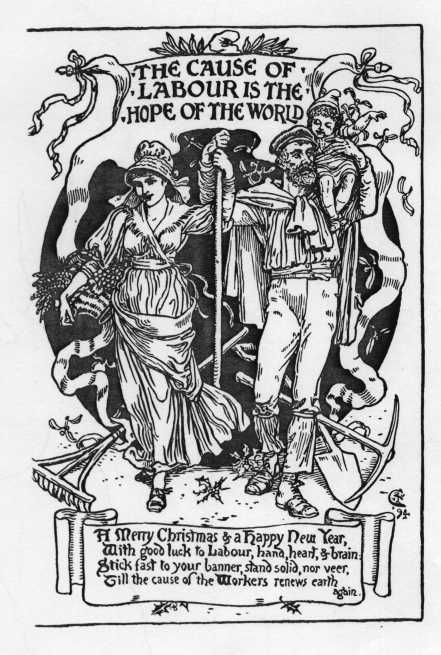
No Need For Synonyms in 1894! This Socialist "Christmas Card", by Walter Crane, hails from a time when "the cause of labour" could be openly and proudly proclaimed. For most of the twentieth century, however, left-wing activists (especially in the USA) were required to devise "suitable synonyms for Marxist terms". Even today, those advocating the cause of Labour are forced to reach for synonyms like "predistribution" to prevent the Right's horses from taking fright.
 
IT’S NOT EASY BEING A SOCIALIST in the United States of America.
 
Long ago: back in the days when I was still impressionable enough to remember such things; I watched a documentary film about the “New Left” in America. “The trick, in this country,” remarked one of the young radicals interviewed, with an engagingly conspiratorial wink, “is coming up with suitable synonyms for Marxist terms.”
 
The young Marxist theorists who penned the first clear declaration of New Left principles – “The Port Huron Statement” – accordingly softened the scary Marxist notion of “the dictatorship of the proletariat” into the much less daunting concept of “participatory democracy”.
 
Seizing control of the means of production, distribution and exchange became the much more acceptable “struggle for economic democracy”, or, as the authors of the Port Huron Statement put it back in 1962: “the economy itself is of such social importance that its major resources and means of production should be open to democratic participation and subject to democratic social regulation”.
 
If attaching the most cherished word in the American political lexicon to left-wing political ideas secured them a hearing from ordinary American workers, then American socialists were only too happy to oblige.
 
I was reminded of this long ago search for non-inflammatory left-wing phraseology only a few days ago. The memory trigger was a newspaper article which claimed that Labour’s new leader, David Cunliffe, was a believer in “predistribution”.
 
How I laughed. Even before researching the term, it was clear to me that in “predistribution” I was dealing with a classic example of a suitable socialist synonym.
 
Coined by the Yale University economist Jacob Hacker in 2011, the term seeks to identify the income that flows into a worker’s hands from sources unconnected to the State. Unlike “redistribution”: the special subsidies, tax advantages and income transfers that flow to the victims of economic and social inequality from the general revenue; “predistribution” identifies the process of reducing entrenched inequalities by increasing the workers’ share of the private sector’s gross profits.
 
Now, how would a Labour leader do that?
 
Well, a New Zealand Labour leader would only have to look back over the course of this country’s history to find the answer.
 
The Liberal Government of John Balance “predistributed” workers’ incomes by handing over the determination of their wages to a special “arbitration” court made up of three arbitrators, representing workers, their employers, and the state.
 
The workers’ representative on the Arbitration Court was, of course, chosen by the New Zealand trade union movement. Indeed, without a strong trade union movement to exact an increased share of the private sector’s profits for its members, “predistribution” has little chance of long-term success.
 
The First Labour Government understood this very well, which is why within a year of winning power in 1935 it had legislated for universal union membership and facilitated the formation of New Zealand’s first effective trade union peak organisation, the Federation of Labour.
 
A Labour leader could, of course, try to “predistribute” without a large and effective trade union movement. This could be done by lifting the minimum wage to $15 per hour and/or legislating for the payment of a “living wage” to particularly poorly-paid categories of workers.
 
From the perspective of a Labour Government, however, it would make much more sense to facilitate the design of a brand new institutional framework for twenty-first century collective bargaining.  Achieved by means of a comprehensive, bottom-up exercise in democratic consultation, these new institutions would become the primary instruments for “predistributing” the national income.
 
Only a trade union movement that had emerged from such an all-encompassing and demonstrably democratic process could legitimately claim the right to play such a vital role in the nation’s economic life. And only while it spoke in the indisputable accents of ordinary working New Zealanders could it hope to survive Labour’s periodic electoral rebuffs.
 
Assuming, of course, that such a massive exercise in “participatory democracy” hadn’t already removed the need for socialist synonyms altogether.
 
This essay was originally published in The Dominion Post, The Waikato Times, The Taranaki Daily News, The Timaru Herald, The Otago Daily Times and The Greymouth Star of Friday, 27 September 2013.

Tuesday, 24 September 2013

Moving The Centre

Centre Of Attention: In Stanley Kubrick's science-fiction masterpiece, 2001: A Space Odyssey, the mysterious black monoliths serve as catalysts for change. Political scientists attribute similar transformational powers to the political centre. In reality, the political centre is a malleable and constantly shifting phenomenon; its allegiances determined by the exogenous political pressures exerted from either side.
THE CENTRE FILLS the politician’s sky like the monoliths in Stanley Kubrick’s 2001: A Space Odyssey. In much the same way as his mysterious black stele are credited with being the prime motivators of human enlightenment and progress, the political centre is deemed to be the fount of all moderation and wisdom. Without it’s decisive intervention, say the pundits, electoral victory is impossible.
 
In reality, the political centre is the most malleable of all electoral clay: capable of being shaped and moulded into practically any shape its sculptors can conceive.
 
The voters who congregate at the extremes of the political spectrum have needs and interests that are clear, permanent and compelling. But the needs and interests of those in the centre are tied inextricably to those of the rich and the poor, and are, consequently, nothing like so constant. Accordingly, those who mass in the centre tend to oscillate wildly between the two extremes: their manic swings to left and right corresponding to the strength of the latter’s economic appeal.
 
Consider the role of the manager. Forty years ago the number of people in managerial positions was relatively small. Then along came the neoliberal revolution and the number of managers in the economy exploded.
 
As New Zealand society was restructured along “free market” lines, those workers lucky enough to keep their jobs were expected to work longer and harder for less. All those new managers were hired to make sure that they did.
 
Like the commissars of Stalin’s Soviet Union, the new managers’ prime mission was to protect and defend the revolution. In fact, their livelihoods depended on its survival.
 
Now, which way do you suppose that new managerial strata voted? For the neoliberal revolution’s friends – or its enemies?
 
The same political dynamic is at work among those who contract for services formerly supplied by the state.
 
By drastically reducing the size of the civil service and contracting out a great many of the services formerly provided in-house, the neoliberals did not, in fact, save a great deal of taxpayers’ money. On the contrary, one American study revealed that the cost of services provided by private contractors was, on average, a third higher than the cost of those same services when supplied by a public provider.
 
But, saving money was never the true objective of those responsible for contracting out public services. Neoliberalism’s purpose was to destroy the ethos of public service altogether and replace it with the ethos of individual enrichment by way of profit-taking.
 
A state that is able to provide its citizens with services that are efficient and cost-effective is a state those same citizens might learn to value and support. Even worse, it might come to be seen as a system worth extending into areas of the economy still dominated by the quest for private gain.
 
The whole point of neoliberalism was – and is – to prevent that from happening.
 
Like the new breed of managers, thousands of new contractors found their own futures and the future of the neoliberal revolution inextricably intertwined.
 
They, too, know on which side their ballot papers are buttered.
 
Now consider what might happen to the people in the centre if the neoliberal revolution was overthrown.
 
Imagine a political party which promised to reduce expenditure on taxpayer funded services by 33 percent – by taking the provision of those services back in-house.
 
Imagine a government which, instead of following economic policies that led to the sacking of thousands of low-paid workers, encouraged the creation of a new kind of workplace. One in which the skills and creativity of the whole workforce was brought to the task of lifting productivity. Such workplaces would have little further need for managers of the neoliberal variety.
 
Managers’ socially useful skills would not, however, go to waste if a reforming government invited them to become an integral part of the social entrepreneurialism it was pledged to unleash.
 
All across New Zealand (and in Christchurch particularly) there is a huge amount of work to be done repairing damaged lives and damaged communities.
 
In her valedictory speech to Parliament, Lianne Dalziel talked about building a “resilient society”. That is a construction job to which the skills of these former managers could readily be applied. Deploying taxpayer resources to foster not dependence but resilience is a public enterprise to which most New Zealanders will gladly contribute.
 
The political centre currently cleaves to the right because the neoliberal order, so ruthlessly imposed over the last 30 years, makes it worth their while to do so.
 
All that is required to shift their allegiance is the effective presentation of a social and economic manifesto that makes it worth their while to do something else.
 
Kubrick’s monoliths were significant not for what they made us do, but for the possibilities they allowed us to see.
 
This essay was originally published in The Press of Tuesday, 24 September 2013.

Friday, 20 September 2013

A Red Wedding?

An Important Reconnection: The Labour Party rank-and-file have elected themselves a leader determined to reacquaint the Party not only with the broader labour movement, but also with the progressive yearnings of a battered New Zealand electorate.

IT WAS ONE of the most shocking episodes in television history. Those who had not read George R.R. Martin’s Game of Thrones watched with rising horror as a large percentage of the television series’ most sympathetic characters were brutally butchered before their disbelieving eyes. Not for nothing was House Frey’s massacre of Robb and Catelyn Stark, Robb’s pregnant wife, and 3,500 of House Stark’s loyal bannermen dubbed “The Red Wedding”.
 
Nor was Martin forced to rely solely upon his (excessively?) bloodthirsty imagination when writing this memorable scene. History furnishes many grim precedents for the all-encompassing massacre of political rivals.
 
Nearly 1,600 years ago the Anglo-Saxon chieftains Hengist and Horsa invited Vortigen and his Romano-British supporters to a great feast to celebrate the pact of peace which their two warring armies had just concluded. But, unbeknown to their guests, the Saxons had concealed daggers in the soles of their boots, and at the cry “nima der sexa!” – “bring out the knives” – Hengist’s and Horsa’s men fell upon their 300 weaponless guests and slew them.
 
This terrible betrayal of the ancient laws of hospitality was remembered as “The Night of the Long Knives” – a name which, 1,500 years later, was joined to the equally bloody purge of Adolf Hitler’s political rivals on the night of 30 June 1934.
 
Inevitably, there will be some who reach for the “Red Wedding” or “Night of the Long Knives” metaphors to describe the (readily predictable) demotion of a handful of the newly-elected Labour Leader, David Cunliffe’s, bitterest caucus opponents.
 
In the five days since his decisive first-ballot win on Sunday, four of Mr Cunliffe’s most formidable adversaries: Trevor Mallard, Chris Hipkins, Darien Fenton, and his principal rival for the leadership, Grant Robertson, have lost their jobs.
 
Not so many casualties really – and none of them the least bit surprising. Into each change of leadership a little blood must fall.
 
The real Red Wedding occasioned by Mr Cunliffe’s triumph has been the restatement of the marriage vows binding Labour’s parliamentary contingent to the wider party organisation. The two had been growing apart for years – to the point where following last year’s annual conference a divorce seemed imminent. What rescued the partnership? The party’s rule changes.
 
In the past, the newly-elected MP’s primary political focus had been the relationship he or she enjoyed (or endured) with his or her caucus colleagues. These were, after all, the people who could push an ambitious MP up the greasy poll of politics – or keep him down. But now, thanks to the new rules, Labour MPs not only need to remain on good terms with their caucus colleagues, but they also need to further the policy objectives of the party’s rank-and-file and address the needs of its affiliated trade union members.
 
This reaffirmation of the bonds between the party and its MPs may yet prompt a larger and much more important reconnection.
 
For most of its history New Zealand has been defined by the achievements of two great progressive political parties: the Liberals and Labour. The century-long quest for security and equality which they began so enthralled the New Zealand electorate that not even the Liberals’ or Labour’s political opponents dared to step outside, or challenge, the overarching social consensus they had fashioned.
 
Certainly, only Labour enjoyed the popular trust and confidence required to establish a regime whose steady elaboration would not only shatter that consensus but open up a vast gulf between the labour movement and New Zealanders’ progressive instincts.
 
What’s more, the fourth Labour Government’s embrace of neoliberal economics freed the Right of New Zealand politics from the constraints of a consensus which had drawn its teeth and blunted its claws.
 
One of the principal enablers of Labour’s treachery was the parliamentary caucus’s essential autonomy from the party and, by extension, the people the party was founded to represent. With no need to heed the will of the party, the personally and politically ambitious were able to go on exploiting Labour’s key institutional weakness.
 
Not any more. The Labour Party’s recent constitutional reforms allow the rank-and-file membership to put a collar on caucus-centred ambition. And now they’ve elected themselves a leader determined to reacquaint the Party not only with the broader labour movement, but also with the progressive yearnings of a battered New Zealand electorate.
 
A very “red” wedding indeed.
 
This essay was originally published in The Waikato Times, The Taranaki Daily News, The Timaru Herald, The Otago Daily Times and The Greymouth Star of Friday, 20 September 2013.