Showing posts with label 9/11. Show all posts

Friday, 10 September 2021

Making The Terrorism Suppression Act Fit-For-Purpose.

Infamous Day: Tomorrow, 11 September 2021, is the twentieth anniversary of the New York and Washington terrorist attacks. Think of the preliminary steps required to make 9/11 happen. Had they been detected, the tragedy could have been prevented. We need legislation equal to that task. 

HE WAS PROBABLY the smartest student I met during all my years at Otago University. After nights out carousing at the Captain Cook Tavern, he was famous for scribbling out essays in the Gazebo Lounge of the Student Union as the deadline loomed (yes, that’s right, people actually wrote essays longhand in those far-off days!) and receiving the, by then, obligatory A+. This fellow seriously impressed Otago’s Philosophy Department, which was – and still is – an extremely difficult thing to do. As Douglas Adams might have said, he had a brain the size of a planet.

It was always a source of curious consolation to me that after leaving university this guy ended up working in the Parliamentary Counsel Office. That the nation’s laws were being drafted and edited by a top philosophy grad, whose brain was the size of a planet, seemed entirely appropriate. Typical, too, of those far-off, pre-Rogernomics days, when having faith in the nation’s public servants did not seem at all naïve or foolhardy.

God knows what happened to this guy. As with most agencies of the old social-democratic Godzone, the Parliamentary Counsel Office was swept away in 1985 – just one more casualty of the Fourth Labour Government’s blizzard of neoliberal reforms.

Why am I recalling all these memories from forty or more years ago? Well, because how our laws are written matters – a lot. As the late Sir Michael Cullen explained in a speech to mark the retirement of the Chief parliamentary Counsel, George Tanner, in 2007:

“My former parliamentary colleague Sir Geoffrey Palmer once speculated that a junior drafter of laws might be as powerful as the most senior jurist, because a drafter makes so many decisions on constructing policy into statutes and regulations. Both drafters and judges give effect to the intentions of Parliament, but inevitably there are tactical decisions about the best way to approach a problem. A drafter of laws is in a pivotal, influential position.”

Indeed they are. We have only to recall the events of the past week to understand how pivotal and influential. A badly drafted piece of legislation – like the Terrorism Suppression Act 2002 – can produce the most appalling consequences. Indeed, when it comes to forestalling even well-signalled terrorist intent, the Act is so poorly drafted as to be practically useless. So much so, that a judge felt compelled to warn the Government that it could prove to be the “Achille’s Heel” of New Zealand’s national security legislation.

The Judge was right.

What the New Lynn terrorist attack has made agonisingly clear is the need for a legislative formula empowering New Zealand’s national security apparatus to identify words and deeds indicative of a clear and firm intention, on the part of an individual, or group, to execute an act of terrorism.

This is by no means as straightforward as it may sound. Empowering the state to indict a person for the thoughts in his or her head is not something a healthy democracy should lightly endorse. What a person might be thinking is bound, at times, to be entirely unworthy of public scrutiny. As Bob Dylan puts it in “It’s Alright Ma (I’m Only Bleeding)”:

If my thought dreams could be seen
They’d probably put my head in a guillotine.


Well, quite.

In the urgent task of making the Terrorism Suppression Act fit-for-purpose, language and logic must advance in lock-step. Police officers, prosecutors, judges and juries must be able to check-off the necessary mental and physical steps leading towards the commission of a terrorist offence. In addition to intent there must be action. Thoughts must be communicated verbally: either electronically, in writing, or on-line. The wherewithal of terror: knives, guns, explosives; must be acquired and assembled for the explicit purpose of inspiring terror. Purposive preparatory action, preceded by the tangibly expressed intention of carrying out a terrorist act. These are the sort of elements around which the legal draftspersons will have to make their “tactical decisions”.

Tomorrow, 11 September, is the twentieth anniversary of the New York and Washington terrorist attacks. Think of the preliminary steps required to make 9/11 happen. Had they been detected, the tragedy could have been prevented. We need legislation equal to that task. It will require not just legal expertise, but all the philosophical brilliance of that far-off genius in the Gazebo Lounge.


This essay was originally published in The Otago Daily Times and The Greymouth Star of Friday, 10 September 2021.

Thursday, 28 March 2019

The Blame Game Continues.

The Never-Ending Lie: It is the oldest of antisemitic tropes: that behind every tragedy, every crime, stands "The Eternal Jew". Nothing could better serve the white supremacist agenda of the Christchurch Shooter than the outrageous claim that Mossad, Israel - The Jews! - were behind the Christchurch Mosque Shootings.

THE RUINS of the Twin Towers were still smoking; people the world over still reeling in shock; and, already, conspiracy theorists were blaming the Jews. The whole 9/11 operation could not possibly be the work of Al Qaida, these conspiracists argued. Bin Laden’s operation simply wasn’t equipped to execute an attack of such extraordinary complexity and lethality. Only Mossad could do that. It just had to be the Israelis.

Why would the Israelis attack the financial capital of their staunchest supporter, the United States of America? How could their involvement in such a colossal crime possibly be kept secret? And, when Israel’s culpability was eventually exposed, and the United States, in righteous wrath, had declared its long-term friendship with the Israeli state to be at an end, what would the perpetrators have gained?

Alas, conspiracists do not trouble themselves with such questions. Great tragedies require great causes. Anything less is an insult to their victims.

That a slipshod operation, which should have been detected and shut down long before any young jihadi ever set foot on an American airliner, somehow managed to succeed, could not be the fault of a US national security apparatus riven with inter-agency rivalries and absurd partisan prejudices. That would be too awful – and too simple – an explanation. There had to be something darker, deeper, and more fiendish at work on 9/11 than straightforward bureaucratic incompetence. And what could be darker, deeper, or more fiendish, than the International Jewish Conspiracy?

Fast-forward to Friday, 15 March 2019, at the Al Noor and Linwood mosques in Christchurch, New Zealand. Fifty Muslim worshippers are shot to death as they pray.

Within half-an-hour, the Police have intercepted and arrested a 28-year-old Australian white supremacist. The following day he is charged with murder and remanded to New Zealand’s most fearsome maximum-security prison at Paremoremo.

A shocked and shaken nation pours out its grief and support for New Zealand’s Muslim community. The New Zealand Prime Minister, Jacinda Ardern, wins international praise for her empathy and dignity. She moves swiftly to outlaw military-style semi-automatic firearms and announces the setting up of a Royal Commission of Inquiry into all aspects of the tragedy.

End of story? Sadly, no.

Even before the bodies of the victims of the Christchurch Mosque Shootings had been laid to rest, a steady drumbeat of anxiety and doubt about the official version of events began thumping away in the shadows.

Was it at all plausible that the Christchurch Shooter acted entirely alone? Is it possible that such a man could hide in plain sight – drawing absolutely no attention to himself for more than two years? How was he able to afford the extensive foreign travel he is known to have undertaken? The guy had no job – so who paid his rent? Could someone without extensive training in terrorist techniques have planned and executed so large and lethal an operation? If not, then who trained him and guided him under the authorities’ radar? Were the 15/3 attacks really a “lone-wolf” operation – or did the Christchurch Shooter have help?

All of these are fair and reasonable questions, and the Royal Commission of Inquiry will undoubtedly spare no effort in answering them.

Unfortunately, the opening of the Royal Commission’s proceedings is months away, and those most deeply wounded by the Christchurch Mosque Shootings are looking for answers now. More importantly, they are looking for a villain who is larger and more impressive than the individual being kept in solitary confinement at Paremoremo.

Who hates the Muslim world enough to slaughter 50 innocent men, women and children? Who has “form”?

On Sunday, 24 March 2019, at a “Love Aotearoa. Hate Racism” demonstration of around one thousand Aucklanders in Aotea Square, at least two people decided to answer those questions.

According to Newshub reporter Scott Palmer:

[A Mt Roskill resident] gave a speech questioning where the gunman got his funding from. He said he suspected it came from ‘Mossad’ and ‘Zionist business’.”

His words were recorded by Apna Television:

“I really want to say one thing today. Do you think this guy was alone ... I want to ask you – where did he get the funding from?

“I stand here and I say I have a very, very strong suspicion that there’s some group behind him and I am not afraid to say I feel Mossad is behind this.”

 Newshub noted that:

One person can be heard shouting in support: “It’s the truth. Israel is behind this. That’s right!”

If he could have heard these words. If he could have followed the hurt and outrage of New Zealand’s Jewish community on Twitter. If he could have detected the first hairline cracks in the splendid edifice of unity and compassion constructed by Prime Minister Ardern and her fellow New Zealanders. Then, it is difficult to imagine the Christchurch Shooter responding in any other way than with a broad, lone-wolfish grin.

This essay was originally posted on The Daily Blog of Thursday, 28 March 2019.

Friday, 14 June 2013

Through A PRISM Darkly

Geek Chic: NCIS-LA's winsome techies 'Eric' and 'Nell' are so busy capturing the top-rating show's viewers' hearts that their constant breaching of citizens' civil rights and privacy passes, if not unnoticed, then, at the very least, unreproved. These, after all, are the people who stand between us and the 'evil-doers'. Against such powerful inoculations of popular culture, CIA whistle-blower, Edward Snowden's, revelations about the PRISM surveillance system are unlikely to spark outrage from more than the usual civil liberties suspects.
 
EDWARD SNOWDEN knows his geopolitics. Where better to seek refuge than in China – the nation most likely to shatter the five fingers of the Anglo-Saxon fist? For the moment, however, the former CIA technician and whistle-blower must be hoping that Hong Kong can hide him from the Anglo-Saxons’ five-eyed “PRISM”.
 
No easy task – as Mr Snowden himself admits: “I could be rendered by the CIA, I could have people come after me, or any of their third party partners – they work closely with a number of other nations … You can’t come forward against the world’s most powerful intelligence agencies and be completely free from risk. Because they’re such powerful adversaries that no one can meaningfully oppose them. If they want to get you – they’ll get you in time.”
 
All of which makes The Bourne Identity read more like a handbook than a thriller. And why Nicky Hager, the man to whom so many of New Zealand’s whistle-blowers have taken their secrets, describes Mr Snowden as “a brave man”.
 
But, does any of it matter? Will the world even be surprised – let alone shocked – at the extraordinary reach of the US National Security Agency’s panoptic surveillance app – PRISM? Isn’t it possible that the citizens of the Anglo-Saxon powers: the USA, the UK, Canada, Australia and New Zealand; far from applauding Mr Snowden’s courage, will condemn him for choosing not to stand with us – but with the terrorists?
 
It is, after all, the Anglo-Saxon nations which provide the biggest audiences for television series like 24 and NCIS. The heroes of these top-rating shows (both of which grew out of post-9/11 collaboration between Hollywood and the US national security agencies) are presented to us as the exemplars of courage and decency.
 
Whether it be 24’s Jack Bauer or NCIS’s Special Agent Jethro Gibbs, the message delivered to Anglo-Saxon viewers around the world is simple and compelling: “The US Government has got our back. These are the good guys who stand between us and the evil-doers.”
 
In every episode we witness these “good guys” – or their geeky side-kicks – routinely hacking into people’s computer hard-drives and tapping into their phone conversations/records. Indeed, these techno-savvy youngsters seem to inhabit a global panopticon from which nothing and no one can hide. Every CCTV camera is at their disposal and every GPS micro-chip ready to turn state’s evidence.
 
The simple cry of “Federal Agents!” grants these heroes warrantless entry to anybody’s property. When outraged suspects demand their rights, our good guys exchange knowing glances and ask them if they’ve read the Patriot Act. And, for those who refuse to co-operate there is always the failsafe threat of a one-way ticket to sunny Guantanamo Bay.
 
Fifty years ago, any agency wielding such totalitarian powers would have been listed among the enemies of freedom. That Americans are now quite comfortable with fictional good guys who sound and act like Soviet-era thugs is a measure of just how much Al Qaida took from the United States on 11 September 2001.
 
And not only from the United States. Thirty-six years ago Rob Muldoon’s plans to expand the surveillance powers of the Security Intelligence Service were met with huge demonstrations in all the main centres.
 
No such protests greeted the legislation which has, over the course of the last 12 years, dangerously extended the surveillance powers of the state. It’s as if agents Bauer and Gibbs have convinced us that: “If we have nothing to hide then we have nothing to fear.”
 
But, as Mr Snowden says: “Even if you’re not doing anything wrong, you’re being watched and recorded ... [I]t’s getting to the point where you don’t have to have done anything wrong you simply have to eventually fall under suspicion from somebody – even from a wrong call. And then they can use this system to go back in time and scrutinise every decision you’ve ever made, every friend you’ve ever discussed something with, and attack you on that basis to derive suspicion from an innocent life.”
 
Because, as the civil liberties lawyer, Tim McBride, observes: “[W]e do have something to hide, not because it is criminal or even shameful, but simply because it is private.”
 
The details of our lives belong to us – not the GCSB. We surrender the right “not to be known against our will” – at our peril.
 
This essay was originally published in The Waikato Times, The Taranaki Daily News, The Timaru Herald, The Otago Daily Times and The Greymouth Star of Friday, 14 June 2013.

Tuesday, 13 September 2011

The Legacy of 9/11

Sowing The Wind: And the whole world has reaped the whirlwind of American wrath.

IT WAS A Wednesday morning, much like any other, ten years ago, when I switched on my television set to witness the fall of the North Tower of the World Trade Centre. I stood there, transfixed, as all the air left my lungs. It was as if someone had punched me in the gut.

I wasn’t alone. The blow struck that day connected with the soft emotional tissue of the entire world; and in the ten years that have passed since “9/11”, the entire world has hardened-up.

But not in a good way.

The enormity of the assault upon the United States conferred upon its Al Qaeda perpetrators a momentary equivalence that proved to be entirely spurious. Yet, at the time, and when the inevitable American counter-attack came, it was enough for people to be convinced that human savagery had become uncontainable, and that all those who sought to “rescue” and “improve” humanity were, ultimately, cheats and liars. After 9/11 and Abu Ghraib, the best thing we, the sparrows of this world, could hope to do was stay out of the hawks’ field of vision.

Which suited the hawks just fine.

Conservative intellectuals and politicians all over the world – but especially in the United States and the United Kingdom – had long maintained that the human animal was wild, vile and in need of constant restraint. Enduring moral fables, insisted the followers of the conservative philosopher, Leo Strauss, were necessary to keep the masses headed in more-or-less the right direction. And for those who stepped out of line there needed to be punishments of sufficient severity pour encourager les autres.

I use the word “fables” advisedly here, because the stories constructed by the men who were empowered by 9/11 did not need to be true – merely motivational. In fact “truth”, with all its unrelenting and indiscriminate powers of illumination, was actually much less helpful than untruth. Those “weapons of mass destruction” – ready for deployment in 45 minutes – were far more effective in mobilising war-fever than any number of tiresome lectures on the geopolitics of middle-eastern oil.

9/11 has cowed and coarsened the quality of public discourse to the point where, increasingly, the wielders of power at home and abroad are treated as forces to be appeased rather than challenged.

We have witnessed some particularly telling examples of this attitude over the past fortnight as conservative academics, politicians and journalists have responded to the investigative journalist, Nicky Hager’s, latest book, Other People’s Wars.

Central to the conservatives’ response is the effort they’ve devoted to shoring up the “moral fables” justifying New Zealand’s involvement in the post-9/11 conflicts. The scorn directed at the book’s author by his fellow journalists shows clearly what a vital role the news media plays in perpetuating the “necessary fictions” so important to New Zealanders’ self-image.

As well they might. The horrors of the 9/11 attacks unleashed, in their turn, many new horrors (Abu Ghraib, Guantanamo, prisoner rendition, waterboarding, drone-aircraft-assisted assassination) as well as rehabilitating many old ones (carpet-bombing, free-fire zones, collateral damage, extra-judicial killings, mass surveillance of civilians).

Many of these latter evils date back to the United States’ last great exercise in imperial power projection – Vietnam. It should come as no surprise, therefore, to learn that many of the principal architects of the post-9/11 global horror franchise (Dick Cheney, Donald Rumsfeld) cut their political teeth in the Nixon Administration. While 9/11 spawned many historical novelties, it also reproduced an equally large – maybe greater – number of continuities.

At the heart of these continuities lies the inescapable fact that the United States remains the planet’s dominant military, economic and cultural power. Like Hitler before him, the leader of Al Qaeda, Osama Bin Laden, misread the secular pluralism and cultural heterogeneity of his enemy as signs of weakness. He paid for that miscalculation with his life.

Nevertheless, the attacks carried out in Al Qaeda’s name ten years ago have produced enduring – if unintended – consequences.

It wasn’t just the twin towers that crumpled and fell on September 11 2001. Demolished also was America’s faith in the humane and progressive ideals which for so many centuries had distinguished it from other great empires. Bin Laden’s true triumph came when President George W. Bush was persuaded to tear up the Geneva Conventions and sanction the use of torture.

How tragic that the man occupying the White House on 9/11 lacked the rare moral strength and wisdom of Norway’s Labour Prime Minister, Jens Stoltenberg, who, when confronted with the horrific work of Anders Breivik, told his people that the only answer to such violence was “more democracy, more openness”. And who then, using the words of one of Breivik’s intended victims, spoke directly to our broken world:

If one man can show so much hate, think how much love we could show, standing together.”

This essay was originally published in The Press of Tuesday, 13 September 2011.

Tuesday, 31 May 2011

In Perilous Times

In No Hurry To Change Horses: No more than in 2002, when, in the perilous times ushered in by 9/11, New Zealand voters opted to stick with the diplomatically savvy Helen Clark; the voters of 2011 are in no mood to abandon their commercially savvy Prime Minister, John Key.

SIX OUT OF TEN New Zealanders say they’re willing to back John Key’s bid for a second term. Four out of ten say they’d prefer some other combination of parties and politicians running the country.

We haven’t seen a gap that wide since 2002.

Back then, of course, the ideological boot was on the other foot. In the early months of 2002, just before the Alliance began the serious business of tearing itself into bloody little chunks, and well before Nicky Hager’s book, Seeds of Distrust, spawned the word “Corngate”, the Centre-Left gave every appearance of having taken out a mortgage on the treasury benches.

Could it be that Mr Key’s soaring popularity is being driven by forces very similar to those that persuaded Kiwis to again repose their political trust and confidence in Helen Clark? The forces erupting out of the tragic events of 9/11.

What happened on that fateful September morning changed everything.

It transformed an unpopular American president, shoe-horned into office by the US Supreme Court, into the symbolic leader of an embattled West. And behind George Bush, their briefcases bulging with geopolitical prescriptions of the most radical kind, crept a shadowy cabal of neo-conservative ideologues determined to pitch America into a state of permanent war.

New Zealand’s leader was also transformed by the events of 9/11. In a suddenly perilous world: where countries were either with the United States – or they were with the terrorists; New Zealanders quietly rejoiced in the fact that their Prime Minister was a woman whose whole adult life had been devoted to the study of international politics.

If anybody could bring New Zealand safely through the turmoil and travail of the “War on Terror” – it was Helen Clark.

Fast-forward six years to the general election of 2008.

Once again the world was convulsed. Not, this time, by Islamic terrorists, but by a collossal financial collapse that threatened to plunge the global economy into a second Great Depression.

And, once again, the New Zealand electorate counted its lucky stars that history had raised up an alternative prime-minister whose whole adult life had been devoted to mastering the ebb and flow of global financial markets.

John Key: raised in a state-house by his widowed mum; currency trader extraordinaire; self-made millionaire; married to his high-school sweetheart; father of two teenage children.

In the dangerously leveraged suburbs, where the governments of developed nations are made and broken, it was hard to imagine a politician better suited to the temper of his times. Truly, John Key was, as one waggish journalist noted, “the candidate from Central Casting”.

And he was lucky.

Though he and his party received scant thanks from the voters, Labour’s Minister of Finance, Dr Michael Cullen, had bequeathed the incoming National Government one of the healthiest sets of government accounts in the Western World. Dr Cullen’s surpluses enabled Mr Key and his Finance Minister, Bill English, to cushion New Zealanders from the worst effects of the global financial crisis.

Mr Key’s success cannot, however, be entirely attributed to extraneous influences and events. Politicians tend to be judged by their choices, and like his predecessor, Mr Key has chosen well.

Helen Clark faced the choice of joining, or staying out of, the Anglo-American invasion of Iraq. By fearing to tread where George Bush and Tony Blair rushed in, she amply confirmed the New Zealand voters’ faith in her political and moral judgement. Watching the unfolding nightmare of Iraq on the news, they quietly congratulated themselves for sticking with Labour.

The strategic choice which has defined Mr Key’s first term as prime minister is whether to embrace the radical neo-liberal policies urged upon him by his Far Right critics in 2009 and 2010; or, to hold fast to the policies of political and economic moderation which have secured his 2008 election victory. To his credit, Mr Key has steadfastly refused to abandon his moderate stance. Stratospheric poll results have been his reward.

In schweren Zeiten – in perilous times – the political trajectory of electorates is almost always towards the safety of the known and the reassurance of proven competence. Riders only change horses in mid-stream when they’re terrified their present mount will pitch them into the torrent.

In the perilous year of 2002, the voters were happy to let Helen Clark guide them safely out of the geopolitical flood. But, in the equally perilous year of 2008 they were only too happy to exchange Ms Clark’s tired red mare for Mr Key’s fresh blue stallion.

Much can happen in six months, but all the polls suggest that New Zealanders retain sufficient confidence in their National steed to dig in their heels and urge it forward to the farther shore.

It may cost them a few treasured possessions, but they’re not yet ready to mount anyone else’s.

This essay was originally published in The Press of Tuesday, 31 May 2011.

Tuesday, 10 May 2011

Civilised Expectations (A Meditation On The Killing Of Osama Bin Laden)

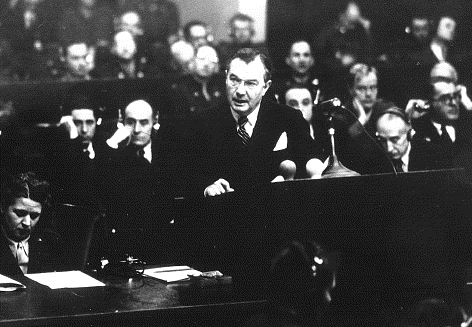
"Leave to live by no man's leave, underneath the law": U.S. Supreme Court Justice Robert H. Jackson addresses the Nuremberg Tribunal on the expectations of civilisation, 21 November 1945. In executing the unarmed Osama Bin Laden without trial has the United States deviated from the very principles it purports to be defending: the universal right to life and liberty, and the Rule of Law itself?

“BASTARDS!” That’s what I always ended up screaming at the television set every time I watched a documentary about 9/11.

As United Airlines Flight 175 made its final, fatal turn towards the South Tower of the World Trade Centre, I imagined the terror of its passengers.

Hearing the details of how the hijackers seized control of United Airlines Flight 93 made me physically sick.

And, up until last Monday, I’d only to witness again the terrible events of 9/11 for every fibre of my being to cry out in blood-red fury for vengeance.

Vengeance for the butchered hostesses; for the 2,752 men and women who died in the twin towers; for the American people, ashen-faced with shock; for a world that stood, transfixed, by the horrors of that day.

And I’d fantasize about standing before the man who made it happen, Osama Bin Laden, gun in hand, and squeezing-off round after round until he crumpled in a bleeding ruin - just like the proud towers brought low by his command that bright September morning.

But last Monday, when I learned that a commando unit of US Navy Seals had done just that, there was nothing. The sense of exhilaration I’d expected to feel just wasn’t there. Instead, I experienced a very different sensation: a feeling of emptiness; of moral vacuity; of a world going under for the final time … in a sea of blood.

And I realised with a dead feeling that Osama Bin Laden had won.


“HAVE A CARE when fighting monsters”, warned the German philosopher, Friedrich Nietzsche, “lest ye become a monster yourself.”

As I watched the crowd outside the White House wave their flags in the darkness, and listened to the guttural chanting of “U-S-A! U-S-A!”, I recalled the images of joyous Palestinians chanting “Allahu Akbar!”, “God is great!”, and passing out sweets, as news of Bin Laden’s successful attack swept along the Arab “street”.

I heard the American Right demand that President Barack Obama release photographs of Bin Laden’s dead body, and I recalled the “proof of death” videos released by Islamic terrorist groups – the ones where they cut off their prisoners’ heads.

I read the columns of respected New Zealand journalists; columns in which Bin Laden’s death is celebrated in gory, gloating detail: “They blew half his face off.” Columns in which the most splendid achievement of Western Civilisation – the Rule of Law – is casually cast aside: “There are certain people to whom the rules of law and life do not apply. There are certain people who simply have to be killed and thrown to the sharks”. Columns in which President Obama is told he had “a duty to kill”; to make it “final and tidy, no civil rights, no due process”.

I read these columns, and more than ever I was seized by the completeness of Bin Laden’s victory. By the way in which his 9/11mission had succeeded in overthrowing all of the religious and civic traditions which had, over the course of twenty bloody centuries, ceded to the West the unprecedented role of global moral arbiter.

Because it wasn’t the Wahhabist tradition of Islam that outlawed slavery, or gave the world the Geneva Conventions, or the United Nations Charter, or the Universal Declaration of Human Rights. It wasn’t Oriental despotism which outlawed the use of torture, or declared that all human-beings – even convicted criminals and prisoners-of-war – possess an absolute right to be treated with dignity.

These were the hard-won achievements of Christian conscience and Enlightenment reason. They were what made us different. They were what made us better than our enemies: better than our own base selves. They were the fruits of what Abraham Lincoln called “the better angels of our nature” – and they were the most precious things we had.

And Osama Bin Laden made us throw them all away.


WE WEREN’T ALWAYS SO CARELESS. As World War II was coming to an end the “Big Three” – Roosevelt, Stalin and Churchill – debated what to do with the defeated regime. Momentarily they toyed with the idea of summarily executing the Nazi leadership. Given the enormity of their crimes, few would have condemned them.

But they knew better.

The Nazi leaders were arrested – and put on trial.

The American prosecutor, Supreme Court Justice Robert H. Jackson, in his opening address to the Nuremberg Tribunal, told us why:

“[Civilisation] does not expect that you can make war impossible. It does expect that your juridical action will put the forces of International Law, its precepts, its prohibitions and, most of all, its sanctions, on the side of peace, so that men and women of good will in all countries may have ‘leave to live by no man’s leave, underneath the law’.”

This is what we’ve surrendered to Osama Bin Laden: the expectation of civilised behaviour.

This essay was originally published in The Press of Tuesday, 10 May 2011.

Friday, 5 November 2010

Terrorist or Fall-Guy?

Seize him!: King James's men arrest Guy Fawkes in the "undercroft" directly beneath the House of Lords on 5 November 1605. Hidden beneath a screen of firewood were 36 barrels of gunpowder. Should the foiling of the most audacious "terrorist" plot in British history be attributed purely to good fortune, or was the dramatic "discovery" of "gunpowder, treason and plot" engineered by the authorities to further their own political purposes? (The Discovery of the Gunpowder Plot. Painting by Henry Perronet Briggs, 1823.)

Remember, remember the fifth of November
Gunpowder, treason and plot.
I see no reason why gunpowder treason
Should ever be forgot.

HAD IT COME OFF, the "Gunpowder Plot" of 1605 would have ranked alongside 9/11 as one of the most audacious and world-altering terrorist attacks in human history.

To mark the 400th anniversary of the Plot, a British television network constructed a replica of the 17th Century Houses of Parliament, installed the 36 barrels of gunpowder Guy Fawkes and his fellow conspirators are said to have hidden in the basement, and ignited them. The resulting massive explosion completely destroyed the replica structure. Explosive experts told the programme’s producers that anyone within 100 metres of the detonation point would have been killed instantly.

So, the target of the Catholic Gunpowder Plotters – the Protestant King of Scotland and England, James Stuart – would certainly have been killed if the barrels of crude explosive had been allowed to do their job. The British Isles would have been plunged into civil war, and the plotters’ ultimate aim – the restoration of Catholic ascendancy – may even have been achieved.

What fascinates me about the Gunpowder Plot, however, is that almost from the moment the plotters were apprehended, tortured, tried and executed, their contemporaries started questioning the truth of the Government’s version of events.

From the very beginning, these "5/11 Truthers" – as they’d be called today – cast doubt upon the Government’s key assertion: that it was entirely ignorant of the plot.

According to the King’s chief minister, the first Earl of Salisbury, Robert Cecil, if one of the plotters hadn’t sent a letter to a Catholic Lord, warning him to stay away from the Houses of Parliament on 5th November, not only the King, but the whole House of Lords and the entire House of Commons would have been blown to Kingdom Come.

The 17th Century "Truthers" – like their 21st Century counterparts – weren’t buying it.

Everybody in London knew that Cecil (the son of Elizabeth I’s long-serving chief minister, Sir William Cecil) had been schooled in the arts of statecraft and intelligence-gathering not only by his father, but by Elizabeth’s spymaster, and the man regarded by many as the Father of England’s "Secret State" – Sir Francis Walsingham.

Walsingham had masterminded the operation which resulted in the execution of Elizabeth’s Catholic cousin, Mary, Queen of Scots. The so-called "Babington Plot" had been run almost from beginning to end by Walsingham himself, in order to snare Mary in an act of treason. The 5/11 "Truthers" argued that the Gunpowder Plot was no different.

In a capital city swarming with Cecil’s spies, they said, it simply beggared belief that the ever-increasing number of Catholic plotters (most of whom would have been under surveillance) and the constantly postponed plot (outbreaks of disease in London had led to the date of the Royal Opening of Parliament being changed several times) went entirely undetected by James’ spymasters.

Like the 9/11 Truthers, the 5/11 doubters argued that a terrible act of terrorism (or, in the case of the Gunpowder Plot, attempted terrorism) was just what the Government of the Day "needed" to further its foreign and domestic policy goals.

The case both would make is that the destruction of the Twin Towers (or the only-just-averted elimination of England’s Protestant rulers) were deliberately engineered by the "secret statesmen" of 21st Century America (or 17th Century England) to persuade their populations that "drastic measures" were necessary to protect the State from its terrorist foes.

Misdirection’s an old and dirty game – as old as politics itself. Robert Cecil learned it from his father and Walsingham, who’d simply followed the example set by Henry VIII’s chief minister, Thomas Cromwell, who had learned it in the palace corridors of Renaissance Italy, where the heirs of the Roman Empire practised the dark arts of treachery and deception with a skill only centuries of hands-on experience can impart.

And, of course, it was Walsingham’s and Cecil’s heirs who taught the Americans how to play. The Office of Strategic Services – which President Roosevelt established during the Second World War (and which later morphed into the Central Intelligence Agency) was tutored by Britain’s Secret Intelligence Service.

Something to think about as you set a match to the blue touch-paper this November night.

Was Guido Fawkes a terrorist – or was he simply the spymasters’ fall-guy?

This essay was originally published in The Timaru Herald, The Taranaki Daily News, The Otago Daily Times and The Greymouth Evening Star of Friday, 5 November 2010.