Showing posts with label Sir Michael Cullen. Show all posts

Friday, 10 September 2021

Making The Terrorism Suppression Act Fit-For-Purpose.

Infamous Day: Tomorrow, 11 September 2021, is the twentieth anniversary of the New York and Washington terrorist attacks. Think of the preliminary steps required to make 9/11 happen. Had they been detected, the tragedy could have been prevented. We need legislation equal to that task. 

HE WAS PROBABLY the smartest student I met during all my years at Otago University. After nights out carousing at the Captain Cook Tavern, he was famous for scribbling out essays in the Gazebo Lounge of the Student Union as the deadline loomed (yes, that’s right, people actually wrote essays longhand in those far-off days!) and receiving the, by then, obligatory A+. This fellow seriously impressed Otago’s Philosophy Department, which was – and still is – an extremely difficult thing to do. As Douglas Adams might have said, he had a brain the size of a planet.

It was always a source of curious consolation to me that after leaving university this guy ended up working in the Parliamentary Counsel Office. That the nation’s laws were being drafted and edited by a top philosophy grad, whose brain was the size of a planet, seemed entirely appropriate. Typical, too, of those far-off, pre-Rogernomics days, when having faith in the nation’s public servants did not seem at all naïve or foolhardy.

God knows what happened to this guy. As with most agencies of the old social-democratic Godzone, the Parliamentary Counsel Office was swept away in 1985 – just one more casualty of the Fourth Labour Government’s blizzard of neoliberal reforms.

Why am I recalling all these memories from forty or more years ago? Well, because how our laws are written matters – a lot. As the late Sir Michael Cullen explained in a speech to mark the retirement of the Chief parliamentary Counsel, George Tanner, in 2007:

“My former parliamentary colleague Sir Geoffrey Palmer once speculated that a junior drafter of laws might be as powerful as the most senior jurist, because a drafter makes so many decisions on constructing policy into statutes and regulations. Both drafters and judges give effect to the intentions of Parliament, but inevitably there are tactical decisions about the best way to approach a problem. A drafter of laws is in a pivotal, influential position.”

Indeed they are. We have only to recall the events of the past week to understand how pivotal and influential. A badly drafted piece of legislation – like the Terrorism Suppression Act 2002 – can produce the most appalling consequences. Indeed, when it comes to forestalling even well-signalled terrorist intent, the Act is so poorly drafted as to be practically useless. So much so, that a judge felt compelled to warn the Government that it could prove to be the “Achille’s Heel” of New Zealand’s national security legislation.

The Judge was right.

What the New Lynn terrorist attack has made agonisingly clear is the need for a legislative formula empowering New Zealand’s national security apparatus to identify words and deeds indicative of a clear and firm intention, on the part of an individual, or group, to execute an act of terrorism.

This is by no means as straightforward as it may sound. Empowering the state to indict a person for the thoughts in his or her head is not something a healthy democracy should lightly endorse. What a person might be thinking is bound, at times, to be entirely unworthy of public scrutiny. As Bob Dylan puts it in “It’s Alright Ma (I’m Only Bleeding)”:

If my thought dreams could be seen
They’d probably put my head in a guillotine.


Well, quite.

In the urgent task of making the Terrorism Suppression Act fit-for-purpose, language and logic must advance in lock-step. Police officers, prosecutors, judges and juries must be able to check-off the necessary mental and physical steps leading towards the commission of a terrorist offence. In addition to intent there must be action. Thoughts must be communicated verbally: either electronically, in writing, or on-line. The wherewithal of terror: knives, guns, explosives; must be acquired and assembled for the explicit purpose of inspiring terror. Purposive preparatory action, preceded by the tangibly expressed intention of carrying out a terrorist act. These are the sort of elements around which the legal draftspersons will have to make their “tactical decisions”.

Tomorrow, 11 September, is the twentieth anniversary of the New York and Washington terrorist attacks. Think of the preliminary steps required to make 9/11 happen. Had they been detected, the tragedy could have been prevented. We need legislation equal to that task. It will require not just legal expertise, but all the philosophical brilliance of that far-off genius in the Gazebo Lounge.


This essay was originally published in The Otago Daily Times and The Greymouth Star of Friday, 10 September 2021.

Monday, 22 March 2021

Something Big.

Lange versus Douglas Round Two? Rumours of a prime-ministerial resignation may be intended to head-off something considerably more dramatic on the policy front.

 
THERE ARE ALL KINDS of political rumours, but they don’t get much bigger than: “The PM is about to resign.” When that rumour was relayed to me on Friday morning, my initial reaction was “Bullshit!” Wellington is a very intimate capital city, so the idea that such an important story could somehow be kept from the Parliamentary Press Gallery, struck me as fanciful. Were it not for the fact that my informant was “a usually reliable source”, I would have given the matter no more than a dismissive shake of the head. Instead, I decided to make some calls.

As I suspected, nothing remotely resembling a resignation rumour had been picked up by the Press Gallery. What I did hear, however, were concerns about “Jacinda”. The Prime Minister, I was told, was “out of sorts”, “morose”, “not her usual self”. Among female journalists, I discovered, there was much speculation about whether or not the PM was pregnant. Scuttlebutt, I thought to myself. Although, I had to concede, the PM’s sunny disposition has, of late, given every appearance of having fallen under a cloud. Even to the casual observer, Jacinda seems distracted.

It is doubtful whether her overall mood was uplifted by the latest poll results. Though Labour still hovers around its Election Night 50 percent, the TV1-Colmar Brunton survey showed Ardern falling a statistically significant 15 percentage points in the Preferred-Prime-Minister stakes.

It is likely that these latest numbers only accentuated the PM’s dissatisfaction with the way she and her government are being represented in the newspaper columns and across social media. This dissatisfaction turned out to be one of the most consistent themes of my Friday-morning soundings. The PM, it is alleged, has been stung by the sharp criticisms of her administration which have been growing in intensity since Labour’s landslide victory last October. At the heart of these critiques lie two inter-related questions: “Why the preternatural caution, Jacinda. What, or who, is stopping you?”

While New Zealanders understood the role played by Winston Peters and NZ First in reining-in the PM’s “transformational” aspirations (and were, accordingly, prepared to forgive Labour’s less-than-stellar record of achievement on the big issues of homelessness and child poverty) after 17 October 2020 that excuse was no longer available. Not when Labour, the Greens and Te Paati Maori between them command 77 seats in New Zealand’s 120-seat House of Representatives.

Labour’s caution and timidity were attributed (often none-too-kindly) to the party’s determination to hold on to the huge swag of former National Party voters who had defected to Labour in recognition of the PM’s outstanding handling of the Covid-19 Pandemic. Commentators mused that “Jacinda” was little more than a brand; and that, for all her talk about “the politics of kindness”, Ardern was just another party leader with one over-riding priority – winning the next election. Perhaps the unkindest cut of all came from one of Ardern’s most reliable supporters on social media. Martyn Bradbury, Editor of The Daily Blog. Playing on the left-wing swearword “Neoliberalism”, Bradbury described the PM as a media-savvy purveyor of “Neo-kindness”.

The message coming back to me throughout Friday was that these accusations had hurt. That the PM was feeling keenly the lack of faith in her bona fides – especially from those who are regarded as being (and who certainly see themselves as being) on the Left. I was told that over the summer Ardern’s determination to keep her promises to the homeless, the poor, and the planet had grown ever-stronger. That she refused to go down in history as an instinctively empathic crisis-manager. That someone who could pull off an electoral rout on the scale of 17 October required an altogether more substantial legacy. The word began to spread through Wellington’s labyrinthine corridors of power that “something big” could be expected on the policy front by the middle of the year.

Hearing this, I wondered how much attention Ardern and her closest advisers had paid to the words of the veteran left-wing trade-union leader, Robert Reid. Barely 48 hours had passed since the Red Tide had ripped the infamous “handbrake” from NZ First’s hands, but Reid was already tweeting out a warning to the new Labour majority government:

“No one mentions that every government is a coalition between the elected governing party(s) and the senior bureaucrats.

“The bureaucracy acts as more of a handbrake than NZ First ever did.

“But most 'ruling' parties continue to let it dictate policy.”

What would happen, I asked myself, if the PM made it clear to her Cabinet colleagues that she was no longer willing to play it safe; that, having made promises to the New Zealand people, and been rewarded with an absolute majority, she was now absolutely determined to keep them?

The most obvious starting point for the PM would be the housing crisis. A major initiative here would not only boost the well-being of New Zealanders considerably, it would also make a huge impression on the level of child poverty. Killing two birds with one stone has always been an attractive political proposition. But, to be at all effective, such an effort would have to be on a scale unprecedented since the 1970s – entailing an eye-wateringly large amount of expenditure.

Alternatively, the PM may have decided to give effect to the Welfare Expert Advisory Group’s recommendations on social development – including a massive increase in core benefit levels. This, too, would provoke genuine horror in Treasury. Effectively eliminating child poverty at a stroke does not come cheap.

And, it is here, perhaps, that the rumour about a prime-ministerial resignation may have had its genesis. Faced with ever-higher levels of government borrowing, Treasury officials would undoubtedly have attempted to pressure the Finance Minister, Grant Robertson, into dissuading his friend and ally that what she was proposing was as irresponsible as it was unlikely to succeed.

In normal circumstances, this might have worked. But, from what I have discovered over the past 72 hours, these are not normal circumstances. Only last week, Robertson’s friend and mentor, Sir Michael Cullen, a man stoically succumbing to terminal lung cancer, is reported to have told a select gathering of Labour Party notables that: “It is not enough simply to win – you have to DO something.” Aware of how determined the PM is to “do” as Sir Michael advises; seized also, as his boss is said to be, by intimations of mortality, Robertson, “the reluctant radical” seems ready, for once, to throw caution to the wind.

From all sides, now, comes word of the imminence of “something big” being announced. The Labour caucus is said to be both “nervous” and “excited”.

Writing in The Daily Blog, Martyn Bradbury (whose connections with the Labour caucus are numerous and strong) sums up the situation like this:

“Jacinda has taken the time over the Summer to decide being kind has to mean something, desperate rumours spread by Wellington bureaucratic elites that there is a split between Jacinda and Grant are designed to create a rift not report on one.”

If Prime Minister Ardern’s big policy gamble fails, then her resignation will, indeed, have to be handed to the Governor-General. But, everything I have learned over the last 72 hours convinces me that “Jacinda” is no longer content merely to win: she means to DO something.


This essay was originally posted on the Interest.co.nz website on Monday, 22 March 2021.

Wednesday, 27 February 2019

Dying In A Ditch For A Capital Gains Tax That Half The Country Doesn’t Want.

Why Is This Man Smiling? Is Sir Michael Cullen's Capital Gains Tax really worth this government dying in a ditch for? Especially if that means all hope of making progress on the issues ordinary Labour and Green voters really do care about will be lost. Even though it will allow the Right to come storming back to power on populist promises of saving the family batch and making it possible, once again, for hard-working Kiwis to cash-in their dreams.

THE LABOUR-GREEN TECHNOCRATIC LEFT is clearly preparing to die in the very same ditch in which the Right hopes to bury the proposed Capital Gains Tax (CGT). This is unfortunate, since one of the more annoying, if unintended, consequences of such folly is likely to be the fall of the Coalition Government. Assuming, of course, that Winston Peters and NZ First are willing to die alongside their Labour and Green comrades. The sheer improbability of that happening is really the only ray of hope illuminating what is otherwise a pretty dreary situation.

It is to be hoped that the partisans of a CGT are stockpiling their rhetorical and evidentiary weaponry with the same eager energy as the National Party, Act and the Taxpayers Union. This latter trio can barely contain their glee that Sir Michael Cullen and his Tax Working Group are preparing to gift them such a large consignment of political dynamite.

Presumably, the advocates of a CGT are confident that this dynamite will explode in the Right’s face. That a CGT, opposed (according to Reid Research) by 54 percent of voters, will nevertheless rouse the “Missing Million” voters from their slumbers and send them marching towards the barricades. Because, according to these same advocates, the CGT is about “fairness”, and fairness is as Kiwi as … umm … voting National and grumbling about tax.

Strangely enough, the Right’s campaign against the CGT will also be based on “fairness”. They will be arguing that it’s only fair that people who have worked hard all their lives to make a success of a farm, a small business, or a rental property, are entitled to be rewarded for all that effort and self-sacrifice by pocketing the capital gain – tax free.

Will the Right focus on the multi-millionaire who invests $10 million, walks away with $50 million, and pays not one cent of tax on his ill-gotten capital gains? Of course not! They’re relying on most New Zealanders not knowing anyone like that. The sort of people most Kiwis do know, however, is the couple who set up their own business, slogged their guts out, and then cashed it in for a tidy sum. Do most Kiwis begrudge these folk their windfall? Not at all. They know what it cost them to get it.

The Right is also betting that the Kiwi dream of becoming one’s own boss remains as strong as ever. At least as strong as any desire to stick it to the rich. That confidence is in no way misplaced since neither the Labour Party, nor the Greens, were willing to make “sticking it to the rich” a central plank of their respective election policy platforms.

Certainly, an invitation to come up with new and inventive ways to “stick it to the rich” formed no part of the Tax Working Group’s terms-of-reference. If it had, then I strongly suspect Sir Michael Cullen would have refused to serve!

In fact, if we think about them, those terms-of-reference were pretty damn lame. The Working Group was not permitted to consider increasing income tax on the very wealthy. They were prohibited from investigating a land tax, or recommending the re-introduction of inheritance tax. Even worse, it was soon made clear by Michael Cullen’s protégé, and Finance Minister, Mr Grant (Budget Responsibility Rules) Robertson, that any revenue raised from a “broad-based” CGT would have to be offset elsewhere in the fiscal system.

So much for the fond hopes of misguided progressives that the additional billions raised by a CGT would be used to fund desperately needed increases in social expenditure.

Nope. Labour and the Greens were having none of that. All they wanted was a CGT. Indeed, so badly did the Greens want it that their male co-leader, James Shaw, recently declared that they didn’t deserve to be re-elected if a CGT was not delivered.

Certainly, when it comes to causes for which activists are ready to endanger their party’s grip on power, the Labour-Green Technocratic Left’s determination to die in a ditch for a CGT is equalled only by the Alliance’s Left’s determination to die in a ditch over the USA’s post-9/11 intervention in Afghanistan. There were many causes for which the Alliance Left might honourably have committed political suicide, but saving the Taliban wasn’t one of them!

The common factor here: what links the Labour-Green Technocratic Left with the old Alliance Left; is a peculiar kind of political tone-deafness. The suggestion that a Western political party eager to be re-elected should stand in the way of punishing those responsible for the atrocities of 9/11 should have sounded absurd in the ears of practical political activists. Similarly, the notion that the single most important change for which ordinary New Zealanders are clamouring is a CGT. Not effective action to eliminate poverty and homelessness; not immediate and drastic measures to combat climate change; not cleaning up our rivers and streams; or improving our mental health services. None of these things – judging by the lethargy and prevarications of this government and its technocratic supporters – are worth dying in a ditch for.

But a CGT is, apparently, deserving of the ultimate sacrifice. Even if it means that all hope of making progress on the issues ordinary Labour and Green voters really do care about will be lost. Even though it will allow the Right to come storming back to power on populist promises of saving the family batch and making it possible, once again, for hard-working Kiwis to cash-in their dreams.

This essay was originally posted on The Daily Blog of Thursday, 21 February 2019.

Friday, 29 January 2016

Are The Greens Arriving From, Or Departing For, Another Planet?

Little Green Men: Coming Or Going? Green Co-Leader, Metira Turei's State of the Nation speech made it very clear that her party has grown very weary of living on Planet Impotence - and may even be contemplating a departure for Planet Key. Her plans for Treasury to audit political parties' manifestos would certainly make the Greens' stay on Planet Key more comfortable.
 
I’M WORRIED that the oft-repeated claim that the Greens come from another planet, might, in fact, be true. Because only someone recently arrived from an altogether more benign solar system could possibly argue that the NZ Treasury casting its cold forensic eye over left-wing parties’ policies is a good idea. The astonishing naivety of the suggestion confirms every old socialist’s slur that when you’re dealing with the Greens, you’re dealing with the children of a very different tribe. And, honestly, after Metira Turei’s “State of the Nation” speech, I’m minded to amend the end of that sentence to read: “a very different and a very stupid tribe.”
 
According to Ms Turei: “New Zealanders deserve more transparency from their politicians so that they can better engage in the political system. That’s why the Green Party is proposing the establishment of [a Policy Costing Unit] to provide independent costings for the policies proposed by political parties. The PCU would be an independent unit within the Treasury and available to all parliamentary parties. It would help cut through the noise of political party promises and deliver New Zealanders unbiased information.”
 
Unbiased information! Clearly, the inhabitants of the planet Ms Turei has been visiting for the past 32 years are entirely ignorant of the 1984 neoliberal coup-d’état spearheaded by the leaders of the New Zealand Treasury. How else are we to explain her child-like faith in the Treasury’s lack of bias? Any other politically aware individual from this benighted chunk of our planet would have not the slightest difficulty in identifying No. 1 the Terrace, Wellington, as New Zealand’s Barad-dûr – dwelling place of the Dark Lord and source of all the woes of Middle Earth.
 
Can it really be true that Ms Turei has never heard of “Economics II”, the special Treasury division headed by the late Roger Kerr (of Business Roundtable fame) which, working alongside Dr Bryce Wilkinson and Dr Graham Scott of “Economics I”, was responsible for bringing together “Economic Management” – the policy bible for what came to be known as “Rogernomics”? Does she really not know that the current institutional “culture” of Treasury descends directly from these implacable ideologues?
 
Obviously not. Otherwise she wouldn’t dream of advocating that her party entrust its policies to Treasury’s tender mercies. Any more than she’d happily dispatch her youngest child for a sleepover at Michael Jackson’s Neverland!
 
And yet, Ms Turei was here, in New Zealand, for the entire time Treasury’s neoliberal evangelists were transforming the country. She knows full well that before 1984 the number of children living below the poverty line was 15 percent, and that after 20 years of Treasury-guided economic “reforms”, that figure had nearly doubled.
 
So, if eradicating child poverty is one of the Greens’ most important “twenty-first century policies” (as she told us, on the radio, only this week) then how is she going to feel when Treasury solemnly vouchsafes to the electorate that the measures her party proposes are not only unlikely to reduce child poverty but may even make it worse. And if she refuses to believe that Treasury would stoop to such blatantly political tactics, then all I can recommend is that she spend an hour or two with Sir Michael Cullen. As Labour’s finance minister from 1999 until 2008, he became something of an aficionado of Treasury’s “ideological burps”.
 
There is, of course, another explanation for Ms Turei’s extraordinary suggestion. It involves the Greens not arriving from, but departing for, another planet. Planet Key.
 
After all, the planet they’re currently living on – Planet Impotence – is a very dreary place. Nothing ever happens on this dismal chunk of rock, and what makes their lives even more frustrating is that Planet Key looks like a place where the right sort of Green could have such a lot of fun! It’s so bright, so blue, and everyone living there looks so happy. A material girl soon grows tired of hanging out with the poor and needy. Surely, it must be someone else’s turn to nursemaid the Labour Party! Especially when, every time Labour manages to construct a spaceship capable of lifting them off Planet Impotence, they always leave the Greens behind!
 
And that’s the beauty of establishing a PCU! It more-or-less guarantees that the Green Party’s Treasury-vetted policies will be ideologically indistinguishable from those of a National Government.
 
This essay was originally published in The Waikato Times, The Taranaki Daily News, The Timaru Herald, The Otago Daily Times, The Greymouth Star of Friday, 29 January 2016.

Friday, 21 August 2015

When The Nation’s Permanent Interests Override Its Impermanent Politicians

Pushback: Rob Muldoon's NZSIS Amendment Bill 1977 inspired huge protest demonstrations up and down the country. The Bill passed, but only at the price of massive and enduring public mistrust of the SIS itself. Were a left-wing government ever to give legislative expression to that mistrust, however, the true purposes of our national security apparatus would very quickly be revealed.
 
SUBMISSIONS TO the Independent Review of Intelligence and Security closed last Friday. No doubt the “Independent Reviewers”, Sir Michael Cullen and Dame Patsy Reddy, are already up to their elbows in the earnest recommendations of their fellow citizens. By March of next year we will learn what they have made of them.
 
In all probability, neither Sir Michael, nor Dame Patsy, will end up recommending much more than a little tweaking here and there to New Zealand’s national security apparatus. The terms of reference of their inquiry were extremely narrowly set – always an indication that nothing too dramatic is expected by the politicians who set the process in motion.
 
A few judicious redefinitions of the scope and powers of the Security Intelligence Service (SIS) and the Government Communications Security Bureau (GCSB) is the most we should anticipate. (Especially after the Prime Minister has strongly and publicly hinted that this is what his government is expecting!)
 
Indeed, any government attempting to make more than minor changes to either institution is asking for trouble. In 1977, the National Prime Minister, Robert Muldoon, ignited a firestorm of nationwide protests when he announced his intention to legislate a substantial increase in the powers of the SIS. The New Zealand Security Intelligence Service Amendment Bill, which dramatically expanded the Service’s capacity to intercept private communications, and forbade the public identification of its agents, was passed by Parliament, but only at the cost of a significant portion of the citizenry’s trust and goodwill.
 
That New Zealand’s so-called “intelligence community” is anxious to retain and build public trust and goodwill has been evident over the past fortnight in the substantive public relations campaign it has waged in advance of the Independent Review. SIS Director, Rebecca Kitteridge, knows how difficult her job will become if her fellow citizens are unwilling to concede the legitimacy of the SIS’s role.
 
But, if losing the trust and goodwill of New Zealand’s citizens is a bad thing, losing the trust and confidence of New Zealand’s allies would be much, much worse. This would, however, be the most likely outcome if the recommendations of those who made submissions to the Independent Review from the left were ever to be taken up and implemented by a future left-leaning government.
 
The submission from the Anti-Bases Campaign, for example (whose spokesperson is the redoubtable left-wing activist, Murray Horton) has recommended to Sir Michael and Dame Patsy that: “New Zealand immediately exits the Five Eyes regime.”
 
The reviewers will, of course, ignore this demand – if only because it falls outside the scope of their inquiry. But, what if a future Labour-Green Government was persuaded to withdraw from the UK-USA Agreement, to which New Zealand has been party for more than 60 years?
 
It is precisely in circumstances such as these that the true function of our national security apparatus would be demonstrated.
 
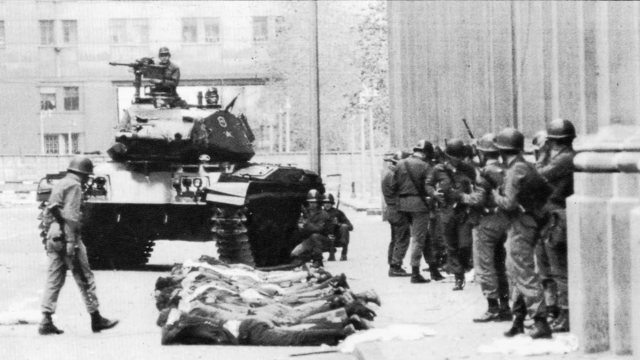
It was the United States Secretary of State, Henry Kissinger, who infamously remarked of the democratically elected socialist government of Chile: “I don’t see why we need to stand by and watch a country go communist due to the irresponsibility of its own people. The issues are much too important for the Chilean voters to be left to decide for themselves.” On 11 September 1973, that government was overthrown by the Chilean armed forces.
 
"The issues are much too important for the Chilean voters to be left to decide for themselves."
- US Secretary of State, Henry Kissinger, justifies the overthrow of Chile's socialist government.
 
On 10 November 1975, outraged that his government was under CIA surveillance, the Australian Labour Prime Minister, Gough Whitlam, let it be known that he would be closing down the joint CIA/National Security Agency’s satellite tracking station at Pine Gap near Alice Springs in the Northern Territory. The following day, Whitlam’s government was dismissed by Sir John Kerr, the Australian Governor-General. (The Pine Gap station was critical to the effectiveness of the “Five Eyes regime”.)
 
In the eyes of both the Chilean armed forces, and Australia’s national security apparatus, the permanent national interests of their respective states had been placed at serious risk by political figures who either did not understand, or were hostile to, those interests. In arriving at these conclusions, both institutions relied upon the intelligence and advice of their nation’s principal military and economic ally, the United States.
 
Although neither Sir Michael, nor Dame Patsy, will admit it, “national security” is all about identifying which permanent national interests are best kept beyond the reach of Democracy’s impermanent practitioners.
 
This essay was originally published in The Waikato Times, The Taranaki Daily News, The Timaru Herald, The Otago Daily Times and The Greymouth Star of Friday, 21 August 2015.

Saturday, 8 August 2015

Revolution In Pipitea Street: The Listener Celebrates The Baby-Boomer Takeover Of The SIS And The GCSB.

Spook Central: Both the SIS and the GCSB are headquartered at "Pipitea Plaza", a 2011 building located just a few hundred metres from Parliament Buildings in Central Wellington.
 
WOW! The SIS Director marched against the Springbok Tour! And the Acting-Director of the GCSB is a lesbian. But, wait, there’s more: the Inspector General of Intelligence used to be a member of the Socialist Action League, and worked in a freezing works for six years! And they’re all women! Surely, with people like these in charge of New Zealand’s “intelligence community”, no reasonable, fair-minded citizen could have the slightest cause for complaint? Clearly, this is a new order in the making. No more Penthouses, no more pies. No more grim, trench-coated spies. The bad old days are as dead as Rob Muldoon. Gone, like the Cold War.
 
Or, at least, that’s what we are supposed to think. “We” being the readers of the Listener. (Issue Dated: August 15, 2015) Baby Boomers mostly. Well-educated and well-heeled. A great many of whom marched against the Springbok Tour, flirted with revolutionary politics in our student days, and then went on to bigger and better things. Some of our best friends are lesbians. Yep, “we” can rest easy now that our generation has taken over everything – even the SIS and GCSB. Baby-Boomers Rule – OK!
 
Was it Listener editor, Pamela Stirling, who came up with the idea? Or, did free-lance journalist, Rod Vaughan, pitch it to her? And was the deal clinched by the promise of access to all three chiefs? And whose idea was that? At some point, someone in the “intelligence community”, decided that a front page story about a “revolution” sweeping the corridors of Pipitea House would be just what the Director ordered. The question is: was that decision made in response to Rod Vaughan’s request for access? Or did someone make Rod an offer that he – and Pamela – couldn’t refuse?
 
Because a front-page story in the Listener, reassuring the Baby-Boomers that the SIS and GCSB are now being run by people just like themselves, was bound to prove very helpful - especially now. That’s because a Government-commissioned review of both agencies, led by Sir Michael Cullen and Dame Patsy Reddy, is about to start asking questions. A cynic might observe that Rod Vaughan’s article has very helpfully suggested most of the answers.
 
What is there to fear, after all, from an SIS staffed by scores of bright-eyed young university graduates determined to keep New Zealand safe from “extremist behaviours”? Or, a GCSB run by someone who understands the importance of reminding “the troops” to “remain focused on the job at hand and to remember their responsibilities to all New Zealanders.”
 
Not that Sir Michael is likely to deliver a report recommending the upsetting of too many apple carts. As Helen Clark’s finance supremo, he always appeared to be doing his best to deliver what the state expected of its ministers. Yes, in the House he could summon up a rhetorical storm fit to set the Tories a-trembling. But, in the Joint Intelligence Committee, sweet reason seems to have prevailed. If Michael Cullen has ever been guilty of troubling the sleep of the “Deep State”, there is scant evidence for it.
 
On the off-chance that there might be New Zealanders less willing to let the Deep State escape all serious scrutiny, however, why not engage in a little pre-emptive PR? A story in the Listener, in which all the “news media, politicians, bloggers and activists” guilty of poking their noses into “the labyrinthine world of the New Zealand intelligence community” were shown to be “completely oblivious to [the] revolution that [is] well under way” within its walls, would undermine any future attempts to “pillory and hold accountable” those responsible for keeping the nation’s secrets.
 
That this could well be the case is confirmed by the Listener’s choice of headlines for Rod Vaughan’s article. The story about SIS Director, Rebecca Kitteridge is called “Secrets & Spies” – a clear reference to Nicky Hager’s exposé of the malign influence of PR on New Zealand politics entitled Secrets and Lies. The story about Una Jagose, Acting-Director of the GCSB, boasts an even more in-your-face thrust at the critics of the SIS and GCSB. It is headlined “Moment of Truth” – which is, of course, the name of the Kim Dotcom-sponsored event featuring Glen Greenwald and Edward Snowden that was held in the Auckland Town Hall just days before the 2014 General Election.
 
The triumphalism of the Listener could hardly be more explicit. In the words Sir Michael Cullen is said to have used to taunt his Tory opponents following the 1999 Labour-Alliance victory:
 
“We won. You lost. Eat that!”
 
This essay was originally posted on The Daily Blog of Saturday, 8 August 2015.

Friday, 29 May 2015

Making Connections: Why, Instead Of Looking Tired, Labour Needs To Get Emotional.

Fifth Time Lucky? After trying, and failing, four times to make an emotional connection with the electorate, perhaps Labour should look for a leader who got himself re-elected to Parliament the old-fashioned way - by raising heaps of cash and then persuading "mainstream" New Zealanders to vote for him. Napier MP, Stuart Nash (above) addresses a provincial business audience.
 
THE LATEST ROY MORGAN POLL has cast a deep pall of gloom over all three Opposition parties. Among Labour supporters, however, a growing sense of utter futility is palpable. Support for the party has crashed back to the abysmal figures of Election Night. Barely a quarter of the adult population is willing to identify Labour as their first electoral choice.
 
The corollary to Opposition gloom is, of course, Government elation. And, with the Roy Morgan poll showing National on 54 percent, who can blame its MPs and supporters for breaking out the bubbly? Remember, this latest poll was conducted when Amanda Bailey’s ponytail was dominating the headlines. Did it damage the Prime Minister’s reputation? (As so many of John Key’s enemies were hoping.) Not appreciably. “Teflon John” continues to shine.
 
At around the same time as Roy Morgan’s callers were working the phones, Sir Michael Cullen and the NZ Fabian Society were attempting to rally Labour’s dejected troops with a presentation entitled, rather hopefully, “Destination: Next Progressive Majority.” Arriving at that destination, says Sir Michael, will depend on whether Labour is able to re-present itself as the party of Choice, Aspiration, Responsibility and National Pride.
 
For that re-presentation to work, Sir Michael stresses, Labour must re-connect emotionally with the electorate. “Policies can be a means to this”, says the former Labour Finance Minister, “but rarely the most important means.” In saying this, Sir Michael is echoing the  advice of Lynton Crosby – the man who, earlier this month, won the UK General Election for the Conservative Party. Policy matters, says Crosby, only inasmuch as it expresses the less tangible and more visceral reasons for supporting one political party over another.
 
“This is Key’s huge strength”, Sir Michael observes, “he has enormous emotional connection with voters. The sloppy language we like to make fun of is the language most people speak, not like University lecturers like Helen, Steve and I. The casualness to turn things aside, not important, at the end of the day.”
 
It is National’s huge strength, as well, because there is no other politician in the Government’s ranks who connects with the ordinary Kiwi voter in the manner of John Key.
 
And it is here, on the question of leadership, that Sir Michael’s otherwise sober and sensible analysis falters.
 
In order to sell a Labour Party based on Choice, Aspiration, Responsibility and National Pride; a credible, likeable (and because, historically, Labour is coming off such a low base) a frankly inspirational leader is required. Someone with a personality powerful enough to rekindle the love Labour lost in the 1980s and 90s – and only fleetingly recovered in the early noughties. Someone capable of sparking-up the old flame. And, more than this, someone fresh and fascinating enough to attract and hold the attention of Generations X, Y and Z. Someone to warrant a selfie – and a vote.
 
Does this sound like Andrew Little? Does it sound like anyone in Labour’s post-2014 caucus? If the answer is “No”, then, even with Sir Michael’s sage advice, the party’s in a pretty pickle. It has tried, four times, to pick a winner: twice by the judgement of the Caucus alone; twice according to the judgement of the whole party. Every single one of them failed to fire. And whoever heard of fifth time lucky?
 
Something has to be done, however, or, like Sir Keith Holyoake, the New Zealand political leader he so closely resembles, the Prime Minister will lead his party to its fourth consecutive election victory.
 
To prevent that from happening, Labour is going to have to take a leaf out of the campaign maestro’s, Lynton Crosby’s, playbook. It is going to have to learn to listen to its pollsters and heed their focus groups. Not to discover what the public wants, and then give it back to them as Labour Party policy; but to learn which lines of argument work, and which don’t. Democratic politics is not about giving the people what they want, it’s about persuading the people that they want what you want. “When in doubt”, says Lynton Crosby, “stand for something!” And then, he might have added, convince a majority of voters to stand with you.
 
If Labour can’t find a leader to do that for them, then, for God’s sake, let them hire a campaign manager who can!
 
This essay was originally published in The Waikato Times, The Taranaki Daily News, The Timaru Herald, The Otago Daily Times and The Greymouth Star of Friday, 29 May 2015.

Monday, 13 April 2015

Rhetoric From An Empty Stage: Sir Michael Cullen Offers Labour Some Suitable Synonyms For Socialist Terms.

A Practical Utopian? Sir Michael Cullen advises Labour to recast its rhetorical appeal to voters in terms more acceptable to twenty-first century ears. The four watchwords he proposes for the 2017 election campaign are: Choice, Aspiration, Responsibility and National Pride. He is, however, eloquently silent on the question of how the New Zealand working class are to be re-admitted to the country's political stage.

THERE ARE FEW NEW ZEALANDERS better placed to speak knowledgeably about their country’s political future than Sir Michael Cullen. Finance Minister in Helen Clark’s ministry (1999-2008) he wrestled with New Zealand capitalism up-close and personal for nine years  and is generally acknowledged to have emerged from the experience, if not unbeaten, then, at the very least, unbowed. The surpluses amassed under his stewardship armoured the New Zealand economy against the raking fire of the Global Financial Crisis; a barrage which could easily have sunk as less well-protected vessel. John Key and Bill English owe Cullen a lot.

Retiring from the hurly-burly of parliamentary politics in April 2009 to take up the Chair of New Zealand Post Ltd, Cullen has maintained a discreet public silence on both the new National Government’s conduct of political and economic affairs, and, more importantly perhaps, on the internal turmoil debilitating the Labour Party he joined 40 years ago.
 
Which is not to suggest that Cullen lost interest in his party, merely that he was wise enough to restrict his interventions to below-the-radar discussions with trusted friends and allies. When it came to the long-running feud between the supporters of David Cunliffe and the “Anyone But Cunliffe” (ABC) faction of the Labour caucus, Cullen came down firmly on the side of Mr Cunliffe’s opponents. He was an early supporter of David Shearer and, in the latest leadership contest, of Grant Robertson.
 
Cullen’s endorsement of Grant Robertson was the former Finance Minister’s first public intervention in the politics of the Left for many years – and he paid dearly for it. Widely tipped to lead the committee charged with reviewing Labour’s disastrous performance in the 2014 general election (the worst in 92 years!) Cullen was very publicly snubbed by Labour’s NZ Council, who gave the job to the more overtly left-wing party elder, Bryan Gould.
 
That rather petty decision to exclude one of Labour’s most experienced and intelligent kaumatua has now been remedied by Cullen’s recent co-optation on to the review panel. Whether the decision to rehabilitate Cullen was made before or after his delivery of a speech entitled “Labour: whither or wither?” is unclear. What cannot be denied, however, is that this 5,000+ word analysis of where Labour finds itself in 2015, and where it needs to be by 2017, more than justifies his inclusion.
 
The mission Cullen proposes for Labour is nothing less than to instil in the New Zealand electorate what the American political philosopher, John Rawls, calls the “reasonable hope” of living in a “practical utopia”.
 
It is difficult to conceive of a phrase which better sums up the historical aspirations of the New Zealand Labour Party. In a country that has never had much time for grand ideological systems, the notion of a down-to-earth, do-it-yourself, No.8-wire utopia; a practical utopia designed to meet the reasonable hopes and dreams of ordinary Kiwis, is as near to a perfect recapitulation of Labour’s mission as it gets.
 
And the need to recapitulate Labour’s mission in a twenty-first century context; deploying words and concepts acceptable to a twenty-first century audience; is central to Cullen’s argument. He uses his own family history to demonstrate how, in the space of just a single century, the solidaristic working-class culture out of which both the British and New Zealand Labour Parties were born, has been broken up and dissolved – not least by the comprehensive social and economic reforms Labour struggled so hard to introduce.
 
As was famously said of those Labour governments, writes Cullen: “success in improving the lot of working people began to move many of them into the camp of those who at least believed, or could be persuaded, that they had more to lose than gain from further change. And, associated with that, the centre-right began a long process of capturing the language of politics – for example, by talking of a property-owning democracy.”
 
These are the voters Cullen urges Labour to woo and win in the run-up to 2017. “To form a strong, stable progressive government Labour still needs to aim to get around 40%  of the vote.” For those party comrades who argue that the gap between Labour’s 2014 result and Cullen’s target can be made up by mobilising the non-vote, Cullen has nothing but scorn:
 
“The missing 15% is not going to come primarily from non-voting socialist fundamentalists as some in recent time seemed to believe. We certainly need to motivate as much of the non-vote as we can to vote for us. But the bulk of the increase has got to come from recapturing votes from National, as they did from us in 2008.”
 
The Labour Party capable of reclaiming these lost sheep, Cullen argues, will have “a clear philosophy, an intelligent strategy, appealing and relevant policies, effective and coherent leadership, and, above all, better emotional connection with a majority of the population.”
 
To secure that connection, Cullen suggests “capturing the ownership of some emotionally resonant words and concepts which we have all too easily allowed our opponents to expropriate.” He lists these words and concepts as: Choice, Aspiration, Responsibility and National Pride.
 
These concepts, says Cullen, need to be “associated with and to suffuse our more traditional ones of fairness, equality, opportunity and (more recently) sustainability.”
 
Easier said than done, one might reasonably object. Because, on the face of it, the concepts Cullen is promoting all possess a distinctly conservative flavour.
 
It is all very well to argue, as Cullen does, that “Choice” can be re-translated to mean “a form of democratisation but only where it is available, as far as possible, to all.” But, for most voters under 40, the word will continue to mean “what I want”.
 
The concept of “Aspiration” faces similar difficulties. Can it really be redefined to mean “opportunity for all”? For most New Zealanders, aspiration is what John Key’s life-story embodies. It’s all about a little boy raised in a state house by his widowed mum, who went on to make $50 million and become New Zealand’s prime minister.
 
The concepts of “Responsibility” and “National Pride” are likely to prove even more resistant to redefinition. Cullen, himself, concedes that” “there is a tendency on the left to think that this is just a cover for beneficiary bashing or some other kind of judgemental approach to life.” Well, yes, there is, and with very good reason!
 
But Cullen indisputably has a point when he says: “At the very heart of social democracy surely lies the notion that we have responsibilities to each other. That is, that we are social beings who wish to pursue the common good – again the idea of a practical utopia. We reject the idea of atomised individuals perpetually striving to climb over each other, that what matters above all is where we end up within a hierarchical society (in essence, alas, a practical dystopia).”
 
Cullen is equally eloquent when it comes to the concept of “National Pride”: “In brief, we need to own a new national pride around our identity as a proudly diverse nation, around what we can do to create a better world, and around a focus on independent, morally-based action in a dangerous world that we cannot opt out of.”
 
When he speaks like this, Cullen recalls his younger self. As a history-lecturer at the University of Otago in the 1970s he thrilled his students with lectures on the English radical tradition; of a world turned upside down. Clearly, it is a tradition that Cullen is reluctant to disown.
 
“The notion of inherent equality allied with the common good stretches far back into the English radical tradition which, at least for some of us, is part of our heritage. As far back, indeed, as 1381 when John Ball posed the searching question “When Adam delf (i.e. dug) and Eve span, who was then the gentleman?” (A reproduction of the woodcut by the great Victorian socialist artist, Walter Crane, asking exactly that question, once held pride of place in Cullen’s university office.)
 
Or the Knight, for that matter?
 
But if the sort of world in which “what matters above all is where we end up within a hierarchical society” is one deplored by Cullen as dystopian, then why did he allow himself to be made a Knight Companion of the New Zealand Order of Merit? Being lectured to about the central tenets of social democracy by someone called “Sir Michael” is just a little disconcerting.
 
Equally unsettling is Cullen’s studious avoidance of the central role played by the trade unions in the development of both British and New Zealand social democracy. Only twice in his paper does Cullen make reference to trade unionism.
 
The first reference is to the New Zealand worker’s supposed lack of faith in unions – as evidenced by National’s decisive victory in the snap-election of 1951:
 
“Increasingly, sections of the working class began to see at least trade unions other than their own as inimical to their interests. The public reaction to the 1951 waterfront dispute typified that development.”
 
The second reference occurs as part of Cullen’s explanation for the Clark-led Labour Government’s failure to roll back the neo-liberal revolution:
 
“But the neo-liberal revolution was central to intensifying trends that were already clear. In terms of legislation, the most important and decisive was the Employment Contracts Act which decimated the trade union movement, at least in the private sector. And so profound was the success of the Act in completing a long term change in public sentiment that it was impossible to fully reverse its effects after 1999.” [My emphasis.]
 
Given that the destruction of organised labour has always been, and continues to be, the key objective of neoliberalism: the one great “reform”, out of which all other neoliberal “reforms” flow and endure; Cullen’s flawed historical observations, and his failure to address the future of organised labour in his recent lecture, are absolutely critical omissions.
 
What they confirm is that, in spite of his sage and often persuasive advice concerning Labour’s electoral rhetoric, Cullen, and the faction of the party he represents, is not yet ready to challenge the singular foundational achievement of the neoliberal era: the expulsion of the New Zealand working-class from the nation’s political stage.
 
This essay was originally posted on The Daily Blog of Saturday 11 April 2015.