Showing posts with label Chile. Show all posts

Saturday, 10 September 2022

Imagining Away The Opposition.

The High Tide Of Popular Protest: In 2019 Chile was racked by massive protest demonstrations. Hundreds of thousands of mostly young, mostly poor, Chileans served notice on their government that the moment had arrived for their country to cast off “Pinochet’s Straightjacket” – the 1980 constitution imposed upon Chile by its former leader, the dictator Augusto Pinochet, as the price it must pay for even a limited restoration of democracy.

HOW QUICKLY THINGS CHANGE. Three years ago Chile was racked by massive protest demonstrations. Hundreds of thousands of mostly young, mostly poor, Chileans served notice on their government that the moment had arrived for their country to execute a decisive break with its recent past. Politically, economically, and culturally, they said, Chile was ready to ditch the debilitating legacy of General Augusto Pinochet’s 17-year-long dictatorship. Most particularly, “Pinochet’s Straightjacket” – the 1980 constitution he imposed upon Chile as the price it must pay for even a limited restoration of democracy – must go.

For a while, it looked as though the youth of Chile, the poor of Chile, the women of Chile, and the indigenous peoples of Chile, would get their wish. A Constitutional Convention was convened. Delegates were elected from every part of Chile who engaged in passionate debates over the nature and purpose of the new rights to be enshrined in their nation’s fundamental law. When they were finished, the delegates submitted what they proudly described as the world’s most progressive constitution to the Chilean people for ratification.

According to The Guardian: “The proposed constitution: included a long list of social rights and guarantees that had appeared to respond to the demands of [the vast social movement that had called it into existence]. It enshrined gender parity across government and other organs of the state – for the first time anywhere in the world – prioritised environmental protection and recognised Chile’s Indigenous peoples for the first time in the country’s history.”

The new constitution also enshrined the social and economic rights which Pinochet’s dictatorship had swept away in the coup d’état that toppled Salvador Allende’s socialist government in September 1973. The Convention’s delegates had attempted to forbid forever the neoliberal economic policies which Pinochet’s military government had road-tested for the free-market ideologues who would go on to guide Great Britain and the USA – and New Zealand – away from the social-democratic policies of the post-war years.

It was too much. Earlier this week, the Chilean people decisively voted down the new constitution which the Convention’s delegates had delivered to them. Like Allende’s Popular Unity Government before them, the delegates had pressed ahead with the radical vision of the future they were so certain would heal the harms of the past. Like the young socialists of 50 years ago, they would not be held back by the reservations of the conservative Chileans they derided as “Momios” (mummies of the Egyptian kind) and, once again, they have paid the price.

One of Allende’s advisers, Prof. Ariel Dorfman, looking back on those days, recalled:

It would take years to understand that what was so exhilarating to us was menacing to those who felt excluded from our vision of paradise. We evaporated them from meaning, we imagined them away in the future, we offered them no alternative but to join us in our pilgrimage or disappear forever, and that vision fuelled, I believe, the primal fear of the men and women who opposed us.

One of the most striking features of the controversial He Puapua Report is its authors’ assumption that constitutional changes every bit as radical and all-embracing as those just rejected in Chile can be introduced to New Zealand without a Constitutional Convention, and without being voted up, or down, in a binding referendum.

Undoubtedly, some of those who favour the dramatic changes proposed in He Puapua will look at what has just occurred in Chile and say: “See? That’s what happens when you give white supremacists the chance to strike down the just and necessary changes required to heal the harms of 200 years of colonisation!” The fate of the world’s most progressive constitution will be seen as vindication of the He Puapua authors’ horror of “the tyranny of the majority”.

But this would be an entirely mistaken conclusion for radical Māori nationalists to draw from the Chilean experience. The fundamental error of the Constitutional Convention was to allow the best to become the enemy of the good.

The harms of the past cannot be healed by legislating them out of existence from on high. Healing will only come kanohi ki te kanohi – face to face – through hard but honest conversations, over many frustrating years, until, unforced, and almost unaware, the overwhelming majority of Māori and Pakeha arrive at their long anticipated destination – together.


This essay was originally published in The Otago Daily Times and The Greymouth Star of Friday, 9 September 2022.

Tuesday, 21 December 2021

Trusting The People: Chile Elects A Far-Left President.

Heartfelt Gratitude: Gabriel Boric’s decisive win, 55 percent to his far-Right opponent’s, Jose Antonio Kast’s, 44 percent, is a reflection of Chile’s two years of political turmoil. Two years of popular mobilisation culminating, first, in the radical Left winning control of the process to create a new Chilean constitution, and now, with the election of the young leader who was dismissed consistently by the mainstream Chilean news media as too radical for the job of President.

I WONDER IF JACINDA will befriend the new President of Chile, Gabriel Boric, with the same enthusiasm that she befriended Justin Trudeau? Boric comes to the presidency at the age of 35 – two years younger than Jacinda Ardern when she became New Zealand’s Prime Minister in 2017 – making him the youngest head-of-state in Chilean history.

The far-Left Boric won his political spurs ten years ago, in 2011, when he emerged as one of the student leaders of the bitter street-fight for more affordable and equitable education services for young Chileans. Boric’s unexpected victory over his far-Right opponent, Jose Antonio Kast, was celebrated by a crowd numbering in the hundreds of thousands in Chile’s capital, Santiago. Older Chileans, remembering the election of the Marxist, Salvador Allende, in 1970, didn’t know whether to laugh or cry. They had seen this movie before.

Boric’s decisive win, 55 percent to Kast’s 44 percent, is a reflection of Chile’s two years of political turmoil. Two years of popular mobilisation culminating, first, in the radical Left winning control of the process to create a new Chilean constitution, and now, with the election of the young leader who was dismissed consistently by the mainstream Chilean news media as too radical for the job of President.

Indeed, Boric was so radical that he drew forth as his principal political opponent an outspoken supporter of Augusto Pinochet, the brutal dictator responsible for the military coup against Allende’s Popular Unity government in 1973. Kast campaigned unapologetically on a hard-Right law-and-order platform and made promises to restore Chile’s traditional (i.e. conservative Catholic) values.

In the first round of voting Kast secured the largest fraction (but less than 50 percent) of the popular vote and, backed by the supporters of the other right-wing parties, was widely predicted to win the final, run-off, contest between himself and scarily radical Boric, the next-highest polling candidate.

Ironically, it was the very real prospect of a Pinochet clone taking control of Chile that mobilised the numbers necessary for Boric to win. Voter turnout surged, with 15 percent more people voting in the second round than the first. Critically, it was the votes of Chile’s youth that turned the tide in Boric’s favour. So radical had been the street-based protests of 2019-20 that there was little enthusiasm among the young for the business-as-usual politics of a presidential election. It was only when they realised that all the gains of the past two years could be wiped-out if they stayed at home that they rallied to the polling-booths in their thousands.

Young Chileans celebrate Boric’s election victory.
It will not all be plain sailing for Boric when he is sworn in as President, in March of 2022. The Chilean Congress remains in the hands of the same centre-Left and centre-Right moderates who have dominated Chilean politics for the past 30 years. Boric can count on a clear majority in neither the Chamber of Deputies nor the Senate, meaning that the fulfilment of his programme to construct a genuinely inclusive “social state” will require either superlative parliamentary skills, or, a willingness to keep the people mobilised – effectively daring the one percenters and their military protectors to do to Boric what they did to Allende.

So, at first blush, it seems most unlikely that Jacinda will be all that keen to be photographed giving Boric a comradely hug at his inauguration. She will be invited, of course, along with heads-of-state and prime ministers from all over the world, and from South America and the Pacific Basin in particular. But will the gal who got hitched at a billionaire’s New Zealand hideaway, and boasted Lorde as her wedding-singer, accept Boric’s invitation? Would Canberra and Washington approve of her being seen to cuddle-up to yet another left-wing Latin-American loose cannon? Once again, it seems most unlikely.

And yet, by March of next year, Jacinda will be facing some pretty daunting choices of her own. Maoridom’s judgement on the recommendations of the He Puapua Report will be out, and the broader debate on co-governance and fundamental constitutional change will be getting underway. If she and her colleagues follow the precedents set over the past four years, and step away from the big political challenges laid at their feet, then Labour’s chances of being re-elected for a third term are slim – at best. Will Jacinda be happy to rest on her Covid laurels? Or will her failure to keep any of Labour’s non-Covid promises overwhelm even those?

Wouldn’t she be wise to spend a little quality-time with President-elect Boric in the intervening months between his stunning victory and his formal inauguration – if only to quiz him about how an historic debate about the future direction of a nation, along with the constitutional reforms required to secure it, might best be organised?

He would likely tell her that once such a process is started, she will find it almost impossible to control – let alone stop. But, he will also likely tell her not to try. By giving ordinary people a real say over their future, her government will bind them to her in exactly the same way that her handling of the Covid crisis in 2020 bound her to “The Team of Five Million”. Trusting the people works, he would tell her. So when, inevitably, those with a vested interest in the status-quo launch their counterattack – don’t flinch. If the people see the future they have won for themselves threatened, they will rally to its – and their leader’s – defence.

That is, after all, his own story.

Besides, 2022 will likely be the year in which Queen Elizabeth II goes to join her fathers. If that happens in the midst of a vibrant constitutional debate in which thousands of young people – young Māori and Pasifika in particular – are engaged, then the chances are high that the inhabitants of these islands will witness the birth of the bi-cultural Republic of Aotearoa. Especially if the combined forces of neoliberal capitalism and the white supremacist Right attempt to strangle it at birth.

Assuming the people prevail, and the Aotearoan republic is born, then the chances must also be high that Chile’s President Boric will cross the Pacific to be present at the inauguration of its first President – his good friend and comrade, Jacinda Ardern.


This essay was originally posted on The Daily Blog of Tuesday, 21 December 2021.

Sunday, 13 June 2021

Re-Writing The Rules of the Game: Where Chile is Leading, Can Aotearoa-New Zealand Follow?

People Power: Ending neoliberalism requires massive and militant action on the ground. Between 2019 and 2020, the young and the poor made Chile ungovernable. Engaging in running battles with the Police and facing-down the army’s bullets, they rendered the political class and its mainstream media mouthpieces increasingly irrelevant to what was happening in the streets, offices, shops, factories, schools and universities of the nation. 

THE EYES OF THE LEFT, all around the world, should be on Chile. Over the next twelve months a Constituent Assembly, comprised of 155 elected Chilean citizens, will draft a new constitution  for their battered and abused country. New constitutions are not written very often. South Africa, post-apartheid, wrote one – to world acclaim. So did Venezuela – and the rest of the world ignored it. Undaunted, the left-wing Venezuelan President, Hugo Chavez, had the Constitution’s key provisions printed on milk cartons, so every citizen, even the poorest, could know their rights.

Chile’s new constitution, however, is being written from scratch, an exercise that has not been attempted in a well-established nation state for more than twenty years. What’s more, with the Constituent Assembly dominated by the Left (in New Zealand, they’d be branded “Far Left”) the constitution which emerges from its deliberations will likely break new ground. Already, the members of the Constituent Assembly (MCA) are committed to ensuring that the rights of Chile’s indigenous people (roughly 10 percent of the population) are constitutionally protected.

The legislation establishing the Constituent Assembly mandated an equal number of male and female members. Interestingly, so radical was the popular mood that considerably more women ended up being elected to the Assembly than men – requiring the men’s numbers to be topped-up! Clearly the rights of women – in all political, economic, social and cultural spheres – will constitute a central pillar of the new constitution.

Given Chile’s tragic post-1973 history, it is also widely anticipated that the new constitution will explicitly repudiate the neoliberal tenets embedded in the constitution imposed upon the Chilean people from above by the military dictator, General Augusto Pinochet, in 1980. Chilean political commentators are predicting the inclusion of a slew of “social chapters” restoring to the state its key responsibility for maintaining the welfare of the people. The privatisation of key utilities – most particularly the water supply – may well be reversed as constitutionally untenable.

Essentially, Chile is engrossed in an extraordinary exercise aimed at reimposing the status-quo ante. Taking the nation back to the point it had reached under the socialist Popular Unity government of President Salvador Allende immediately prior to the military coup d’état of 11 September 1973. Allende died in that coup, and thousands more Chileans were murdered in the months and years that followed.

In the early 1970s, Allende’s government had been one of the most progressive in the world, making it that most dangerous of things – an example other peoples might feel inclined to follow. The USA, in particular, was terrified that Allende’s brand of democratic socialism might spread across Latin America. US President, Richard Nixon’s National Security Adviser, Henry Kissinger, summed-up the Administration’s position when he declared: “I don’t see why the United States should sit back and watch a country turn communist due to the irresponsibility of its own people.”

With the Left crushed, Chile became the proving ground for the neoliberal theories of Professor Milton Friedman. All the measures with which the rest of the world would soon become agonizingly familiar: deregulation, privatisation, regressive fiscal policies, abandoning economic protectionism and opening the economy to foreign investors, dismantling the welfare state and destroying the trade unions; were tested out on the politically defenceless Chilean people.

Although a measure of democracy was restored to Chile in 1990, it was heavily circumscribed by the point-blank refusal of the political class in general (and the armed forces in particular) to countenance the slightest attempt to dismantle the neoliberal order Pinochet had so firmly established. It required nothing less than the global Covid-19 pandemic to generate the massive popular rising necessary to force the Chilean powers-that-be to sanction the calling together of a constituent assembly to re-write the rules of the political game.

There are a number of lessons here for Aotearoa-New Zealand – providing its progressive forces are ready and willing to learn from the Chilean example.

The first of these is that ending neoliberalism requires massive and militant action on the ground. Between 2019 and 2020, the young and the poor made Chile ungovernable. Engaging in running battles with the Police and facing-down the army’s bullets, they rendered the political class and its mainstream media mouthpieces increasingly irrelevant to what was happening in the streets, offices, shops, factories, schools and universities of the nation. In the course of making this uprising, the young and the poor learned “on the job” how to conduct their own politics – independent of the political parties which had traditionally represented their interests. (In the elections for the Constituent Assembly, the ruling right-wing party received fewer that 30 percent of the votes, and the equivalent of our Labour Party was outpolled by a combination of communists, anarchists, feminists, indigenous Chileans and environmentalists.)

The second lesson to be drawn from recent events in Chile, is that changing the rules of the game – i.e. drawing up a new constitution – is not something to be left to elite theorists meeting behind closed doors. New ideas, revolutionary ideas, cannot be imposed upon the population from above and remain progressive ideas. (Never forget that Rogernomics was a revolution imposed from above – with disastrous results for workers and beneficiaries.) If what the radicals and revolutionaries who pulled together the He Puapua Report are proposing is any good, then the young and the poor will make it their own. When that happens, all the rest will follow. Demand the election of a Constituent Assembly to write Aotearoa-New Zealand’s bi-cultural constitution. Let the young and the poor chose their own candidates. For the first time in decades give them the chance to cast a vote that matters. Throw an additional 700,000 votes onto the electoral scales – and see what happens.

There’s a third lesson to be drawn from Chile’s experience. Not, this time, from its recent experience, but from the experience of 1970-1973. And that lesson is: Make sure you have someone watching your back. Because who, in the end, can protect the work of Chile’s Constituent Assembly from the same forces that destroyed the work of Salvador Allende’s Popular Unity government? Who will stand between the people and the armed forces – guided and resourced by the United States? That’s not just a question for Chileans. Were the young and the poor of Aotearoa-New Zealand to successfully outmanoeuvre their own political class, where should they look for protection? Australia? The United States?

In the end, it’s the question that all revolutionaries must be ready to answer: “Having made the revolution, how do we keep it?”


This essay was originally posted on The Daily Blog of Thursday, 10 June 2021.

Thursday, 7 November 2019

Global Protests Rage On: But Slogans Are Not Plans.

Feeding The Flames: It is simply not enough to demand an end to “corruption”, or “inequality”, or the overbearing influence of the authorities in Beijing. These are just “lowest common denominator” demands: the sort of slogans that pull people onto the streets. They are not a plan.

WHERE’S THE PLAN? Across the planet massive protests, like Californian forest fires, rage out of control. In Santiago, Chile, hundreds-of-thousands march and are met by tear gas and water cannons. In Hong Kong, the confrontations between protesters and police have become almost routine. In Beirut, the crowds, having already brought down Lebanon's Prime Minister, are now going after its President. But what do they want? Where’s the plan?

It is simply not enough to demand an end to “corruption”, or “inequality”, or the overbearing influence of the authorities in Beijing. These are just “lowest common denominator” demands: the sort of slogans that pull people onto the streets. They are not a plan.

There’s reason for this lack of specificity. The moment a protest movement begins to consider specific reforms it opens itself up to debate and division. Unity, difficult to maintain at the best of times, seldom survives the democratic consideration of political alternatives. The moment competing reform programmes are presented, and the mass protest movement begins sorting itself into supporters and opponents of the specific measures being proposed, politics rears its ugly head. The intoxicating unanimity of chanting slogans in the street gives way to the peevish horse-trading of constructing a viable political alternative.

In the end, you can’t keep politics out of politics. A crowd is not a deliberative instrument – no matter how earnestly the Beirut masses insist that it is. Faced with the protesters’ fantasy, the exasperation of Lebanese parliamentarians is entirely understandable. In spite of their guarantees that the grievances of the people have been heard, and will be answered, the crowd stubbornly refuses to disperse. Their massive presence is all they bring to the table. It is not enough. Short of embracing the direct democracy of Ancient Athens, the crowd must, at some point, allow their elected representatives to do what they do.

The unreality in Hong Kong is even more pronounced. What do the protesters expect the Territory’s administrators to do? Set up an independent city state on the model of Singapore? Except, of course, their city state – unlike Singapore – will be defiantly democratic. But, no one seems to have a believable answer when sceptics demand to know under whose protection this independent democracy will be established?

Are the young people in the streets proposing to throw themselves back into the arms of the United Kingdom? Or do they want Trump’s United States to be their new sugar-daddy? And China? What do they suppose the People’s Republic will be doing as the Hong Kong population lines up for a second helping of imperialism? Do they really suppose that Beijing will cheerily wave good-bye as its most important financial hub simply walks away?

It is precisely to keep Hong Kong within its grasp that Beijing has ordered the Territory’s police to avoid the use of deadly force. Clearly, it is the Chinese Government’s intention to wait the protesters out. At some point, Beijing knows, these youngsters will begin to ask themselves how long they’re prepared to postpone completing their university studies. They will also begin to wonder whether the Territory’s extensive surveillance capabilities have placed their personal details on file. And, if they have, how might that affect their future careers?

If, however, the protesters are able, somehow, to convince the rest of Hong Kong’s population to follow them into the arms of the imperialists, then Beijing would no longer have any reason to exercise restraint. The People’s Liberation Army would be unleashed upon the youth of Hong Kong with exactly the same orders it carried into Tiananmen Square in 1989. The resulting bloodbath would be carefully scaled to put an end to any thoughts mainland Chinese youth might have of emulating Hong Kong’s example.

The poor and the marginalised throughout Chile should also give thought to the intentions of their country’s armed forces. It took the democratic elements of Chilean society 17 years to persuade the generals to return to barracks. How likely is it that they will stay there if buildings continue to be torched and shops continue to be looted? How long will the Chilean middle-class remain committed to democracy in the face of the poor’s open contempt for the rights of private property-owners?

Over recent days, the language used by Chile’s right-wing President, Sebastian Pinera, has carried frightening echoes of the language used by Augusto Pinochet – the general who overthrew Salvador Allende, Chile’s democratically elected socialist president, in 1973. Rioting and looting, while undoubtedly cathartic, is not a plan.

Popular rage can frighten politicians: sensibly directed it can even chasten them. What rage cannot do, however, is serve as a substitute for reason. The young, well-educated Lebanese who are tired of economic mismanagement and corruption, and who long for the day when secular politics is able to replace the careful balancing-act that keeps the country’s Christian, Sunni and Shia citizens from engaging in communal slaughter, would be most unwise to confuse themselves for the Lebanese “people”. They may represent the best and the brightest which Lebanon has to offer, but they do not represent all of it. Has Hezbollah joined the protests in the streets? And what will happen if/when it does?

When the world witnessed the “Arab Spring” it waited in fervent hope for an Arab Summer that never came. The young, middle-class Egyptians who crowded into Cairo’s Tahrir Square demanded democracy. But, when they got it, the answer it provided to the question: “Who are the people, and what do they want?” was not at all to their liking. Within months, the soldiers were back in charge, and the people’s choice, the Muslim Brotherhood, were back in jail – or dead. In politics, as in no other human activity, people should be very careful what they wish for.

Planning for the future will always produce a richer harvest than merely wishing away the present. Protest, if it is to be effective, has to make more than noise – it has to make sense.

This essay was originally posted on The Daily Blog of Monday, 4 November 2019.

Wednesday, 27 February 2019

How Big Is Your Army?

Prone To Failure: Proclaiming class war without a large force of armed citizens at your back is a very dangerous thing to do. Just ask Juan Guaido, Venezuela’s CIA-trained “Interim President”, how much luck he’s having overthrowing his country’s democratically-elected president without the support of either the Police or the Armed Forces.

POLICE NUMBERS just topped 13,000. Forty years ago there were fewer than half that number – considerably fewer. Astonishingly, we now have almost as many cops as we do soldiers. At last count the New Zealand Defence Force numbered 14,921. Put those numbers together and the state’s coercive potential turns out to be not far shy of 30,000 highly-trained and fearsomely-equipped men and women. Those who allow expressions like “revolution” and “class war” to trip so merrily off their tongues should be required to explain where their 30,000 highly-trained and fearsomely-equipped men and women are currently hiding – just waiting for the word.

Proclaiming class war without a large force of armed citizens at your back is a very dangerous thing to do. Just ask Juan Guaido, Venezuela’s CIA-trained “Interim President”, how much luck he’s having overthrowing his country’s democratically-elected president without the support of either the Police or the Armed Forces.

Guaido can call the Venezuelan middle-class on to the streets and encourage his far-right student supporters to throw stones at the riot cops, but so long as President Maduro’s police officers and soldiers remain loyal, Guaido’s coup d’état will remain a busted flush. In the aftermath of this past weekend’s concerted campaign to force open Venezuela’s borders with Columbia and Brazil, Guaido’s only real hope of success lies in the USA and its reactionary allies lending him some armed men and women of their own.

Holding back all that stock-piled US “aid” and preventing all those Venezuelan emigres from flooding into the country is, therefore, crucial to the survival of Maduro’s Chavista regime. If the borders are forced open, then the way will be clear for the US equivalent of Russia’s “little green men” to slip across and start doing to Venezuela what Vladimir Putin’s soldiers-in-mufti (fighting alongside local rebel groups) did in Crimea and Eastern Ukraine. If you’ve been wondering why Maduro is going to such lengths to prevent the breaching of his country’s borders, then wonder no more.

Not that you’ll hear the scores of journalists dispatched to cover the “liberation” of Venezuela from its socialist “dictator” talk about any of this. There has, to date, been almost no coverage of the fact that neither the Red Cross nor the United Nations’ relief agencies will have a bar of Guaido’s “humanitarian” effort. Again and again these organisations have attempted to alert the Western media to the fact that by so thoroughly politicising the delivery of humanitarian aid, the US and its allies have betrayed their real (and far from humanitarian) agenda.

Had these journalists been sent to cover the Trojan War, they’d have loudly insisted that the citizens of Troy were morally obliged to haul the departing Greeks’ giant wooden horse inside the city walls. Twenty-four hours later, as Troy’s temples burned, and its inhabitants were put to the sword, these same journalists would invite the watching world to join them in celebrating the “restoration of Trojan democracy”.

Beware of Americans bearing gifts.

The story is very similar with France’s Gillets Jaune. In spite of weeks of at times violent confrontations with the French authorities, and thousands of arrests, the “Yellow Vests” are no closer to their goal of evicting President Emmanuel Macron from the Élysée Palace. Notwithstanding their profound distaste for the job they’ve been given, the French Police continue to obey the brutal orders of their political masters.

A revolution without arms does not remain a revolution for very long. Just ask the unfortunate Chileans who fell under the killer blows of General Augusto Pinochet in 1973. They may have elected Salvador Allende, a self-described Marxist, as their President. Their Popular Unity Coalition may have won election after election. But, as a democratic government, they were obliged to persuade the unconvinced half of the Chilean electorate that the revolutionary changes the Left was seeking were worthy of their support. Not to simply impose them regardless. This they did not do.

As Ariel Dorfman, a leading left-wing intellectual of the tumultuous Allende years, later recalled in his bitter-sweet autobiography, Heading South, Looking North:

“It was difficult, it would take years to understand that what was so exhilarating to us was menacing to those who felt excluded from our vision of paradise. We evaporated them from meaning, we imagined them away in the future, we offered them no alternative but to join us in our pilgrimage or disappear forever, and that vision fuelled, I believe, the primal fear of the men and women who opposed us … [T]he people we called momios, mummies, because they were so conservative, prehistoric, bygone, passé … [W]e ended up including in that definition millions of Chileans who … should have been with us on our journey to the new land and who, instead, came to fear for their safety and their future.”

Our own progressive coalition government could benefit hugely from reading Dorfman’s memoir. Proposing measures that cause a large number of voters “to fear for their safety and their future” is never a wise course of political action. And those who urge the government to simply ignore and/or roll over the top of the “greedy fucks” who raise objections to its policies should be required to answer the question which veteran left-wing organiser, Matt McCarten, always asks of those demanding revolution and class war:

“How big is your army?”

To be followed immediately by: “And will it defend your revolutionary cause with the ferocity of 13,000 police officers and 14,921 members of the New Zealand Defence Force fighting to protect the status-quo?

This essay was originally posted on The Daily Blog of Tuesday, 26 February 2019.

Thursday, 26 October 2017

Strategies Of Right-Wing Resistance: It CAN Happen Here.

Mass Resistance To A Left-Wing Government: Women bang pots and pans in protest at the shortages arising out of the right-wing strategies of resistance directed against the left-wing government of Chilean President Salvador Allende 1970-73.

CAN WE REALLY DO THIS? As the euphoria of victory wears off, and the sheer enormity of the challenge confronting progressive New Zealand reveals itself, it would be foolish not to feel just a little bit daunted. We face an economic system without the slightest idea how to solve the problems created by its discredited policies and practices. Nevertheless, the Neoliberal Establishment remains very strong, and just as soon as it settles upon an effective strategy of resistance, the fightback will begin.

Two principle lines of attack present themselves. The first, sketched out in this morning’s NZ Herald editorial, is to paint the new Labour-led coalition as little more than a pink-tinted continuation of Bill English’s National Government.

The Herald’s leader-writer dismisses any notion that the new regime represents some sort of sharp break with Neoliberalism. He is at pains to point out that all the key elements of the “Open Economy” remain firmly entrenched. All we are hearing from Labour, he says, is the rhetoric of change. But, even the most cursory examination of the Labour-NZ First-Green Government’s priorities, argues the Herald’s leader-writer, reveals them to be little changed from those of the Clark-Cullen years: priorities to which both John Key and Bill English were more than happy to subscribe for 9 years.

This is a subtle strategy, directed principally at the new government’s most ideologically-committed supporters. Its purpose is to demoralise, antagonise, and inflame suspicion. At its heart stands the figure of Grant Robertson: Finance Minister and close friend of Prime Minister Ardern. As the prime-mover of the Labour-Greens’ self-limiting “Budget Responsibility Rules”, Robertson has already positioned himself as New Zealand Capitalism’s first line of defence against left-wing fiscal recklessness. By praising Robertson’s political moderation and economic orthodoxy, the Herald’s mouthpiece intends to divide and conquer the Neoliberal Establishment’s most coherent progressive critics.

The most obvious deficiency with this “demoralisation” strategy is that it leaves the Opposition with very little room in which to manoeuvre politically. If the Labour-NZ First-Green Government is really just a slightly pinker version of its pale-blue predecessor, then how can National attack it with any credibility – or success? To raise a political storm violent enough to reclaim the Treasury Benches requires the red-hot passion of the fanatic – not the lofty sneers of the neoliberal intellectual who recognises kindred economic spirits when he sees them.

That Richard Prebble recognised this in an instant is unsurprising. Few living New Zealand politicians can claim a better rapport with the dark animal spirits needed to rouse this country’s right-wing voters. It was Prebble who recognised the futility of Act attempting to sell pure free-market policies to an electorate that wasn’t buying them. It was only when he identified the party with law and order, crime and punishment, environmental scepticism, and the deep anti-Maori prejudices of rural and provincial New Zealand that Act was able to lift itself up and over the 5 percent MMP threshold. Like Rob Muldoon before him, Prebble understands that to make right-wing Kiwis angry enough to destroy the Left, you first have to frighten them out of their wits.

Hence Prebble’s outrageous claim that Winston Peters is guilty of mounting a coup d’etat against Kiwi democracy. It is not his purpose, and neither, I suspect, does he believe it should be National’s, to convince New Zealanders that they have nothing to fear from what, in all likelihood, will prove to be a pretty mild and responsible Labour-led Government. His aim, and almost certainly the aim of most of the National Party caucus (and their surrogates in the mainstream news media) is to splash as much red paint over Jacinda Ardern, Winston Peters and James Shaw as is humanly possible.

The Labour-NZ First-Green Government will be presented by these hard-line rightists as an illegitimate and dangerously anti-capitalist regime. Its anti-business and anti-farming policies, they will argue, are not only incompatible with genuine Kiwi democracy, but also constitute a direct attack on the sanctity of private property. As such, it will not be enough to merely oppose this far-left government; it will be necessary to fight it head-on.

Interviewed on RNZ’s “morning Report” this morning, Ken Shirley, CEO of the Road Transport Forum (and former right-wing comrade-in-arms with Richard Prebble and Roger Douglas in both the Labour and Act parties) reminded listeners of the massive truck-owners protest in the dying days of Helen Clark’s government. If Jacinda’s government went ahead with its plans to use the Road User Charges collected from the RTF’s members for purposes other than the maintenance and construction of roads, then similar protests could be expected.

Prior to the coup that toppled the left-wing “Popular Unity” government of Salvador Allende in 1973, the country’s economy had been made to “scream” by a nationwide strike organised by the right-wing truckers’ union and supported by the bosses of Chile’s biggest trucking companies. The ensuing shortages brought thousands of angry, middle- and working-class women onto the streets, banging their pots and pans in protest. The right-wing newspapers maintained a relentless barrage of criticism against the “anti-democratic” and “incompetent” government of Chile’s self-proclaimed Marxist president. Calls for Allende’s forcible removal grew louder and more frequent until, on 11 September 1973, General Pinochet was obliged to overthrow the “communist dictator”.

A very similar project of economic destabilisation and political mobilisation was set in train by the right-wing opponents of the left-wing Venezuelan President, Hugo Chavez, in 2002.

As a strategy of right-wing resistance, it has proved successful in a distressingly large number of countries. Progressive New Zealanders would be most unwise to believe, even for a moment, that it cannot happen here.


This essay was originally posted on The Daily Blog of Thursday, 26 October 2017.

Friday, 21 August 2015

When The Nation’s Permanent Interests Override Its Impermanent Politicians

Pushback: Rob Muldoon's NZSIS Amendment Bill 1977 inspired huge protest demonstrations up and down the country. The Bill passed, but only at the price of massive and enduring public mistrust of the SIS itself. Were a left-wing government ever to give legislative expression to that mistrust, however, the true purposes of our national security apparatus would very quickly be revealed.
 
SUBMISSIONS TO the Independent Review of Intelligence and Security closed last Friday. No doubt the “Independent Reviewers”, Sir Michael Cullen and Dame Patsy Reddy, are already up to their elbows in the earnest recommendations of their fellow citizens. By March of next year we will learn what they have made of them.
 
In all probability, neither Sir Michael, nor Dame Patsy, will end up recommending much more than a little tweaking here and there to New Zealand’s national security apparatus. The terms of reference of their inquiry were extremely narrowly set – always an indication that nothing too dramatic is expected by the politicians who set the process in motion.
 
A few judicious redefinitions of the scope and powers of the Security Intelligence Service (SIS) and the Government Communications Security Bureau (GCSB) is the most we should anticipate. (Especially after the Prime Minister has strongly and publicly hinted that this is what his government is expecting!)
 
Indeed, any government attempting to make more than minor changes to either institution is asking for trouble. In 1977, the National Prime Minister, Robert Muldoon, ignited a firestorm of nationwide protests when he announced his intention to legislate a substantial increase in the powers of the SIS. The New Zealand Security Intelligence Service Amendment Bill, which dramatically expanded the Service’s capacity to intercept private communications, and forbade the public identification of its agents, was passed by Parliament, but only at the cost of a significant portion of the citizenry’s trust and goodwill.
 
That New Zealand’s so-called “intelligence community” is anxious to retain and build public trust and goodwill has been evident over the past fortnight in the substantive public relations campaign it has waged in advance of the Independent Review. SIS Director, Rebecca Kitteridge, knows how difficult her job will become if her fellow citizens are unwilling to concede the legitimacy of the SIS’s role.
 
But, if losing the trust and goodwill of New Zealand’s citizens is a bad thing, losing the trust and confidence of New Zealand’s allies would be much, much worse. This would, however, be the most likely outcome if the recommendations of those who made submissions to the Independent Review from the left were ever to be taken up and implemented by a future left-leaning government.
 
The submission from the Anti-Bases Campaign, for example (whose spokesperson is the redoubtable left-wing activist, Murray Horton) has recommended to Sir Michael and Dame Patsy that: “New Zealand immediately exits the Five Eyes regime.”
 
The reviewers will, of course, ignore this demand – if only because it falls outside the scope of their inquiry. But, what if a future Labour-Green Government was persuaded to withdraw from the UK-USA Agreement, to which New Zealand has been party for more than 60 years?
 
It is precisely in circumstances such as these that the true function of our national security apparatus would be demonstrated.
 
It was the United States Secretary of State, Henry Kissinger, who infamously remarked of the democratically elected socialist government of Chile: “I don’t see why we need to stand by and watch a country go communist due to the irresponsibility of its own people. The issues are much too important for the Chilean voters to be left to decide for themselves.” On 11 September 1973, that government was overthrown by the Chilean armed forces.
 
"The issues are much too important for the Chilean voters to be left to decide for themselves."
- US Secretary of State, Henry Kissinger, justifies the overthrow of Chile's socialist government.
 
On 10 November 1975, outraged that his government was under CIA surveillance, the Australian Labour Prime Minister, Gough Whitlam, let it be known that he would be closing down the joint CIA/National Security Agency’s satellite tracking station at Pine Gap near Alice Springs in the Northern Territory. The following day, Whitlam’s government was dismissed by Sir John Kerr, the Australian Governor-General. (The Pine Gap station was critical to the effectiveness of the “Five Eyes regime”.)
 
In the eyes of both the Chilean armed forces, and Australia’s national security apparatus, the permanent national interests of their respective states had been placed at serious risk by political figures who either did not understand, or were hostile to, those interests. In arriving at these conclusions, both institutions relied upon the intelligence and advice of their nation’s principal military and economic ally, the United States.
 
Although neither Sir Michael, nor Dame Patsy, will admit it, “national security” is all about identifying which permanent national interests are best kept beyond the reach of Democracy’s impermanent practitioners.
 
This essay was originally published in The Waikato Times, The Taranaki Daily News, The Timaru Herald, The Otago Daily Times and The Greymouth Star of Friday, 21 August 2015.

Monday, 8 September 2014

By Other Means: Bringing Down A Government, Or Keeping One In Power, No Longer Requires Tanks.

Coup D'état By Crowd: With the appeal to naked force no longer acceptable in a post-Cold War world, the United States and its allies were forced to develop new, less objectionable means of removing their enemies from power. Paradoxically, democracy became the only plausible means of preserving the global dictatorship of the United States' neoliberal ideology. Or, at least, it looked like democracy.

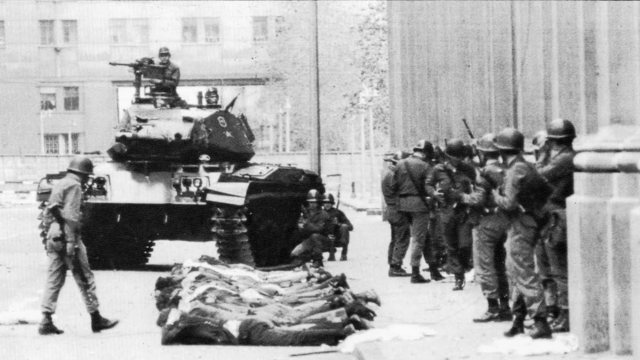
TOPPLING GOVERNMENTS in the twenty-first century, or installing them, is no longer the business of soldiers. It used to be, back in the days of the Cold War. Just think of Chile in 1973, or Argentina in 1976. Back then nobody much cared about the optics. So there were tanks on the streets. So a few thousand people “disappeared”. So what? They were commies. Nobody cared. Good riddance!
 
With the fall of the Berlin Wall, however, and the dissolution of the Soviet Union, things changed. Lacking the Cold War justification of “resisting attempted subjugation by armed minorities or by outside pressures” the United States and its allies were forced to develop a new way of making sure that their friends continued to acquire and/or retain power, while their enemies – unaccountably – suffered one set-back after another.
 
The Old Way Of Dealing With America's Enemies: Tanks roll through the streets of Santiago, Chile, 11 September 1973.
 
The first step was to make sure that even if their friends failed the political consequences would be minimal. There were to be no more elections like the Chilean election of 1970, in which the victory of Salvador Allende’s Popular Unity coalition resulted in the introduction of genuine left-wing policies. The imposition around the world of the neoliberal “Washington Consensus” (which began with the arrival of the “Chicago Boys” in post-coup Chile) meant that even nominally “left-wing” parties could be relied upon to refrain from introducing measures calculated to inhibit or restrict the free operation of market forces.
 
The second step was to devise a whole new repertoire of non-military methods for bringing a government down. Essentially this involved using the core freedoms enshrined in all democratic states: freedom of speech; freedom of the press; and the freedom to assemble peacefully for a redress of grievances; not to advance democracy but to create a simulacrum of it. What appeared to the world to be a spontaneous uprising of the people against a corrupt and dictatorial regime, would, in fact, be the culmination of months, even years, of careful planning by teams of operatives (spies?) inserted into the target country by the United States and its allies.
 
The classic examples of this new technique of “coup d’état by crowd” were the so-called “colour revolutions” that brought down the democratically elected governments of Serbia, Georgia and Ukraine. (In the case of the latter, twice!) The Americans spent millions of dollars in these countries establishing political organisations, founding newspapers, setting up radio and television stations, and creating websites – all of which were then used to recruit thousands of perfectly genuine followers (usually young, middle-class university students) who would then be led onto the streets to confront the government.
 
These ostensibly peaceful protests were almost always carefully stage-managed to ensure that the authorities, goaded to breaking-point by a tiny, well-trained and well-paid “hard-core” fraction of the crowd, would over-react and start beating the protesters indiscriminately. Graphic examples of this state violence would then be broadcast around the world (often via social media) and, inevitably, the size of the protests would grow and the demands of the protesters would escalate.
 
The critical demand of these “people’s movements” would be the holding of new elections. This was especially so when the “revolution’s” precipitating event was an election whose result was disputed (as in Serbia in 2000). One of the key methods employed to make the claims of a “stolen” election plausible was the publication of bogus opinion polls. The government’s enemies – both foreign and domestic – would fabricate polls showing massive disapproval of the governing party and correspondingly massive support for its challengers. When the ballot boxes disgorged a radically different result the immediate response of the government’s enemies was that the election had been “stolen”. Gravely concerned, the US, UK and European Union would immediately lend their voices to the call for fresh elections.
 
The New Way: Kiev, Ukraine, January 2014.
 
Sometimes, of course, these tactics spooked the government under attack into doing the subversives’ work for them. Informed by his own (and the Russian’s) intelligence agencies that the US was active behind the scenes, building and funding his liberal opposition, the Serbian strongman, Slobodan Milosevic, panicked and stole the election for real. Perfect!
 
Interestingly, the process works just as well in reverse.
 
If there’s a government the powers that be, domestically and/or internationally, wish to keep in office, then exactly the same funds will be lavished on exactly the same hidden persuaders. Social media will be skilfully and extensively employed, not to attack the incumbent government, but to undermine and smear its political opponents. Opinion polls will consistently demonstrate the government’s overwhelming popularity. Sympathetic journalists will disparage any suggestion of widespread popular discontent with the status quo. Political activists and parties evincing just a little too much passion and/or promising just a little too much in the way of genuine, as opposed to purely cosmetic, reforms will suddenly find all manner of things going wrong. They’ll hear strange clicking sounds on their landlines. Their computers may be hacked or stolen. The controls of their leader’s car may suddenly malfunction, sending him tumbling down a bank.
 
And nary a tank in sight.
 
This essay was originally posted on The Daily Blog of Friday, 5 September 2014.