Showing posts with label British General Election of 2015. Show all posts

Sunday, 17 September 2017

VOTE!

Let's Do This Now! New Zealand is poised to repeat the circumstances that produced the shock British election result of 2015. Those with a retentive political memory will recall how both the pollsters and the pundits were predicting an extremely close election which could very easily see the Labour Leader of the Opposition, Ed Miliband, moving in to Number 10 Downing Street as Britain’s next prime minister. Didn’t happen.

IF, ON ELECTION NIGHT 2017, you end up staring at the numbers in horrified disbelief. If National proves the people at Reid Research are the best pollsters in the business. If the Jacinda Train runs out of puff several percentage-points short of being able to form a government. If the Greens: the dear, earnest, tree-hugging Greens; fall below the 5 percent MMP threshold. If, after all these calamities, you’re casting about in your anger and your grief for an explanation, then reclaim from the back of your mind this crucial piece of information from Elections New Zealand.

As at 15 September, just over a week out from Election Day, “nearly 20,000 fewer young people under 30 [have] registered compared with 2014”.

Got that? Notwithstanding the fact that the leadership of the Labour Party has passed to a young woman of 37. Notwithstanding the fact that Labour is promising to enact a suite of policies aimed directly at addressing the problems besetting young New Zealanders. Notwithstanding the fact that the most future-focused of all New Zealand political parties, the Greens, are at serious risk of being ushered out of Parliament altogether. Notwithstanding all of these things, fewer citizens under 30 have registered than three years ago!

New Zealand is poised to repeat the circumstances that produced the shock British election result of 2015. Those with a retentive political memory will recall how both the pollsters and the pundits were predicting an extremely close election which could very easily see the Labour Leader of the Opposition, Ed Miliband, moving in to Number 10 Downing Street as Britain’s next prime minister.

Didn’t happen.

As polling stations across the British Isles closed their doors, and the counting began, the BBC released an exit poll indicating a comfortable win for the British Conservative Party. Pundits and Opposition politicians alike were dumbfounded. When all the polls were predicting a close race – and some a Labour win – how could the BBC’s exit poll possibly be true?

The Tories knew the answer. They had cottoned-on to what was happening weeks before. All those young Britons who’d happily told the pollsters that they supported Ed Miliband and Labour were by no means as committed to making their way to a polling-booth and actually voting for them. Older voters, on the other hand, were borderline obsessive when it came to exercising the franchise. And guess what? Around three-quarters of them were Tories.

Two years later, back here in New Zealand, the chances of something very similar unfolding are distressingly high. Just consider these additional stats from Elections New Zealand:

“So far, 97 percent of people over 70 have enrolled to vote, but as the age drops, so does the percentage. Only 75 percent of people between the ages of 25 and 29 enrolled to vote and that proportion dropped to 67 percent for 18 to 24-year-olds.”

Combine that data with the latest Colmar Brunton poll’s finding that 67 percent of voters aged between 18 and 34 told the pollster that they were intending to vote for the Labour Party. 1New’s political editor, Corin Dann, has described this as a “youthquake” – and if 18 to 34-year-olds voted in anything like the same numbers as the over-60s, then he’d be right, and Labour/Green would cruise to a stunning election victory.

But, will they? In 2014 around 200,000 young New Zealanders declined to cast a vote. If that degree of abstention is repeated in 2017, then the same gasps of disbelief that greeted the BBC’s exit poll in 2015 will likely be heard here as the Early Voting figures are released on the evening of 23 September. Youthquakes are not born of young voters’ stated intentions, they only occur when young people get themselves to a polling station, step into a booth, fill out a ballot-paper, and drop it into a ballot-box. Jacinda will not become prime minister by millennials liking her on Facebook. To effect a change of government, it is absolutely necessary that young New Zealanders vote.

Among all this doom and gloom there is, however, some good news.

When the Tory British Prime Minister, Teresa May, called a snap election earlier this year, the pundits and pollsters were determined not to be caught napping a second time. If younger citizens, in spite of declaring their support for a political party, don’t actually make it to the polling booths, reasoned the pollsters, then we must adjust our raw results to take account of the high level of youth abstention.

Accordingly, the overwhelming majority of polls released prior to the June British election showed the Conservatives increasing their parliamentary majority. Many of the British pundits went further – predicting a massive collapse in Labour support across the country.

Didn’t happen.

Young British voters had learned from the experience of 2015. They understood that if Jeremy Corbyn’s “For the Many, Not the Few” manifesto promises were ever to be honoured, then they would have to get out and vote for them. Which is exactly what they did – in numbers far surpassing the youth turnout of 2015. Support for the Labour Party surged. Teresa May lost her parliamentary majority.

The moral of the story is pretty bloody clear: VOTE!


You can enrol, and vote, at your nearest Advance Voting polling station (check out their locations at www.elections.org.nz ) right up until 22 September. It is NOT possible to enrol on Election Day itself (Saturday, 23 September) so – VOTE EARLY.

And once you’ve enrolled and voted, make sure everyone you know, who’s 18 and over, and wants to change the government, GOES OUT AND DOES THE SAME.


This essay was originally posted on The Daily Blog of Saturday, 16 September 2017.

Thursday, 14 May 2015

Hearts And Souls: When People And Parties Make History.

Scots Wha Hae! SNP Leader, Nicola Sturgeon, pumps the air alongside her elated Scottish National Party followers as the scale of their victory over Labour becomes clear.
 
“I set out really to change the approach, and changing the economics is the means of changing that approach. If you change the approach you really are after the heart and soul of the nation. Economics are the method; the object is to change the heart and soul.”
 
Margaret Thatcher 1981
 

WALK INTO the Opposition Leader’s Office with ideas about changing the heart and soul of the nation and see how long you last. Andrew Little’s advisers don’t really do souls. And the average punter’s heart doesn’t exactly lend itself to metrical capture. Try to run either of them through a computer and things are liable to get messy. No, Little’s advisers prefer polls and focus groups, and the joys of regressive analysis. They’re much more fun.
 
Much more fun, but, apparently, not much use – as the events of 7 May in the United Kingdom have just proved. South of the River Tweed, metrics proved to be one of the UK Election Day’s biggest losers. The pollsters, statisticians and data-crunchers, in which the British Labour Party had invested so much, got it wrong. Turns out that the heart and soul of a nation can’t be measured – it can only be felt.
 
North of the River Tweed, the politics of hearts and souls (as opposed to stats and polls) had triumphed in truly historic fashion. As the results were posted, it soon became clear that the Scottish National Party (SNP) had wiped the Labour Party off Scotland’s electoral map.
 
Throughout the campaign, Labour had equated the national fervour stirred up by the SNP with the worst kind of nationalism. Former Labour supporters were accused of succumbing to the SNP’s “rapture” – as if they were a bunch of slack-jawed American fundamentalists. It didn’t work. No matter how many times Labour demonstrated that the SNP’s promises could not possibly be paid for, the voters blithely ignored them. Their hearts and their souls were elsewhere.
 
Meanwhile, south of the border, the right-wing parties were only too happy to present themselves as the staunch defenders of England’s heart and soul. The UK Independence Party, UKIP, implored voters to stop the EU, and the mass influx of foreigners its rules continued to sanction, from destroying what it meant to be British. It was a message that resonated just as loudly on the Left as it did on the Right. UKIP wasn’t a threat to the Tories alone; in Labour’s heartland UKIP candidates were moving, ominously, into second place.
 
The Tories themselves needed no lessons in the politics of hearts and souls. England, they warned, was about to be squeezed. Labour, that great defender of the EU, was about to enter into an unholy alliance with the SNP. The English people risked being caught between Labour’s socialist internationalism and the demands of the independence-seeking Scots. The country was in danger!
 
Against these nationalistic battering-rams, the gates of Labour could not hold. It had asked the voters to stand with the poor and the underpaid; it had asked them to make the wealthiest 1 percent pay their fair share of tax; and it had pledged to defend the NHS. But, what it had not been able to do was convince those who were neither very poor, nor very rich, that Labour had the faintest idea what was going on in their hearts, or cared very much at all about what was happening to their souls.
 
Margaret Thatcher knew that true political success would only come when the Conservatives’ explanation of what it meant to be British proved to be more compelling than Labour’s.
 
“What’s irritated me about the whole direction of politics in the last 30 years”, she told The Sunday Times on 3 May 1981, “is that it’s always been towards the collectivist society. People have forgotten about the personal society. And they say: do I count, do I matter?”
 
Thatcher’s emphatic answer was: “Yes – you do!” To all those hundreds-of-thousands of “personal societies”, inhabited by the families and friends of the individual voter, the Conservative Party proclaimed the unequivocal message: “You do count! You do matter!”
 
You do count! You do matter! Margaret Thatcher campaigning in 1979.
 
Browbeaten by the boss; burdened by mortgages they could only just afford; resentful of strikers in the factories; frightened by unemployed youngsters on the streets: these Britons turned gratefully towards the one party that reassured them they were, and always had been, the heart and soul of the nation.
 
The great irony, of course, was that just 36 years earlier, in 1945, exactly the same message had been taken into every home by Labour. After 10 years of economic depression, and six years of war: when it had grown easier and easier to believe that individuals were no more than the dust ground out between the massive cogs and wheels of the economic machine; or, nameless soldier-ants, fighting in defence of the nest; Labour came into the lives of millions of fragile families and said: “You do count! You do matter!” And their hearts were warmed, and their souls soothed, and for more than 30 years the Tories dared not dismantle what the socialists had built in England’s green and pleasant land.
 
Scottish Labour may scorn its former supporters for succumbing to the rapture of the SNP, but New Zealand Labour could learn a lot from the Scottish experience. The amazing collapse of Labour’s vote in Scotland was about much more than the SNP. Somehow, out of the thwarted referendum and its aftermath, a majority of Scots came to the collective conclusion that the heart and soul of their nation, for so long forsworn, was theirs to save.
 
As with the British people in 1945 (and the New Zealand people in 1935) such historically charged moments are capable of transforming a political party into a vehicle for both national salvation and cultural renewal. And the reason why so many voters are willing to climb on board is that from some place deep within, unreachable by polls, focus groups or data crunchers, the conviction arises that, together, they and their party have come to represent, if only for one brief breath of history, the heart and soul of the nation.
 
This essay was originally posted on The Daily Blog of Tuesday, 12 May 2015.

Tuesday, 12 May 2015

Standing For Something

Mephistopheles In A Savile Row Suit: Lynton Crosby (of the infamous Crosby/Textor firm of right-wing political consultants) conducts a master-class on behalf of the Patchwork Foundation. Crosby's catch-phrase "When in doubt - stand for something" is one the Left would do well to ponder.
 
“WHEN IN DOUBT, stand for something.” So says Lynton Crosby, the man who, according to the UK’s Guardian newspaper, “really won the election for the Tories”. On the face of it, Mr Crosby’s catchphrase appears to be a statement of the bleeding, bloody obvious. But, the fact that he has had to reiterate it again and again over the course of his long and highly successful career as a political campaign adviser, strongly suggests that to a great many people in politics the need to “stand for something” isn’t obvious at all.
 
An old friend of mine, a Labour Party activist in Glasgow – God help him – was railing at me about the shallowness of the Scottish National Party’s (SNP) candidates and their paucity of policy. He’d just witnessed good Labour MPs, who had stood by their constituents through the bitter years of Thatcherism, wiped out by callow youths barely old enough to shave. It wasn’t right. It simply shouldn’t have happened.
 
But what did Labour stand for? That was the question which so many of Scottish Labour’s former supporters could no longer answer. It’s why so many of them voted for the SNP. Because the Nationalists unquestionably stood for something. Not just for independence – although that was hugely important – but for the sort of society that more and more Scots have come to believe only independence can bring.
 
Crucially, for my embittered friend in Glasgow, that’s the society which Labour’s founding heroes – like the Scotsman, Keir Hardie – promised to build. The society that Tony Blair effectively cancelled when he persuaded the Labour Party to remove the in/famous  “Clause IV” from its constitution.
 
Clause IV had promised:
 
To secure for the workers by hand or by brain the full fruits of their industry and the most equitable distribution thereof that may be possible upon the basis of the common ownership of the means of production, distribution and exchange, and the best obtainable system of popular administration and control of each industry or service.
 
That’s what Labour used to stand for. That’s what hundreds of thousands of Scots believe a party of the working-class should still stand for. That Labour no longer stands for anything remotely resembling Clause IV is why the SNP’s derisive nickname “Red Tories” was able to wreak such historic havoc upon the electoral map of Scotland.
 
After defining what they stand for, the next thing Lynton Crosby advises his conservative clients to do is attempt to define what their opponents stand for. The effectiveness of this strategy may be seen in the way Labour’s democratic socialist objectives have been made to stand for (at best) union tyranny and gross inefficiency, or (at worst) secret policemen and concentration camps.
 
“The socialist objectives of Clause IV confuse ends with means,” the Blairites helpfully parroted throughout the early 1990s, “the triumph of Labour’s values cannot be secured by the methods of the now defunct Eastern Bloc.” As if the UK’s welfare state, its National Health Service (NHS) and nationalised industries were in any way comparable to the totalitarian Stalinist regime of the Soviet Union. As if the privatisation of the UK’s water supply and railway network has been a roaring success. As if the hollowing-out of the NHS (under both Conservative and Labour governments) has made Britons healthier or happier.
 
What, then, do the Tories stand for? Supplying a politically persuasive answer to this, the most important of questions, is how Lynton Crosby really earns his money. The most truthful answer: the Conservative Party stands for the untrammelled right of those already in possession of wealth and power to make and acquire more; would not play well with “the man down there on the corner waiting for the bus”. Even so, Mr Crosby’s and his ilk’s description of Conservative aims and objectives is only slightly altered.
 
What contemporary conservatism stands for is the right of persons possessing the requisite energy and talent to acquire wealth and power without unwarranted obstruction or restriction. In a funny sort of way, this formulation is not so very far from “Old Labour’s” promise to “secure for the workers by hand or by brain the full fruits of their industry.” The difference, of course, is that the Tories expect the workers to secure these on their own.
 
Labour used to be feared by the people the Conservative Party represents because it stood ready to expose this “you can make it on your own” mantra for the cruel con it has always been. That Labour was so easily defeated in England and Scotland last Friday is almost entirely due to the fact that it no longer offers workers any answer except “make it on your own”.
 
That is Mr Crosby’s greatest triumph: not only helping the Tories to remember what they stand for; but making Labour forget.
 
This essay was originally published in The Press of Tuesday, 12 May 2015.

Friday, 8 May 2015

Still Building Jerusalem? British Labour And The "Spirit Of '45".

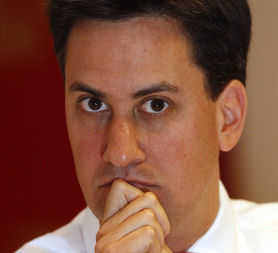
Man Of The Hour? After five years of right-wing economic austerity, the British Labour Party leader, Ed Miliband, should be celebrating an historic landslide victory this morning – not casting his eyes, warily, north of the border.
 
UNLESS THE POLLSTERS have got it very wrong, it’s probably too soon to say who has won the UK General Election. After five years of right-wing economic austerity, that’s extraordinary. The British Labour Party should be celebrating an historic landslide victory this morning – not casting their eyes, warily, north of the border, to where the Scots really are celebrating an historic electoral rout.
 
A great part of the problem afflicting labour and social-democratic parties all over the western world is the vast gulf that now separates the party activist from the party voter. Though many of Labour’s activists may have grown up in families only one generation removed from the mean streets of working-class existence, that gap is all important.
 
In the UK, the activist’s grandparents may have been among the tens-of-thousands who gathered outside Transport House on 26 July 1945 to celebrate Labour’s crushing victory over the old order, and to sing – no, not The Red Flag – but Jerusalem, the English poet, William Blake’s, great summons to moral and spiritual transformation.
 
I will not cease from mental fight
Nor shall my sword sleep in my hand
Till we have built Jerusalem
In England’s green and pleasant land
 
That “Spirit of 45” was hot enough to keep up the pressure in Labour’s political boilers for another quarter-century.
 
Victory! The British Labour Party leader, Clement Atlee, celebrates his own re-election and Labour's landslide victory on the night of 26 July 1945.
 
The wholesale democratisation of British society, which the Spirit of 45 catalysed, made possible the next great wave of political transformation. Building on the solid economic foundations of the Welfare State, the post-war “Baby Boom” generation extended Labour’s revolution into the fraught territory of race, gender and sexuality. These “new social issues”, which also included the struggles against nuclear annihilation and environmental desecration, recalled to the men and women of 45 the words of the old trade union song, Bread and Roses:
 
Small art and love and beauty their trudging spirits knew
Yes, it is bread we fight for, but we fight for roses, too
 
The great hope, of course, was that, in the next generation – the Baby Boomers children – this  great, two-pronged assault on inequality and injustice would culminate in a new kind of society: a society in which economic and social democracy would finally be able to clothe the bare skeleton of political democracy with living flesh and blood.
 
That this did not happen is explained, at least in part, by the fact that the men and women of 1945 built too extensively and too well. Full employment, strong trade unions and massive social housing programmes joined with free public health and education to produce a generation for whom the gut-wrenching realities of want, ignorance, idleness, squalor and disease had retreated to the realm of parental memory. The power of collectivism, so essential to the defeat of those evils, would also fade. Increasingly the question asked was not: “What do we need?” But “What do I want?”
 
As the thirty-year period of reconstruction, which fuelled the great post-war boom, fell victim to stagnation and the most successful rear-guard action in defence of profit and privilege the world has ever seen, the ideological separation of social from economic freedom saw the fire beneath Labour’s boiler shrink to embers and ashes.
 
By the time Tony Blair’s “New” Labour Party confessed to being “intensely relaxed about people becoming filthy rich”, it was clear that the Spirit of 45 was dead. A Labour Party that no longer burns to create a society in which none are filthy rich, and none obscenely poor, isn’t a “new” Labour Party; it’s not a Labour Party at all.
 
Does Ed Miliband understand this? Does he now accept that Labour, by upholding “economic freedom” as an unqualified good, has contributed hugely to the burgeoning social inequalities against which he’s spent the last five years campaigning? We must hope so.
 
We must also hope that in the ten minutes he spent chatting with the visiting New Zealand Labour Leader, Andrew Little, he reiterated the futility of promising to get tough on inequality, without also promising to get tough on the causes of inequality.
 
That mental fight, in both the UK and New Zealand, remains to be fought. A generation still waits for their bows of burning gold, their arrows of desire; for their spears – oh clouds unfold! – for the chariots of fire that only a real Labour Party can give them.
 
This essay was originally published in The Waikato Times, The Taranaki Daily News, The Timaru Herald, The Otago Daily Times and The Greymouth Star of Friday, 8 May 2015.