
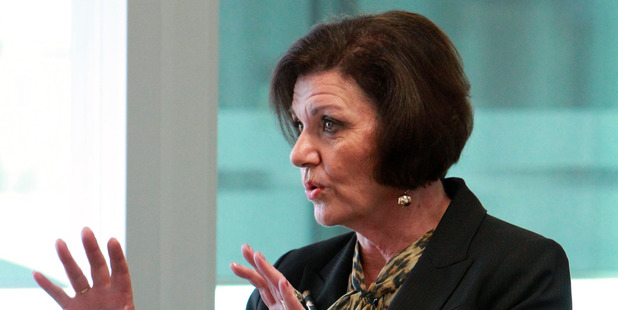
Shaking-Up CYF: Minister of Social Development, Anne Tolley, must balance the urgent need to "modernise" the delivery of New Zealand's child and family support services against the equally pressing need to improve the delivery of such services to Maori. Achieving both objectives without alienating large sections of the Maori community will not be easy.
FAR-REACHING CHANGES LOOM if the ideas of the Expert Panel
set up to “modernise” Child Youth and Family (CYF) are implemented. Their just
released report: “Investing in New Zealand’s Children and their Families” envisages
both a new approach to child welfare, and a new set of structures to give their
re-ordered priorities practical effect. At the same time, however, the Expert
Panel was also asked to address the disproportionate number of Maori children
requiring the intervention of child welfare professionals. Achieving both
objectives without alienating large sections of the Maori community will not be
easy. The Minister, Anne Tolley, does not want an embarrassing cultural
stand-off.
At the core of most explanations for the appalling social
statistics in which New Zealand’s indigenous people are enmeshed is the
continuing impact of colonialism on the lives of Maori people. For
one-and-a-half centuries, the loss of land, and the economic consequences of
that loss, has not only impoverished Maori, but has also led to the tragic
manifestations of that enforced poverty being used to justify the dominant
Settler Society’s racist assumption of cultural superiority.
The problem with this argument is that, if it is true, then
all the tragic manifestations of Maoridom’s enforced poverty: domestic
violence, child abuse, drug and alcohol addiction, criminal offending, chronic
illness, homelessness and educational under-achievement; must also be true.
That being the case, the most obvious solutions which present themselves to the
dominant Settler Society, will all tend to involve extracting Maori from the
negative consequences of colonialism, and replanting them in environments which
reflect its more positive features.
In the words of the Expert Panel’s Final Report:
“There has been considerable debate in the past three
decades on the place of children in Māori society and on the place of whānau.
Much has been said in order to emphasise the differences in Māori society from
others and this is not always accurate or true. Some interpretations have
confused the issue. The safety of Māori children is paramount and any work we
do must be child-centred. A well-functioning whānau provides a sound basis to
help solve the problems that face these children at particular times in their
lives, but a badly functioning whānau can be dangerous. We must never
compromise the safety, security, and sense of belonging of any child in their
care arrangements.”
Decoded, this paragraph signals the abandonment of the
policy that the best interests of
vulnerable and/or abused Maori children will always be best served by keeping
them in the care of their extended family group. The policy itself arose out of
the grim experiences of both Maori and other indigenous people (most
particularly Aboriginal Australians) at the hands of Settler Societies whose
official child welfare policy held that it was in the afflicted child’s best
interest to be raised in strict isolation from its parents’ culture.
This was the policy approach that led to such eugenicist
tragedies as the so-called “Stolen Generation” of Aboriginal children. Maori
nationalists were determined that such pernicious examples of Settler Society
racism would never be repeated. CYF’s “Whanau First” approach, first
implemented in the late 1980s, was intended to ensure that young Maori were not
cut loose from their cultural moorings and transformed into Brown Pakeha.
In practical terms, however, CYF’s Whanau First approach
all-too-often saw abused Maori children thrown out of the frying-pan and into
the fire. With the toxic legacies of colonialism still at work across broad
swathes of Maori society – how could it be otherwise?
How can Anne Tolley, and the new organisation she intends to
erect in CYF’s place, square this vexing circle? At least part of the answer
lies in that interestingly euphemistic phrase, “a well-functioning whanau”.
Logic would suggest that the chances of serious abuse
occurring in a well-functioning whanau are reasonably slim. In all societies
there are virtuous as well as vicious familial cycles. Could Ms Tolley be
wondering: “If success breeds success, perhaps it can also foster it?”
As anyone who’s read Charles Dickens’ novels will attest,
that is certainly how the Victorians viewed the problem. What better fate could
there be for a helpless waif raised in an Orphanage than to end up as the
adopted son of a well-to-do middle-class gentleman?
Is this how Ms Tolley and her Neo-Victorian colleagues
propose to rescue the neglected and abused children of Maoridom? Not by
replicating the racist horrors of the Stolen Generation, but by taking full
advantage of the fact that the Maori Renaissance of the 1980s and 90s has given
birth to a rapidly expanding Maori Middle-Class. Is she hoping to see them
doing well by doing good? First, as the providers of the sort of “early
intervention” and “wrap-around services” envisaged by National’s “social
investment” strategy; or, if that fails, by offering Maoridom’s battered babies
a well-functioning foster whanau?
This essay was
originally published in The Press of Tuesday,
12 April 2016.
