Showing posts with label Maori Sovereignty. Show all posts

Monday, 12 April 2021

A Break In The Wave: Giving Effect To The UN Declaration On The Rights Of Indigenous Peoples In Aotearoa/New Zealand.

Stormy Seas: Will Jacinda Ardern's Labour Government stand behind the revolutionary proposals contained in He Puapua – the 20-year plan devised by a government appointed working group to realise the UN Declaration on the Rights of Indigenous Peoples in Aotearoa/New Zealand?


“GETTING AHEAD of the story” is one of the most important aspects of crisis management. As the PR mavens are fond of reminding their clients: “Explaining is losing.” If Jacinda Ardern’s Labour Government is not very careful, however, it will soon find itself having to explain why it has failed to reject out-of-hand an official document which calmly anticipates the end of democracy as most New Zealanders understand it.

The Report of the Working Group on a Plan to Realise the UN Declaration on the Rights of Indigenous Peoples in Aotearoa/New Zealand is one of the most remarkable documents ever submitted to a Minister of the Crown. Set forth on its pages is a twenty-year plan to transform New Zealand from one of the world’s oldest and most respected continuous democracies into what would effectively be a political condominium, presided over by co-equal Maori and Non-Maori rulers. A state in which the economic and cultural power of non-indigenous New Zealanders would be much diminished, and the authority, wealth and influence of its indigenous people greatly expanded.

Entitled He Puapua, the report’s authors: Claire Charters, Kayla Kingdon-Bebb, Tamati Olsen, Waimirirangi Ormsby, Emily Owen, Judith Pryor, Jacinta Ruru, Naomi Solomon and Gary Williams; are refreshingly upfront about the scope of their endeavours. In an explanatory note on the report’s title they sate:

‘He puapua’ means ‘a break’, which usually refers to a break in the waves. Here, it refers to the breaking of the usual political and societal norms and approaches. We hope that the breaking of a wave will represent a breakthrough where Aotearoa’s constitution is rooted in te Tiriti o Waitangi and the UN Declaration on the Rights of Indigenous Peoples.”

For most people “the breaking of the usual political and societal norms and approaches” is another way of describing revolutionary change. Certainly, it is difficult to interpret the Declaration Working Group’s (DWG) blueprint for change as anything less. It is highly unlikely, however, that when the Prime Minister spoke of “transformation”, she was referring to He Puapua’s proposed revolutionary reconstruction of the New Zealand state.

Even so, when the Minister of Maori Development, Nanaia Mahuta, presented her paper entitled DEVELOPING A PLAN ON NEW ZEALAND’s PROGRESS ON THE UNITED NATIONS DECLARATION ON THE RIGHTS OF INDIGENOUS PEOPLES to the 18 March 2019 meeting of the Cabinet Māori Crown Relations: Te Arawhiti Committee, it is rather surprising that her colleagues were not temporarily deafened by political alarm bells going off in their heads.

Did none of those present think to parse out the potentially disastrous political consequences of commissioning a “Declaration plan” which, according to Mahuta, “could be a national plan of action, a strategy, or some other tool that provides a map that demonstrates and guides progress across government. I expect the Declaration plan to include time-bound, measurable actions that show how we are making a concerted effort towards achieving the objectives of the Declaration.”

Clearly not, because that is precisely what the DWG presented to the Minister seven months later. Te Puni Kokiri’s response to the document was certainly not discouraging: “The DWG provided the Minister with their final report, He Puapua, on 1 November 2019. The DWG’s report was highly insightful and provided a positive starting point to guide our thinking and will be used as part of the work programme to develop a Declaration plan.”

Somewhere, however, someone decided that, on reflection, it might be better to keep the content of He Puapua under wraps. It was not until October of 2020 that Mahuta consented to the release of a highly truncated version of the report.

Unsurprisingly, given the content of He Puapua, opponents of the now decades old “Maori Separatist” agenda were not slow to recognise its radical implications for the future of New Zealand’s constitutional arrangements. Former Act MP, and founder/director of the New Zealand Centre for Political Research, Muriel Newman, even managed to secure of copy of the whole 123-page document

Newman’s judgement of the report’s contents was savage:

In essence, once a Treaty-based constitution is in place and tikanga is embedded in the common law, under Vision 2040 Maori separatists will control the country.

This is not pie in the sky. It is already underway.

There has been no public debate about the Declaration, nor was it mentioned in the Labour Party’s election manifesto.

The only information freely available about this UN plan to replace New Zealand democracy with tribal rule – and enact the biggest overhaul of public affairs this country has ever seen – was a general announcement by Minister Mahuta in 2019, and now, a year and a half later, the partial publication of a document revealing Jacinda Ardern’s dangerous intentions.


Are the National Party and Act aware of the existence of He Puapua, its contents and recommendations? Maybe not. In October of 2020 both of the right-wing parties were in the midst of an election campaign and its aftermath. It is just possible that they missed the importance – and even the fact – of its release altogether.

Besides, as Newman points out, it was under the Prime Ministership of National’s John Key that New Zealand signed-on to the Declaration on the Rights of Indigenous Peoples. Or, more precisely, it was Key who authorised the Maori Party co-leader, Pita Sharples to fly off secretly to New York in April 2010 to surprise the world with his country’s acceptance at the United Nations.

At the time this was considered something of a coup for both Sharples and Key. After all, the Labour leader, Helen Clark, had consistently refused to support the Declaration while she was prime minister. Clark, like Winston Peters, was convinced that its provisions would have dire consequences for the country’s democratic institutions. Peters’ summation was typically trenchant: “The United Nations Indigenous Peoples Declaration… is the final step on the road to separatism. This is the road to Zimbabwe.”

But if Newman is right, and National is steering clear of the whole issue out of embarrassment, that still leaves unexplained Act’s failure to respond to what can only be considered the most extraordinary political gift.

For a classical liberal party like Act, the idea that a fundamental transformation in the nation’s constitutional, legal, political, economic and cultural arrangements could be contemplated in secret, and enacted piecemeal, without the prior passage of an authorising referendum, piles anathema upon abomination.

Act’s leader, David Seymour, should be demanding from the present Minister of Maori Development a categorical rejection of He Puapua’s “roadmap”. At the very least he should be seeking a rock-solid commitment from Willie Jackson – and the Prime Minister – that the creation of a bi-cultural state, founded squarely upon the prevailing reading of te Tiriti o Waitangi and the provisions of the UN Declaration on the Rights of Indigenous Peoples, will only proceed on the basis of a two-thirds referendum majority.

Will he, though? The possibility has to be conceded that Act – along with National – will dismiss He Puapua as just one more example of Te Puni Kokiri’s magical thinking. If this is, indeed, their response, then they will be vindicating the prediction made nearly 40 years ago by Donna Awarere, author of the ground-breaking series of articles published in Broadsheet under the title “Maori Sovereignty”:

The strength of white opposition will be allayed by the fact that Maori sovereignty will not be taken seriously. Absolute conviction in the superiority of white culture will not allow most white people to even consider the possibility.

The likely consequences for Labour, however, if “white people” are persuaded to take the ideas and plans contained in the DWG’s report seriously, are potentially so dire that the only realistic way to get ahead of this story is to kill it – and He Puapua – stone dead.


This essay was originally posted on the Interest.co.nz website on Monday, 12 April 2021.

Friday, 5 March 2021

The Revolution All Around Us.

Revolutionary Formula: "A new Aotearoa is on the rise. Tangata Whenua (Māori) + Tangata Tiriti (all other ethnicities who are committed to a tiriti centric Aotearoa) = the Aotearoa I believe in fighting for." - Rawiri Waititi, Co-Leader of the Maori Party.

NEW ZEALAND is in the early stages of a revolution. No, not one of those revolutions. The streets are not overflowing with revolutionary crowds. The factories have not been taken over by the workers. The old constitutional order has not been cast aside. The nation’s historical time-line has not been reset to Year Zero. But, make no mistake, a revolution is underway.

At the heart of this revolution is an evolving understanding of what sort of country we live in – and would like to live in. The clearest description of this revolution and its ultimate objectives that I have read so far is contained in a tweet posted in the name of Maori Party co-leader, Rawiri Waititi. To describe the tweet as jarring would be something of an understatement:

The cau casity of Caucasian’s and their ‘active assimilation agenda’. Pay them no attention, their archaic species is becoming more extinct as new Aotearoa is on the rise. Tangata Whenua + Tangata Tiriti = Aotearoa > Tangata Whenua + Pakeha = Old Zealand.

Waititi was quick to distance himself from this message, describing it as the work of someone in his office who acted without his authority. Setting to one side the obvious question: “What kind of office is Waititi running?”, the tweet’s content offers New Zealanders a raw and unmediated synopsis of the Maori Party’s revolutionary agenda. “Transformative” barely covers it!

The first element to note is the highly charged racial vocabulary. “Caucasian” is being used, rather than Pakeha, in much the same way as the latter once referred to Maori as “Polynesians”, and for the same purpose. To subsume a geographically and culturally specific identity into a much larger and more general racial category.

Very clearly, it is not a nice category. In the exercise of their “caucacity”, Caucasians are accused of pursuing an “active assimilation agenda”.

This is a curious charge. Historically, “assimilation” was very much on the agenda of the New Zealand state. In the years after World War II, as Maori began migrating from the countryside to the big cities in large numbers, doing everything possible to turn them into “ordinary” New Zealanders was generally regarded as the most “progressive” policy response available to the authorities. Think of it as an early iteration of the “They are Us” formulation.

The intention was to create a “colour-blind” society. The key category was “citizen” – with all that implied about equality of access to gainful employment, housing, health and education. An excessive focus on racial identity was seen as unhelpful in this regard. The objective was a nation in which the terms “Maori” and “Pakeha” counted for much less than “New Zealander”. It is to the policy of assimilation that the members of “Hobson’s Pledge” pay homage with their insistence that we must all become “one people”.

What makes the tweet’s claim that an “active assimilation policy” is still part of the New Zealand state’s agenda so odd, is that the term “assimilation” long ago became a very dirty word in the corridors of power. From the 1980s onwards the clear policy of successive governments has been to support and strengthen the unique features of te ao Maori. From the Treaty of Waitangi Act of 1975 to the establishment of Kohanga Reo and the recognition of Maori as an official language, the direction of travel has been all one way: from mono-culturalism to bi-culturalism.

It was Donna Awatere, author of the seminal series of Broadsheet articles entitled “Maori Sovereignty”, who rejected this new goal of a bi-cultural New Zealand as insufficiently ambitious. Inspired by the irredentist national strategy of the Palestinian Liberation Organisation, she argued for a sovereign Maori nation, freed from the constitutional, economic, political and cultural hegemony of the colonial culture which had, through the judicious application of force and guile, supplanted her own.

Following the Palestinians, Awatere argued for a strategy which is best described as “reverse colonisation”. On the one hand, delegitimise the colonisers’ occupation of lands that were never theirs; on the other, offer them the opportunity of assimilating themselves into Aotearoa, the sovereign Maori state that would slowly, surely, and non-violently, replace the colonial relic known as New Zealand. (Those with long memories will recall that for as long as it remained a revolutionary socialist organisation, the creation of a unitary, secular, Palestinian state, continued to be the PLO’s ultimate goal.)

Although Awatere’s personal evolution took her further and further away from the revolutionary vision that inspired “Maori Sovereignty”, her ideas and perspectives were taken up and developed by Maori nationalists across the country.

Perhaps the best way to get an idea of the revolutionary processes at work in this country, is to conduct a thought experiment involving another one.

Imagine that the Palestinians living in the occupied territories, rather than descending ever deeper into terrorism and religious zealotry, had adopted the non-violent civil-disobedience tactics of Gandhi and Martin Luther King. Further imagine that the progressive Israeli political parties, urged on by the Americans, had responded by negotiating seriously with the PLO.

Consider the speed with which the whole situation in Israel/Palestine might have been transformed; the exciting possibility that young Jews and Arabs, together, might have mapped out a future in which the land of Israel/Palestine was deemed to have physical and cultural space enough for both peoples. Who knows, they may even have persuaded their political leaders to set up a permanent tribunal to hear and settle the many grievances arising out of the excesses of Zionist colonisation.

Gradually, thanks in no small part to the state education system and state media, the fearless elucidation of Zionism’s manifest injustices might have persuaded a critical mass of young Israelis to abandon their country’s name altogether. Slowly, surely, non-violently, “Israel” might have come to be known, once again, as “Palestine”.

Impossible? Certainly, Israel/Palestine has a great many more obstacles to overcome than New Zealand/Aotearoa. Still, if Jew and Arab had stopped firing bullets at each other way back in the 1870s and started marrying each other in great numbers – who knows where that unfortunate land might be today?

Which brings us back to that interesting tweet: and to what is undoubtedly its most objectionable sentence: “Pay them no attention, their archaic species is becoming more extinct as new Aotearoa is on the rise.”

Now, viewed from the perspective of those whose ancestors were, at the turn of the 19th Century, confidently expected to become “die out”, this sort of gloating racism is, perhaps, forgivable. From the perspective of the descendants of the colonisers, however, it sounds unnervingly like a direct challenge – an existential threat.

That sentiments like these could so easily put the chant of the White Supremacists at Charlottesville: “You will not replace us!”; into the mouths of angry Pakeha, clearly never occurred to whoever sent out the tweet in Rawiri Waititi’s name. Or (and this is a much more distressing thought) maybe it did?

Waititi is, therefore, to be commended for the speed with which he moved to defuse this political IED. Within a few hours, he had re-written the tweet, and clarified his own position on the slow revolution unfolding all around us:

A new Aotearoa is on the rise. Tangata Whenua (Māori) + Tangata Tiriti (all other ethnicities who are committed to a tiriti centric Aotearoa) = the Aotearoa I believe in fighting for.

Strewth! When you put it like that, Rawiri, so do I.


This essay was originally posted on The Daily Blog of Friday, 5 March 2021

Tuesday, 23 August 2016

Let Sleeping Ghosts Lie.

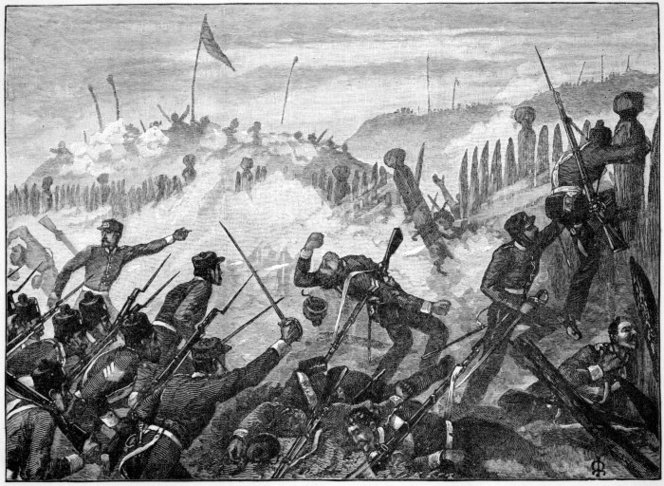
Fighting For A Principle? At the Battle of Rangiriri, 1863, General Duncan Cameron's invasion force overcame the Maori King's defences at Rangiriri. It marked the beginning of the end of Maori sovereignty in New Zealand. In proposing to commemorate the New Zealand Wars, what does the Government hope Maori and Pakeha will remember? The "principles" their ancestors died for? We must hope not - lest the war begins again.
 
IT HAD TO COME, this official recognition of the dead of the New Zealand Wars. After four decades of constant revision, our nation’s story has reached the point where even those who fell in the battles that made it are summoned forth from the shadows. In recognising these ghosts, however, we must not deceive ourselves that the causes for which they fought and died will somehow remain unrecognised.
 
In announcing the Government’s intention to set aside a day to commemorate those who fell in the battles of one-and-a-half centuries ago, The Deputy-Prime Minister, Bill English declared that the time had come “to recognise our own conflict, our own war, our own fallen, because there is no doubt at Rangiriri ordinary people lost their lives fighting for principle in just the same way as New Zealand soldiers who lost their lives fighting on battlefields on the other side of the world”.
 
And what principle would that be, Mr English? The principle of dual sovereignty? – because that was what the Kingitanga represented. The principle of tino rangatiratanga? – in recognition of which the sovereign rights of Maori chiefs had been deemed inviolate under the Treaty of Waitangi? Or, was it the more general principle, recognised then, as it is now, that the military invasion and seizure of territory occupied by people who have not struck a blow against you is an international crime?
 
When teachers are asked to explain why 12,000 Imperial troops invaded the Waikato and the Bay of Plenty in 1863-64, how would Mr English have them reply? Should they tell their pupils that the Maori fighting force, against which this massive army advanced, struggled to maintain a muster of four-figures? And what should they say about the million Maori acres confiscated by the Settler Parliament? How should that be justified?
 
Perhaps these questions should be left for the Minister of Arts Culture and Heritage, Maggie Barry, to answer. She was, after all, the person who described the invasion of the Waikato, and the Battle of Rangiriri, as: “a deeply regrettable time in our history”. Speaking to those gathered to witness the repatriation of the Rangiriri battle-site to the Kingitanga on Friday, 19 August, she emphasised the significance of commemorating the New Zealand Wars: “It is important to us as a nation. At least as important as our World War I commemorations, if not more so.”
 
Much more so, Ms Barry. The formation of the New Zealand State was predicated on the full and final subjection of its indigenous people. In the two decades separating the signing of the Treaty, in 1840, and the invasion of the Waikato, in 1863, tens of thousands of mostly British immigrants had poured into New Zealand. In 1852, the British Foreign and Colonial Office responded to this influx by granting a large measure of self-government to the burgeoning settler population. The Maori tribes of the North Island interior countered by establishing the Kingitanga. While the Maori King’s writ ran, no more land would be sold to the Pakeha. To the London investors and Auckland land speculators who were chafing at the bit to turn this British “possession” into a paying proposition, such defiance was intolerable. New Zealand’s restless natives needed to be taught a lesson. General Duncan Cameron and his 12,000-strong army would be the teachers.
 
So what, exactly does Ms Barry find “regrettable” about the New Zealand Wars? That the Pakeha won them? That the confiscated lands of the Waikato, Bay of Plenty and Taranaki tribes went on to form the foundation of New Zealand’s economic prosperity? That the victory of the colonial forces, by removing the risk of further warfare, prepared the way for the breakneck development of the colony in the half-century that followed? Are these the consequences of the New Zealand Wars that the Minister of Arts Culture and Heritage regrets? Probably not.
 
So what, exactly, will Maori and Pakeha talk about on this yet-to-be-announced day of commemoration? Will the victors tell the vanquished how damned decent it was of their ancestors to let their ancestors kill so many warriors and steal so much land? Will the vanquished shrug their shoulders and say, “No worries, Bro, it was a long time ago”? And will the victors smile indulgently, slap the vanquished on the back, and say: “Quite right, Mate, it was, and we’re all New Zealanders now.”
 
We shall see. Of one thing we can be certain, however: the dead who have slept for one-and-a-half centuries beneath the disputed soil of Aotearoa will have a very different story to tell.
 
There is a reason why so many of the signposts to old battle sites are weathered and overgrown; why lichen has been allowed to obliterate the names of those who fell.
 
Sleeping ghosts, like sleeping dogs, should never be needlessly awakened.
 
This essay was originally published in The Press of Tuesday, 23 August 2016.

Friday, 4 September 2015

Best Flag Not Included Among The “Final Four”

The Tino Rangatiratanga Flag: It’s a flag that speaks, directly, to this country’s past, present and future. For that reason, alone, it makes the strongest case for being chosen as the present flag’s replacement. That it is also a superb design merely strengthens its claim.
 
THERE’S A HOUSE not far from here that flies the Tino Rangatiratanga flag. Every day, rain or shine, its flutters bravely atop its slender flagpole. A statement? Certainly. But isn’t every flag? The Tino Rangatiratanga flag stands for Maori sovereignty. It’s about the proper relationship between those who came to these islands first and those who came later. In other words, it’s a flag that speaks, directly, to this country’s past, present and future. For that reason, alone, it makes the strongest case for being chosen as the present flag’s replacement. That it is also a superb design merely strengthens its claim.
 
Tragically, New Zealanders will not be given the opportunity to vote for the Tino Rangatiratanga flag. The government-appointed Flag Consideration Panel has released the four “finalists” from the 40 designs it selected from the more than 10,000 submissions it received – and the Tino Rangatiratanga flag is not among them. (Hardly surprising, really, since it didn’t make the “Top-40” either!)
 
Even more tragically, not one of the “Final Four” comes close to the Tino Rangatiratanga flag in terms of either graphic power or cultural resonance. Though the Panel was charged with ensuring that any new flag’s design reflected the importance of the Treaty of Waitangi-inspired partnership between Maori and Pakeha, not one of the chosen flags features the red, white and black “colours” that are fundamental to Maori artistic expression. Not to worry, the Panel have carefully covered the base marked “Maori” with a flag featuring a stark black koru. Sorted.
 
The remaining designs all feature the Silver Fern – either on its own, or, in combination with the Southern Cross.
 
The problem is that a flag based on these traditional New Zealand symbols cannot help but draw attention to the country’s colonial history. If England was represented by the rose, Ireland the shamrock, Scotland the thistle, and Wales the leak, then what was New Zealand’s national “flower”? The answer turned out to be the ubiquitous silver fern. The Aussies contribution to Great Britain’s sprawling imperial garden was the wattle.
 
The Southern Cross, too, reflected the Northern Hemisphere origins of the Southern Hemisphere’s British colonisers. South of the Equator the stars were different. “Crux” (The Cross) just happened to be the constellation most easily identified by emigrants travelling in southern latitudes. Perversely, the “Southern Cross”, rather than representing a new beginning, ended up reminding the colonists how far they were from “home”.
 
The substitution of the silver fern for the Union Jack is not, therefore, a bold statement of nationhood – merely a capitulation to the embarrassment of incorporating another nation’s flag in the corner of our own.
 
But why be embarrassed in the first place? Everything about New Zealand, from its political institutions, to its courts, its schools, universities, and sporting codes, have been borrowed directly from the British. Yet nobody is suggesting we give up the Westminster System, the Common Law, the unrivalled cultural achievements of Britain’s artists, philosophers and scientists – let alone Rugby or Cricket! So, why quibble about keeping Britannia’s flag? What better reminder could there be of where the nation of New Zealand has its origins?
 
Except, of course, our nation was built on Maori foundations. For all its mock gothic architecture and borrowed parliamentary rituals, New Zealand is the deliberate creation of speculative British capital. Initially, a source of raw materials: timber, flax and gold. Later, a magnificent British farm. For the hard-bitten men who created her, New Zealand was always expected to pay her way. Its original inhabitants, and the complex culture they had created over seven centuries of occupation, were simply in the way. Those who could not be pacified by British missionaries would be dispossessed by British troops. Whatever flags they may once have flown were hauled down and forgotten.
 
A New Flag Flying - It may require a revolution to do it.
 
And we are still forgetting them – or leaving them out of the reckoning. But go to any gathering whose purpose is not to celebrate the status quo. Visit any place where the aspirations of Maori are on the agenda. Think of any future in which the needs of both the colonisers and the colonised are fairly assessed – and you will find a new flag flying.
 
It may require a revolution to do it, but, one day, the Tino Rangatiratanga flag will replace the Silver Fern, the Southern Cross and the Union Jack.
 
This essay was originally posted on the Stuff website on Thursday, 3 September 2015.