Showing posts with label Marxism. Show all posts

Saturday, 20 August 2022

The Oppressors’ Trifecta: Race, Gender, and Class.

Tatou, Tatou - All Together: According to the promoters of the Tripod Theory, subsuming all other emancipatory struggles into the one great struggle between capitalists and proletarians was a mistake. Exploitation wasn’t purely a question of economics, it was a vast, multi-faceted collection of struggles in which racism and sexism featured hugely. Far more could be achieved, they argued, by recognising the co-equal status of race, gender and class in the “triple oppression” of humanity.

THE SEVENTIES had come to an end with Western Leftism in a thoroughly confused state.

Actually Existing Socialism still held sway over most of the Eurasian continent. Admittedly, the Chinese variant bore less and less resemblance to the original Soviet model, which had rounded off the Seventies by invading Afghanistan. It was, however, extremely hard to like either of the Communist behemoths. Of the French revolutionary credo: Liberty, Equality, Fraternity; the actually existing socialists had mastered only equality. Although Cuba and the recently liberated Portuguese colonies of Angola and Mozambique were making slow but steady progress towards fraternity.

For Western Leftists, Actually Existing Socialism’s evident failure to promote liberty proved to be a deal-breaker. After all, what had the Sixties and Seventies been about – if not freedom? The anarchist firebrand, Emma Goldman, had written to Lenin in 1917: “If you make a revolution, and there’s no dancing, then I’m not coming.” The New Left felt exactly the same about freedom. When Actually Existing Socialism finally embraced liberty, wild horses wouldn’t be able to keep the Western Left away, until then …

But, if class-based revolutionary politics found itself becalmed, the so-called “New Social Movements” movements arising out of the struggle for Black civil rights in the USA and South Africa, feminism’s second wave, and the energetic pursuit of gay and lesbian liberation, had storm-force winds in their sails. As the Eighties dawned, it was almost impossible to engage in left-wing politics without acknowledging these new emancipatory movements, or avoid incorporating their radical insights into the Left’s revolutionary praxis.

Predictably, the New Social Movement’s hardest sell was to that part of the Left which still clung to the ideas of Karl Marx. It wasn’t that the Marxists were incapable of recognising the oppression of Blacks, women and gays, merely that they regarded the struggle of these subordinate groups as mere skirmishes within the overarching and all-important battle between Capital and Labour. Class consciousness was the “Open Sesame!” to the free and abundant world that socialism would make possible. Since exploitation was indivisible, the struggle against it had to be the same. Unity – not Identity – was the watchword.

The fighters for racial, sexual and gender equality were having none of it. They would not be subsumed in the “world historical struggle” whose ideological generals all seemed to be straight, white, and male. If the personal was political, then these unconscious beneficiaries of white supremacy and patriarchy had some serious shit to work through.

Enter the Tripod Theory. According to its promoters, subsuming all other emancipatory struggles into the one great struggle between capitalists and proletarians was a mistake. Exploitation wasn’t purely a question of economics, it was a vast, multi-faceted collection of struggles in which racism and sexism featured hugely. Far more could be achieved, they argued, by recognising the co-equal status of race, gender and class in the “triple oppression” of humanity.

Each of these buttresses of oppression depended on and was upheld by the other two. Patriarchy provided capitalism with an already elaborate framework of sexually-charged power and control, while white supremacy had made possible the vast accumulation of slave-generated wealth that set the capitalist system in motion. Race and gender thus raised profound cultural issues that could never be accommodated comfortably in the narrow economism of class politics.

The Tripod Theory gave rise to another metaphor, one in which the Left, by embracing the concept of the “three oppressions”, constructs a fighting platform upon which Blacks, women, workers and gays can fight white supremacy, patriarchy, homophobia and capitalism side by side – each group aiding the other. Race, gender and class thus become the three legs of the Left’s footstool, distributing the revolutionary load equally.

In an attempt to draw the separate struggles of the traditional socialist Left and the New Social Movements into a useful theoretical and political dialogue, Rob Stevens, a progressive academic based at the University of Canterbury, bravely launched the journal Race Gender Class in 1985. It ran for 14 issues and ceased publication in 1995.

Glancing through the issue released in 1991 it very soon becomes clear that if Stevens and his editorial collective had hoped the ideologies related to race, gender and class might, by virtue of being brought together on the pages of a single periodical, somehow give rise to a new and powerful revolutionary praxis, then they must have been disappointed. Not even the tender ministrations of Bill Birch, Ruth Richardson and Jenny Shipley: which had, in that bitter year, 1991, dramatically raised the Misery Index for unionised workers, solo mums and the whole beneficiary underclass (in which Māori and Pasifika figured so disproportionately) could generate the intersectional fightback anticipated by the Tripod Theory.

And just in case any unreconstructed class warriors out there feel moved to lay the blame for this failure at the feet of the race and gender contingents of the broader emancipatory movement, it is worth recalling that it was the Council of Trade Unions which refused to call the general strike that would, undoubtedly, have brought together workers, women, people of colour, and gays on the one platform where real and durable alliances are formed – the barricades.

What the 1991 issue does make clear, however, is the dramatic progress made by those who elected to march under the colours of race and gender. It’s not just the familiar names of Jane Kelsey, Moana Jackson and Vincent O’Malley that catch the eye, but also that the issues they wrote about have such a contemporary feel. Thirty years ago, discussions about the implications of the Treaty “partnership” were confined to a tiny minority of senior public servants, academics and activists (pretty much the readership of journals like Race Gender Class). Thirty years later, the issues debated by the ideologues of race and gender in 1991 constitute the political agenda of the 2020s.

But, if the Politics of Identity have thrived over the course of the past three decades, the Politics of Class have dwindled and faded. Which is not to say that the vast gulf separating the human-beings who keep the capitalist system running, and those who pocket the profits, has not widened since the days of the tragically optimistic Tripod Theory. Nor that the rate of global exploitation has eased in any way. Merely that 1991 was also the year that the Soviet Union fell to pieces.

Turns out that the only thing keeping Western Leftism remotely credible was Actually Existing Socialism. With the reality of class-based politics removed – along with the Berlin Wall – the Politics of Identity, now on two legs, race and gender, was free to run away and join the capitalist circus. What these identarians have yet to appreciate, however, is that Capitalism remains the ringmaster. Thirty years on, all that the politics of race and gender have become is the entertainment.


This essay was originally posted on The Daily Blog of Thursday, 18 August 2022.

Tuesday, 21 January 2020

Revolution in New Zealand? Not Even Close!

No Fires Thanks, We're Kiwis: For the moment, in those close-to-home places where revolutions are born, there may be tetchiness and resentment, frustration and complaint, but nowhere is anybody uttering the cry that will bring a New Zealand revolution into being: “We have found the way to make tomorrow better than today!”

WHERE DO REVOLUTIONS begin? The answer, invariably, is “close to home”. Where demonstrable public need meets unresponsive public authority. Where collective outrage invites violent repression. Where injustice spawns indignation and indignation demands action. Where popular action generates governmental reaction. That’s where revolutions are born.

Once begun, what makes a revolution successful? It is tempting to respond with the purely historical observation that revolutions succeed where they are able to muster sufficient armed force to overwhelm those dedicated to their failure. People with guns allow revolutions to succeed. But is mere armed force enough? Surely, before people are willing to wage war on the Revolution’s behalf, they must first believe its objectives to be both desirable and achievable.

The need for guns, and the willingness to use them, almost always arises when the authorities announce their intention to thwart the people’s intentions. When real change, desperately needed, and now within the people’s grasp, is suddenly faced with the prospect of being halted and/or reversed by forces loyal to the status-quo. That is when people start looking for the means to preserve the imminence of change.

Historically, the people’s determination to preserve the imminence of change is soon extended to ensure the preservation of those who have made them believe that change is imminent. Fearing that the authorities are coming for their leaders, people typically resolve to impede their progress: peacefully if possible; by force if necessary. The leaders themselves, realising that the revolution’s failure will more than likely lead to their demise, are left with little choice but to keep pushing it forward as hard and as far as they can. The revolution’s survival, and their own, become welded together.

The French Revolution of 1789, for example, was kicked-off by the fear that the King’s troops were about to visit retribution upon the revolutionary crowds of Paris. The latter rushed to the Bastille, hated symbol of royal power, because they were convinced that within the fortress-prison’s walls they would find the muskets, cannons and gunpowder they needed to resist the King’s soldiers.

The storming of the Bastille, 14 July 1789.

In the Russian capital, Petrograd, in February-March 1917, the soldiers who had refused to fire on the crowds of women demanding bread for their starving families knew that the Czar would immediately dispatch troops to disarm and punish them as mutineers. If their revolt was not extended, then many of them would die. Accordingly, they reached out to radical left-wing politicians and to their working-class supporters in the factories. By joining forces with the political enemies of the hated Czarist regime, and offering them the protection of their rifles and machine-guns, they helped to turn what had started-out as a protest against bread shortages into a full-scale revolution.

But, the events in Petrograd unfolded more than a hundred years ago. Is there a plausible scenario for revolution in New Zealand in 2020? The short answer is “No.” Nothing has occurred for decades in New Zealand that matches in any way the cultural, intellectual, and political preparations that preceded the French and Russian revolutions.

In Eighteenth Century Europe, for example, the cultural supremacy of the Catholic Church and the political doctrine of Absolute Monarchy had been profoundly weakened by what came to be known as “The Enlightenment” or “The Age of Reason”. Breakthroughs in moral and political philosophy, together with the rapid expansion of science, called into question the existence of the Judeo-Christian God and, thus, the “divine right of kings”. Within the ruling classes doubt grew, and from these doubts ordinary people drew confidence that their own ideas and priorities were as worthy of serious consideration as their lords’ and masters’.

Crucially, in the shape of an elected parliamentary assembly, the people had also identified a mechanism capable of supplanting the autocratic rule of the monarch. The self-evidently desirable objectives of “liberty, equality fraternity” were thus made achievable. In the people’s “deputies”, gathered together in the revolutionary “National Constituent Assembly”, the people’s will had finally found its political vector.

In Petrograd, 128 years later, the critical political vector of the “nation” had been replaced by Karl Marx’s “proletariat”. Likewise, the revolutionary mechanism ceased to be a parliament filled with elected representatives, and became, instead, a multitude of workers’ councils (soviets) filled with instantly recallable delegates elected in the factories and regiments. Replacing the Enlightenment and its philosophers was the revolutionary Marxist party – whose ruthless and highly disciplined “cadres” were determined to inspire and guide the soviets of workers and soldiers.

Other determinants of success were also at work in 1789 and 1917.

Bankrupt of both the ideas and the funds required to address the multiple crises afflicting his subjects, the French king, Louis XVI, set in motion a massive, kingdom-wide effort to identify and collate the grievances of the French people. These Cahiers de doléances provided the core agenda of the Estates General – the feudal body charged with advising the Crown, which had not been called together for 175 years! Thus equipped, the people’s representatives possessed a clear idea of what they had to do.

In 1917, also, the Russian people’s priorities were clear. Czar Nicolas II had led them into a disastrous war with the Austro-Hungarian and German empires. Millions of conscripted peasant-soldiers had been killed, the Russian economy was in ruins, and the Russian people were starving. Their lords and masters had failed utterly to protect them and were either unable or unwilling to feed them. When the leader of the revolutionary workers’ party, Vladimir Lenin, arrived at Petrograd’s Finland Station, his speech to the workers’ and soldiers’ delegates was short and to the point: “Peace! Bread! Land! All power to the soviets!” With these simple but highly effective promises, Lenin’s party ruthlessly blew away the political fog engulfing the ineffectual Russian parliament and set in motion the world’s first socialist revolution.

Lenin promises "Peace! Bread! Land!" at the Finland Station, Petrograd 1917.

It should be clear by now that New Zealand’s cultural, economic and political situation bears no comparison with the two great Western revolutions. Neither Maori nor Pakeha culture offers anything to compare with the devastating ideological critiques which the Enlightenment and Marxism brought to bear on the political regimes of France and Russia. Animism with corporate clip-ons is no more a revolutionary doctrine than post-modernism incongruously blended with the politics of identity.

Nor is New Zealand trapped in the sort of intractable economic and military crises that brought down the Bourbon and Romanov dynasties. In fact, it presents itself as a highly successful neoliberal capitalist economy. Which is not to say that poverty has been eliminated, or homelessness overcome, merely that the levels of inequality and social injustice which beset all but a handful of western states is not dramatically worse in New Zealand than it is in other comparable countries. Certainly, the grave challenge of Climate Change looms over New Zealand’s future but, once again, that is a problem to which the entire world has yet to find a workable solution.

Most importantly, the New Zealand ruling-class retains sufficient faith in its ability to manage the nation’s affairs to render any challenge to its dominance ineffective. No mass movement with a practical programme of revolutionary change exists in this country. Nor does it contain a disciplined revolutionary party dedicated to creating one. Those who proclaim themselves champions of change and fighters against injustice are currently more willing to go to war with each other than with neoliberal capitalism. Indeed, it is possible to argue that identity politics, far from being a revolutionary phenomenon, has become the paradoxical vector for neoliberal consolidation. The ever-more-strident calls to recognise every new construction thrown up by the social kaleidoscope have a way of drowning out the truly revolutionary demands for a radical redistribution of the economic pie.

For the moment, in those close-to-home places where revolutions are born, there may be tetchiness and resentment, frustration and complaint, but nowhere is anybody uttering the cry that will bring a New Zealand revolution into being:

“We have found the way to make tomorrow better than today!”

This essay was originally posted on The Daily Blog of Tuesday, 21 January 2020.

Friday, 13 December 2019

Some Thoughts On Socialism As Jeremy Corbyn Loses The UK General Election.

Forlorn Hope: When the call came down to make Corbyn unelectable, the Establishment's journalists and columnists rose to the challenge. Antisemitism was only the most imaginative of the charges levelled against the old democratic-socialist. There were many more and, sadly, they appear to have worked. Boris Johnson may not be much liked or trusted, but he’s more liked and trusted than Jeremy Corbyn.

WHAT BETTER DAY to assess the latest contribution from The Daily Blog’s resident Marxist than Election Day in the UK? I’m pretty sure Dave Brownz will be as gobsmacked as I most certainly will be if Jeremy Corbyn’s Labour Party ends the day with the makings of a majority in the House of Commons. Should the impossible happen, however, the issues raised in Dave’s post will take on a new urgency. The question of whether socialism and democracy can operate successfully together will instantly, in the UK at least, cease to be a matter of academic debate.

The essence of Dave’s argument is that any attempt to introduce socialist policies, while all the core institutions of the bourgeois capitalist order are still standing, is doomed to fail. According to this argument, every socialist reform attempted by a Corbyn-led government of the UK would end up being thwarted. Either, Labour’s changes would be welcomed as a much needed intervention on behalf of Britain’s beleaguered capitalists. Or, if Corbyn’s reforms did, indeed, strike at the heart of UK capitalism, his government would be deposed. Peacefully, if possible. Violently, if necessary.

Dave’s (and Marx’s) way out of this no-win situation is to call for “the dictatorship of the proletariat”. In place of the social forces which currently run, justify and benefit financially from capitalism, set up an entirely new system operated by its victims. Only then, say the Marxists, can socialism have the slightest chance of surviving and flourishing.

There is a grim logic to this position. Certainly, a socialist government surrounded by capitalist institutions will very swiftly find its room for political manoeuvre shrinking. The courts will intervene on behalf of those affected by its most radical policies. Senior public servants will leak its transformative plans to the capitalist press. Right-wing middle-class students take to the streets in protest. Foreign corporations will threaten to seize the nation’s overseas assets in the event of inadequately compensated nationalisations. Hostile capitalist powers will impose sanctions in order to “make the economy scream”. Dave’s argument: that if all these forces are not first swept away by the revolutionary masses, then they will conspire to strangle an infant socialist government in its cradle; is pretty compelling.

To date, Corbyn’s fate lends credence to Dave’s case. In the four years he has led the British Labour Party he has been the target of an unrelenting campaign of personal vilification and political destabilisation. With hindsight, it is clear that the Labour Party has, for decades, been kept “fit for office” through a combination of destruction and creation. The careers of potentially successful Labour left-wingers have been destroyed, while the reputations of those considered a “safe pair of hands” have been enhanced – mostly by Capitalist Britain’s well-positioned defenders in the security services and the news media. Corbyn’s success was a slip-up – a big one. Exactly how big is indicated by the sheer viciousness of the campaign set in motion to destroy him.

It has, however, been an extremely costly exercise for “The Establishment”. To “get” Corbyn, the supposedly left-wing Guardian newspaper was forced to reveal its unshakeable allegiance to the “dictatorship of the bourgeoisie”. When the call came down to make Corbyn unelectable, the Guardian’s journalists and columnists rose to the challenge. Antisemitism was only the most imaginative of the charges levelled against the old democratic-socialist. There were many more and, sadly, they appear to have worked. Boris Johnson may not be much liked or trusted, but he’s more liked and trusted than Jeremy Corbyn.

The temptation to subscribe to Dave’s critique of democratic-socialism’s contention that liberal capitalism can be dismantled and reassembled without sacrificing its “progressive” features – such as Freedom of Expression, the Rule of Law and Personal Liberty – is very strong. Especially once it becomes clear that, as I used to tell my fellow trade unionists back in the 1980s, “all the rights we possess as citizens of a democracy are given to us on just one condition – that we never use them”. But, to move from this bleak realisation to the Marxists’ wholesale embrace of proletarian dictatorship strikes me as a step too far. It requires us to pretend that the terrible events of the twentieth century never happened. That the exigencies of dictatorship – regardless of whose particular class interests it is established to serve – do not lead inevitably to censorship, concentration camps and mass executions.

The trick, it seems to me, is to so conduct yourself as a democratic-socialist government that the capitalists are insufficiently motivated to overthrow you. There is, as alluded to above, a high price to be paid for exposing the iron fist of fascism inside liberal capitalism’s velvet glove. Nevertheless, convincing the Powers-That-Be that your left-wing government has more to offer them alive than dead isn’t easy. It requires a mixture of political wisdom and cunning not often found among the men and women of the Left. Harold Wilson almost had enough to achieve his goal of fusing the interests of British capitalists and British workers in “the white heat of technology” – creating thereby a “producers’ alliance” that would overpower the City of London and “Put Britain First”. Had he been Prime Minister at any other time but the Cold War, who knows, he might have succeeded.

Could Corbyn have made a similar case for a “producers’ alliance” to restore Britain’s waning economic fortunes? If he had somehow contrived to link Wilson’s project to the economic and cultural frustrations fueling Brexit – maybe. A democratic-socialist European Union: offered to Labour voters as an alternative to the present, bureaucratic, neoliberal monstrosity; now that might have been worth voting “Leave” to achieve. Barring some sort of miracle, however, it’s too late to make that case now.

No doubt Dave Brownz will shake his head at such naivety. But, even as Labour goes down to yet another defeat in the UK, I refuse to abandon the hope that one day we’ll find the right person at the right time. Because, in the end, if your socialism isn’t democratic, then it’s not worth having. No one ever said achieving social justice and freedom would be easy, but then, as my dear old dad used to say: “Nothing worthwhile ever is.”

This essay was originally posted on The Daily Blog of Friday, 13 December 2019.

Tuesday, 12 November 2019

Not So Much "OK Boomer" As "OK Ruling Class".

Distract And Divert: The rise of what we have come to call “Identity Politics” represents the ideological manifestation of the ruling class’s objective need to destroy class politics, and of the middle-class’s subjective need to justify their participation in the process.

THE RELIEF of the ruling class can only be imagined. Thirty years after the collapse of actually existing socialism in Eastern Europe, they have more or less faded into invisibility. The ruling class (also known as the bourgeoisie) along with the proletariat, are now little-used politico-historical terms: as distant from today’s activists as the “patricians” and “plebeians” of Ancient Rome.

If you’re lucky, the villains of the twenty-first century Left are the “One Percent”. Otherwise, the people’s enemies are identified by characteristics over which they have no control: ethnicity, gender, sexual orientation and age. The fact that, 80 years ago, belonging to the wrong ethnicity and/or sexual orientation was enough to get you exterminated by the Nazis is but one of the many ironies associated with contemporary leftists.

Even the “One Percent” designation, introduced into popular discourse by the short-lived “Occupy Movement”, is a curiously disembodied term. To be a member of the One Percent is an entirely passive condition. You are a statistic. A percentage of the population made relevant solely by another percentage – i.e. the quantum of societal wealth your statistical sliver possesses.

Once again, a person’s villainy has nothing to do with what they do and everything to do with what they are. The other disturbing aspect of Occupy’s vilification of the One Percent is the way in which the remaining 99 percent of the population are let off the hook entirely. As if 1 percent of any group has ever been able to control the other 99 percent without a lot of help!

The contrast with Karl Marx’s world of class agency could hardly be more stark. To read his (and Friedrich Engels’) The Communist Manifesto is to enter a world in which classes act. To be a member of the bourgeoisie is to be in constant motion. This is because, once secured, economic, political and social power must be constantly reinforced and protected. Proletarians, likewise, are constantly struggling to weaken the grip of their capitalist masters. In Marx’s defining sentence: “The history of all hitherto existing society is the history of class struggles.”

In other words: the human order is made and reproduced by human action. Which means the human order can be changed by human action. Our destiny is not predetermined by our ethnicity, gender, sexual orientation or age, but by how effectively we participate in class struggle.

Sadly, the effectiveness with which working-class New Zealanders – New Zealand proletarians – have struggled against the more-or-less continuous onslaught of the New Zealand ruling class and its bourgeois helpers since 1984 has been sub-optimal. They allowed themselves to be betrayed by the country’s trade union bureaucracy in 1991, and remained pathetically loyal to a Labour Party which had, between 1984 and 1990, dismantled the social-democratic economy their parents and grandparents had struggled so hard to establish in the 1930s and 40s. The most highly-skilled and enterprising members of the New Zealand working class decamped in their thousands for Australia. Those who remained were forced into competition with the swelling numbers of immigrant workers who were admitted to make good the shortfall.

Unsurprisingly, this process produced innumerable socio-economic victims and with them enormous socio-economic resentment and rage. To an extent not before seen in New Zealand, it became necessary to obscure the suffering of these working-class citizens and, at all costs, prevent it from assuming a political dimension.

This has always been a major aspect of the bourgeoisie’s function in capitalist society, but in the aftermath of the neoliberal revolution of the 1980s and 90s it came to absorb an ever-greater amount of middle-class energy. A great deal of that energy was devoted to making sure that the class oppression in which more and more of them were now engaged remained hidden – not only from the victims, but also from themselves. In essence, this involved masking conscious human agency behind the immutable markers of human identity. The rise of what we have come to call “Identity Politics” represents the ideological manifestation of the ruling class’s objective need to destroy class politics, and of the middle-class’s subjective need to justify their participation in the process.

Redirecting the rage and resentment of those on the receiving end of neoliberal economic policy away from those actually responsible – the capitalist ruling class and its middle-class enablers – was always going to involve a pretty substantive re-interpretation of social reality. It meant recasting the malignant behaviours associated with poverty and powerlessness as the inherent failings of particular human sub-groups: whites, males, straights and, most recently and ridiculously, Baby Boomers.

Is it really the contention of the 55-year-olds-and-under who now blame the Boomers for all their woes, that every human-being born on the planet in the years 1946-1965 has benefited unfairly from the economic, social and political trends of the subsequent decades? Even the billions of people born in the Third World? The millions more born in the Soviet Bloc? Are they really insisting that there was not a huge discrepancy between the experiences of working-class Baby Boomers living in the capitalist west and their middle-class compatriots growing up alongside them? If so, then the degree of Gen-X and Millennial self-deception; their inability to recognise what has actually been happening around them since 1984 – or the role they and their own middle-class families have played in it – is astonishing.

What a victory for the ruling class! To create at least two generations incapable of understanding that the wealth and comfort of their middle-class parents was the necessary price of their complicity in destroying the self-defence mechanisms of the New Zealand working-class. Or that their own difficulties in replicating their parents’ lifestyle is purely and simply because their parents’ success was so comprehensive that the going rate for oppressing the lower orders of society has fallen sharply. How pleasing it must be for those at the top to see how much more willing the young are to turn on their parents and grandparents than on the true villains – the ruling class.

If the members of Generation X and the Millennial Generation really want to improve their lifestyles, then they should force up the price of complicity in class oppression by threatening to embrace or, even better, adopt for a generation or two, the precepts of Marx’s class struggle.

This essay was originally posted on The Daily Blog of Tuesday, 12 November 2019.

Tuesday, 3 July 2018

The Revolutionary Logic Of Alexandria Ocasio-Cortez.

The Harbinger: What lies beyond the cultural logic of late-capitalism? The revolutionary logic of Alexandria Ocasio-Cortez.

FOR AS LONG as socialism constituted a genuine threat, red-baiting remained a constant feature of United States politics. With the implosion of the Soviet Union in 1991, however, red-baiting eased-off. Global capitalism was in a triumphant mood and its celebrants looked upon those who still espoused the socialist cause with a mixture of condescension and pity. In their eyes, at least, the socialists had missed history’s bus. The traditional Left had been left behind.

Taking the place of the old-fashioned, Soviet-style Marxist-Leninists in triumphalist capitalism’s new line-up of people to hate were the so-called “Cultural Marxists”. Their mission was said to be nothing less that the complete undermining of Western Society: its values; its traditions; its institutions.

Exactly why the cultural Marxists would want to do this was never made entirely clear. The traditional Marxists had sought to replace the exploitation and individualism of capitalist society with the co-operation and collectivism of socialism. Highly contentious though this goal may have been, it was also reassuringly rational. Cultural Marxism, on the other hand, was presented as being wholly negative. What the cultural Marxists appeared to want was the utter destruction of the system which had defeated “actually existing socialism” in 1991. It was a nihilistic quest for political vengeance – nothing more.

What the triumphalist capitalists failed to grasp was that the new philosophy they mis-named Cultural Marxism was in fact the ferocious enemy of all grand ideological narratives – especially Marxism. Post-modernism, far from being the enemy of the free market, was its principal protector. In a famous essay, published in 1984, the American literary critic and political theorist, Fredric Jameson, described post-modernism as “the cultural logic of late-capitalism”.

Fittingly, it was Karl Marx and Friedrich Engels, authors of The Communist Manifesto, who best described capitalism’s terrifying capacity for cultural corrosion:

Constant revolutionising of production, uninterrupted disturbance of all social conditions, everlasting uncertainty and agitation distinguish the bourgeois epoch from all earlier ones. All fixed, fast-frozen relations, with their train of ancient and venerable prejudices and opinions, are swept away, all new-formed ones become antiquated before they can ossify. All that is solid melts into air, all that is holy is profaned, and man is at last compelled to face with sober senses his real conditions of life, and his relations with his kind.

Post-modernism provides the sort of philosophical architecture in which a ruling-class determined to strip society of its most cherished assumptions can find refuge. The triumph of global corporate culture has, however, left maladaptive conservative intellectuals stranded. To them, the world feels as though it is under attack from their worst (i.e. Marxist) enemies. The conservative mind, which clings so tenaciously to “ancient and venerable prejudices”, simply cannot accept that it is capitalism itself which is dictating the dissolution of moral certainty and the indiscriminate mixing of the present with the past. Post-modernism is the surest means of keeping “late-capitalism’s” opponents – the Right as well as the Left – off balance. People cannot walk on air.

People can, however, “face with sober senses” the “real conditions of life” and the real relationships within which they are enmeshed. And it is precisely at such moments: when culturally and politically people are freed from the myths that have constrained their lives; when the post-modernist Wizard of Oz is exposed for the charlatan he is; when reality shatters the screens onto which late-capitalism’s unrealities have been projected; that the politically impossible happens and a 28-year-old Hispanic woman espousing “democratic socialism” defeats the candidate of the Democratic Party machine in the primary election for New York's 14th Congressional District.

What lies beyond the cultural logic of late-capitalism? The revolutionary logic of Alexandria Ocasio-Cortez.

Red-baiting is about to be given a new lease on life.

This essay was originally posted on The Daily Blog of Tuesday, 3 July 2018.

Friday, 17 February 2017

Capitalism's Saviours: The Professional-Managerial Class.

"Hi! We're from the Professional-Managerial Class, and we're here to help!" The PMC downgraded the common experiences of economic exploitation which had formerly bound the Left together, supplanting them with exploitation narratives grounded in the experiences of race, gender and sexuality. Capitalism doesn’t oppress humanity, went the PMC’s argument, racism, sexism and homophobia do.
 
BARBARA AND JOHN EHRENREICH spotted the looming disaster on the Left nearly 40 years ago. This was an impressive achievement given the temper of the times. For right-wingers, the 1970s were a decade of dread. They feared that the Left was on the cusp of an irreversible victory. They would have been delighted to learn that their ideological foes faced disaster, but they would have struggled to identify the vector of their demise.
 
But the Ehrenreichs knew what it was. They had even given it a name: “The Professional-Managerial Class.” (PMC)
 
In the rather leaden Marxian prose then in vogue, the Ehrenreichs defined the PMC as “consisting of salaried mental workers who do not own the means of production and whose major function in the social division of labour may be described broadly as the reproduction of capitalist culture and capitalist class relations.”
 
In slightly less daunting language: the role of the PMC was to explain and justify the workings of capitalism to everyone who was not a capitalist, a professional, or a manager.
 
Who were they talking about? Well, in addition to the more obvious groups “hidden within the processes of production” i.e. “middle-level administrators and managers, engineers and other technical workers”, the Ehrenreichs controversially nominated “workers who are directly concerned with social control or with the production and propagation of ideology”. These they identified as “teachers, social workers, psychologists, entertainers, writers of advertising copy and TV scripts”.
 
Now, if you’re thinking: “Hey, that sounds like a description of the membership of the Labour Party and/or The Greens!” Well then, take a bow, because you have grasped the essence of the Ehrenreichs’ troublesome prophecy.
 
The PMC was already on the rise politically when the Ehrenreichs’ seminal paper was published in 1979. Its impact was clearly visible in the Democratic Party where a new generation of liberal politicians were ruthlessly marginalising the defenders of Roosevelt’s New Deal in preparation for the Carter Administration’s turn towards the “monetarist” ideas of the right-wing economist Milton Friedman.
 
The “turn” in the United Kingdom had come even earlier, in 1976, when the Labour prime minister of the time, Jim Callaghan, told his stony-faced party conference:
 
“We used to think that you could spend your way out of a recession, and increase employ­ment by cutting taxes and boosting Government spending. I tell you in all candour that that option no longer exists, and that in so far as it ever did exist, it only worked on each occasion since the war by injecting a bigger dose of infla­tion into the economy, followed by a higher level of unemployment as the next step.”
 
If Callaghan’s pronouncement prompts the thought: “But that sounds just like the sort of thing David Lange and Roger Douglas used to say!” Then, once again, take a bow.
 
The institutions that Callaghan’s and Carter’s little helpers were most concerned to rein-in were the trade unions. Organised labour represented a dangerously independent repository of economic, political, social, and, most crucially, class power. While they persisted there was always the worrying potential for explanations and justifications unfavourable to the “reproduction of capitalist culture and capitalist class relations.”
 
By the 1970s, trade unions in Scandinavia and the United Kingdom had even begun to construct practical alternatives to the capitalist way of doing things. The arguments of class solidarity and collective action were acquiring an unprecedented degree of persuasiveness.
 
The policies of Margaret Thatcher and Ronald Reagan eventually put paid to the union threat. But the iron fist of neoliberalism urgently needed covering with a velvet glove.
 
The PMC was there to take on the task. They downgraded the common experiences of economic exploitation which had formerly bound the Left together, supplanting them with exploitation narratives grounded in the experiences of race, gender and sexuality. Capitalism doesn’t oppress humanity, went the PMC’s argument, racism, sexism and homophobia do. Eliminating these evils requires education, training and a willingness to embrace cultural diversity. A task far beyond the capacity of the working-class Left.
 
The Ehrenreichs knew how this would end. With the politics of identity and the politics of class in conflict – and left-wing unity shattered. The PMC and the working-class could have confronted the capitalists over who should own and control collectively created wealth. Instead, they confronted each other over the barricades of knowledge, skills and culture.
 
This essay was originally published in The Waikato Times, The Taranaki Daily News, The Timaru Herald, The Otago Daily Times and The Greymouth Star of Friday, 17 February 2017.

Thursday, 23 July 2015

Friends And Allies: What Is The “Comprador Bourgeoisie” When It’s At Home?

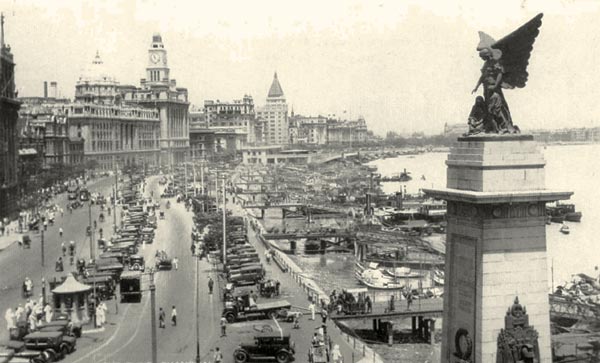
Imperial Façade: Shanghai's famous "Bund", where Western and Japanese capitalists rubbed shoulders with what Mao's communists called the "bourgeois comprador class" - the local capitalist intermediaries who built and maintained the crucial links between the Chinese people and the foreign investors, multi-national corporations, bankers and military interests of the imperial powers. Ironically, a reinvigorated China is now cultivating comprador capitalism in the societies of its dependent trading partners.
 
CHINA’S RAPID RISE to superpower status (at least economically) is producing some delicious political ironies. Eighty years ago, Mao Zedong’s communists wrote scathingly about China’s “bourgeois comprador class”. These were the local Chinese capitalists who acted as intermediaries between the Chinese people and the foreign-controlled enterprises and investors then operating in China under the protection of the major imperialist powers (Great Britain, Japan, France and the USA). The expression eventually entered the broader Marxist lexicon as “comprador bourgeoisie” and is defined as: “A section of an indigenous middle class allied with foreign investors, multi-national corporations, bankers and military interests.” The political irony lies in the fact that today’s comprador bourgeoisie is no longer located in China, but in the societies of her increasingly dependent trading partners.
 
As New Zealand’s largest trading partner, China is steadily wooing our own bourgeois comprador class away from its traditional friends and allies among the foreign investors, multi-national corporations, bankers and military interests of the UK, the USA and Australia. Already, a number of large Chinese banks have set up shop in New Zealand and have thought it politic to recruit both a former prime-minister, and a former leader of the opposition, to sit on their boards of directors. In light of the on-going furore about offshore investment in Auckland residential property, it is clear that this country’s largest real estate agencies must also be numbered among the more prominent members of our comprador bourgeoisie.
 
The Chinese surnames controversy has also exposed the role played by what might be called “cultural compradors”. The penetration of foreign capital, and the political leverage that goes with it, is only very occasionally accomplished at the point of an imperial bayonet. By far the most common method of establishing foreign influence is by using religion and/or ideology to recruit a local following to perform the role of domestic friends and allies. Such people constitute an invaluable bulwark against any attempt by the opponents of foreign influence and control to reassert national values and interests.
 
The extraordinary attacks on the Labour Party: the vicious accusations of “racism” levelled against Andrew Little and Phil Twyford; both provide grim evidence of the cultural compradors’ reckless hatred of the bourgeois compradors’ deadliest foe – the national bourgeoisie.
 
The word “national” notwithstanding, it is the Labour Party which has always represented New Zealand’s national bourgeoisie most effectively. As one of this country’s foremost public intellectuals, the late Bruce Jesson, shrewdly observed: “National knows how to govern for capitalists; but only Labour knows how to govern for capitalism.” The National Party may be “relaxed” about foreign investors pushing the price of a house beyond all but the wealthiest Kiwi’s reach, but Labour, by promising to restrict the rights of foreigners to purchase land, indicates its willingness to put the interests of New Zealanders first.
 
Dr Bryce Edwards: "Global Cosmopolitan".
 
The University of Otago political studies lecturer, Dr Bryce Edwards, frames the struggle of comprador against national capitalists as a contest between what he calls “Economic Nationalists” and “Global Cosmopolitans”. It’s a neat trick. Rather than dealing with the very hard choices New Zealanders are going to face as the economic and cultural power of China and its local facilitators waxes ever greater, Bryce has simply re-cast the drama as an existential confrontation between ageing patriots, clinging stubbornly to the outdated shibboleths of the nation state; and free-wheeling global citizens of the twenty-first century, possessed of an impressive collection of internationally marketable skills – but no country.
 
Bryce would also like to cloak his cultural comprador allies in the frayed costume of twentieth century socialist internationalism. He is hardly alone in this. All over the world, the Left is engaged in a bitter debate over whether nationalism can ever be turned to progressive purposes; and if it is still (or ever was) possible to construct socialism in one country.
 
Bryce is, however, wrong to try and smuggle those who would prepare the way for Chinese state capitalism in New Zealand into the honourable precincts of progressive disputation. Cultural compradors, like the comprador bourgeoisie, of which they are part, have no interest in constructing a political space in which the future of New Zealand can be reasonably debated. In their eyes, the future of New Zealand has already been decided – and not by New Zealanders.
 
This essay was originally posted on The Daily Blog of Thursday, 23 July 2015.

Saturday, 16 April 2011

Mislaid Narratives

Black Riders, Dark Heroes: Roger Kerr, mouthpiece for the Neoliberal Nazgul of the Business Roundtable, deserves our admiration for his unceasing promotion of the capitalist narrative. Oh that the Left had such a fearsome ideological warrior.

WHAT CAN I SAY about Roger Kerr? Advised that the CEO of the Business Roundtable is the subject of The Nation’s investigative endeavours this Saturday (16 April) I’ve been wracking my brains (as one of The Nation’s panellists) for something intelligent to say, about the man.

Most Leftists wouldn’t bother. After Sir Roger Douglas, Roger Kerr is probably the most readily identifiable representative of the entire Rogernomics era. And his Business Roundtable, comprised of the CEOs of New Zealand’s leading businesses, plays the role of Tolkien’s Nazgul in The Lord of the Rings: the most potent instrument of an ancient evil men believed they had overcome but which has risen anew to plague this Middle Earth.

But even if Roger Kerr is regarded as a villain by the Left, he is – like most literary villains – a character who fascinates every bit as much as he repels.

When interviewed on television, and even more so in the flesh, his eyes are alive with what can only be described as merriment. On the occasions I have met him I could not help feeling that he had already anticipated every objection I could possibly muster to his line of argument and was quietly amused at their lack of force. Like a thoroughly prepped witness, he has a cogent and alarmingly persuasive response to any and every question his left-wing prosecutors might throw at him.

And it’s this imperviousness to cross-examination that sums up the real damage Roger Kerr and the Business Roundtable have done to political discourse in New Zealand. By treating the determination of national policy as a zero-sum game: a life-and-death struggle in which any neoliberal objective not won must be considered lost; Kerr and his big business backers have rendered open and intelligent debate impossible. Developing the military metaphor a little further, 21st Century political discourse resembles two armies firing bullets of a different calibre at each other. The enemy’s ammunition cannot be used in your weapons – and your own ammunition cannot be used in theirs.

The contrast between the neoliberal approach to managing the economy and society and the approach that prevailed from the end of World War II until the end of the 1970s could hardly be starker. The so-called “mixed economy” of the post-war era blended a great deal more than simply publicly- and privately-owned enterprises. By recognising that the workers’ and the bosses’ ideological narratives both contributed important insights to the processes of production, Keynesian economics encouraged a pluralism that drew all of the important “players” into the game.

For the thirty years between the end of World War II and the mid-1970s, the primary objective had not been to “win the game”, but to come up with solutions that were acceptable to as many of the players as possible. It was an approach which required a willingness to give as well as to take: which more or less mandated a search for consensus; and which gave great heed to empirical expertise.

The neoliberal paradigm, which Roger Kerr so effectively embodies, rejects the quest for consensus utterly and harnesses empiricism for purely instrumental ends. The utility of an argument lies not in how close it comes to reflecting the truth, but in how effective it is at undermining the arguments of those who threaten neoliberalism's objectives. For neoliberals, facts are like clubs – useful things for beating your opponents to death.

Nowhere is neoliberalism’s essential hostility to empiricism more overtly on display that in the so-called “debate” over climate change. Because accepting the empirical data of anthropogenic global warming would require neoliberalism to surrender a great many of its most cherished ideological assumptions about the ineluctable beneficence of capitalism, it has enlisted scores of compliant scientists to manufacture arguments sufficiently club-like to secure, if not outright victory, then at least a planet-endangering stalemate.

What should I say, then, about Roger Kerr? I guess I’d have to say that I admire him – but only in the way I admire the Wehrmacht or the Waffen-SS. When viewed as a ferociously well-organised, well-equipped and highly-motivated fighting force, Roger Kerr and the Business Roundtable – like the Wehrmacht and the Waffen-SS – evoke feelings of awe and fear. But asked to judge whether they constitute a contribution to, or a subtraction from, the sum total of human happiness, I'd have to say that the only good thing they have ever done is to expose the howling ideological void where a strong and competitive left-wing opposition should be.

A few days ago, in her magisterial summation of The Hobbit Dispute, Helen Kelly wrote persuasively about the extraordinary success of the neoliberal establishment in implanting a narrative highly beneficial to the interests of the employing class in the minds of the New Zealand population:

“Basically the story runs like this – and I am simplifying it. Work is a benefit, business is the benefactor and workers are merely the beneficiaries. Workers should be grateful for a job; a job is a privilege; employers should be lauded for the contribution they make to growing economic wealth.”

Kelly’s problem, as President of the CTU, and the problem facing the entire Left, is that they have yet to adjust to the fact that the employing class has walked away from the consensus-based politics of the Keynesian Era.

The Left’s current narrative is all about "co-operation" with the employers; bargaining in “good faith”; strengthening “social partnerships” and “building consensus”. What they have forgotten is that the historic compromise thrashed out between Capital and Labour in the aftermath of the Great Depression and the global war against fascism featured not only the old laissez-faire description of the master-servant relationship (which Kelly so accurately summarises above) but the classic Marxist description of the capitalist as the last in a long line of overlords who've unjustly appropriated the ‘surplus value’ created by working people’s labour.

This working-class narrative is summed-up neatly in the 1916 lyrics of Ralph Chaplin’s union anthem Solidarity Forever:

They have hoarded untold millions
That they never toiled to earn
But without our brain and muscle
Not a single wheel can turn

It’s a narrative that seizes the moral high ground for the worker and casts the employer as thief and parasite. The capitalists are a criminal class which is only able to preserve its expropriated wealth because it controls the police, courts, schools, news media, legislature and, when push finally comes to shove, the armed forces.

According to this story, the liberation of the working-class can only be achieved when the contradictory forces shaping and reshaping capitalist society finally resolve into a general, revolutionary crisis: when, in Marx’s ominously clanking sentences:

“Centralization of the means of production and socialization of labour at last reach a point where they become incompatible with their capitalist integument. Thus integument is burst asunder. The knell of capitalist private property sounds. The expropriators are expropriated.”

This is the narrative Helen Kelly and the Left generally have mislaid. The narrative which, right up until the 1980s, continued to haunt the capitalist imagination. The German poet, Heinrich Heine, writing in the 1840s described their nightmare like this:

“Communism is the secret name of the dread antagonist setting proletarian rule with all its consequences against the present bourgeois regime. It will be a frightful duel. How will it end? No one knows but gods and goddesses acquainted with the future. We know only this much: Communism, though little discussed now and loitering in hidden garrets on miserable straw pallets, is the dark hero destined for a great, if temporary, role in the modern tragedy …”

Roger Kerr – and all he represents – have persuaded themselves that the “Dark Hero’s” moment in the "modern tragedy" has come and gone. The task of Helen Kelly – and all who march on the Left – is to convince Roger and his friends that what they have so far witnessed is only the First Act.

This essay is exclusive to the Bowalley Road blogsite.

Sunday, 24 January 2010

Justifying Progressive Taxation

About time Atlas shrugged? The creator of this 19th Century political cartoon had no difficulty in identifying who carries who in capitalist society. Ayn Rand notwithstanding, it is the countless millions of proletarian Atlases who prevent Capitalism's world from sinking. Progressive taxation is the price the capitalists' pay for keeping their feet dry.

IT’S ALREADY BEGUN – the wealthiest New Zealanders and their hired guns are already laying down a curtain of covering fire for what looks like being the most inequitable Budget since 1991. The report of the hand-picked Tax Working Group has already (and very predictably) recommended a reduction in the top marginal tax rate from 38 to 30 percent – to be paid for by an increase in the rate of GST from 12.5 to 15 percent. And to head-off the inevitable protests from the Left, the editors, journalists and columnists of the Right are already casting (here and here) the objections of the nation’s "progressives" as manifestations of "the politics of envy" and plain, old-fashioned class hostility.

And they’re winning.

Most left-wingers simply assume that "progressive taxation" – the more income you receive, the more tax you must pay – requires little or nothing in the way of economic or philosophical justification. It is simply presented as "a good thing" – like Motherhood and Apple Pie. If its defenders feel at all obliged to justify the fact that 44 percent of income tax receipts are extracted from just 10 percent of the tax-paying population, they do so by pointing out that this same group of taxpayers controls more than half the nation’s wealth. If their incomes weren’t redistributed by means of progressive taxation, the say, our society would rapidly become even more unequal than it is at present.

But, once again, the Left is assuming that everybody, like themselves, looks upon inequality as "a bad thing" – something which, if it can’t be entirely eliminated, must be ameliorated to the maximum extent possible.

But is this true? Do the wealthiest layers of our society, and those who aspire to join their ranks, really believe all human-beings are equal? Or that our society should be organised to give every one in it "a fair go"?

In my opinion, the answer to that question is: "No – they don’t." Reading the columns and blogs of the Right’s leading apologists, I get the distinct impression that the doctrines of Social Darwinism command a considerable following in this country. Just consider the reaction elicited by Social Welfare Minister, Paula Bennett, whenever she exposes the worst excesses of the beneficiary class. Think about the widespread support for Anne Tolley’s campaign to impose a test-based "standards" regime on our educational system – a policy which the upper and middle classes instinctively recognise as likely to rebound to their social and economic advantage.

No. I don’t think all New Zealanders view inequality as "a bad thing". Not at all. Not by a long shot.

The Left needs to ask itself how the notion of "the more you earn, the more you pay" ever got established. How were the upper and middle classes of modern capitalist societies ever persuaded to go along with fiscal policies so manifestly designed to limit both their wealth and their power?

The answers might surprise them.

For a start there was the enormous moral and social force of the Judeo-Christian and Islamic religious traditions. The Jewish prophets reserved their most devastating condemnations for those who refused to share their wealth with the poor; who "ground the faces of the widows and orphans". Jesus famously declared that it was "easier for a camel to pass through the eye of the needle, than for a rich man to enter the Kingdom of Heaven". Philanthropy was similarly mandated by the Prophet Mohammed – all Muslims are required to contribute to the maintenance of the poor.

In an irreligious age, and in a nation as secularised as New Zealand, it is easy to forget that, in the past, conformity with these moral precepts was a condition for the salvation of one’s immortal soul. Jewish, Christian and Islamic culture expected people to turn over a significant portion of their wealth to their less fortunate brethren. After all, to see oneself as a child of God more or less mandates a belief in equality and fraternity: if God is our father, then we are all brothers and sisters.

These fundamentally religious precepts flowed naturally into the secular faiths of democracy and socialism.

The French Revolution struck down the notion that inherited privilege had any legitimate role to play in the modern age. The new capitalist wealth, however, was earned. In stark contrast to the wealth of the aristocracy, argued the bourgeois revolutionaries, the capitalist’s profits were the product of individual wit and energy and, therefore, manifestations of democracy.

Classical Marxism dispelled this notion with a vengeance, imbuing wealth with the same moral taint as the teachings of Jesus, Mohammed and the Old Testament prophets. According to Das Kapital, the capitalists appropriated the "surplus value" of their worker’s labour in the form of profit – exploiting the new industrial proletariat no less ruthlessly than their predecessors, the feudal landlords, had exploited their serfs.

The progressive income tax was simply "social democracy’s" means of clawing back the proletariat’s pilfered sweat and talent. Not for nothing was the second of Marx & Engels’ ten demands in The Communist Manifesto: "A heavy progressive or graduated income tax".

The Right, at least, recognises the revolutionary political, social and economic objectives behind the institution of progressive taxation, even as it rejects and denies the religious and/or ethical justifications for its imposition.

In the months ahead, New Zealand’s left-wingers will have to learn once again what their parents and grandparents came to grasp only after long struggle and bitter experience: that equality and social justice are never simply given; they must be fought for – and won.