Showing posts with label Class Warfare In New Zealand. Show all posts

Thursday, 30 September 2021

Blame Games.

The Pathologies Of Poverty: And all this must have been known. In the ministries of Social Development, Health, Education and Corrections. In the Police. Politicians must have known about it, too. How could they not? When, every day, the victims of their “Look markets – no hands!” policies were beating a desperate pathway to their electorate office doors? But knowing something, and doing something aren’t always the closest of neighbours. Often they’re as far apart as Devonport is from Otara, and Remuera from Otahuhu.

AND SO, at last, we understand what building your house on someone else’s home means. It means living on top of those who were here before you. It means doing everything within your power to prevent them from getting out from under your crushing weight – and standing upright. It means always having someone to blame.

It means packing your poorest, your most desperate citizens, into a handful of ramshackle South Auckland suburbs. Requiring them to send their kids to substandard schools. Providing them with hospitals that start falling apart even before they are finished. Denying them an effective system of public transport. Paying them the minimum wage. Crowding them into sub-standard accommodation. Policing them harshly. Imprisoning them in shamefully disproportionate numbers. Offering them little, if any, rehabilitation when they are in jail.

And now, as if all this beneficence wasn’t enough, it means expecting them to co-operate fully with the authorities in the fight against the Delta variant of Covid-19.

And amazingly (given their treatment) most of the Māori and Pasifika residents of South Auckland are doing exactly that – co-operating fully. In spite of being shut in behind a complex motorway system that might almost have been designed for the purpose of keeping South Auckland out of sight and out of mind. In spite of all the evidence indicating that when Covid arrives it heads straight for the poorest part of town. In spite of Māori and Pasifika community workers warning those charged with managing the Covid-19 pandemic that the official messaging was all wrong for their people. In spite of everything the Pakeha powers-that-be did, or, more accurately, failed to do, the Māori and Pasifika residents of South Auckland are getting tested – and vaccinated – in their tens-of-thousands.

And inevitably, it isn’t enough.

Maybe, if successive governments had spent the last thirty years building the sort of state housing that the soon-to-be-dismantled Housing Corporation was perfecting in the early 1980s, then the people of South Auckland would have been sheltered from the Coronavirus in decent, publicly-owned and properly maintained homes.

Maybe, if those same governments had worked co-operatively with South Auckland not-for-profits and cultural institutions to design and support a system of health delivery attuned to the needs and preferences of Māori and Pasifika families, then, when Covid-19 arrived, those same families would not have fallen prey to misinformers and conspiracy theorists.

Maybe, if both National and Labour had entertained the truly radical notion that entrusting local communities with the power and the resources to teach their children in a way that made them proud of their successes, rather than ashamed of their failures, then the talent and entrepreneurial spirit abounding in those same communities might have been invested in something more personally and socially rewarding than criminal gangs.

But, because those past governments didn’t, our present government is continuing the practice of crowding individuals and families into motels and boarding-houses. It is difficult to imagine an environment better suited to the spread of a virus – especially one as infectious as the Delta variant of Covid-19. (Concentrating so many of the gangs’ actual and potential clients in these places must also be acknowledged as extremely helpful – although not to public health, or personal security.)

And all this must have been known. In the ministries of Social Development, Health, Education and Corrections. In the Police. Politicians must have known about it, too. How could they not? When, every day, the victims of their “Look markets – no hands!” policies were beating a desperate pathway to their electorate office doors? But knowing something, and doing something aren’t always the closest of neighbours. Often they’re as far apart as Devonport is from Otara, and Remuera from Otahuhu.

And, truth to tell, all of us living in the House of Middle-Class Pakeha know that our wealth and comfort comes with a hefty price-tag. It’s just that we’ve learnt how to defer calculating the cost by keeping the decaying communities of the poor, rank with the stench of deprivation and discarded dreams, as far away from our leafy suburbs as possible. Out of sight, out of mind, works every bit as well for the “boguns” and the “boofheads” of the Pakeha working-class as it does for Māori and Pasifika communities – better, in a way, since working-class Pakeha lack the conscience-tugging combination of ethnicity and indigeneity.

But, guilty consciences are difficult to live with. Especially when it becomes clear that all the te Reo speaking and name-changing that guilt-ridden Pakeha can be bullied into accepting will not make one South Auckland family richer or better housed. Unfortunately, where consciences turn sour, prejudices tend to flourish. Once the idea takes root that leafy Auckland is being kept from its pleasures by homeless Māori and Pasifika, the demands will not be slow in coming for South Auckland to be locked-down, ring-fenced, and left to stew in its own Covid juices.

It is then we will discover just how securely the House of Pakeha has been built on the home of Māori. How willing tangata whenua truly are to go on carrying its weight – and accepting its blame.


This essay was originally posted on The Daily Blog of Thursday, 30 September 2021.

Friday, 4 December 2020

The Last Thing Working-Class New Zealanders Need Is “Stability And Certainty”.

Make Some Noise! The problem with keeping conditions stable and certain for the middle-class is that it more-or-less obliges the Government to refrain from implementing policies likely to produce significant improvements in the condition of the working-class. Most especially, it obliges Jacinda Ardern and her colleagues to do next-to-nothing for the poorest and most vulnerable members of the working-class. Improving their lives would simply be too costly. It would require precisely the sort of new taxes and tax increases that Labour has already ruled out of contention.

THERE IS SOMETHING quite seriously out-of-kilter with the universe when I find myself agreeing with Richard Prebble. Commenting in this morning’s (2/12/20) NZ Herald, Prebs states with unnerving accuracy: “Labour won the election but we elected a conservative government. Gone from the government programme announced in the speech from the throne is any promise of ‘transformational change’. Instead we have the false promise of every Tory, ‘stability and certainty’.

Many conservatives will disagree with Prebble’s analysis. In their eyes, Jacinda Ardern is still “a pretty communist”, and her party a collection of fire-breathing “Cultural Marxists” hell-bent on transforming New Zealand into the Venezuela of the South Pacific. [No, I’m not really sure what a “Cultural Marxist” is either – but the term is very big right now in right-wing circles!] The conservatives’ confusion is understandable, however, given how common it has become for radical ideas about culture and identity to be conflated with the ideology of the “Left” in general.

Prebble is not so easily distracted. He won his political spurs in the days when leftism was mostly about the economic, social and political consequences of being born into a particular social class. The Labour Party he grew up in took as its starting point the condition of the New Zealand working-class and how it could be improved. The point of Prebble’s admirably acidic column is that this “Labour” government has begun its second term from a very different starting-point: namely, the condition of the New Zealand middle-class and how it can be protected. Hence, its very public commitment to “stability and certainty”.

The problem, of course, is that keeping conditions stable and certain for the middle-class more-or-less obliges the Government to refrain from implementing policies likely to produce significant improvements in the condition of the working-class. Most especially, it obliges Jacinda Ardern and her colleagues to do next-to-nothing for the poorest and most vulnerable members of the working-class. Improving their lives would simply be too costly. It would require precisely the sort of new taxes and tax increases that Labour has already ruled out of contention.

Not that Prebble is the least bit interested in tax rises. His big worry is New Zealand’s woefully low levels of productivity. Like any good Rogernome, he sees the solution to this country’s poor productivity in terms of upping the rate of exploitation: i.e. making the nation’s employees work harder and longer for less. He’s all about further deregulating an already comprehensively de-regulated labour market. Yes, he would start by undoing Labour’s minimal improvements to paid leave and minimum wages, but it wouldn’t stop there.

The funny thing about Prebble and his ilk is that the solution to our low rate of productivity has always been staring them in the face. The fastest way to lift productivity is to force employers to substitute innovative technology for the absurdly cheap and indifferently-skilled human labour that has, since the 1990s, been permitted to take its place. By dramatically lifting wages and improving working conditions, a reforming government would require inefficient businesses to either find a way to work smarter or close down. The inevitable rise in unemployment would be met with a massive state programme of upskilling and employment creation.

Not that this government would dream of implementing such a solution. Not only would it outrage the small-business sector, but it would unnerve the professional and managerial classes. Those who work for salaries are extraordinarily sensitive to what we old trade unionists used to call “the relativities”. Put simply, any appreciable rise in the income of the “lower orders” unmatched by a corresponding upward movement in the income of their “betters” will be construed as a direct attack on their social prestige and position – which, of course, it is. Maintaining the yawning gap in the life experiences of wage workers and salaried professionals is one of those unspoken and unbreakable laws of capitalist society that “reformers” ignore at their peril. Fortunately for the class that dominates Labour’s caucus, Jacinda doesn’t do peril!

But, if the Sixth Labour Government is unwilling to follow either Prebble’s path, or the path of uplifting the working-class, then how can it hope to escape the latter’s anger and disillusionment when they realise that in spite of all her “kind” words, Jacinda is not going to help them? Tragically, my gut instinct tells me that she and her colleagues are going to try and distract them.

For quite a long time now it has been clear to those who make it their business to keep an eye on such things that most of this country’s blue collars are to be found around brown necks. So many of this country’s most poorly paid jobs are being done by Maori, Pasifika and immigrant workers. They make up the bulk of the “working poor” and they are represented disproportionately in the ranks of beneficiaries.

These are the people who struggle to pay the rent, or, far too often, struggle to find a landlord to pay rent to. Theirs are the schools that are failing. Theirs the hospitals that are underfunded. It is their mothers, daughters, sisters and wives who are abused for wearing the hijab. It is their fathers, sons, brothers and husbands who are pulled over by the cops. Most of all, they are the New Zealanders for whom the daily injuries of race are experienced much more directly and painfully than the injuries of class.

What could be easier than to portray racism as the root cause of their misery? Especially when it is so much cheaper, politically, to persuade people that their problems arise out of the personal failings and prejudices of their fellow citizens, rather than from the structures of economic exploitation and social subordination in which they are trapped. As an explanatory tool, race has the added advantage of being something we cannot do anything about. Those who are born poor, on the other hand, are not bound by their genetic inheritance to remain so. To make race the problem is to choose a war that can never be truly won. Healing the injuries of class, however, is something human-beings have done before – and can do again. What’s more, the great thing about combatting the injustices of class is the way it renders racial differences increasingly unimportant.

When an injury to one is treated as an injury to all, the only colour people tend to see is red. It’s a colour that has bugger-all to do with “stability and certainty”, but it used to have a whole lot to do with Labour. Even Richard Prebble knows that.


This essay was originally posted on The Daily Blog of Thursday, 3 December 2020.

Tuesday, 12 November 2019

Not So Much "OK Boomer" As "OK Ruling Class".

Distract And Divert: The rise of what we have come to call “Identity Politics” represents the ideological manifestation of the ruling class’s objective need to destroy class politics, and of the middle-class’s subjective need to justify their participation in the process.

THE RELIEF of the ruling class can only be imagined. Thirty years after the collapse of actually existing socialism in Eastern Europe, they have more or less faded into invisibility. The ruling class (also known as the bourgeoisie) along with the proletariat, are now little-used politico-historical terms: as distant from today’s activists as the “patricians” and “plebeians” of Ancient Rome.

If you’re lucky, the villains of the twenty-first century Left are the “One Percent”. Otherwise, the people’s enemies are identified by characteristics over which they have no control: ethnicity, gender, sexual orientation and age. The fact that, 80 years ago, belonging to the wrong ethnicity and/or sexual orientation was enough to get you exterminated by the Nazis is but one of the many ironies associated with contemporary leftists.

Even the “One Percent” designation, introduced into popular discourse by the short-lived “Occupy Movement”, is a curiously disembodied term. To be a member of the One Percent is an entirely passive condition. You are a statistic. A percentage of the population made relevant solely by another percentage – i.e. the quantum of societal wealth your statistical sliver possesses.

Once again, a person’s villainy has nothing to do with what they do and everything to do with what they are. The other disturbing aspect of Occupy’s vilification of the One Percent is the way in which the remaining 99 percent of the population are let off the hook entirely. As if 1 percent of any group has ever been able to control the other 99 percent without a lot of help!

The contrast with Karl Marx’s world of class agency could hardly be more stark. To read his (and Friedrich Engels’) The Communist Manifesto is to enter a world in which classes act. To be a member of the bourgeoisie is to be in constant motion. This is because, once secured, economic, political and social power must be constantly reinforced and protected. Proletarians, likewise, are constantly struggling to weaken the grip of their capitalist masters. In Marx’s defining sentence: “The history of all hitherto existing society is the history of class struggles.”

In other words: the human order is made and reproduced by human action. Which means the human order can be changed by human action. Our destiny is not predetermined by our ethnicity, gender, sexual orientation or age, but by how effectively we participate in class struggle.

Sadly, the effectiveness with which working-class New Zealanders – New Zealand proletarians – have struggled against the more-or-less continuous onslaught of the New Zealand ruling class and its bourgeois helpers since 1984 has been sub-optimal. They allowed themselves to be betrayed by the country’s trade union bureaucracy in 1991, and remained pathetically loyal to a Labour Party which had, between 1984 and 1990, dismantled the social-democratic economy their parents and grandparents had struggled so hard to establish in the 1930s and 40s. The most highly-skilled and enterprising members of the New Zealand working class decamped in their thousands for Australia. Those who remained were forced into competition with the swelling numbers of immigrant workers who were admitted to make good the shortfall.

Unsurprisingly, this process produced innumerable socio-economic victims and with them enormous socio-economic resentment and rage. To an extent not before seen in New Zealand, it became necessary to obscure the suffering of these working-class citizens and, at all costs, prevent it from assuming a political dimension.

This has always been a major aspect of the bourgeoisie’s function in capitalist society, but in the aftermath of the neoliberal revolution of the 1980s and 90s it came to absorb an ever-greater amount of middle-class energy. A great deal of that energy was devoted to making sure that the class oppression in which more and more of them were now engaged remained hidden – not only from the victims, but also from themselves. In essence, this involved masking conscious human agency behind the immutable markers of human identity. The rise of what we have come to call “Identity Politics” represents the ideological manifestation of the ruling class’s objective need to destroy class politics, and of the middle-class’s subjective need to justify their participation in the process.

Redirecting the rage and resentment of those on the receiving end of neoliberal economic policy away from those actually responsible – the capitalist ruling class and its middle-class enablers – was always going to involve a pretty substantive re-interpretation of social reality. It meant recasting the malignant behaviours associated with poverty and powerlessness as the inherent failings of particular human sub-groups: whites, males, straights and, most recently and ridiculously, Baby Boomers.

Is it really the contention of the 55-year-olds-and-under who now blame the Boomers for all their woes, that every human-being born on the planet in the years 1946-1965 has benefited unfairly from the economic, social and political trends of the subsequent decades? Even the billions of people born in the Third World? The millions more born in the Soviet Bloc? Are they really insisting that there was not a huge discrepancy between the experiences of working-class Baby Boomers living in the capitalist west and their middle-class compatriots growing up alongside them? If so, then the degree of Gen-X and Millennial self-deception; their inability to recognise what has actually been happening around them since 1984 – or the role they and their own middle-class families have played in it – is astonishing.

What a victory for the ruling class! To create at least two generations incapable of understanding that the wealth and comfort of their middle-class parents was the necessary price of their complicity in destroying the self-defence mechanisms of the New Zealand working-class. Or that their own difficulties in replicating their parents’ lifestyle is purely and simply because their parents’ success was so comprehensive that the going rate for oppressing the lower orders of society has fallen sharply. How pleasing it must be for those at the top to see how much more willing the young are to turn on their parents and grandparents than on the true villains – the ruling class.

If the members of Generation X and the Millennial Generation really want to improve their lifestyles, then they should force up the price of complicity in class oppression by threatening to embrace or, even better, adopt for a generation or two, the precepts of Marx’s class struggle.

This essay was originally posted on The Daily Blog of Tuesday, 12 November 2019.

Friday, 12 April 2019

Making The Tradies Pay.

Crunching The Numbers: On the subject of the Capital Gains Tax, it is simply not sufficient to assert that all income is the same and, therefore, must be taxed the same. Those who say this ignore the fact that, as RNZ’s Guyon Espiner so rightly observed, not all income is made the same. The working life of the small business owner is very different from that of wage and salary earners. In addition to plying their trade and/or providing their service, they are saddled with a great many other responsibilities.

IT’S A CLASS WAR – of a most unusual kind. The looming battle over Labour’s Capital Gains Tax (CGT) pits a pampered and overpaid Professional and Managerial Class (PMC) against the constantly expanding class of tradespeople, service providers and independent contractors: the tens-of-thousands of small businesspeople whose daily labours continue to make, move and mend this country.

The PMC is determined to protect its cosy position in New Zealand society by making sure that any expansion of the state’s revenues is secured by taxing something other than their salaries.

They have been made aware of the rapidly rising incomes of the “tradies”. How could they not, with their brand new SUVs clogging the streets outside the local school every morning and afternoon? What’s more, they strongly suspect that all this new-found wealth is not being taxed in the same way that their incomes are taxed. They may not know much about running a business that isn’t funded by someone else’s money, but they’re pretty sure these nouveaux riche boofheads are dab hands at short-changing the IRD.

Clearly, these upstarts need to be taxed at the same rate as themselves – 33 cents in the dollar. And because, as the owners of small businesses, they can get away with paying themselves ludicrously low wages, they must be made to hand over to the IRD one-third of the currently tax-free capital gains they make when they sell their businesses.

They’ll squeal and moan, of course, but a CGT is by far the fairest fiscal solution. Capital gain is a form of income – and all income must be taxed. Besides, it’s just not right that people with nothing more than a trade certificate (or whatever they call it) and often with no qualifications whatsoever, should be making more money than someone who spent four or five years at a university getting properly qualified. A university, mind you, not a dreary polytechnic tucked away in some provincial hell-hole like Wanganui or Invercargill!

But simply saying that all income is the same, and must be taxed the same, ignores the fact that, as RNZ’s Guyon Espiner so rightly observed, not all income is made the same.

The impressively credentialled members of the PMC, large numbers of whom are employed by the state, turn up for work every day and are paid every fortnight. All the necessary deductions for tax and ACC have been taken care of by their employer. If they’re teachers, nurses, social-workers, or just plain, common-or-garden civil servants, there’s a very high probability they’ll be members of a union. Regular pay-rises and improved working conditions are expected – and delivered.

Life for the small business owner is very different. In addition to plying their trade and/or providing their service, they are saddled with a great many other responsibilities. They have to take care of their own tax payments – as well as the tax payments of any staff they may employ. Then there’s Kiwisaver and ACC payments to sort out. They must conform to the provisions of OSH legislation and deal with the infernal complexities of the RMA. For many, being able to pay their bills depends upon other people paying theirs – and getting some debtors to cough-up can be a nightmare.

So, Guyon is right. Not all income is made the same. Which is why not all income is taxed the same.

Which leaves the PMC with a problem. They are only too aware of the need for increased government spending on health, housing, education and the environment. After all, so many of their jobs are about providing these public goods. On the other hand, they have a lifestyle to maintain; overseas trips to pay for; kids to finance into university and home ownership. Yes, their salaries may be large – but they’re fully extended. They are not keen on paying higher income tax. Not keen at all.

It might not be so bad if all these tradies; these restaurateurs; these independent contractors were caring and responsible citizens. But dammit! What’s with all these monster SUVs? Haven’t they heard of global warming? And the things they say! Honestly, it borders on hate speech. Sexists, racists, homophobes: the whole kit and kaboodle. To call them “deplorables” would be to seriously understate the problem. And then they get to retire with a cool million bucks – tax-free.

No bloody way!

This essay was originally published in The Otago Daily Times and The Greymouth Star of Friday, 12 April 2019.

Friday, 15 September 2017

One Picture: Toby Morris's Brilliant Take On National's Attack Strategy.


Auckland cartoonist Toby Morris has produced this superb pictorial commentary on National's campaign tactics. His chilling adaptation of the Nat's "Winning Runners" television ad exposes the class warfare which, when all the superficialities are stripped away, constitutes the dark matter of every general election.


This posting is exclusive to Bowalley Road.

Friday, 11 August 2017

You Can’t Turn A Green Party Red Overnight.

Red Or Green? Metiria Turei’s sudden and dramatic elevation of issues relating to the poor and marginalised shocked and surprised many of the Greens’ middle-class voters. That their own social class was being cast as the villains of her “I, Daniel Blake” drama did not make the acceptance of Ms Turei’s radical welfare policies any easier.
 
THE GREENS as a political party, a social movement, and an electoral block, constitute three very different groups. Metiria Turei, by failing to balance the respective claims of each group, has plunged all three into a potentially terminal political crisis – destroying her own parliamentary career in the process.
 
The Green Party defectors’ (David Clendon and Kennedy Graham) grasp of the moral expectations of actual Green voters has proved to be considerably stronger than their co-leader’s.
 
As numerous political scientists and journalists have pointed out over the 28 years of the Green Party’s existence, its electoral base is overwhelmingly middle-class. “The wives of doctors, lawyers and architects from Wadestown and Mt Eden”, as one Press Gallery pundit put it.
 
Putting to one side the sexist over-simplification, the raw electoral data shows him to be more right than wrong. Nandor Tanczos, Sue Bradford and Keith Locke – the so-called “Red Greens” – may have captured the headlines when the Green Party first squeaked into Parliament back in 1999. But, the MP who most resembled the typical Green voter was the very middle-class Sue Kedgely. Close behind her was the irrepressible Rod Donald. As the former manager of a small business, he, too, represented a good-sized chunk of the Greens’ electoral base.
 
If one listened only to the rhetorical sallies of Sue Bradford, one could be forgiven for thinking that the Green party was chock-full of eco-socialists. Well, it ain’t necessarily so. For the voters concerned about dangerous food additives, genetic engineering and climate change, the Greens were neither Left, nor Right – the Greens were in front!
 
Metiria Turei’s sudden and dramatic elevation of issues relating to the poor and marginalised shocked and surprised many of the Greens’ middle-class voters. Their astonishment turned to alarm as the political implications of her defiance of WINZ acquired greater clarity. The Greens’ co-leader obviously regarded the laws surrounding the administration of social welfare as unjust manifestations of one class’s determination to limit the life chances of another. That their own social class was being cast as the villains of this “I, Daniel Blake” drama did not make the acceptance of Ms Turei’s radical welfare policies any easier.
 
Given that this sort of class war rhetoric had not been deployed in mainstream New Zealand politics for many decades, the public’s (including 51 percent of Green Party voters’) largely negative reaction to Ms Turei’s intervention was hardly surprising.
 
That Labour voters had celebrated enthusiastically their early leaders’ run-ins with the law reflected the extent to which class-based political ideologies had seized the imagination of the New Zealand working-class. Labour’s formation in 1916 came barely three years after the Great Strike of 1913 – generally accepted by historians as the closest this country has ever come to open class warfare. As late as 1932, it was still possible for unemployed rioters to wield the Auckland Methodist Mission’s picket fence against the Police – and receive absolution.
 
“If what happened last night makes authority act to help desperate people obtain the justice they deserve,” said Colin Scrimgeour, in his guise as the broadcaster “Uncle Scrim”, “the pickets torn off the fence of the Methodist Mission in Airedale Street will have caused this church to give the people the most outstanding service of the church’s hundred years of history.”
 
By 1935, however, Labour’s new leader, the avuncular Mickey Savage, was dampening-down the fiery class rhetoric of his party. To extend the appeal of Labour beyond the militant trade union movement from which it sprang, Savage required his comrades to master a more inviting and inclusive political language.
 
Herein lay Ms Turei’s error. To ask a political party to embrace the uncompromising goals of a social movement, in defiance of the moral expectations of at least half of that party’s electoral base, and without the lengthy preparations necessary to modify those expectations, can only be described as the purest political folly. It is all very well to present yourself as the reincarnation of Victor Hugo’s Jean Valjean, the hero of Les Miserables, but only after a majority of your fellow New Zealanders have been made familiar with the plot – and only if your own and Jean Valjean’s poverty are genuinely comparable!
 
The tragedy is not only that Ms Turei’s unapologetic radicalism has terminated her political career, but that the Greens did so little to prepare their supporters for its sudden arrival.
 
This essay was originally published in The Waikato Times, The Taranaki Daily News, The Timaru Herald, The Otago Daily Times and The Greymouth Star of Friday, 11 August 2017.

Saturday, 16 April 2016

The New Black Is Blue: National’s Grip On The Electorate Remains A Strong As Ever.

The Winner: Like Dorian Gray’s, National’s sins have left not the slightest blemish upon its public face. No doubt, in some upper room, safe from prying eyes, a cursed canvass portrays it’s true hideousness. So long as it stays there, securely hidden, National’s supporters simply do not care.
 
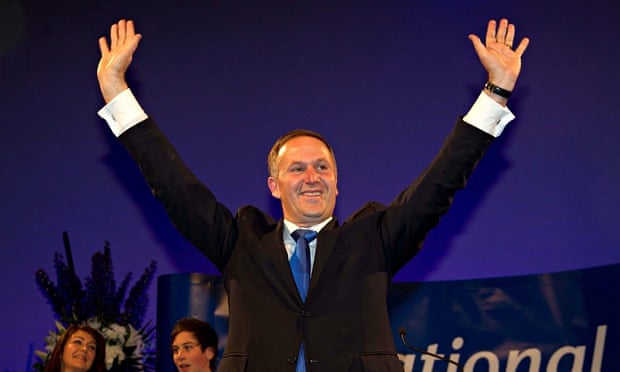
THE NATIONAL GOVERNMENT’S unprecedented run in the polls rolls on. Eight years in office and still the level of support for John Key’s ministry in the New Zealand electorate continues to fluctuate between an unassailable 45 and 55 percent.
 
These would be outstanding numbers even under the old First-Past-The-Post electoral regime. Under a proportional, multi-party system they are extraordinary. In fact, given all the things Key and his colleagues have done, or failed to do, they should be impossible.
 
And yet, like Dorian Gray’s, National’s sins have left not the slightest blemish upon its public face. No doubt, in some upper room, safe from prying eyes, a cursed canvass portrays its true hideousness. So long as it stays there, securely hidden, National’s supporters simply do not care.
 
This state of not caring – evinced by close to half the population – is something new and disturbing in New Zealand politics. It speaks of hardened attitudes and even harder hearts; of an electoral bloc that has simply shut its eyes and ears to the plight of less fortunate and hard-pressed citizens. That they have remained faithful to the Key Government for eight years is because in all sorts of subtle and not-so-subtle ways it has told them that they are right not to care. Not caring is the new black: National’s new blue.
 
It’s important to grasp the fact that this ingrained lack of compassion is in no way reflective of simple bigotry or ignorance. The new National supporter is not the sort of know-nothing backwoodsman from the provinces who hated queers and backed Springbok Tours. Confronted by the Left for their apparent lack of compassion, these new National supporters will round on their accusers and charge them with constructing a soft and dependent society critically lacking in grit and resilience. Their refusal to mollycoddle the poor and work-shy may look like cruelty, they will say, but in the long term it will be revealed for what it is – the most socially productive manifestation of true kindness.
 
That this hard-nosed approach entrenches inequality and widens the social divide is fine by them. People have always needed incentives. Big sticks for the poor. Juicy carrots for the rich. “You don’t make a poor man rich”, they insist, “by making a rich man poor.” A healthy society is one in which the poor person’s burning desire to escape his or her poverty is only equalled by the well-off person’s fear of falling into it. Those who make it into the winners’ circle need to know how hard it is to get there – and stay there.
 
This is the gospel according to John Key’s new National Party, and its capacity to attract and hold close to half the electorate is unprecedented. The professional middle-class, hitherto susceptible to the Left’s appeals for them to join it in the struggle for equality and social justice, must now be counted among the new National Party gospel’s most enthusiastic converts. The better angels to which Labour once appealed have long since been made redundant and let go.
 
Those poll numbers ain’t going to change anytime soon.
 
This essay was originally posted on The Daily Blog of Saturday, 16 April 2016.

Tuesday, 22 September 2015

National's Love-Affair Is With The Right - Not The Centre.

Speaking For The Nation - Acting For The Right: John Key at the Pike River Memorial Service. Promises that the 29 entombed miners would not have died in vain could not survive the recklessly self-interested lobbying of National's Far-Right electoral base - farmers and small business.
 
JOHN KEY IS PROUD of his government’s performance. Twelve months on from the 2014 General Election his message to the people of New Zealand is characteristically upbeat:
 
“Families are also being helped by an economy which is continuing to grow”, the Prime Minister enthuses in his anniversary media release. “There were over 49,000 new jobs created in the nine months to June 2015 and the average wage is up $1500.  The services sector – which includes tourism – has seen 35 months of straight growth.”
 
Fulminate as they might against his government’s deficiencies, Mr Key’s opponents have no effective answer to the argument advanced by the opinion polls. After seven years in office, the Key-led Government is still racking up percentages in the high 40s/low 50s – popularity scores without precedent in New Zealand’s political history. Small wonder, then, that conservative leaders from the other Anglophone countries (most notably the new Prime Minister of Australia, Malcolm Turnbull) sing his praises!
 
A journalistic consensus has grown up around the indisputable success of Mr Key’s ministry. The Prime Minister, it is argued, has forged a bond with “Middle New Zealand” which, to date, has proved indissoluble. Pundits talk about “John Key’s enduring love affair with Centrist New Zealand”. These are good lines – but is the Fourth Estate telling us the truth?
 
The proposition that the New Zealand National Party is a “centrist” political institution is hard to stand up. Certainly, it has suited some National Party prime ministers (Sir Keith Holyoake and John Key among them) to steer their political vessel into the sheltered waters of bi-partisan agreement. At its ideological core, however, National remains a party of the Right. Without the reliable support of that part of the New Zealand electorate which identifies itself as “right-wing”, National would not be able to form any sort of stable government.
 
The Litmus Test for just how right-wing National has always been – and remains – is its treatment of the trade unions. National’s first prime minister, Sid Holland (himself a former member of the far-right New Zealand Legion) lost little time in engineering the infamous lockout of the Waterside Workers Union in 1951. This colossal industrial confrontation, which pitted the National Government against the cream of organised labour, lasted 151 days and was only won by severely curtailing New Zealanders’ civil and political rights for the duration of the dispute.

Foundation Myth: The First National Government blooded itself in the 1951 Waterfront Lockout. Sixty-four years later, the party's hatred of trade unions remains undimmed.
 
Forty years later, National launched an even more extreme assault upon the trade unions. The Employment Contracts Act (1991) reduced the trade union movement to a pale shadow of its former strength. Rights enjoyed by New Zealand workers for close to a century were simply legislated away – entrenching the power of New Zealand’s employers to a degree unprecedented in this country’s history. In less than a decade union density in New Zealand fell from 45 percent to 20 percent. In today’s private sector less than one in ten workers belong to a union.
 
National’s hostility towards even this enfeebled labour movement remains as visceral as ever. No “centrist” government would have connived in the watering-down of the health and safety reforms arising out of the Pike River mining disaster. But National, driven by its far-right supporters in the farming and small-business sectors, was willing to endure both public ridicule and moral censure, rather than rebuff the recklessly self-interested lobbying of its electoral base.
 
At the heart of National’s hatred of the unions lies an even deeper fear of the working class as a whole. Like all right-wing parties, it strives to paint itself as the natural ally of “aspirational” members of both the working and middle classes. Even so, “getting ahead” will never count for as much in National Party circles as looking after those who “got ahead” long, long ago. These people are very clear about the direction in which the nation’s wealth should flow. National’s job is to make sure it keeps flowing their way – forever.
 
It’s why the Welfare State remains the National Party membership’s particular bugbear. Like an enormous dam, it captures wealth that would otherwise come to them. Sid Holland’s original intention was simply to repeal the Social Security Act (1938). But the New Zealand voter repeatedly refused to oblige him; only consenting to a National Government after Holland and his party had pledged to keep the welfare state in place.
 
One only has to listen to Mr Key’s colleagues pronounce on “welfare dependency”, however, or the need for private-sector sourced “social investment”, to understand how unrelenting this pressure from National’s core right-wing constituency remains. With affordable housing in unprecedented demand, would a “centrist” government advocate selling-off thousands of state houses?
 
Thirty years of state-sanctioned selfishness have swollen the ranks of right-wing New Zealand – prising thousands from Labour’s grip in the process. Mr Key rides high because the Left has fallen so low.
 
This essay was originally published in The Press of Tuesday, 22 September 2015.

Tuesday, 21 July 2015

Class Trip: Should Labour Go After The "Bogan Vote"?

Cries From The Heart: That young working-class males, growing up in the post-1984 era, were often gripped by feelings of extreme frustration, resentment, anger, worthlessness and despair is hardly surprising. Socially, they appeared to have lost all value; politically, they had become invisible – and utterly without champions.
 
CAN LABOUR WIN the “Bogan Vote”? Should it even try? Seriously, if going after the votes of “Waitakere Man” is considered bad, then pursuing the Bogan Vote must, surely, be worse? And yet, at one time, the in-work, well-remunerated, union-dues-paying, domestically-settled, family man – and his sons – constituted the heart and soul of the Labour vote. Indeed, so irrevocably gendered was the New Zealand working-class vote that the poet, James K. Baxter, made humorous reference to it in his otherwise bleak suburban tragedy, Calvary Street:
 
Where two old souls go slowly mad,
National Mum and Labour Dad.
 
In 2015, however, Baxter’s stereotype seems all wrong. Fifty years after the publication of Calvary Street it is Dad who votes for National and Mum who (maybe) votes for Labour. In 2015, the self-employed, well-remunerated, domestically-settled, family man – a.k.a Waitakere Man – is much more likely to vote for the Right than the Left. His children, if they bother to vote at all, probably do the same.
 
Bogans are very different from, and should never be confused with, the offspring of Waitakere Man. Waitakere Man represents working-class New Zealand males on an upward socio-economic trajectory. Bogans, by contrast, represent working-class New Zealand males on the socio-economic skids. They are the blokes – especially the young blokes – who struggle to find and remain in even the most poorly-paid employment. Their domestic situations tend towards the precarious. They rent rooms – not houses – and struggle to both make and retain strong social connections. That’s why mateship is so crucial to the Bogan identity; especially mateship built around sporting allegiances and motor vehicles.
 
The fathers and grandfathers of 21st Century Bogans were the men for whom the fully employed, compulsorily unionised, welfare state was, primarily, constructed. Men of modest educational attainment and limited ambition who were able, nevertheless, live full and rewarding lives under the state’s (and their union’s) protection. These were the men who worked for the state-owned Post Office and Railways; whose families occupied state houses; whose award-wages kept them, if not in luxury, then, at least, in reasonable comfort. They were also the Labour Party’s most loyal supporters. That it was Labour, in the person of Roger Douglas, who destroyed their world and cast them and their families onto the scrapheap, is the defining Bogan betrayal.
 
To the sons of these men, growing up in the 1980s and 90s it must have seemed as if the “new” New Zealand cared about everybody except them and their dads.
 
Maori were in the middle of a “renaissance”. Multi-million-dollar “Treaty Settlements” were being signed. For the coming generations of Maoridom there would be university scholarships and trade-training programmes. New business enterprises were planned, and special housing schemes. Things were looking up – if you were Maori.
 
For women, too, all paths appeared to lead upward and onward. At school, the Bogan boys’ female class mates were constantly being told that “Girls can do anything!” And with the top posts of Governor-General, Chief Justice, Prime Minister and CEO of New Zealand’s largest company all held by women, that inspirational feminist slogan seemed no idle boast.
 
For young, working-class blokes without tertiary qualifications or readily marketable skills, however, inspirational slogans were in short supply. The two great institutions which working-class New Zealanders had constructed to protect and advance their interests: the trade union movement and the Labour Party; were no longer able or willing to do so. Labour had been taken over by Thatcherite ideologues in the early 80s. And, in 1991, the public sector unions had voted down the call for a General Strike against the Employment Contracts Bill. Not that it was the unions of the public servants, teachers and nurses which were about to be decimated by National’s union-busting legislation. That fate was reserved for the unskilled and semi-skilled workers of the private sector. Within a decade, barely one private-sector worker in ten remained unionised.
 
That young working-class males, growing up in the post-1984 era, were often gripped by feelings of extreme frustration, resentment, anger, worthlessness and despair is hardly surprising. Socially, they appeared to have lost all value; politically, they had become invisible – and utterly without champions.
 
Indeed, the opposite appeared to be true. More and more, the Bogans began to hear themselves described in the most derogatory terms. Expressions imported from the USA – like “rednecks” and “white trash” – entered the vocabulary of the Bogans’ middle-class detractors. In a Labour Party almost entirely purged of its working-class membership, the people who had once constituted the very heart of its electoral support were increasingly regarded as the natural enemies of the party’s new, upwardly-mobile, and socially-liberal apparatchiks.
 
Only very occasionally, did the Bogans become visible to the rest of New Zealand. Denied anything even remotely resembling the ennobling narratives available to Maori and women, they had become little more than the butt of stand-up comedic humour. With their mullet haircuts and Metallica T-Shirts, the best they could hope for was to be treated as a colourful Kiwi sub-culture – something akin to the outcast “Juggalo” movement in the United States.
 
And then in 2003, Possum Bourne died. The rally-car champion had been a hero to tens-of-thousands of Bogan “petrol heads” and they turned out in vast numbers to bid him farewell. It was a poignant reminder of just how many young New Zealanders lived below the radar of a society obsessed with wealth and “winning”. Like the huge Pasifika turn-out for Jerry Collins, 12 years later, Possum Bourne’s mourners were emblematic of a New Zealand routinely ignored, even denigrated, by those with the power to keep the spotlight aimed exclusively at themselves.
 
So, yes, I believe that Labour should try to win the “Bogan Vote”. Not only because, having ignored them for 30 years, Labour owes them – big time. But also because Neoliberalism will never be defeated by the social groups it lifted up, only by those it cast down.
 
This essay was originally posted on The Daily Blog of Monday, 20 July 2015.

Friday, 24 April 2015

Before ANZAC Day: How It Really Was.

The Good Old Flag: Strike-breakers pose proudly under the Union Jack, Waihi, 1912. In the two years immediately preceding World War I, the “good old flag” had become an emblem of bitter class warfare. Undaunted, it was the Union Jack that 2,779 "sons of the empire" ended up dying for at Gallipoli in 1915.

TELLING PEOPLE “how it really was” is the historian’s first and, some would say, only duty. On the eve of the hundredth anniversary of the Gallipoli landings it’s a duty that weighs very heavily. So much has been spoken and written about the events of 25 April 1915, and what they mean to New Zealand, that anyone attempting to tell people truthfully “how it really was” risks extinguishing the roseate glow of our national mythology in the cold white light of the historian’s flash-bulb.
 
Let’s begin with “the good old flag” under which so many volunteers marched off to war in 1914. Not their own New Zealand Ensign, but the Mother Country’s Union Jack.
 
In the two years immediately preceding 1914, that “good old flag” had become an emblem of bitter class warfare. Nowhere was this more vividly displayed than in the mining town of Waihi.
 
Only rarely can the Union Jack have been borne aloft by a more disreputable bunch of flag-wavers. Answering to such outlandish names as the “Snake Charmer” and “Harvey the Pug”, the strike-breakers brought to Waihi by the owners of the Waihi Gold Mine advertised their officially sanctioned status by rolling into town on a horse-brake draped with “the good old flag”.

Strike-breakers arrive in Waihi, 1912: The "Snake Charmer" is second from left in the bowler hat. "Harvey the Pug" stands in the middle wearing a white scarf.
 
The message could not have been clearer: the red flag of the “Red” Federation of Labour (to which the striking Waihi miners proudly belonged) had met its match.
 
Pretty soon the residents of Waihi were encountering crudely scrawled representations of the Union Jack on the walls of their houses and public buildings – usually accompanied by the words “God Save the King!”
 
Emboldened by the presence of the Police Commissioner, John Cullen, Harvey the Pug and his mates paraded brazenly up Waihi’s main street bellowing out their own, revised, version of “The Red Flag”:
 
We’ll work the mines and never fear,
We’ll drive the Red Flag out from here.
The Socialists we cannot stand,
We’ll drive them out from Maoriland.
 
Snake Charmer, Harvey the Pug, and the other strike-breakers (backed up by Commissioner Cullen’s 80 Police Constables) were as good as their word. On 12 November 1912, “Black Tuesday”, Waihi was “politically cleansed” of “Red Fed” miners and their families. They boarded the trains and ferries to Auckland in fear of their lives. The strike-breakers had besieged the Miners Union Hall, and one of the socialists they could not stand, Fred Evans, who’d tried to stop them, was beaten to death.
 
Exactly one year later, in the midst of what came to be known as “The Great Strike of 1913”, thousands of Auckland unionists marched in memory of Fred Evans. His former comrades carried a banner declaring: “If blood be the price of your cursed wealth, Good God we have bought it fair.” There were no Union Jacks.
 
"If blood be the price of your cursed wealth, Good God we have bought it fair": "Red Fed" supporters commemorate the anniversary of Fred Evans' murder. Auckland, 12 November 1913.
 
A mile across town, hundreds of “Special Constables” and their horses, known forever after as “Massey’s Cossacks” (after the then Prime Minister, William F. Massey) were encamped on the Auckland Domain. They had come from Northland and the Waikato to break the waterside workers’ picket-lines and open the Auckland wharves. In Wellington, identical contingents of “Specials”, this time from the Wairarapa, had arrived to battle the capital’s striking wharfies.
 
Massey's Cossacks: Mounted Specials arrive in Wellington, 1913.
 
The formation of these special police units had been recommended by Colonel Edward Heard, acting commandant of New Zealand’s military forces. Rather than have his soldiers take over the role of the Police on the streets of the major cities, as Prime Minister Massey, his Attorney-General, Alexander Herdman, and Commissioner Cullen were urging, Colonel Heard, in the strictest secrecy, undertook to instruct his senior officers to raise a force of special constables to break the Red-Feds” rapidly escalating strike.
 
One year later, in November 1914, many of these same special constables were on their way to a very different kind of war. From “Massey’s Cossacks” they had graduated to the Auckland and Wellington Mounted Rifles, now combined, with troopers from Canterbury, into the New Zealand Mounted Rifles Brigade.
 
From Mounted Specials To Mounted Rifles: The NZ Mounted Rifles Brigade, Cairo 1914.
 
They were young and brave and bigoted patriots, ready to smite the King-Emperor’s enemies anytime, anywhere – including outside the gates of the Auckland and Wellington wharves. They fought like demons for Chunuk Bair and we must honour their courage. Even if “the good old flag” they fought for was not their own.
 
That’s how it really was.
 
This essay was originally published in The Waikato Times, The Taranaki Daily News, The Timaru Herald, The Otago Daily Times and The Greymouth Star of Friday, 24 April 2015.