Showing posts with label Nato. Show all posts

Saturday, 30 November 2024

Sabre-Rattling.

Putin’s Thunderbolts: What message was the devastating arrival of the Russian Federation’s nuclear-defanged MIRVs supposed to send? And how should the government of far-away New Zealand respond?

THE IMAGES BROADCAST ON CNN were terrifying. Out of a glowing circle of dim light, multiple bolts of fire, moving at astonishing speed, burst from the lowering clouds and, in a thundering series of shattering explosions, struck the Ukrainian city of Dnipro.

It was a sight very few people, other than the weapons-scientists of the Cold War superpowers, had ever witnessed. Simply put, the arrival of MIRVs – Multiple Independently-targeted Re-entry Vehicles – was never intended to leave any witnesses.

How so? Because, at the tip of each independently-targeted re-entry vehicle was a nuclear warhead. Wherever they landed, destruction would be absolute.

Delivered by an ICBM – Inter-Continental Ballistic Missile – MIRVs were the ultimate doomsday device. Travelling at hypersonic speed, impossible to interdict (notwithstanding the claims of President Ronald Reagan’s notorious “Star Wars” programme) the MIRV innovation represented the apotheosis of the MAD – Mutual and Assured Destruction – doctrine. ICBM-delivered MIRVs were never supposed to be deployed, because their deployment signalled the imminent demise of human civilisation.

The man who ordered the strike on Dnipro, President of the Russian Federation Vladimir Putin, has told the world that what it witnessed was a new weapon: hypersonic, deadly-accurate, and devastating.

He should not be believed.

Russia has been firing its “new” hypersonic ballistic missiles at Ukraine for more than two years. Never before, however, has the launch of such missiles been preceded by a “heads-up” call to NORAD – the North American Aerospace Defence Command. Russia’s notification was necessary because NORAD’s satellite surveillance system is well aware of the difference between the “signature” of a hypersonic missile-launch, and that of an ICBM. Without the heads-up, NORAD would have had to treat the ICBM launch as the commencement of a nuclear attack.

Putin and his military commanders are not yet ready to initiate a countdown to Armageddon. So, what were they doing? What message was the devastating arrival of all those nuclear-defanged MIRVs supposed to send? And how should the government of far-away New Zealand respond?

Part of the answer to that question was supplied in the simultaneous confirmation of the Russian Federation’s latest protocols relating to the use of nuclear weapons. Whereas, in the past, the Federation declared its willingness to use nuclear weapons only in response to an attack using nuclear or other weapons of mass destruction “when the very existence of the state is put under threat.”

The Federation’s new nuclear war-fighting doctrine represents a significant lowering of that threshold. The deployment of nuclear weapons may now be contemplated in circumstances where military aggression by a non-nuclear state, acting “with the participation or support of a nuclear state” (a clear reference to Ukraine) threatens to inflict an unacceptable degree of devastation upon the people and infrastructure of the Russian Federation, and/or that of its close ally, Belarus.

Unsurprisingly, the Prime Minister of Poland, Donald Tusk, has expressed his alarm at this latest Russian attempt to pressure the USA and its Nato allies into forcing the Ukrainian government to suspend its recently-sanctioned deployment and use of American and British long-range ballistic missiles against targets hundreds of kilometres inside the Russian Federation’s borders.

On Friday, 22 November 2024, Tusk warned that: “The last few dozen hours have shown that the threat is serious and real when it comes to global conflict.” New Zealand’s Prime Minister, Christopher Luxon, and its Foreign Minister, Winston Peters, have yet to offer a substantive response to Russia’s terrifying demonstration of the MIRVs’ destructive potential.

New Zealand investors, by contrast, appear to be in exuberant spirits. While bourses across the European Union wobbled uneasily, the NZX50 closed out the trading week with a 2 percent surge to 13,017. Either the prospect of global conflict does not bother Kiwi investors, or they have already filed Russia’s threats under “sabre-rattling”.

Russia’s use of an ICBM equipped with MIRVs is not, however, an excuse for either indifference or exuberance. Taken together, the Dnipro attack and the changes to Russia’s nuclear doctrine are nothing more nor less than a direct threat to Ukraine, the USA, Nato, and the rest of the world’s free peoples – including our own.

Narrowly justifiable when issued in retaliation for an unprovoked nuclear attack, the threatened use of nuclear weapons is completely indefensible in the context of Ukraine’s conventional defensive response to the Russian Federation’s illegal invasion of its sovereign territory in February 2022. That Nato declined to offer a more robust response to Putin’s nuclear sabre-rattling of more than 1,000 days ago can only, with the benefit of hindsight, be viewed as a dangerous dereliction of its duty to protect Europe and the wider world.

That New Zealand has been content, ever since the Russian invasion of Ukraine, to take cover behind the broad shoulders of the United States, the United Kingdom, Canada and Australia, is also a kind of dereliction.

Since 1985, New Zealand has proudly declared itself nuclear-free, incurring thereby the profound disapproval – bordering on the wrath – of our traditional Anglophone allies. Internationally, successive New Zealand governments have advocated strongly for both nuclear non-proliferation and nuclear disarmament. In doing so, we have acted in accordance with the argument advanced by David Lange during the famous Oxford Union debate of 1 March 1985:

The fact is that Europe and the United States are ringed about with nuclear weapons, and your people have never been more at risk. There is simply only one thing more terrifying than nuclear weapons pointed in your direction and that is nuclear weapons pointed in your enemy’s direction: the outcome of their use would be the same in either case, and that is the annihilation of you and all of us. That is a defence which is no defence; it is a defence which disturbs far more than it reassures. The intention of those who for honourable motives use nuclear weapons to deter is to enhance security. Notwithstanding that intention, they succeed only in enhancing insecurity. Because the machine has perverted the motive.

This country’s obligation to stand shoulder-to-shoulder with Ukraine is all the greater because the Ukrainians belong to that tragically small number of peoples who possessed nuclear weapons and gave them up.

In the aftermath of the Soviet Union’s collapse in 1991, the newly independent state of Ukraine was prevailed upon by the US and its allies to surrender its nuclear arsenal. In return, the United States, alongside the newly-minted Russian Federation, undertook to preserve and defend Ukraine’s territorial integrity – by force if necessary.

New Zealand has singularly failed to draw the correct lesson from Ukraine’s fate. We have cosied-up to our Five Eyes partners in the belief that, as a tiny country, we stand in need of large and powerful friends. But where were Ukraine’s large and powerful friends when she needed them? Tragically, they were in the same place they were in when the men and women (especially the women) of Afghanistan needed them.

If the invasion of a strategically-located European nation, a nation the United States had solemnly promised to defend, was not enough to persuade Uncle Sam to lock-and-load, then what possible reason could New Zealand possess for expecting him to lock-and-load on its behalf?

At the very most we might anticipate Uncle Sam being willing to arm us, and then watch us fight to the last New Zealander. Just as he was willing to (under)arm Ukraine and watch it fight to the last Ukrainian.

Putin is rattling his nuclear sabre in its scabbard for the very simple reason that, to date, it has worked.

Having staged aggressive manoeuvres on Ukraine’s borders for weeks prior to the February 2022 invasion, the Russian President had observed no instantaneous and unreserved mobilisation of Nato armies to the borders of Russia and Belarus; heard no announcement from the White House that America intended to honour its guarantee to defend Ukraine’s territorial integrity, and expected the Russian Federation to do the same; and observed no commitment on the part of the smaller members of the United Nations (which New Zealand could have led) to augment, as far as they were able, Ukraine’s right to self-defence.

All those measures, all those declarations, may not have been as terrifying as Putin’s demonstration of what a nuclear attack looks like; but every lesson to be drawn from the Russian bully’s career points to them being terrifying enough.

We can only hope that Donald Trump, soon to inherit America’s sabre – and its scabbard – is learning how to rattle it like mad.


This essay was originally posted on the Interest.co.nz website on Monday, 25 November 2024.

Tuesday, 5 March 2024

Unintended Consequences.

The Basilisk’s Glare: From his eyrie in the Kremlin, Putin’s eyes remain fixed upon the United States. Not in fear does he gaze upon the world’s unconquerable continental Goliath, but with rising hope. In President Biden’s palsied hand, the sword of freedom is loosely held. Meanwhile, from the heartland of the continent, the people America has left behind are steadily pushing their comb-over Moses towards Washington.

TWO YEARS AGO, when Vladimir Putin sent his armed forces across Ukraine’s borders, he was expecting a quick war. His generals had reassured him that the Ukrainians wouldn’t fight, Nato would sit on its hands, and his soldiers would be welcomed with kisses and flowers. Kyiv, they told him, would be his within three weeks – tops.

Putin’s advice was ill-founded in every respect. The Ukrainians did fight – and are still fighting. Nato, far from sitting on its hands, has backed the Ukrainian war effort with massive quantities of munitions and economic aid.

Everything short of unleashing Nato’s own forces against the Russian invaders has been thrown into this war in Eastern Europe. More important, at least from Putin’s perspective, Nato has expanded.

Daunted by Russia’s naked aggression, and its disdain for international law, Sweden has abandoned 200 years of neutrality for Nato membership, Finland has done the same. Nato navies now control the Baltic from Copenhagen to Helsinki. And Russia has given itself an additional 1,200 kilometres of “hostile” borders to patrol. To paraphrase Winston Churchill: From the Gulf of Riga to the Black Sea, all the ancient nations of Europe are gathered behind Nato’s security guarantee – its tripwire for Armageddon.

And yet, from his eyrie in the Kremlin, Putin’s eyes remain fixed upon the United States. Not in fear does he gaze upon the world’s unconquerable continental Goliath, but with rising hope. In President Biden’s palsied hand, the sword of freedom is loosely held. Meanwhile, from the heartland of the continent, the people America has left behind are steadily pushing their comb-over Moses towards Washington.

Donald Trump’s army is distinguished not only by its enormity, but by its indifference to the rest of the world’s troubles. “Beware of foreign entanglements”, warned their first President, George Washington, and Trump’s followers are ill-disposed to gainsay their founding father.

“Why should we defend the borders of Ukraine”, they demand to know, “when Biden refuses to defend his own from hordes of illegal immigrants?” Sufficient unto the day are the troubles of these “deplorable” Americans.

“Make America Great Again” is embroidered on their headgear, but the greatness they invoke is not the greatness of the American military cornucopia that supplied the Red Army with the wherewithal to defeat Hitler’s invasion. With the food that fed them, the boots in which they marched to battle, and the heavy trucks that carried their ordnance across the limitless East-European Plain – all the way to Berlin.

Nor is it the greatness that saw America garrison Europe with its own sons: those young soldiers who stared down their Soviet opposite numbers across the narrow defiles of innumerable Checkpoint Charlies, all along the Iron Curtain, for the four frigid decades of the Cold War.

No, the greatness Trump seeks to restore is the greatness of White America. The America that looks right through Native Americans, African-Americans, Hispanics, Asians, and all the other vibrant elements of the great American melting-pot – as if they don’t exist. The greatness of Christian America which, in spite of invoking “Jesus!” at every turn, conducts itself as though the New Testament does not exist. Trump’s people are seeking the greatness they passionately believe can be theirs only by putting “America First!” – and the rest of the world dead last.

In the hands of these Americans, Putin is placing all his hopes. And yet, even if Trump wins the presidency and, to the cheers of his followers, tells Nato to go to hell, Putin’s dreams of a de-fanged Europe may still not come to pass.

Even without the United States, Europe constitutes an unanswerable challenge to Russia’s imperial dreams. Half-a-billion strong, possessed of a technological and industrial prowess that far exceeds the Russian Federation’s, the nations of Europe have the capacity to become, in very short order, a truly formidable military power. Two of its nations (the UK and France) already possess nuclear weapons, Germany could easily become Europe’s third.

Are these, the unintended consequences of his geopolitical hubris, truly the outcomes Putin was anticipating when, on 24 February 2022, his armies shattered the hard-won peace of Europe? An enlarged Nato, Germany furiously re-arming, and the Poles dreaming of once again rescuing Europe from eastern invaders, just as John III Sobieski did outside the gates of Vienna in 1683.

The West is not beaten yet.


This essay was originally published in The Otago Daily Times and The Greymouth Star of Friday, 1 March 2024.

Friday, 5 August 2022

Seating Arrangements

Proximate Cause:  Tellingly, it was Helen Clark who was seated close by when, earlier this week, Jacinda Ardern delivered a speech carefully crafted to keep New Zealand’s dairy exports heading China’s way. Photo by Politik

PURISTS WOULD ARGUE that New Zealand’s foreign policy should not be determined by who its Prime Minister sits next to. Their preference would be for consistency of message and predictability of action at all times.

Easier said than done, of course. Contradicting the President of the United States when you’re seated next to him in the White House would be a diplomatic incident in its own right. Small wonder, then, that Jacinda Ardern decided that when in Washington, talk like a Washingtonian.

Ms Ardern is not so naïve, however, as to imagine that both the tone and the vocabulary of her Washington pronouncements would go unnoticed by those who speak the language of Beijing.

Aware that the New Zealand Prime Minister’s next stop would be the Nato summit meeting in June, China’s diplomats opted to remain silent. They were keen to hear what she would say when she was seated next to the Nato Secretary-General, Jens Stoltenberg.

In the official White House communique of 31 May 2022, President Joe Biden and Ms Ardern jointly singled out the Peoples Republic of China as “a state that does not share our values or security interests”, noting that any Chinese attempt to establish “a persistent military presence in the Pacific” would, by fundamentally altering the region’s strategic balance, give rise to national security “concerns” in both New Zealand and the USA.

One month on, the heady incense of Ukraine’s heroic resistance to Russian aggression which suffused Nato’s Madrid summit (28-30 June 2022) seemed only to brighten the militaristic glint in the New Zealand Prime Minister’s eye. Impressed, no doubt, by the lengthening geopolitical reach of the Nato partners – now extending all the way to the Indo-Pacific – Ms Ardern wound her diplomatic rhetoric up a notch. China, she said, “has in recent times also become [like Russia] more assertive and more willing to challenge international rules and norms.”

This was too much for Beijing. China’s Wellington embassy described Ms Ardern’s comments as “wrong and thus regrettable” and “not helpful in building trust”.

To the untrained ear, this may sound like a mild rebuke. But to those, like the Australians, who have, in the relatively recent past, forfeited China’s trust, the economic penalties following such rebukes have been anything but mild.

It’s all very well to stand shoulder-to-shoulder with the shieldmaidens of Finland, Sweden, Estonia and Denmark and breathe in the heady perfume-du-jour – L’air du Cordite. But, eventually, all New Zealand Prime Ministers are obliged to get off at the World’s last bus-stop and breathe in L’air du Cow.

Not for nothing is our foreign service dubbed MFAT – the Ministry of Foreign Affairs and Trade. By asserting the indissoluble linkage of New Zealand’s diplomatic and economic interests, our diplomats might just as easily have called themselves the Ministry of Milk Fat. It has always been thus. In two world wars we traded blood for butter, and, even today, it is the brute calculation of who pays for what that ultimately determines our allegiances.

Ms Ardern may have thrilled to the martial music of our “traditional allies” and longed to strike the heroic poses of her North European counterparts but, for all their war songs, the Americans and the EU nations weren’t offering to bankrupt their own dairy farmers by taking all the milk solids we can send them.

Thankfully, at least some of the employees of MFAT still have their eyes on the only prize that matters – the well-being of New Zealanders. Thankfully, some still understand that the only “national security” worth a damn is the security that comes from being able to pay your country’s bills. And the only country making it possible for us to do that; the only country willing to take all the milk solids we can send; is the Peoples Republic of China.

To her credit, Prime Minister Ardern always comes back to that single, crucial, fact of New Zealand economic life. It helps that the National Party’s foreign affairs spokesperson, Gerry Brownlee, “gets it” too. Even more helpful is the fact that the woman who negotiated New Zealand’s free trade agreement with China is as alive and alert as ever.

Tellingly, it was Helen Clark who was seated close by when, earlier this week, Jacinda Ardern delivered a speech carefully crafted to keep those milk solids heading China’s way.


This essay was originally published in The Otago Daily Times and The Greymouth Star of Friday, 5 August 2022.

Friday, 10 June 2022

Our Least Worse Option.

We Can Be Heroes: Ukrainian newly-weds pose for the cameras before heading-off to the front-lines. The Russo-Ukrainian War has presented young people with the inescapable reality of heroism. They see Volodymyr Zelensky in his olive-drab T-shirts; they see men and women their own age stepping-up to do their bit. They have learned that there are some things worth fighting for – worth dying for. They have also learned how to say: Sláva Ukrayíni! – Glory to Ukraine! 

THERE ARE MOMENTS in history when the essential powerlessness of our leaders stands exposed for all their people to see. Moments when they are struck forcefully by the brutal realisation that they have no good options – only the least worse ones. The manner in which they respond to these moments is critical.

Volodymyr Zelensky, for example, presented with the reality of Russian forces rolling across Ukraine’s borders at multiple points, had to accept the reality that his worst nightmare was now upon him. The man who had campaigned on promises of peace, now faced war with an enemy the whole world expected to be rumbling through his capital city within three days.

The Americans famously offered Zelensky a ride out of harm’s way. He refused. Faced with no good options, he chose what was, morally, the least worse: he stayed where he was. Outnumbered and outgunned, he nevertheless vowed to defend his homeland and his people.

And the hearts of the peoples of the West beat a little faster. After the shame of the cowardly flight from Afghanistan, the spirits of Westerners were lifted. Everywhere, from the battlements of Edinburgh Castle, to the rooftops of Dunedin, Ukraine’s blue and yellow banners suddenly blossomed, like bright flowers of freedom.

To the immense relief of their elders, young people were presented with the inescapable reality of heroism. They saw Zelensky in his olive-drab T-shirts; they saw men and women their own age stepping away from their university studies; saying farewell to their workmates; and presenting themselves to be trained in the operation of deadly weapons. They learned that there are some things worth fighting for – worth dying for. They also learned how to say: Sláva Ukrayíni! – Glory to Ukraine!

How much easier it would have been: not only for Vladimir Putin and the Russian Federation, but also for the West itself, if Zelensky had taken that ride. If Kyiv had fallen in three days and a puppet government subservient to Moscow had been installed. Diplomatically, the world would have been confronted with a convenient fait accompli. Western leaders, most particularly, President Joe Biden, would have huffed and puffed. Sanctions of a largely cosmetic nature would have been imposed. And that would have been that.

The waters of the world, briefly disturbed, would have returned to their former placidity. And the children of the West would have received yet more lessons from their leaders. That might makes right. That nothing is worth fighting for. That heroism is dead.

It has taken the example of Zelensky to make us understand, fully, the true political magic of Winston Churchill’s example in 1940. France had fallen, and those who purported to speak the language of realism argued that Great Britain was “irredeemably lost”. The world expected to learn, any day, of Britain’s surrender, confirming the irreversible advance of fascism across the entire globe. But, Churchill said “No!” Refusing to bow to the “inevitable”, he vowed that Britain would “never surrender”.

The flame of freedom, guttering, grew suddenly stronger and brighter. The darkness hesitated and drew back. Hope sang – like a nightingale in Berkeley Square.

So, what do we do now? Now that Ukraine is fighting for us all? Now that we can no longer afford to let her lose? What is the least worse option being offered to our own leader, Jacinda Ardern?

She may already have taken it.

Diplomatically and militarily the game is changing. Russia and China are already allies – and only likely to grow closer together. Against the fluttering complexities of liberty and democracy, they will offer the straight lines and sharp edges of authoritarianism. In place of the heady wines of freedom, they will offer the opium of security.

It would be most unwise to believe that this new Eurasian behemoth will not find friends. The wounds inflicted by the West still bleed in many countries. Among the victims of imperialism, the virtues of democracy and freedom are often obscured by tears.

But, if we would not shed tears of our own, then we must look to our own safety. At the end of this month, Prime Minister Ardern will attend the Nato Summit. Alongside Australia’s Anthony Albanese, she will hear plans for a great Western alliance extending the protections of collective security well beyond the North Atlantic.

Our least worse option.


This essay was originally published in The Otago Daily Times and The Greymouth Star of Friday, 10 June 2022.

Tuesday, 29 March 2022

Double Standards: What’s Evil In Ukraine Is Apparently Good For The Solomon Islands.

Hypocrisy In Arms: The “international rules-based order” has encouraged the rest of the world to declare economic war on the Russian Federation in retaliation for its illegal invasion of Ukraine. Only time will tell whether that very same order will demand the imposition of equally swingeing sanctions on Australia and New Zealand should they decide to intervene in the Solomon Islands.

THERE HAS TO BE something wrong with us. It’s the only explanation that makes sense. Some sickness of mind and spirit that blinds us to our own extraordinary diplomatic hypocrisy. The hypocrisy on display in relation to the Solomon Islands’ proposed security agreement with the Chinese is, however, beyond astounding. Indeed, with the attention of the world focused so intently on Russia’s invasion of Ukraine, the reaction of our own government, and those of New Zealand’s friends and allies, is scarcely believable.

What is it, after all, that the entire Western World is denouncing in Ukraine? Is it not the idea, expounded by the Russians, that Ukraine is located within the Russian Federation’s sphere of influence, and that its oft-expressed desire to join Nato constitutes a clear and present threat to Russia’s national security?

Have not the Russians repeatedly denounced the extension of Nato’s military reach to the very borders of their Federation? Do they not present this as conclusive evidence of the West’s predatory designs upon the national territory and resources of the Russian state?

And has not the West rejected Russia’s claims? Most particularly, has it not rejected the notion that it is any longer acceptable to speak about nations having “spheres of influence”? Is the West’s vehement condemnation of Russia’s invasion of Ukraine not based upon the principle that nation states have an inalienable right to determine their own destinies?

The governments of all the Western powers, including our own, are doing everything within their power, short of actually joining the conflict, to support Ukraine, and to punish the Russian Federation for violating the territorial integrity and national sovereignty of an independent nation state and United Nations member by an act of military aggression.

The Australian Government has been loud in its condemnation of Russia – as has its news media – and yet, just a few days ago, the following opinions were given wide coverage by the Rupert Murdoch-owned News.com.au under the headline: “Australia ‘must ready Solomon Islands invasion’ to stop China security deal”

According to David Llewellyn-Smith, publisher of MacroBusiness and former owner of The Diplomat, a journal dedicated to Asia-Pacific affairs, the coming into full effect of the proposed security pact between the Solomon Islands and the Peoples Republic of China would mean “the effective end of [Australia’s] sovereignty and democracy”.

“There is no way that Australia can allow this deal to proceed” wrote Llewellyn-Smith. “If it must, the nation should invade and capture Guadalcanal such that we engineer regime change in Honiara. There are other soft power levers to pull first and we should pull them forcefully. But we should also immediately begin amassing an amphibious invasion force to add pressure.”

If it was put to Llewellyn-Smith that his own reasoning is identical to that of Vladimir Putin, he would, almost certainly, reject the comparison. And yet, he is proposing to engineer regime change in the Solomon Island’s capital, Honiara, by invading and capturing Guadalcanal – the island in which the city is situated. The difference between Llewellyn-Smith’s proposal and Putin’s attempts to engineer regime change by invading Ukraine and capturing its capital city, Kyiv, is extremely difficult to discern.

And, just in case, we feel tempted to dismiss these sentiments as the rantings of yet another bellicose Australian pundit, with which that increasingly belligerent country seems infested, New Zealand’s very own Professor Anne-Marie Brady has told RNZ’s “Mid-Day Report” host, Māni Dunlop, that: “the draft agreement to station military forces on Solomon Islands could see the South Pacific cut off and encircled by Chinese forces.” 

Brady’s interview reveals just how deeply the instincts of Western imperialism are embedded in New Zealand’s foreign affairs community. According to the University of Canterbury professor, the Solomon Islands represent a “failed state”, riddled with corruption and Chinese influence-peddling, problems with which, in spite of 14 years of Australian and New Zealand military occupation in the guise of the Regional Assistance Mission to Solomon Islands (RAMSI) its political class is still plagued. Accordingly, it can only benefit from stepped-up “assistance” from its Australian and New Zealand “friends”.

Like a good Kiwi, Brady shies away from Llewellyn-Smith’s call for a return to the gunboat diplomacy of the Nineteenth century. But, quite how the deal with China can be stopped short of resorting to the use of force and/or rampant Anzac influence-peddling and corruption, the professor does not say.

What makes Brady’s intervention even more interesting is her connections with a research-project-cum-think-tank known as SSANSE - “Small States and the New Security Environment”. As The Daily Blog noted back in May 2020, SSANES was/is based in Iceland and was/is at least partially funded by Nato. Brady’s assessment of New Zealand’s strategic predicament back in 2020 was nothing if not dramatic:

The global environment has not been so challenging for New Zealand since 1942 when British forces in Singapore, who were New Zealand’s shield, fell to the advance of the Japanese. New Zealand must now face up to the national security risk of the Covid-19 outbreak. The current situation poses a risk not only to New Zealand, but collectively, for our Pacific, Five Eyes and NATO partners, as well as like-minded states who uphold the international rules-based order.

That “international rules-based order” is, presumably, the same order which has encouraged the rest of the world to declare economic war on the Russian Federation in retaliation for its illegal invasion of Ukraine. Only time will tell whether that order will demand the imposition of equally swingeing sanctions on Australia and New Zealand should they “invade and capture Guadalcanal” in order to secure “regime change in Honiara.” Since neither Canberra nor Wellington would dare contemplate such an action without the endorsement of “our Pacific, Five Eyes and NATO partners”, it is reasonably safe to conclude that it would not.

It might be wise, however, for the likes of Llewellyn-Smith and Brady to ask themselves whether China might not be playing an extremely clever game here. Thinking about it, what better demonstration of Western hypocrisy could there be than a frankly imperialist and racist re-imposition of Five Eyes control in Honiara to protect the English-speaking people’s “sphere of influence” in the Pacific?

How much easier could the West make it for China to convince all those nations on the receiving end of the “international rules-based order” that its rules are meant for “thee” but not for “me”? That while it is an unconscionable violation of international law to invade the territory of people whose skins are white; it is no more than an act of friendship to invade and capture the islands of people whose skins are brown.


This essay was originally posted on The Daily Blog of Tuesday 29 March 2022.

Monday, 28 February 2022

Russia Invades Ukraine: A Crime – And A Mistake.

Be Careful What You Wish For: Putin has conjured into being the very strategic nightmare he spent the last 20 years attempting to forestall. His actions have given all the nations of Western and Eastern Europe a terrifying reminder of the wisdom of banding together against the Russian Bear.

I’M WHAT’S KNOWN, on the Left, as a “Tankie”. That is to say I am not a reflexive opponent of the Russian regime. In the Georgian border regions; in Syria; and until 24 February 2022, in the Ukraine; I have, by and large, been sympathetic to the aims and objectives of the Russian Federation. More specifically, right up until this past week, I have had a sneaking admiration for the way in which President Vladimir Putin, in spite of finding himself in some extremely difficult positions, has nevertheless managed to checkmate his Western opponents.

But that’s all over now. It’s one thing to silence with tanks and artillery the Washington-inspired braggadocio of Georgia’s opportunistic leader. Or, to throw Russia’s military support behind the least worst protagonist in the Syrian civil war. But, to order a full-scale invasion on Ukraine? That’s not Chess, that’s Draughts – and not even very good Draughts. Putin has over-reached himself – quite possibly fatally.

It is difficult to understand why Putin couldn’t understand just how much ground he had made, diplomatically, by staging large-scale military manoeuvres on the Ukrainian border. The increasingly hysterical shrieks and yells emerging from Washington and NATO Headquarters in Brussels were achieving nothing useful for the West – apart from validating Putin’s critiques of NATO’s expansionist doctrine. As prediction after prediction of a Russian invasion of Ukraine proved inexact, Moscow gave every indication of being grimly amused. The Russian talent for irony and sarcasm was on full display.

Even better, the hysterical reactions of Washington and Brussels, were prompting the appearance of some no doubt very satisfying (to Moscow) cracks in the NATO alliance. To the evident delight of the Russian foreign ministry, Germany and France (both of which are guilty of invading Russia in the past, and then paying a terrible price for their aggression) took up their roles as guarantors of the Minsk Accords. For the price of an extended round of annual manoeuvres, the Russian Federation, and its Belarussian ally, were on the verge of reaping a bountiful diplomatic harvest.

So, what went wrong? How was the Kremlin’s master Chess-player suddenly robbed of both his strategic and his tactical senses?

In the harsh light of Russia’s invasion of the Ukraine, during which so many of the predictions and descriptions of the Russian armed forces’ battle-plans have been proved correct, it is surely reasonable to speculate that the Americans may have cracked the Russian military codes, giving them full access to all of the Kremlin’s strategic and tactical conversations. Or, they may have a highly-placed spy on the inside who is relaying to them the same information. They may even have both.

For Putin, a political leader schooled in the security services of the old Soviet Union, the revelation of such a catastrophic security breach would be devastating. The paranoid style of politics that pervaded the old KGB would have been intensified in Putin, the former KGB officer, to the point where he may simply have stopped thinking clearly.

If the debilitating revelation that Russia’s national security had been fundamentally compromised was further aggravated by serious disinformation concerning the character and intentions of the Ukrainian Government, then Putin’s descent into an enraged and murderous paranoia is readily explained.

Whatever happened, it was clear, several days out from the invasion, that something in Moscow had changed. RT, the Federation’s worldwide propaganda arm (now unavailable on New Zealand’s Sky Network, it’s former host) seemed to flounder as it struggled to come to grips with the Kremlin’s rapidly darkening tone.

Up until Putin’s rambling history lecture of 22 February, immediately followed by the recognition of the Donetsk and Luhansk breakaway republics, it had seemed as though RT’s leading lights were perfecting their scornful one-liners for the day Russia’s military forces on the Ukrainian border proved NATO wrong by simply turning around and returning to barracks.

Certainly, that was the outcome for which Putin’s government had been preparing the Russian people over the preceding weeks and months – and, it must be said, it was also the outcome the Ukrainians were expecting. Very few people on either side of the border wanted, or were prepared for, a full-scale invasion. The very fact that spontaneous anti-war rallies erupted all over the Russian Federation bears testimony to the shock and dismay provoked by Putin’s aggression against his fellow Slavs.

It is instructive to contrast Putin’s total failure to prepare his people for a full-scale invasion of Ukraine with the many months George W. Bush spent convincing the American people that his equally illegal invasion of Iraq was both militarily necessary and morally justified.

One is reminded of the decidedly unenthusiastic reception given to the Wehrmacht’s tanks as they rolled through the streets of Berlin in the early stages of the so-called “Munich Crisis” of September 1938. The German people did not want war with Britain and France, which is why they cheered to the echo the peacemaker, Neville Chamberlain, as he made his way through the streets of Munich – much to the disgust of the Fuhrer, who most emphatically did want war with Czechoslovakia.

It is worth contemplating the historical lessons of the Munich Crisis in relation to the crisis currently unfolding in Ukraine. Had Chamberlain, backed by France and Italy, not signed over the largely German-speaking Sudetenland to Adolf Hitler and, instead, warned him that Czechoslovakia would not be abandoned, then it is highly likely that Hitler’s generals (who were quite unconvinced that Germany could win such a war) would have deposed him in a military coup d’état. Had that happened, it is entirely possible that the Second World War could have been avoided.

The Russian Federation’s possession of nuclear weapons rules out any overt military response on the part of NATO, but the harshness of the economic sanctions regime it has imposed is bound to give Putin’s generals and oligarchs pause.

Nothing is more expensive than full-scale war. While, geographically, Russia may be a vast country, economically it is smaller than Italy. Far from heralding the restoration of Russian greatness, a drawn-out war against Ukrainian resistance fighters (supported and supplied by a ferociously united West) coupled with the debilitating economic and political effects of swingeing sanctions (not to mention the financial and human costs of a prolonged occupation) can only weaken the Russian Federation profoundly.

Even from the perspective of hard-line Russian nationalists, Putin’s wild gambit makes no sense. Indeed, those of a Machiavellian disposition among the Russian elites may come to the conclusion that some of Putin’s more rational geopolitical objectives stand a much greater chance of being achieved if Putin is no longer on the scene. Amidst the palpable and near universal relief which a change of regime in Moscow, followed by the withdrawal of all Russian forces from Ukraine, would undoubtedly bring, a comprehensive revision of European security arrangements might end up being welcomed – by all sides.

As matters now stand, however, Putin has conjured into being the very strategic nightmare he spent the last 20 years attempting to forestall. His actions have given all the nations of Western and Eastern Europe a terrifying reminder of the wisdom of banding together against the Russian Bear.

Ironically, the Ukrainians Putin dismissed as “drug addicts and neo-Nazis” stand revealed as heroes and patriots: men and women willing to lay down their lives for their country. Certainly, President Volodymyr Zelensky has demonstrated communication skills even more impressive than those of our own Jacinda Ardern. His social-media broadcast from the heart of besieged Kyiv was nothing short of inspirational. No one, now, is interested in accusations of undue Washington influence, widespread corruption, and neo-Nazi militias.

Russia’s “tankie” support in the West was based on Putin’s moral, political and military jiu-jitsu: his hitherto impressive knack for using the weight and power of his Western antagonists against them; and his skill at exposing the crass hypocrisy of those powers who have never hesitated to commit the very same sins they are forever attributing to Russia.

But, there is nothing clever about Putin’s invasion of the Ukraine. It will achieve nothing but massive material destruction and untold human suffering. Even worse, from the perspective of the unfortunate Russian people, Putin’s invasion has provided an ex post facto justification for their enemies’ most predatory designs .

As the deeply cynical, but nonetheless brilliant, French statesman, Charles Maurice Talleyrand (1754-1838) said of Napoleon’s ill-judged decision to abduct and execute the politically unfortunate Duke d’Enghien:

“This is worse than a crime, it’s a mistake.”


This essay was originally posted on the Interest.co.nz website on Monday, 28 February 2022.

Friday, 25 February 2022

The West Will Ignore Putin’s Weary Anger At Its Peril.

Out Of Patience: Putin’s weary anger said it all. The Ukraine and Russia are one. The West cannot have her. If NATO is determined to fight, then Russia will fight back. And, if Russia falls, she will not fall alone.

ON CHRISTMAS EVE 1991, Germany and Austria, without warning or consultation, recognised the independence of Slovenia and Croatia.

Six months earlier, on 25 June 1991, these hitherto constituent republics of the Federal Republic of Yugoslavia had declared themselves independent states. Naturally, the Yugoslav Government objected in the strongest terms and sent its army north. NATO’s Secretary-General, the former British Foreign Secretary, Lord Carrington, attempted to negotiate a peaceful settlement.

Sufficient progress was being made for the Yugoslav Government to order the army’s tanks back to their bases. Its consternation, when the newly re-united Germany recognised the breakaway republics’ independence, and Austria partially mobilised its armed forces along the Slovenian border, is readily imagined. The Americans, the EU, and the United Nations were equally non-plussed.

Yugoslavia may have been crumbling, but the unilateral recognition of Slovenian and Croatian independence by Germany and Austria undoubtedly hastened its disintegration. The tragic consequences: civil war, murderous ethnic cleansing, NATO’s assault on Serbia (the largest of the Yugoslav successor states) cost tens-of-thousands of innocent lives.

Were Germany and Austria punished for their deliberate fracturing of another European state? Did the United States, the EU and NATO impose a devastating regime of sanctions upon them? Were massive supplies of weapons shipped to Yugoslavia in an attempt to keep its fragile constitutional architecture standing? Was the German Chancellor, Helmut Kohl, vilified across the Western news media as another Adolf Hitler? Did his neighbours manoeuvre hostile battle-groups along his country’s borders?

Of course not. Indeed, it is highly unlikely than more than one in ten of the people reading this post will even remember Germany’s and Austria’s flagrant breach of international law – or care.

Those belonging to the realist school of international diplomacy may have raised an eyebrow at the two German-speaking nation’s uncharacteristic departure from international diplomatic norms, but they didn’t engage in hysterical name-calling or fill the airwaves with dire predictions of European war. (Even if the more perspicacious among them, remembering the fraught history of the Balkan states, foresaw only bad things flowing from Germany’s and Austria’s rash decisions.)

It was clear to everyone that the Yugoslavia forged by Marshall Tito in the white heat of the Second World War and, while he lived, a remarkably successful experiment in multi-ethnic, multi-cultural, and socialist co-operation, was unravelling at an alarming rate. Old crimes were being remembered, vengeful ghosts were rising from the killing fields of the German occupation. Few international scholars, and even fewer experienced diplomats, were surprised that Catholic Slovenia and Croatia wanted out, or that they fell gratefully into the nearest pair of outstretched arms.

The contrast with the present hysterical condemnation of Russia’s recognition of the breakaway republics of Donetsk and Luhansk could hardly be clearer. There is precious little evidence of hard-headed realism in the West’s diplomacy, only inchoate rage at Russia’s stubborn refusal to become the vassal of a declining American super-power and its dangerous kennel of NATO attack-dogs.

Vladimir Putin was absolutely correct to describe the break-up of the Soviet Union as a geopolitical catastrophe. The Russians had done the world an enormous favour in taking responsibility for the cutthroat nations of Eastern Europe and the Baltic littoral.

Few people in the West now recall how many of these states allied themselves with Nazi Germany during World War II. But the Russians have not forgotten whose soldiers were positioned on the flanks of Stalingrad as von Paulus’s Sixth Army closed in for the kill. Nor have they forgotten how eagerly the Latvians, Lithuanians, Estonians and, yes, the Ukrainians, helped the Einsatzgruppen murder two million of their Jewish neighbours.

Setting these bloodlands free was always a risky proposition.

Not that the NATO Alliance had many thoughts to spare for the recent history of Eastern Europe. As the Soviet Union fell apart and the elites of its constituent republics seized the moment to make their fortunes, the Americans and their European vassals could only look on in awe at the world of rich geopolitical pickings opening up before their eyes.

The wildest dreams of Western geopoliticians, dating all the way back to the end of the First World War, could now be realised. Georgia, the Caucasus, Moldova, Belarus, and the geopolitical jewel in the crown, Ukraine: all of them were up for grabs – daggers pointed directly at the heart of Mother Russia. “Come one, come all!” cried Washington and Brussels – “NATO’s door is always open!”

Poor, deluded Mikhail Gorbachev: how could he possibly have been so innocent as to take on trust George H. W. Bush’s pledge that NATO would not advance “one inch” beyond the River Elbe? Had the combat boot been on the other foot, would the Soviet Union have given such a pledge? Or, if it did, would it have felt bound to honour it?

Some have laughed at Putin’s rambling history lesson of 22 February, preliminary to his signing of the documents recognising the breakaway Donbass republics. He was not, however, joking. His criticism of Lenin and the Bolsheviks was entirely serious.

As good socialists they were determined to honour the principles of national self-determination. Putin’s argument is that by doing so they made the later disintegration of the Union of Soviet Socialist Republics a great deal easier than it should have been. Had the Bolsheviks treated Ukraine and the other constituent republics in the same way as the Tsarist regime: beloved provinces of one great, indissoluble nation – Russia – then the almost casual agreement of August 1991 to break up the Soviet Union might have been averted.

But, we are where we are. Like a baited bear, the Russian Federation has watched through small, black eyes as NATO’s attack-dogs crept closer and closer. Unlike the doomed creatures chained by neck and ankle in the bear-pits of yesteryear, however, the Russian Bear is constrained only by how many of these slavering curs it is willing to kill, and how.

Putin’s weary anger said it all. The Ukraine and Russia are one. The West cannot have her. If NATO is determined to fight, then Russia will fight back. And, if Russia falls, she will not fall alone.


This essay was originally posted on The Daily Blog of Thursday, 24 February 2022.

Bear-Baiting.

Unchained: It is certainly fine sport, this high-stakes game of bear-baiting. Ukraine’s dog goes in first, hackles raised, teeth bared. Close behind sidle NATO’s new members – Poland, Romania, Bulgaria and the Baltic States – jaws slavering, US-supplied fangs gleaming. While all around them, wild and eager, the newshounds of the Western media bark and bark and bark. Only France and Germany hang back. They’ve baited this bear before and know from bitter experience how sharp are its teeth, how dangerous its claws.

THE THING TO REMEMBER about bear-baiting is that, like “reality” television, there is very little about it that is real. This cruel spectacle, enjoyed by English kings and commoners alike for nearly 800 years, always weighted the odds heavily against the bear. Had they not, there would have been no one to bet on but the bear. Mastiffs and Bulldogs are fearsome beasts, but neither of them could last five minutes in a fair fight with an angry bear.

The bear simply had to be handicapped. Accordingly, the baiters took care to chain the bear by the leg, or the neck, to an iron stake driven into the middle of the bear-pit. They were also careful to set more than one dog against the bear. Sometimes, to be absolutely certain that the dogs had a fighting chance, the baiters would pull the bear’s canine teeth and pare-back his lethal claws.

Thus was the uncertainty of the encounter heightened, and the range of outcomes upon which to place a wager multiplied. How many dogs would the bear be able to kill or maim before he was brought low? How long could the chained and defanged creature hold out? One hour? Two?

King Henry VIII enjoyed the sport so much he had a bear-pit constructed at his Whitehall palace. It is not recorded how much the sovereign won or lost betting against the bears.

Sad to say, sovereign powers are still engaged in bear-baiting. The bear in question may be the symbolic representative of Russia, but the principle is the same. De-fang it by stripping away all the territories you can trick or bribe into abandoning their homeland. Pare back its claws by means of economic sabotage and diplomatic chicanery. Chain it unfairly behind indefensible borders. And then send in your dogs.

And were there ever dogs so vicious as the dogs of the West? The dogs of NATO? Poor Mikhail Gorbachev: bedazzled by dreams of a democratic and de-militarised Eastern Europe; intoxicated by the idea of a free and mutually supportive association of nation states stretching all the way from the North Sea to the Pacific Ocean; he foolishly neglected to get in writing President George H. W. Bush’s guarantee that NATO would not advance “one inch” beyond the River Elbe.

How could he have forgotten the old Russian proverb that no less a person than Ronald Reagan had quoted to him (in passable Russian) Doveryay, no proveryay: “Trust, but verify.”

Ah, but those NATO dogs are cunning fellows. Thirty-two years after Bush and his Secretary of State, James Baker, gave their word to Gorbachev, they snarl at the Russian bear: “Where’s your proof that NATO ever offered such a guarantee? You have no proof. You lie!”

The Western Media, a dog whose teeth are every bit as sharp as NATO’s, gleefully inserts the word “contested” whenever the Russian President, Vladimir Putin, repeats Gorbachev’s claim.

In this baiting game, however, no dog is more gangrel, greedy or vicious than the puppet-regime purporting to represent the people of the Ukraine. Installed by the Americans in 2014, after their armed gangs of self-avowed fascists had driven the elected government from power, Kyiv’s humble servants have kept a very useful small-war smouldering on Russia’s border for 8 years. Their signature on the Minsk Protocol as worthless as all their subsequent protestations of peace and goodwill.

It is certainly fine sport, this high-stakes game of bear-baiting. Ukraine’s dog goes in first, hackles raised, teeth bared. Close behind sidle NATO’s new members – Poland, Romania, Bulgaria and the Baltic States – jaws slavering, US-supplied fangs gleaming. While all around them, wild and eager, the newshounds of the Western media bark and bark and bark. Only France and Germany hang back. They’ve baited this bear before and know from bitter experience how sharp are its teeth, how dangerous its claws.

But, what is this? What has happened to the chain that the baiters were at such pains to reassure the gamblers remained firmly fastened around the bear’s neck? And surely those claws are much longer than they should be? Dear God! That Ukrainian dog has ventured much too close – can someone not pull him back beyond the reach of those powerful arms?

We have wagered everything on NATO’s dogs. How could we have missed the Russian bear’s nuclear teeth?


This essay was originally published in The Otago Daily Times and The Greymouth Star of Friday, 25 February 2022.

Thursday, 22 September 2016

“Better Now Than Later!” – Nato Deploys 4,000 Additional Troops To Eastern Europe.

A Demonstration Of Strength? Is Nato's decision to deploy an additional four battalions (approximately 4,000 troops) to Poland and the Baltic States a demonstration of strength: a firm “don’t mess with even the smallest of our member states”, directed at the President of the Russian Federation, Vladimir Putin; or yet further evidence of the West’s rising levels of anti-Russian paranoia?
 
THE MOMENTS OF MAXIMUM PERIL, diplomatically-speaking, are seldom the consequence of excessive strength. Strong states have little reason to fear their neighbours. It is, rather, perceptions of national decline and diminishing military strength that spur national elites towards diplomatic recklessness – and war.
 
How, then, should we interpret the news that in May 2017 the Nato alliance will be deploying an additional four battalions (approximately 4,000 troops) to Poland and the Baltic States? Is it a demonstration of strength: a firm “don’t mess with even the smallest of our member states”, directed at the President of the Russian Federation, Vladimir Putin; or yet further evidence of the West’s rising levels of anti-Russian paranoia?
 
On the face of it, Nato remains a very strong alliance – especially in relation to the military capability of the Russian Federation. According to an article authored by Ian Shields of Anglia Ruskin University and published in The Independent of 28 May 2016: “NATO is significantly larger than Russia in simple numbers: NATO has a total of 3.6m personnel in uniform, Russia 800,000; NATO 7,500 tanks, Russia 2,750; NATO 5,900 combat aircraft, Russia 1,571.”
 
But numbers aren’t everything, it’s what you do with them that counts. At the 1805 Battle of Austerlitz, the French Emperor’s, Napoleon Bonaparte’s, Grande Armée of 67,000 men outmanoeuvred and decisively defeated a combined Austrian and Russian force of 85,000. Imagination, daring and superior strategic thinking continue to play a vital role in diplomatic and military encounters.
 
In this respect the Russian leader has proved himself more than match for his European rivals. His willingness to use military force, both to advance and defend his country’s strategic interests, has reduced Nato to playing repeated games of catch-up and bluster. For the West’s political leadership Putin’s successes have been galling enough. For Nato’s generals, however, Russia’s strategic application of force has been a personal and professional humiliation. They are hungry for revenge.
 
The decision to deploy an additional 4,000 troops to Russia’s western borders has been undertaken in an attempt to both intimidate and deter Putin from contemplating a lightning-fast repossession of the former Soviet republics of Estonia, Latvia and Lithuania. Nato knows that Russia’s massive army could roll over the Baltic states in a matter of hours. Its purpose in stationing troops there is not to halt any Russian advance, but to require Russia’s soldiers to engage American, British and Canadian troops on their way to the Baltic shore.
 
Applying the same process of cold deliberation that he used in relation to Georgia, the Crimea and eastern Ukraine, Putin must decide whether this “Cross the Latvian border and start World War III” threat is real, or just another example of Nato bluster. The generals may be willing to incinerate the world for Latvian independence, but what about the peoples of Western Europe? And, how willing would a President Trump, or Clinton, be to invite their own people’s annihilation by authorising a nuclear strike against Russia?
 
In Trump’s case, Putin is reasonably confident that the nuclear codes will not be activated for the Baltic States. He cannot be so sure about the hawkish Hillary Clinton. That being the case, it is not difficult to understand why Putin is deploying his cyber warriors against the Democratic Party’s candidate. It is just one more demonstration of Putin’s strategic daring – and yet another example of the West’s inability to come up with an effective response.
 
It is often argued (by the winners of World War I) that Germany was only willing to risk war with Russia in 1914 because its generals knew that given a few more years, and a few more French loans, the Russian “steamroller” would be utterly unstoppable. “If war is going to come in any case”, they are said to have reasoned, “better now than later.”
 
There are alarming echoes of these grim calculations in Nato’s most recent deployment. Faced with economic stagnation, diminishing military budgets, and increasingly restive populations, have the generals of Europe – and Britain in particular – come to the same doom-laden conclusion as the German General Staff of 1914.
 
“If we wait, then in a few years Nato will be both militarily and politically incapable of stopping Putin and the Russians from reconstituting their lost empire. Better now than later!”
 
This essay was originally posted on The Daily Blog of Wednesday, 21 September 2016.

Wednesday, 25 May 2016

Dying For Latvia?

Preparing For War: Nato forces in the former Soviet republic of Latvia as part of the 2014 "Silver Arrow" military exercises in the Baltic states. Such naked demonstrations of Nato's extended reach - right up to the borders of the Russian Federation - risk plunging the world into a full-scale nuclear war. Which poses the question: Is Western Civilisation really prepared to incinerate itself for ... Latvia?
 
A WEEK AGO, in London, the United Kingdom moved a step closer to war with the Russian Federation. Launching his book, 2017: War With Russia, General Sir Richard Shirreff (Retd) exhorted the Nato powers to dramatically increase their military presence along Russia’s borders – or risk its opportunistic invasion of the tiny Baltic state of Latvia. Shirreff’s dire predictions, informed by his time as Nato’s deputy-commander, are intended to be taken seriously.
 
We would be wise to do so: not for the reasons Shirreff is putting forward, but because the appearance of literature such as 2017: War With Russia has a very worrying precedent. In the years leading up to the outbreak of the First World War, the British people were assailed by a deluge of newspaper and magazine articles identifying Germany as Great Britain’s imminent assailant. The virulently anti-German publisher, Alfred Harmsworth, even went so far as to commission anti-German novels. The title of the most popular example, The Invasion of 1910, even bears an unhealthily close resemblance to Shirreff’s novel.
 
The motivation behind this sort of war propaganda – past and present – arises out of concerns in elite circles that military spending has fallen to levels inconsistent with the maintenance of national security. Published in 1906, The Invasion of 1910 was credited by the authors of the 2001 study, Dressing Up For War, with “inducing an atmosphere of paranoia, mass hysteria and Germanophobia that would climax in the Naval Scare of 1908–09”. This latter event, also whipped-up by the British press, precipitated a full-scale (and extremely profitable) arms race with the German Empire.
 
As Deputy-Commander of Nato, Shirreff aroused the ire of the British Secretary of Defence, Phillip Hammond, by publicly declaring the Cameron Government’s cutbacks in military spending to be a “dangerous gamble”. The retired General was not alone. His fear, that inadequate funding will lead to an anaemic Nato, is shared by many other military leaders across Europe.
 
Their greatest fear, however, is irrelevance. That Nato may no longer possess a legitimate purpose has haunted its commanders ever since the fall of the Soviet Union in 1991. US Presidential hopeful, Donald Trump’s, publicly voiced scepticism about Nato’s continued relevance will not have allayed their fear. (It is, surely, no accident that the US President who rides to Europe’s rescue in Shirreff’s novel is a woman!)
 
Of course, the disbanding of Nato would not be a nightmare for its generals only. It would also be a disaster for British, European and American arms manufacturers. In both cases, the prospect of a demilitarised central and eastern Europe could only have been extremely alarming. And yet, this was precisely the undertaking which the last Soviet President, Mikhail Gorbachev, believed he had extracted from US President George H. W. Bush, in return for terminating the Warsaw Pact and allowing a reunified Germany to remain a Nato member.
 
That the Nato alliance has, since 1991, been extended all the way to the borders of the Russian Federation, even incorporating the EU puppet-states of Latvia, Estonia and Lithuania (tiny “countries” which spring into existence during periods of Russian weakness, only to be reabsorbed into the territory of their giant neighbour the moment that weakness passes) is, therefore, strategically highly significant. Indeed, it is difficult to conceive of a more chilling demonstration of the enduring power of what US President Dwight Eisenhower called “the military-industrial complex” – and its European subsidiaries.
 
That Russia remains deeply aggrieved by what it regards (with some justification) as Nato’s anti-Russian expansionism is entirely unsurprising. Neither have its grievances with the West been in any way diminished by what it sees as the Nato powers’ donkey-deep involvement in the so-called “colour revolutions” which overthrew the Russia-friendly regimes of Georgia and Ukraine. In the latter case, Russia’s President, Vladimir Putin, felt sufficiently threatened by the prospect of an openly fascist EU and Nato member on his country’s doorstep, that he first annexed the strategically vital Crimean peninsula, and then extended his nation’s military protection to the Russian-speakers of Ukraine’s breakaway eastern provinces.
 
Clearly Shirreff and his fellow Nato generals felt unmanned by their Russian counterparts’ resolute military action. In provoking Russia’s robust response, however, they did achieve Nato’s over-riding political objective: the reinstatement of Russia as Europe’s (and the World’s?) bogeyman.
 
With the successful precedent of the build-up to the First World War before them, the Nato “war party” is now attempting to leverage public anxiety about Putin’s intentions into the stationing of beefed-up and battle-ready Nato forces on Russia’s borders, provisioned by an EU-wide increase in military spending.
 
After Shirreff’s book, therefore, the question which the peoples of the United States and Europe need to ask themselves is existentially clear: “Are we willing to see ourselves, and the rest of the world, undergo nuclear incineration – for the sake of Latvia?”
 
This essay was originally published in The Press of Tuesday, 24 May 2016.

Friday, 27 February 2015

A Killing Joke: Halford Mackinder's Last Laugh

Defending The Heartland: Russian volunteers bar the eastward road to a US-installed Ukrainian government determined to derange the strategic equilibrium of Eastern Europe - even at the risk of igniting World War III.
 
IN THE CAPITAL CITIES of Europe, diplomats are sharing the following, rather grim, joke: It seems that Washington, having missed out on the beginning of World Wars I and II, is determined to be in right at the start of World War III.
 
No one in the European Union is laughing very loudly. The flames of war are already lighting-up Europe’s eastern horizon, and a fire in your neighbour’s house, if not extinguished quickly, can all-too-easily set your own ablaze.
 
Beneath the joke’s mildly anti-American punch-line lie a host of barely acknowledged European fears. For almost half-a-century after the end of World War II the nations of Europe were effectively relieved of the responsibility for formulating their own foreign policies. To the east, the nations of the Warsaw Pact followed Moscow’s lead. In the West the members of Nato allowed themselves to be guided by Washington.
 
With the fall of the Berlin Wall in 1989, and the collapse of the USSR two years later, that all changed. The collapse of the Soviet Empire allowed a huge power vacuum to develop between the eastern border of the newly re-united Germany and the western border of a Russian Federation shorn of territories formerly regarded as integral and indispensable to the Russian State.
 
Diplomacy, like nature, abhors a vacuum. The West was thus presented with some very difficult – but crucially important – choices. Would the United States and her European allies take advantage of Russia’s temporary weakness and extend Nato’s reach hundreds of kilometres to the east. Or, would they acknowledge the historical justification for Russia’s demand that a buffer-zone of friendly and largely demilitarised states be erected between itself and the military might of the Nato powers? After all, the last time a large Western European state decided to move eastwards, 20 million Russian citizens lost their lives.
 
In spite of giving the last Soviet leader, Mikhail Gorbachev, his word that the Nato powers would not attempt to extend the alliance all the way to Russia’s new borders, the US President, George H.W. Bush, and his successors, attempted to do exactly that.
 
Their strategy was almost exactly the same as the one which had been urged on the Big Three victors of World War I, Great Britain, France and the USA, by the British envoy to Southern Russia in 1919, the geopolitician, Sir Halford Mackinder.
 
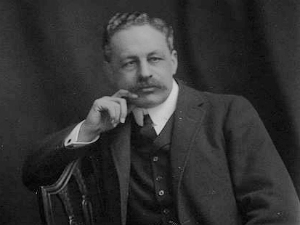
Sir Halford Mackinder: The father of geopolitics.
 
To keep the revolutionary Russian government weak, he argued, it would be necessary to construct a “cordon sanitaire” of Western-oriented regimes out of bits of the now defunct Austro-Hungarian, German and Russian Empires. Crucially, among the territories to be included in Mackinder’s list of westward-oriented buffer-states were Georgia, Byelorussia and the Ukraine.
 
According to Mackinder’s own “Heartland” theory, whichever great power, or combination of great powers, ended up acquiring these territories – especially the Ukraine – would soon be in a position to rule the world. This was because the possession of these territories would open the way to the strategic heart of what he called “The World Island” – the geographically contiguous Eurasian and African land-masses.
 
Mackinder’s infamous geopolitical formula: “Who rules East Europe commands the Heartland; Who rules the Heartland commands the World Island; Who rules the World Island commands the World”; was to inspire not only Adolf Hitler, but an alarming number of American geostrategic thinkers throughout the Cold War.
 
 
Geopolitics For Beginners: Frank Kapra's Why We Fight - a motivational series of films produced for American servicemen during World War II - leans heavily (and without attribution) on Mackinder's geopolitical theories. That  they were seized upon by German nationalists in the 1920s and 30s rendered Mackinder's ideas unfit for polite public discussion. (But not for Cold War strategy sessions!) The relevant section begins about 4 minutes in.
 
These same geostrategic thinkers, confronted with the unexpected collapse of the Soviet Union, immediately sought to apply Mackinder’s formula. The US and its Nato allies were urged to take control of East Europe as quickly as possible.
 
What was surprising was that the West European states, freed from the threat of Moscow’s armoured divisions, were unwilling to assert a more independent course. In spite of seeing the ruin all previous attempts to apply Mackinder’s geopolitical formulae had wrought upon Europe, her leaders made no attempt to restrain their American counterparts.
 
Perhaps those European leaders would have tried harder, had they known that Russia’s rising political star, Vladimir Putin, and his sinister coterie of foreign policy and military advisers, were every bit as enthusiastic in their admiration for Sir Halford Mackinder’s theories as their hawkish American adversaries. The West is not going to be permitted to rule East Europe on their watch. Not while Russia still commands nuclear weaponry.
 
Contemplating the outbreak of World War III is no joke.
 
This essay was originally published in The Waikato Times, The Taranaki Daily News, The Timaru Herald, The Otago Daily Times and The Greymouth Star of Friday, February 27, 2015.