Showing posts with label Russo-Ukrainian War 2022. Show all posts

Friday, 30 December 2022

2022: Annus Horribilis.

Trauma: The catastrophic conclusion to the anti-vaccination mandate protest in Parliament Grounds on 2 March 2022 is seared in the minds of New Zealanders. Those dramatic scenes were, however, easily eclipsed by the planetary violence of Climate Change, the biological violence of Covid-19, the political violence of Three Waters, and the deadly military violence of the Russian Invasion of Ukraine.

AS THIS TERRIBLE YEAR, this annus horribilis, draws to a close, we must all hope that 2023 brings us happier days.

As we watch the Chinese Government transition from its old, hardline, Covid-19 elimination strategy, characterised by long and uncompromising lockdowns, to a new, laissez-faire, wide open borders (and bugger the health system) strategy, uncannily like our own, we have confirmation that not even the totalitarian regime of Xi Jinping’s Communist Party can operate indefinitely without a social licence.

Not that our own government is returning the compliment by acknowledging the lack of genuine social licences for its own flagship policies – and changing them. There is more than a whiff of totalitarian indifference to public opinion in the Labour Caucus’s blunt refusal to change course on Nanaia Mahuta’s Three Waters project.

When the results of the local government elections made it painfully clear that whatever limited social licence central government might have claimed for Three Waters had been withdrawn, the Labour Government refused to flinch. The former National Party Cabinet Minister Nick Smith, now Nelson’s Mayor, implored the Prime Minister, Jacinda Ardern, to back away from the project. Failure to do so, he suggested, would indicate that her government had a “death wish”.

Undeterred, Labour doubled-down. Constitutional conventions became confetti. The co-governance provisions of Three Waters became stronger and their likely impact on Māori-Pakeha relations even more divisive.

And this situation looks set to be made ten-times worse the moment the public cottons-on to the fact that the cost of borrowing the billions required to “fix” their drinking-, storm- and waste-water systems is to be extracted from the pockets of the poor schmucks who “own” – but do not control – the four vast “entities” at the heart of the Three Waters project. A bitter realisation, that will hit home about the time they open their new-fangled water bills.

The Labour Government’s intransigence on Three Waters was not, however, matched by its response to the ever-increasing clamour for decisive state action on global warming. Far from becoming this government of Gen-Xers’ “nuclear-free moment”, the Labour-Green tag-team on Climate Change has impressed New Zealanders only by its prodigious ability to dilly, dally and delay. If the New Zealand football team possessed this government’s talent for kicking the can down the road, they could have won the World Cup!

Maybe, if Labour possessed an environmental faction as strong as its Māori faction more progress might have been made on Climate Change. But, if the Government refuses to be guided by public opinion on the deeply unpopular policy of co-governance, it is acutely sensitive to the social and economic realities that continue to keep SUVs at the top of the list of motor-vehicles purchased in New Zealand. When pushbikes replace four-by-fours in Kiwi affections, it is then – and only then – that our carbon emissions will plummet.

Covid, Co-Governance and Climate-Change may have helped to shape the domestic politics of New Zealand in 2022, but they have done so in the shadow of something much larger and more terrible than anything we Kiwis could conjure-up.

War.

Russia’s bloody invasion of Ukraine has dealt what looks like being the final death-blow to the “international rules-based order” overseen by the United Nations. What we deplored, then ignored, in Syria, has come home to the cursèd bloodlands of Eastern Europe.

The global economic system, already rendered dangerously fragile by the financial measures required to fight the Covid-19 pandemic, has received a vicious kick in the gonads from Russia’s combat boots. Rising inflation has ignited multiple cost-of-living crises – even in the world’s wealthiest countries – precipitating social and political conflicts not seen for nearly half-a-century.

But Vladimir Putin’s aggression has done something else. It has stimulated martial feelings long thought dead and buried in the materially abundant (but spiritually impoverished) societies of the West.

The Russo-Ukraine War has not produced a global peace movement – even under Putin’s constant threats of nuclear escalation. On the contrary, it has generated a “war movement”. Prior to 24 February 2022, Volodymyr Zelensky would not have struck most people as the man to revive the Latin verse: Dulce et decorum est pro Patria mori – Sweet it is and fitting to die for one’s country.

When the heroism and sacrifice of war seem preferable, and more honourable, than an enervated peace, it is, truly, a terrible year.


This essay was originally published in The Otago Daily Times and The Greymouth Star of Friday, 30 December 2022.

Tuesday, 13 September 2022

The Ukrainian “People’s Storm” Lays Waste Putin’s Dreams.

Old Men And Boys: The Russian soldier pictured on the right has a white beard and looks to be in his sixties. He is standing before a Russian lorry and is carrying a Kalashnikov automatic rifle. But, the most remarkable detail of this photograph, circled in red by whoever sent it, is what this soldier is wearing on his feet. No combat boots for this man. He is expected to go into battle wearing plastic sandals!

AS ALLIED ARMIES were closing in on Nazi Germany from the East and the West, Joseph Goebbels launched the Volkssturm. Inspired by the great popular uprising of ordinary Germans against Napoleon, the Volkssturm (Peoples Storm) was composed of the very last reserves of German manpower. Old men and teenage boys were handed an armband and an anti-tank weapon and ordered to resist – to the death – the vast Allied armies advancing relentlessly, and unstoppably, towards the German heartland.

The creation of the Volkssturm was not just a hopeless gesture, it was a profoundly wicked one. By early 1945, Germany had already lost the war. Continued resistance was utterly futile. To send out old men in their sixties, and boys as young as twelve, to fight highly-trained and well-equipped soldiers was nothing short of murder. Only the leaders of a government bereft of ethics, who had lost all contact with the real world, could contemplate such a disastrous call-up.

What then should we make of the photograph posted on the website Tea Leaves and Russia showing what is purported to be a Russian soldier. The man has a white beard and looks to be in his sixties. He is standing before a Russian lorry and is carrying a Kalashnikov automatic rifle. But, the most remarkable detail of this photograph, circled in red by whoever sent it, is what this soldier is wearing on his feet. No combat boots for this man. He is expected to go into battle wearing plastic sandals!

Now, it is important to own up to the possibility that the photograph might be a fake. That what we are actually looking at is a Ukrainian grand-dad doing his bit for his country’s war effort by pretending to be this poorly-equipped Russian conscript-of-last-resort. Vladimir Putin’s Volkssturm.

But if the photograph is genuine: if this is the quality of the reserves Putin is throwing into the fight; then the general collapse of the Russian Federation (RF) forces in the face of the general offensive of the Armed Forces of Ukraine (AFU) is explained. Against a military force trained and equipped with the latest high-tech weapons by the Americans and their Nato allies, whose commanders, unlike their Russian counterparts, are encouraged to take the initiative and make their own battlefield decisions, and whose already sky-high morale is now off-the-scale, the RF has very little to offer by way of effective resistance.

Images recorded on the advancing AFU troops’ smartphones show tanks and armoured vehicles abandoned on the roadsides. Perhaps they are empty of fuel. Perhaps they have no more ammunition left to fire at the enemy. Whatever the explanation, their crews have fled towards the east, desperate to reach the safety of the Russian border. Moscow is attempting to portray this as a “regrouping” – it is no such thing. What the world is looking at here (at least that part of the world which is not obsessively following the “coffin” – i.e. the body – of the late Queen on its journey south to London) is not a “re-grouping” – it’s a rout.

Just how serious the situation has become for the Russian Government of Vladimir Putin is captured in these words to the Russian President, supposedly spoken by a representative of the leadership of the Russian General Staff:

“Our troops have no more offensive capabilities, and soon there will be no more opportunities for defence. You lost Vladimir Vladimirovich!”

Taken together with the already confirmed reports of representative bodies in St Petersburg and Moscow passing resolutions demanding Putin be charged with treason, and reports of military movements in the capital suggestive of preparations for a military coup d’état, it is difficult to resist the conclusion that Putin’s political (and personal?) survival must now be considered doubtful.

Putin and his coterie of supportive oligarchs, bureaucrats, and politicians will be desperate, now, to fix the blame for the military catastrophe unfolding across Eastern Ukraine on his battlefield commanders. His mouthpieces are already calling for the execution of these “treacherous generals”. The military commanders of the Russian Federation must, therefore, move with the utmost haste to protect themselves from the wrath of “Vladimir Vladimirovich”. By decapitating the political leadership, before it decapitates them.

Not only is the personal survival of these principal players at stake at this critical moment, but so, too, is the general shape and structure of the Russian Federation.

In 1905, the Russian Czar, Nicholas II, suffered a catastrophic naval defeat at the hands of the Japanese Empire – an “upstart” power whose military capabilities the Russians had fatally underestimated. The result was a nationwide uprising which came within an ace of overturning the Russian autocracy.

Putin’s oligarch allies will not want defeat at the hands of the “upstart” Ukrainians to spark a third Russian revolution. Better to depose Putin quickly and cleanly, make peace with Ukraine, and restore a measure of normality to the Federation, Europe, and the world in general. As Bob Dylan has the gangster Joey Gallo say in his eponymous ballad: “It’s peace and quiet that we need to go back to work again.”

At any other time, developments on this scale, and of this importance, would be dominating our headlines and, like the Ukrainians themselves, the rest of the world would be following the advance of their forces with bated breath. Only time will tell whether the Western World’s utter distraction by the death of Queen Elizabeth II, and the accession of King Charles III, was a help or a hindrance to the Ukrainian offensive.

It is, however, possible that the Queen’s death, by distracting the West, prevented its more hawkish leaders from making the sort of accusations and threats that only ever end up strengthening Putin’s hand. That Ukraine’s armies racked up their victories while the eyes of the West were elsewhere, may yet prove to have been the most extraordinary stroke of good luck.

By dying when she did, the Queen may well have saved the life of that sandal-wearing Russian greybeard, as well as tens-of-thousands of equally ill-equipped and poorly-trained Russian troops, and given the Armed Forces of Ukraine the clear airwaves they needed to drive Putin’s armies back across the border.

Goebbel’s Volkssturm could nor rescue the Third Reich, but Volodymyr Zelensky’s “Peoples Storm” (with a little help from the Americans) has made it possible for Ukraine to lay waste the fondest hopes of Vladimir Putin – and his allies in Beijing.


This essay was originally posted on The Daily Blog of Tuesday, 13 September 2022.

Friday, 5 August 2022

Seating Arrangements

Proximate Cause:  Tellingly, it was Helen Clark who was seated close by when, earlier this week, Jacinda Ardern delivered a speech carefully crafted to keep New Zealand’s dairy exports heading China’s way. Photo by Politik

PURISTS WOULD ARGUE that New Zealand’s foreign policy should not be determined by who its Prime Minister sits next to. Their preference would be for consistency of message and predictability of action at all times.

Easier said than done, of course. Contradicting the President of the United States when you’re seated next to him in the White House would be a diplomatic incident in its own right. Small wonder, then, that Jacinda Ardern decided that when in Washington, talk like a Washingtonian.

Ms Ardern is not so naïve, however, as to imagine that both the tone and the vocabulary of her Washington pronouncements would go unnoticed by those who speak the language of Beijing.

Aware that the New Zealand Prime Minister’s next stop would be the Nato summit meeting in June, China’s diplomats opted to remain silent. They were keen to hear what she would say when she was seated next to the Nato Secretary-General, Jens Stoltenberg.

In the official White House communique of 31 May 2022, President Joe Biden and Ms Ardern jointly singled out the Peoples Republic of China as “a state that does not share our values or security interests”, noting that any Chinese attempt to establish “a persistent military presence in the Pacific” would, by fundamentally altering the region’s strategic balance, give rise to national security “concerns” in both New Zealand and the USA.

One month on, the heady incense of Ukraine’s heroic resistance to Russian aggression which suffused Nato’s Madrid summit (28-30 June 2022) seemed only to brighten the militaristic glint in the New Zealand Prime Minister’s eye. Impressed, no doubt, by the lengthening geopolitical reach of the Nato partners – now extending all the way to the Indo-Pacific – Ms Ardern wound her diplomatic rhetoric up a notch. China, she said, “has in recent times also become [like Russia] more assertive and more willing to challenge international rules and norms.”

This was too much for Beijing. China’s Wellington embassy described Ms Ardern’s comments as “wrong and thus regrettable” and “not helpful in building trust”.

To the untrained ear, this may sound like a mild rebuke. But to those, like the Australians, who have, in the relatively recent past, forfeited China’s trust, the economic penalties following such rebukes have been anything but mild.

It’s all very well to stand shoulder-to-shoulder with the shieldmaidens of Finland, Sweden, Estonia and Denmark and breathe in the heady perfume-du-jour – L’air du Cordite. But, eventually, all New Zealand Prime Ministers are obliged to get off at the World’s last bus-stop and breathe in L’air du Cow.

Not for nothing is our foreign service dubbed MFAT – the Ministry of Foreign Affairs and Trade. By asserting the indissoluble linkage of New Zealand’s diplomatic and economic interests, our diplomats might just as easily have called themselves the Ministry of Milk Fat. It has always been thus. In two world wars we traded blood for butter, and, even today, it is the brute calculation of who pays for what that ultimately determines our allegiances.

Ms Ardern may have thrilled to the martial music of our “traditional allies” and longed to strike the heroic poses of her North European counterparts but, for all their war songs, the Americans and the EU nations weren’t offering to bankrupt their own dairy farmers by taking all the milk solids we can send them.

Thankfully, at least some of the employees of MFAT still have their eyes on the only prize that matters – the well-being of New Zealanders. Thankfully, some still understand that the only “national security” worth a damn is the security that comes from being able to pay your country’s bills. And the only country making it possible for us to do that; the only country willing to take all the milk solids we can send; is the Peoples Republic of China.

To her credit, Prime Minister Ardern always comes back to that single, crucial, fact of New Zealand economic life. It helps that the National Party’s foreign affairs spokesperson, Gerry Brownlee, “gets it” too. Even more helpful is the fact that the woman who negotiated New Zealand’s free trade agreement with China is as alive and alert as ever.

Tellingly, it was Helen Clark who was seated close by when, earlier this week, Jacinda Ardern delivered a speech carefully crafted to keep those milk solids heading China’s way.


This essay was originally published in The Otago Daily Times and The Greymouth Star of Friday, 5 August 2022.

Friday, 10 June 2022

Our Least Worse Option.

We Can Be Heroes: Ukrainian newly-weds pose for the cameras before heading-off to the front-lines. The Russo-Ukrainian War has presented young people with the inescapable reality of heroism. They see Volodymyr Zelensky in his olive-drab T-shirts; they see men and women their own age stepping-up to do their bit. They have learned that there are some things worth fighting for – worth dying for. They have also learned how to say: Sláva Ukrayíni! – Glory to Ukraine! 

THERE ARE MOMENTS in history when the essential powerlessness of our leaders stands exposed for all their people to see. Moments when they are struck forcefully by the brutal realisation that they have no good options – only the least worse ones. The manner in which they respond to these moments is critical.

Volodymyr Zelensky, for example, presented with the reality of Russian forces rolling across Ukraine’s borders at multiple points, had to accept the reality that his worst nightmare was now upon him. The man who had campaigned on promises of peace, now faced war with an enemy the whole world expected to be rumbling through his capital city within three days.

The Americans famously offered Zelensky a ride out of harm’s way. He refused. Faced with no good options, he chose what was, morally, the least worse: he stayed where he was. Outnumbered and outgunned, he nevertheless vowed to defend his homeland and his people.

And the hearts of the peoples of the West beat a little faster. After the shame of the cowardly flight from Afghanistan, the spirits of Westerners were lifted. Everywhere, from the battlements of Edinburgh Castle, to the rooftops of Dunedin, Ukraine’s blue and yellow banners suddenly blossomed, like bright flowers of freedom.

To the immense relief of their elders, young people were presented with the inescapable reality of heroism. They saw Zelensky in his olive-drab T-shirts; they saw men and women their own age stepping away from their university studies; saying farewell to their workmates; and presenting themselves to be trained in the operation of deadly weapons. They learned that there are some things worth fighting for – worth dying for. They also learned how to say: Sláva Ukrayíni! – Glory to Ukraine!

How much easier it would have been: not only for Vladimir Putin and the Russian Federation, but also for the West itself, if Zelensky had taken that ride. If Kyiv had fallen in three days and a puppet government subservient to Moscow had been installed. Diplomatically, the world would have been confronted with a convenient fait accompli. Western leaders, most particularly, President Joe Biden, would have huffed and puffed. Sanctions of a largely cosmetic nature would have been imposed. And that would have been that.

The waters of the world, briefly disturbed, would have returned to their former placidity. And the children of the West would have received yet more lessons from their leaders. That might makes right. That nothing is worth fighting for. That heroism is dead.

It has taken the example of Zelensky to make us understand, fully, the true political magic of Winston Churchill’s example in 1940. France had fallen, and those who purported to speak the language of realism argued that Great Britain was “irredeemably lost”. The world expected to learn, any day, of Britain’s surrender, confirming the irreversible advance of fascism across the entire globe. But, Churchill said “No!” Refusing to bow to the “inevitable”, he vowed that Britain would “never surrender”.

The flame of freedom, guttering, grew suddenly stronger and brighter. The darkness hesitated and drew back. Hope sang – like a nightingale in Berkeley Square.

So, what do we do now? Now that Ukraine is fighting for us all? Now that we can no longer afford to let her lose? What is the least worse option being offered to our own leader, Jacinda Ardern?

She may already have taken it.

Diplomatically and militarily the game is changing. Russia and China are already allies – and only likely to grow closer together. Against the fluttering complexities of liberty and democracy, they will offer the straight lines and sharp edges of authoritarianism. In place of the heady wines of freedom, they will offer the opium of security.

It would be most unwise to believe that this new Eurasian behemoth will not find friends. The wounds inflicted by the West still bleed in many countries. Among the victims of imperialism, the virtues of democracy and freedom are often obscured by tears.

But, if we would not shed tears of our own, then we must look to our own safety. At the end of this month, Prime Minister Ardern will attend the Nato Summit. Alongside Australia’s Anthony Albanese, she will hear plans for a great Western alliance extending the protections of collective security well beyond the North Atlantic.

Our least worse option.


This essay was originally published in The Otago Daily Times and The Greymouth Star of Friday, 10 June 2022.

Monday, 6 June 2022

Summer Is Coming.

A Sun-Hardened Road To Victory: The point of maximum danger will come if/when a day arrives when the Russian forces in Ukraine lose all offensive capability and begin to fall back under Ukrainian pressure. That moment is likely to come when the state-of-the-art weaponry currently being dispatched from the United States is effectively deployed on the battlefields of Ukraine. Weapons with the power to shut down the massive artillery barrages Russian military commanders rely upon to take their objectives.

THE AMERICANS are doubling down on their commitment to keep the Ukrainian armed forces in the field against the Russians. The Biden Administration’s decision to dispatch another billion-dollars-worth of state-of-the-art artillery to Kiev has been met with fury in Moscow. The rage of Putin and his mouthpieces is understandable. Washington is giving the Ukrainians the weapons they need to keep the devastating Russian self-propelled guns out of range of the Donbass cities Moscow must take to secure anything remotely resembling victory.

What do the Americans know about Russia’s present military situation that makes them willing to incur Putin’s wrath in this way? The Russian President has warned the United States and its Nato allies repeatedly that the supply of weapons capable of fundamentally altering the strategic balance of its “Special Military Operation” in Ukraine will produce unimaginable consequences. By this, Putin is clearly alluding to the Russian Federation’s nuclear capability. “Give Ukraine too much help,” he is saying, “and I’ll use my nukes.”

That’s a big bluff to call.

To find out why Biden and his Defence and National Security advisors may be willing to call Putin’s bluff, we have to go all the way back to January and February of this year. From the wealth of detail relating to Russia’s offensive plans for Ukraine – subsequently borne out by the facts of the Russian invasion – it is clear that there had been a massive breach of Russian military security. Somehow, the Americans were reading Russia’s political and military leaders’ mail.

Obviously Putin, himself a counter-intelligence specialist, took steps to close up the breach. Senior figures in the political and military hierarchy started blipping off Russian screens.

Job done?

Apparently not.

It is highly doubtful that the Americans would feel confident enough to call Putin’s nuclear bluff if they did not have it on very good authority, from those in a position to do so, that any move toward the tactical or strategic use of nuclear weapons by the Russian President will result in his immediate deposition.

This could mean something thoroughly cinematic – like a patriotic bodyguard drawing his pistol, shooting Putin and his advisers dead, crying “Long Live Russia!” and then turning the weapon on himself. Alternatively, it could involve the commanders of Russia’s Strategic Rocket Forces sending an H-Bomb tipped missile hurtling into Putin’s supposedly blast-proof nuclear bunker. (Spoiler Alert: There’s no such thing.) Or, it could amount to senior officers in the know quietly communicating Putin’s location to the Americans in sufficient time for them to carry out the deposition themselves.

Certainly, there can be little doubt in the minds of senior Russian commanders that the Americans know pretty much exactly where they are at any given moment of the day or night. The sheer number of Russian commanders killed by sniper-fire or drone-strikes since 24 February makes that terrifyingly clear. They will also know that if Putin is insane enough to actually order a tactical nuclear strike, the American response will be a massive, decapitating, counter-strike that will leave Russia leaderless and rudderless. Precisely because Russian nuclear-war-fighting doctrine devolves launch authority, in extremis, to battlefield commanders, the Americans will make damn sure that there are no battlefield commanders left alive.

In the context of this discussion it is important to remember that when the world was literally on the brink of Nuclear Armageddon in October 1962, it was the good sense and humanitarian instincts of the political commissar aboard a Soviet nuclear-armed submarine under attack from US Navy-launched depth-charges, off Cuba, who persuaded the vessel’s commanders not to respond with its nuclear torpedoes. By refusing to put his key in the unlocking mechanism, he saved himself, the crew, and the whole world from nuclear annihilation.

There is absolutely no reason to suppose that Russian patriots have become so extreme that, rather than depose a delusional and potentially genocidal president, they would see the whole of Mother Russia – along with the rest of the planet – reduced to a radioactive ash-heap. Nor is it fanciful to suppose that Russia’s most intelligent and capable citizens have not long since realised that their country has no viable future as an independent nation if it persists in the folly of attempting to “Make Russia Great Again” by force of arms. The only questions that matter now are: How many of those intelligent and capable citizens are there in the upper echelons of the Russian armed forces? And: How many of them have a working back-channel to the US Joint Chiefs of Staff?

The point of maximum danger will come if/when a day arrives when the Russian forces in Ukraine lose all offensive capability and begin to fall back under Ukrainian pressure. That moment is likely to come when the state-of-the-art weaponry currently being dispatched from the United States is effectively deployed on the battlefields of Ukraine. Weapons with the power to shut down the massive artillery barrages Russian military commanders rely upon to take their objectives.

In the hugely popular television series, Game of Thrones, the stark warning that “Winter is coming” struck fear into the hearts of all the peoples of Westeros. Along the bitterly contested battle-lines of the Russo-Ukrainian War, the warning that should strike fear into the Russians’ hearts is the seasonal opposite of the Game of Thrones. Not the bitter snows of winter, but the sun-hardened fields of the Ukrainian plains, across which the Blue and Yellow Walkers can move with deadly speed.

What stark warning should Putin fear?

“Summer is coming.”


This essay was originally posted on The Daily Blog of Friday, 3 June 2022.

Tuesday, 31 May 2022

The World’s Rapidly-Changing Strategic Environment.

In Mandarin, Taiwan is spelt U-K-R-A-I-N-E: It is all very well for President Joe Biden to pledge his country’s military intervention should China invade Taiwan, the real trick is making Beijing believe him. Why would it, when Washington has been so careful to ensure that its own forces, and those of other Nato members, do not come into contact with Russian military units. After all, China’s nuclear arsenal is no less apocalyptic in its potential than Russia’s. 

“TIME IS SPEEDING UP”, says Wigram Capital Advisors’ principal Rodney Jones. His reference is to the speed at which the geopolitical situation is being transformed by the actions of Russia and China. Specifically, Jones is alluding to the presence of the Chinese Foreign Minister, Wang Yi, in the capitals of the South Pacific and the prospect of at least ten of the region’s micro-states being drawn into a “China-Pacific Island Countries Common Development Vision” by Beijing. As Jones forcefully reminds us, the “generally benign strategic environment” in which Prime Minister Helen Clark blithely located New Zealand more than twenty years ago, is long gone.

The Chinese Government, sensing a measure of disarray in US foreign policy, has not lost any time taking advantage of the global confusion and alarm caused by the Russian Federation’s invasion of Ukraine. Looking past the ardent demonstrations of support for the Ukrainian Government’s resolute defence of its territory, Beijing has calculated that this enthusiasm will fade as the economic consequences of the war begin to be felt by the peoples of Europe and North America – not to mention Australians and New Zealanders.

It is all very well for President Joe Biden to pledge his country’s military intervention should China invade Taiwan, the real trick is making Beijing believe him. Why would they, when Washington has been so careful to ensure that its own forces, and those of other Nato members, do not come into contact with Russian military units. After all, China’s nuclear arsenal is no less apocalyptic in its potential than Russia’s. Biden’s monosyllabic tough-talk could only have been a bluff, and the White House’s immediate walking-back of his bellicose pledge into the relative diplomatic safety of “strategic ambiguity” proved it.

Not only that, but Biden’s resort to bluff can only serve to deepen Beijing’s conviction that the United States no longer feels confident that its military strength is equal to the challenge of the emerging Eurasian duumvirate. In this regard, the meeting in Tokyo of “The Quad” (USA, Japan, Australia, India) may not have delivered the geostrategic warning to Beijing that the Americans intended.

Anthony Albanese is not Scott Morrison, and the stance adopted by the new Labor Government of Australia seems likely to be considerably less belligerent than its predecessor. If the global economy continues to weaken, it is also quite likely that the folly of equipping Australia with eight nuclear-powered submarines will be postponed indefinitely.

The announcement of the trilateral AUKUS (Australia, United Kingdom, United States) Pact in September 2021 is unlikely to have impressed China’s military leadership, most particularly since the US’s most powerful Quad allies, Japan and India, were not persuaded to join. To the Communist Party of China, the Anglophone AUKUS will have all the appearance of an absurd imperial anachronism. Once again, the impression conveyed is of a flailing and failing United States.

Of much more interest to the Chinese will be the reaction of the Indian Government to the Russo-Ukrainian War. India’s ties to Russia are strong, making it a less than vehement supporter of the West’s ruinous sanctions regime. Nor can New Delhi be insensible to the potential strategic challenges arising out of the Sino-Russian “entente” of 4 February 2022.

The Indian Prime Minister, Narendra Modi, will be observing with keen interest President Vladimir Putin’s ability to withstand the economic warfare unleashed upon his country by the West. Should the Russian Federation’s military forces begin to gain the upper-hand in Ukraine, and if China’s financial support renders the sanctions regime bearable, then Modi and India’s political class will have some serious thinking to do.

Does it make sense for a non-European nation like India to be perceived as some sort of Western lap-dog? Especially when it could, instead, become a crucial part of the Eurasian superpower fast emerging as the nemesis of the imperialist West?

If India goes, can the oil-rich nations of the Middle East be far behind?

All too aware of the energy vulnerability of the United States – not to mention the acute sensitivity of the American electorate to ‘rising gasoline prices at the pump’ – some US legislators are already attempting to throw their weight around on the question of how much oil the member states of OPEC should be sucking out of the ground. Threats of passing legislation allowing the United States Government to seize the American-based assets of “uncooperative” OPEC states are unlikely to impress the Saudis or their Arab allies. The defection of key oil producers to “Eurasia”, and the end of the US dollar as a fiat currency, would also spell the end of American/Western hegemony.

Even if Eurasia fails to materialise as the new global hegemon, the continued global dominance of the United States still cannot be taken for granted. Beijing will be paying as much attention as Moscow to the outcome of the 2022 mid-term congressional elections. Most political scientists agree that the chances of the Democratic Party retaining control of the House of Representatives and the Senate are close to zero. But, if the Republicans come surging back, then the potential for serious internal disorder breaking out in the United States is very high. Not only can a house divided against itself not hope to stand, but it also cannot possibly bend the rest of the world to its will.

With all of the above potentialities for Western disaster in play, it is not difficult to understand why, all over the world, the Chinese are actively probing for points of weakness. The South Pacific has clearly been identified by the geopoliticians in Beijing as an area ripe for the insertion of Chinese money and influence.

There will be those in the New Zealand foreign affairs community who respond to this probing with all the flatulent bombast of the pith-helmeted imperialists of yesteryear. These are the armchair warriors who are currently urging the Labour Government to tell the Chinese to “Clear orf out of ‘our’ backyard!” As if, like the Russians, we regard nearby, supposedly independent, nation states as falling within our sphere of influence.

Fortunately, however, there are also foreign affairs and trade specialists who understand that ‘national security’ is not simply about military force and the ability to project it aggressively. No nation can call itself secure if its economy is falling apart, and it people falling into poverty. As this country’s largest trading partner and key export market, China is not a country New Zealand should be in any hurry to infuriate and/or alienate. And, there are plenty of Australian politicians and businesspeople who feel the same way.

New Zealand’s “generally benign strategic environment” has not been undermined by the Pacific’s rising superpower. History teaches us that it’s the waning superpowers, edged-off the geopolitical stage by more dynamic rivals, that the world’s small and vulnerable states have most reason to fear.


This essay was originally posted on the Interest.co.nz website on Monday, 30 May 2022.

Friday, 29 April 2022

Armies Of The Dead.

Not Forgotten, Or Forgiven: At this moment our television screens are filled with stories featuring Ukrainians and Russians. Over the course of the past century, both of these peoples have endured almost unbelievable levels of pain, rage and guilt. The statue pictured above, entitled The Bitter Memory of Childhood is part of the national memorial to the Ukrainian Famine in Kyiv.

WHERE DOES PAIN, rage and guilt go? At the level of the individual human-being, psychologists are confident that they go to the construction of a personality which reflects and all-too-often reproduces these searing experiences.

As the British poet W.H. Auden wrote on the eve of war in September 1939:

I and the public know
What all schoolchildren learn,
Those to whom evil is done
Do evil in return.

The truth of this bleak observation is borne out in virtually every programme screened on the Crime & Investigation channel of Sky Television. In the back-story behind the most terrible crimes there are almost always harrowing tales of childhood trauma and abuse. As the branch is bent, so grows the tree. Serial killers are not born, they are made.

But what about whole collectivities of human-beings? What about the peoples and nations that have experienced pain, rage and guilt? Where does it go?

At this moment our television screens are filled with stories featuring Ukrainians and Russians. Over the course of the past century, both of these peoples have endured almost unbelievable levels of pain, rage and guilt. It stretches credulity well beyond its breaking-point to suggest that what happened between the outbreak of the First World War and the end of the Second did not leave its mark on both Russia and Ukraine.

The deliberate creation of famine in Ukraine by the Soviet government of Russia is estimated to have led directly to the deaths of between 3 and 7 million people – most of them peasant farmers.

The details of this political crime, almost too awful to read, have been compiled by historian Timothy Snyder in his book Bloodlands: Europe Between Hitler and Stalin.

Those fortunate enough to live in Ukraine’s towns and cities did not die in anything like the same numbers. But their survival came at a price. They were forbidden by the Communist Party commissars from feeding the skeletal creatures that appeared like wraith’s in their streets and squares. They died where they fell, were loaded on to trucks, and buried under cover of darkness in mass graves.

What does that do to people? Where do the emotions stirred up by such behaviour go?

A partial answer to that question came in 1941 when the Wehrmacht rolled across the Soviet border into Ukraine. Hundreds-of-thousands of Ukrainian nationalists collaborated with the German invaders. It was the local knowledge of these Ukrainians which allowed the German Einsatzgruppen to round up and kill their communist neighbours.

Seeking retribution from those they held responsible for the needless deaths of family and friends is, at least, comprehensible. But the ferocity with which Ukrainians fell upon their Jewish compatriots is beyond rational explanation. Only recently has grainy film footage of these 1941 pogroms come to light. It is the stuff of nightmares. The Holocaust had many helpers.

Russians and Ukrainians are not, of course, alone in perpetrating the most heinous of crimes against their neighbours. Like so many others guilty of similar atrocities, however, the perpetrators were required to bury the terrible memories that came with them. Years of silence. Decades of nightmares. Lifetimes of unacknowledged trauma. How can their effects not have bled into the social tissue of the nations involved? A moral gangrene that spread and spreads.

Not only that, but among the many thousands of historical killers were some who actually enjoyed the killing. Deriving pleasure from causing pain and suffering is not information most human-beings are all that eager to share – at least not explicitly. The intergenerational consequences of such psychopathology’s indirect communication can only be guessed at. How have the children of these monsters been spending their emotional inheritance?

For most Westerners, the war unfolding in Ukraine makes no sense. Russians and Ukrainians look the same, speak the same languages, have lived lives that were, until very recently, culturally indistinguishable. Why are they fighting?

The chilling answer is that both sides are commanded by ghosts. It is the unquiet dead, the unpunished crimes, the gagged memories of countless perpetrators and their victims that drive these armies forward. Impulses barely understood, inherited from parents and grandparents who could neither speak about nor forget the horrors they had witnessed or performed.

Two nations to whom great evil has been done are being driven, by dead hands, to do evil in return.


This essay was originally published in The Otago Daily Times and The Greymouth Star of Friday, 29 April 2022.

Friday, 15 April 2022

Where Is The Peace Movement?

Casus Belli: The bodies in the street, the terrible revelations of rape and torture: these only make matters worse. Our instinctive response, when confronted with such images is not to calmly contemplate the best means of extricating all concerned from the horrors of war, but to punish those responsible for such atrocities.

WHY HAS THE RUSSO-UKRAINIAN WAR not generated a global movement for, at the very least, an immediate cessation of hostilities? The aggressor, Russia, possesses nuclear weapons, and has issued thinly-veiled threats that it is prepared to use them if any other power attempts to interfere in its “military operation” in Ukraine. The slightest miscalculation, therefore, could trigger an all-out nuclear exchange – and the end of civilisation as we know it. In such precarious circumstances, mobilising global support for a peaceful resolution to the conflict seems like a good idea. So, why isn’t it happening? Where is the peace movement?

Before attempting an answer to that question, it is worth casting our minds back to the first quarter of 2003. The United States and the United Kingdom were engaged in obvious preparations for a full-scale military invasion of Iraq. All over the world people were gathering in huge demonstrations to oppose the US/UK plans. Over a million protesters flooded the streets of the UK’s largest cities in what was, almost certainly, the largest political protest in the nation’s history. Vast crowds similarly thronged the streets of American cities. In France, Italy and Germany it was the same. Time magazine described the global peace movement as the other great power on the planet.

All to no avail. Like the Russian Federation, the United States was not about to be dissuaded from doing what it believed it had to do. That it would go to war without the sanction of the UN Security Council, and on the basis of intelligence claims that most independent experts dismissed as spurious, was not about to slow the administration of George W Bush down. Peace movement or no peace movement, the invasion would go ahead as planned.

The demonstrable futility of the international protest movement against the Iraq War offers a pretty solid explanation for the absence of a global pacifist response to the Russo-Ukrainian War. Among those coming of age in the first quarter of the Twenty-First Century, it may simply be understood that if a major power is resolved to attack another country, no amount of chanting and placard-waving will stop it. Didn’t the UK Prime Minister Tony Blair’s spin-doctors respond to media taunts that there were a million citizens on out on the streets, by referencing the tens-of-millions who weren’t?

The other obvious lesson to be drawn from the global protests against the US/UK invasion of Iraq is that they would never have happened (or, at least, not on anything like the same scale) had their organisers not been living in democracies. If the Russian Federation showed the same respect for fundamental human rights as the United States, it is possible that a million or more Russians would have turned out to protest the invasion of Ukraine. What the world actually witnessed on the streets of Moscow and St Petersburg was the brutal suppression of every attempt at protest by the thuggish Russian police.

It is these images of suppression and violence that bring us to the heart of the matter. People around the world rose up against the prospect of the invasion of Iraq in part because they believed that the two nations responsible, the USA and the UK, were still, in some hallowed and undefiled place, receptive to the moral case for peace. All the evidence may have pointed in the opposite direction, but, in their heart-of-hearts, the historical friends and allies of the United States and the United Kingdom wanted to – needed to – believe that they were better than the murderous bullies Bush and Blair had turned them into.

Very few people believe that some hallowed and undefiled place exists in the dark monstrosity that is the Russian state. There are no democratic orchards in Russia. The fruits of freedom and justice do not grow there. The conditions are too harsh. Even when the tree of liberty is smuggled in and persuaded to bloom, which is seldom, the flowers fade for lack of warmth. Russia is a hard, cold country, and difficult to love, even if you’ve a mind to. But no people on earth knows more about suffering – and how to share it.

And we are suffering, but not in a way that does Russia any good. Our suffering is vicarious, inspired by the pain and heroism of the Ukrainian people. How else are the people of the West supposed to feel when they are presented with the image of a Ukrainian father, now a soldier, fighting back tears as his wife and son are borne away from him on a westbound train to safety, clutching in his hands his little boy’s toy ambulance – all that is left to him? Are we supposed to be filled with an urge to make peace? Or, are we already part of the war?

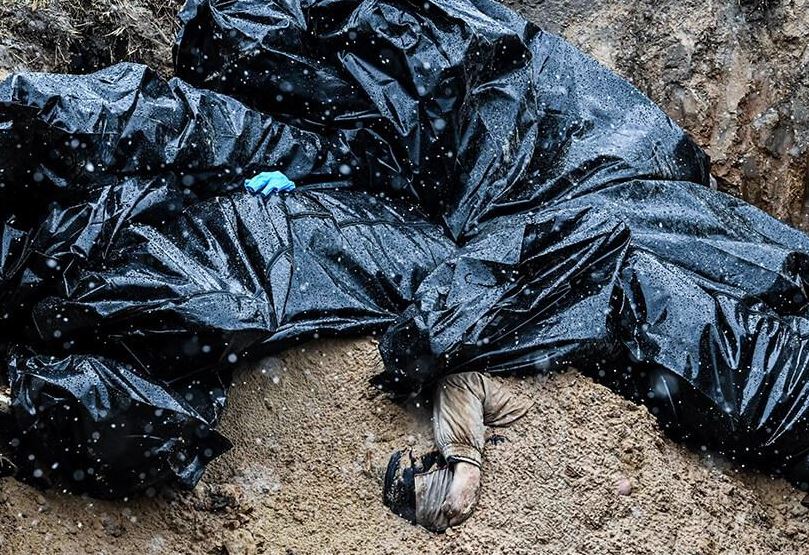
The bodies in the street, the terrible revelations of rape and torture: these only make matters worse. Our instinctive response, when confronted with such images is not to calmly contemplate the best means of extricating all concerned from the horrors of war, but to punish those responsible for such atrocities. Perhaps that’s what they’re intended to do. Perhaps, as the Russians insist, they are fake news. But while such images are all the world is seeing, there will be no global peace movement.

And if there is worse to come: if the wounded Russian Bear tears the Ukraine to pieces; and if the world is bombarded with ever more tragic and terrifying images of Ukraine in extremis; then it will not be a global peace movement that emerges, but a global war movement. Channeling the wild bellicosity of the masses celebrating the outbreak of the First World War, the people of the West, heedless of the nuclear danger, will cry: “Do your worst, Russia – and we will do ours!”


This essay was originally posted on The Daily Blog of Friday, 15 April 2022.

Friday, 8 April 2022

America’s To Lose: But the Outcome Of The “Great Game” Remains Unclear.

Disputed Territory: By 1991 it looked as though America’s geopoliticians had won the Great Game. The Soviet Union had collapsed, Eastern Europe was theirs for the taking, and the People’s Republic of China had allowed itself to be transformed into a giant American factory. No wonder a US State Department analyst, Francis Fukuyama, had jubilantly penned a paper entitled “The End of History”.

THE GREAT GEOPOLITICAL CHALLENGE confronting the United States is that the Americas are separated from Eurasia by two broad oceans. Since the end of the Second World War, from which it emerged as the undisputed global hegemon, this geopolitical challenge has required the American government to transform Western Europe into a military, economic and cultural appendage of the United States.

Had the United States failed to effect this transformation, its own economy would have faltered, and capitalism, as a global system, could very easily have collapsed. Making the nations of Western Europe part and parcel of the American economy – principally as borrowers of American dollars and consumers of American exports – was crucial to preserving the American people’s economic prosperity and, hence, the USA’s political stability.

Had the USA not launched the “Marshall Plan” for European recovery, and intervened aggressively in the domestic politics of France and Italy, it is practically certain that the formidable Communist Parties of those two countries would have come to power, bringing the whole of Europe under the tutelage of the Soviet Union.

And Great Britain?

The United States had taken a majority shareholding in Great Britain Ltd during the darkest days of 1940. In return for the US President, Franklin D. Roosevelt, keeping his country in the war, Winston Churchill, was forced to set in motion the dissolution of the British Empire.

It is likely Churchill consoled himself for this capitulation to necessity with fairy tales about a “special relationship” between the USA and Great Britain. No doubt he truly believed that in the unfolding history of the English-speaking peoples, Britain would be seen to have played the role of Ancient Greece to America’s Ancient Rome: peacefully blending its old empire into something new and altogether larger and more powerful.

The Americans would not have disagreed with the last bit, but they were never foolish enough to believe in the rest. Since becoming the world’s banker during the First World War, US capitalism had been aching to get its hands on the protected markets and resources of the geographically vast British Empire. The only thing the Americans were willing to share with the British was the English language.

As the Brits found out to their cost during the Suez Crisis of 1956, the sun had well and truly set on the British Empire. It had become an expensive joke. The British lion was stuffed.

Which still left the USA facing the problem of Eurasia. The Soviet Union and China might be broken and destitute after years of oppression and war, but beneath the graves and the rubble lay resources that could make them rich enough to one day compete with the United States for the rest of the world’s allegiance.

The geopolitical planners in Washington understood that American hegemony could only be sustained by making damn sure that neither Russia nor China ever arrived at that strategically critical position. What they were in the process of doing to the British Empire, they were determined, eventually, to do to the Russians and the Chinese: break them into pieces and transfer their markets and resources into the safekeeping of Uncle Sam.

By 1991 it looked as though America’s geopoliticians had done it. The Soviet Union had collapsed, Eastern Europe was theirs for the taking, and the People’s Republic of China had allowed itself to be transformed into a giant American factory. No wonder a US State Department analyst, Francis Fukuyama, had jubilantly penned a paper entitled “The End of History”.

But, the clever boys and girls in the State Department, and their moronic friends in the military and the CIA, had not factored in the extraordinary historical resilience of the Russians and the Chinese. Henry Ford had told his fellow Americans that “history is bunk” – and they had believed him. Drunk on the heady brew of their “unipolar world”, US geopoliticians had called their global victory too soon. Eventually, after twenty years of getting its ass kicked in the Middle East, the United States had to confront the inconvenient truth that Eurasia wasn’t beaten yet – not by a long shot.

Inevitably, Russia and China had produced leaders in possession of the requisite political steel to exploit the Americans’ mistaken assumption that they could command the rest of the world to dance – and it would dance. Only when it was too late did Washington understand that Moscow and Beijing has music of their own, and dance-steps with which America was entirely unfamiliar. In the global edition of Dancing With The Stars, Vladimir Putin and Xi Jinping made Bush, Obama, Trump and Biden look like flat-footed rubes.

Snapping out of their premature imperial bender, the Americans did their best to re-energise the Drang nach Osten (Drive to the East) that had been set in motion by the Soviet Union’s collapse. The United States’ geopolitical catspaw, Nato, had been expanded all the way to the borders of the Russian Federation. Washington and its surrogates were stirring up trouble in China’s western border province of Xinjiang. Bait the Bear and Poke the Dragon had become the only games in town.

But these were no sand-blasted Middle-eastern dictators they were facing. Russia and China were nuclear powers. Getting rid of Putin and Xi would require something the Americans have never been over-endowed with – guile.

Regardless, they laid a trap for Putin, baited it with Ukraine, and waited. If Russia took the bait, the United States and Nato would unleash, as one pundit put it: “an economic and cultural Barbarossa”. And if Xi was foolish enough to come to Putin’s aid, then they were quite willing to declare full-scale economic war on the People’s Republic as well. A geopolitical twofer!

Except, the imposition of crippling sanctions cuts both ways. The USA is pinning all its hopes of finally subduing Eurasia on both Russia and China succumbing to the impact of the West’s economic warfare before it blows back into Europe, Africa, the Middle East, South Asia and, ultimately, and perhaps a lot faster than Washington anticipates, into America itself.

The Russian Federation has released a map of the world showing all those nations who have declared themselves “Enemies of Russia” by joining the economic blockade. The most striking thing about the map is that it identifies not only Putin’s (and potentially Xi’s) enemies, but also those parts of the world inhabited by white people.

If Eurasia survives the sanctions; and if, in the process, it creates a new economic order from which the great American hegemon and its hangers-on are excluded; then it will not be the USA that wins the Great Game, it will be Russia and China, the masters of Eurasia.

Because, as the inventor of geopolitics, Sir Halford Mackinder (1861-1947) wrote more than a century ago:

Who rules East Europe commands the Heartland; [Russia] Who rules the Heartland commands the World Island; [Eurasia plus Africa] Who rules the World Island commands the World.


This essay was originally posted on The Daily Blog of Friday, 8 April 2022.

Bloody Anniversaries.

My Lai, Vietnam, 16 March 1968: That was the day two companies of United States infantry descended on what the Americans called “Pinkville” and began killing civilians. The Vietnamese inhabitants of the village, between 300 and 500 of whom would be dead by nightfall, called it My Lai.

WHY, IN THE MIDST of an horrific war between Russia and Ukraine, did we let the anniversary pass? With talk of atrocities and war crimes filling the airwaves, how could we have overlooked the events of 16 March 1968?

That was the day two companies of United States infantry descended on what the Americans called “Pinkville” and began killing civilians. The Vietnamese inhabitants of the village, between 300 and 500 of whom would be dead by nightfall, called it My Lai.

The My Lai Massacre, as the wanton butchery and rape of unarmed men, women and children came to be known, was notable for two extraordinary interventions.

The first occurred on the day of the killings, when Warrant Officer Hugh Thompson and his helicopter crew, witnessing the mass murder taking place just a few hundred feet below them, landed their aircraft close to a group of My Lai villagers cowering in a bunker and organised their safe evacuation, making it clear to the American soldiers menacing them, that he and his men were prepared to use their aircraft’s heavy machine gun to keep the villagers safe.

Returning to base, Thompson told his commanding officer: “It’s mass murder out there. They’re rounding them up and herding them in ditches and then just shooting them.”

The other extraordinary intervention came two years later when the President of the United States, Richard Nixon, intervened to have the only individual convicted for his role in the My Lai Massacre, Lieutenant William Calley Jnr, released from the military jail where he was being held pending his appeal and placed under house arrest. Sentenced to life imprisonment on 22 counts of murder, Calley ended up spending only three-and-a-half years in custody.

In 1971, patriotic Americans could sing along to Terry Nelson’s “Battle Hymn of Lt Calley” – a tribute to the man considered a hero by many of his countrymen. By contrast, Warrant Officer Thompson and his crew were denounced by the then Chairman of the House Armed Services Committee, Mendel Rivers, as “traitors”.

In war, frightened and disillusioned young men are capable of the most atrocious behaviour, especially if encouraged to do so by those placed in command over them. At the outbreak of World War I, for example, German conscripts were ordered to engage in acts of Schrecklichkeit – frightfulness – as a means of deterring civilians from attempting to resist their advance. Thousands of men, women and children died.

In the final days of the First World War, when it was clear that all was lost, and with the Allies advancing rapidly towards the German frontier, there were instances of the retreating German soldiers murdering as many of the inhabitants of the villages and towns they were abandoning as they could find - seemingly out of a combination of petulance and spite. Schrecklichkeit indeed!

The images we have all had to confront this week from the Ukrainian town of Bucha are reminiscent of the scenes that confronted Australian and New Zealand troops in Flanders at the end of 1918.

Our Prime Minister quite rightly described the killing of unarmed Ukrainian civilians by Russian conscripts as “beyond reprehensible”. United States President, Joe Biden, went further, calling the man responsible, President Vladimir Putin, a “war criminal”. National’s foreign affairs spokesperson, Gerry Brownlee, has called for the expulsion of the Russian ambassador.

This latter demand would be easier to endorse if Mr Brownlee had made a similar call when the United States, the United Kingdom and Australia unleashed their “shock and awe” attacks on Iraq in March 2003. Then, too, there were confronting images of a capital city lit up by the explosions of cruise missiles; heart-wrenching scenes of civilians killed as they cowered in bunkers.

That was also an illegal war, launched without UN sanction, against a nation that had not attacked its invaders. The siege, bombardment (with phosphorous shells) and eventual occupation of the Iraqi city of Fallujah certainly bears comparison with the Russian armed forces’ siege and bombardment of the Ukrainian port city of Mariupol.

Why then did Mr Brownlee fail to call for the expulsion of the American ambassador, President Bush’s mouthpiece in Wellington?

No part of humanity, no nation on Earth, carries a “Get Out of Jail Free” card that the Devil will honour.

Every date on the calendar commemorates a crime against humanity.


This essay was originally published in The Otago Daily Times and The Greymouth Star of Friday, 8 April 2022.

Thursday, 7 April 2022

Forgetting To Remember: News Coverage of the Russo-Ukrainian War.

Six O'Clock Stories: The journalism to which we are nightly subjected is not intended to supply information, it is intended to be affective – that is to say it is aimed almost exclusively at arousing our feelings.

WATCHING THE NEWS coverage of the Russo-Ukrainian War is a struggle. The entire Western news media, our own included, have hurled themselves into the fray on the side of “the brave Ukrainians”. There is nothing in the news coverage that encourages us to contrast and compare the events we are witnessing now, with remarkably similar events a great many of us have witnessed in the recent past. There’s nothing that encourages detachment, reflection or the exercise of sober judgement. As the war unfolds, our news bulletins have come to resemble George Orwell’s “Five Minute Hate” from Nineteen Eighty-Four.

The thing to bear in mind as you watch the news coverage is that it is the product of a whole team of journalists and technicians. They are the people who decide what is shown and how it is edited. They are the people who write the autocue script for the news anchor/s to read in front of the cameras.

What you are watching is a carefully constructed narrative which, in its essentials, does not change from broadcast to broadcast. We are supplied with a cast of heroes and villains to cheer on and condemn. An occasional nod in the direction of fairness and balance may be inserted, but any serious challenge to the dominant narrative will be contradicted more or less immediately. Nothing is permitted to blunt the emotional impact of the coverage. The journalism to which we are nightly subjected is not intended to supply information, it is intended to be affective – that is to say it is aimed almost exclusively at arousing our feelings.

Pause here and think about that for a minute or two. At war with Ukraine is a nation in possession of more nuclear devices than any other nation on the planet. With each passing day the Western news media’s portrayal of the President of the Russian Federation, Vladimir Putin, grows increasingly lurid. He has become a devil-like caricature: someone who is clearly either mad or bad – probably both.

The people responsible for our nightly news bulletins do nothing to dispel this characterisation, indeed, they reinforce it. No one anywhere appears to have asked themselves: “Is it wise to go on demonising Vladimir Putin? Is it prudent to promote the imposition of an ever-increasing number of crippling sanctions upon Putin, his supporters and the Russian people? If he truly is as mad and bad as the Western media is suggesting, might such tactics not cause him to lash out with his nuclear weapons?

Take, for example, the massacre of civilians at Bucha. Right across the West, Putin is being branded a war criminal, and calls are growing for him to be put on trial in the manner of Goering and Hess at the end of World War II.

Except that nobody knows what happened in Bucha – apart from the fact that many civilians lost their lives. There has been no independent investigation; no collection of evidence and eye-witness testimony, no patient piecing together of a timeline. The forensic work simply hasn’t been done.

The world simply does not know if the killings were the result of a deliberate policy, formulated by Russian commanders, at the behest of Putin; or, whether they were the awful consequence of terrified and panicky conscript soldiers who had seen dozens of their comrades killed and wounded as their armoured column was blown to pieces by the Ukrainian armed forces – fellow Slavs who, they’d been assured, were their friends and compatriots.

Inasmuch as he ordered the invasion of Ukraine, Putin is culpable. Without his order, the terrible events of the past few weeks would not have happened. In that sense, the Russian President does indeed have blood on his hands. But to hold him guilty of a war crime: without evidence, without witnesses, without a trial; isn’t that asking for trouble?

What incentive is the West giving Putin to negotiate a peace settlement? What is it doing to reduce the chances of the Russian Bear, backed into a corner, lashing out with his thermos-nuclear claws?

Moreover, as John Minto so rightly points out in his latest post, if Putin is a war criminal, then so are the men who launched the illegal invasion of Iraq in 2003. As anyone who has watched the disgusting video, released to the world by Chelsea Manning and Julian Assange, of the crew of an American Apache attack-helicopter opening fire on a group of unarmed Iraqi civilians and journalists in Baghdad, on July 12, 2007, surely understands, there are no “goody” countries and “baddy” countries. The United States is no less guilty than the Russian Federation of plotting and waging “aggressive war” on a fellow member of the United Nations.

But, as John writes:

There were no sanctions against the US, UK and Australia, there were no US soldiers, military leaders or politicians held to account. There were no arms sent to help the Iraqis facing overwhelming odds in their fight against the US and its allies. There were no moves to charge George Bush (US President), Tony Blair (UK Prime Minister) or John Howard (Australian Prime Minister) for war crimes before the International Criminal Court. 

[In fact, the USA refuses to accept the jurisdiction of the International Criminal Court! – C.T.]

As our nightly news bulletins are put together over the course of the day there is scant evidence that anybody on the “team” is raising these sorts of objections, or demanding at least some effort be made to place what is happening in Ukraine in its historical context. While it is true that many younger journalists would only have been children in 2003, that is certainly not true of their senior colleagues. As experienced journalists they should all have vivid memories of the Iraq War and its many crimes.

What that means is that, in putting together their coverage of the Russo-Ukrainian War, New Zealand broadcasters and publishers are either unconsciously, or deliberately, suppressing all recollection of the events that have shaped the last thirty years.

One almost hopes they are doing so deliberately: that, at least, would suggest they believe in something – no matter how bereft it might be of historical understanding and/or moral purpose. The alternative explanation: that the past has simply dropped out of their day-to-day consciousness, and that they receive the Ukraine “story” ready-made from “sources” they see no need to interrogate or challenge; is much, much scarier.

It was the Czech novelist, Milan Kundera, who said it best:

The struggle of man against power is the struggle of memory against forgetting.


This essay was originally posted on The Daily Blog of Thursday, 7 April 2022.

Friday, 18 March 2022

The Second Cold War.

A Hot Start To The Second Cold War: This new world-historical conflict may have started out as a fight for democracy and freedom, but it is unlikely to remain one for long. The comfortable states of Europe may be content to defend their affluence to the last Ukrainian, but Ukraine may not. This Second Cold War will not be a repeat of the First.

THE WORLD is now in the grip of a second cold war. Like the first, this second cold war will not be short. And, as New Zealanders and the rest of the planet’s peoples are discovering, this war will not be cheap – in either blood or treasure.

Let us begin with that commodity which, even more than petrochemicals, has the power to break the world – bread.

Between them, the Russian Federation and Ukraine produce roughly a third of the world’s wheat and half of its Sunflower Oil. Much of Africa and most of the Middle-East depend upon the flour and cooking-oil produced by the two nations currently tearing apart the breadbasket of Europe. Without flour and oil, hundreds-of-thousands, swelling to millions, of blameless families will soon be experiencing the pangs of hunger.

The last time this happened in the Middle East (largely as a consequence of a poor Russian harvest and the effects of a long and devastating drought) the streets of the afflicted nations were soon filled with angry protesters demanding not only bread, but political change.

The so-called “Arab Spring” proved to be as fruitless as it was convulsive. Those states which were not hurriedly returned to the status-quo-ante, like Egypt, were, like Syria and Libya, reduced to rubble and anarchy – courtesy of the United States, the United Kingdom, France and (in Syria) the Russian Federation.

A second Arab Spring may not turn out to be as easily managed as the first. Eleven years ago, relations between Russia and the West were sufficiently settled to permit a high degree of Western intervention in the upheavals. Obviously, that will not be the case today. The Second Cold War will more-or-less require the Russian Federation to do all it can to disrupt Arab states beholden to the West – like Egypt, Jordan and Saudi Arabia. Indeed, it is highly likely that the Russians will turn their wheat into a potent instrument of subversion.

None of these considerations applied at the outbreak of the First Cold War. The continental United States, untouched by the hand of war, its bank vaults bulging with the world’s gold, was in a position to feed a global human population approximately one quarter the size of today’s. The bountiful harvest of America’s Great Plains was more than enough to feed the world’s hungry, which it did, to the dramatic augmentation of American “soft power” wherever “US Aid” cargoes were unloaded.

As the Second Cold War unfolds, however, the USA’s effortless domination of 1945’s world population of 2 billion is unlikely to be repeated. Feeding the 8 billion human-beings of the 2020s will be a much taller order. In the years that lie ahead, food will be much too valuable to simply give away. Indeed, it will have become one of the most powerful weapons in the economic war that has already broken out between Russia and the West.

The other huge difference between the Second Cold War and the First is, of course, that in 1945 China was a devastated country, smashed to pieces by Japanese imperialism, and wracked by civil war. In 2022, China bestrides the world: not only an economic colossus, but also a military power it would be most unwise for the West to provoke too seriously.

The severing of all ties between Russia and the West, a decision which marks the end of the Age of Globalisation (and the neoliberal economic and political systems it sustained) can only result in the evolution of a gigantic Eurasian economic and military entity dominating the geopolitical pivot points of the entire planet.

Protected on their flanks by the Atlantic and Pacific Oceans, the United States and its Western Hemisphere “allies” will have the option of splendid isolation.

Not so Europe, above which the Eurasian super-entity will tower like an angry Goliath. The never-ending civil war in Ukraine, prosecuted by ultra-nationalist guerrillas trained and equipped by the illiberal states of Eastern Europe will, like all such wars, engender unintended political consequences.

This new world-historical conflict may have started out as a fight for democracy and freedom, but it is unlikely to remain one for long. The comfortable states of Europe may be content to defend their affluence to the last Ukrainian, but Ukraine may not.

This Second Cold War will not be a repeat of the First.


This essay was originally published in The Otago Daily Times and The Greymouth Star of Friday, 18 March 2022.

Monday, 14 March 2022

Of American Geese And Russian Ganders.

Moral And Diplomatic Failure: Shouldn’t journalists from small nations like New Zealand be reminding the international community of its obligation to not only demand full accountability from those nations that commit crimes against humanity, but also from those that cause them?


SATURDAY NIGHT’S BULLETIN of 1 News featured a very peculiar, and disturbing, item. Put together by journalist Thomas Mead, the item noted with alarm the fact that some New Zealanders were backing Vladimir Putin and Russia against Volodymyr Zelenskyy and Ukraine.

Those involved were described by Mead as “conspiracy theorists”, a term he appeared to be using as a synonym for “evil crazies”. This highly tendentious characterisation was not in the least challenged or repudiated by the two academics Mead consulted. Neither the political scientist, Steve Hoadley, nor the University of Auckland’s “Misinformation Project” spokesperson, Snajama Hattotuwa, challenged Mead’s assumptions about Putin’s supporters.

Were New Zealand at war with the Russian Federation, then this degree of overt media propagandising might, just, be excusable. When the youth of one’s country are locked in an existential struggle with its enemies, balance and nuance tend to fall by the wayside. A war being fought on the other side of the world, however, surely requires plenty of both. Demonising one’s fellow citizens for the “sin” of refusing to view a faraway war through the lens of their own government serves neither journalism nor democracy.

Then again, since the New Zealand Parliament has, unanimously, rushed through all the stages of a bill enabling the New Zealand state, independently of the United Nations Security Council, to impose sanctions on Russian businesses and individuals, perhaps New Zealand really is at war with the Russian Federation.

While the imposition of economic sanctions on another country and its citizens falls well short of ordering one’s armed forces into battle against them, it is difficult to characterise the measure as anything other than a declaration of economic warfare.

An effective sanctions regime, by wreaking havoc on the targeted nation’s economy is intended to inflict non-physical harm on its citizens. It is, unquestionably, an act of coercion. A lesser act of coercion, at least in the short term, than firing artillery shells and dropping bombs, but an act of coercion nonetheless.

This is why the imposition of sanctions, a remedy institutionalised by the League of Nations in the years immediately following World War I, was presented as the most effective international response to aggression – short of all-out war. It amounted to a declaration of economic hostilities upon the aggressor state by the whole world. As such, it made it difficult for the aggressor state to retaliate effectively. It also constituted an unanswerable international moral rebuke of the offending nation’s actions.

Re-adopted by the United Nations following the Second World War, the sanctions option was placed in the hands of the UN Security Council. Providing the five permanent members of the Security Council (USA, Russia, UK, France and China) were in agreement, the world would be empowered to squeeze the economy of an aggressor state until the pips squeaked.

There was, however, an inherent weakness in this arrangement. Since only the world’s most powerful states were ever likely to thumb their noses as the United Nation’s Charter, and since those states could veto any intervention by the UN Security Council, then the application of sanctions as a means of coercing delinquent states into demonstrating an acceptable standard of international conduct became something of a dead letter.

New Zealand has long been a critic of the veto power of the five permanent members of the UN Security Council – depicting it as a fundamental obstacle to the enforcement of the provisions of the UN Charter. A little reflection, however, makes it perfectly clear why the veto power has always been critical to the maintenance of international peace and stability.

What possible reason for retaining their membership of the United Nations would the great powers have if it was possible for a majority of the five permanent members to “gang-up” on the rest? It is the veto that keeps the planet’s most dangerous nations seated around the multilateral table. If the UN Security Council had possessed the power to impose sanctions on the Bush Administration for its unlawful invasion of Iraq, would the USA still be a member of the UN? Of course not.

The problem which now confronts the world is that the preponderant economic and military power of the United States has persuaded its leaders to evade the limitations associated with the veto by imposing swingeing economic sanctions upon its enemies without Security Council authorisation. It masks this dangerous unilateralism by pressuring those states under its sway (which includes most of the world’s nations) into joining its sanctions regimes. Any reluctance on the part of US “allies” to participate in these brazen acts of economic coercion is overcome by threatening to extend the sanctions to any entity deemed guilty of ignoring them.

In a more rational world, the very fact one of the five nuclear-armed permanent members is contemplating exercising its veto would be enough to convince the other four that a full-scale diplomatic effort is required to identify the most fruitful options for easing the tension. Tragically, the most malign legacy of the Cold War, which froze international relations for forty years, is the way in which its “Free World” allies have opted to remain passengers on the United States’ war chariot, and how many of its erstwhile Warsaw Pact enemies have sought its protection from their former Russian suzerain.

That Russia would eventually demand to know why sauce for the American goose was not also sauce for the Russian gander was inevitable. If the Americans could determine that a nation thousands of miles from its shores, which had made no aggressive move in its direction, could nevertheless be invaded by a coalition led by two of the five permanent members of the Security Council – ostensibly to defend themselves – then Moscow was surely entitled to do the same to a nation located on its western border which had voiced its determination to throw in its lot with Russia’s Nato “enemies”.

That the answer: because two wrongs do not make a right; and that it is no more acceptable for Russian missiles to kill Ukrainian children than it was for American missiles to kill Iraqi children; should have been obvious to Vladimir Putin, is, unfortunately, no help at all. Because the chancelleries of the world looked the other way when the USA tore up the UN Charter in 2003, their powers of moral persuasion in 2022 are not as forceful as they should be.

Rather than replicating the McCarthyism of the Cold War, shouldn’t journalists from small nations like New Zealand be reminding the international community of its obligation to not only demand full accountability from those nations that commit crimes against humanity, but also from those that cause them?


This essay is exclusive to Bowalley Road.

Monday, 7 March 2022

It’ll Take More Than Tax Cuts, Mr Luxon.

Something Old, Nothing New: In a week when smoke billowed over Kyiv and Wellington, what did National’s Christopher Luxon offer? Tax cuts.


IF EVER THERE WAS AN OPPORTUNITY for a conservative leader to seize the political initiative it was this past week. Seldom, in the post-war period, has there been such a confluence of disturbing and distressing events. War in Europe. Flames in Parliament Grounds. Covid-19 cases surging above 20,000 per day. Petrol prices topping $3.00 per litre.

A forceful demonstration of leadership by the Leader of the Opposition was required. A performance that not only addressed the hurt and confusion of New Zealanders, but also offered them reassurance and guidance.

On Sunday, 6 March 2022, the opportunity for a game-changing “State of the Nation” speech was right there in front of National’s Christopher Luxon.

Why didn’t he seize it? Why was his SOTN address such a limp and uninspiring effort? Political leaders worthy of the name possess an intuitive feel for what is on the voters’ minds. They don’t need a pollster to identify the main topics of conversation at the nation’s dinner-tables, office water-coolers, and public bars.

Given the week we have all lived through, Luxon’s speech should have been about security: what has happened to it, and how it might be restored. That is what the country wanted to hear, but that is not what the country got.

Luxon’s SOTN speech was straight out of National’s “Boiler Plate” file. Conventionally structured, rhetorically flat, and offering a policy package indistinguishable from all the other, equally undistinguished, SOTN speeches delivered over the past five years.

In a week when smoke billowed over Kyiv and Wellington: when New Zealanders had been frightened and angered by a series of shattering and bewildering events; what did National’s leader offer?

Tax cuts.

In a nation confronted with the enormous challenge of actually doing something meaningful about climate change – tax cuts. In a country where the restoration of social cohesion could hardly be more urgent – tax cuts. In a world where the red-lines of international conduct have been obliterated under the tracks of Russian tanks – tax cuts. (Although, to be fair, Luxon did address a few maudlin sentences to the people of Ukraine at the top of his address.)

This was not the speech of a serious – or even a very careful – politician. In his de rigueur castigation of Labour’s “socialism”, Luxon offered up the following anecdote:

“I remember sitting in a modest Moscow flat with a couple in their late 40s on a dark and snowy afternoon. It couldn’t have been clearer that socialism – in terms of Government control of everyday life and lack of rewards for hard work – had abjectly failed and actually created misery.”

Except that the Soviet Union blipped-off History’s screen in 1991 – when Luxon was still a university student. The earliest he is likely to have visited Moscow as an employee of Unilever was sometime after 1993. That would put his Moscow family squarely in the period of Neoliberal “Shock Therapy”. It was a time of accelerated social and economic collapse when millions of Russian workers lost their jobs, their homes, their pensions, and their hopes. The Yeltsin Years, when average Russian life expectancy actually fell.

If you’re going to sing the damnations of Soviet socialism, it helps to belong to a generation old enough to remember it!

The “Moscow Family” story is, however, illustrative of the “paint-by-numbers” approach of Luxon’s speechwriters. Clearly, the National Party possesses no one as talented as John F. Kennedy’s Ted Sorenson, or the US Republican Party’s Peggy Noonan and Pat Buchanan. Even more clearly, Luxon lacks the literary skills of a Barack Obama. The rhetorical genius of a Winston Churchill? … Sadly, no.

Does it matter?

Surely, the preponderance of recent poll data indicates that all Luxon has to do to win in 2023 is to sit still and not be Jacinda Ardern. If he can do that for the next 18 months, then all the smart money is on him becoming New Zealand’s next prime minister. Why draw attention to yourself with grandiose speeches about the state of your country and/or the state of the world? Surely, the offer of modest tax cuts is precisely the sort of small, but ideologically reassuring, gesture that will get National over the line?

Perhaps. If all the indicators pointed to New Zealand emerging from the worst of the Covid-19 Pandemic by the end of the third quarter of 2022, with life rapidly returning to normal by Christmas – well then, sitting still and saying as little as possible probably would be the best strategy. Especially if the fast-fading Covid Crisis throws into sharp relief all the unfinished and unstarted business of the Sixth Labour Government.

But is that any longer a particularly likely scenario? Is it not more probable that the Russo-Ukrainian War, internationally, and the ongoing breakdown of social cohesion, domestically, will foster a much starker, less forgiving, and more polarising kind of politics? A politics of daunting policy options and high-stakes gambles. A politics of fearless saviours and unforgiving avengers. Luxon might just pass muster as the hero of a fluffy Hollywood rom-com, but he hardly makes the cut as a Marvel super-hero.

Certainly, there is nothing in Luxon’s SOTN address to match the tone of Jacinda Ardern’s speech following the extraordinary events of 2 March 2022. This was not a “kind” speech. Indeed, it revealed the Prime Minister’s cold fury at what had transpired on Parliament Grounds. More importantly, it drew attention to the explosion of misinformation and disinformation that had fed the violence on Parliament’s front lawn, and which continues to eat away at the nation’s social cohesion. Something, she warned, that would have to be addressed.

Set forth in Ardern’s speech are the themes that will likely drive the political discourse of the next eighteen months. Perhaps the best way to encapsulate the Government’s new strategy is to cite the title of that greatest of trade union fighting songs: “Which Side Are You On?”

In its essence, it will ask the New Zealand electorate to choose between those who understand how radically the world has changed, and how much the country needs to change if it’s to keep up; and those who refuse to acknowledge that New Zealand is well beyond being restored to something approaching normality by a handful of modest tax cuts.

In the scathing words of Finance Minister Grant Robertson:

“National is still missing in action on a plan for the major issues that will define New Zealand’s future. The speech said nothing about how we will meet the challenge of climate change or seize the economic opportunities that come from a low carbon economy to provide higher wage jobs.”

Luxon will need to lift his game by a significant margin if he is not to find himself and his party positioned on the wrong side of history.

Recalling the first verse of “Which Side Are You On”:

They say in Harlan County
There are no neutrals there.
You’ll either be a union man
Or a thug for J. H. Blair.

If Luxon lets Labour manoeuvre him into the role of J.H. Blair, then he can kiss good-bye his chances of becoming Prime Minister.

To have a fighting chance, he’ll need a lot more than tax cuts.


This essay was originally posted on the Interest.co.nz website of Monday, 7 March 2022.